

MR. DOOLEY A hard time th’ rich have injyin’ life.
MR. HENNESSY I’d thrade with them.
MR. DOOLEY I wud not. ’Tis too much like hard work.
THE NIGHT OF MONDAY, 11 November 1901, was moonless, and shadows drowned the canyons of downtown New York City. Wall Street, darkest canyon of all, was deserted except for a group of carriages waiting outside the House of Morgan. Midnight struck, then one o’clock.
Inside the gloomy building, behind successive ramparts of granite, mahogany, and ground glass, three financiers conferred. James J. Hill and E. H. Harriman habitually shunned the light of day, the flash and glare of publicity. As for J. Pierpont Morgan, the third party to the business at hand, his aloofness was so Olympian that he was not even present. An aide, George W. Perkins, negotiated in his stead.
This common need for seclusion had little to do with shyness, although Morgan’s carbuncled nose, Hill’s bald pate, and Harriman’s wire-spectacled features twitching around a huge damp mustache brought out the worst in small boys and cartoonists. Had the financiers been as gorgeous as gods, their desire would likely still be to operate in private. Combinations, they felt, were best put together quietly.
Decent, driven men, they had enriched themselves beyond imagination by anonymous deals in railroad stocks. They had built up great transportation systems, stimulated interstate commerce, and improved life for uncounted millions of people. Their philanthropies were legion, their senses of social responsibility sincere.
Yet they had learned with chagrin that the wages of large achievement were public scrutiny and malice. This only made them retreat deeper into themselves. At the heights of their careers, they were a bruised, petulant trio, bent on further organization of the economy—its “Morganization,” in popular parlance.
Their meeting tonight demanded especial discretion. It marked the climax of a secret seven-month war between Hill’s Great Northern and Harriman’s Union Pacific railroads for control of Morgan’s Northern Pacific. Also at stake was the Burlington & Quincy road, connecting the three systems with Chicago. Mere rumors of this “battle of titans,” earlier in the year, had precipitated the worst panic in Wall Street history; Morgan had been obliged to pump sixteen million dollars into the market to save the stock exchange from collapse.
Right now, Hill seemed to be winning. Harriman had managed to amass a majority of Northern Pacific preferred shares, but they were due to be retired by forced exchange for common shares on New Year’s Day 1902, and Hill (with Morgan’s connivance) owned a majority of those. There was no guarantee, however, that Harriman would not challenge the power of those shares in court. If successful, he would end up controlling four of America’s six western rail networks. That thought was enough to whiten what was left of James J. Hill’s hair.
At sixty-three, Hill was ten years older than Harriman. The strain of fighting a ruthless adversary had taken its toll. One horizon-filling vision still haunted him: the combination of the Great Northern, the Northern Pacific, and the Burlington into a rail megasystem covering seventeen states and thirty-two thousand miles of track. Harriman alone could prevent that dream from becoming reality. Hill therefore had to seduce “the little man,” as he called him, into some sort of partnership.
What lay before them and Perkins was a proposal to create a trust so immense as to absorb the stock of all three railroads—some four hundred million dollars’ worth. These securities would be invested in a “holding company,” which would act as a conduit for profits, and protect the component roads. Harriman would be rewarded with board seats proportionate to his Northern Pacific holdings, free access to the Burlington system, and a huge sum of cash. Hill proposed calling their new trust “The Northern Securities Company Limited.”
Anybody could see from the draft charter that Northern Securities, if incorporated, would be the greatest combination in the world, second only to U.S. Steel. It would earn one hundred million dollars a year. Its commerce would extend from Chicago to Seattle, and thence, via Hill shipping lines, as far as China.
The flaw in this Columbian scheme was that the Great Northern and Northern Pacific were competitive roads. Mutually operated, they might seem to be acting in restraint of interstate trade, as defined by the Sherman Antitrust Act.
But Hill was confident of the legality of his charter. The finest trust attorneys in the country had researched the Supreme Court’s interpretation of the Sherman Act, and found no precedent to threaten Northern Securities. Indeed, the decision in U.S. v. E. C. Knightseemed to affirm the right of a holding company to acquire competing stocks, whether the result was monopoly or not.
The bells of Trinity Church struck two o’clock. It was time for a decision. Harriman weighed the cost of further warfare against the profits of truce, and pronounced himself “perfectly satisfied” with Hill’s offer.
George Perkins agreed to join them on the board of the new trust, as representative of the House of Morgan. The three men voted to file for immediate incorporation. Then they went into the night.

THE NEXT DAY, Tuesday, 12 November, Roosevelt finished drafting his first Annual Message to Congress. The task had occupied him, on and off, for more than seven weeks. He had taken particular pains with the subsection on trusts, and was looking forward to reading it to his Cabinet.
SECRECY SURROUNDING THE formation of Northern Securities lasted a further twenty-four hours. Not until Wednesday morning did a prominent but vaguely worded announcement of “a settlement” in “the Northern Pacific matter” appear in the New York Sun, Morgan’s mouthpiece. There was no hint of the formation of a new trust, but more details were promised later in the day. Clearly, the story was so big Morgan wanted to delay it until after the stock exchange closed.
Roosevelt worked until lunchtime. At 1:15 he called for the White House barber—he had an eccentric fondness for being shaved in the early afternoon—then marched with glowing cheeks into the dining room. He asked the Attorney General of the United States to accompany him.
ROOSEVELT HAD TAKEN to calling Philander C. Knox his “playmate.” At first sight, the little lawyer seemed an unlikely candidate for friendship. He was short, smooth, pale, and expressionless, a porcelain egg of a man, weighted in place, yet tilting to the slightest touch. His dark blue eyes stared in different directions. No spoon could crack him open for inspection. In the words of a frustrated interviewer, “He offers no point of attack.”
Knox was the quintessential attorney, ready to argue any brief for a fee. The larger the fee, the better he argued. Happily for him, corporations in his home state of Pennsylvania could afford very large fees indeed. By the time he joined the second McKinley Administration, Knox had argued himself into the highest income bracket of the law, and his client list boasted such names as Carnegie, Mellon, and Frick.
The Attorney General spent his money well, in nouveau-riche style. His first gesture on coming to Washington had been to beat the Count of Monte Cristo’s price for a pair of high-stepping horses. He established himself in a lavishly redecorated mansion on K Street, wore pearls at cuffs and collar, and entertained all comers to magnums of Moët & Chandon Impérial. Although he affected to be bored by his own splendor, Knox worked behind the biggest desk in town, and was lobbying for a new, palatial Department of Justice building. “I think I shall need a large appropriation.… It should be built entirely of marble.”
His languid, laissez-faire law enforcement so far had earned him the nickname “Sleepy Phil.” Cynics noted that Knox had helped organize U.S. Steel. Henry Adams dismissed him as a Wall Street stooge, “sodden with corporate briefs,” not realizing that Knox needed instructions in order to function. President McKinley had never supplied them. A friend remarked, “There must be a client—Knox would not know himself without one.”
Roosevelt was quick to remedy this deficiency. He had asked Knox to help him draft the trust-control paragraphs of his Message to Congress, with encouraging results. “I am being advised by the best Attorney General this Government has ever had.” In just eight weeks the two men had become fast friends. They could often be seen riding together in Rock Creek Park.
Knox, Roosevelt discovered, was a distinguished equestrian. Those high-stepping horses were not just for show. Neither were the thousands of leather volumes in his library; the Attorney General was a perpetual, if monotonous, quoter of verse and historical facts. He was polite without being humble, and could be startlingly outspoken. This further endeared him to his “client.” When a visitor asked the Roosevelt children who their father’s favorites were, they drummed their spoons and piped in chorus, “Mr. Root and Mr. Knox.”
NEITHER THE PRESIDENT nor the Attorney General would reveal what they discussed over lunch on 13 November 1901, but since the Hill-Harriman “settlement” was the day’s big news, they probably devoted little time to the weather. Such a truce could portend only one thing: further monopolization of the railroad industry. Roosevelt knew both Hill and Harriman slightly, and Morgan rather better. But he was more concerned with the Sun’s revelation that George W. Perkins had been an auxiliary party to the settlement.
Perkins was the brightest of J. P. Morgan’s “golden boys”—clever, charming, successful in both insurance and finance, a self-made millionaire at thirty-nine. To Roosevelt, he was a close friend, “one of the men I most respect.” Perkins had come to the White House recently to advise him on the corporate section of his Message—along with another Morgan partner, Robert Bacon. (Handsome, godlike “Bob,” who so overshadowed pale “Teddy” in the Harvard class of ’80!) It was plain now why they had reacted negatively to his antitrust paragraphs, “arguing like attorneys for a bad case.”
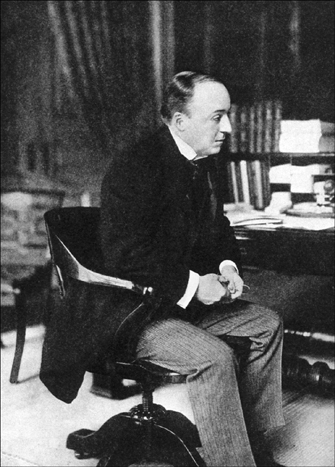
“THE BEST ATTORNEY GENERAL THIS GOVERNMENT HAS EVER HAD.”
Philander Chase Knox, ca. 1901
Whatever doubts the President may have had about trust control, he had none now. “Perkins may just as well make up his mind that I will not make my Message one hair’s breadth milder.”
MORGAN, HILL, AND HARRIMAN announced the Northern Securities Company late that afternoon. A few evening newspapers carried the story, but its full impact did not register across the country until Thursday, 14 November. By then, a majority of directors named to the board had approved the conversion and combination of their various stocks, and the giant trust was a fait accompli. The New York Sun praised Hill’s charter as “broad and masterly.”
The New York Journal saw it as yet another step toward universal monopoly. Ordinary citizens had lost their capacity to feel “rage and terror” at such news; all they wanted to know was “whether the concentration shall be in the public interests or against them.” With heavy irony, the Journal complimented “the best business brains in America” for advancing socialism’s concept of a nationalized industrial state:
They are smoothing out all the difficulties, consolidating staffs, and creating one vast, smoothly running machine. When they have finished, all the Government will have to do will be to assume the debts of the system, exchange national bonds for stock, and give the general manager a commission from the President of the United States.
The irony was lost on George Perkins, who excitedly clipped the column and sent it to Roosevelt. “To me there is a great deal of significance in an editorial of this kind from a paper like the Journal.”
In due course, both Perkins and Robert Bacon were reported to have joined the board of Northern Securities, balancing the power of Hill and Harriman. Other board members came from the Rockefeller empire, and the Vanderbilt and Gould systems. The complete directorate read like a miniature Who’s Who of finance capitalism.
The more Roosevelt and Knox looked at Northern Securities, the more they saw it as a symbol of the arrogant beauty of Combination. Unlike U.S. Steel—a smoky picture, to most minds, of ovens and boilerplate—the new trust was imaginable in detail, length, and breadth. Here was a shining necklace of rails, bejeweled with real estate, spread across America’s bosom. What it adorned, it monopolized.
Speculators rushed to buy. One of the first was Senator Hanna. “Can I get some of the new ‘Holding’ Co. stock as an investment,” he begged Perkins. “I asked Mr. Hill to give me some and he said he would but I would like more.… I wish you would look ‘a little out’ for me.”
Lesser citizens to whom one share, at $110, represented ten weeks’ wages wondered how a company purporting to operate in Hoboken, N.J., could do legitimate business halfway around the globe. The popular journalist Ray Stannard Baker, writing for Collier’s Weekly, noted with what “humdrum monotony” five or six plutocratic names appeared on the rosters of giant corporations. “You can ride from England to China on regular lines of steamships and railroads without once passing from the protecting hollow of Mr. Morgan’s hand.”
What would happen when these owners of owners began owning one another? Morgan already owned Perkins. Who would be the ultimate ruler of the American economy? “Is it possible,” Baker asked, “that the time will come when an imperial ‘M’ will repose within the wreath of power?”
As if in answer to his question, the Roman initials T.R. were emblazoned on the sides of White House carriages.
IN MID-NOVEMBER, the leaders of the Senate began to return to town, many on complimentary railroad passes signed by Hill or Harriman, and paid courtesy calls on the President. Mark Hanna took a look at his Message typescript, and reacted even more negatively than Perkins. “I see dynamite in it.”
He objected in particular to the heated tone of Roosevelt’s language against overcapitalization. Phrases such as baleful evils, despotism, and storm centers of financial disturbance would not go down well on Wall Street, while inevitable depression, reduced wages, and mismanagement and manipulation might imperil the current détente between capital and labor.
Other senators proposed other changes. None seemed to notice that for every word the President had written in criticism of “bad” trusts, there were five in praise of good. Gradually, reluctantly, he erased adjectives, then sentences, then whole paragraphs. He suppressed his condemnation of price-fixing and preferential rebates. He withdrew a proposal to make corporate records subject to government scrutiny. He even crossed out his wish for a Constitutional amendment “to confer on the National Government the power to supervise great industrial combinations.” The Senators were still not satisfied. They were the legislative veterans, he the executive novice, dependent on their support in consolidating his presidency. So he continued to cut, pages at a time.
RESTRAINED AS HE might have become on matters of trust policy, Roosevelt remained outspoken on the subject of appointments. His daily public reception, held at noon in George Cortelyou’s antechamber, amounted to a patronage mart, and he reveled in the opportunity to show off the decisive speed of his mind. “Tell me what you have to say, quickly, quickly!” No matter how concise the request, he was always ready with a reply—and not always the one hoped for:
|
SENATOR DEBOE |
Mr. President, I have Collector Sapp’s resignation in my pocket, but— |
|
ROOSEVELT |
You have? I’ll take it. Here, Mr. Cortelyou; wire Mr. Sapp that his resignation has been accepted and ask him to turn the office over to his first deputy at once. Have someone telephone the Treasury.… (Over his shoulder, moving on) That’s all right, Senator; everything will be promptly attended to. |
He would whirl on round the room, pumping hands and grinning, ejaculating his automatic “Glad to see you!” and “Dee-lighted!” like snorts from a steam engine. Office-seekers learned not to trifle with his memory (“Haven’t you a jail record?”), nor to present him with trumped-up dossiers of support (“Petition? I could get a petition to have you hanged!”).
Those other White House pests, the murmurers of special requests, found Roosevelt impossible to buttonhole. Like an actor, he projected his voice past them, at the crowd. The more furtive his interlocutor, the louder he responded, and he took care to repeat,fortissimo, any request that he deemed improper. The effect was of salt poured on slugs. Even as the supplicants melted away, Roosevelt’s voice would follow: “Senator Depew, do you know that man going out? Well, he is a crook.”
There were days when the visitors besieging him were so numerous that Cortelyou had to empty the antechamber five times before lunch. On such occasions the President could be overstimulated, and his frankness coarsened to rudeness. “I don’t give a damn for the Legislature of Texas!” he roared at Senator Joseph Bailey, making a lasting Democratic enemy. He called to an aide, over the heads of Representative John Dalzell and Senator Julius Caesar Burrows: “Come here, Mr. McAneny, and help me with these two gentlemen. They are boring me about appointments.” Burrows left the White House angrily, muttering, “This young man won’t last long.”
Monitors of Roosevelt’s Western patronage noticed that an ability to shoot straight seemed to appeal to him more than strict fidelity to the Bill of Rights. Civil Service Commissioner William Dudley Foulke recorded his interview with Pat Garrett, slayer of Billy the Kid and candidate for Customs Collectorship of El Paso, Texas:
|
ROOSEVELT |
How many men have you killed? |
|
GARRETT |
Three. |
|
ROOSEVELT |
How did you come to do it? |
|
GARRETT |
In the discharge of my duty as a public officer. |
|
ROOSEVELT |
(looking pleased) Have you ever played poker? |
|
GARRETT |
Yes. |
|
ROOSEVELT |
Are you going to do it when you are in office? |
|
GARRETT |
No. |
|
ROOSEVELT |
All right, I am going to appoint you. But see you observe the civil service law. |
The appointment dismayed many Texans, not because of Garrett’s bloody record but because he was an agnostic. “In El Paso,” the President said approvingly, “the people are homicidal but orthodox.”
ON 18 NOVEMBER 1901, Secretary of State Hay and the British Ambassador, Lord Pauncefote, signed their long-negotiated treaty granting the United States exclusive right to build an interoceanic waterway in Central America. Two days later, the Isthmian Canal Commission, appointed by President McKinley to recommend the “most practicable and feasible” route, reported in favor of Nicaragua. This news was held for release after the opening of Congress, but William Randolph Hearst got an advance copy of the report, and splashed it across the pages of his New York Journal.
It was a big scoop, if not much of a story. Popular and Congressional sentiment had been in favor of a Nicaragua Canal for so long that the Commission’s decision was expected. Panama might possibly have been chosen, but that fetid little Colombian province was already a monument to the folly of French canal engineers. After twenty-two years of mismanagement, scandal, disease, and death, all that was left of Ferdinand de Lesseps’s grand canal du Panama was a gang of lethargic workers, some crumbling buildings and rusty machinery, and an immense, muddy scar reverting to jungle.
Nicaragua, in contrast, offered a virgin landscape, a healthy climate, one hundred miles of navigable freshwater, and the lowest pass in the Cordilleras. Its leaders were unanimously eager to reach an agreement with the United States, whereas those of Colombia were divided by civil war, unable to treat with their own rebels, let alone representatives of a foreign power.
And yet—this was Hearst’s real news—one sentence in the report implied that the Commission was not wholehearted about its recommendation:
There are certain physical advantages, such as a shorter canal line, a more complete knowledge of the country through which it passes, and lower cost of maintenance and operation in favor of the Panama route, but the price fixed by the Panama Canal Company for the sale of its property and franchises is so unreasonable that its acceptance cannot be recommended by this Commission.
Minus that extra compensation—$109 million—a Panama Canal would cost $156 million, as opposed to $200 million for a Nicaragua Canal. And it would be finished sooner, thanks to the French excavations. So mere economics had kept the commissioners from endorsing the private preference of the President of the United States.
ROOSEVELT FINISHED READING his revised Message aloud to the Cabinet on 22 November. All twenty-five thousand words were his own work. Previous Presidents had done little more than to collate and introduce the reports of executive departments. But he was still a writer, with a writer’s reluctance to sign prose he had not composed, or at least edited. Feeling a sudden revulsion for the ink-stained typescript, he sent it off to be printed.
Twelve days still intervened before the reassembly of Congress. He decided that he wanted to be alone with his family for a while, somewhere away from Washington. The executive yacht Sylph was rigged, and Navy Yard cannons primed for a twenty-one-gun salute. By 3:30 that afternoon, the Roosevelts were on their way up Pennsylvania Avenue. Passersby were touched to see the President kissing four-year-old Quentin, first on one chubby cheek, then the other.
BACK IN MINNESOTA, James J. Hill saluted his own child, Mary, in his own fashion, with twenty dollars in gold. He had earned them during his first few days as president of the Northern Securities Company. “It is the hardest job I have ever undertaken,” he said, in the voice of a man whose ambitions were complete.
WHILE THE SYLPH cruised the lower Potomac, through chill salt mists, Americans browsed a syndicated newspaper article entitled TEDDY’S HOROSCOPE. The astrologist-author noted that Theodore Roosevelt had become President under a remarkable coincidence of Capricorn and Aquarius. This meant that, beginning in 1902, his Administration would bring about many changes, particularly with respect to “laws” and “treaties.” He would increase the nation’s military power, and go on to handle “vast political problems, the like of which we do not dream of today.”
Although Roosevelt was a man much influenced by Mars, he was likely to be peaceable in foreign affairs. His aggression would spill out on the domestic front. (But he would be asking for trouble if he tried to bully Congress.) There was likely to be “a remarkable recrudescence” of social violence soon. While some years of prosperity lay ahead, “a crash is surely coming, and securities will drop to rock bottom.”
The President need not worry about ill health or assassination. But he was fated to suffer “the death of some intimate friend … or cabinet official, probably the latter.”
JOHN HAY’S AVUNCULAR fondness for Theodore Roosevelt had became almost grandfatherly as he watched him struggle toward statesmanship. The President, he wrote a friend, was “a young fellow of infinite dash and originality.”
Although Hay was sometimes embarrassed by Roosevelt’s gaucheries, he forgave them as folies de jeunesse. Youth, as the President kept saying, was “a curable disease.” How boyish of Theodore not to notice, that final freezing Friday before Congress assembled, that the Cabinet Room fire was unlit, and that some of his older officers were still in their overcoats! And how charmingly unpretentious—when he at last did notice—to light the logs himself, and coax them to flame!