
3
On 13 February 1788, commenting on the first day of the trial of Warren Hastings, The Times observed: ‘From the scarcity of accommodation at every part of the West end of the town, the trial of Mr. Hastings is supposed to have drawn more people to London than have visited the metropolis at any one time for several years past’.1 Returning to the theme in a column entitled ‘Parliamentary Intelligence’, The Times informed its readers that, on the previous day, the House of Lords had debated regulating the tickets of admission to the trial. The Duke of Norfolk, it was reported:
thought it would be proper for the tickets to be signed by the receiver as well as the donor. His reason for suggesting this to their Lordships, was to prevent the common practice of forging them, which had been adopted on former trials of similar nature. The signatures he meant should be in their Lordships’ own hand writing. The tickets, he conceived, should be signed as they were given for every day of the trial.2
During the first six months of 1788, British society at large was so obsessed with the impeachment of the Governor-General that designers chose to decorate everyday items, such as fan-leaves, with images of the trial Daniel O’Quinn has called ‘a public sensation like no other’.3 Among the stunning collection of fans amassed throughout the nineteenth century by the businesswoman and collector Lady Charlotte Elizabeth Schreiber (1812–95), a couple of identical fan-leaves (Figure 3.1) – unmounted and mounted with wooden sticks, respectively – are significant in this regard.4 Produced in 1788, both items replicate Thomas Prattent’s etching, A view of the court sitting on the trial of Warren Hastings Esq. (Figure 3.2). Prattent’s image represents the galleries of Westminster Hall crowded with spectators and is reproduced in brown above a grey-greenish pattern. A legend helps to identify the participants: in the work by Prattent, the inscription is placed below the image; in the fan version, it is located within two elegant medallions decorated with the head of a Medusa.
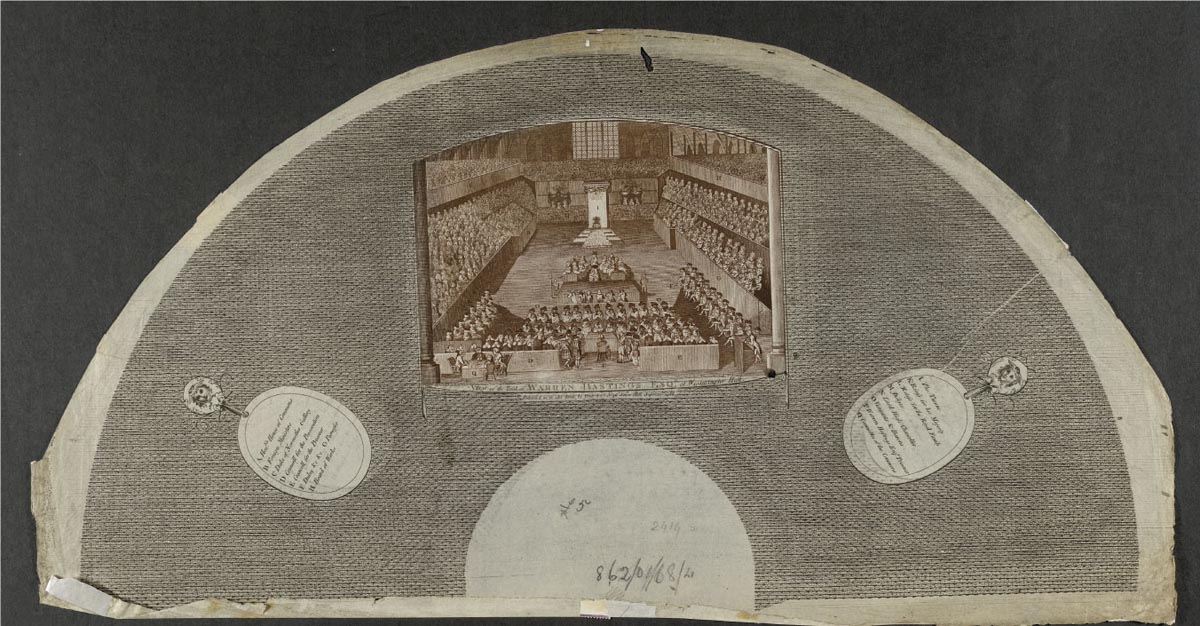
Fig. 3.1 Anon., Print/fan, 1788. BM 1891,0713.387. © Trustees of the British Museum.
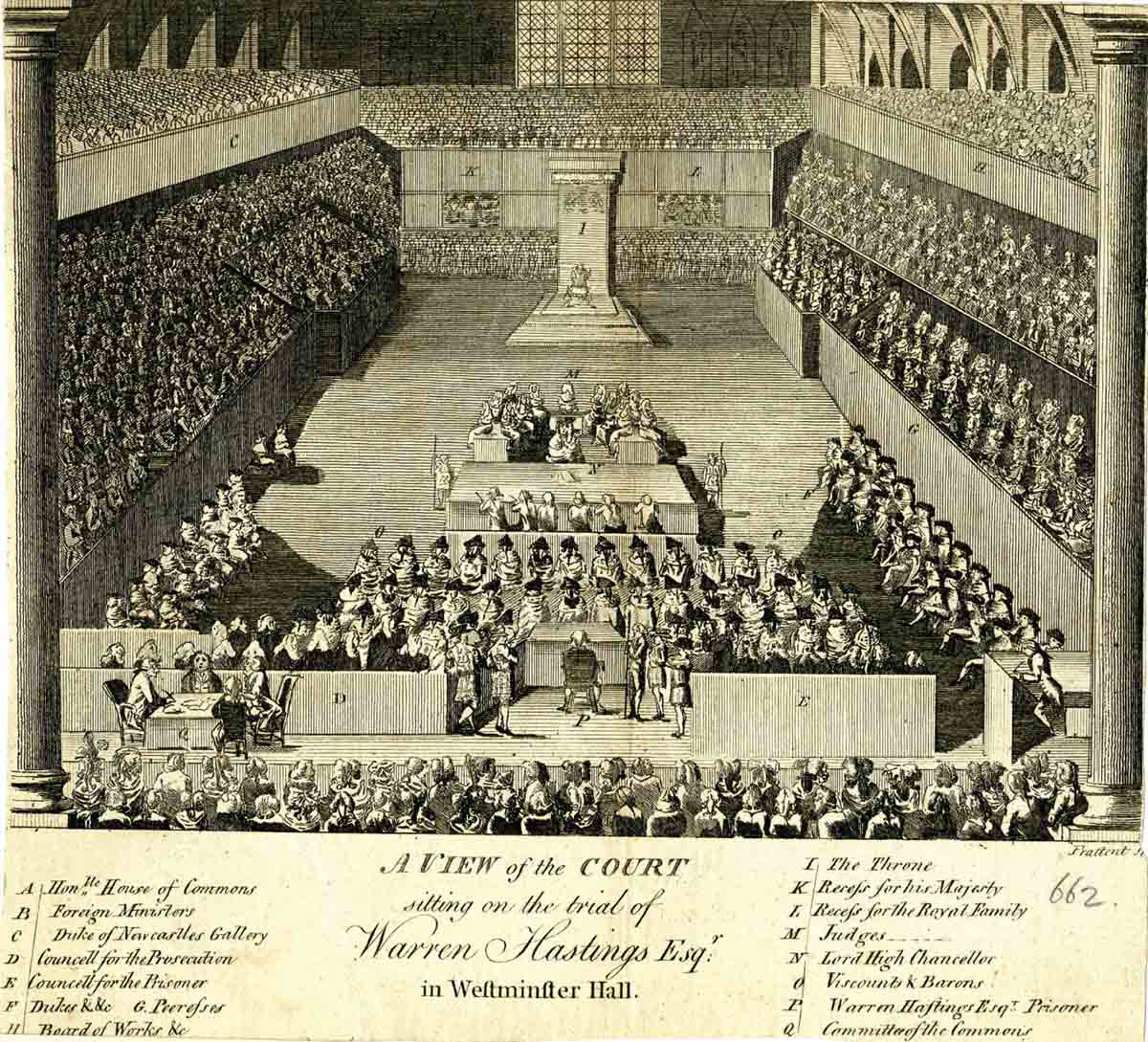
Fig. 3.2 Thomas Prattent, A view of the court sitting on the trial of Warren Hastings Esq., 1788. BM 1880,0911.1217. © Trustees of the British Museum.
While staring at such fans as those decorated with a scene of Westminster Hall during the cause célèbre, ladies and gentlemen commented on the most fashionable spectacle of the moment and, possibly, showed each other where they were seated. MacIver Percival has, indeed, remarked that a fan’s decoration ‘beguiled a dull moment, or formed a topic of conversation’.5 Since fans were inexpensive items, and therefore universally carried, we might venture to say that those women whose social status did not permit them to enter the courtroom eagerly looked for these collectibles, not only to celebrate but also, somehow, to participate vicariously in this sensational event.
From January to June 1788, newspapers reported and commented extensively on what had become – in the words of Nicholas B. Dirks – ‘not just the trial of the century, but the most extraordinary political spectacle in Britain during the second half of the eighteenth century’.6 Significantly, Glynis Ridley has suggested that ‘The impeachment proceedings opened […] in an atmosphere of expectation and publicity that would stand comparison with any televised celebrity trial today’.7 Although numerous scholars have commented on the sensationalism and theatricality which permeated the event,8 the relationship between ancient rhetorical treatises and the theatrical gestures performed at Westminster Hall deserves further exploration.
In this chapter, I will show the extent to which classical rhetorical strategies, as well as contemporary oratorical treatises, deeply influenced the managers’ spectacular performances. In particular, I will focus on the orators’ body language and dramatic enactments, and argue for the constant overlapping of theatre and politics. As will be discussed below, classical – especially Roman – rhetorical treatises exhorted orators to utilize their body as an eloquent visual medium, an expressive vehicle of passions, apt to manipulate their audience’s feelings. Similarly, the prosecutors fully exploited the theatrical atmosphere and staged a sentimental drama in a legal arena, hence constructing and conducting the imperial discourse with the magic of histrionic rhetoric. As with classical oratores and professional actores, their flamboyant performances comprised heightened physical reactions, such as swooning, painful fits, and indispositions.
Since the arraignment of Hastings stopped being a sensation after a few months, I have chosen to analyse the most intense and exciting performances given at Westminster Hall between February and June 1788, namely Burke’s account of the Rangpur horrors and Sheridan’s orations in defence of the Begums of Oudh. Before turning to the magic of Burke’s and Sheridan’s extraordinary shows, however, some further thought should be given to the spectacular context in which the two orators performed.
Turning a legal conflict into a theatrical show
Conceived from the outset as a dramatic setting, the location of the trial, Westminster Hall, was extensively modified between December 1787 and February 1788, as temporary stands were erected on four sides to accommodate a vast public.9 The Hall was impressive not only for its symbolic resonances – it had been the setting of some of the most celebrated events of English history, such as the trials of Sir Thomas More (1478–1535) and Charles I – but also for its visual display; its magnificent decoration having a profound impact on those who entered it. With its stunning hammerbeam roof, its walls draped in scarlet, and the crowd of refined gentlemen and ladies assembling there, the hall was permeated by an atmosphere of grandeur. Reporting on the first day of the trial, Sir Gilbert Elliot (1751–1814) told his wife: ‘it is difficult to conceive anything more grand or imposing than this scene […]. Everything that England possesses of greatness or ability is there assembled, in the utmost splendor [sic] and solemnity’.10
A mid-nineteenth-century illustration to London Interiors (Westminster Hall, Trial of Warren Hastings), gives us a taste of what a spectator might have experienced at the time (1841–4: BM 1948,0217.83). The engraving shows the hall as seen from the north end. In the foreground, the grave members of the Committee of the House of Lords, recognizable in their wigs and black robes, talk animatedly, while some notables move around. The three magnificent boxes with a golden canopy that appear at the far end of the hall were built for the Lord Chancellor, the King (although he never attended the trial), and the Princes. On the left- and right-hand sides, as well as at the end of the hall, one sees the temporary stands crowded with ladies and gentlemen.
Those who attended the trial belonged to the crème de la crème of British society and foreign representatives in England. The brightly coloured, elegant clothes and the wigs, along with the dignified, upright position of most of the spectators depicted, bear witness to their high social status. The fourth side of the seating is not shown, but can be identified in an anonymous print, Plan of the High Court of Parliament, Erected in Westminster Hall for the Trial of Warren Hastings, Esq. Late Governor-General of Bengal, for High Crimes and Misdemeanors [sic], on Wednesday, February 13, 1788 (c.1788: BM 1978,U.1960). A legend shows the layout of the areas reserved to the participants: the fourth side was assigned to the ‘Honorable [sic] House of Commons’ and peeresses; the Lord Great Chamberlain’s Box for Ladies was also located there.
Not only was Westminster Hall transformed into a theatre in the round, but even the auditors and the prosecutors seemed to have turned into the fashionable audience of a theatrical entertainment and the actors of a sentimental drama, respectively. References to theatre in contemporary comments of the impeachment are legion. The pages of the diary of Lady Sophia Fitzgerald (1762–1845), for example, record the impressions of a casual frivolous audience for whom the trial was a public spectacle and Burke a ‘charming’ performer:
[15 February 1788] Sophia was obliged to get up very early, which she did not much like: breakfasted, then went to call upon Lady Talbot and they both went to the Trial, where they stayed till four o’clock. Mr Burke spoke, and they were delighted with him. It really was very fine. […]
[16 February 1788] Sophia persuaded her mother to go to the Trial to-day, as she knew it would entertain her to hear Mr Burke. He was charming again, and Mother very well pleased at having gone. […]
[18 February 1788] We went again to the Trial to hear Mr Burke, who really made one’s blood run cold with the account of all the tortures and cruelties in the East Indies. […] We all went in the Evening to see the play at Richmond House. Henry [an amateur actor] was charming. Mrs Siddons [the renowned tragic actresses] was there.11
That the impeachment of Hastings was conceived on a par with the theatre is further suggested by contemporary newspapers. Eddy Kent has noticed that the London Chronicle published a description of the opening day’s procession from the House of Lords to the High Court of Parliament in Westminster Hall ‘in a format not dissimilar from conventional contemporary theatre notices’:12
The Lords were then called over by the Clerk, and arranged by Sir Isaac
Heard, Principal King at Arms, when upwards of two hundred proceeded
in order to Westminster Hall. The Peers were preceded by
The Lord Chancellor’s attendants, two and two.
The Clerk of the House of Lords.
The Masters in Chancery, two and two.
The Judges.
Serjeants Adair and Hill.
The Yeoman Usher of the Black Rod.
Two Heralds.
The Lords Barons, two and two.
The Lords Bishops, two and two.
The Lords Viscounts, two and two.
The Lords Marquesses, two and two.
The Lords Dukes, two and two.
The Mace Bearer.
The Lord Chancellor with his train borne.
(All in their Parliamentary Robes)
The Lords Spiritual seated themselves on their Bench, which was on the side on which they entered; as they passed the throne, they bowed to it, as if the King was seated in it. The Temporal Lords crossed over the house, and each made a respectful bow to the seat of Majesty.13
It should also be recalled that eighteenth-century accounts of private theatricals often included comments on ladies’ dresses. A 1799 article describing a private invitation to attend ‘two pretty little Dramatic Pieces’ at Lord Shaftesbury’s house, for example, recorded that Lady Barbara Ashley Cooper ‘was neatly dressed in a beautiful tartan jacket and philibeg, made of silk, and a blue bonnet. The young ladies were dressed in tartan silk bodices, and white muslin petticoats ornamented with tartan: the dresses were very beautiful and elegant’.14
Similarly, the newspapers reporting on the impeachment of Warren Hastings offered detailed descriptions of the stylish clothes and jewels that could be admired in Westminster Hall. Commenting on the first day of the trial, The Times noted that: ‘There were few feathers, and these very low – but a profusion of artificial flowers ornamented the ladies heads – Many wore chains, and strings of pearl, or of beads of various colours from their ears – […] The gowns were full and flowing, with long trains – the fabric mostly of sattin – the colours dark or white’.15
The contrast between what ought to have been the austere atmosphere of a courtroom and the improper sensual ostentation of female grace can be gleaned from several newspapers. The Morning Post and Daily Advertiser, for instance, recorded that:
It was impossible […] not to be struck with the symmetry of the building erected for the trial, the convenient disposition of its parts, and the appearance of awful grandeur through the whole. But all these vanished, or were absorbed in the contemplation of the beauteous females that graced the benches, and dispelled the awe we felt, when we consider that this was the seat of VINDICATIVE JUSTICE. Rich in beauty as in dress – they could not be viewed without admiration and emotion – their jewels darted light, but their eyes shot fire.16
In the above excerpt, the abundance of terms referring to the semantic field of sight (‘appearance’, ‘contemplation’, ‘viewed’, ‘eyes’) amplifies the effect of a theatrical show. In this respect it might be worth recalling that the word ‘theatre’ is related to the Greek verb θεᾶσθαι, ‘to behold’. In a similar way, as a number of records indicate, we can assess to what extent visual details played a key role in the impeachment of Hastings.
One of the most vivid descriptions of the opening sessions of the trial was provided by the then Keeper of the Robes to Queen Charlotte, the novelist Frances Burney. According to Elizabeth Samet, Burney’s journal ‘accurately captures the trial’s theatrical atmosphere and the conception of courtroom-as-stage so crucial to an understanding of Burke’s rhetoric’.17 As if depicting an evening at the theatre, Burney’s pages are interspersed with a myriad visual details and, especially, a complex interplay of glances. On the first day of the impeachment, for example, she observes how, throughout the reading of the general charges against the defendant:
Mr. Hastings […] began to cast his eyes around the House, and having taken a survey of all in front and at the sides, he turned about and looked up; pale looked his face – pale, ill, and altered. I was much affected by the sight of that dreadful harass which was written on his countenance. Had I looked at him without restraint, it could not have been without tears. I felt shocked, too, and ashamed, to be seen by him in that place. I had wished to be present from an earnest interest in the business, joined to a firm confidence in his powers of defence; but his eyes were not those I wished to meet in Westminster Hall. I called upon Miss Gomme and Charles to assist me in looking another way, and in conversing to me as I turned aside.18
This scene depicts a triangular exchange of looks which, besides Hastings and the diarist herself, involves the latter’s brother, Charles (1757–1817), and Miss Gomme. The abundance of verbs referring to the semantic field of sight (‘to cast his eyes around’, ‘looked up’, ‘looked at’, ‘be seen’, ‘looking another way’) conveys the sense of the incessant movement of restless eyes, both horizontally (‘around’, ‘in front and at the sides’, ‘about’, ‘aside’) and vertically (‘up’).
Inside this theatrical frame, Hastings resembles the suffering hero of a sentimental drama: so visibly altered are his features that not only does Burney feel emotionally shaken (‘I felt shocked, too, and ashamed’) but she experiences physical symptoms as well, verging on tears as she responds to the pathos of the scene. Being profoundly touched by the suffering of a distressed character was very common among eighteenth-century theatre-goers, who were expected to show palpable signs of sympathy, ‘specifically’ – as Jean Marsden reminds us – ‘through highly visible tears’.19
In her lively account of the trial, Burney further records that both the general public and Burke’s colleagues made use of opera glasses, and I would suggest that, as in the theatre, the spectators of the trial watched and admired ladies and gentlemen in other parts of the hall, as much as they observed the orators’ performances. As a contemporary playwright, James Boaden (1762–1839), contended, theatres ‘are made glittering and gaudy, because our spectators love to be an exhibition themselves’.20 Attending a play at Drury Lane or Covent Garden at the end of the eighteenth century was in fact quite different from our experience of the theatre. Jeffrey N. Cox has noted that, while we are used to ‘a solemn theatrical experience’ in a dark, quiet place, at the time audiences ‘would have gone to large, noisy, constantly illuminated spaces’, where they spent time in social conversation, laughed, looked around and were looked at.21
Similarly, when the proceedings at Westminster Hall were particularly technical and tedious, spectators rose to greet an acquaintance or gossip with a friend. The unorthodox, careless attitude of a Member of the House of Commons is quite emblematic in this respect:
In the midst of the opening of a trial such as this, so important to the country as well as to the individual who is tried, what will you say to a man – a member of the House of Commons – who kept exclaiming almost perpetually, just at my side, ‘What a bore! – when will it be over? – Must one come any more? – I had a great mind not to have come at all. – Who’s that? – Lady Hawkesbury and the Copes? – Yes. – A pretty girl Kitty. – Well, when will they have done? – I wish they’d call the question – I should vote it a bore at once!22
Interestingly, even members of the foreign elite remarked on the similarity between the courtroom and the theatre: ‘A Spanish gentleman enquired on Friday last of the person who sat next to him, whether the Peeresses were privileged to laugh as loud in Westminster-hall, as they do at a playhouse?’, The Times reported on 5 March 1788.
Not only literary sources but also contemporary illustrations of the trial offer us glimpses of a distracted audience. The watercolours of James Nixon (c.1741–1812), for example, crystallize spectators in the act of talking to each other, rising, yawning, dozing and looking around through opera glasses.23 Among the variety of contemporary ephemera that add to our impression of a restless, inattentive audience treating the impeachment as an evening at the theatre or a fashionable social event, Sarah Sophia Banks’s collection of tickets from the trial deserves special attention.
Souvenirs from a trial
Despite being a precious source of information for Romantic-period social history, Sarah Sophia Banks’s collection of ‘Tickets for Warren Hastings Trial’ has received little attention. This is scarcely surprising, considering that Miss Banks (1744–1818) gathered more than 30,000 objects, including coins, medals, cards, prints and bookplates.24 Immediately after her death, her collections of printed and engraved ephemera were donated to the British Museum, and there they have remained since 1818. The majority of her Hastings memorabilia and some additional rare and curious items probably reached Sarah Sophia via her brother’s contacts: Sir Joseph Banks was a renowned naturalist and the longest-serving president of the Royal Society, as well as a well-connected member of several clubs, such as the Spalding Gentlemen’s Club.25
Thanks to the large number of important guests who visited Sir Joseph, Sarah Sophia could satisfy her keen interest in the social world of elite society. In 1779, a few months after her brother’s marriage to Dorothea Hugessen (1758–1828), Miss Banks moved in with them. The three of them were thereafter inseparable, and invitations would customarily come for Sir Joseph Banks, Lady Banks, and Miss Banks. As we will see below, few of the letters included in Sarah Sophia’s collection of ‘Tickets for Warren Hastings Trial’ bear witness to their close relationship.
Comprising 110 items (BM J,9.1–110), the ‘Tickets for Warren Hastings Trial’ collection is primarily composed of admission tickets. Ladies and gentlemen wishing to attend Burke’s and Sheridan’s spectacular speeches and, more generally, to gain access to Westminster Hall, had to produce a ticket. The pass was presented to a receiver who, as if at the entrance of a theatre, ‘tears off a Corner of it, and returns it’.26 Miss Banks’s ephemera testify to this practice – as shown in Figure 3.3, Admission-ticket for day 28 of the trial of Warren Hastings – and also of the changes that admission tickets to the trial underwent over time.
As we noted at the beginning of this chapter, the Duke of Norfolk’s apprehension that passes might be forged was well founded: notwithstanding the precautions taken, as early as the first day of the trial, the engraved tickets (featuring the Great Chamberlain’s coats of arms and the motto ‘sub liberate quietem’) were counterfeited. According to the London Chronicle, in order to prevent falsification, the Duke of Norfolk ordered ‘That all the tickets issued from the Great Chamberlain’s Office on Thursday the 14th, and on every succeeding day of the trial of Warren Hastings, Esq. be signed and sealed by the respective Peers’ to whom they had to be delivered, ‘with an exception to those of the Royal Family’.27 The tickets collected by Miss Banks prove that this measure came into effect. As can be seen, for instance, in Figure 3.3, the passes were signed and sealed not only (as in the case of Figures 3.4 and 3.7) by the Deputy Great Chamberlain, Sir Peter Burrell (1754–1820), but also by the Peers for whom the tickets were intended. Thanks to the order of the Duke of Norfolk, more than 200 years later, we still know the names of some of the fashionable spectators who attended the trial.28
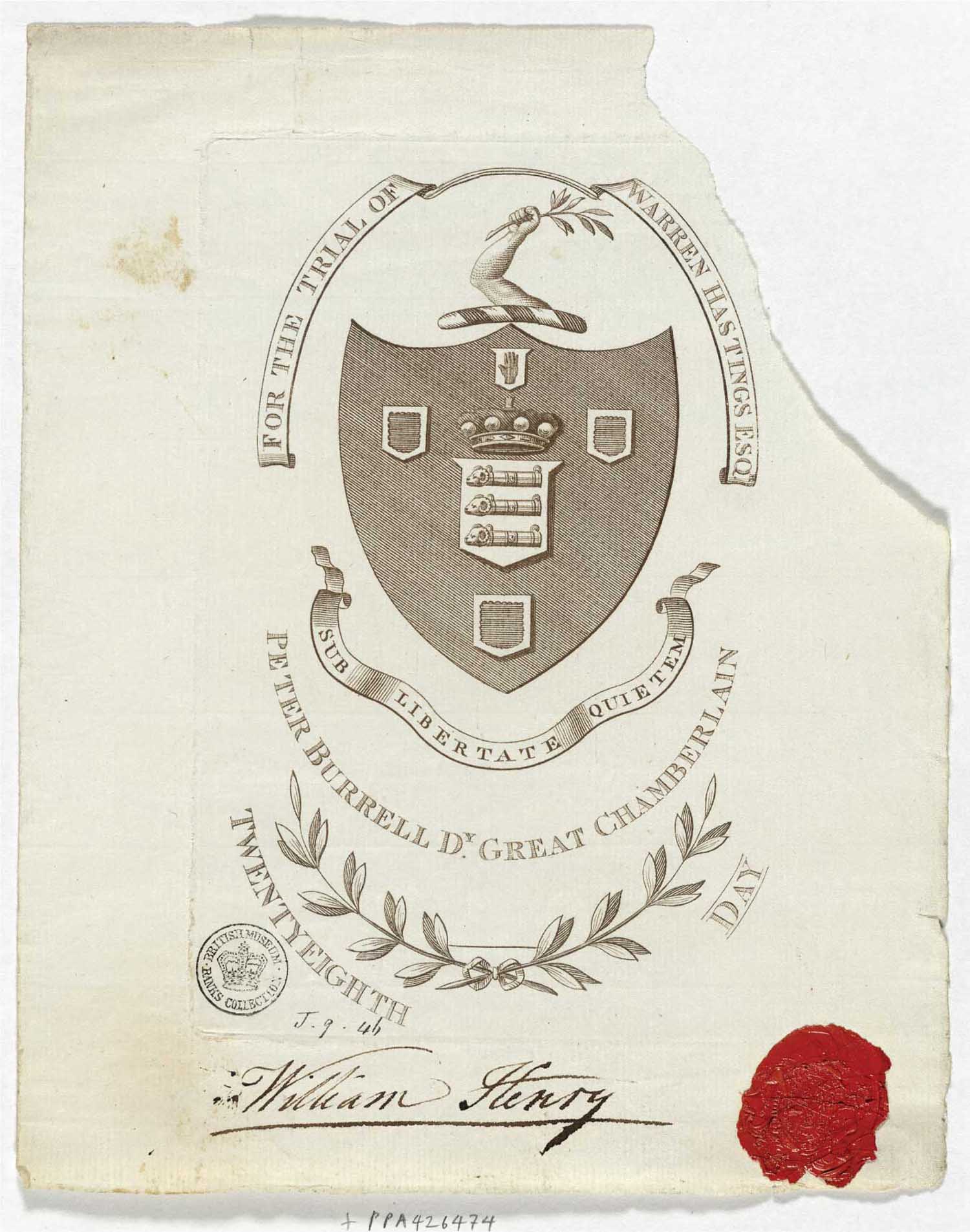
Fig. 3.3 Admission-ticket for day 28 of the trial of Warren Hastings, 1787. BM J,9.46. © Trustees of the British Museum.
In order to prevent forgery, each day the passes were changed in colour as well as in the design.29 These modifications are evident in Sarah Sophia’s collection: the tickets are signed and printed in a variety of colours (ochre yellow, emerald green, olive green, orange, red, blue, sepia, dark brown) and the engravings differ. So, for instance, ‘Esquire’ is differently abbreviated ‘Esq’. or ‘Esq.r’. Besides being printed in different colours, some tickets (such as Figure 3.3) also show the specific day of the trial for which they were intended. That the design of the tickets frequently varied is further proved by Miss Banks’s annotation. Indeed, as well as collecting the items themselves, Sarah Sophia recorded information about them. On the back of one of the passes (Figure 3.4), for example, she wrote: ‘May 6. 1788 Suppose this would have been the same since April 10. but did not send for it till May 6. (believe it has been changed once since April 10.)’. Again, on the verso of another (c.1787, BM J,9.30), she commented: ‘between May 6. 1788. and Feb. 15. 1790. (or certainly before Feb. 15. 1790.)’. As it is evident from this, the design was printed anew after 15 February 1790.
For sessions that were expected to be particularly interesting, such as when Burke and Sheridan were scheduled to perform, passes were in great demand.30 As with contemporary performers, who were asked for tickets by members of their families and friends, so were the managers of the trial against Hastings. In the early weeks of the trial, for example, Edmund Burke begged Sir Peter Burrell to dispense him a supernumerary ticket for a gentleman of his acquaintance (Mr Baker). As the orator wittily put it, ‘I have hunted you, whilst Mr Baker was hunting me, through Westminster Hall last Night, and we all missed each other’.31 The Great Chamberlain must have been very strict about the distribution of tickets, if the Gazetteer reported, not without a vein of irony:
Though there is so much room in the hall, particularly in the box and gallery of the Great Chamberlaim [sic], Sir Peter Burrell is most rigid in the disposal of tickets; so much so, that Mr Hastings has a ticket for his admission. Were he to lose his ticket upon any one day, he might send an answer to the Court, when called upon to come forward, that they would not let him enter.32
From the opening of the impeachment until the close of the parliamentary session in June 1788, the trial of Hastings dominated political satires, and the tickets for Westminster Hall were not spared. Indeed, they became so familiar that they were soon parodied by two of the most celebrated caricaturists of the time, James Sayers (1748–1823) and James Gillray. In their cartoons, For the Trial of Warren Has[tings]/Seventh Day (Figure 3.5) and Impeachment ticket. For the Trial of W-RR-N H-ST-NGS Esqr (c.1788, BM 1851,0901.391), the three rams’ heads of Sir Peter Burrell’s coat of arms are replaced by those of Burke, Fox and Francis; the embowed arm above the Great Chamberlain’s crest no longer holds an olive branch: in Sayers’s print, it brandishes a scourge; in Gillray’s, a bludgeon. Also the motto ‘sub libertate quietem’ is deformed and replaced with the slogan ‘sub libertate tyranni’.33 Miss Banks’s collection of satirical prints includes a copy of both prints.
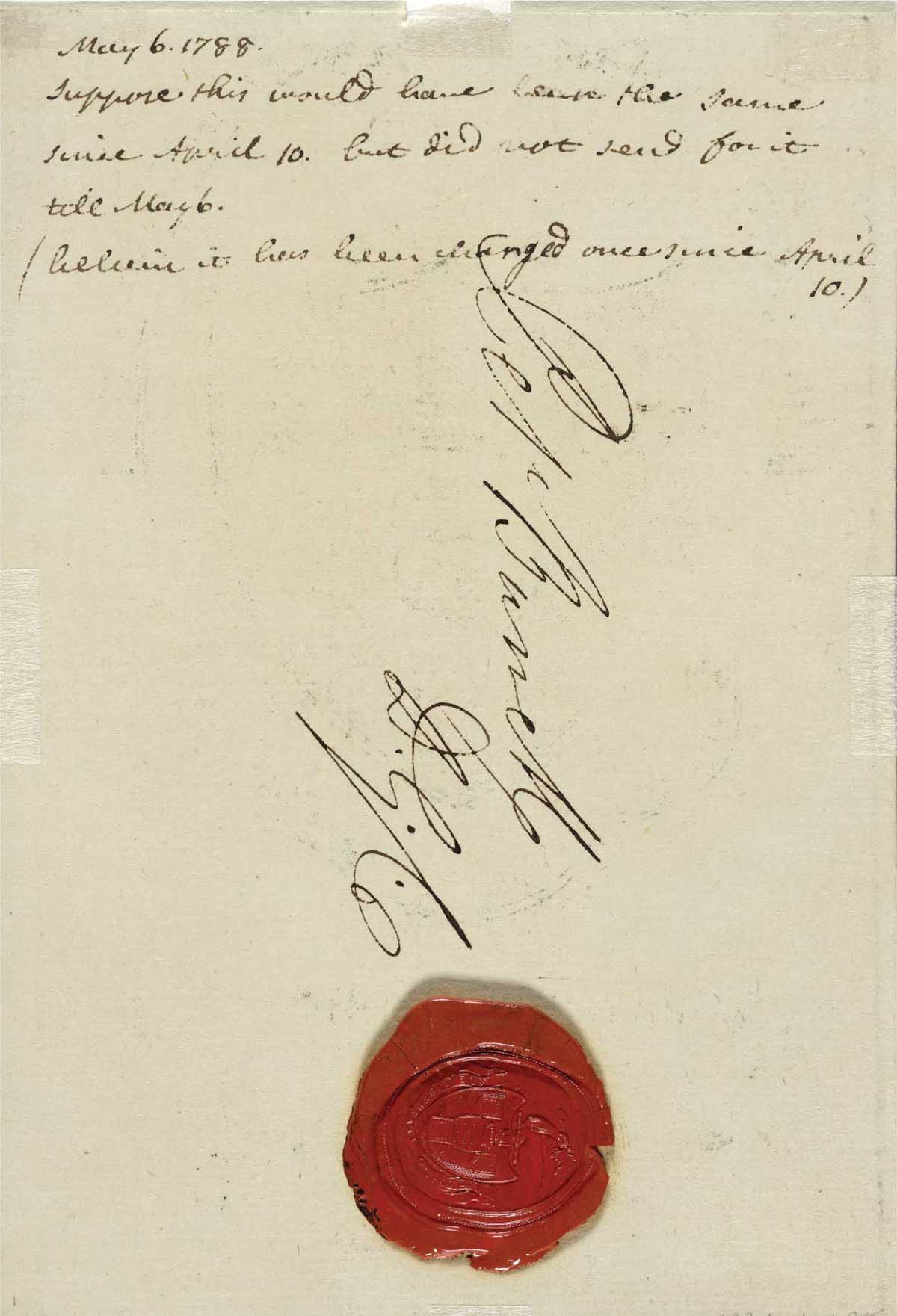
Fig. 3.4 Admission-ticket, 1787. BM J,9.21. © Trustees of the British Museum.
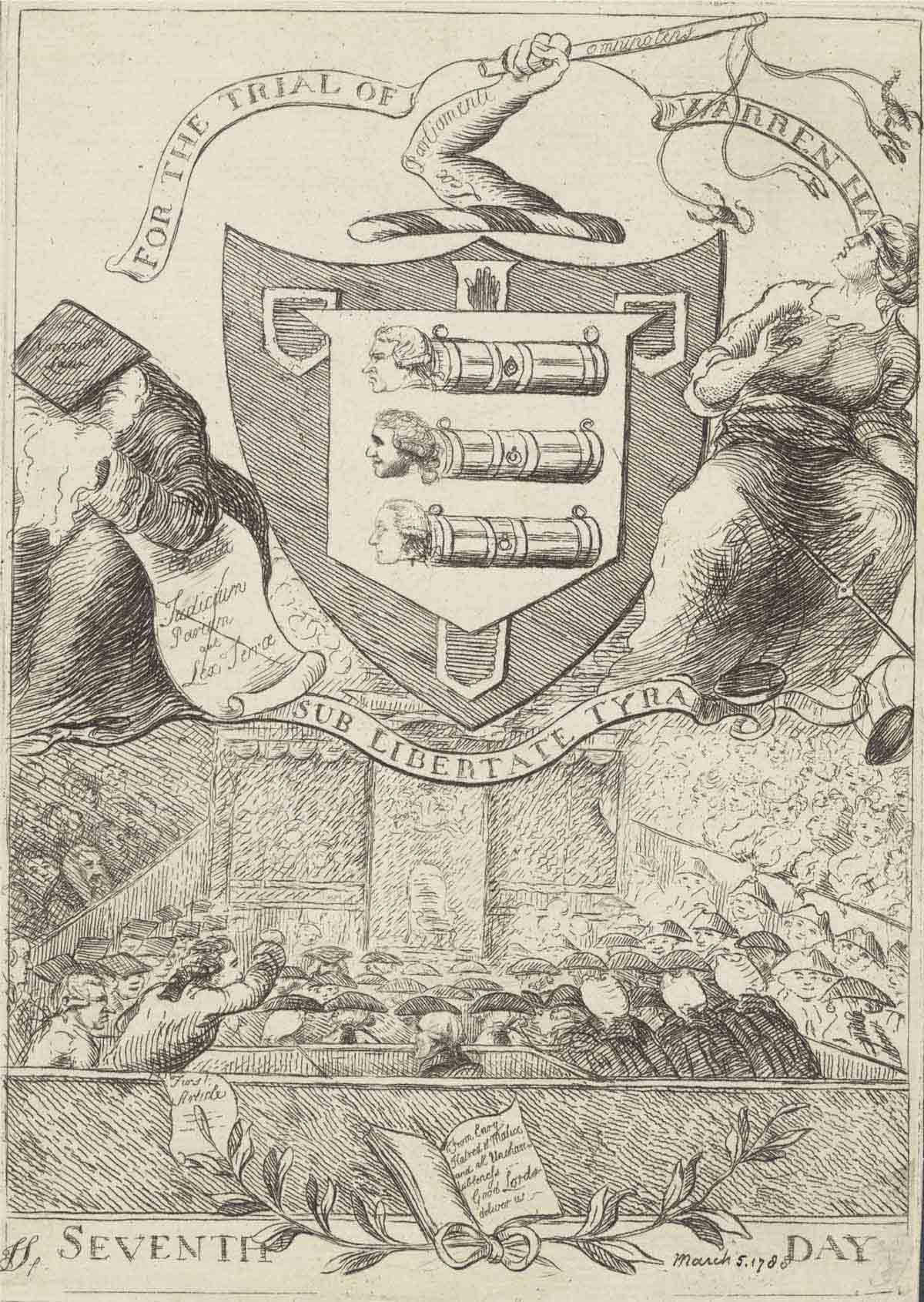
Fig. 3.5 James Sayers, For the Trial of Warren Has[tings]/Seventh Day, 1788. BM 1868,0808.5692. © Trustees of the British Museum.
Even though her collection of ‘Tickets for Warren Hastings Trial’ is composed mostly of Sir Peter Burrell’s passes, Sarah Sophia gathered other printed ephemera, including a list of ‘Refreshments to be had in the Hall’ (Figure 3.6). A genuine collector, on the verso she recorded the date – 19 February 1788 – in which these ‘curious Bills of Sandwiches’, as a newspaper described them, were handed about Westminster Hall.34 This advertisement is particularly significant, as it reinforces our impression of a trial perceived as a theatrical spectacle. As the impeachment sessions normally started late in the morning and lasted for many hours, food and drink could be brought in or purchased in the hall itself.
It should be recalled that most tickets did not permit the bearer exit and readmission.35 In this sense, Sir Joseph certainly belonged to an inner circle of a privileged few, as one of his passes proves (Figure 3.7). This ‘not transferable’ ticket, which allowed the bearer ‘to pass and repass’, must have been part of a limited, special edition. In fact, besides being numbered (No. 16), the pass bears the name and title of the person it was issued to – Sir Joseph Banks Bt (Baronet). That these tickets were particularly rare is further suggested by a letter from Edmund Burke to Sir Peter Burrell. In February 1788, the former asked the Great Chamberlain for a ‘pass and repass’ ticket for a gentleman whose ‘health is so bad that he cannot attend very long at a time or in any fixed place; at the same time he is extremely anxious to hear the Trial’.36 Significantly, the orator reassured Burrell that this gentleman was ‘incapable of abusing it’ and promised to ‘keep this favour a secret’.37
The rarity of ‘pass and repass’ tickets, along with Burke’s promised secrecy, seem to suggest that, had the auditors been given permission to come and go, Westminster Hall – as was the case with most theatres at the time – would have turned into a chaotic and noisy place. We should not forget that eighteenth-century spectators would sit, stand up, enter and leave, with theatres as sites of an endless flow of people moving and settling. Some spectators, for example, wishing to dine first or attending to some business, might send their servants to hold their seats and arrive at the end of the first act, others, instead, wishing to save money, ‘might enter for half price after the third act of the mainpiece’.38
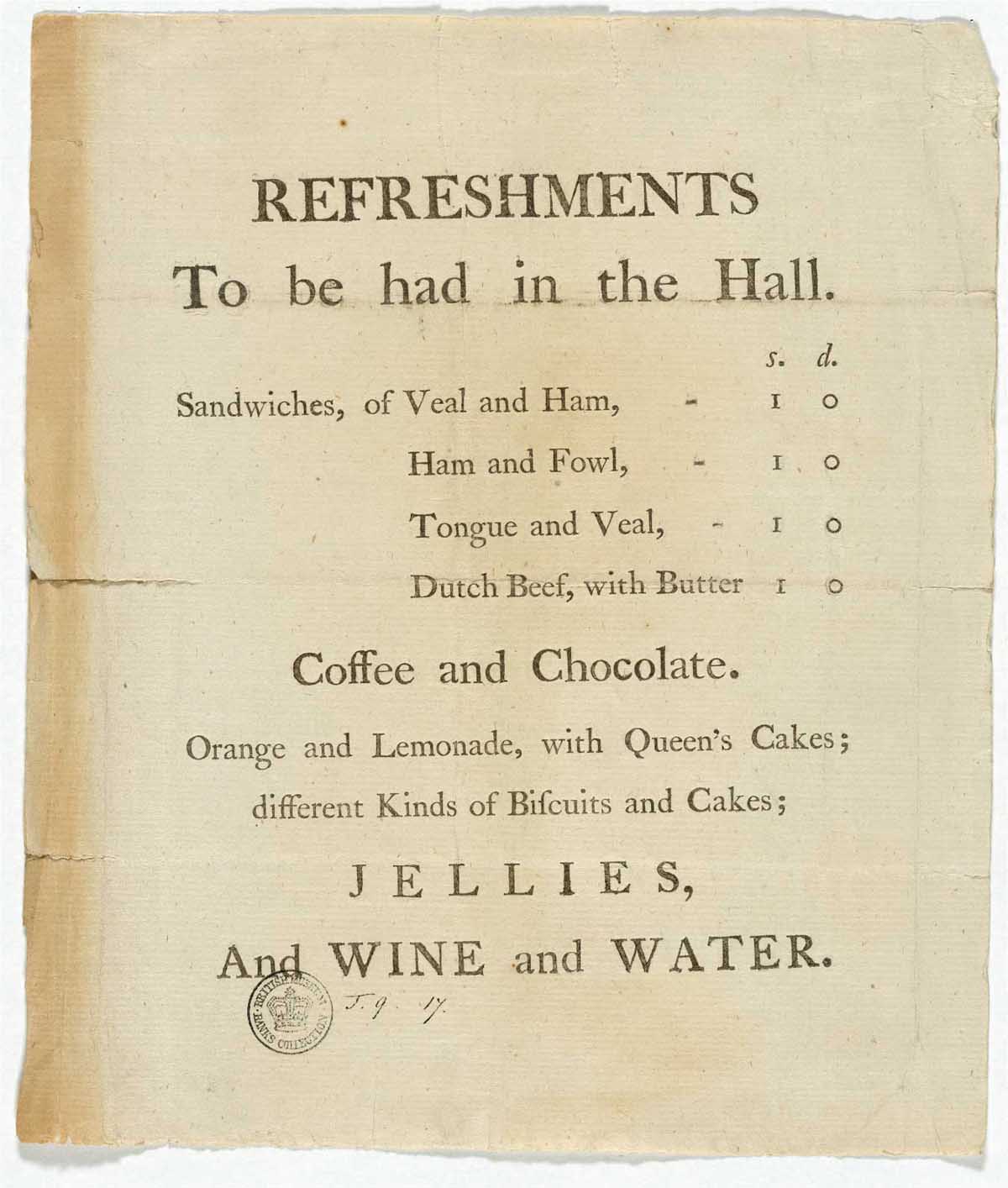
Fig. 3.6 Refreshments to be had in the Hall, 1788. BM J,9.17. © Trustees of the British Museum.
According to the leaflet collected by Miss Banks, refreshments sold inside Westminster Hall included different kinds of sandwiches (veal and ham, ham and fowl, tongue and veal, Dutch beef with butter), at the cost of one shilling each; (unpriced) delicacies, such as coffee and chocolate; orange and lemonade with Queen’s cakes; different kinds of biscuits and cakes; jellies, wine and water. Those who bought this refined food must have been gourmands; as if they had been enjoying a spectacle at the theatre, the frivolous audience at the impeachment was more interested in consuming food – we can imagine them eating, gossiping, and looking around with spy glasses – than in paying close attention to the grave debate taking place in front of them.
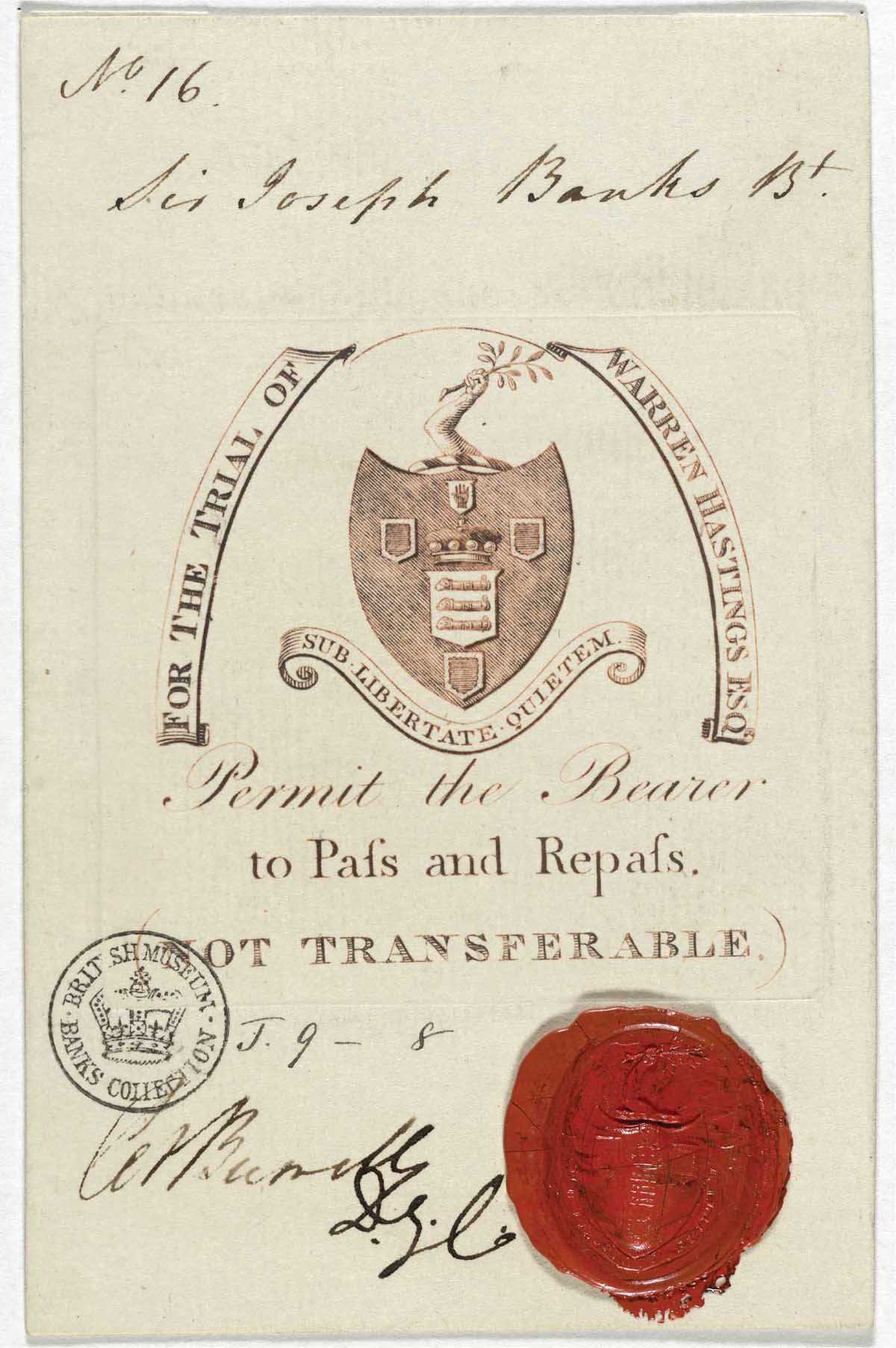
Fig. 3.7 Admission-ticket, 1788. BM J,9.8. © Trustees of the British Museum.
The practice of eating and drinking while watching a theatrical performance was common in the late eighteenth century. On a visit to London’s Sadler’s Wells Theatre in 1786, the German novelist and traveller Sophie von la Roche (1731–1807), for instance, observed:
The scenes in the pit and boxes we found as strange as the ten-fold comedy itself. In the pit there is a shelf running along the back of the seats on which the occupants order bottles of wine, glasses, ham, cold chops and pasties to be placed, which they consume with their wives and children, partaking while they watch the same play. The front seats of the boxes are just the same.39
Complete with a distracted audience consuming food and wine, the atmosphere at Sadler’s Wells Theatre resembled that of Westminster Hall during the Hastings trial.
Besides a vast array of printed ephemera, Miss Banks’s collection also includes a few peculiar tickets.40 As shown in Figure 3.8, they appear to be passes to enter the box of Sir William Chambers (1722–96), the eclectic architect under whose direction the Office of Works built the wooden stands inside Westminster Hall. These five items feature a coat of arms, presumably Sir William’s, the Cross and motto – nescit occasum, ‘it knows no decline’ – of the Swedish order of the Polar Star, as well as the inscription: ‘William Chambers, Surveyor General of his Majesties [sic] Works’.41
Sir William and the Banks must have been closely acquainted, as a couple of letters inserted in Sarah Sophia’s collection further suggests. One of them, addressed to Lady and Miss Banks, reads:
S William Chambers presents his Compliments to Lady and Miss Banks and has sent them three tickets they need not have the trouble of going sooner than Eleven o’clock as the under written note will Secure them a front row in Lady Chambers’s box. (BM J,9.6)
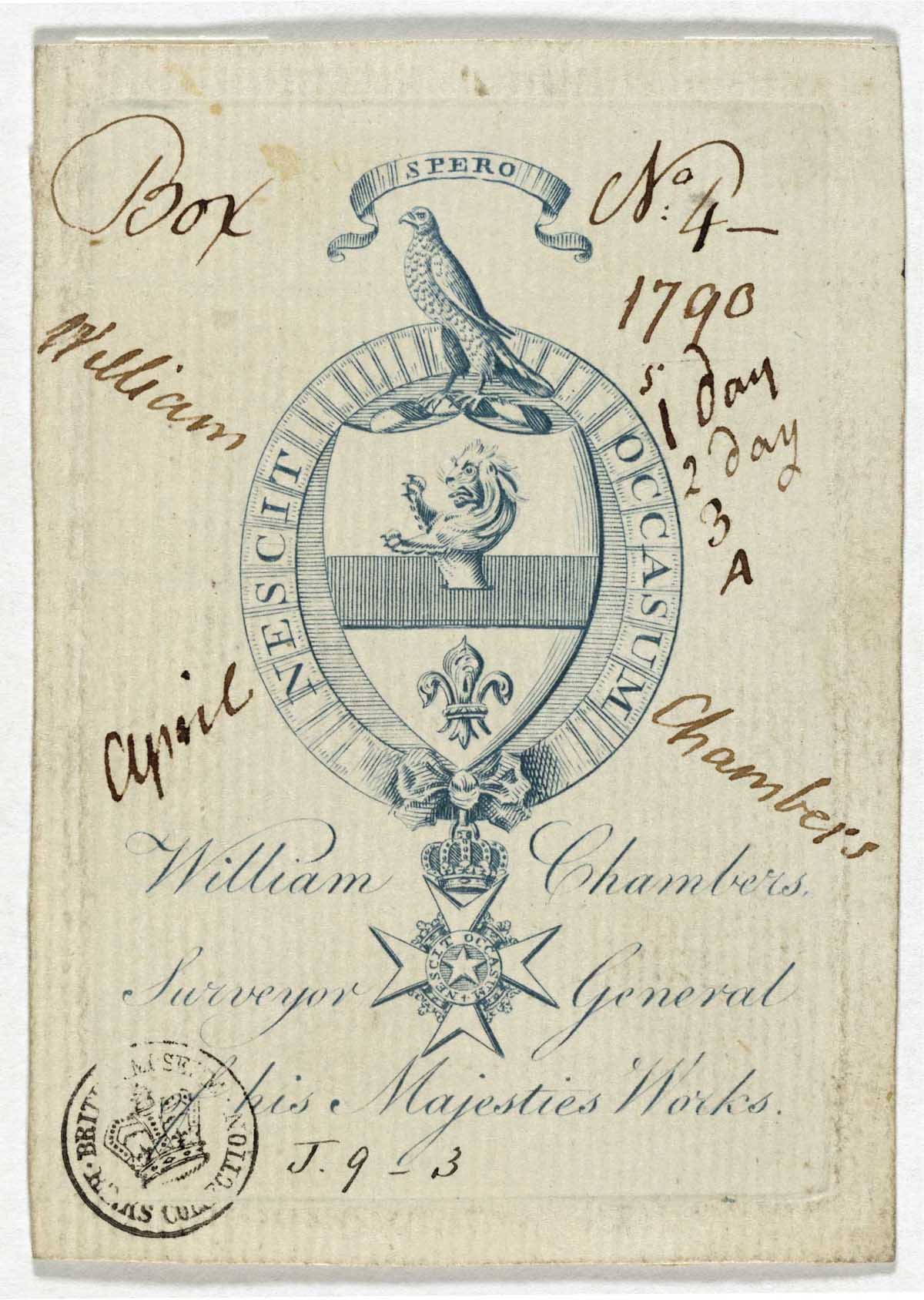
Fig. 3.8 Admission-ticket, 1787 c. BM J,9.3. © Trustees of the British Museum.
Written in the same thin, neat hand, but addressed to Sir Joseph, is also another epistle:
Dr Sir I am Glad to have three tickets to send you the way in, used to be remarkably commodious and flatter myself it will still be so, and my box is so placed that the Ladys [sic] may go in and out whenever they please, hoping you will be of the party. Have taken the liberty of sending three tickets instead of two but if you do not want it please to give it to any of your friends. Berners St Feb 12 1788. (BM J,9.7)
Although this letter is unsigned and the seal is broken, the note was certainly penned by Sir William. Indeed, not only is the epistle written in the same hand as BM J,9.6 but it also bears an important clue to solve the enigma, that is to say the name of the street where the letter was presumably drafted – Berners Street (north of Oxford Street). In 1766, Sir William Chambers moved from Poland Street to 13 Berners Street.
So well known was Sir Joseph Banks that on the same day (the eve of the opening of the impeachment) not only was Sarah Sophia offered a seat in Lady Chambers’s Box, but also in the Great Chamberlain’s.42 Especially designed for ladies, the latter was centrally located and guaranteed an enviable view. Sir Joseph himself was given a ticket that allowed him to be admitted (as a note on the back reads) ‘to the Great Chamberlain’s Gallery during the whole time of the trial’ (BM J,9.25).43 He gave this pass to his sister, who promptly inserted it in her collection.
Owing to Sir Joseph’s influential acquaintances, Lady and Miss Banks were thus offered special tickets that granted them numerous privileges: they did not need to rush to secure good seats, but were invited into Lady Chambers’s exclusive box. Moreover, they could arrive late in the morning. This was not the case for everybody: as with contemporary playhouses, a system of reserved seats did not exist, as admission tickets for the trial permitted entrance, but did not guarantee a specific seat. For example, in the description of her third time at Westminster Hall, Frances Burney confessed: ‘We went early, yet did not get very good places’.44
People queued for hours outside Westminster, especially when renowned orators were due to speak. The correspondence of the British elite for the early months of 1788 is scattered with references to the audience’s rush to the courtroom. In a letter addressed on 22 February 1788 to the diplomat William Eden (1744–1814), the politician and collector of books and prints, Anthony Morris Storer (1746–99), noted for example: ‘Everybody is up by nine o’clock, the ladies have finished their toilette by that time, and are at the door of Westminster Hall, pressing and squeezing to get good places within’.45
Among the vivid images evoked in Sir Gilbert Elliot’s letters to his wife, the portrait of the crowd gathering round Westminster Hall becomes sinister: outside the courtroom, the polite and sociable elite metamorphoses into a violent and impatient mass of people who do not hesitate to press and crush those around them. Aware of the wild rush and injuries that entering Westminster Hall might produce, Elliot offered to accompany a lady, Mrs Morrice, to ‘save some of her bones at the door getting in’.46 As Sir Gilbert himself wrote to Lady Elliot:
It is not yet seven o’clock in the morning, and I expect Mrs. Morrice to call every moment on her way to Westminster Hall, where I am to accompany her, by way of saving some of her bones at the door getting in. She will have to mob it at the door till nine, when the doors open, and then there will be a rush as there is at the pit of the playhouse when Garrick plays King Lear. This will give you some notion of the expectation raised on this occasion. The ladies are dressed and mobbing it in Palace Yard by six or half after six, and they sit from nine to twelve before business begins.47
This passage refers to 3 June 1788, the thirty-second day of the trial and the first of Sheridan’s four-day-long speech. As we shall see, so high was the expectation of the public that the price of the tickets, as well as the eagerness to secure good seats, had no precedent. For this reason, ladies who normally assembled in front of the courtroom by nine o’clock arrived, instead, by six.
While referencing different sessions, both Anthony Morris Storer’s and Sir Gilbert Elliot’s comments are littered with allusions to the theatre. For a start, the audience faced a few hours’ wait – during the winter months, ‘shivering, without either fires or beaux to warm them’ – before the legal spectacle had even begun.48 Commenting on the eighteenth-century London stage, Allardyce Nicoll has noted that ‘when any special attractions were announced it was necessary to reach the playhouse doors at least an hour and a half before the scheduled time of the performance’.49
Secondly, entering Westminster Hall – as with most theatres at the time – was a traumatic process. Those who were not wealthy enough to buy a ticket for the boxes could risk life and limb in their struggle to gain admission to the playhouse. In his lively survey of eighteenth-century London, Jerry White has observed that ‘Popular actors and plays could produce a great crush at the doors that sometimes proved dangerous and worse’.50 In this sense, it is certainly not coincidental that Sir Gilbert compared Sheridan to one of the most celebrated theatre stars of the time, David Garrick. Although on 3 June no grievous accident was reported, the London Chronicle stressed that ‘very great difficulties occurred, and several ladies in the crowd had their habiliments stripped from them’.51 Despite these discomforts and ‘difficulties’, Londoners had a fascination with the theatre. It is in this light that we should read Sir Gilbert’s vibrant account:
We stood an hour and a half in the street in the mob, and at last the press was so terrible, that I think it possible I may have saved, if not her [Mrs Morrice’s] life, at least a limb or two. I could not, however, save her cap, which perished in the attempt. Shoes were, however, the principal and most general loss. Several ladies went in barefoot; others, after losing their own, got the stray shoes of other people, and went in with one red and one yellow shoe.52
For the fashionable members of society who entered Westminster Hall in 1788, therefore, the trial of Warren Hastings was akin to a theatrical spectacle. In this context, Sarah Sophia Banks’s collection of ‘Tickets for Warren Hastings Trial’ is a precious source of information for the social history of her age. It offers a portrait of the elite which is not static and lifeless, a faded image crystallized into a remote past; on the contrary, it conjures up a dynamic tableau of knights and baronets writing letters, sending tickets; people crowding outside Westminster Hall; the Banks trio arriving late in the morning; gentlemen presenting counterfeited tickets; ladies wearing gorgeous dresses and jewels; peers leaning out of boxes, peeresses looking around with their opera glasses; auditors sipping chocolate; gentlemen requiring an ‘exit and readmission ticket’ – and so on. As these vignettes show, the spectators who attended the impeachment against the former Governor-General of Bengal behaved as if they were at Drury Lane or Covent Garden, their frivolity being more attuned to the variegated spectacle of a theatrical evening than to a parliamentary debate questioning the moral integrity of the Empire.
Aware of the theatrical atmosphere in the court, Hastings’s prosecutors acted accordingly and performed like the actors of a melodrama. Significantly, classical rhetoricians – above all Cicero – had attached much importance to acting techniques. In point of fact, effective body language was fundamental to making a ‘strong push at the passions’ of the audience.53 As we shall see in a moment, Burke and his fellow managers followed Cicero’s prescriptions: they excited the attention and engaged the emotions of their hearers, shaping their rhetoric in less technical and instead in more emotional terms.
Actio in performance
In a recent study on eighteenth-century British eloquence, Paddy Bullard has suggested that, although the art of rhetoric was firmly rooted in national contexts, ‘commentators on rhetoric from England, Ireland, and Scotland shared a classical and humanistic inheritance as the basis of their criticism, and they also felt that they were involved in a common conversation’.54 As early as 1712, for example, the writer and politician Joseph Addison (1672–1719) argued over the importance of ‘Gestures’ and ‘Voice’ for a successful public speaker. Published in the Spectator, the article opens with a Latin epigraph from Ovid’s Metamorphoses – abest facundis Gratia dictis (No Charm does his eloquence adorn) – which encapsulates and foreshadows the writer’s thought.55 Throughout the piece, Addison repeatedly asserts that English speakers are dull and vapid. Comparing British orators to ‘cold and dead’ figures, or ‘speaking Statues’, Addison laments the lack of ‘those Strainings of the Voice, Motions of the Body, and Majesty of the Hand, which are so much celebrated in the Orators of Greece and Rome’.56
Thirty years later, in Scotland, ancient and modern public speaking were juxtaposed and contrasted anew. In an essay entitled Of Eloquence (1742), the philosopher David Hume (1711–76) highlighted how eighteenth-century British oratory – ‘argumentative and rational; […] calm, elegant, and subtile’ – paled when compared to the ‘pathetic and sublime’ elocution of classical orators.57 ‘Even a person, unacquainted with the noble remains of ancient orators’ – he pungently remarked – ‘may judge, from a few strokes, that the stile [sic] or species of their eloquence was infinitely more sublime than that which modern orators aspire to’.58
Addison’s article and Hume’s essay testify to the rich and lively debate on rhetoric that flourished in Britain – notably in Scotland – during the second half of the century. The copious number of studies penned at that time include, among others, Lectures on Rhetoric and Belles Lettres (1748–51), by the renowned moral philosopher and political economist Adam Smith (1723–90); The Philosophy of Rhetoric (1776), by the Church of Scotland minister George Campbell (1719–96); A Course of Lectures on Oratory and Criticism (1777), by the natural philosopher Joseph Priestley (1733–1804); and Lectures on Rhetoric and Belles Lettres (1783), by the literary critic Hugh Blair, to give just a few of the famous names. In 1748 Adam Smith began delivering a course of public lectures on rhetoric and belles lettres in Edinburgh, and he continued to give them as ‘private classes’ after he was offered regular employment as professor of logic at Glasgow University in 1751.
Within this dynamic context, elocutionists promoted new methods of pronouncing and performing speeches, focusing on what Paul Goring has called ‘emotionally affecting modes of delivery’.59 In order to mould British orators into persuasive performers who appealed to the emotions of the audience, importance was particularly attached to the body, as a medium to express and transmit feelings. For example, in The Art of Speaking (1761) – one of the most influential manuals on elocution published in the 1760s – the educationist and author James Burgh (1714–75) argued that the most important part of oratory was ‘delivery, comprehending what every gentleman ought to be master of respecting gesture, looks, and command of voice’.60
An eloquent body was thus essential to raise and manipulate the passions of the audience. In this sense, the orator’s voice was also an important tool that might enable the orator to influence the minds of an audience. Among his many classically informed reflections on composition and delivery was the antiquary and biographer John Ward’s (1678/9–1758) observation that ‘the orator’s province is not barely to apply to the mind, but likewise to the passions, which require a great variety of the voice, high or low, vehement or languid, according to the nature of the passion he designs to affect’.61
Certainly, delivery was the key to persuasion through the emotions. From this perspective, classical canons of rhetoric retained a good deal of currency in the eighteenth century, particularly in parliamentary oratory. Although some of the managers performed very successful speeches, the most affecting orations delivered throughout the eight years of the trial were Burke’s account of the Rangpur atrocities (18 February 1788) and Sheridan’s four-day oration on the Begums of Oudh (3, 6, 10, and 13 June 1788). In recent years, these striking speeches have been approached from various perspectives, including the historical, political, artistic, literary and postcolonial. And yet, they have never been systematically surveyed in light of Graeco-Roman rhetorical treatises. What I wish to argue here is that Burke’s and Sheridan’s coups de théâtre were not only related to eighteenth-century modes of delivery or the contemporary vogue for sentimental drama, but that they were also influenced by classical rhetorical prescriptions, which recommended that the orator should transform legal debates into spectacles of justice.62 My reading of Burke’s and Sheridan’s dramatic performances will be conducted with reference to Cicero’s and Quintilian’s theoretical works on oratory (respectively, De Oratore, Orator, Brutus, and Institutio Oratoria) and, specifically, through the lens of De Oratore.63
In June 1788, when he delivered his four-day speech before the Lords, Richard Brinsley Sheridan was already widely known as a brilliant orator. The previous year, on 7 February 1787, he had opened the Begums of Oudh charge (the fourth Article of Charge against Hastings) in an ‘epic’ speech of five hours and forty minutes, which was followed by the first burst of applause ever heard in the Commons.64 Unanimously praised in London as one of the finest orations ever performed there, the echo of the Begum speech reached as far as India, where the Calcutta Gazette lauded it in the most enthusiastic terms:
A speech fraught with argument, so detailed, yet so compact, illumined with flashes of eloquence so sublime, and fraught in such a degree with all the powers that tend to conviction, we speak from the highest authority, when we say, was never heard within the walls of St. Stephen’s chapel’.65
So successful was Sheridan’s speech that, in 1813, while commenting on Sheridan ‘and other hommes marquants’, Lord Byron (1788–1824) still described it as ‘the very best Oration […] ever conceived or heard in this country’.66
As a consequence of Sheridan’s extraordinary performance in 1787, the request for tickets in June 1788 was unprecedented and entrance passes were ‘sold for as much as fifty guineas’.67 ‘You have no conception of the rage and clamour for tickets for to-morrow’s trial’; – Sir Gilbert Elliot wrote to his wife on the eve of the great orator’s performance – ‘at Mrs. Legge’s people were almost putting their hands into one’s pocket for them’.68 Not unexpectedly, the ‘ticket-hunting’ had started a few months earlier, no doubt since April 1788, as a letter published in The World clearly suggests. Addressing an unspecified ‘Sir’, the author of the epistle asks for as many as eleven tickets for ‘the day that Mr. Sheridan is to display his powers, not only as a Manager but as a Performer’.69 Significantly, Sheridan is referred to both as an orator (‘a Manager’) and as an actor (‘a Performer’).
As this example demonstrates, borders between politics and theatre were often blurred and easily crossed over. Christopher Reid has shown how eighteenth-century parliamentary debate should, in effect, be understood as a form of dramatic action: both ‘drama and oratory address themselves to a collective audience’ and ‘indeed develop their full potential, in the process of performance’.70 Even where a verbatim record preserves a parliamentary speech in a written form, Reid continues, ‘certain important details of the performance – intonation, delivery, gesture, reception, and so on – will inevitably be lost’.71 With this in mind, we might perhaps understand why Sheridan himself, conscious of the crucial importance of acting, never published the great speech he delivered in February 1787. Commenting on the orator’s decision to leave the magic of his performance to pure imagination, his biographer, Thomas Moore (1779–1830), emphasized how ‘We may now indulge in dreams of the eloquence […], as we do of the music of the ancients and the miraculous powers attributed to it’.72
Analogies between political and theatrical characters had repeatedly been pointed out in the classical world, particularly in Rome.73 Cicero, for example, frequently recommended that orators should receive a theatrical training: ‘we must carefully observe not only orators but also actors’ (Intuendi nobis sunt non solum oratores, sed etiam actores).74 Interestingly, in Latin, both actors and lawyers were referred to by the same term, actores.75 This accident of language highlights similarities: as William Batstone has put it, actors and lawyers ‘are the ones who hide behind the mask, manipulate the mask, make you see what you do not see’.76 In this respect, in his renowned treatise on the orator’s education, Quintilian significantly observed:
I have frequently seen tragic actors, having taken off their masks at the end of some emotional scene, leave the stage still in tears. And if the mere delivery of the written words of another can so kindle them with imagined emotions, what shall we be capable of doing, we who have to imagine the facts in such a way that we can feel vicariously the emotions of our endangered clients?77
It was not by chance that Cicero not only defined orators as veritatis ipsius actores (players that act real life) and actors as imitatores autem veritatis ([those] who only mimic reality),78 but even likened his ideal orator to Roscius, Rome’s most famous actor.79
It is against this background of dramatized politics – with the courtroom turned into a stage, and orators into actors – that we should read Ralph Broome’s vitriolic attack on the managers’ exasperated theatricality. In Letters from Simpkin the Second to his Dear Brother in Wales, a popular verse narration of the trial of Hastings, Broome (d. 1805) repeatedly provides evidence of what Julie Stone Peters has defined as ‘misconstrual of law as entertainment’.80 In one of his lampoons, Broome depicts Sheridan as a playwright:
As SHERRY in speaking is fond of Precision,
He adopts the Theatrical mode of Division:—
That is, he arranges the Plot and the Facts,
And the Play will consist of a Number of Acts.81
In another, he shows how Sheridan was taken ill after describing slaughters and tortures allegedly committed in India. The pamphleteer’s comment is full of keen irony: Sherry’s fainting is not the expression of a sensitive soul but, rather, ‘a trick, which stage orators use in their need’:
Such horrors presented themselves to his view,
That SHERRY took fright at the picture he drew;
He had something, ’twas thought, still more horrid to say,
When his tongue lost its powers, and he fainted away.
Some say, ’twas his Conscience that gave him a stroke,
But those who best know him, treat that as a joke;
’Tis a trick, which Stage Orators use in their need,
The Passions to raise, and the Judgment mislead.82
As the final line of this passage intimates, one of the crucial questions lying at the heart both of classical treatises on oratory and of contemporary works on theatre was that of ‘feeling the part’. Indeed, as Jay Fliegelman remarks, ‘the oratorical manuals of the period were often indistinguishable from acting manuals’.83 Thus, for example, in The Actor (1750) – the first English acting treatise to examine the emotional attributes of a performer – John Hill (1714–75), a physician and actor himself, observed:
It is a maxim as old as the days of Horace; if you wou’d have me shed tears, you must weep your self [sic] first. That excellent author address’d this doctrine to orators; but it is still more applicable to actors. […] in order to his [the tragedian’s] utmost success, it is necessary that he imagine [sic] himself to be, nay that he for the first time really is, the person he represents.84
Orators were encouraged to appeal to the emotions of the audience also in eighteenth-century rhetorical treatises. ‘The most virtuous man, in treating of the most virtuous subject, seeks to touch the heart of him to whom he speaks’, Hugh Blair noted.85 In particular – Blair continued – ‘The internal emotion of the Speaker adds a pathos to his words, his looks, his gestures, and his whole manner, which exerts a power almost irresistible over those who hear him’.86
This view was shared by, among others, Burke, Sheridan and Elliot. The year before the beginning of the trial, on 12 December 1787, the latter had opened proceedings against Sir Elijah Impey (1732–1809), a school friend of Hastings’s from Westminster, who had been the Chief Justice of the Supreme Court at Calcutta for most of Hastings’s administration. The most important charge against Sir Elijah was the execution of Maharaja Nandakumar (d. 1775), a Hindu Brahaman official in Bengal who was tried by the newly constituted Supreme Court. After accusing the Governor-General of accepting bribes, Nandakumar was in turn accused of forgery allegedly committed in 1769 and sentenced to death. The death penalty for such a crime appeared inordinately harsh and the execution of Nandakumar inevitably aroused suspicion that Hastings ‘had taken an active part in bringing it about’.87
Elliot’s speech was extraordinarily well received and the following day Burke wrote a letter to Lady Elliot to congratulate her on her husband’s exceptional delivery:
It was an opening of wonderful Splendour and Beauty; a magnificent Portico full of Chaste Grandeur, and perfectly suitable to the Temple of Justice which it leads to. […] This well combined piece was so very affecting, that it drew Tears from some of his auditory, and those not the most favourable to his Cause. In Truth the whole came from the heart, and went to the heart.88
As Burke noted, Sir Gilbert’s great success was due to the display of an emotional body language, enhanced by an appropriate ‘Tone and modulation of Voice’. In accordance with the Ciceronian theories that encouraged the orator to stamp on himself the same feelings he wished to arouse in the audience, Elliot’s oration ‘came from the heart and went to the heart’. Similarly, Sir Gilbert’s own comment on his performance – ‘what a powerful ingredient in eloquence a sincere feeling in the speaker is’ – shows how he himself had introjected classical rhetorical prescriptions.89
In classical Rome, Cicero had, indeed, stressed the importance of persuasive appeals based on emotions that might be transferable from the orator to the audience. This principle, known as ipse ardere, to be oneself aflame, is explored at length in De Oratore. Antonius, one of the characters in the treatise, utilizes this phrase in reference to Crassus’s rhetorical ability: ‘to me you seem to be not merely inflaming the arbitrator, but actually on fire yourself’ (non solum incendere iudicem, sed ipse ardere videaris).90 The imagery of fire – the fire of passion that consumes the orator and spreads among the auditors – is recurrent throughout Cicero’s dialogue. For instance, it is Antonius again who explains:
For just as there is no substance so ready to take fire, as to be capable of generating flame without the application of a spark, so also there is no mind so ready to absorb an orator’s influence, as to be inflammable when the assailing speaker is not himself aglow with passion.91
Perhaps Elliot had this passage in mind when he described Sheridan’s June orations on the tragedy of Oudh; his letters to his wife abound with references to the semantic fields of fire and cold.92 According to Sir Gilbert, Sheridan’s opening speech on 3 June was disappointing, in part, because it was too contrived and lacked ‘the luxuriance and grace of spontaneous nature’. ‘His exordium’ – Elliot continued – ‘was […] colder and less effective than I expected from him’.93 Elliot’s portrait of a distant, unemotional speech is further conveyed by a vivid metaphor: Sheridan’s eloquence is compared to ‘flowers, which are produced by great pains, skill, and preparation, and are delivered in perfect order, ready tied up in regular though beautiful bouquets’.94 A good example, in this sense, is Sheridan’s description of the Indian zenana (the area of the household reserved for women):
Women there are not as in Turkey. They neither go to the mosque nor to the bath. It is not the thin veil alone that hides them; but, in the inmost recesses of their zanana [sic], they are kept from public view by those reverenced and protected walls which, as Mr. Hastings and Sir Elijah Impey admit, are held sacred even by the ruffian hand of war or by the more uncourteous hand of the law. But, in this situation, they are not confined from a mean and selfish policy of man – not from a coarse and sensual jealousy. Enshrined rather than immured, their habitation and retreat is a sanctuary, not a prison. Their jealousy is their own jealousy – a jealousy of their own honour, that leads them to regard liberty as degradation, and the gaze even of admiring eyes as inexpiable pollution to the purity of their fame and of their honour.95
Sheridan’s key point here is the harem/zenana, Turk/Indian dichotomy.96 While the harem, evoked metonymically by an allusion to the Ottoman Empire (‘Turkey’), its religion and culture (‘the mosque’ and ‘the bath’), was associated, among other things, with sexual slavery and perversion, the Indian women’s wilful withdrawal from public life is tinged with a quasi-religious aura (‘reverenced and protected walls, which […] are held sacred’; ‘enshrined rather than immured’; ‘their retreat is a sanctuary’). In terms of style, the stark contrast between harem and zenana is structured with litotes and antitheses, as well as with a triple, almost-chiasmatic repetition of ‘jealousy’ (‘Their jealousy is their own jealousy – a jealousy of their own honour’). Undoubtedly, this speech was ‘the work of a man of very extraordinary genius’. Yet its ‘artificial execution’ – we can picture Sheridan here as a cold, authoritative speaker in perfect control of his material – left the audience’s ‘passion’ and ‘judgment unaffected’.97
On 6 June, again, Sheridan appeared distant and detached, so much so that Elliot confessed: ‘I object to it […] as bearing too evidently the marks of deliberate and cold-blood preparation just where the utmost degree of real passion and fire is to be represented’.98 From the outset, Sheridan’s second-day speech was pervaded by an ‘artificial fire’.99 For instance, arguing for the improbability of an attempt of the Begums on the East India Company, the orator observed:
The next circumstance which I wish your Lordships to advert to is what is admitted through the whole of this testimony – I mean the infinite improbability at least that the Begums should have made this attempt, and the absolute impossibility of their succeeding. But I don’t ask you then to say that because a crime is improbable to have been attempted, and the success is impossible, therefore the attempt is not made. No, my Lords; but I think again I have a right to claim this; because I am ready to admit that it is impossible to look into the history of these transactions – it is impossible to trace the conduct of the wild and irregular mind of the man whom we accuse – without admitting that there is such a thing as a perverse propensity to evil that leads the mind of a man to evil acts, even where the perpetrator has no obvious motive, either of interest or opposition, to answer.100
Such highly structured passages were based on parallelisms with homoteleuton (‘the infinite improbability’ and ‘absolute impossibility’), repetitions (‘improbability’/‘improbable’; ‘impossibility’/‘impossible’/‘impossible’; ‘attempted’/‘attempt’; ‘evil’/‘evil’) and alliteration (‘perverse propensity’), making them readily memorable, but devoid of emotive appeal.
Where his first two orations were only marginally successful, Sheridan’s final speech on 13 June was universally praised as triumphant.101 Although, upon this occasion, Sir Gilbert did not comment on the orator’s general style of speaking, he praised his performance as ‘finer […] than ever’.102 According to The Times, the orator’s elocution ‘surpassed every thing that was ever heard or imagined’. ‘Mr. Sheridan’ – the reporter continued – ‘broke out in a strain of the most pathetic and beautiful language that can be conceived, and we lament our insufficiency to do it the justice it is so highly entitled to’.103 This time we can imagine Sheridan being himself aglow – or, as Cicero would have put it, ipse inflammatus – to the point that ‘he once or twice had nearly fainted away’.104
According to Sheridan’s account, Hastings had incited the Wazir, Asaf al-Daula, to seize his mother’s and grandmother’s treasure. Although, as Julie Carson has noted, indicting Hastings for crimes against the family presented ‘nothing remotely resembling evidence’,105 Sheridan’s great speech still vibrates with the magic of his extraordinary performance:
Good God! my Lords, what a cause is this we are maintaining! What! when I feel it a part of my duty, as it were, when I feel it an instruction in my brief to support the claim of age to reverence, of maternal feebleness to filial protection and support, can I recollect before whom I am pleading? I look round on this various assembly that surrounds me, seeing in every countenance a breathing testimony to this general principle, and yet for a moment think it necessary to enforce the bitter aggravation which attends the crimes of those who violate this universal duty.106
The numerous exclamations of this passage bear witness to the pathos of the orator. The appeal to all the auditors (‘this various assembly that surrounds me’) and the advocation of a ‘universal duty’ – filial pity – were part of a rhetorical strategy, enabling Sheridan not only to form a close bond between himself and his audience, but also, even more importantly, to ‘generate sentimental identification’ with the distant and alien Begums.107 Indeed, it was this very sentimental identification that paved the way for one of Sheridan’s most moving sections on filial love:
My Lords, how can I support the claim of filial love by argument, much less the affection of a son to a mother, where love loses its awe, and veneration is mixed with tenderness? What can I say upon such a subject? What can I do but repeat the ready truths which with the quick impulse of the mind must spring to the lips of every man on such a theme? Filial love – the morality, the instinct, the sacrament of nature – a duty; or rather let me say it is miscalled a duty, for it flows from the heart without effort – its delight – its indulgence – its enjoyment.108
It is not difficult to imagine Sheridan inflamed with the all-consuming passion that enthralled the ladies and gentlemen sitting in Westminster Hall. Through the oratorical symbiosis of body and language, Sheridan successfully utilized what his father, the actor and orthoepist Thomas Sheridan (1719?–88), had called ‘the language of emotions’.109 Like Cicero, Sheridan’s father had argued for the importance of a body language ‘composed of tones, looks, and gesture’, by means of which ‘the [speaker’s] passions, affections, and all manner of feelings, are not only made known, but communicated to others’.110
Just as Sheridan seemed to be suffering, the audience was spectacularly seized by a fit of tears: ‘there were few dry eyes in the assembly’ – Elliot informs us – ‘and as for myself, I never remember to have cried so heartily and so copiously on any public occasion’.111 This highly emotional drama reached its climax when Sheridan collapsed into Burke’s arms, seemingly overwhelmed with physical pain and intense feelings. Among the audience who assisted at this coup de théâtre, the historian Edward Gibbon commented: ‘Sheridan, on the close of his speech, sunk into Burke’s arms, but I called this morning, he is perfectly well. A good actor’.112 Sheridan’s final act was commented on by Warren Hastings himself, who lamented that the managers had turned ‘the Court into a theatre’.113 Once again, politics and theatre overlapped.
With his pathetic performance culminating in a swoon, there is, indeed, little doubt that Sheridan’s ‘prosecuting theatrics’ were profoundly influenced by the contemporary vogue for sentimental drama.114 Between 1740 and 1780, theatre was dominated by the acting style of the celebrated actor David Garrick, who emphasized the importance of actors themselves feeling the emotions they portrayed.115 Drawing on Cicero’s and Quintilian’s exhortations to orators to emulate actors, Burke himself remarked how Garrick was:
a man to whom were all obliged; one who was the great master of eloquence; in whose school they had all imbibed the art of speaking, and been taught the elements of rhetoric. For his part, he owned that he had been greatly indebted to his instruction.116
As a result, it is not surprising that the theatre-going, fashionable audience who attended the trial in 1788 responded to the orators’ performances as if they were at a playhouse. In the eighteenth and early nineteenth centuries, the discourse of sensibility powerfully shaped the spectators’ responses to theatrical spectacles. For example, as Jim Davis has pointed out, the intense tragic performances of Sarah Siddons caused both men and women to cry and ‘some of her female supporters even succumbed to hysteria and fainting fits’.117 Similarly, as we have seen above, spectators reacted to Sheridan’s highly emotional delivery on 13 June with copious tears. This was also the case with Elliot’s affecting speech against Sir Elijah Impey on 9 May 1788: as he himself put it, he achieved a success ‘beyond my most sanguine expectations’.118 Again, the reasons for this triumph are to be traced in the emotional intensity of the orator’s performance. In a letter penned to his wife on 10 May 1788, Sir Gilbert explained:
I was fortunate enough to conclude with an affecting passage. I had tears and violent emotions all round me as before, and my powers certainly went very far beyond any idea I could have formed of myself. Dudley Long was one of the weepers, Adam another, and indeed the whole House and gallery were worked up to an extraordinary degree of feeling and emotion.119
Given the overpowering impressions that both Sheridan and Elliot made on their audience and given the sympathetic response that they inspired in their spectators, it is tempting to speculate that, just as the orators’ histrionic performances were influenced by the contemporary style of acting characterized by an intense emotional delivery,120 so were they also informed by classical rhetorical models. Indeed, classical scholars such as James M. May have shown that every Ciceronian oration is rich in passages full of pathos, ‘several even ending with the orator in tears, barely able to continue’.121 In a passage from De Oratore, for example, Antonius observes how:
(Moreover) it is impossible for the listener to feel indignation, hatred or ill-will, to be terrified of anything, or reduced to tears of compassion, unless all these emotions, which the advocate would inspire in the arbitrator, are visibly stamped or rather branded on the advocate himself.122
Repeatedly, Cicero highlights the importance of stirring up the audience’s emotion as the most important means for winning lawsuits.123 In Brutus 89, for instance, the Latin orator makes it clear that inflammare iudicem (inflaming the court) is far more important than docere (instructing):
of the two chief qualities which the orator must possess, accurate argument looking to proof, and impressive appeal to the emotions of the listener, the orator who inflames the court accomplishes far more than the one who merely instructs it.124
It is within this perspective of inflammare rather than docere that we should undoubtedly read Burke’s peroration on the Rangpur horrors. On 18 February 1788, seizing on the reports of atrocities allegedly perpetrated by revenue collectors in Rangpur, a district in northern Bengal, the Anglo-Irish orator provided the audience with gruesome details. The gravamen of Burke’s charge was that a certain Devi Singh (d. 1805) had bribed Hastings in order to be awarded the revenue farms of Rangpur. As a consequence of the Governor-General’s corruption – Burke thundered – Devi Singh’s agents had inflicted tremendous tortures on the local population.125
As P. J. Marshall has shown, these reports caught Burke’s attention too late to be incorporated in the charges. However, when the orator perused the list of horrid and nefarious cruelties purportedly inflicted in the most ferocious manner, he ‘was obviously much moved by what he read and fully recognized that others would be so moved’.126 Despite the unreliability of these events and their irrelevance to the charges brought against Hastings, Burke dilated upon the episode ‘for’ – he wrote to Philip Francis – ‘it has stuff in it, that will, if anything, work upon the popular Sense’.127 Affecting popular sentiment was, in fact, ‘essential to Burke’s purpose’ (to steal a phrase from Richard Bourke).128 Believing the Lords to be biased in favour of Hastings, Burke thought that the most likely means of putting pressure on them to condemn the accused was to inflame the audience.129
Willingly sacrificing accuracy for the sake of sensationalism, the prosecutor dwelled on shocking scenes of torments, the instruments of torture and maiming, as well as mutilated and bleeding bodies.130 ‘In the process’ – Marshall contends – ‘he [Burke] produced some memorable rhetoric, such as his description of how torturers “crushed and maimed those poor, honest, laborious hands” ’.131 As will be shown in some detail in the following chapter, the whole section of the Rangpur speech is interspersed with frequent references to brutal corporal punishments – one of the most notorious and often cited episodes is that of the nipples of the women being put ‘into the sharp edges of split bambooes’ and torn from their bodies.132 This long and lurid catalogue of atrocities is, indeed, structured through a sequence of disturbing vignettes, which include scourging with rods made of ‘a poisonous plant called Bechettea plant, a plant, which is deadly caustic, which inflames the parts that are cut, and leaves the body a crust of leprous sores and often causes death itself’.133 As with his shocking account of Jane McCrea’s death analysed in Chapter 2, Burke’s speech on the Rangpur horrors slips into a register of hyperbolic realism.
Burke’s vivid account of abominations had its effects. ‘It is impossible for us to give the public any idea of the influence of his description’, the London Chronicle claimed. According to the reporter:
The cruelties practiced on helpless people, so shocking to humanity, to modesty, and to every tender and manly feeling, convulsed and agitated the whole Assembly. The ladies were, throughout the whole Hall, in agony of grief, and the tear of compassion stood in the eye of the most veteran soldier present.134
So greatly did Burke stir the feelings of his auditors that many ladies, among whom were the most acclaimed tragic actress of the time, Sarah Siddons, and Sheridan’s wife, the celebrated soprano Elizabeth Ann Linley, fainted away. With a simile drawn from the classical world, the aforementioned politician and collector, Anthony Morris Storer, likened Sarah Siddons to Niobe, the mythological figure who cried unceasingly in grief: ‘even she who has drawn tears from so many others has shed them on hearing Mr. Burke’s description of India. Mrs. Siddons, they say, was like Niobe, all tears, and Mrs. Sheridan fainted away’.135
In this theatrical setting, quite interestingly, roles are reversed, with Mrs. Siddons and Mrs. Sheridan transforming from objects of the audience’s glances to members of the audience themselves. Edmund Burke, in turn, appeared to be no longer the spectator of a tragedy starring Sarah Siddons – in a celebrated passage from his Reflections he would recall ‘the tears that Garrick formerly, or that Siddons not long since, have extorted from me’ – but metamorphosed into a supreme actor.136 Commenting on the Rangpur speech, the Gazetter and New Daily Advertiser reporter concluded: ‘Certainly such a tragedy was never exhibited on any stage’.137
To amplify the drama, after dwelling on the goriest details, the orator himself was taken ill with a sudden pain in his side. Burke’s sickness was said to have been caused by ‘his drinking cold water and eating oranges during the time he was speaking’.138 Oranges were commonly reputed to soothe a dry and sore throat. Sir Gilbert Elliot, for instance, was much annoyed at his mouth being ‘as dry as parchment, in spite of an orange which I kept sucking’.139 Apparently, it was not uncommon for orators to feel indisposed after eating cold oranges. For example, on 5 March 1788, The Times reported that an orator, a certain Mr. Erskine, was taken ill while pleading at the bar of the House of Commons: ‘His indisposition’ – noted the newspaper – ‘was occasioned by eating an orange, which was too cold for his stomach, and brought on a shivering’.140 According to Burke, however, his sudden malaise was not produced by ‘a draught of cold water which he drank in the midst of the heat of his oration’ – as he seemingly told Frances Burney – but was, instead, caused by the revolting tortures he was describing:141
My Lords, I am sorry to break the attention of your Lordships in such a way. It is a subject that agitates me. It is a long, difficult, and arduous; but with the blessing of God, if I can, to save you any further trouble, I will go through it this day.142
Burke tried to resume, but was in no state to continue and the session had to be adjourned. Although the account of the Rangpur horrors probably took no more than half an hour, its importance is much greater than its length would suggest. Undoubtedly, this was one of the most sensational speeches ever pronounced during the trial, and was regarded by Burke’s contemporaries as a masterpiece of rhetoric. ‘We may venture to say a more perfect piece of oratory was never delivered to an English audience’, observed the London Chronicle on 19 February 1788. Even newspapers normally hostile to Edmund Burke, such as The World, lauded the power of the images that, by the magic of his eloquence, the orator was capable of evoking: ‘his descriptions were more vivid – more harrowing – and more horrific – than human utterance on either fact or fancy, perhaps, ever formed before’.143
Within this narrative of pain, Burke’s body language acquired possibly greater importance than his verbal language. By fainting, he transformed distant, impalpable torments into visible and tangible sufferings. His body became a decisive medium to direct the feelings of his spectators against Hastings. By means of the technique of aposiopesis – that is, when an orator breaks off the speech to suggest overwhelming emotion – Burke provided his audience with a powerful example of emotional response to imperial atrocities. According to Ahmed, the Irish-born orator’s performance – along with the very theatricality of the trial – seems to suggest that the basis of civil society lies in ‘social mimicry’.144 Similarly, Stone Peters has noted that the detailed description of tortured body parts, made visible through Burke’s pain and indisposition, ‘would communicate itself somatically to the listeners, whose tears (mixing pathos and pathology) would both realize this bodily transmission and offer visible proof of their sympathy’.145
Burke’s histrionic style, with its emotional insistence, combined a variety of different features and cultural influences, among which were personal temperament, classical oratory, contemporary sentimental drama and the omnipresent eighteenth-century obsession with sympathy. It is difficult to define how far each of these components affected him, not least because by overlapping and intertwining, they all informed the Anglo-Irish orator’s vivid rhetoric or ‘painted orations’, as Horace Walpole called them.146 Undoubtedly, as with Sheridan and Elliot, eighteenth-century theatre and its emphasis on pathetic performances influenced Burke considerably. The fact that the trial of Warren Hastings was performed in an atmosphere of extensive theatricality, then, added to the managers’ tendency to turn to the irresistible natural force of theatre which classical rhetoricians had employed.