
5
From the beginning of the impeachment, both Hastings and his accusers realized that the trial would take place before a tribunal of newspaper readers, as much as before the audience in Westminster Hall. It was thanks largely to the expansion of newspaper reporting and parliamentary printing from the 1770s that – as Christopher Reid has put it – ‘oratory had also come to matter outside the House [of Commons]’.1 Tellingly, in the course of the trial John Scott-Waring (1747–1819), agent and principal director of propaganda of the Governor-General, invested a sum of nearly £6,500 on articles and cartoons in the press.2
The impeachment of Hastings was, in fact, debated and commented on not only in the newspapers, but also in periodicals and reviews, such as The Gentleman’s Magazine and the London Magazine, or the Monthly Review and the Critical Review respectively. However, a quick survey of the latter (which usually came out monthly or yearly) shows that comments tended to be less detailed than those newspapers published on a daily basis; and more importantly, unlike daily newspapers, in the monthly publications allusions to Cicero’s impeachment of Verres were sporadic, and often without reference to either Burke or Hastings. A significant example, in this sense, is the Annual Register. Edited originally by Burke, this periodical ‘quickly became’ – to borrow the words of Paul Langford – ‘the standard reference work of contemporary events’.3 Throughout the duration of the trial (1788–95), the Register referred to the greatest Roman orator and the propraetor of Sicily only once, on the occasion of Fox’s speech to add Francis to the committee of managers for the impeachment (11 December 1787).4
As argued in the previous chapter, Burke repeatedly implied that he was Cicero and Hastings was Verres and allusions to the prosecution of the propraetor of Sicily were made not just by the Irish-born orator, but also by contemporary observers of the trial. From 1786 onwards, newspapers and, in smaller numbers, satirical prints represented Burke as a British Cicero and Hastings as a modern-day Verres. Concentrating on the major newspapers published in Britain and British newspapers issued in India, as well as on satirical cartoons, I will show how the arraignment of Verres and the Hastings impeachment inextricably intertwined in the imagination of the educated eighteenth-century Englishman.5 Despite this, however, the novelty of the cause célèbre began to fade after a few months, and the initial surge of public interest was replaced by a sense of increasing boredom. Therefore, I shall particularly direct my attention to the press and caricatures issued between 1786 and 1788, as the period in which interest in the trial was at its peak.
Tullius Indianus
As early as 1781 India’s first printed newspaper, the Hicky’s Bengal Gazette; or the Original Calcutta General Advertiser, published two issues with an English translation of ‘CICERO’s famous Oration before the Senate of ROME against VERRES, who had been Governor in ASIA Minor’.6 Despite belonging to different parts of the extant corpus of the Verrine orations, both translations share similarities. For instance, both articles are given considerable prominence, as they are strategically displayed in the first two columns of the front page. Also, in both cases the original text is not reproduced, nor is the identity of the translator revealed. As a result, the English version is rather loose and, what is more, a number of sections of Cicero’s orations are omitted without any indications to the reader.
Although not directly related to the trial of the Governor-General of Bengal, both articles constitute clear evidence that, well before the impeachment of Hastings, the arraignment of Verres was associated with the British presence in India. Of particular interest in this respect is a trenchant note inserted in the conclusion to the second article:
After Reading and duly pondering the afore recited Speech of the immortal CICERO […] let us shift the Scene in immagination [sic] and by the powers of Fancy Conceive SICILY (as described by Cicero) to be the CARNATIC. –
The PEOPLE OF ROME the INDIA PROPRIETORS, or the ENGLISH NATION at large. – The CONSCRIPT SENATORS – the ENGLISH PARLIAMENT. –
CICERO in the Person of Ed. Bourke [sic], the E. of SHELBURNE Mr. T. PITT, Mr. Dunning. And CAIUS VERRES as a xxxx Type of SIR THOMAS PILLAGE. –
The native honest powers of Sympathy confirm the horrid Picture. –7
Not unexpectedly, as India (the Carnatic) is equated to Sicily and the British Parliament to the Roman Senate, so is Edmund Burke named as the British counterpart to Cicero. Conversely – and perhaps surprisingly – Verres is related to a certain Sir Thomas Pillage. It would be tempting to speculate that the person cast in the role of this arcane character is Warren Hastings. However, as P. J. Marshall has acutely observed, ‘During 1781 Burke had become increasingly critical of Hastings, but he could still refer to him as a “respectable” person’.8 Therefore, the mysterious Sir Thomas may be, instead, Sir Thomas Rumbold (1736–91), first Baronet. During his service as Governor of Madras (1778–81), Rumbold was, in fact, held responsible for Haidar Ali’s victories over the Madras army in 1780 and as such was ‘recalled by the Court of Directors to answer charges of negligence and corruption’ (whence probably the nickname ‘Pillage’).9 It is also worth noting that Madras is situated in the province known as the Carnatic – hence the exhortation to ‘conceive Sicily (as described by Cicero) to be the Carnatic’.
The two articles published in 1781 by the Hicky’s Bengal Gazette are important also for another reason. A vast number of key words and expressions, including ‘cruel oppressor’, ‘rapacious Insolence’, ‘Avarice’, ‘clearly convicted’, ‘Iniquitous Administration’, ‘Oppressed, plunder’d and Ruined by those who are sett [sic] over them’, are emphasized by means of different types, either italics or capital letters.10 As I demonstrated in Chapter 4, seven years later most of these terms would be used by Burke in his ‘Speech on the Opening of the Impeachment’.
If we move forward in time, we find that the Hastings trial runs in parallel with the impeachment proceedings against Verres in various English-language Indian newspapers. On 7 January 1788, for example, the India Gazette: or, Calcutta Public Advertiser gave over much of its front page to the ‘report of the secret committee, containing articles of Impeachment against Warren Hastings’. This piece is a distillation of the speeches delivered by two Hastings supporters, Lord Hood (1724–1816) and the Alderman John Wilkes (1725–97), respectively. These orations were pronounced in the House of Commons on 9 May 1787, a full eight months before being published in the India Gazette.11 John Wilkes’s discourse appears to be particularly significant, as:
in the course of the proceedings he had […] more than once heard Mr. Hastings compared to Verres; but the House would recollect that when the Governor General of Sicily was called to an account before the Roman Senate, there scarcely was an inhabitant of that Island who did not exhibit a complaint against him; whereas in the present case, though the prosecution or persecution of Mr. Hastings had been in progress above three years, not a single complaint had come from India against the Governor General of Bengal. On the contrary every letter that had been sent home, was full of expressions of gratitude and applause of the conduct of Mr. Hastings while he held the Government of India.12
If we are to believe the Alderman’s speech, in 1787 Hastings had already been compared to Verres several times. Acting as a partisan of the former Governor-General of Bengal, Wilkes firmly rejected the parallel with the propraetor of Sicily, but did not make any reference either to Cicero or Burke. Ten days later, on 17 January 1788, the Calcutta Gazette; or, Oriental Advertiser published a long article summarizing the conclusion of the same parliamentary session (9 May 1787).13 Also in this case, the names of Cicero and Burke do not appear. Conversely, we are informed that John Courtenay (1738–1816), one of the managers of the impeachment:
took notice that Mr. Hastings had in the course of the preceding debates, been compared to Verres, to Alexander, to Scipio, and to Epaminondas. He said, he thought the first the comparison most in point; but he would not refer to the Romans and Grecians for a comparison. It was so long since he had read books relative to them, that he had almost forgotten their contents. He would look to more modern history for a comparison, and he recollected an apt and a close one. It was Ferdinando Cortez, to whom he alluded. Ferdinando Cortez, had been sent out by Charles the fifth, to make discoveries in South America, to instruct to murder, and to baptize the uninformed Indians. He pursued his object, and his footsteps were marked with blood and cruelty; insomuch that the news of his brutality reached Madrid, and was thought so much a national disgrace, that an enquiry into his conduct was deemed due to the national character […].14
This passage offers us a valuable insight into the long series of historical Greek and Roman characters with whom the Governor-General of Bengal was compared. Besides being associated with Verres, Hastings was, in fact, repeatedly mentioned alongside great statesmen and generals, such as Alexander, Scipio and Epaminondas.15 If we consider, for example, the parallel with Alexander the Great, Hastings himself recounts that, on the seventh day of the trial (22 February 1788 – a month after the publication of the above issue of the Calcutta Gazette), Charles James Fox observed:
Mr. Hastings had lately been compared to a conqueror, whose fame filled the universe: […] Alexander the Great. But if any resemblance were found, it could not be to Alexander when his mercies and his victories kept an equal pace; – it could not be to the generous or forgiving conqueror; – the likeness must be meant to Alexander maddened after a debauch; to Alexander in petulant wantonness setting temples on fire – to Alexander when his follies and his crimes had excited horror and contempt sufficient to obscure the radiance of his former glories. – In the first points of the comparison there was not a shade of resemblance; in the latter part of the parallel there was all the justice that could be required.16
In his own account of the impeachment, Hastings reports further that on the eighth day of the trial (25 February 1788) the king of Macedonia was invoked again by Charles Grey (1764–1845), the youngest member of the managers. According to Grey’s allegations, the Governor-General of Bengal had exhorted Major Popham’s soldiers to plunder the fortress where the wife and the mother of the Rajah resided:
These females of dignified rank were, therefore, stripped of every resource in their want, and of every solace to their eye! – Those who had compared Hastings to Alexander the Great, would here find their parallel was greatly deficient. Alexander had so comported himself to the wife and mother of Darius, that they scarcely felt their loss; – Mr. Hastings on the contrary, had so demeaned himself to the wife and mother of Cheyt Sing, that the unfortunate Rajah felt their sufferings as the keenest aggravation of his own.17
Both Charles James Fox’s and Charles Grey’s references to Alexander exemplify how eighteenth-century British politicians freely selected episodes from the life of classical figures and adapted them for their own purposes. It is, then, not surprising that from time to time Alexander was either invoked as a merciful and generous conqueror, or, conversely, as a debauched general. Unlike Fox and Grey, however, Courtenay sarcastically refused any parallel with ‘the Romans and Grecians’, opting instead for a historical figure taken from ‘more modern history’, that is to say Hernán Cortés (1485–1547), the Spanish conquistador who overthrew the Aztec empire.18 The reference to Cortés appears even more significant if we put it in relation with Richard Brinsley Sheridan’s later Pizarro (1799). This play, a dramatization of the Peruvian struggle against the Spanish conquest, also alludes to Sheridan’s speeches at the Hastings impeachment. Among the multiple allegorizations that habitually accompany the interpretations of this tragedy, Sara Suleri has read its villain protagonist, ‘the implacable Pizarro’, as Hastings.19
If we turn our attention to Burke, we note that he is significantly associated with Cicero in a letter published in the issue of The World for 4 January 1794.20 This date is remarkable if we consider that, by then, the trial of the Governor-General of Bengal (which would conclude the following year) had long ceased being a sensation. The epistle is interwoven with witticism and it is certainly no coincidence that the identity of its author is hidden under the nom de plume of Aristophanes, the Greek comic playwright renowned for his subtle irony and political parodies. Significantly addressed to ‘a Friend of Mr. Hastings’, the letter opens with Aristophanes’ reaction to what we may assume was another letter: ‘Great was my surprise’ – the writer observes – ‘on perusing the World of the 7th instant, to perceive that any one, tho’ anonymously, would stand forth as a vindicator, much less a panegyrist, of that celebrated man Mr. H’.21
From the opening lines, the tone of the epistle is overtly sarcastic: not only does Aristophanes note that ‘any one would praise such a character at the expence [sic] of his own’, but he also wittily describes the supporter of the Governor-General of Bengal as a modern-day Don Quixote:
I always imagined quixotism was only the tale of romance, and little expected to find it realized in the enlightened era of the 18th century – the attempt to rescue a fair damsel from the chains of inchantment [sic] is as vain as to remove a fallen here from the weight of his crimes.
Just as the mysterious ‘friend of Hastings’ is vilified (Aristophanes suggests that he may have opted for obscurity, owing to ‘gratitude for favors [sic] received, or the vanity of being singular’) so is the Governor-General of Bengal variously described as either ‘a character who will be fortunate if he sinks into oblivion’, or, by contrast, as someone who ‘ought for the benefit of humanity, be transmitted to posterity, as a monitor to future men in similar situations, to warn them against the temptations of avarice’.
Subsequently, Aristophanes comments sharply on the anonymous writer’s accusations against Burke: ‘you exclaim against Tullius Indianus, for depressing Mr. H – to raise Lord C – and do you really think, Sir, there is a latitude for comparison in the two characters?’ Like Aristophanes, Burke is not named directly but concealed behind a witty pseudonym that conflates a reference to Marcus Tullius Cicero with the trial of the Governor-General of Bengal. Along with ‘Mr. H’ – a clear reference to Hastings – the author of the letter, then, mentions a more obscure ‘Lord C’, possibly Charles Cornwallis, Governor-General of India from 1786 to 1793, whom Aristophanes praises as someone ‘whose career in India, has been marked neither by a spark of avarice, nor malice, but a noble disinterestedness’.
In order to savour fully the irony implied in the phrase ‘latitude for comparison’, readers are expected to be acquainted with Burke’s orations against Hastings, particularly with the ‘Speech on the Opening of the Impeachment’. Indeed, on 16 February 1788, the fourth day of the trial, Burke had accused Hastings of ‘geographical morality’:
he [Hastings] has told your Lordships in his defence that actions in Asia do not bear the same moral qualities as the same actions would bear in Europe. […] we are to let your Lordships know that these Gentlemen have formed a plan of Geographical morality, by which the duties of men in public and in private situations are not to be governed by their relations to the Great Governor of the Universe, or by their relations to men, but by climates, degrees of longitude and latitude, parallels not of life but of latitudes.22
As this passage suggests, Burke made it clear that the Governor-General of Bengal and his entourage did not ‘extend universally’ – as Jennifer Pitts has put it – ‘the fundamental standards of respect, lawfulness, and humanity that applied at home’.23 Rather, they cynically excluded and discriminated against the Indians on the basis of different ‘climates’, ‘longitude and latitude’.
At this point, Aristophanes dismisses any possible accusations of bias against Hastings on his part. We are thus told that, despite a residence of many years in India, he never saw the Governor-General of Bengal but once. Aristophanes’ subsequent comments are poured forth with his usual caustic irony: he calls Hastings ‘the hero’, and even refers to him as a ‘subject for the anatomists experiments’. The letter finally concludes with a sardonic piece of advice to the friend of Hastings, in which the Greek philosophers Heraclitus, Democritus and Pythagoras are evoked as the repositories of all wisdom:
in reveiwing [sic] Mr. H –’s career, I perceive such picture as a Heraclitus might lament over, and a Democritus sneer at – to those who have benefited by the profusion of his government, and have persuaded themselves into his admirers, if they attempt a defence, I beg to recommend the observance of Pythagoras – to prevent enquiry, silence is the best antidote.
‘Nothing new under the sun’
As far as the newspapers published in Britain are concerned, the trial of the Governor-General of Bengal and that of Verres appear to have been considered in juxtaposition right after Burke’s ‘Speech on Motion for Papers on Hastings’ (20 February 1786). As I have noted in Chapter 4, in his address to the House of Commons, the Anglo-Irish orator compared Britain to Rome and suggested – though indirectly – that, as much as Warren Hastings could be regarded as a modern-day Verres, he himself could be thought of as a new Cicero. The following day, 21 February, all the major London papers, including the General Advertiser, General Evening Post, London Chronicle, Morning Herald, Morning Chronicle and London Advertiser, Morning Post and Daily Advertiser, St. James’s Chronicle: or, the British Evening Post, and Whitehall Evening Post, summarized and commented on Burke’s oration. According to the General Advertiser, Burke provokingly remarked that, in spite of Rome’s rampant corruption and Verres’s powerful connections, ‘the Roman Senate allowed not only the time for digesting the matter of the accusation, but also opened, without reserve, all the cabinets which contained the documents the accuser called for’.24 On the contrary – the Anglo-Irish orator continued – he himself was prevented from collecting documents against Hastings (‘Can it now be said that the cause of justice is in liberal hands, if documents which the accuser demands are to be retained?’).25
As a number of the London papers published between 1786 and 1788 suggest, the comparison between Burke and Cicero must have been a theme constantly debated outside the doors of Westminster Hall. Burke’s own equation of himself with ‘Tully’ was discussed in at least two numbers of the Public Advertiser. In the 28 February 1786 issue, the newspaper commented ironically:
In one of Mr. Burke’s invective orations against Mr. Hastings, we were most obligeingly [sic] reminded, that Cicero, when accusing Verres, was supported by the whole power of the Roman Senate. This modest comparison of himself to Tully, must greatly endear Mr. Burke to those who have long admired him for that extreme diffidence, which is so opposite to the matchless intrepidity of face usually ascribed to other adventurers of his country.
The theme was resumed a week later (7 March 1786) in the same ironic vein:
Mr. Burke very much resembles Cicero in the opinion of his friends, and he has ever emulated the character of the great orator; but it happens unfortunately, that neither Major Scott, nor Mr. Hastings, chuse [sic] to accept the part of Verres, which is absolutely necessary in order to fill up the dramatis personae.
What is interesting here is that, as much as Burke’s supporters fostered an identification of the Anglo-Irish orator with Cicero, Hastings and, in this case, also John Scott-Waring (‘Major Scott’) were implicitly associated with Verres. Moreover, the reporter employs the expression dramatis personae, thus reinforcing the impression that the impeachment of Hastings was followed and commented on in the terms of a theatrical performance.
That the Governor-General of Bengal was cast in the role of Verres is further seen in numerous examples, such as the issue of The Times for 9 March 1787. Here, Jonathan Swift’s 1710 translation of the incipit of the first Verrine oration was reproduced and prefaced by a short note:
There is nothing new under the sun. Caius Verres was guilty of the same crimes above 18 hundred years ago, that are now laid to the charge of Mr. H-s. The similarity is very striking, as will appear by the following extracts from an oration of Cicero translated by Dean Swift, and published in the Examiner, No. 17, November 30, 1710, and was intended by him to reflect the conduct of the Earl of Wharton, whilst he was Lord Lieutenant of Ireland. To apply it now, there needs only to substitute H-s for Verres – Great Britain for Rome – and India for Sicily.26
Had there been any doubt about the identity of ‘Mr. H-s’, the equation ‘Great Britain for Rome’ and ‘India for Sicily’ would have dispelled it. These observations, as well as Swift’s translation, appeared verbatim a year later in a letter to the Editor of The Times (12 June 1788). On that occasion, however, the name of Hastings was printed in full.27
By 1788, the parallel between the Governor-General of Bengal and Verres, together with the equation of Edmund Burke with Cicero, was widely circulating among the reading nation and had long become the subject of public argument. This is also borne out by a series of articles published throughout the month of February 1788 in the columns of the Public Advertiser (5, 6, 7, 11, 13, and 15 February 1788).28 In the preface to the six-part series, the author – a certain Amicus Curiae – suggests that the juxtaposition between the two pairs of men (Hastings and Verres; Burke and Cicero) originated ‘from the whisperings of his [Hastings’s] accusers [sic] friends’ and, later, ‘From conversation travelled to the public papers’.29
From the outset, the author of the letter proves to be biased towards Hastings and openly declares his intention to ‘operate in favour of that Gentleman’s exculpation’. According to Amicus Curiae, many readers were not conversant either with Roman history or with the British administration of India and, as such, they were unable to form ‘a judgement upon the various volumes of reports, charges, paragraphs, inuendos [sic], &c. &c’. that before and since the commencement of the trial had gained currency around ‘in prejudice’ of the Governor-General.30 As a remedy, the writer offers to draw a parallel that may lead the public ‘to discriminate the good from the bad, the frivolous from the wise – the patriot from the braggadocio’.31 The next five instalments are titled: ‘A View of the Characters and Conduct of C. Verres, Praetor of Sicily, and Warren Hastings Esq; late Governor General of Bengal. With a Parallel between M. Tullius Cicero, and the Right Hon. Edmund Burke’. This title is significantly complemented by a sort of motto from Dr Johnson, which may somewhat be read as a defence of Hastings’s (minor) faults: ‘In all political regulations good cannot be complete, it can only be predominant’.
Both the second and third letters focus on the propraetor of Sicily. After highlighting how ‘the administration of Rome was in every branch of it infamously corrupt’, Amicus Curiae divides Verres’s enormities into four heads: ‘1st corruption in judging of causes, 2d extortion in collecting the tythes and revennes [sic] of the Republic, 3d plundering the subjects of their statues and wrought plate, 4th illegal and tyrannical punishments’.32 As Margaret M. Miles notes, ‘The Amicus Curiae certainly read the Verrines closely and knew Cicero well’.33 Each charge is, indeed, illustrated by an apt and detailed example that follows closely the Ciceronian text. Also, it looks likely that Amicus Curiae consulted The History of the Life of Marcus Tullius Cicero by Conyers Middleton, as the passages published in the 6 and 7 February editions of the Public Advertiser bear a striking resemblance to those included in Middleton’s Life.
The accusation of corruption in the judging of cases is exemplified through the story of Dio of Halesa, a man of eminent fortune whose inheritance lawsuit was tried before Verres himself. The unlucky protagonist of the story was forced to pay ‘about nine thousand pounds’ and to hand over his celebrated breed of mares, as well as the valuable furniture of his house.34 As for the charge of extortion, Amicus Curiae offers a distillation of the third Verrine of the Actio Secunda. In particular, he emphasizes that, by an edict of his own, Verres had ordered that ‘the proprietor should pay whatever the collector demanded’.35 Owing to the governor’s greed, the Sicilian husbandmen were forced to leave their lands and houses, while ‘Desolation spread itself around – most people thinking it safer to trust to chance, than to live under the fangs of such a tyrant’.36
In the edition for 7 February, the crime of plundering is delineated through the story of Antiochus, king of Syria.37 After visiting Rome, Antiochus stopped at Syracuse, where Verres, who knew he was travelling with a great treasure, received him with particular civility. Pleased to have earned Verres’s attention, Antiochus returned the invitation and incautiously displayed ‘numberless vessels of solid gold, set round with the most precious stones’. Verres – Amicus Curiae comments – ‘who had not only a taste for this kind of curiosities – but an appetite to make them his own’, borrowed some of the vessels and ‘took care never to return’ them.38 The propraetor also appropriated a candlestick of inestimable value that was intended as an offering to Jupiter Capitolinus. Subsequently, Amicus Curiae observes that when any vessel laden with valuable exotic goods arrived in the ports of Sicily, Verres seized its cargo and sent the whole crew (‘those miserable captives in chains’) to the Laotomiae [sic], quarries of stone converted into a prison by the tyrant Dionysius.39
Finally, in the two following instalments, Amicus Curiae explicitly compares Verres to Hastings (11 February 1788) and Cicero to Burke (13 February 1788). Both letters present a similar structure: after a preamble, they are divided into concise paragraphs concerned either with the Roman character or with its Anglo-Irish counterpart. Unsurprisingly, the parallel between Verres and Hastings is clearly biased in favour of the Governor-General. However, as in the preface to the series, the writer cunningly encourages his readers ‘to draw their conclusions’ from facts, thus giving the impression of leaving members of the public free to judge for themselves:
I come now to state the character and conduct of Verres and Mr. Hastings, contrasting such facts as were proved against the former, with those generally in favour of the latter. Hence the public will be enabled to draw their conclusions without the false lights of partial and anticipated comparisons.40
In keeping with the introductory note, the governor of Sicily is depicted as a greedy, inhuman tyrant, with Amicus Curiae employing expressions such as ‘pecuniary intoxication’ and ‘despotic manner’.41 Conversely, Hastings is eulogized as a just and honourable ruler. In Amicus Curiae’s words, he ‘not only left his Government in a state of established peace and security, but all the resources of its abundance unimpaired, and in many instances improved’.42
While the propraetor of Sicily and the Governor-General of Bengal appear to be the opposite of each other, the comparison between Cicero and Burke reveals surprising similarities. Indeed, Amicus Curiae suggests that ‘it would be difficult to find, particularly at the distance of near two thousand years, such a striking resemblance of character as between the Roman and Modern Senator – Both the greatest orators of their time – both the wisest statesmen – both the champions of distressed provinces’.43 This introduction is ironic and misleading, as in the course of the letter Amicus Curiae praises the ancient orator, but directs sarcastic barbs at Burke. For example, Cicero’s appellations of new man and foreigner are presented as a matter of fact – Cicero was born at Arpinum, a province of Rome. The same remark is then extended to Burke, but not without a tinge of irony: ‘Mr. Burke was born and educated in the kingdom of Ireland, lately little better than a province to England and it is said claims an equal descent with the Roman orator’.44 In the following paragraphs, the accuser of Verres is portrayed as a talented orator and writer, as well as a skilful lawyer. On the contrary, Burke’s description as philosopher and orator is full of mordant wit. For instance, whereas ‘Cicero’s writings touched all that was useful and elegant in life, Mr. Burke’s pen has likewise treated on all that is beautiful and sublime; and as to the utility of his speeches, they will be as much the delight and admiration of posterity, as they are the political land-marks [sic] of the present day’.45 Other parallels include Cicero’s perilous voyage to Sicily, on the one hand, and (‘at much less expence [sic]’) Burke’s ‘travel’ to the India-House, the London headquarters of the East India Company, on the other.46
Finally, in the last letter of the series, Amicus Curiae addresses the Lords (‘that high Court of Judicature’) and humbly suggests what ‘they may perhaps consider’ when formulating their final verdict on Hastings.47 The text is interspersed with expressions that denote deference, respect and submission, such as ‘That Right Honourable Court perhaps will consider’ and ‘they perhaps will keep in view’. Once again, Amicus Curiae’s reflections are aimed at defending Hastings. The writer also remarks how ‘in the management of a great empire, […] some unintentional errors must necessarily creep in’. In spite of some ‘private’ minor mistakes which Hastings may have made – Amicus Curiae continues – the Directors of the East India Company gave him a ‘unanimous vote of thanks for his good services’.48 The writer concludes his letter by urging the Lords to take into account the repercussions of their verdict for ‘all Governors, Commanders in Chief, &c. who may in future be employed under his Majesty’s government in any part of the world’. Ironically, on the same day, in Westminster Hall, Edmund Burke came to the same conclusion, but sought the opposite outcome: ‘my Lords […]’ – he thundered – ‘You do not decide the Case only; you fix the rule. […] It is according to the Judgment that you shall pronounce upon the past transactions of India, connected with those principles, that the whole rule, tenure, tendency and character of our future government in India is to be finally decided’.49
Two satirical prints
As Amicus Curiae acutely remarks in his first letter to the Public Advertiser, after slipping from whisperings to conversations and from conversations to newspapers, the parallel between Hastings and Verres, and between Burke and Cicero, travelled ‘to the print-shops, where, under the character of the Roman Orator, the person and manner of Mr. Burke are too faithfully delineated to escape the observations of those who have ever once seen this very distinguished character’.50 As is well known, satirical prints circulated widely in Britain at the time and such was their impact on moulding public opinion that, as Jim Davis has put it, ‘the print shops themselves became an important cultural institution’.51 Those who could not afford to buy prints, Davis continues, could, nonetheless, observe them in the windows of print shops, as shown in Gillray’s renowned etching, Very Slippy-Weather (1808, BM 1851,0901.1248).52 In particular, it is quite likely that Amicus Curiae had in mind two caricatures, namely James Sayers’s The Impeachment (Figure 5.1) and John Boyne’s Cicero against Verres (Figure 5.2). Even though these cartoons have already been discussed by a few critics, they deserve attention here, as – along with newspapers – they formed and forged the national imagination with regard to the trial of Hastings.53
As I mentioned above, in February 1786 the Public Advertiser drew attention to parallels between the Anglo-Irish orator and Cicero and between the propraetor of Sicily and Warren Hastings. Sayers picks up the analogy and represents Burke in the garb of a Roman (he is clothed in a tunic and long cloak), while wearing his own wig. The orator is portrayed in the act of brandishing the ‘Articles of Impe[achme]nt’, with his head turned menacingly towards a turbaned Hastings. On the extreme left of the etching, the latter is wearing an oriental dress, while his face, turned aside, is invisible. From his dramatic gesture – he stretches out his hands – we may assume that he is protesting his innocence. Above Hastings’s head two papers fly in the air, as if lifted by the energetic movement of Burke’s right arm: they are the ‘Treaty of Peace with the Mahrattas’ and the sketch of Chait Singh, the Raja of Benares, respectively. Both papers allude to the twenty-two ‘Articles of Charge of High Crimes and Misdemeanors’ that Burke produced against Hastings between 4 April and 5 May 1786.54 Besides Hastings and Burke, the cartoon includes a third character hidden beneath the orator’s cloak. The seated figure who holds his head with his hands in despair is John Powell (d. 1783), a ‘defaulting cashier’, in Nicholas K. Robinson’s words, ‘whom Burke, when in office, and amid much criticism, had reinstated to the Paymaster’s staff’.55 In front of Powell are visible an open account book and a noose – a clear reference to Powell’s suicide in May 1783. Beneath the title, a few lines of verse spell out Sayers’s unfavourable comparison between Cicero’s rigorous morality and Burke’s tainted reputation after his restoration of Powell:
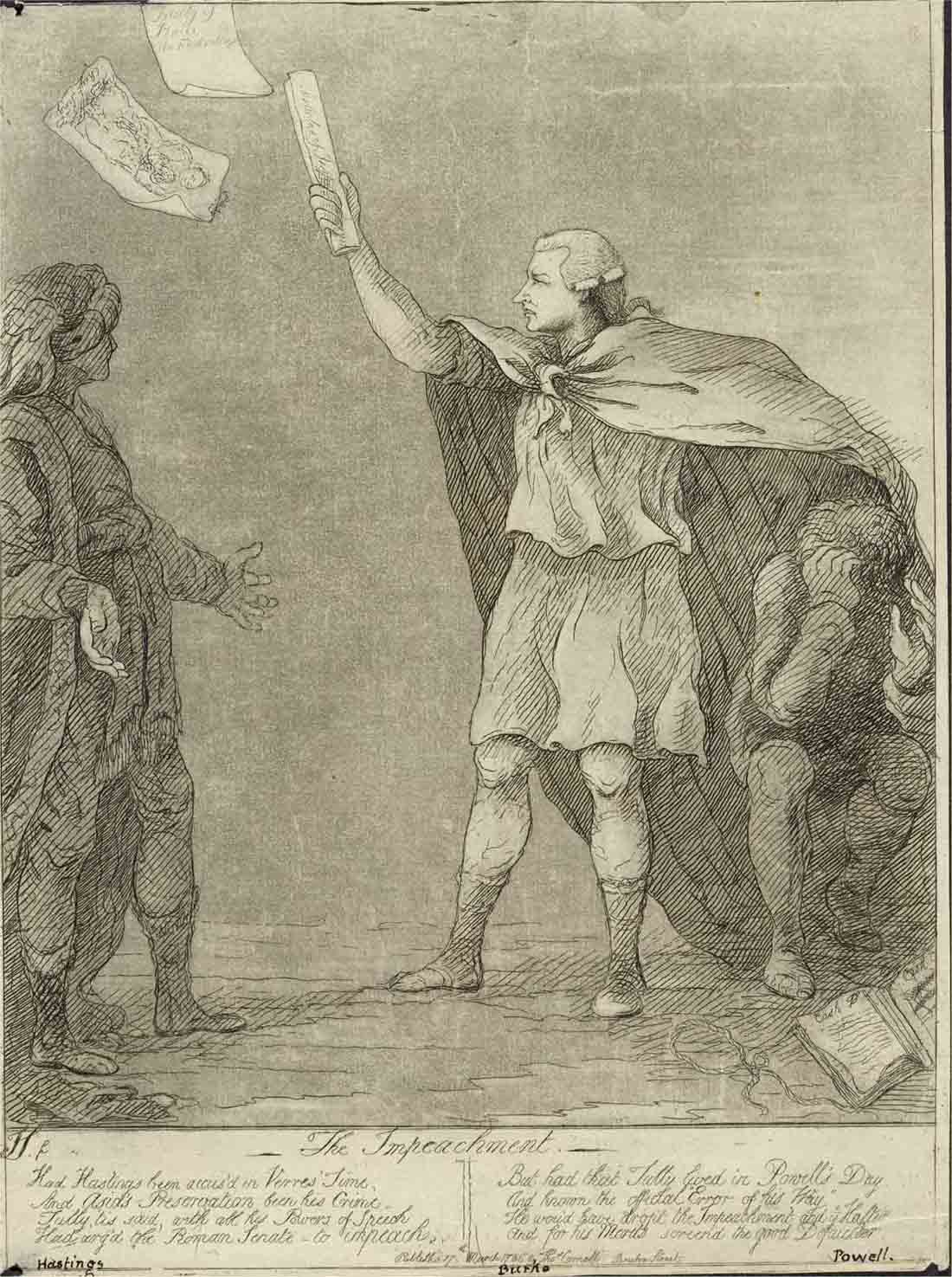
Fig. 5.1 James Sayers, The Impeachment, 17 March 1786. BM 1868,0808.5488. © Trustees of the British Museum.
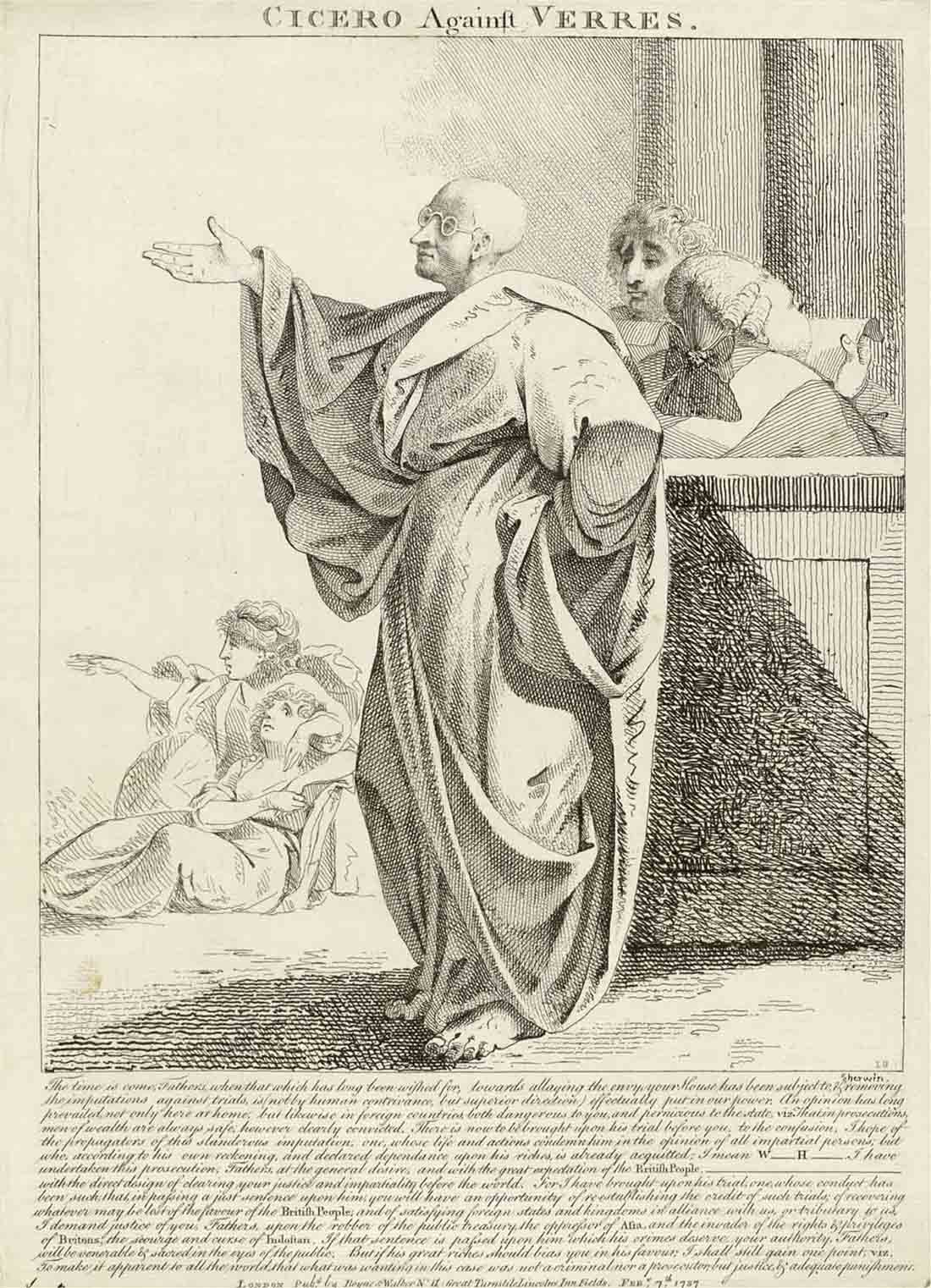
Fig. 5.2 John Boyne, Cicero against Verres, 7 February 1787. BM 7138. © Trustees of the British Museum.
Had Hastings been accus’d in Verres’ Time,
And Asia’s Preservation been his Crime,
Tully, ’tis said, with all his Powers of Speech
Had urg’d the Roman Senate – to impeach,
But had that Tully lived in Powell’s Day,
And known the official ‘Error of his Way’
He wou’d have drop’t [sic] the Impeachment and ye Halter
And for his Merits screen’d the good Defaulter.
Burke is also dressed as a Roman in Boyne’s cartoon. Despite wearing a voluminous toga, the Anglo-Irish orator is clearly recognizable by his characteristic spectacles. As the trial dragged on, these spectacles became a recurring trope in the satirical prints, and – as Daniel O’Quinn contends – ‘were deployed in an increasingly complex fashion’.56 Boyne represents Burke at the centre of the scene, in the act of declaiming a speech according to classical rhetorical prescriptions: his right arm is emphatically extended in the air, while his left hand rests on his hip.57 This grave posture is somewhat spoilt by Burke’s bald head and exaggeratedly big bare feet. Behind the orator, the heads and shoulders of Fox and North – who had forged an alliance in 1783 – are visible on the right-hand side, above a partition.58 Fox looks on with melancholy and stares out to where Burke’s audience is presumably sitting, while North, indifferent to the scene, reads a paper short-sightedly. On the left-hand side, two women are seated on the ground: they embody Britannia with a shield and, presumably, India. The former embraces and comforts the latter, who languishes exhausted, her head reclined on Britannia’s shoulder. The image also reproduces Burke’s speech:
The time is come, Fathers, when that which has long been wished for, towards allaying the envy, your House has been subject to, & removing the imputations against trials, is (not by human contrivance, but superior direction) effectually put in our power. An opinion has long prevailed, not only here at home, but likewise in foreign countries, both dangerous to you, and pernicious to the state, viz. That, in prosecutions, men of wealth are always safe, however clearly convicted. There is now to be brought upon his trial before you, to the confusion, I hope of the propagators of this slanderous imputation, one, whose life and actions condemn him in the opinion of all impartial persons; but who, according to his own reckoning, and declared dependence upon his riches, is already acquitted; I mean W__H__. I have undertaken this prosecution, Fathers, at the general desire, and with the great expectation of the British People, with the direct design of clearing your justice and impartiality before the world. For I have brought upon his trial, one, whose conduct has been such, that, in passing a just sentence upon him, you will have an opportunity of re-establishing the credit of such trials; of recovering whatever may be lost of the favour of the British People; and of satisfying foreign states and kingdoms in alliance with us, or tributary to us. I demand justice of you, Fathers, upon the robber of the public treasury, the oppressor of Asia, and the invader of the rights & privileges of Britons, the scourge and curse of Indostan. If that sentence is passed upon him which his crimes deserve, your authority, Fathers, will be venerable & sacred in the eyes of the public. But if his great riches should bias you in his favour, I shall still gain one point, viz. To make it apparent to all the world, that what was wanting in this case was not a criminal, nor a prosecutor; but justice, & adequate punishment.
In light of what we have seen so far, it comes as no surprise that this oration is an English translation of the beginning of Cicero’s Verrines, namely Verr. I.1–3. Apart from a few ironic alterations, this is the same version published by the Hicky’s Bengal Gazette (21 April–28 April 1781). As far as I have been able to ascertain, this anonymous translation was enormously successful in the last two decades of the eighteenth century. One finds it, for example, in British – and even American – schoolbooks of rhetoric, among instances of exemplary declamations.59 Interestingly enough, Boyne’s variations of the original text are emphasized by means of different types. Thus, Caius Verres turns into ‘W_ H_’; ‘Roman people’ and ‘Romans’ are replaced by ‘British people’ and ‘Britons’; while ‘Asia Minor and Pamphylia’ are substituted by ‘Asia’, and ‘Sicily’ by ‘Indostan’.
It is clear that, from the earliest stages of Burke’s campaign against Hastings, newspaper reporters, as well as caricaturists, explored and described the cause célèbre in terms of a re-enactment of the proceedings against Verres. Contemporary English-language papers published in India attest to the tendency to portray the former Governor-General of Bengal either as a latter-day Verres or, as with the speeches of MPs supportive of Hastings, as a celebrated statesman or general from Graeco-Roman antiquity. In parallel with the equation of Hastings–Verres, Burke was described as a British Cicero. In one example of this characterization, a certain Aristophanes referred to Burke with the pseudonym Tullius Indianus, combining classical antiquity with contemporary politics. An examination of the London press similarly shows that from 1786 Burke and Hastings were compared to Cicero and Verres. Beginning with a series of articles published in the Public Advertiser a few days before the opening of the trial, by early 1788 this parallel was widely explored amongst the reading nation and had become the subject of satirical cartoons. As we saw in Chapter 1, ancient Greek and Roman characters were not empty names from an alien and distant past, but rather, figures of real relevance who pervaded the discourse surrounding current political affairs.