
CHAPTER 7
FIVE YEARS AFTER communism collapsed in Poland, the man who had picked up the pieces wanted the world to know how he had done it. Leszek Balcerowicz had been finance minister in Solidarity’s first postcommunist government and authored the eponymous Balcerowicz Plan that had employed “shock therapy” to transform Poland’s communist command economy into a market economy in late 1989 and 1990. Shock therapy had required the imposition of all the calling cards of the politics of breaking promises—extreme price increases, budget cuts, interest rate hikes, bankruptcies, and unemployment. Many policy makers, both within and outside the Polish government, had feared that people would openly revolt against the barrage of economic discipline, but they had not. Though there had been pockets of resistance, the Poles had largely accepted the Solidarity government’s rude introduction of the global capitalist economy with stoic acquiescence.
In a 1994 article, Balcerowicz set out to explain why. The key to his success, he wrote, had been the “period of extraordinary politics” that had followed the collapse of communism. In such periods of history, “epochal political change” creates “a special state of mass psychology” within a citizenry that heightens its “readiness to accept radical economic measures.” During such moments, “both leaders and ordinary citizens feel a stronger-than-normal tendency to think and act in terms of the common good.” This tendency, in turn, creates “political opportunities” for a government to impose measures that would otherwise be too unpopular. Periods of extraordinary politics, in short, gave governments a unique amount of “political capital” that they could use to implement the politics of breaking promises.
The connection between extraordinary politics and economic discipline was strong enough that Balcerowicz felt comfortable providing a general model of their relationship (Figure 7.1). The key variable, r, defined as society’s “level of readiness to accept radical economic measures,” decreased dramatically once politics returned to “normal,” so it was important to use the period of extraordinary politics to enact unpopular policies. The first postcommunist Solidarity government had done this, and as a result, it had successfully imposed the politics of breaking promises without inciting popular backlash.1
The last of Poland’s communists had not been so lucky. The political order over which they presided was anything but extraordinary, and whatever political capital they once had with the population had been frittered away in the cycles of social unrest and state repression that had defined the 1970s and early 1980s. However, the communists’ challenge was the same as Balcerowicz’s. They had spent their final days trying to answer the same questions as those posed to the first Solidarity government. How could they get the Polish people to accept radical and unpopular economic measures? How could they impose the politics of breaking promises? Their answer was also a period of extraordinary politics: the roundtable agreement of April 1989. The Polish roundtable was the first step in the collapse of communism and the revolutions of 1989, but its original purpose was to provide the communist government with political legitimacy so it could impose the politics of breaking promises.
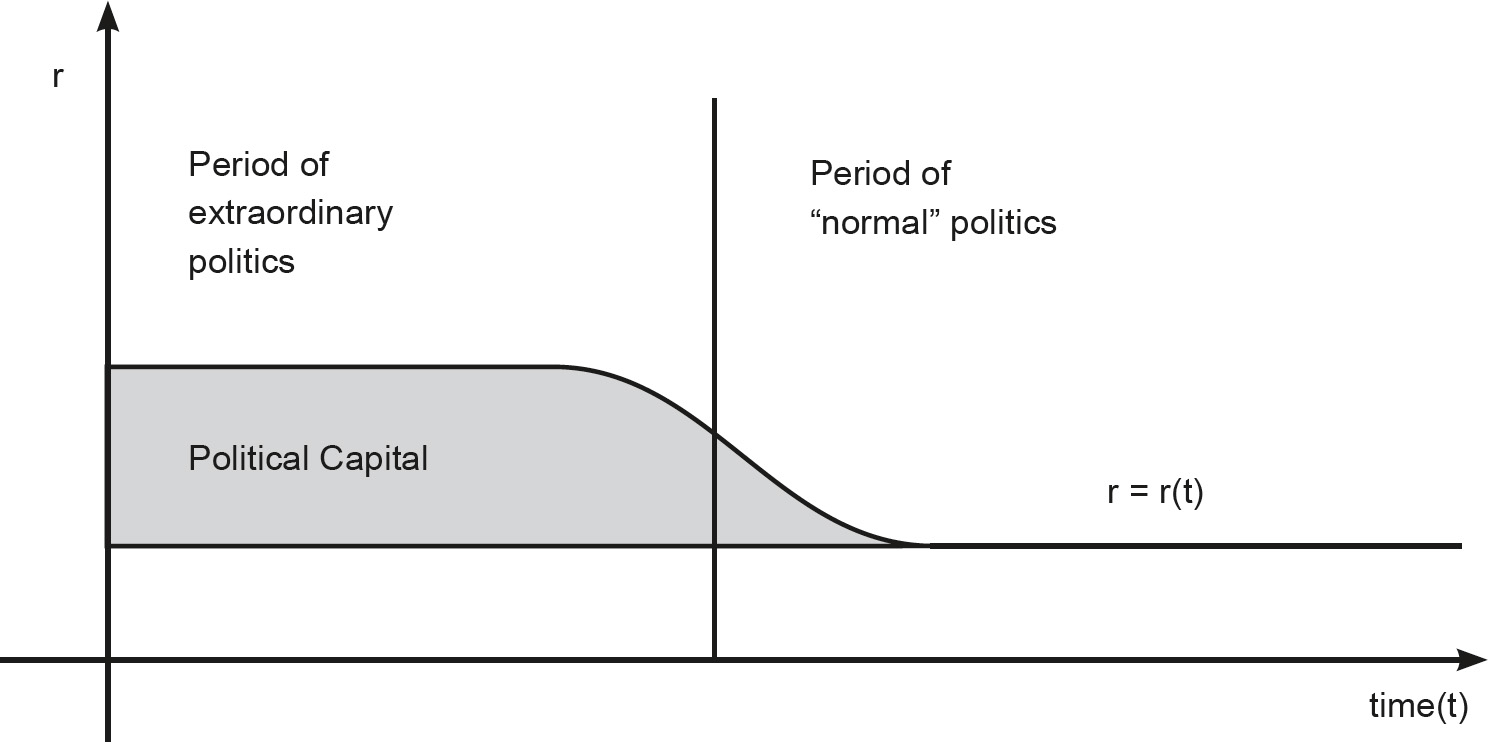
Figure 7.1 The period of extraordinary politics.
Reformatted from Leszek Balcerowicz, “Understanding Postcommunist Transitions,” Journal of Democracy 5, no. 4 (1994): 75–89, fig. 1. © 1994 National Endowment for Democracy and the Johns Hopkins University Press. Reprinted with permission of Johns Hopkins University Press.
By the late 1980s, the Polish state owed its international creditors $39 billion and sat at the mercy of Western governments, banks, and international institutions. These Western entities wielded what we might call “the power of omission”: they withheld the considerable resources of Western governments and global financial markets until political and economic conditions on the ground in Poland conformed to their economic and political demands. Capitalist banks and international institutions, led by the International Monetary Fund (IMF), demanded that the communist government impose a capitalist perestroika on Polish society. Western governments, led by the United States, demanded that the government undertake such a perestroika without resorting to violence or a renewal of martial law. The West demanded, in short, that promises be broken in Poland, and broken peacefully.
After years of unrest triggered by austerity, Polish leader Wojciech Jaruzelski and his leading cadre concluded in the early 1980s that they could meet these demands only if they gained the broad support of Polish society. Beginning in the early days after martial law, they therefore undertook a series of political initiatives aimed at regaining popular support. At first, these were blatantly cosmetic alternations that did little to change the structure of political power. But as the economic crisis worsened throughout the remainder of the decade and the need for popular support grew in equal measure, Jaruzelski took ever more radical steps to legitimize the communists’ rule by engaging the two most popular institutions in Poland: the Catholic Church and, eventually, Solidarity. Like Poland’s Western creditors, the church and Solidarity exerted their own power of omission: they could refuse to endorse any government economic reform proposal that did not also bring real political change to Poland.
The combination of these foreign and domestic pressures eventually led to the roundtable and the collapse of communism in Poland. Scholars have generally shied away from granting economic forces or Western actors any significant role in causing the revolutions of 1989, but this chapter paints a dramatically different picture.2 By forcing Polish leaders to confront the politics of breaking promises, Western officials, particularly at the White House and the IMF in Washington, played a decisive role in ending communism in Poland and, by extension, spurring the revolutions of 1989. Their pursuit of the politics of breaking promises in Poland was not a conscious strategy of regime change, but regime change was its effect. Jaruzelski did not initiate the roundtable process solely to meet Western conditions, but without them, he would not have been forced to break promises and thus would not have been forced to seek the approval of the church, Solidarity, and, ultimately, Polish society.
The Polish revolution of 1989 was therefore the product of a multisided contest among the communist leadership, the Polish people, and Western institutions to determine just how extraordinary Polish politics would have to become for the Polish people to accept economic discipline and for the West to free the country from its financial shackles. In the end, both the people and the West demanded nothing short of the communist state’s full capitulation.

Long before there was any talk of roundtables and democratic elections in Warsaw, Poland’s communist leaders firmly understood that the economy would ultimately determine their political fate. “Three-quarters of Poland’s political problems would disappear,” Mieczysław Rakowski told a visiting British diplomat in 1984, “if Polish living standards of 1979 could be restored.” He continued, “For anyone governing Poland the primary problems [are] economic. All others [are] secondary.”3 Under the cover of martial law, the government had eliminated the worst inflationary vestiges of the 1980–1981 crisis through draconian budget cuts and price increases, and a semblance of economic stability, if not prosperity, returned. But every member of both the government and the opposition understood that real economic growth would only return once the country again had access to Western capital, technology, and raw materials.4
Looking east for help was increasingly not an option. After the declaration of martial law, Moscow announced increased economic support for Jaruzelski to great fanfare, but the reality of its aid turned out to be a meager affair. The Polish Ministry of Foreign Trade concluded in 1982 that the resources the country needed to replace Western imports simply were “not available from other Comecon countries.”5 Jaruzelski continued to lobby Soviet leaders for greater economic aid throughout the early 1980s, but all they offered him was ideological criticism of his handling of Polish society.6
Capitalist banks showed even less interest in supporting Poland than the Kremlin. The Polish government’s 1981 announcement that it would need to reschedule its debt left the banks with a general feeling of “acute suspicion” toward the country’s economic prospects.7 Most of them sought to cut their exposure, write down their Polish loans as losses, and run for more profitable hills elsewhere in the global economy. As an American banker put it in 1985, the banks’ strategy for Poland focused “on draining the country of as much cash as possible.”8 This strategy resulted in four rescheduling agreements between the banks and the Polish government from 1982 to 1985. In each agreement, the banks rescheduled 95 percent of the loan principle but received the interest payments from the government on time.9 This arrangement paid off as handsomely for the banks as it did poorly for Poland. Each year, the banks received an annual “take out” of interest payments, but Warsaw fell ever deeper into a debt trap, as each rescheduling agreement simply compounded maturing debt payments into new future obligations.10 Thus, although the country’s debt burden grew from $24 billion to $39 billion from 1981 to 1989, Poland received virtually no new capital from the West during the 1980s.
The Poles’ only hope for regaining the banks’ favor was to come to terms with the International Monetary Fund. As with every other sovereign debtor throughout the global economy in the 1980s, the banks made their reengagement with Warsaw contingent on the Polish government reaching an agreement with the Fund. This left the IMF, and the Western governments that served as its gatekeepers, in an extremely powerful position.
The Reagan administration hoped to use this power to serve both political and economic ends. In the aftermath of martial law, administration officials quickly agreed that vetoing the Poles’ outstanding application to rejoin the Fund would be a cornerstone of their effort to sanction Warsaw. The administration also decided in the early days after martial law that it would pursue three political goals in Poland: the end of martial law, the release of all political prisoners, and the renewal of a national dialogue among the government, the Catholic Church, and Solidarity. Until Jaruzelski took these three steps, the Reagan team committed itself to cementing Warsaw’s quarantine from the international financial system. Through its IMF veto, a suspension of government-sponsored credits across NATO (North Atlantic Treaty Organization), and an indefinite postponement of negotiations to reschedule Poland’s debts to Western governments, Washington ensured that Warsaw would not regain normal relations with the global financial system until it met Western political demands.11
But that was not all. In the midst of the ballooning sovereign debt crisis, meeting political conditionality alone would not be enough. In order to receive debt relief and regain financial market access, the Reagan administration made clear that Poland would also have to meet the Treasury Department’s global standards for dealing with delinquent debtor nations. As National Security Decision Directive 54, the Reagan administration’s policy statement on Eastern Europe, stated, “U.S. policy is to extend debt relief only when it is necessary as a financial measure to ensure repayment and when the debtor country embarks on an economic/financial stabilization program designed to rectify the country’s financial position.” Such economic and financial stabilization programs would be overseen by the IMF, and nations like Poland would not receive easy treatment simply because they might demonstrate domestic political liberalization or independence from Moscow. “Political and security objectives” would be given “due weight” in determining US support for the IMF’s operations in the region, but ultimately economic and financial priorities would be “first among other decision criteria.”12
Therefore, two levels of conditionality were built into the Reagan administration’s Poland policy, and both hinged on the IMF. Washington would first make Poland’s reentry into the Fund contingent on Warsaw meeting political conditions like ending martial law and releasing political prisoners. But the simple act of joining the IMF would not give Warsaw access to the Fund’s resources. For that, the Polish government would have to come to terms with the Fund on a financing agreement, which would require Warsaw to meet the Fund’s strict demands for austerity and structural adjustment.
Administration officials well understood that these two levels of conditionality made the Fund their most important point of leverage over Poland. As one National Security Council (NSC) staffer judged it, IMF membership was the main Western bargaining chip “of active interest to the Poles” because it held out the “promise of hard currency.” The West would therefore be “able to use this to press Poles to reform [their] economy.” And because granting IMF membership would be a “major concession,” the staffer noted, the United States could also “tie political strings” to the lifting of its IMF veto.13 National Security Advisor William Clark very much agreed. “IMF involvement” in Poland, he wrote to Secretary of State George Schultz in spring 1983, could “speed liberalizing reforms with a positive human rights spillover.” The Fund would also have the benefit of “maintain[ing] a neutral character.”14 American officials were under no illusions that the Fund’s work would be quick or easy. But in maintaining Poland’s quarantine from the global financial system, they hoped to alter the calculus of the communist leadership in Warsaw over time.15
There is little evidence this litany of American conditions influenced Jaruzelski’s decision-making in the immediate aftermath of martial law. The Polish government fully partook in the mutual acrimony that defined the Polish-American relationship in the early 1980s, and officials in Warsaw saw little reason to bend to Western pressure while the post–martial law economic reforms successfully stabilized the country.16
Jaruzelski and his leading cadre, however, shared two beliefs in common with policy makers in Washington: they would eventually have to reconcile with the Polish population to find new sources of legitimacy after martial law, and they would slowly have to introduce market reforms into the economy. The specific types of reconciliation, legitimation, and market reforms Polish officials had in mind in the early 1980s diverged widely from Washington’s vision. They firmly believed, for instance, that they would never again negotiate with Solidarity, and they were convinced they could not impose the most extreme forms of IMF-mandated structural adjustment. But they also knew they could not rule the country forever under the iron fist of martial law and the stalled economic system of central planning. The key, then, was to find the tipping point in political and economic reform at which both Western governments and the Polish population would forgive them for martial law and return to business as usual. Through the remainder of the decade, Polish leaders undertook increasingly bold political and economic initiatives in search of this tipping point.
The first efforts in this direction were transparently self-serving and fooled no one into thinking the Polish United Workers’ Party (PZPR) was really interested in reform. In the months following martial law, the party announced the creation of the Patriotic Movement of National Rebirth (PRON), an organization composed of minor political parties in parliament meant to create “the appearance of a ruling coalition.”17 After the government officially declared Solidarity illegal in October 1982, it eventually announced the creation of a network of state-sponsored trade unions—the All-Poland Alliance of Trade Unions (OPZZ)—to create a similar appearance of independent workers’ representation in the halls of power. In November 1982, Jaruzelski met with the leader of the Polish Catholic Church, Cardinal Józef Glemp, and the two men agreed on an informal quid pro quo: the government would allow the Polish pope, John Paul II, to visit his homeland in 1983 if the church would criticize Western sanctions and publicly encourage the Polish people to refrain from striking. Both sides held up their end of the bargain, and the papal visit was set for June 1983. Then, as 1982 drew to a close, the government took one last step toward a return to normalcy by suspending, if not fully repealing, martial law.
These initial steps toward reconciliation set the stage for a period of bargaining among the government, the church, and the West over an exchange of steps toward limited political reconciliation for relief from Western sanctions. After the papal visit went off without a hitch, the government fully repealed martial law in July. Under pressure from its European allies to restart debt-rescheduling negotiations, the Reagan administration announced that it would rejoin the negotiations if the Polish government moved toward freeing all remaining political prisoners. The church pressed the same demand domestically, and the government, eager to regain society’s trust, found itself “desperately anxious to solve the prisoner problem” by early 1984.18
Jaruzelski wanted sanctions relief in return, however. So, throughout 1984, the US and Polish governments brokered a series of deals in which all remaining political prisoners were freed in exchange for an end to many American sanctions and, most importantly, a lifting of the American IMF veto.19 Many Solidarity dissidents were subsequently rearrested, but at the dawn of 1985, the first stage of American conditionality had momentarily been met. Due to a confluence of domestic and international pressures, Jaruzelski had lifted martial law and freed all political prisoners, and in return, the Reagan administration had agreed to open the gates to the IMF. Now the real work of adjusting Polish society to meet the demands of global capital would begin.
When Poland officially rejoined the IMF in June 1986, it did not take long for observers, both within and outside the country, to note that Warsaw and the Fund were now “on a collision course.”20 The source of the collision lay in the fundamentally different directions the IMF and the Polish government wanted capital to flow across Poland’s borders. As in every debtor country around the world, the IMF’s foundational goal in Poland was to turn the country into a net exporter of capital—or, in economic terms, to produce a Polish current account surplus. To produce such a surplus, the Fund aimed to push the Polish government to implement an austerity and structural adjustment program. In a country where austerity had provoked political crises in 1970, 1976, and 1980, this portended future political upheaval. Therefore, the Fund’s economic demands confronted Poland’s communist leadership with a political challenge: in order to come to terms with the Fund, they would also have to come to terms with the Polish population. What those terms would be defined Polish history from 1986 to 1989.
IMF officials took note of the tension between global capital and the Polish working class in the days after Warsaw rejoined the Fund. IMF staffer Hans Schmitt laid out the challenge ahead in stark and prescient terms. For austerity and structural adjustment to be “tenable in Poland,” he wrote in an internal memo, “it must be acceptable both to bankers abroad and labor at home. At the moment the requirements of each seem to be incompatible with one another.” The banks and governments seeking to recoup their loans wanted to establish conditions in Poland that would allow for a sustainable outflow of capital from the country. Labor, seeking to improve its plight after years of economic hardship, wanted capital to flow into the country. Schmitt noted the difference. “Bankers require a surplus on external current account large enough to ensure the progressive repayment of debt, and an adjustment in domestic demand (and in wages) large enough to produce it.” On the other hand, “labor requires a minimum growth in wages (and in domestic demand) and a deficit on external current account large enough to finance any shortfall in GDP to support it.” The IMF, he concluded, “need[s] to find where, if anywhere, the twain can meet.”21
The Fund was well acquainted with the interests of Polish labor because it was in direct communication with Solidarity. Most labor unions around the world loathed the IMF and the structural adjustment policies it imposed on its members. Solidarity shared in this opposition. The union wrote to the Fund in 1985 that it would “come out strongly against measures leading to the substantial reduction of consumption, increases of prices, freezes on real wages or deterioration in social care.”22 But that did not mean it opposed the IMF altogether. On the contrary, Solidarity declared itself “probably the only labor union in the world” that welcomed its nation’s membership in the IMF because it saw the power that Fund conditionality might have to change the political status quo in Warsaw.23 Therefore, despite their misgivings about the IMF’s economic policies, Solidarity’s leaders ultimately believed their long-term goals aligned well with the Fund. “Solidarity would like to see Poland in the IMF,” the leadership wrote, because “it would be more beneficial for the country to be bound with the West” than with the Communist Bloc.24
Nevertheless, the impasse between labor and capital remained, and observers both within and outside Poland began to conclude that resolving it would require a political solution. Specifically, it would require political legitimacy in Poland. On the eve of their country’s accession to the World Bank and IMF, two Polish financial officials warned their comrades that “the experience of other countries indicates that IMF programs often encounter serious social resistance, which repeatedly led to their discontinuation and a suspension of subsequent loan installments. We must not allow such an eventuality because it would cause another collapse of our position on the international financial market and socio-political repercussions [domestically].” To overcome society’s resistance, the officials recommended that “the arrangements negotiated with the IMF and World Bank should be subject to wide consultation (up to and including a referendum . . . ) in order to build a social consensus around the program.”25
Financial observers in the West very much agreed. Paul McCarthy, an executive at Chemical Bank in New York responsible for relations with the Eastern Bloc, wrote in an article just two months later, “The future actions of Western lenders are interrelated with Poland’s handling of its domestic difficulties. New money will be unlikely until the Polish government can assure political stability. Political stability cannot be guaranteed unless the government can fundamentally overhaul the economy. . . . The economy cannot be structurally reformed without the support of the Polish people and workforce.” This was where the IMF could play the vital role of catalyst. “The IMF has a major bargaining chip,” McCarthy wrote, “in that it controls the single commodity that Poland currently needs the most and is least able to attain. The Fund can provide substantial credits, ranging to $700 million annually.” Moreover, “IMF loans could begin attracting new credits from banks and governments.” But Western creditors would only change their view once Jaruzelski had gained the popular legitimacy required for austerity. “If Jaruzelski seeks reform without enfranchising the major constituencies, he risks failure,” McCarthy concluded. “Meaningful reform will require the support of the Polish people, as further substantial cuts in living standards would be inevitable.”26
The Fund itself began to press this point in their meetings with Polish officials. In February 1987, the managing director, Jacque de Larosière, sat down to lunch with the president of the National Bank of Poland, Wladysław Baka. Baka resisted the Fund’s calls for austerity on account of “major political and social obstacles.” De Larosière admitted the government was in a tough position but maintained that both Western governments and banks favored austerity, and thus it needed to be “implemented boldly (preferably in one stroke)” in order to convince them “that policies in Poland had changed radically for the better.” This would not be easy, and it needed to be “acceptable to the population.” Thus, “some preparation of public opinion would be necessary.”27
Using political maneuvers to prepare public opinion for the hardships of economic reform was not a novel idea for Jaruzelski. As we have seen, he emerged from martial law ready to use token acts of political liberalization to rebuild the government’s domestic legitimacy and international standing. By 1986, the question was how far he and the communist leadership were willing to go in this direction. Gorbachev’s rise in the Soviet Union widened the Polish communists’ political room for maneuver, but it did not immediately affect their strategy toward the opposition. Throughout 1985 and the first half of 1986, the government rearrested countless Solidarity leaders. Both the Catholic Church at home and Western governments abroad did not look kindly on this regression to repression, so alongside the prospect of future IMF-mandated austerity, the government faced renewed calls to free all political prisoners by the summer of 1986.28
Polish leaders responded to these pressures by opening a new phase in their search for the tipping point at which Polish society and Western governments would restore their domestic legitimacy and international creditworthiness. In the summer of 1986, the government announced a “second stage” of economic reform that was meant to deepen the moves toward enterprise independence and individual initiative that had first been launched in 1982. On paper, these reforms aligned with the IMF’s vision for the country: they aimed to achieve “market equilibrium” through price increases, subsidy reductions, tighter credit policies, liquidation of inefficient enterprises, and the reduction of price and foreign exchange controls. Fund officials reported that they had a “good deal of sympathy” with the goals of these reforms, but they criticized the government’s plans for making “virtually no mention” of the Fund’s top priority, “balance of payment objectives.”29 Domestic reform was all well and good, in other words, but if it did not produce a sustainable outflow of capital from Poland, the Fund was not really interested in supporting it. To produce such an outflow, Polish officials knew they would have to step up their austerity efforts. They assured the Fund that they would try to reduce subsidies on things like “coal, milk, and foreign trade,” but they feared the “social tensions in response to the associated price increases.”30
To head off these potential tensions, the leadership paired its “second stage” of economic reforms with a new set of political innovations. Most prominent of all, they announced a new general amnesty in September 1986 that set all the nation’s political prisoners free. In the Politburo document detailing the reasons for its decision, the leadership recognized that the issue of political prisoners was preventing Poland from sharing in the fruits of Gorbachev’s rapprochement with the United States and Europe. “The improvement of relations between the two superpowers . . . has led to a significant increase in East-West dialogue,” officials wrote. “However, Poland was not included in this process. The West applied tactics against our country, which make progress in normalizing relations with Poland dependent on assessments of the development of our [internal] situation.” Keeping political prisoners locked up would provide the West with further reason to “continue restrictions and hinder the development of economic and diplomatic relations.”31 These were restrictions the leadership could ill afford, so in September 1986, they let all remaining political prisoners walk free.
To build on the amnesty’s momentum, the government also augmented the transparently self-serving Patriotic Movement of National Rebirth with a new Consultative Council. Meant to be composed of credible independent voices in Polish public life ranging from Catholic intellectuals to academics to moderate opposition figures, the Consultative Council was charged with advising Jaruzelski on ways to “increase trust” in society, build “social agreement,” establish “conditions for economic progress,” and develop “current and forward-looking social policy.”32 Like the “second stage” economic reforms, however, the council failed to appease its main audience, Polish society, or divide its main target, Solidarity. Lech Wałęsa quickly denounced it on the grounds that dialogue needed to “be institutionalized, but not in sham institutions.”33 Shunned by Solidarity and meekly supported by the church, the Consultative Council opened in December 1986 to little public approbation.
Though these domestic political initiatives were not enough to sway domestic public opinion, they were enough to win the repeal of the last American sanctions still in effect. In January 1987, US deputy secretary of state John Whitehead traveled to Warsaw for the highest-level bilateral talks since martial law. The following month, President Reagan officially restored Poland’s most favored nation (MFN) trading status with the United States and reopened Poland’s access to US government-sponsored credits. Having long railed against the all-powerful evil of American sanctions, Jaruzelski believed these steps would at last reopen his nation’s access to global financial markets.
What he discovered instead was the harsh reality of life in the privatized Cold War. The mere fact that the US government no longer officially discouraged economic ties to Poland did not automatically mean global capital holders would restore their former friendly ties with Warsaw. For that to happen, the government would have to come to terms with the IMF, impose domestic austerity, and produce a sustainable outflow of capital from the country. Slowly, Jaruzelski began to understand these new ways of the world. “You could say that the sanctions were repealed within the last year,” he told East German leader Erich Honecker in September 1987. “Yes and no.” The restoration of policies like MFN was fine, he said, but it only boosted Polish export income by about $20 million. Such a sum “requires no comment,” he told Honecker. “This is nothing.” Similarly, the restoration of Poland’s political contacts with Western governments was “important.” But diplomatic relations alone did not “put bread on the table.” Only the “ban on lending” really mattered, and even though the ban had been formally repealed, “in practice the blockade continues.” As long as Poland’s debt to Western governments remained in default and the IMF continued to withhold its endorsement of Poland’s economic reforms, capitalist banks and Western governments would not reopen their pocketbooks. Even though the United States had formally lifted all its sanctions, Jaruzelski concluded, “as before, economic warfare is being carried out against Poland.”34
In Moscow, the general’s imperial patrons could see very clearly what was happening to their ally but felt powerless to stop it. The size of Poland’s debt was a key measure of Soviet impotence. Anatolii Cherniaev, Gorbachev’s foreign policy aide, recalled his boss complaining, “Poland is crawling away from us, and we in Moscow are doing nothing. And what can we do? Poland has a $56 billion [sic] debt. Can we take Poland on our balance sheet in our current economic situation? No. And if we cannot—then we have no influence.”35
Spurned by the Kremlin and rejected by the Polish working class, Jaruzelski had little choice but to expand his search for political legitimacy in the service of economic reform so that he could come to terms with the IMF. In July 1987, he gave an interview to the Wall Street Journal in which he discussed the challenges facing his country. “As we’ve learned in the past,” he began, “even the most beautiful and well-constructed decisions and intentions, if they do not command the support of society, they fail.” Therefore, he announced that he was considering calling a national referendum on “painful but imperative” steps aimed at bringing the nation into “economic equilibrium.”36 The general specifically intended the interview to signal to the IMF that public opinion preparations were underway. In a meeting with Fund representatives the day after the interview appeared, a Polish official said the referendum would “muster support for economic reform and austerity measures” and that the timing of the interview “was influenced, inter alia, by hopes of a program with the Fund.”37
There were pressing domestic reasons to propose the referendum as well. Like Rakowski earlier in the decade, Jaruzelski believed in 1987 that the party’s domestic political standing was primarily a function of the country’s economic performance. “If it was possible to improve . . . the economic situation, above all, the material situation of workers, then there would be no problem,” Jaruzelski told Honecker.38 By 1987, however, the patina of progress in the economy that had followed martial law was fading. An internal government report from August 1987 warned, “Generally, anxiety is rising due to the prolonged economic crisis.” Such a situation provided Solidarity with its only hope of reemerging as a potent political force. From the union’s perspective, “each action by the authorities in the economic sphere will be favorable to the opposition . . . a full implementation of reform . . . will result in a temporary decline in purchasing power, layoffs, etc.” Thus, “the adversary has come to the conclusion that it does not have to bother much—it is enough to sustain a mood of justified anger and wait and join, at the right moment, the eruption of dissatisfaction, as in 1980.”39 Best, then, to head off the dissatisfaction by legitimizing the economic reforms.
The arrival of US vice president George H. W. Bush for an official visit to Warsaw in September 1987 reinforced the connection between economic reform and political legitimacy. In his meetings with Bush, Jaruzelski repeatedly returned to the importance of gaining debt relief, reaching an agreement with the IMF, and receiving new hard currency credits from the West.40 In return, Bush reminded his host that there were still two prongs to American conditionality—politics and economics. The Poles would have to come to terms with the IMF to reopen access to international financial markets, but only “steps toward democratization would yield a positive U.S. [government] response.”41 The Poles would, in short, have to impose austerity and reach the national reconciliation the Reagan administration had demanded since martial law.
Jaruzelski’s referendum was officially set for the end of November. By the day of its arrival, Western political and financial pressure had provided the Polish state with ample reason to seek both popular legitimacy and a mandate for austerity. Both priorities were directly reflected in the referendum’s two questions to the Polish people. Were they in favor of introducing a “Polish model of deep democratization of political life with the goal of . . . increasing citizens’ participation in governing the country?” And were they in favor of a full government program for “radical” economic recovery, “knowing that this will require a difficult 2–3 year period of rapid changes?”42
Officially, Poles said they were not in favor of the government’s plans. Because the government set the threshold for victory at a majority of all possible voters, and many voters stayed home, the referendum failed even though a majority of those who did vote gave their assent. Jaruzelski emerged disappointed but undeterred. He told the Central Committee and the press that the referendum result did not indicate the population was against reform. Rather, it simply signaled that “a significant and important part of the society” had “doubts and fears” about the pace of change. Despite these misgivings, reforms were “a fact of life” that could not be avoided, he said. Thus, instead of “a one-stroke radical restructuring,” reform would be carried out over three years, price increases would be tempered, and the official trade union, the OPZZ, would be allowed to negotiate a wage increase for its workers.43 It was not long before Polish wages and Polish prices were racing each other into the stratosphere.
This set the stage for the revolutionary year of 1988. On February 1, food, alcohol, and cigarette prices increased by an average of 40 percent, gasoline prices increased 60 percent, and transportation and rent prices were substantially increased.44 Because the state unions were allowed to negotiate a compensatory wage increase, the higher prices did not so much impose austerity as set off an inflationary spiral. Ever mindful of the foundational connection between their economic and political fate, Polish leaders immediately understood that this was a recipe for political turmoil. In March 1988, researchers in the Central Committee produced a remarkably detailed and prescient investigation of the burgeoning relationship between economic crisis and political upheaval. They began their analysis by presenting data that clearly demonstrated that the nature of the communist government’s problem with the Polish population was economic rather than political (see Table 7.1).
Table 7.1: Polish public opinion research.
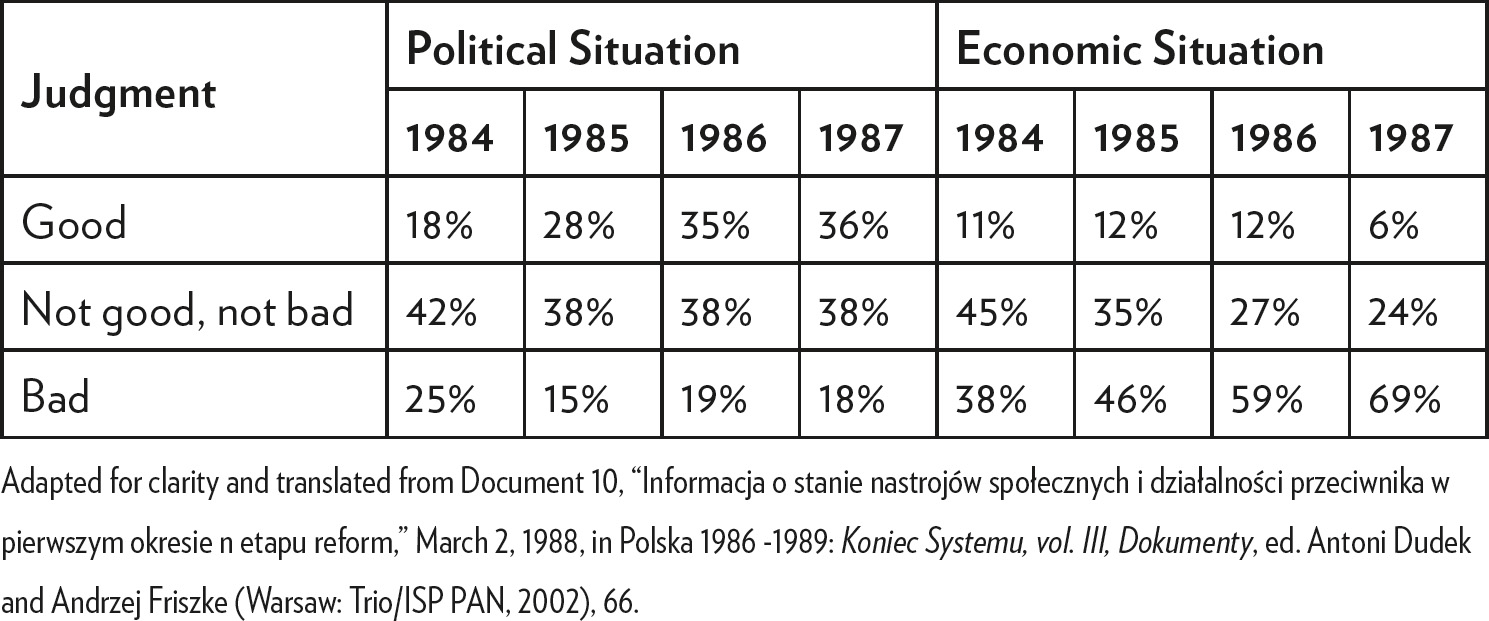
In such an environment of economic pessimism, Solidarity posed a very particular kind of threat to the communist system. Because Poles were generally satisfied with the country’s political situation, the researchers concluded the union was “not able to lead an effective fight on the level of politics and political demands.” But, they hastened to add, “the question arises whether the socio-economic situation, affecting the standard of living of the working people, open such opportunities to it [Solidarity]? No doubt such possibilities exist.” Solidarity could “realistically strengthen to dangerous proportions if they are able to control the existing dissatisfaction of various groups with their economic situation.”45 The union’s leaders shared the Central Committee’s belief that their power ultimately derived from the social costs of economic reform. In February 1988, Solidarity leader Bronisław Geremek proposed in an interview that the government enter into an “anti-crisis pact” with Solidarity, the Catholic Church, and other institutions that maintained society’s trust. He framed the necessity of the pact in economic terms. “Without authentic social forces, a breakthrough cannot be made in the economic situation of the country,” he told the magazine.46 Both sides—the communist leadership and Solidarity—therefore shared the same understanding of the situation: economic reform would bring significant social costs, require domestic political legitimacy, and empower Solidarity.
In the face of the burgeoning turmoil of austerity, Jaruzelski and his advisers began to contemplate opening a new front in their quest to regain domestic legitimacy and international creditworthiness. In a pair of memos drafted in early 1988, a group of senior officials encouraged Jaruzelski to embrace further political liberalization as a means of limiting society’s economic frustration and gaining debt concessions from the West. If the party provided “groups of the moderate opposition with limited joint responsibility” and absorbed “the tamest elements of the moderate opposition within our influence and institutions,” society would become more amenable to economic reform. This included Wałęsa. The advisers proposed the creation of a new Senate chamber of parliament to complement the existing Sejm, and they recommended the Solidarity leader be offered a high-profile, harmless seat in the new chamber. Just to be sure that these cosmetic changes to the country’s political institutions did not alter the actual balance of power, they also proposed the creation of a strong office of the presidency—based on “a French, or even an American model”—to counterbalance the moves toward parliamentary democracy.47 Maximizing the party’s power was, as ever, at the top of their minds.
Indeed, the advisers began to embrace the very logic of extraordinary politics that would come to define Balcerowicz’s plans during the first Solidarity government. They warned Jaruzelski that society would view “the increase in freedoms” associated with democratization “mainly as a mark of the authorities’ weakness and softness.” But that was not their purpose. Democratic reforms were instead meant to give the party a tool it otherwise lacked: the power to carry out unpopular economic reform. “Democratic evolution carried out at an appropriate pace and scope has the power . . . to fulfill the role of a safety valve for [social] moods . . . only when it is a factor accompanying radical, efficient, effective, and resolute actions in the economic sphere. Otherwise, it will be one of the drivers of the crisis.”48 The party would do well, in other words, to use the honeymoon period of political reform to implement the most socially disruptive parts of its economic agenda.
The party would also do well, the advisers told Jaruzelski, to use any moment of domestic political progress to demand debt relief from the West. “Before this whole package of changes is revealed . . . , confidential talks in Washington, and perhaps also the major capitals of Western Europe and the Vatican, seem necessary,” they wrote. “The whole package (together with Wałęsa) should be put on the table, and there should be at least tacit approval for the suspension of Polish foreign currency payment obligations.” There should also be, they concluded, an improvement in “our credit and other negotiations regarding economic cooperation with the West.”49
As the country’s streets and factories remained at peace in the early months of 1988, Jaruzelski did not yet see a need to embrace the risky strategy of political liberalization. Only the reality of social unrest could shift his thinking, and in April 1988, that reality at last arrived. Strikes ripped through the country as workers sought to keep their wages in line with prices. Generally, the strikes were spontaneous acts of workers hoping to defend their economic interests, but as predicted, Solidarity used the strikes to strengthen its position, and some workers eventually called for the union’s reinstatement.50 The government used a combination of bribery and repression to silence the wave of strikes by early May, but the economic damage had been done. By June, prices and wages were expected to rise 55 percent and 60 percent, respectively, for the year. Far from declining, as the government hoped and the IMF demanded, the real wage of Polish workers was rising by about 5 percent.51 The conflict between capital and labor IMF officials had anticipated when Poland joined the Fund in 1986 was now fully in motion, and initially, Polish workers maintained the upper hand.
Politically, the news was even worse. Just as they had predicted early in the year, government officials concluded after the strike that Solidarity was “using the public dissatisfaction with the material situation and the poor prospects for its imminent improvement to open a political crisis in Poland.”52 This made austerity very dangerous, as the head of the state-sponsored unions, Alfred Miodowicz, warned Jaruzelski. “It is risky, both from a political and economic point of view,” he wrote on May 3, “to continue economic policies resulting in a gradual reduction of real income in the socialist economy.”53
It was indeed a risk, but because of the country’s international financial straitjacket, it was a risk Jaruzelski needed to take. The IMF was disappointed to see wages rising rapidly and outpacing the growth in prices. This was precisely the opposite of the austerity policies that would produce a sustained outflow of capital from Poland. So, over the summer of 1988, Fund officials changed their tune. Instead of simply encouraging the government to “prepare public opinion,” they started to demand the government build a “social consensus” around reform. On June 27, 1988, the Fund managing director, Michel Camdessus, suggested to the visiting Polish deputy prime minister, Zdzisław Sadowski, that “increased popular participation in political decision-making might . . . reconcile the population to the sacrifices required for economic stabilization.”54
This encouragement only served to reinforce many Polish leaders’ thinking about how to overcome society’s resistance to broken promises. As Jaruzelski later recalled, “I believe that at that time [the late 1980s] I understood that one can undertake radical reforms and impose unpopular decisions only under two conditions: in an authentic, well-established democracy or in a totalitarian or at least repressive state. We were neither one nor the other.”55 In the spring of 1988, the leadership seesawed between plans to become either one. Jaruzelski’s trusted advisor, fellow military general, and minister of the interior, Czesław Kiszczak, twice formulated plans to implement a state of emergency.56 At the same time, plans to implement some form of limited democratic system gathered pace. In the aftermath of the April strikes, a team of Central Committee experts encouraged the party to appoint a new government “based on the formula of broad national consensus” that would open a “dialogue with all the constructive forces” in society. Such a government was necessary because “the second stage of the reform, which requires social sacrifices and will create social problems . . . , requires much broader public support for the leadership than currently available.”57
In the aftermath of the April strikes, Jaruzelski was willing to countenance these calls to build a government of social consensus and national reconciliation, but he remained adamantly opposed to relegalizing Solidarity. This left him in search of a different partner that maintained the trust of society, and the Catholic Church quickly became his preferred choice. Throughout the summer of 1988, Jaruzelski’s advisers tried to garner the church’s support for plans to establish a new Christian Democratic Party that could act as a force of loyal opposition to the Communist Party’s leadership. Wałęsa, they said, could even be made chairman of the new Senate chamber actively under consideration. As long as the church would endorse an arrangement that precluded the reemergence of Solidarity, the communist leadership made clear that it was ready to cut a deal.58
The communists’ offer put the church in an extremely powerful position. The fate of both the PZPR and Solidarity now lay in its hands. If church leaders endorsed the government’s plans to introduce political pluralism without Solidarity, the union likely would have struggled to continue its fledgling resurgence, and the country would have been set on very different path from the one it ended up taking in 1989. If the church withheld its endorsement, however, the government would have little choice but to continue its search for domestic legitimacy by negotiating directly with Solidarity. Therefore, like Western banks and governments, the church possessed its own power of omission: it could withhold its blessing from the communist leadership until their plans conformed to the church’s demands. The question in the summer of 1988 was whether the church would stop short of using this power to force the communists to negotiate directly with Solidarity.
The Polish people provided the answer. As the church and state contemplated their arranged marriage, a new wave of strikes broke out in August. Workers across the country went on strike for better wages and the reinstatement of Solidarity. The new wave of working-class revolt made the church’s decision much easier and the communists’ predicament much harder. On August 20, the church’s representative, Andrzej Stelmachowski, told his communist interlocutors that the church would only help end the strikes once the party had announced its intention to begin talks with Wałęsa about trade union pluralism.59 If the party wanted to renew its legitimacy, it would have to confront its opposition directly.
As the church tightened the screws on the PZPR, the Soviets continued to loosen theirs. In July 1988, Gorbachev arrived in Poland for a meeting of Warsaw Pact leaders. In a speech to the Polish leadership, the Soviet general secretary embraced what he called “socialist pluralism” in relations between socialist countries. In a conversation with Rakowski in early August, one of Gorbachev’s top advisors, Georgy Shakhnazarov, made the meaning of this slogan more concrete. If it came to a situation like the Polish Crisis of the early 1980s, Shakhnazarov said, “we . . . would not intervene.” Rakowski asked what would happen if Solidarity took power. Shakhnazarov stated, “Well, it [Poland] would probably take on a status close to Finlandization. The USSR would have to accept that.”60
These signals of acquiescence from the East directly affected the communist leadership’s domestic thinking in Poland. Jaruzelski’s advisers wrote to him on August 10. “At the moment,” they wrote, the Polish leadership’s only asset was “Soviet support.” This would “weaken, or even disappear,” they concluded, “as soon as the ineffectiveness of our actions [in Poland] becomes apparent.” Faced with the loss of Soviet support and the challenge of austerity, the advisors felt the PZPR had no choice but to share power with the opposition as quickly as possible. This should happen “early enough to be able to secure the dominant position of the Polish United Workers’ Party in the conditions of a successful and transformative division of power.”61 Sharing power today in order to maximize the party’s power tomorrow: this was the hallmark of the politics of breaking promises in the Eastern Bloc. By August 1988, its logic had become inescapable for the communist leadership in Warsaw, and Jaruzelski was ready to embrace it.
On August 31, 1988, the eighth anniversary of the Gdańsk Accords that had brought Solidarity into legal existence, Poland’s ruling and working classes found themselves face to face once again. Minister of the Interior Czesław Kiszczak sat down with Wałęsa and invited the Solidarity leader to take part in negotiations about launching a roundtable. At the two sides’ first official exploratory meeting on September 16 in the Warsaw suburb of Magdalenka, Kiszczak made the party’s reason for exploring a compromise abundantly clear. The roundtable could, he said, “respond to and eventually correct the economic model, which should ensure that reforms are effectively realized, achieve economic equilibrium, and resolve the debt issue. The success of the economic reform program . . . depends upon its understanding and social acceptance.” Wałęsa agreed that was necessary “to save the country from collapse,” but he quickly made his own conditions clear: “union pluralism and the legalization of Solidarity.”62 This was still not something the party was ready to do, so the two sides quickly gridlocked over the nature of Poland’s social and political future.
Like Western institutions and the Catholic Church before it, Solidarity now had an opportunity to exercise its own power of omission. The union would only endorse the government’s economic plans once the Communist Party had met its political conditions and legalized its right to exist. And like Western institutions and the church before it, the question confronting Solidarity’s leaders was whether they would accept anything less than the fullness of their demands before endorsing the party’s program. Over the fall of 1988, it became clear they would not. Like Western institutions and the church, Solidarity, too, would hold the party’s feet to the fire until the communists agreed to all their demands.
At first, this principled obstinance produced few results. Within weeks, the Magdalenka talks broke down over the issue of trade union pluralism, and it appeared the idea of a roundtable was to be short lived. At the end of September, Rakowski assumed the role of prime minister and announced his intention to form a government of national unity by inviting members of the opposition to become government ministers. Hoping to increase pressure on the party to accept Solidarity’s demands, every opposition member turned Rakowski down. Rather than feeling pressure to come to terms with the opposition, however, he proceeded undeterred with the state’s most spectacular move against Solidarity since martial law: on October 31, he closed the Gdańsk Shipyard, the union’s birthplace, on account of unprofitability.63
It was a move laden with intention and significance. Over the course of the 1980s, Rakowski had watched with increasing dismay as successive Polish governments wilted, in his judgment, before the challenge of imposing economic discipline. By 1988, he was the premier advocate within the party apparatus of strengthening and legitimizing the state’s power for the express purpose of breaking promises. “The workers have become our enemies,” he confided to his diary in the midst of the August strikes. “Our ammunition is weak. We tolerate illegal strikes.” The government needed “to get out of trenches” and attack its working-class opposition, he told Jaruzelski two days later.64 The closure of the Gdańsk Shipyard was his bayonet charge against Solidarity. “I have become convinced that the people want democracy, but also want a strong state,” he told Gorbachev in October. It is little wonder, then, that he soon became known in some circles as “the Polish Margaret Thatcher.”65
As in Thatcher’s Britain, unions would play a decisive role in either accepting or resisting the politics of breaking promises. The difference in Poland was that there were two national unions—the legal OPZZ and the illegal Solidarity—vying for the hearts and minds of the working class. By 1988, Alfred Miodowicz, the leader of the OPZZ, could see quite clearly that the party’s twin strategies of imposing austerity and engaging Solidarity would destroy his personal power and harm the very working class that communism professed to protect. He also believed quite firmly that Wałęsa was a simple electrician who had no business leading a national movement. So, in November 1988, he set out to expose the Solidarity leader as a fraud and burnish the party’s working-class credentials by challenging Wałęsa to a live debate on national television. Things did not go as planned. Rather than appearing as an overhyped simpleton, Wałęsa projected the calm self-assurance of a man with truth on his side. “We will not make people happy by force,” Wałęsa told Miodowicz and the country at large. “Give them freedom.”66 In polling taken immediately following the debate, 68.3 percent of Poles saw Wałęsa as the winner, and just 1.3 percent saw him as the loser. Support for legalizing Solidarity rose from 42 percent in August 1988 to 62 percent the day after the debate.67
By changing so many minds in society, the debate also changed the mind of the man who mattered most: Wojciech Jaruzelski. Before the debate, Jaruzelski had held out hope that he could get the Solidarity leadership to join the communist system and take joint responsibility for austerity without actually legalizing the union. In the weeks following the debate, he and his team realized their resistance was futile, and they set about preparing the party leadership for the legalization of its long-time enemy.68
The prospect of Western financial assistance was key to overcoming the stiff resistance of the party apparatus. The Central Committee roundly criticized Jaruzelski when he presented the idea of legalizing Solidarity and starting roundtable negotiations in January 1989. In response, the general and his closest advisors threatened to resign and stormed out of the room. Once cooler heads had prevailed, Jaruzelski returned to the chamber and laid out his reasons for supporting this unpalatable step: the roundtable would buy the government a period of social peace; it would enhance the party’s legitimacy by increasing popular participation in upcoming elections; and it would unlock Western economic aid. Without the West’s “funds, without these various connections, loans, [and] the postponement of some repayments, we will be unable to jumpstart the economy. It is simply out of the question, and it may even get worse.” Unable to resist Jaruzelski’s logic, the Central Committee approved the plan to legalize Solidarity and open the roundtable.69
Polish officials quickly tried to turn domestic political progress into international financial reprieve. “The main purpose of the roundtable talks,” a Finance Ministry official told the IMF in early February 1989, “is to offer a political concession so as to facilitate the implementation of the authorities’ economic plans.”70 Since the summer of 1988, Fund officials had watched the inflationary turn in Poland with increasing concern, and they had repeatedly told Polish officials that much more discipline would be required before an agreement with the Fund could be reached.71 But Polish officials were unwilling to risk the imposition of austerity during the roundtable, so the Fund was not optimistic that the politics of breaking promises would soon prevail in Poland. IMF officials heard many times from their Polish counterparts that the roundtable was “an attempt to rally social support for a program of radical economic reform,” but there was little immediate evidence to show for it.72 Instead, Fund officials recognized that if they or the Polish government made an explicit demand for “an ‘x’ percent reduction in real incomes,” they might cause the “breakdown of [the] roundtable discussions.”73 So as the roundtable opened in February 1989, the Fund stayed in the background and let the negotiations play out on their own.
Against the backdrop of the Communist Bloc’s long history of state repression, the opening of the roundtable was a truly astonishing, if not bizarre, sight to behold. The American embassy in Warsaw noted the irony of having “a totalitarian regime begging for opposition participation in governing the country, while the opposition resists pressure to become involved.” Solidarity was reluctant to play ball with the government’s attempt to co-opt their position in society because they knew the purpose for which it would inevitably be used: to legitimize unpopular economic reform. The union only went along with the party’s plans because, as Bronisław Geremek said, it viewed the negotiations as “the price they must pay” for the party to legalize the union.74
Solidarity began to pay that price on February 9, 1989, when the roundtable opened with a large plenary session. The substantive negotiations were quickly divided into three working groups: one to debate the specifics of trade union pluralism, one to negotiate political reforms, and one to discuss social and economic policy. Before the roundtable opened, Wałęsa and Kiszczak had decided on two foundational points of agreement that would guide the negotiations at the trade union and political reform tables. First, Solidarity would be legalized, not relegalized, so that the government did not have to admit martial law was a mistake. And second, partially free elections would be held for the Sejm to ensure the party retained control of the chamber and Solidarity received a substantial minority. These high-level agreements gave the trade union and political reform tables the outlines of an agreement before they even began.
No similar agreement was reached with regard to the economy. Despite their acceptance of the austerity that would necessarily come in the future, Solidarity officials pursued a policy at the roundtable meant to maintain their credibility with Polish labor. This credibility was in question because, over the course of 1988, Miodowicz had begun to position the OPZZ as the only remaining bastion of resistance in Polish society to the imposition of international capitalist exploitation. In this role, he posed an equal threat to the PZPR and Solidarity. The State Department reported on the eve of the roundtable that Miodowicz “can represent himself as the only true defender of workers’ rights against a cabal seeking to introduce free enterprise and impose wage restraints.”75 In the economic reform debates at the roundtable, representatives from the PZPR and Solidarity had to be ever mindful of the ironic prospect that the state-sponsored OPZZ, which had long appeared to be a naked tool of government manipulation, might actually win the hearts and minds of Polish workers.
Advocating for wage indexation was Solidarity’s way of maintaining its own credibility. If wages could be guaranteed to move in tune with prices, the union believed it could both reinforce its credentials as a protector of labor and head off a “pay race” between different sectors of the economy.76 Because they were also interested in winning hearts and minds, neither the government nor the OPZZ was in a position to directly oppose indexation, so the economic roundtable reached an agreement to index wages at 80 percent of the inflation rate.77
On other economic and social issues, however, there were signs of Solidarity slowly and reluctantly embracing the politics of breaking promises. To many of the union’s leaders, an eventual embrace of austerity and neoliberal economics simply appeared unavoidable by 1989. Solidarity’s response to the issues of price and housing reform signaled the beginning of a transformation in the union’s thinking. At the second meeting of the working group, the communist representatives called for agricultural and food prices to be freed. Price increases were, of course, the third rail of politics in communist Poland, so a union representative told the American embassy that “taking responsibility for the food price issue” made the Solidarity leadership “very nervous.” Nevertheless, the official said, the leadership also knew that prices would eventually have to be liberalized in any final economic reform, which would inevitably mean higher living costs for Polish citizens. Thus, in response to the government promotion of the benign effects of competition under market capitalism, Solidarity turned to the rationale underlying the modern welfare state—the use of government spending to soften the wrenching effects of market transformation. “Food stamps,” the Solidarity negotiating team told the roundtable, should accompany any price liberalization.78
Similar dynamics affected the roundtable’s negotiations over housing policy. Housing in Poland had long been a national disaster. Because of heavy government subsidy, housing prices had long since stopped reflecting the social value and economic cost of the property. There was thus little incentive for construction firms to build new housing at a faster pace. By the late 1980s, Poles had to wait twenty years to move into an apartment of their own. Such waitlists transcended political differences, so everyone at the roundtable agreed radical reform was necessary. The solution was both obvious and painful—raise the price of housing. As with so many other areas of the economy, however, this solution would hurt millions of Polish citizens and force Solidarity to abandon its traditional labor interests. Aleksander Paszynski, the Solidarity negotiator in charge of housing policy, noted the contradictions of reform. Solidarity would have to “brutally” tell society that the era of cheap housing was over and instead work to provide a social “safety net.” He lamented that “as trade unionists, Solidarity leaders support higher wages and maintaining standards of living, but as supporters of economic reform, they find themselves backing higher prices and higher rents, even if this leads to greater income disparities.”79 Such were the contradictions of the union’s slow embrace of the politics of breaking promises.
In exchange for breaking promises, of course, Solidarity wanted real political control. “If we are to sign a social accord,” the Solidarity representative to the economic roundtable, Witold Trzeciakowski, said, “We must control its implementation.”80 Issues of social and political control would ultimately be decided at the highest levels, so on March 2, Wałęsa and Kiszczak met again to address the shape of the final political settlement. In exchange for Solidarity’s support of a strong presidency, Kiszczak offered the creation of a wholly new chamber of parliament, the Senate, whose 100 members would be freely chosen in open elections. Although the power to introduce legislation would remain in the Sejm, where the party would maintain control, the Senate would be given “blocking” power on economic, social, and environmental matters. More to the point, it would give Solidarity the ability to engage in politics without being co-opted into government programs with which it disagreed. The new chamber was a momentous concession that met the union’s most important demands for both an independent political voice and some form of control over the implementation of reform.81
The roundtable negotiations continued through the end of March and were not officially signed until April 5, but the basic structure of the final agreement was now in place. Elections would be held in June, and the PZPR would control the Sejm; 65 percent of the seats would go to the party and its allies, while the other 35 percent would be freely elected. The Senate would also be freely elected, and the president would be elected by a majority vote from the two houses of parliament combined. Because the Sejm was much bigger than the Senate, this would ensure that Jaruzelski became president. The elections were set for early June.
As the parties reached agreement domestically, they also began to present a united front internationally. Solidarity entered the roundtable negotiations with a firm belief that the country’s foreign debt was the government’s problem, but it had discovered that the debt was its “carrot” in the negotiations. Therefore, as the roundtable progressed, the union threw its support behind a joint appeal with the government for debt relief from the West.82 When Solidarity leader Jacek Kuroń met with US deputy secretary of state Thomas Simons in early May, the long-time enemy of the communist state told his American counterpart, “The reds deserve some reward for the roundtable.”83
The appearance of this Polish united front put the US government in an awkward position. Since Reagan’s National Security Decision Directive 54 on Eastern European policy, an unresolved tension between US political and economic conditionality had festered beneath the surface of US policy. American officials had long professed to care about both political and economic conditions, but their convictions had never really been tested by events on the ground. Now that the signs of political progress in Poland were undeniable, American policy makers were forced to decide which set of conditions was most important. Would they actually—as George H. W. Bush had told Jaruzelski in 1987—reward political progress in Poland, even if the economy remained unreformed? Or would they hold to the twin foundations of their conditionality and only offer financial relief to Poland once Warsaw had met both Washington’s political and economic demands? Was the United States’ immense power of omission meant to produce a democratic Poland, a capitalist Poland, or both?
These questions consumed the new Bush administration in its first few months in office in early 1989. Condoleezza Rice, a staffer on the National Security Council, laid out the nature of the debate in a March internal memo. The government’s political and diplomatic agencies, led by the State Department and the NSC, firmly believed the United States needed to respond to the political progress of the roundtable with immediate economic support. Rice counted herself in this camp. “The President promised the Polish regime that we would reward political reform with economic flexibility,” she wrote. “To now require economic reform first would constitute ‘moving the goal posts.’” Moreover, “we have told all of the East Europeans that political reform is a precondition for economic reform because illegitimate governments cannot impose strict austerity measures.”84 For agencies like the State Department and the NSC, which had been fighting the Cold War in Europe under conditions of bipolar political paralysis for four decades, it was political change in Poland that really mattered. Now that it was underway, these agencies believed the administration needed to use its economic resources to reward the choice for political liberalization.85
Washington’s custodians of the global financial system stridently disagreed. If decades of Cold War competition had made the political situation in Europe appear intractable to the State Department and the NSC, the sovereign debt crisis of the 1980s had made the world’s debt problems appear equally intractable to the Treasury Department. Treasury officials therefore viewed developments in Poland through the lens of global debt and saw little reason to adjust their global standards for dealing with debtor nations to encourage political progress in the Cold War. “Arguments about a consistent global debt policy,” one NSC official wrote on the eve of the roundtable’s completion, “expose a view that there are other regions of equal importance, for instance Latin America, and that Eastern Europe does not deserve special treatment. Current U.S. policy assigns greater weight to economic criteria than political ones in questions of debt relief . . . and in extensions of credits.”86 In the Treasury Department’s eyes, even if the roundtable represented “a major political advance,” its economic reforms were “likely to be minimal.” Therefore, regardless of Poland’s importance in the Cold War, the Treasury Department argued that the United States should only “reward economic reform.”87
George H. W. Bush ultimately agreed with this view. In an April 1989 speech, the new president laid out the United States’ response to the astonishing events unfolding in Eastern Europe, and his list of actions left much to be desired for those focused on supporting political reform. The United States would “facilitate cooperation and direct contacts between U.S. firms and Poland’s private business sector” and pursue “imaginative exchange, educational, cultural, and training programs,” Bush said. But his administration would not press the IMF for leniency. “A stand-by agreement should be subject to the usual IMF standards,” he told the Poles, because “IMF conditionality can help Poland pursue needed economic reforms.”88 The United States would, in short, demand both democracy and capitalism in exchange for access to the manifold blessings of global financial markets. The Poles would, in the end, have to conquer the challenge of breaking promises before they could rejoin the world economy.
Solidarity’s strong showing in the June elections initially complicated this task. When Poles went to the polls on June 4, Solidarity won a surprising landslide victory in the new Senate chamber (ninety-nine out of one hundred seats). In the Sejm, the party’s candidates, who needed 50 percent of the eligible voting population to avoid competing in the second round of elections, failed to achieve their threshold even though they ran unopposed. Though the PZPR and its allied parties achieved enough support to form a government after the second round of voting on June 18, the overall election results were a stunning rejection of the PZPR’s leadership and authority. By the end of the month, Kiszczak, the communists’ choice for prime minister, was unable to form a government on his own, and talk of Solidarity joining the government began to surge.
This left the union’s leadership with the familiar choice of determining how much power to demand in exchange for its participation in the political system. On July 3, Adam Michnik offered a bold answer: “Your President, Our Prime Minister.” In an article by that name, Michnik proposed that Solidarity be allowed to form its own government in exchange for electing Jaruzelski president. Throughout the remainder of July, the country debated Michnik’s proposal while the nation’s political future hung in the balance. The prospect of Western financial assistance and debt relief played a crucial role in this national debate. “One of the main arguments for the [Michnik] Plan,” the US ambassador reported, “. . . is the rampant expectation that a Solidarity government would be better placed to secure vital economic assistance from the West.”89
For Solidarity leaders, the heartening prospect of increased Western assistance was balanced by the daunting prospect of taking responsibility for an economy in freefall. At a decisive meeting on August 1, many in the leadership spoke out against Michnik’s plan on precisely these grounds. “If the economic diagnosis is bad,” Andrzej Stelmachowski said, “it would be folly to take over the government. . . . If we are expecting a deterioration [of the situation], we should not assume responsibility for it.” Michnik was of a different mindset. “We have such an international constellation, a historical moment, when we can catch something,” he said. He encouraged his comrades to seize it. As for the economics of the situation, Michnik’s view was simple. “We are doomed for one [program],” he said, “a sharp, sudden entrance into the market.”90
Michnik’s plan eventually carried the day. On August 24, Tadeusz Mazowiecki became the first noncommunist prime minister of Poland since the start of the Cold War, and a period of truly extraordinary politics arrived in Warsaw. Balcerowicz, who had been a chief architect of the union’s economic platform before martial law in the early 1980s, became finance minister, and he quickly committed the new government to implementing a program of “radical reform.”91 Even before Balcerowicz officially entered office, the Finance Ministry had already composed a four-month plan to impose all the hallmarks of the politics of breaking promises during the Mazowiecki government’s early days.92 Balcerowicz agreed with the ministry that the speed with which the reform was implemented was of the utmost importance. As he wrote in his 1994 article on extraordinary politics, “The brevity of the exceptional period means that a radical economic program, launched as quickly as possible after the breakthrough, has a much greater chance of being accepted that either a delayed radical program or a nonradical alternative that introduces difficult measures (e.g. price increases) in piecemeal fashion. Bitter medicine is easier to take in one dose that in a prolonged series of doses.”93
The young American economists Jeffrey Sachs and David Lipton very much agreed. After spending the 1980s fighting the fires of the sovereign debt crisis in Latin American, Sachs and Lipton arrived in Poland in the summer of 1989 to advise Solidarity on its economic program. Though they did not use the phrase “extraordinary politics,” they knew its logic well, and they urged the Solidarity leadership to seize its moment in the political sun to implement the most unpopular elements of the domestic economic reform program.94
Sachs and Lipton also urged Solidarity leaders to think of extraordinary politics in international terms as well. The Mazowiecki government, they maintained, was not just a sign of a new start for Polish citizens domestically; it was also a sign of the end of the Cold War internationally. Sachs and Lipton urged their Polish counterparts to use this fact to demand debt relief from the nation’s Western creditors.95 On September 14, they sent Balcerowicz “a draft proposal to suggest the kind of document that you could circulate to the Western governments, the IMF, and the World Bank.” In the proposal, the new Mazowiecki government would commit to implementing a shock program of breaking promises that would include price increases, subsidy reductions, monetary austerity, trade liberalization, and the privatization of state-owned enterprises based on the model of Thatcher’s Britain. In exchange, however, the new government would demand that the IMF apply its conditionality “firmly but also imaginatively” and that Western governments and banks commit to “a definitive reduction of Poland’s debt burden.”96 On September 22, Balcerowicz sent Western governments, the IMF, and the World Bank an almost verbatim copy of the Sachs-Lipton document to announce his economic plans. When the IMF received the document, Fund officials concluded that it represented “a good basis for us to work with the authorities.”97
The Bush administration quickly reached the same conclusion. After almost a decade of waiting, events on the ground in Poland at last aligned with American political and economic conditionality in the fall of 1989. Poland would go through both a democratic revolution and a capitalist perestroika, and Washington was now eager to offer support. On October 3, 1989, Scowcroft wrote to President Bush, “We have said repeatedly, as have our allies, that the West is prepared to assist the Poles when they demonstrate their willingness to accept tough and painful reforms. The Balcerowicz plan suggests that they are ready to do so.” The Solidarity leadership, Scowcroft wrote, “has decided that they must institute radical, shock-treatment reforms now, during the Mazowiecki’s government’s political honeymoon with the Polish population.”98 The administration now stood ready to aid the new government’s endeavor. Over the fall of 1989, it rallied Western nations to provide Warsaw with a $1 billion fund to aid Poland’s transition to a convertible currency and free trade. In early 1990, Western governments agreed to an unprecedented rescheduling agreement on Poland’s debt that stretched out repayment over fourteen years, more than twice its normal repayment schedule.99 It took longer to reach agreements on debt reduction, but in 1991, Western governments forgave roughly 50 percent of Poland’s debt obligations. Commercial banks followed suit with their own debt-reduction package in 1994.100
Each of these moves toward international financial relief was tied to Warsaw’s implementation of the politics of breaking promises at home. Throughout the fall of 1989, negotiations continued among the Mazowiecki government, the IMF, and Western governments over the shape of the newly titled Balcerowicz Plan. On December 28, the Sejm voted on a package of ten laws intended to fulfill the aims of the Balcerowicz Plan and bring a market economy to Poland. In the years that followed, the politics of breaking promises arrived in full force. Real wages declined by 30 percent and industrial production declined by 25 percent in 1990. Unemployment, which had previously been nonexistent, began an excruciating climb in early 1990 until it reached 13 percent by 1991.101
Through it all, Poland’s erstwhile communist leaders stood in awe of the economic discipline Mazowiecki and his comrades were able to impose on the Polish people. “If we still had power,” Rakowski ruefully wrote in his diary in October 1989, “then there would not be a single peaceful day in the country. . . . One strike would chase another. And today? Although Mazowiecki’s government is pursuing a lethal economic policy, there are no strikes.”102 Jaruzelski, who had imposed the most unpopular decision of the postwar period on the Polish people, agreed. The “necessary social support” for economic reform, he eventually concluded, could “be granted only in a system of parliamentary democracy.” Only such a system could “carry the burden of unpopular decisions.”103