
CHAPTER 2

The tumultuous twentieth century emerged out of the forces at play during the close of the nineteenth, when two German composers, Johannes Brahms (1833–1897) and Richard Wagner (1813–1883), dominated the intellectual conversation within the world of classical music. The aesthetic arguments that emanated from their purported rivalry became a recurrent theme throughout the new century, with its debates about the value of old (Brahms) and new (Wagner), pictorial music (Wagner) and non-descriptive or “absolute” music (Brahms), and Wagner’s concept of the “music of the future.”1
The genius of Wagner lay in his vision of creating a “total artwork,” one in which every aspect of the musical and dramatic experience was controlled by a single person—himself. And in 1876, against all odds, he succeeded. He first conceived an enormous four-part epic poem that hearkened back to the earliest German and Scandinavian myths, which he wrote in an invented pseudo-archaic German, and then composed the music to it. He supervised the design for the most modern theater in the world—one in which the orchestra was hidden from sight and where a total blackout was possible, allowing unprecedented control of the lighting within the confines of the auditorium.
In the Bayreuth Festspielhaus, as the theater was called, Wagner directed all the visual elements, making use of both the latest and traditional stage technologies, including gas lights, gauze, smoke, steam curtains, and “magic lantern” effects, as well as three-dimensional and two-dimensional scenery. He perfected the use of what is known as the leitmotif—a term that Wagner did not use but that refers to short and memorable melodic, rhythmic, or harmonic fragments that represent characters, objects, and situations in the music drama, and which are subsequently repeated throughout the work as “memory themes.” And he composed it all with the staging in his mind, demanding the total synchronization of gesture with music from his singers.
The great German helden-baritone Hans Hotter was taught the words, the music, and the gestures when he learned the roles of a Wagner opera, so that all of it was one organic muscle memory. “The hardest thing about singing Wotan for Wieland [Wagner] when Bayreuth reopened after the war,” Hotter told me in 1989, “was to unlearn how I used the spear when I sang.” Wieland, the composer’s grandson, created new productions of the Wagnerian canon from 1951 until his death in 1966, eliminating Wagner’s required and expected synchronized gestures from his staging.
After twenty-eight years of gestation and composition—and after taking a respite to compose Tristan und Isolde and Die Meistersinger von Nürnberg (The Master Singers of Nuremberg)—Wagner’s fifteen-hour opera cycle Der Ring des Nibelungen (The Ring of the Nibelung) premiered at the newly constructed Festspielhaus (Festival Hall) in August 1876. Over four nights the audience experienced a Romantic retelling of the ancient myth of a magical ring forged from the gold of the Rhine. First, the gold is stolen by cursing love and forged into an all-powerful ring. Then the ring itself is cursed when it is stolen from the dwarf who made it. Generations of loves and lies, compromises, broken oaths, and the machinations of gods, demi-gods, dwarves, two giants, two dragons and, above all, humans—both evil and heroic—bring the world to the destruction of the old gods with the death of humanity’s greatest hero, Siegfried, and the self-immolation of his human wife, a former Valkyrie named Brünnhilde, who realizes that human love is the greatest power in the universe. In the end, nature, which had been lovingly described throughout the storytelling, is returned to its primordial balance when the twice-cursed ring is returned to the bottom of the Rhine and the earth is cleansed of its evil.
Wagner’s achievement was on an unprecedented scale in music theater—and his influence remains incalculable even in the twenty-first century. At the same time Wagner was translating on a monumental scale the coalescence of all Western art as embodied in the foundational philosophy of Greek drama, which included sung poetry, visual design, costumes, movement, and important historical and social issues, he was also composing music that was “futuristic” in that it broke with many of the conventions of opera and also expanded harmonic function and melodic phrase lengths so as to achieve “endless melody.”
His supposed antagonist—binary historical models, such as Newton’s Third Law of Motion, seem to demand that everything in the universe have an equal opposite—was Johannes Brahms. Brahms’s overt musical inspiration was the actual past—the lineage and legacy of classical music, rather than Wagner’s imagined past of retelling ancient stories with his simultaneous commitment to composing music of the future. While Wagner was interpreting the philosophy of the ancient Greeks, Brahms was busy collecting the handwritten manuscripts of the composers of previous eras and using generally abandoned musical forms like the fugue, brought to perfection in the 1700s by Johann Sebastian Bach, and the early seventeenth-century variation form called the passacaglia as a way of linking his music to a living, contemporary, and ever-evolving German tradition.
Brahms’s interest in older musical forms and his search for continuity became part of a new academic study: musicology—a field that has fed music departments in almost every university in the world and for which a person can achieve the highest academic degree, a doctorate in philosophy.
For centuries, composers studied with their teachers and only heard other living composers’ music. Equally important, they did not expect their music to last past whatever performances they could arrange before moving on to their next piece. They received no royalties, and if they sold their music, it was to a publisher who earned money for his company. Although this situation began to change in the nineteenth century, music was seen as a disposable art form and audiences were used to hearing only new music. By the end of the nineteenth century, however, composers were beginning to understand how to earn money from their works even when they were not present to perform them. That, too, is part of the rise of musicology and the sense that old music composed for the stage and concert hall had a value, not only as something to be studied but also as something to be performed for profit even after the composer’s death.
In the simplest of terms, one can say that Wagner and Brahms were seen to be representing the future and the past of music—a false dichotomy and one that was fueled by Vienna’s most powerful critic of the time, Eduard Hanslick (1825–1904). That Wagner wrote operas almost exclusively, while Brahms wrote everything but operas, made this exaggerated difference easy for many to accept. Wagner, after all, told stories. All his works had titles and scenery. Brahms published his works by generic categories (symphony, quartet, etc.) and opus numbers, rarely using a descriptive title, as he did with his “Tragic Overture,” Opus 81. This has helped set up an exaggerated battle between the future and the past.
It might be hard to understand Hanslick’s influence today. Even if a few contemporary critics are thought to influence the public, theirs is nothing like the influence that Hanslick exerted during a time of great and varied musical output in Vienna, “the City of Music.” Born in Prague, and having studied law and music, Hanslick was a towering figure in the music world, looming over it and judging it for fifty years from 1854, with the publication of his book Vom Musikalisch-Schönen (The Beautiful in Music), to his death in 1904. His anti-Wagnerian aesthetics, seen as conservative by Wagnerites, held that music could be beautiful whether or not you liked it; that emotion is not present in music and music does not even represent emotion, even though it may awaken feelings; that music is sound and motion, and its beauty is based on its form and form alone. Music does not describe anything at all.
Hanslick was an ardent supporter (and friend) of Brahms, and he came to hate the musical theatrics of Wagner and Wagner’s self-proclaimed “music of the future.” Hanslick’s is an aesthetic philosophy that ran counter to the way the Greeks defined and described music, and echoes of Hanslick’s voice can be heard well into the twenty-first century. Those who hold to his position believe that good music is “absolute,” regarding it as pure, whereas music that somehow tells a story (“program” music) is of significantly lesser value. It is ironic that Hanslick’s anti-futurist conservative philosophy was subsequently taken up by the modernists of the twentieth century who also railed against program music, epitomized in music for the cinema but also prevalent in many works composed for the concert hall. At the same time, these modernists were embracing the symphonies of Gustav Mahler, who wrote to the German writer and music critic Max Kalbeck, “From Beethoven onwards, there is no modern music that has not an inner program.” Ironies abound when it comes to the twentieth century, as we shall see.
Thus, Wagner, whose music was able to describe water, a rainbow, tumultuous storms, heroic deeds, curses, dragons, spiritual and carnal love, and one hopping frog, was the very opposite of a composer of absolute music. Brahms, who wrote music for instrumental ensembles and called his symphonies by numbers and without descriptive names, was the great living representation of Music itself.
In reality, Brahms profoundly admired Wagner. We have four letters between the two geniuses regarding Brahms’s owning part of the manuscript of the 1861 Paris Opéra version of Wagner’s opera Tannhäuser. Wagner wanted it back (ostensibly for his son Siegfried to have) and suggested that it could not mean much (“a curiosity”) to Brahms. Brahms replied that he did not collect curiosities, and that young Siegfried had plenty of musical manuscripts by his father, but as a fellow composer he could not refuse the request. Here’s where the correspondence gets interesting: Brahms asked for something in return, “perhaps the Meistersinger,” and signed his letter “With the greatest respect and esteem.”
Wagner, after receiving the manuscript that had been used (and abused) by the French copyists to create parts for the orchestra, thanked Brahms and then noted that all copies of Die Meistersinger had sold out. Wagner hoped Brahms would accept instead a leather-bound display copy of Das Rheingold, stamped in gold, that had been exhibited at the Vienna World’s Fair of 1873. Wagner pointed out that his music had been accused of being mere “stage scenery” (Hanslick!), and that Das Rheingold had exposed him to this reproach, since there was much descriptive music in that opera, from its first five minutes of water music to the rainbow bridge at its end. Wagner jokingly inscribed the much-handled Rheingold score to Brahms with the following: “To Herr Johannes Brahms as a well-conditioned substitute for an ugly manuscript. Bayreuth 27 June 1875. Richard Wagner.” He ended his letter: “Greetings with highest esteem from your very devoted and indebted Richard Wagner.”
The final letter of the four is the moment when the two greatest German composers of their time—and supposed enemies—meet in a sacred place of reconciliation. A war that would rage for a century to follow has ceased as two magisterial kings stand on the field of battle and demonstrate respect for the other—but without giving an inch.
That letter, written by Brahms in June 1875, refers to Wagner’s gift as a “splendid present.” Brahms notes that he prefers Die Walküre to Das Rheingold and hopes Wagner does not take that comment amiss. It is important to remember that by 1875, Wagner had yet to premiere the final two operas from his Ring cycle but had also completed both Tristan und Isolde and Die Meistersinger. Thus, Brahms, like many others, was impatiently awaiting the completion of Wagner’s mammoth undertaking and the opening of his new theater in Bayreuth. Brahms writes,
We have, after all, a strange, if stirring, enjoyment of watching this unique work of yours raise itself gradually and come to life—much as the Romans have, when a colossal statue is being dug up. In your less pleasant occupation of witnessing our astonishment and disagreement, the only things that help, of course, are a deep feeling of conviction, and the ever-spreading, ever-growing esteem your imposing creativity calls forth.
I thank you very much again and am, with the
greatest respect
Yours very truly
Johs. Brahms2
In this moment the received wisdom of the ages is confronted by surprising facts. The duality of the world becomes clouded by complexity, and we are grateful not to perceive the world in terms of black and white. We are permitted to love both Wagner and Brahms and not take sides in an old and questionable aesthetic battle. That Brahms admitted to knowing Wagner’s operas and actually owned (therefore purchased) Wagner’s handwritten manuscript, sitting in his collection alongside autographs of Mozart, Haydn, Gabrieli, and Bach—among the greatest composers of the past—says all one needs to know. While Wagner seemingly did not know Brahms’s music at the time of their correspondence, we know he subsequently asked to see one of his symphonies—in both full score and piano reduction—and clearly he saved Brahms’s letters, just as Brahms saved the letters from Wagner. It may reasonably be assumed Wagner studied Brahms’s First Symphony, but that is only a guess.
When Wagner died in February 1883, Brahms was in the middle of composing his Symphony No. 3, and anyone with ears to hear will find multiple quotations from Wagner’s greatest works half buried in the score—a broken memory from Tristan just before the end of the first movement, surrounded on either side by silence; the love motif from the Ring as an unexpected song that rises to an unprecedented level of emotion during the recapitulation section in the second movement—like those Roman statues Brahms alluded to in his letter to the master, and safely hidden from Hanslick’s “pure” vision of music by the man he saw as epitomizing it.
In 1933 Schoenberg published an article entitled “Brahms the Progressive” in which he set out “to prove that Brahms, the classicist, the academician, was a great innovator in the realm of musical language, and that, in fact, he was a great progressive.” Clearly the lines were already blurring between the two so-called antagonists, and Schoenberg was leading the charge. Wagner might have been composing music of the future, but Brahms was composing “progressive” music. It was this new way of hearing Brahms that was avant-garde code for justifying its value—as if anyone who loved Brahms needed a reason. Ironically, Schoenberg himself remains a victim of black-and-white portraiture. He was far more interesting—and important—than that, as we have already noted.
Today, more than a century after the Wagner/Brahms battles in the press, we can see how similar these two men were. Both searched the past to justify and inspire their new music. Wagner looked to ancient myths—not only their subject matter, but also poetic structures that frequently depended on questions and answers to move the story forward, as well as the dramatic procedures of Greek drama. Wagner’s opera Siegfried, which takes over four hours to perform, never has more than two people on stage at one time, a requirement attributed to Aeschylus. Brahms looked to musical forms from the German past. Both composers understood that nothing is really new and nothing can ever be repeated. New and old are a part of the same entity—merely convenient (and frequently misleading) points of view.
1900: THE FUTURE ARRIVES
Fourteen years after Wagner’s death in Venice, Brahms died in Vienna on April 3, 1897. Soon afterward, the world entered a new century that carried with it the complex technologies of not just a “modern” world, but a world of “futurism.” Futurism was an ambiguous concept that nonetheless pitted experimentation against tradition and saw new as better, even if “new” was a concept that was difficult to define.
The preoccupation with The New became more and more important as a method of valuing any work of art in those years—as it frequently is today in reviewing contemporary classical music—partially because of a misunderstanding of Wagner’s theories of the future of German music. This criterion would have been irrelevant to Bach or Mozart, whose preoccupation was with what they would compose next, not what was new. The next composition was new.
Europe has always been a self-referential culture. Painters and artists made copies of famous works so that the rich could have them in their palaces and grand estates. Are these works real art or new fakes? The terms “copies” and “forgeries” have to do with commerce, but what of intrinsic artistic value? The Brandenburg Gate is the architectural symbol of Berlin. It consists of twelve Doric columns and is based on the gateway to the Acropolis in Athens, which was completed in 432 B.C.E. The Brandenburg Gate was completed in 1791. Is it art or a fake—or both? In German, the word for art—Kunst—and the word for artificial—Künstlich—are derivatives, as is true in English. The issue of authentic art versus ersatz and imitative art would, after all, become a fundamental and poisonous issue for eliminating “Jewish” German music during the Nazi regime.
Travelers to Cologne inevitably visit its gigantic cathedral. Workers began building it in 1248 but stopped in 1473, leaving it incomplete for almost 400 years. Recommencing in 1842, work on the cathedral was finally completed in 1880. Although it looks like the Cathedral of Notre-Dame in Paris (1163–1345), the Cologne Cathedral is actually a relatively modern completion that was spurred by a Romantic idea of the Middle Ages—the same spirit of the age that inspired Wagner to compose his Ring cycle, his Tristan, his Meistersinger, and his Parsifal. Indeed, after the devastating fire that practically destroyed Notre-Dame on April 15, 2019, the world learned that it, too, was a result of years of architectural intervention and modification, including its iconic spire, which was designed by Eugène Viollet-le-Duc in the mid-nineteenth century.
In other words, when you visit the Cologne Cathedral today, think of the Mass composed in the 1360s by Guillaume de Machaut, as well as the Seventh Symphony (1881–83) by Anton Bruckner, because both the music of the Middle Ages and the music of the late Romantic era are present in the completed building’s architecture—what Goethe called its “frozen music.” Again, is it old or new? Is it authentic or a cheap replica?
Within a generation after the completion of the Cologne Cathedral, Europe was consumed with early twentieth-century “isms”—futurism, cubism, expressionism, vorticism, constructivism, and surrealism. Other isms from the previous century—Marxism, socialism, communism, and, perhaps most important of all, anarchism—persisted as the new century marched inexorably into the Great War that engulfed much of the world. Marking the centenary of that war in 2014, many new books added to the plethora of information that can be summed up with one sentence. The most powerful countries in the world and their empires were entangled in so many treaties and ancient feuds that one incident—the assassination of Archduke Franz Ferdinand in Sarajevo on Sunday, June 28, 1914, at the hands of a nineteen-year-old named Gavrilo Princip—brought the world into conflict on a scale never before seen.
The Great European Civil War, as many have called World War I, ended empires and monarchies, redrew the boundaries of countries, and sliced up new pieces of the pie for the powerful, including the creation of countries such as Iraq, with little or no regard for the populations that became citizens of those countries. Music was a part of the international reorganization, before, during, and after.
The run-up to the Great War was a time of frenetic artistic vitality and variety. A multitude of thoughts fueled the passionate debates about art and music in those years and the era’s overriding spirit, which was to find something new by breaking and/or rejecting something old.
What that new thing was in music involved rejecting certain aspects of music through a series of experiments, while preserving others. Thus, Schoenberg began composing music that unmoored music from its tonal system, but still kept the same number of notes within the octave. Stravinsky began creating music that was in more than one key at the same time, and with disjointed and unpredictable rhythms that disoriented the listener. But, like Schoenberg, Stravinsky was still writing narrative works—works that told a linear story on a stage. Schoenberg made use of expressive vocalizing—rhythmic speech, singing, and occasional shouting—and Stravinsky did it in terms of dance and mime.
With thousands of newspapers being published every day and new monthly music journals in Europe, the press could fuel the debates. At the same time, we must also understand what was actually being programmed and supported by the public in those years. Audience response is often cited in reviews, such as ovations, the demand for encores, and so on. In the case of operas, the number of repeat performances and productions in other opera houses were a reflection of audience response, not of a good or bad review. Therefore, we can actually understand more clearly what was successful during those years—and it was not the experiments, though they got a lot of attention in the press, and still do today.
In the years before World War I, existential questions were asked that most certainly had not been at the forefront of composers’ minds in preceding centuries. Does music have a purpose? If it does, what might that be? Aristotle believed that music was meant to soothe us, but maybe it should teach us or shake us out of complacency. Maybe it should open our ears to the sounds of the modern world that surrounds us, rather than to the closed environment of a concert hall. And, after all, why should a composer write what people want to hear?
There was a collective sense that something was looming. Reading diaries and articles from the time as quoted in the many histories of that era, it is clear that an excitement/dread was building with each news story of another strike, another incursion, another war in the Balkans, another beheading of Christians in the waning years of the Muslim Ottoman Empire. Some saw an inevitable war that would finally cleanse society, much as wars were justified in ancient myth and old histories, while others found the crescendo of violence abhorrent. Still others thought it was all a bluff and there could not possibly be a war within Europe. They were wrong.
Music responded to and collaborated in the run-up to the Great War, a war that would ultimately expose its avant-garde to accusations of complicity in the madness that killed so many millions of people and marked the precipitous fall from grace of Europe and its self-regard as being the great civilizing force in the world, epitomized by its culture and, above all, its music. “Western music” is called by this name because it was the music first described in the writings of the foundational fathers of what is still called Western civilization, the Greeks. “West of what?” is the logical question. Although this appellation ignores the fact that music—all music—is the result of our very human desire to mimic what we hear, it is used in this text as a shorthand for music that developed in Europe and then, because of its enormous popularity, spread back into the world from which it came.
The classical music that developed in Europe is a glorious compendium of the world’s cultures collected over many thousands of years, beginning with the indigenous music of the first humans, and carried on trade routes by commerce, religion, war, and our human curiosity—and a desire to find pleasure.
The 4,000-mile Silk Road had existed for 2,000 years when ancient Romans first purchased the magical fabric made from the larvae of silkworms. Those who sold it also brought music with them—the music of China, Persia, India, and nomadic tribes—and the Romans paid for it with physical currency, as well as an intangible gift: the music of Rome, itself a compendium of music from the Greeks and global Roman conquests in northern Africa and the Middle East, which then traveled back across deserts and mountains—a journey said to take four years—toward the white mulberry trees of China, where the silkworms lived.
Music of those ancient times continued to collect, imitate, and adapt, setting the stage not only for the notes composed more than 1,000 years later by Bach and Wagner, but also for the instruments they wrote for. It took 35,000 years, from the Stone Age to the mid-nineteenth century, to achieve the modern flute. Gold and bronze trumpets have been found in the tombs of the pharaohs. As in European music, there are twelve pitches within the octave in traditional Chinese music, which, as the Encyclopaedia Britannica states, are “acoustically and proportionately in the same relation as is found in the Greek Pythagorean system, one of the classic tuning systems that was used extensively in the West.” Ancient systems based on groups of twelve (as opposed to ten) are historically linked to units of time, like the signs of the zodiac and the hours of the day that the Babylonians used. What we call classical music, then, is a product of alternating cultural currents of adaptation, assimilation, inexact mimicry, and the desire to create and hear music and make it one’s own. Embedded in this music are our collective memories, our humanity, and our instinct to share them.
Music, from the Greeks onward, was understood to be an expression of civilization—and also to be civilizing. After the disastrous Great War, music was the subject of even more passionate debates than those that had been waged before its outbreak in 1914. But before we skip ahead of ourselves, we will examine two historic musical events on the eve of World War I.
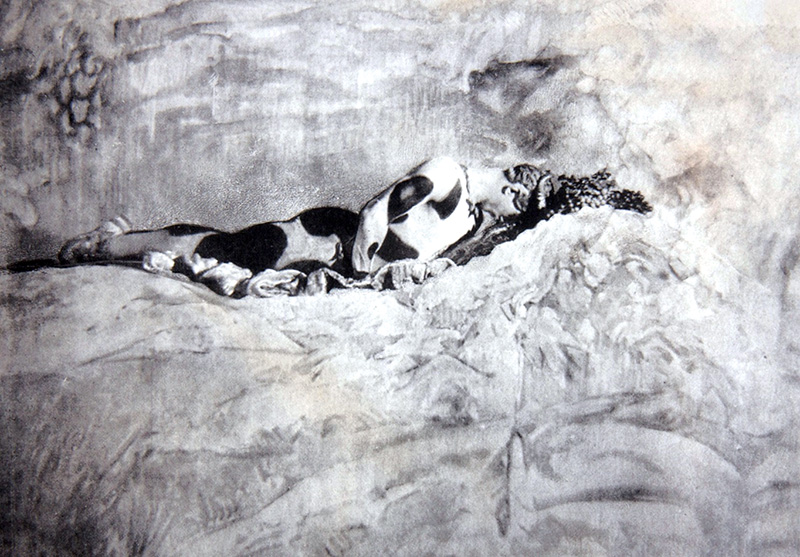
Vaslav Nijinsky replicating a final gesture from his 1910 Prelude to the Afternoon of a Faun for the Ballets Russes. Photo by Baron Adolph de Meyer (1912). (Public domain)
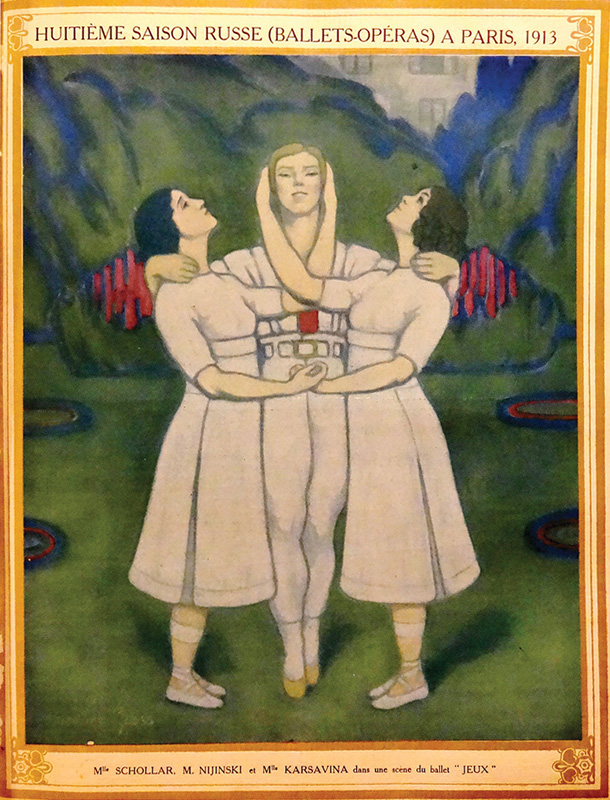
The climactic pose from Nijinsky’s 1913 ballet Jeux (Games) as rendered in pastel by Valentine Gross, first published in the magazine Comoedia illustré in 1913 and subsequently used as a souvenir program. (Public domain)
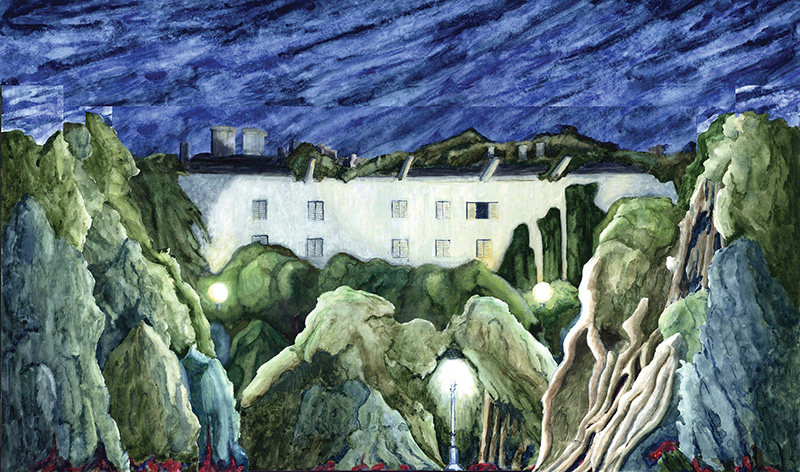
The original set design for Jeux by Léon Bakst, realized here as a composite image by James Edward Burns in 2013, reconstructed and supervised by Kenneth Archer for the University of North Carolina School of the Arts. Note the exaggerated, jungle-like foliage of London’s Bedford Square observed from an architecturally neutered version of 18–19 Bedford Square. One window symbolizes the voyeuristic nature of the ballet and three electric lights create an unnatural ambiance for nocturnal activities.
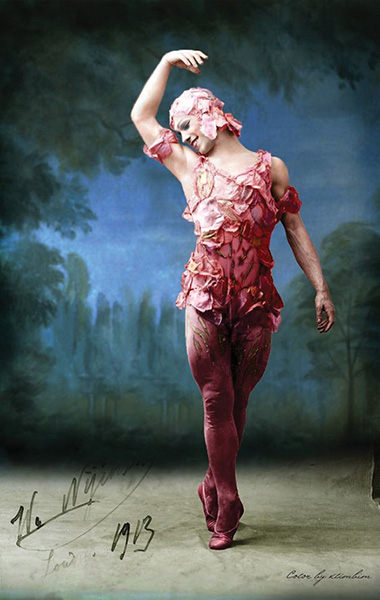
Vaslav Nijinsky as the Rose in Léon Bakst’s costume, first seen in 1911 and repeated on the Ballets Russes’ program following the world premiere of Stravinsky’s Le Sacre du printemps (The Rite of Spring) in 1913. The original monochrome photo by Charles Gerschel was colorized to match the costume’s overall dusty-rose appearance. (Public domain)
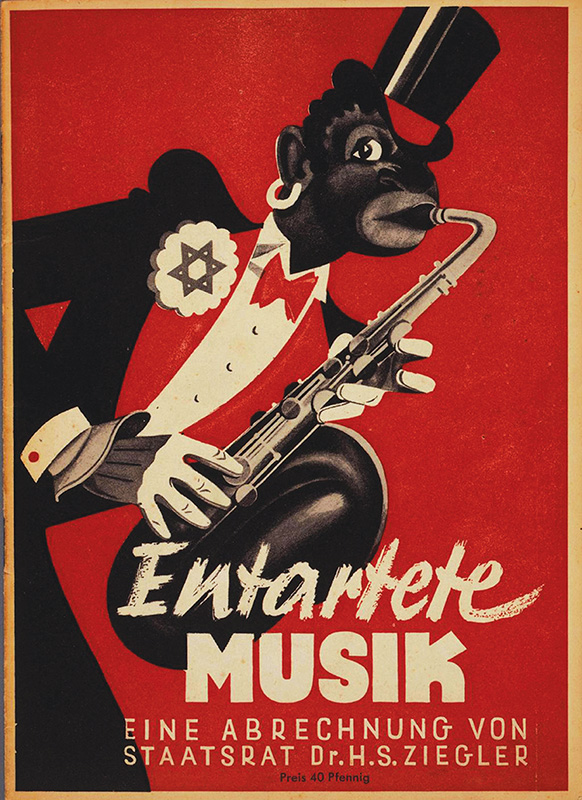
Poster designed by Ludwig Tersch for the Nazis’ Entartete Musik (Degenerate Music) exhibition in 1938. Private collection. (Album/Alamy Stock Photo)
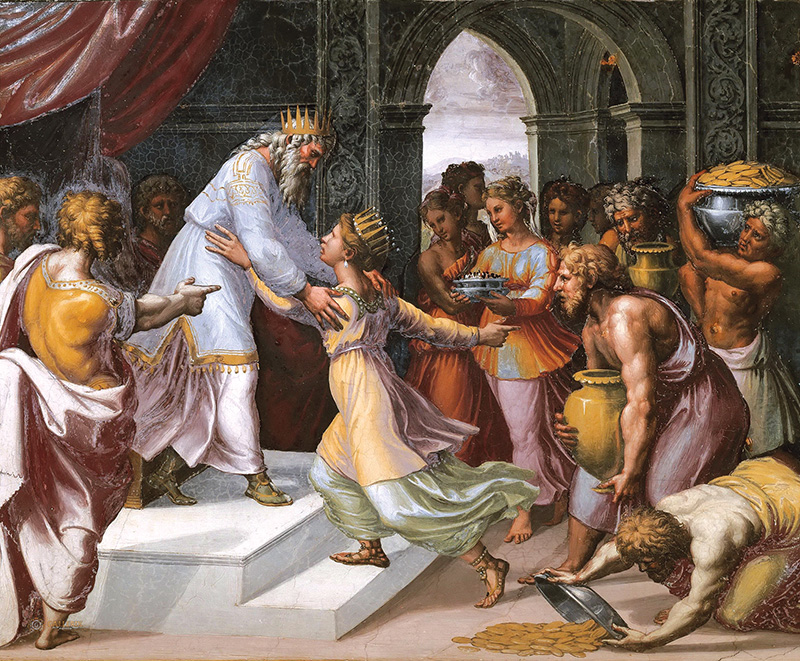
Raphael’s Queen of Sheba Paying Homage to Solomon. The fresco was recreated in tableau vivant for the 1812 Vienna premiere of Beethoven’s Fifth Piano Concerto (the “Emperor”). (Public domain)
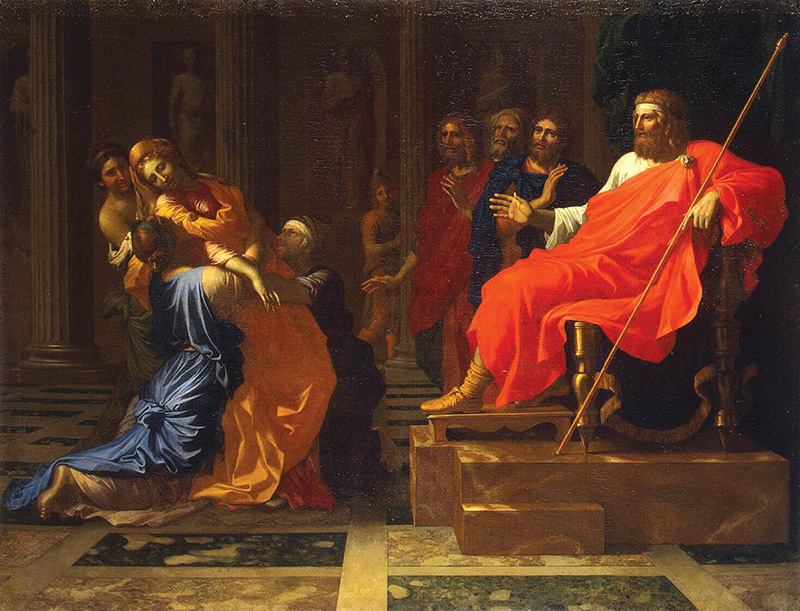
Nicolas Poussin’s Swooning of Esther (sometimes called Esther before Ahasuerus) was the second biblical scene re-created in tableau vivant for the Vienna premiere of Beethoven’s Fifth Piano Concerto. We do not know if the tableaux were presented before or during the musical performance, which, in any case, Beethoven attended. (Public domain)
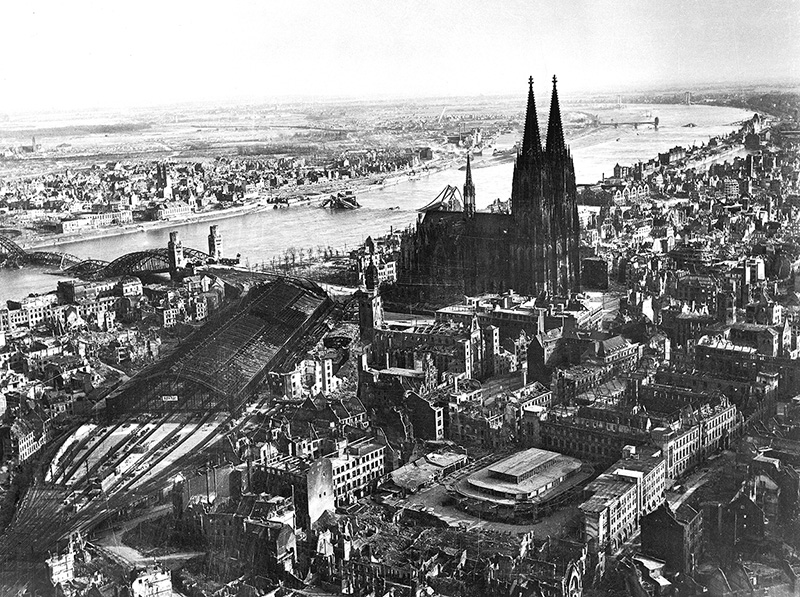
Cologne, Germany, in 1945. The bombing by Britain’s RAF began in 1940, and after 262 air raids in which some 13,000 civilian homes were destroyed, only the spires of the Cologne Cathedral stood watch over the destroyed city. Photo by Margaret Bourke-White for Life magazine. (Getty Images)