
9
In 1997, independent researchers uncovered a large mass grave close to the Belomor Canal, in the northwestern corner of Russia. The site, called Sandarmokh after the closest village, is a pine forest in which about 9,000 people were shot in 1937 and 1938. The victims were men and women of sixty ethnicities and nine religions, with an unusually high proportion from the political and academic elites. More than 1,000 of the murdered were delivered here from many hundreds of miles away, from the Solovetsky camp. For unknown reasons, they were brought here alive, forced to dig their own graves, and then shot on the spot. The site was discovered in 1997 by Veniamin Iofe and Irina Flige, leaders of the Memorial Society in St. Petersburg, together with a local enthusiast, Yury Dmitriev, from Petrozavodsk. None of these three researchers was trained as a historian, though Iofe was a political prisoner (1965–1968)—good training in itself.
Energy of the Remnant
The discovery was based on the testimony of Captain Matveev, who was sent by the NKVD to Karelia in 1937, shot thousands in Sandormokh, and was arrested by the same commissariat in 1939. This Matveev died an old man in 1981. His evidence has also survived in the archives, and led to the discovery of the remains of his victims. The excavations at the site recovered bones and skulls, many marked by a bullet hole. Decomposing under a thin layer of soil, the corpses of the people whom Matveev executed on each of his daily missions form separate depressions in the ground.
Today, humble wooden poles or stakes mark every mass grave. Specially designed as a local symbol of mourning, these poles, with their sharply angled roofs, vaguely remind the viewer of either a peasant cross or a human figure with hands raised in prayer. Scattered among the pines, they make an impressive image. The complex also includes a figurative sculpture that represents the falling prisoners and an angel. The angel’s hands are bound; he uses his wings to protect the prisoners. On the top of a stone obelisk, an inscription says, “People, do not kill each other.” This monument was created by Grigory Saltup, an artist and writer from Petrozavodsk. After taking part in the excavations at the site, Saltup applied to the Karelian Republic’s Ministry of Culture with a project for a monument. The government promised funding, but the money never materialized; Saltup believes that the ministry wanted a kickback. Saltup went ahead regardless. He built a three-meter model in his workshop, mortgaged his apartment, eventually scaled down the project, and completed it in a local factory.1 Today, the memorial in Sandarmokh is one of the most important, and best developed, of the secular sites of memory of the Soviet victims. After this memorial was opened, different religious communities erected their specific crosses here, and now these crosses compete with the “poles” and with each other. The Russian Orthodox Church has built a chapel nearby. The visual structure of the Sandarmokh memorial is effective, but information on the site is completely absent. There is no museum here, no information board, and the directions on the highway indicate the “Sandarmokh Cemetery” rather than a historical memorial.
I interviewed Yury Dmitriev, a slight man with a sailor’s mustache and unusual energy. He is obsessed with the duty of memory, which he feels as his personal responsibility. His father served in the Soviet military; his own family’s connection to the Soviet terror seems to be irrelevant.2 Among his discoveries is the largest known burial ground in the area of the Belomor Canal, the notorious construction site of the gulag that connected the Baltic and White Seas. Dmitriev knew that in 1933, the hectic race to beat the spring floods killed about 10,000 of the prisoners who dug the ten-kilometer-long rocky, frozen terrain of Canal No. 165, which connects the northern and the southern parts of the Belomor Canal. Wandering in the woods with a local hunter, Dmitriev found a deep hole made by a raccoon that had dug up human remains from under a layer of stones. Nearby, Dmitriev identified about 100 depressions in the moss floor. In this marshy land, the victims had dug deep holes, in which they were shot and covered with stones in a futile attempt to prevent animals from digging them up. There is no monument there.3 In 1997, Dmitriev found another mass grave in Krasny Bor, twenty kilometers from Petrozavodsk. He identified and marked about forty “shooting holes,” and then started excavations. After months of work with a shovel and a computer, Dmitriev identified the names of 1,193 victims and two executioners. Having failed to convince the authorities to allocate money for a memorial, Dmitriev erected a self-made one. Two rocks stand vertically like strange teeth pointing to the skies.
Simultaneously, Dmitriev was working on The Karelian Book of Memory, which he published in 2002, after many years of assiduous research and dogged fund-raising. This 1,000-page volume lists more than 13,000 biographical entries for those who were murdered in Karelia in 1937–1938.4 In this work, Dmitriev was supported by Ivan Chukhin, whose father was an NKVD officer who was implicated in the terror, and Pertti Vuori, whose father was murdered in 1936 by the same NKVD in Karelia. It was a remarkable team: a descendant of a victim, a descendant of a perpetrator, and a third party, as neutral to the subject as it is possible to be. Before their Book of Memory was completed, however, Chukhin and Vuori both died young men. Having survived them, Dmitriev publicly stated that his coauthors had been killed by “the black energy of crimes and murders which were committed decades before.” Using his own words, the local newspaper described Dmitriev’s ordeal:
After many months, which Dmitriev spent in the archive reading the files of those who were exiled or shot, he lost his appetite, could not sleep. . . . There is a black energy; it leaks into everyone who touches the yellowish pages of interrogations, denunciations, and shooting protocols. But Dmitriev continued his work on the Book of Names. He ran out of money. His friends died. His nerves betrayed him. His relationships were destroyed. He lapsed into months of heavy drinking.7
On the central square of the northern city of Vologda, a supply hub of the Belomor Canal, there are monuments to the Soviet heroes of the revolution, to the Soviet heroes of World War II, and to the Orthodox cathedral that was destroyed by those same Soviets. The fourth corner of this square is still empty, as if in anticipation of another monument: one to the victims of the Soviet terror, who died in and around Vologda in huge numbers. “There is nothing more inconspicuous than a monument,” said the writer Robert Musil after the collapse of the Austro-Hungarian Empire. Looking at the ruins of the Soviet empire, I would add: there is nothing more conspicuous than an absent monument.
But Aleksandr Lukichev, the Speaker of the Vologda Municipal Council, told me that there were other forms of keeping memory of the victims, which were proper to this special subject. “We know about them from literature,” said Lukichev. His grandfather, a peasant, was accused of anti-Soviet conspiracy in 1931 and died in a camp. Concerned about his grandfather’s memory, Lukichev obtained archival documents to produce a book and a documentary film that tells the story of his grandfather. But creating a monument to the millions of other, similar cases was not on his agenda, Lukichev asserted. He advised me to visit a memorial stone on the place of a mass grave near the former KGB building, where relatives and descendants of the victims of Soviet murder on this and other sites gather once a year. There, on a piece of granite, one can read: “To the memory of the victims of political repressions. We love. We remember. We mourn.” No further information about the “political repressions” is available at the site. “How do people understand what it is all about?” I asked. Once again, Lukichev referred to “literature.” After seven years of work as an elected official, Lukichev is now writing historical books.
Solution of Memory
In a work that has become exemplary, in the 1980s-1990s a group of French historians led by Pierre Nora produced an eight-volume study of French monuments and other sites of historical memory.5 Shifting the emphasis from the content and functions of cultural memory to its forms and “sites,” Nora interpreted monuments belonging to several epochs of French history as representations of the changing national identity. Erecting these monuments, he argues, the state imprints its own self-representations as they were shaped in time, and constructs its own grandeur. This is memory as Pantheon: the selective representation of great personalities and events of the past. For a modern nation-state, immortalizing the memory of its victories and great leaders becomes not only an indispensable instrument but, moreover, a part of its internal structure.6 Such monuments demonstrate the continuity of the political tradition of a nation-state from its great founders.
Nora’s volumes presented cultural memory as a number of spatially organized sites, which are static, self-contained, and unconnected. These volumes contrasted memory and history as if they belonged to two different worlds: memory vanishing and romanticized, and history modernizing, trivializing, and all but colonizing. They overemphasized the spatial structures of cultural memory and underestimated its temporal dynamics. They focused on monuments, memorials, and museums, and deprecated the historical controversies and competing narratives that fuel imaginative novels and alternative histories. As Pierre Nora’s phenomenal success in the France of the 1990s showed, this shift of balance responded to the needs of that society. In his subtle analysis, Tony Judt connected Nora’s volumes with François Mitterand’s monumental constructions that were erected during the same decade. I would add that both were created when France shunned the Internet, the deterritorialized and increasingly language-neutral space of memory, and chose instead Minitel, a closed network bound by French language and fixed terminals.7 France is special, but in many ways it is also typical, and Judt generalized: “The Western solution to the problem of Europe’s troublesome memories has been to fix them, quite literally, in stone.”8 It was indeed a Franco-German solution, but in eastern Europe and Russia, it did not translate into anything close in scale either to German memorials or to French historiography. In these eastern parts of the West, the cultural memory is out of balance, but its trajectory moves in the opposite direction. In Russia and eastern Europe, novels, films, and debates about the past vastly outpace and overshadow monuments, memorials, and museums.
I like to compare monuments to crystals that settle in a solution of memory, provided that this solution is strong and stable. But in the east of Europe, cultural memory is hot and liquid rather than cool and crystallized.9 Its structures are temporal rather than spatial. Its units are memory events rather than sites of memory. Contemporary Russian memory barely approaches the minimal conditions of crystallization. Its important condition, analogous to the temperature of the solution, is social consensus. High social consensus encourages the proliferation of monuments, but since there is not much to debate if everyone agrees, it discourages public debates; we see such a situation in contemporary Germany. In contrast, low consensus suppresses public memory, but can intensify its manifestations among the remembering minority. The enthusiastic efforts of solitary individuals, veritable heroes of memory like Dmitriev or Iofe, are vital in this situation. Like catalyzers, they help the solution of memory to shape the crystallike monuments.
This intuitive model allows for a range of possible imbalances and imperfections, and in the east of Europe these shifts are the opposite of those that Judt noticed in France. Studies of Russian memory and mourning should take full account of the proliferation of cultural texts, from memoirs to novels to films, and the lack of monuments in the region. Monuments are inconspicuous if people are not talking and writing about them; mourning rites are incomplete if they do not crystallize in monuments. The interaction between texts and monuments makes the core of cultural memory, but this interaction has not been adequately explored in memory studies.
The arts of memory are diverse. Awareness of the past may be achieved by the publication of a document or by the erection of an obelisk; by writing a memoir or by creating a memorial; by launching a discussion or by opening a museum. In culture, as in a computer, there are two forms of memory, which might be likened to hardware and software. Soft memory consists primarily of texts (including literary, historical, and other narratives), while hard memory consists primarily of monuments. Of course, the soft and the hard are interdependent. Monuments without inscriptions are mute, while texts without monuments are ephemeral. The monumental hardware of cultural memory does not function unless it interacts with its discursive software. On the other hand, the software—public opinion, historical debates, literary imagery—would pass away with every subsequent generation or even fashion if it were not anchored by monuments, memorials, and museums. The hardening of memory is a cultural process with specific functions, conditions, and thresholds. It is not the mere existence of the hardware and the software but their interaction, transparency, and conflicts that give cultural memory life. Like a computer, culture does not work if either the software or the hardware does not work, or if there is no proper interaction between the two. The Holocaust survivor and writer Primo Levi wrote that if he had been asked right after his emancipation what to do with the camp where he was imprisoned, he would have said, “Destroy it forever along with the Nazi and the Germans.” But forty years later, he would prefer to see on this place a “warning monument.”10
Printing and digital technologies have largely de-territorialized cultural memory. Texts such as the Jewish Torah or medieval manuscripts are singular. Located in sacred spaces, they function as hardware monuments as well as software texts. In contrast, the modern arts of memory, from memoir to film to the Internet, are neutral to space. Often describing specific sites, they do not have location themselves: mechanically or electronically reproduced, they are available in many places at once. Still dependent on space and its sites, modern memory is structured by time. Its temporal units are memory events, which I define as acts of revisiting the past that create ruptures with its established cultural meanings.11 Memory events are secondary to the historical events that they interpret, usually taking place many years or decades later. Sometimes a memory event attains the significance of a historical event, therefore blurring the distinction between the two. But there are also a number of differences.
Memory events unfold in many cultural genres, from funerals to historical debates, from museum openings to court proceedings, from the erection or the destruction of a monument to archival findings, films, novels, exhibitions, and websites. Historical events tend to be singular while memory events rarely are. They repeat themselves in new, creative but recognizable forms, which circulate in cultural space and reverberate in time. Like waves, these events move across cultural spaces, and they are indeed often carried by waves.
Sites of memory structure its cultural hardware; memory events structure its software. Memory events are simultaneously acts and products of memory. They have their authors and agents—initiators and enthusiasts of memory—who lead the production of these collective events in the same way as film directors make their films. Memory also has its promoters, as surely as it has its censors and foes. As multimedia products, memory events feature a permanent interaction between “hardware” (sites, monuments, and so forth) and their “software” (historical, literary, and other texts). Like a computer, cultural memory is dependent on the balance between hardware and software—sites and events, monuments and texts, traces of the past and stories about it, hardware and software.
Memory events change how people remember, imagine, and talk about the past. They are performatives, and we can apply to memory events some ideas from Habermas’s theory of communicative action.12 In my adjusted version, the power of a memory event depends on its truth claims, that is, whether the community perceives it as a true description of the past; on its originality claims, that is, whether the community perceives it as new and different from the accepted version of the past; and on its identity claims, that is, whether the community perceives the changing vision of the past as central to its identity.
Texts and Monuments
The Russian-American scholar Roman Jakobson noted that in celebrated poems by Pushkin (The Bronze Horseman, The Stone Guest, and so forth), a statue comes to life and confronts a human character, who in effect loses his memory, mind, or life.13 More recently, another Russian-American scholar, Mikhail Yampolsky, formulated a contrasting idea. He believes that a monument creates a “mystical protective zone,” a sacral space around the monument that stops the flow of time.14 Precisely because monuments freeze history, their rare moments of dynamism are imbued with uncanny effects, which are associated with an exchange between the living and the dead.
Contemplation of the future monument to the poet is a leitmotif of some spectacular pieces of Russian poetry, from the eighteenth-century Derzhavin to the twentieth-century Akhmatova. In 1836, Pushkin wrote, “I have erected a monument to myself, not made by human hands”; in 1962, Brodsky responded, “I have erected a different monument to myself! Its back is turned to the shameful century.” Reportedly, these latter verses inspired the sculptor to erect Brodsky’s monument in Moscow, which shows its back to the Kremlin.15 The real and practical events that happen to monuments, such as their removal, destruction, vandalism, or renaming, tend to provoke strong responses in their observers. Transformations of monuments are memory events, and they necessarily entail productive interactions with texts. When monuments move in Pushkin’s stories, they create uncanny effects; when texts penetrate the monumental space, they are able to vitalize monuments. It is the combination of stones and texts that makes monuments work; without words, the meaning of these stones would be undecipherable. For example, the Solovetsky stone in St. Petersburg is complemented with strong inscriptions, such as “To the victims of Communism.” Such a monument can also be vandalized by words. In 2002, I witnessed the results of one such attempt, in which unknown vandals wrote on the Solovetsky stone in St. Petersburg in red oil, “Too few were shot.”
According to Yampolsky, a monument creates a mystical zone in which time stops its flow, as in a snapshot, and space is transfigured from its neutral, dispersed condition into one that radially focuses on the monument. Do such monuments need to physically exist, to be made of stone or bronze? Or can they be textual but still produce the same effects? Mourning texts of various genres—poems, memoirs, novels, and even scholarly treatises—have an ability to memorialize the horror of the past by emulating the same petrifying effect by purely textual means. The effect comes from an unusual, unexpected stoppage of the narrative flow, creating a static image that becomes memorable and mournful precisely because of this contrast between its frozen, petrified fabric and the flow of the story that encircles it. I will give several examples of this effect of the textual monument, as I call it, and will then turn to the important Soviet poetic text of mourning, Akhmatova’s Requiem, which presents such a monument in the process of petrifying.
An exciting example of the textual monument stands out in the middle of Khrushchev’s memoir. He remembers how at the peak of the Stalingrad battle, he could not find the headquarters of one of the armies that took part in encircling the enemy. It was a dark night near the frontline, and Khrushchev and his entourage lost their way. Rockets illuminated the terrain, but they saw only three dead bodies on the ground, two naked German soldiers and a gray horse. “Naked corpses are very visible at nighttime,” Khrushchev says. He made circles around these corpses, and time and again returned to them. “No matter which way we went, we kept returning to the same corpses. It was simply some kind of enchanted place! Without end, we kept meeting the corpses of the two naked soldiers and the gray horse. What kind of bewitchment was this? Like something out of Gogol! A devil was leading us around this place.”16 Khrushchev said to his companion, a general, that they would remember these two Germans and the horse. Indeed, twenty-something years later, when he dictated this memoir, he mentioned these dead bodies five times. The reader also remembers them. Contrasting with the lively flow of Khrushchev’s memoir, this expressionist scene concentrates the tension and anxiety of an organizer of the Stalingrad triumph. Static and repetitive, it embodies the death wish at the center of the life-affirming victory.
In Bakhtin’s book on the carnival, there is a similar scene, horrifying, central, and petrified: “the Crimean sculptures” of pregnant, smiling old women. “This is an expressive and characteristic grotesque. It is ambivalent: pregnant death, death that is giving birth.” For generations of readers, these eternally smiling, eternally pregnant sculptures symbolize both the laughter and horror of Bakhtin’s text.17 In Dmitry Likhachev’s memoir, one of the most striking pages describes an open car that removed the frozen corpses from the Leningrad streets during the siege of the city in 1942. “The car that stuck in my memory was loaded with corpses, frozen into the most fantastic positions. It was as if they had been frozen in the act of giving speeches, screaming, grimacing, prancing. Raised hands, open glassy eyes. Some of the corpses were naked. One female corpse stuck in my memory, she was naked, brown, skinny, she was standing up in the car like a pillar, propping up the other corpses.”18 The description goes on and on, and it erects a memorable, horrible monument to the victims of the siege, one that would make a fine subject for future sculptors.
In her Requiem, a cycle that Akhmatova passed to the underground circulation in 1961 (it was published in the USSR only in 1987), she describes her experience of standing in line at the Crosses prison in 1938 with the purpose of passing food to her son, Lev Gumilev, who was held for investigation there before serving in the gulag for the next six years. She reports in rhymes that over seventeen months, she spent 300 hours in these lines. “We were all in a torpor there,” Akhmatova says. Only the dead were smiling then, says Akhmatova, in a trope that is as grotesque as Bakhtin’s. Through the poem, she describes the steady, frozen, and petrified character of the torpid line. She also depicts the internal change that she underwent because of her fear for her son and her compassion for him, and this change she also describes as petrifying. “I have a lot of work to do today; / I need to slaughter memory, / Turn my living soul into stone.” Indeed, petrification is a process that she describes throughout the poem; in some lines the son turns into stone, in another line apostle Peter does, then the mother. In the last and culminating poem of the cycle, Akhmatova develops this theme by describing her desire that a future monument be erected to her on the place where she stood in line at the Crosses. At the end of the poem, the narrator is already a monument: “Let the thawing ice flow like tears / From my immovable bronze eyelids.”
In this poem, Akhmatova predicted important phenomena of the subsequent development of Russian memory: “I’d like to name them all by name, / But the list has been confiscated.” From this desire to list the victims she turns to another impossible desire, to erect a monument to one of them, herself: “if ever in this country / They decide to erect a monument to me,” she writes, it should be located at the Crosses prison where her son was kept.19 Akhmatova speaks about this monument not metaphorically (text as monument) but literally, as a man-made monument. She does not specify any feature of this monument but its location. This is an essential feature of the postcatastrophic monument: it rarely has a visual concreteness, since any such concreteness would reduce the catastrophic experience to a human routine, but it memorializes the fact and location of the catastrophe.
There is no monument to Akhmatova at the Crosses prison in St. Petersburg.20
Memorials of Guilt
Looking at monuments in Paris, Washington, D.C., or St. Petersburg, we see the body of the nation on display. Monuments represent its continuing identity as a desired and often mythical unity between the state, the people, and their common history. They work as materialized forms of patriotic sentiment: sites of historical memory, of course, but first and foremost visible and touchable bodies of nationalism, which has created the present by distorting the past.
States do not eagerly erect monuments that memorialize their guilt. Some of their crimes were committed in colonial territories, and the burden of memory is placed upon those former colonies. The memory of the “collateral damage” that resulted from national glory is more often preserved in oral or written texts than in monuments. Monuments to revolutions and internal conflicts glorify those who won them and tend to ignore those who lost them. In times of revolution, monuments become one of the first, and certainly the most visible, targets for overthrow; their unexpected movements create memory events. In the Iraq war we saw how the self-celebrating monuments of power became stages for the most dramatic shows. Similar acts of foundational violence against monuments were important in the American, French, and Russian revolutions.21
By building monuments to its former enemies and victims, the state asserts its own transformation. This deconstructive mode tends to go along with military failure, decolonization, or revolution. Memorials at the sites of mass terror usually consist of two parts, a museum and a monument. The museum tells the story and displays the material traces of the events. Producing a coherent narrative, a museum is available to discursive analysis and rational criticism, like a lecture or a book. In contrast to a historical museum, a monument should not be judged by rational criteria. Generating emotional responses, monuments are close to rituals. While museums embody historical knowledge, monuments are pieces of art, and they do not make truth claims. The typical monument is usually a tower, obelisk, or another secular, abstract symbol, visible from all around. In contrast to the museum component, the monument usually does not have a figurative, historical meaning. In the museum portion, reconstructions of a gas chamber, a barrack, or a cell refer to their historical prototypes and aspire to reproduce them as closely as possible. In contrast, obelisks were not present in the camps when they functioned as camps. Monuments do not reproduce historical reality but rather comment upon it, emotionally and judgmentally. Maybe one way to interpret the vertical shape and central location of such monuments is to imagine a wooden stake that nails a mythological vampire to the ground.
In Russia, such stakes do not nail, and vampires are always ready to fly. Lack of social consensus blocks the crystallization of memory. Its solution remains oversaturated and volatile. Left in solution or locked in software, memory creates virtual circles. In contrast, in Germany, the first monuments to the dead were erected inside the camps right after the victims’ liberation. The conversion of camp into museum demonstrated that it was not to be used in its former, frightening function by the new powers; it also informed the population about the methods of the defeated regime. This process was initiated by the former prisoners, who erected the first primitive signs of their mourning right after their emancipation in the form of wooden obelisks, grave markers, and so forth. In different sectors of the occupation, the processes of memorialization developed in different ways. In the eastern sector, the management of the camps was led by the changing ideological prescriptions of the Soviet and GDR governments. From 1945 to 1951, the Soviet troops and police used ten former Nazi camps on the territory of the GDR to house German prisoners of war. Later, some of these sites were transformed into museums, but the Soviet part of these camps’ history was carefully omitted.22
Victims into Sacrifices
In Russia, the Memorial Society was founded in 1987 by enthusiasts of memory who started a campaign for a national monument to the victims of repressions. There was a foundational energy in this initiative, an identity claim that aspired to break the continuity with the Soviet past and to create a new, nonrepressive nation. In 1989, Veniamin Iofe and a group of activists from the Memorial Society erected their first memorial, a simple granite stone, in the cemetery on Solovetsky Island. Ten years later, speaking near this stone, Iofe said that it was created as a “question mark that asked about the meaning of this tragedy. We wanted to understand why all these millions were sacrificed, if they were indeed sacrificed? What was the supreme value which demanded these sacrifices?”23 Iofe’s doubt regarding the idea of sacrifice parallels Giorgio Agamben’s ambigious concept of homo sacer, which describes the victims of the Nazi camps as those who could be killed but not sacrificed.24
As often happens in mundane situations of violent or premature death, the victims and, even more so, their peers and their descendants want to find meaning in their suffering. If meaning can be discovered, then death becomes a sacrifice, rather than just a loss or a murder. Mass murders can be sacrificially interpreted in religious terms, as punishment for sins, or in political terms, as the cost of nation-building, modernization, or similar causes. The Russian language adds to the possible confusion: the Russian word “zhertva” has two meanings, “victim” and “sacrifice,” and Iofe explicitly played with this double meaning. He motivated his choice of the simple local stone, an empty signifier or “question mark,” by his refusal to interpret victimization as sacrifice: “an ordinary natural stone which, with time, could probably take on a more definite contour, but this will happen only with time, when we reach a new understanding.”25
What is truly important for this memorial practice is location. In 1990, a stone from the Solovetsky camp was erected near the headquarters of the Soviet secret police, NKVD-KGB, where the FSB (Federal Security Service), its post-Soviet reincarnation, still resides. This monument to the victims of the Solovetsky camp marks the square where the statue to its founder, Felix Dzerzhinsky, was demolished in 1991. In 2002, another Solovetsky stone was erected in St. Petersburg across the Neva River from the KGB residence, where the FSB is working now. Why did huge boulders have to be transported for thousands of miles, from the Solovetsky Islands to Moscow and St. Petersburg? Does a spirit of place travel with them? The idea of the spirit of place feels pre-Christian. However, in 2007 the Russian Orthodox Church reproduced the same logic of transporting spirits: carved in the Solovetsky Islands, a gigantic cross was ceremonially brought to Butovo near Moscow, a mass grave that the church has made into its official site of memory. But in Moscow, the former mayor Yury Luzhkov proposed reinstating the statue to Dzerzhinsky. Various compromises have been discussed, one of them being the replacement of the Solovetsky stone with a gigantic water clock. Two symbolic visions compete at this site: one of historical time, which changes by unpredictable leaps from the old condition (a monument to the executioner) to a new and radically different one (a monument to his victims); another of circular time, which always returns to the starting point, like a water clock. Brought from afar and converted into monuments, even boulders acquire political lives.
The sculpture of previous ages had greater narrative capacity. Russian official monuments of the nineteenth century told long, complex, horizontally developing narratives, much as comics and graphic novels do today. Soviet and Russian monuments to victories and victims of World War II were also multifigured and descriptive. Traveling in European Russia today, one cannot miss the huge memorial complexes to the “Great Patriotic War” with monuments showing armed soldiers in the moment of self-sacrifice. They contain lists of the heroes and the ubiquitous but not always true inscription, “Nothing is forgotten, nobody is forgotten.”
According to an exhibition of monuments to the victims of the gulag staged in 2007, there were 1,140 such monuments and memorial plaques currently in place on the territory of the former Soviet Union: stones, crosses, obelisks, bells, bas-reliefs, and angels. Among these monuments, there are very few realistic sculptures that depict an actual prisoner in a moment of suffering. Interestingly, if anthropomorphic sculptures are found at all, they are usually erected in places like Ukraine, Kazakhstan, or Tuva, where a bare, senseless life in the camp is easier to reimagine as a sacrifice to the nationalist cause. For example, in the Tuva Republic in southeastern Siberia, a huge bronze man in national clothing was erected in 1989 with the inscription, “The Untamed. To the victims of political repressions in Tuva.” The general rule seems to be that guilt monuments are nonfigurative, while pride monuments tend to depict people, on horseback or otherwise. It is easier for postcolonial memory to construct meaning for losses and revolutions than it is for postsocialist memory. The imagining of meaningless suffering requires nonhuman, abstract or monstrous symbols. These monstrous monuments feel strange and sometimes shocking, but the most important memorials to the victims of the Soviet terror belong to this category.26 Fascinating examples include a monument in St. Petersburg by Mikhail Shamiakin, which represents two sphinxes across the Neva River from the infamous Crosses prison, with Akhmatova’s verses on their pedestals; Moloch of Totalitarianism in Levashovo by N. Galitskaia and V. Gambarov, which shows a robotic cannibal who is devouring or raping a human figure; and what is probably the largest and most successful among the post-Soviet monuments, the Mask of Sorrow in Magadan by Ernst Neizvestny, which represents a concrete Leviathan, composed of multiple human faces, with a cross in place of the nose.
Sculptor Ernst Neizvestny became known in 1962 when he confronted Khrushchev during the latter’s notorious attack on the artists and poets of the Thaw, whom Khrushchev called “abstractionists” and “homosexuals,” two words that he believed to be derogatory. During that meeting, Khrushchev and other members of the Politburo openly threatened to shoot some Moscow artists or to send them to a lumberjack camp.27 In response, Neizvestny, a former World War II combat officer, offered to prove his macho sexuality with any woman nearby, and said that he would commit suicide before “they” would arrest him. Years later, the dying Khrushchev asked his wife to commission Neizvestny to create his grave monument, which she did. Made of black and white pieces of marble, the monument symbolized Khrushchev’s internal contradictions. In his memoirs, published after his emigration to the United States, Neizvestny expressed his feelings toward the Soviet officials by calling them “cannibals who were scared of their own wives”; he also gave a brilliant psychological analysis of his former friends in the party apparatus. Playing with the doubling idea that he used for Khrushchev’s monument, he created two similar monuments for two opposite occasions, one celebrating Soviet power and another condemning it. The fifteen-meter high Mask of Sorrow (1996), a concrete sculpture in Kolyma, is a genuinely impressive monument to the victims of the Soviet terror. It obviously refers to Abraham Bosse’s image of Leviathan on the frontispiece of Thomas Hobbes’s book of 1651. It has not been noticed, however, that in a warped way this monument also refers to an equally huge bas-relief on the facade of the headquarters of the Central Committee of the Communist Party of the Turkmen Soviet Republic, in Ashkhabad, which Neizvestny created in 1975. Both pieces present a Hobbesian image of a monstrous state that consists of its miniscule subjects who are also its victims, and a cross that is cutting this total space apart, in a visual revenge and spiritual redemption. If this anti-utopian, Christian image of political mourning was appealing to the pious Russian officials of the 1990s, one can only guess what it meant for their Turkmen colleagues in the 1970s.
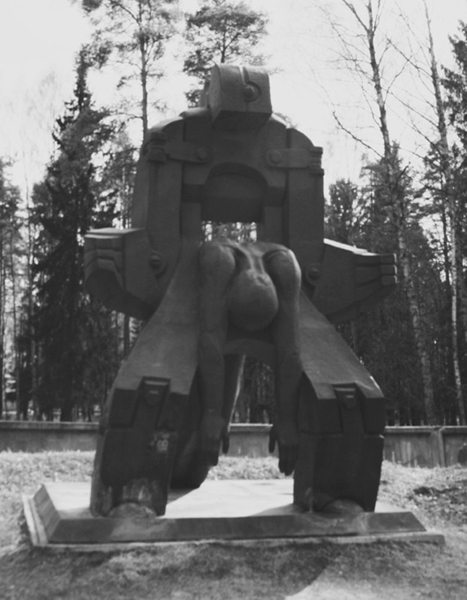
figure 13. Moloch of Totalitarianism (1996), a memorial at the Levashovo Cemetery near St. Petersburg. Photo by the author.
In the current practice, stones and monsters comprise two types of monuments that express the political nature of life and death in the camps. Bare stones convey the memory of bare life, construed from the perspective of the victims. Monster monuments express the unimaginable quality of the experience of the millions of goners. When trying to create a monument to the victims of the Great Terror, Russian artists also produce anthropomorphic or zoomorphic images such as a crying woman (the monument in Abakan), a man on his knees (Tver), or a wounded bird (Astrakhan). In almost all these projects, “victims” are represented as passive sufferers, deprived of any capacity for resistance. This imagery is very different from the contemporary German, and especially Israeli, representations of the Holocaust, which search for heroes of the resistance rather than for passive sufferers.28 Russian monuments do not give any hint of the solidarity of political prisoners, their fights with criminals and with the administration, their numerous camp rebellions and escapes. Other than the usual image of prison bars and barbed wire, these monuments do not tell us much about techniques of torture, incarceration, or execution. These depoliticized images avoid Soviet emblems and say nothing about the ideology that determined all of these murders. A basic lack of information is typical for all of these monuments, including the most sophisticated ones. The director of the local museum in Medvezhiegorsk told me that it was easier to open a whole exhibition about “political repressions” inside museum walls than to put up a single information board on a site of mass murders. Information boards seem more vulnerable to criticism than highly abstract monuments, and the initiators of memory tend to reserve their knowledge for their books, most of which have tiny print-runs. It is lack of information that makes post-Soviet monuments inconspicuous. In 2000, on a highway from St. Petersburg to Pskov I visited a small café, which had on its wall a memorial board, carefully crafted in metal. It said that victims of the Stalinist repressions had been murdered here. It did not say who the victims were; nor did it say who hung the board, or when. The owners of the café knew nothing. No wonder that when I passed through again a few years later, the board had simply disappeared.
Monuments to the Soviet victims have been built by civil society, but the resources that are necessary for these monuments, starting with their sites, are controlled by the state. The only trustworthy feature of the memorialized event seems to be the location of the murders—Butovo, Sandarmokh, Levashovo . . . Interestingly, the most important monuments are erected not on the sites of the former camps or prisons, as is true in many German cases, but near them. This out-sitedness features the most important of these monuments, such as the boulder on Lubianka Square in Moscow, which abuts the edifice of the NKVD-KGB-FSB, or Shemiakin’s two sphinxes and the nearby monument to Akhmatova in St. Petersburg, which looks at the Crosses prison across the wide Neva. This pattern demonstrates not the replacement of the old regime by a new one, but rather manifests their quiet coexistence. In a comparative perspective, such localization is not necessarily exceptional. The obvious analogy is the Berlin Holocaust Memorial near the Reichstag. On the other hand, even such proximate location of memory is far from being the rule in Russia. Near the horrifying building of the Leningrad KGB, there is not a single monument, plaque, or inscription commemorating the millions of its victims. Such a monument is notably absent from the vicinity of the Kremlin as well.
Near the Solovetsky stone in Moscow, since 2007 the Memorial Society has organized annual commemorations of the Great Terror on the eve of October 30, the Day of Memory of Victims of Political Repressions, instituted by President Yeltsin in 1991. For hours, volunteers read aloud thousands of names, and some spontaneously add, “my grandfather,” “my uncle . . .” In provincial centers such as Vologda, descendants of the victims come annually, on October 30, to the local memorials. In these commemorations, the monument becomes a center of a social ritual, which integrates this hardware construction with ceremonial texts and performative acts in an organized, politically meaningful spectacle of memory. Commemoration of October 30 was initiated in 1974 in Soviet prisons as Political Prisoners’ Day. In 1991, when this date was adopted by the Yeltsin government as an official memorial day, its title was changed to the Day of Memory of Victims of Political Repressions, a change that, as one observer notes, effectively prevents the commemoration of current, post-Soviet political prisoners.29
According to the Memorial Society, there were about 400 fully deployed camps that comprised the system of the gulag. But only two of the gulag sites, in the Solovetsky Islands and in Perm, house small museums (or dedicated departments of museum) that show the conditions in the camps, the techniques of torture and murder, the documents, and the portraits. These two camps are bookends marking the very beginning (Solovetsky) and the very end (Perm) of the system of the gulag. There are no memorials or museums on the sites of many significant camps, which contained dozens or hundreds of thousands of prisoners. However, in some centers of the northern gulag, the modest objects on display at local museums are fascinating. In a small exhibit in the Kargopol museum there is a clay pitcher. As the detailed plaque says, this pitcher was presented to the museum by the descendants of a camp guard, who, sometime in the 1930s, appropriated a package that was sent to a prisoner, a pitcher full of honey. The family of the guard preserved the legend of this pitcher. In such exhibits, however, it is practically impossible to find answers to the most obvious questions: How many prisoners went through this camp? How many died here, and when? Who were the founders of this camp, its administrators, guards, executioners?
The monument at the Perm camp consists of a concrete construction resembling an observation tower, which is not fitted with a machine gun, the central attribute of such towers in the times of the gulag, but instead supports two objects that are rarely combined: a church bell and a hunk of barbed wire. This monument is located at the only gulag site that has been converted into a museum. One can visit barracks and the administration building, look at many historical exponents, and even sample authentic prisoner fare in the prison mess. The creators of this museum hope to attract tourists. Its advertisement in a commercial newspaper specifically said that the museum would be attractive to “children and foreigners.” In Novgorod, not far from the ancient city wall, there is a Soviet-looking park with a monument to the Bolshevik Revolution, which presents two hands clutching a globe. One hundred meters away there is a monument to this revolution’s victims. It depicts a candle made of granite, with a metallic wick at the top. The inscription addresses the visitor on behalf of the victims of the Soviet terror, “Do not allow our fate to become your fate.” As in so many other cases, texts prove stronger than monuments.
On Solovetsky Island, in 1992, the Russian Orthodox Church erected a cross at the entrance to Sekirnaia Mountain, an infamous site of mass murders. The cross bears a long, elaborate text devoted to the memory of the victims, formulated in archaic but strong and clear language. While the cross itself is noticeable from far away, the inscription can be seen and read only in the closest proximity. Numerous tourists overlook this inscription, perceiving this monument as just another cross, one of many in the monastery. On a mass grave on Solovetsky Island two monuments visibly compete with each other: an Orthodox cross and a granite stone erected by the Memorial Society. Neither of them contains information about those who are buried there. In 2002, the Moscow Academy of Art, Sculpture and Architecture, in collaboration with the Memorial Society, held a contest for designs for a future monument “to the victims of political repressions” on Solovetsky Island. Out of fifty entries, twenty proposed Orthodox chapels as monuments. Crosses, angels, and bells played the central part in nine designs. In eleven projects, memory was represented by secular symbols, such as obelisks or ruins. Seriously developed museum space was proposed only in five projects. Only two proposed reconstructing parts of the camp.
The Solovetsky camp, the first and “model” camp of the gulag, functioned for about twenty years, and hundreds of thousands of people were incarcerated there through the years. The buildings of the monastery have now been returned to the church and are used according to their original function. One memorial plaque on the buildings that surround this enormous site of mass murder is heartbreakingly simple. It reads, “The Children’s Barrack of the Solovetsky Camp.” However, in 2011 the Russian government, led by Prime Minister Vladimir Putin, decided to move the historical museum from the island to the mainland. This probably means that soon there will be nothing on the island but the monastery, and no memory of the camp and its secular prisoners will be preserved locally.
In the case of the gulag, the return to the religious symbolism of memory denies its historical specificity. Many of those who perished there were not Christians, but Jews or Muslims, and many were atheists. Canonical Orthodox crosses are different in shape not only from Catholic and Lutheran crosses but also from the Old Believer crosses. Therefore, on sites such as Sandarmokh, one can see a number of different crosses, which have been erected by non-Orthodox religious minorities. The secular, political character of the Soviet terror makes its religious interpretation highly questionable. Mourning senseless loss on such a catastrophic scale is an impossible task. Though this unrepresentability has been theorized less in the case of the gulag than in the Holocaust, many heirs of the gulag’s victims have intuitively chosen nonsacrificial monuments to commemorate their dead.
The Virtual Gulag
Almost all projects of memorialization in Russia, the soft and the hard, have been initiated by private persons. On the other hand, private individuals and voluntary associations cannot erect monuments without the collaboration of the state. Access to archives is controlled by the state (specifically the FSB, the descendant of the KGB), and this access has been diminishing throughout the last decade. Financial resources and land property, which are required for any memorial, are also controlled by the state. If writing memoirs is predominantly an individual activity, constructing memorials is a collective one. Moreover, because of the large scale and public nature of memorials, their construction generally requires the participation of the state. Hard memory is usually the responsibility of the state, while soft memory is the domain of society.
The German art of memory is richer in experiments, both successful and failed. Among the successes is the Monument to the Burned Books on Bebelplatz in Berlin. Created in 1996, the monument is a semitransparent window in the pavement, through which pedestrians can see many empty bookshelves, an underground library without books. Another interesting example is the “Warm Monument” in Buchenwald, erected in 1995 on the site where fifty years earlier, prisoners erected the first monument to the murdered. The sculptor has placed at the site a rectangular stone that is heated to human body temperature, giving it a kind of living energy. Tourists love to touch it in the wintertime.30 Recent memorials to the victims of the Holocaust in Berlin caused furious debates in Germany. One could probably measure the success of a monument not by its aesthetic appreciation by the critics or even by the public, but by the amount of discursive responses generated by it. What is important for the memorial function of the stone-made hardware is its debate-provoking capacity. Complaining of “Holocaust fatigue,” some critics are concerned that the German audience is growing immune to Holocaust monuments, even to the new ones, and that without social debate these monuments fail to realize their supposed functions. This was the point of an important discussion launched in the late 1990s by the writer Martin Walser, who accused the German state of “instrumentalization of the Holocaust.”31 According to Walser, it is senseless to repeat the same project of memory, converting it into a “compulsory exercise,” while the public progressively loses interest in it. One might suggest that the way to return the intrinsic value to the monuments would be to initiate a political debate that would make meaningful symbols of these monuments once again. In an unexpected way, Walser’s controversy produced precisely such a result.
As vehicles of cultural memory, texts and monuments differ in their relation to the public sphere. In a democratic society, the public sphere strives to realize its ideals of inclusivity, free speech, and competition. Fully applicable to texts about the past, this vision does not work with monuments. The Habermasian public sphere is a textual domain; public monuments do not comply with its laws but instead remain outside of it. Monuments are monological; they usually stand on their sites with no rivals to challenge them; they do not debate and compete. Though two different opinions on the same historical subject are perfectly legitimate, there cannot be two monuments on the same spot. Intellectual debate about the past is pluralistic, but monuments are singular. A historical debate cannot provide a final conclusion to the question of memory—a monument does. There are exceptions, of course; American Civil War memorials, which in some cases feature monuments to each side of the war in close proximity, are one such exception.
However, no memory is absolutely hard. Physical preservation of monuments, cemeteries, and other sites of memory take titanic efforts. Renaming and reframing can change the meaning and destiny even of those places that are well preserved. St. Petersburg was renamed four times in one century, and this process reflected major transformations of its role and meaning despite the relative intransigence of its historical center. Monuments can move back and forth. Russians have seen some bronze czars removed and returned to their places, and the same may still happen to some of the remaining or removed stone dictators.
During vague discussions of a “third de-Stalinization” under President Medvedev (the first two having taken place under Khrushchev and Gorbachev), the Memorial Society in Moscow produced a pioneering plan for establishing memorial museums of Stalinist terror in Moscow and in St. Petersburg. As an alternative to this dream, the Memorial Society in St. Petersburg has developed the Virtual Gulag, a web-based project that acknowledges the political limits of the situation and uses digital, largely cosmopolitan means for dealing with them. Virtual Gulag combines the features of an online exhibition of the nationwide memorabilia of the gulag with a catalog of the actual sites of memory, the local monuments and museums, that have emerged during the fifty years of de-Stalinization.32 Independently of local politics, an ever-larger part of our memory now resides online, and post-Soviet Russia, with its high proportion of Internet users, is no exception. Readable and visible from anywhere and to some extent bilingual, this virtual and cosmopolitan memorial has many advantages. However, it is decisively de-territorialized. The continuity of place is a universal and potent weapon of humans’ struggle with relentless time. The idea of the sacred is often connected to the place where the dead are buried, and even more so to the place where they were murdered and left unburied. Cemeteries and monuments materialize a belief in a spirit of place, which remains on the site of death through years and, as an article of faith, forever. No such spirits inhabit the Internet, but the memory it preserves may turn out to have a longer life.