
1
Both Russian citizens and foreign visitors know this image well: the 500-ruble banknote, which has been in use for the past two decades. It shows the Solovetsky monastery, a magnificent edifice on an arctic island, one of the most cherished sanctuaries of the Orthodox Church. But look closer and you will spot an odd detail: instead of onion-shaped cupolas, the cathedral is topped with wooden pyramids.
There was a period in the long history of this monastery when awkward planks roofed the cathedral towers. In the 1920s and 1930s, the cathedral was used as a gigantic barracks for a prison camp that was deployed on this island.1 Its convicts destroyed the leaking cupolas and built the pyramidal roofs, which survived until the 1980s, when the reconstruction started. The Solovetsky camp was the earliest and “exemplary” camp in the gulag system that defined twentieth-century Russia. In cultural memory, this camp functions as a metonym for all Soviet camps—a part that stands for the whole and embraces all the horror and suffering of the Soviet victims. The title of Aleksandr Solzhenitsyn’s great book The Gulag Archipelago alludes among other things to the Solovetsky Archipelago. The memorial stones that mourn the victims of Stalinism on the central squares of Moscow and St. Petersburg were both brought from these islands.
In the twenty-first century, the monastery has fully restored its onion-shaped cupolas and other features of its ancient past. The monastery houses a historical museum that tells the story, albeit incompletely, of the murderous camp that once functioned within its walls. However, after many years of struggle between the monastery and the museum, in 2011 the Russian government decided that the museum should move from the island to the mainland. The Solovetsky story was to be streamlined. One part of its past would become the whole; another part would be excised and sent elsewhere. Simultaneously, Russia’s Central Bank decided to revise the image on its note; on September 6, 2011, the bank announced the issuing of a new version of the note, which now features the onion-shaped domes of the Solovetsky monastery. Though the bank did not comment on these changes, their meaning is clear: there is no place for the memory of state terror on the state currency.
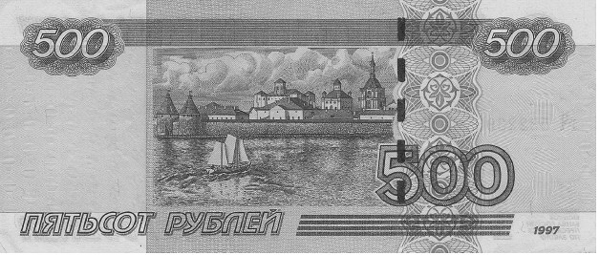
FIGURE 1. A 500-ruble banknote, which shows the Solovetsky Monastery as it looked in the late 1920s, when it housed the exemplary camp of the gulag. The banknote has been in circulation in the Russian Federation since 1995.
The post-Soviet series of banknotes showcase noncontroversial sites of national glory, from the Monument to the Millennium of Russia to the Bolshoi Theater. It is all but impossible to imagine that a concentration camp would be deliberately included among these images. But as I write, the 500-ruble banknote with pyramidal towers is still in circulation. This version of the note—a memorial to the Solovetsky camp, not the Solovetsky monastery—was continuously printed and reprinted from 1995 to 2011. The image survived several modifications of the note, including its redenomination in 1997, when the banknote of 500,000 rubles was exchanged for 500 rubles, with the same image of the concentration camp.2
Whether millions of Russians are aware of this or not, it is the mournful images of the Soviet gulag that they carry in their wallets, touch, handle, glance at, and exchange daily. But this site of memory is as warped as it is common. Perhaps the 500-ruble banknote carries a double message, representing the Solovetsky monastery for pedestrians and the Solovetsky camp for connoisseurs. With its layers and contradictions, this double image exemplifies the typical complexity of mourning for the Soviet victims. Sometimes the proverbial Russian censorship plays a role in these mourning games, but sometimes we know that censorship is not an issue. It would be brash to suspect the officials of the Central Bank of a subversive conspiracy, nor would I dare to speculate about their unconscious motivations. Probably the most realistic, down-to-earth way to understand this amazing banknote is to see it as a ghostly apparition. Whatever the actual design- and decision-making process that shaped the note may have been, the note’s cultural role is very close to that of a ghost. It is unknown who brought the banknote image into being, and how; the same is true for ghosts. The picture on the banknote reminds those who are in the know about a hidden secret of the past—a specialty of ghosts. This is probably how ghosts come to us these days, to haunt the public sphere and marketplace rather than aristocratic manors and deserted graveyards.
Though I do not know who created the 500-ruble banknote, I know who uncovered its meaning. A local scholar of the Solovetsky Archipelago, Yury Brodsky, noticed the unusual towers on the bill, identified the image as belonging to the gulag period, and published his revisionist story.3 As a result of this interpretative act, the meaning of a routine artifact changed from one of self-celebration to mourning.
Too Much Memory?
In contrast to the Nazi terror that featured a crystal-clear boundary between the victims and perpetrators, the Soviet terror targeted many ethnic, professional, and territorial groups. Though in some waves of terror the Poles, the Ukrainians, the Chechens, or the Jews suffered more than others, there were other waves when the terror chose Russians. Some of these operations focused on the peasants, and others targeted the intelligentsia, but some periods extracted a particularly heavy toll from the state and party apparatus. It was a rule rather than an exception that the perpetrators of one wave of terror became victims of the next. Though in every singular act of torture or murder the victim and the executioner were separated by an enormous distance, the fact was that a little later, in several months or years, the executioner would likely become a victim of the same treatment. This rotation makes it very difficult to reach any historical, philosophical, or theological—in fact, any rational—understanding of these events. Nikolai Shivarov, an investigator who forced Osip Mandelstam and several other poets and writers to acknowledge their “criminal” enmity toward the Soviet system, committed suicide as a convict of the gulag in 1940.4 After hundreds of thousands perished on the construction site of the Belomor Canal, the head of this construction project, Semen Firin, was sentenced and shot in 1937. After millions died in the gulag, its organizer and chief administrator, Matvei Berman, was sentenced and shot in 1939. Thousands of perpetrators were purged, arrested, tortured, and executed in the waves of repressions that decimated the bureaucratic bodies responsible for repressions, the People’s Commissariat of Internal Affairs (NKVD) and related bodies of the Communist Party, in Moscow and the provinces. Victims and perpetrators were mixed together in the same families, ethnic groups, and lines of descent. Sometimes they also found themselves mixed together in the same cells and barracks. Unlike their peers in the colonial domains of the socialist empire such as Ukraine or the Baltic states, who felt oppressed by a foreign power and were eager to resist it, and unlike even the peasants in Russian villages who perceived collectivization as the ruthless imposition of an urban and therefore foreign order, the victims from the Russian intelligentsia perceived the terror as senseless and monstrous precisely because it was self-inflicted. Indeed, at the Moscow trial of 1992 that failed to ban the Communist Party as a criminal organization, its attorneys produced a bizarre argument: since Communists suffered from “repressions” more than others, their organization could not be blamed for these crimes, even though it had organized them. Since their peers have already punished some perpetrators, this argument goes, there is no need to punish these people again.
If the Nazi Holocaust exterminated the Other, the Soviet terror was suicidal. The self-inflicted nature of the Soviet terror has complicated the circulation of three energies that structure the postcatastrophic world: a cognitive striving to learn about the catastrophe; an emotional desire to mourn for its victims; and an active drive to find justice and take revenge on the perpetrators. As in Shakespeare’s Hamlet, these three impulses—to learn, to mourn, and to avenge—compete for the limited resources of the melancholic mind. The suicidal nature of the Soviet atrocities made revenge all but impossible, and even learning very difficult. To learn about oneself is the toughest among the challenges of learning. Mourning, however, has had no limits.
There is no umbrella concept to embrace all the branches and institutions of the Soviet terror. In cultural memory, the Solovetsky camp represents the system of the gulag, and the gulag represents the Soviet terror. However, victims of the Soviet regime also suffered in many other institutions of the criminal state: during the arrest when the state came into their homes, searched their belongings, and separated them from their families; in investigative prisons, where the state applied the most inhuman (and illegal, under that state’s own laws) methods of torture; in various forms of “administrative exile” and “special resettlement” that broke up families and dictated where people must live, often forcing them to move to isolated and remote locations where conditions were so harsh as to be life-threatening; in grand-scale social experiments such as collectivization and forced industrialization, with famine and urban poverty as their results; and also in other institutions of disciplinary power such as psychiatric hospitals, orphanages, and, last but not least, the Soviet army, with its universal draft and endemic brutality.5
The popular word that renders the horror of the Soviet penitentiary system is “zona,” the fenced zone of a prison or a camp. “The zone” means everything that is the opposite of “freedom” (svoboda), which, in this usage, embraces all that is the life beyond the fence. “The zone” is, essentially, the gulag from the prisoner’s point of view. The institutional framework of the gulag is much broader, and I follow the tradition of using this concept, “gulag,” as an imprecise but convenient term for the whole variety of Soviet-era penitentiary institutions.6 Historically, the word “gulag” is the bureaucratic acronym of the Stalin-era’s State Administration of Camps, which was closed down in 1960. But the potential for meaningful generalization of this concept is huge. Veniamin Iofe, probably the most impressive intellectual of the Memorial Society, has defined the gulag as a kind of shorthand for Soviet oppression in all its forms. “Our compatriots still have the gulag within,” wrote Iofe in 2001.7 With this range of definitions, it is not surprising that the number of gulag victims is uncertain; the available estimates range between 5 and 30 million. Even the number of their official “rehabilitations” is unknown; it ranges, by different accounts, from 1.2 to 4.5 million. Indeed, the only certainty about the Soviet catastrophe, apart from its massive scale, is its very uncertainty. We do not have anything like a full list of victims; we do not have anything like a full list of executioners; and we do not have adequate memorials, museums, and monuments, which could stabilize the understanding of these events for generations to come.
Unlike the treatment of former Nazi officials in Germany, no professional ban was ever instated for former leaders of the Communist Party of the Soviet Union, let alone its rank-and-file members. Only negligible compensation has been provided to those victims who have been officially “rehabilitated.” Many more of those who were robbed by the Soviet Communists, such as the millions of collective farmers, for example, will never see any form of compensation whatsoever. This unfinished business is one of the reasons for the obsessive return of history in contemporary Russian culture and politics.
There was no external authority, such as occupying forces or an international court, to dispense justice; and there has been no serious philosophical debate in Russia, secular or religious, over problems of collective guilt, memory, and identity. Despite an attempt made in the early 1990s to initiate such a debate by the historian and gulag survivor Dmitry Likhachev (see chapter 4), Russian intellectuals have not produced anything comparable to the great book by Karl Jaspers, The Problem of Guilt.8 In Germany or France, denial of the Holocaust is a crime, but in Russia a politician or professor can disseminate propaganda for the Soviet past and ignore or deny its crimes without subjecting himself or herself to the slightest risk. While Europeans are talking about the “mnemonic age,” a “memory fest,” and a growing obsession with the past “around the globe,” some Russian authors complain about the “historical amnesia” in their country.
In fact, “nostalgia,” rather than “amnesia,” has become a fashionable word and an important element of post-Soviet culture.9 Allusions to the past make up an important part of the political present. Political opponents in Russia differ most dramatically not in their understanding of economic reforms or international relations, but in their interpretations of history. Discussions of current policy issues rarely go without reference to historical experience. Concepts and labels like “Stalinism,” “the cult of personality,” and “political repressions” are rhetorically employed as often as modern legal or economic terms. The events of the mid-twentieth century still make up a living, contentious experience that threatens to return again and therefore feels frightening and uncanny (see chapters 10 and 11).
In 2011, one of the most popular Russian journalists, Oleg Kashin, who had just recovered from injuries inflicted in a beating reminiscent of the manner in which the Soviet state treated its dissidents, said that Stalin was “the third person sleeping in every one of our beds. . . . Napoleon has long become a brand of cognac, and Stalin should have become the name of a kebab or a sort of tobacco, but we constantly drag him out of the grave.”10 Post-Soviet memory operates as a living combination of various symbols, periods, and judgments, which are experienced simultaneously. The present is oversaturated with the past, and this solution refuses to produce any sediment. As Tony Judt put it, in western Europe, the problem is a shortage of memory, but in eastern Europe and Russia, “there is too much memory, too many pasts on which people can draw.”11
Too much or too little, one thing is clear: the very nature of the Soviet terror makes it difficult to comprehend, remember, and memorialize. To the scholars of Stalinism, there is nothing more foreign than the German-Jewish idea of the uniqueness of the Holocaust, and the reason for this is not only the desire to receive the proper recognition for the victims of Stalinism on a par with the victims of Nazism but also the intuitive understanding of the multitude of “repressions”—genocides and democides—that constitute Stalinism.12 There were many waves of “repressions,” and most of them were repetitive, chaotic, confusing, and overwhelming. Even though their total numbers can be set forth in the homogenous language of demographic losses, in other respects they defy standardization, spread out as they were over a good part of the twentieth century and across the gigantic space of Eurasia. The descendants of these repressions’ survivors do not share the concepts that were crucial for the perpetrators and fatal for the victims. The “kulaks,” the “saboteurs,” the “bourgeoisie,” the “social parasites,” the “anti-Soviet elements,” and other “class enemies” were exterminated for belonging to these categories, which have no meaning for us.
Remembering the Soviet terror often entails disbelief that such things could have happened. This is a productive feeling, but the least appropriate response to it would be a redemptive narrative that demonstrates the functionality of terror.13 The victims’ suffering and the perpetrators’ intentions are both unbelievable in man-made catastrophes, and “suspension of disbelief,” a popular literary convention, cannot help us to learn their lessons. The Holocaust historian Saul Friedlander writes about disbelief as a deep and common response to the Nazi terror. He states that though a common goal of historical writing is “to domesticate disbelief, to explain it away,” the research on the Holocaust should resist this temptation.14 Scholars of the Soviet period should aspire to do the same. Writing history does not imply resolving its warped contradictions in a smooth, functional narrative. Making sense of the memory of the past does not require sharing its weird presumptions. We do not need to comprehend the murderer’s motives in order to mourn his victim, though many mourners do know the desire to understand what happened, and why, and what it meant.
At the end of the twentieth century, many influential thinkers, particularly in the field of economics, connected socialist ideas with Stalinism and claimed that striving for full equality and universal justice logically leads to state-sponsored terror. Yet we also know ample historical instances of terror committed for the sake of private property, both in colonial and domestic contexts. Whether socialism inescapably led to Stalinism or whether the latter was a result of unique and unfortunate choices and circumstances, there is no doubt that the Soviet regime compromised the ideas of socialism gravely, and maybe even irreversibly. As a result, mourning for the human victims of the Soviet experiment coexists with mourning for the ideas and ideals that were also buried by this experiment. This is double mourning, for the people who were murdered for the sake of ideas and for these ideas, which were also killed by this violence—a warped concept in itself.
The Work of Mourning
For many years, Nadezhda Mandelstam had a painful, persistent nightmare: she is standing in line to buy food and her husband, Osip, is standing behind her; but when she looks back, he is not there. Not recognizing her or not willing to talk to her, he walks away. She runs after him to ask, “What are they doing to you ‘there’?” But Osip never responds.15 Importantly, Mandelstam put the word “there” in quotation marks, as if she saw these quotation marks in her dream; though she had no way of conceptualizing “those” who had taken away her husband, she needed a grammatical fiction or placeholder, which remained unspecified but which, with an element of self-irony, she put into quotation marks.
It is not the pain of knowing, but rather the desire to know—“What are they doing to you ‘there’?”—that lies at the heart of mourning. This desire to know the unbearable is also a desire to share its burden, to express it in clear words or images, to tell the story—what “they” have done to him “there”—to the close community of equals, and then to others as well. At this stage, Victims’ Balls become textual; in other words, communicative memory about the terrible past flows into cultural memory, where it stays indefinitely.16 With a somewhat similar meaning, Walter Benjamin said that “memory is not an instrument for exploring the past but its theatre. He who seeks to approach his own buried past must conduct himself like a man digging.”17 Two barely compatible metaphors—theater and digging—reveal the problem of mourning. A man who digs into his own past is also a performer who plays his role in public. Whether he performs digging in the soil, in the archive, or in popular culture, this is a practical activity, the work of mourning. But this work does not end once the past has simply been dug up and revealed. Only when they become public, as in a theater, do these excavations of the past, buried and unburied, complete the work of mourning.
From Pushkin’s major works Boris Godunov (1825) and Eugene Onegin (1833), both of which analyze remorse for an unjustifiable murder, to Dostoevsky’s Crime and Punishment (1866), and then to Aleksandr Blok’s Retribution (1919), the classics of Russian literature provide spectacular templates for mourning, shame, and repentance. Rediscovering these classical examples after a long period of revolutionary enthusiasm, the late-Soviet culture produced its own ways of coming to terms with the horrible past. Three cultural genres led the Soviet mourning: literature, music, and film. In literature, mimetic mourning and political protest melded in such works as Boris Pasternak’s Doctor Zhivago (published in the West in 1957 and in Russia in 1988), Anna Akhmatova’s Requiem (1963, 1987), the memoirs of Nadezhda Mandelstam (1970–1972, 1999), Aleksandr Solzhenitsyn’s The Gulag Archipelago (1973, 1989), Varlam Shalamov’s Kolyma Tales (1978, 1987), and Vasily Grossman’s Life and Fate (1980, 1988). Another leading genre was music, a traditional medium of mourning that had the additional advantage of being impenetrable for the censors. Dmitry Shostakovich composed a series of major works that mourned the victims of the Soviet period, from his “Leningrad” Symphony No. 7 (1942) to his late works (1962–1972) that combined music with political poetry. I argue in this book that a number of major Soviet films belong to the same pantheon of mourning.
I rely on the concept of mourning more than on other concepts that have been tested in this field, most notably trauma.18 As Sigmund Freud classically defined it, mourning is an active, realistic, and healthy process. It has its limits, both in time and in intensity. It has its interminable counterpart, melancholia, though of course there is much uncertainty about the boundary between them. Freud was a great mourner in his late years, and the concept of mourning was at the center of his thinking, close to but different from the concept of trauma. Trauma is a response to a condition that had been experienced by the self; mourning is a response to a condition of the other. An individual subject who has suffered a trauma, such as shell shock, cannot represent the traumatic situation; this representational inability is precisely what constitutes trauma.19 In contrast, mourning is all about representation. Nadezhda Mandelstam knew exactly whom she lost, when she saw him for the last time, and what the circumstances of his arrest were. There is no such knowledge in trauma.
Remembering its losses, a postcatastrophic culture lives on through the subsequent generations, as the survivors who struggle with their traumas give way to the descendants who mourn the victims of the catastrophe. We mourn for our grandparents whether we remember them or not, and we mourn for the victims of the Jewish Holocaust or the French Revolution whom we do not remember. It is easier to understand Marianne Hirsch’s concept of “postmemory” as a domain of mourning rather than a domain of trauma or the posttraumatic.20 The alternative idea, that trauma with its subtle psychological dynamic can be passed down through generations, is conceptually more complex and empirically less verifiable.
Different in their relations to representation, the two conditions, mourning and trauma, are similar in relation to repetition. In mourning as well as in trauma, the subject obsessively returns to certain experiences of the past, and these returns obstruct this subject’s ability to live in the present. Sometimes—in those cases when, as Freud put it, the subject loses her ability “to love and work”—this obsession with the past is clearly pathological, but sometimes it is temporary and reversible. After World War I and the revolutions that ended it, Freud formulated his newest discovery, the “compulsion to repeat.” Easily explained by the pleasure principle when the repetition involved pleasurable gratification, it became a puzzle when, as Freud observed, the material and the process of repetition were both excruciating. It is not only that wounding experiences of the past turned into painful memories in the present. Freud discovered more than this: the past’s uncanny ability to contaminate the present. To account for this anachronistic phenomenon, Freud revised his whole system, looking far (though not far enough, in my opinion) beyond the pleasure principle. The new dichotomy that he devised juxtaposed remembering, which relates to the past as past, and repeating, which reenacts the past in the present.
Repetition and remembering make present selected features of the past. Refined by Shakespeare, Coleridge, and other connoisseurs of mourning, the English language renders the relevance of these time-bridging processes better than German or Russian, which do not have any precise equivalent for the English prefix “re-,” with its universal but deep meaning. Indeed, the word “representation” captures with elegance the mechanism of making the nonpresent relevant for the present, while “remembering” connotes, in a crisper way than is available to theory, reconnecting the lost member with its peers, the reciprocal relations between the reconstitution of the community and the return of its repressed, prodigal elements.
As Freud notes, his patients tended “to repeat the repressed material as a contemporary experience instead of, as the physician would prefer to see, remembering it as something belonging to the past.” The physician would prefer to see remembering, but like his distant colleagues, historians, he often sees repetitions. In remembrance, the past and the present are distinct; in repetition, they are fused, so that the past prevents the subject from seeing the present. The therapist’s duty is to short-circuit these cyclical reverberations of the past by helping the patient “to re-experience some portion of her forgotten life” so that it might be remembered rather than reenacted. “The ratio between what is remembered and what is reproduced varies from case to case,” but the patient needs “to recognize that what happens to be reality is in fact only a reflection of the forgotten past.” Commenting on this idea, the anthropologist Michael Taussig postulates a “double action”: the subject both reexperiences her past and distances herself from it; the subject is both in and out of this past, and it is at that point that she realizes that what she is confronting “is not the past but a memory.”21
In his introduction to the German translation of Dostoevsky’s The Brothers Karamazov, Freud gives a challenging example of the mimetic nature of mourning. Interpreting Dostoevsky’s epileptic seizures, Freud declares: “We know the meaning and intention of such death-like attacks. They signify an identification with the dead person, either with someone who is really dead or with someone who is still alive and whom the subject wishes dead.”22 Though mourning usually strives to revivify the past, it can also be anticipatory: the subject imagines or rehearses a future horror, something that he fears could happen, or something that he fears he will bring to pass through his own guilty desires. In this remarkable construction, Freud allows for the possibility of redirecting the energy of mourning toward other purposes, such as revenge, rebellion, or forewarning.
The dichotomy between repeating and remembering is central for Freud’s “technique,” but culture blurs these processes. Only an “impulsion to remember,” writes Freud, can overcome the “compulsion to repeat,” but the forces of resistance work against this process: “The greater the resistance, the more extensively will acting out (repetition) replace remembering.”23 On the stage of postcatastrophic memory, the dialectics of repetition and remembering produce warped imagery, which combines the analytic, self-conscious exploration of the past with its reverberations and transfigurations. Spirits, ghosts, demons, and other creatures conflate reenactments with remembrances in creative forms that can be naive or sophisticated, regressive or productive, influential or isolated. What we usually fear is the uncertainty of the future, but we often imagine this future as a repetition of the past.
Though Freud did not elucidate the overarching logic of his post–World War I works on repetition, mourning, and the uncanny, it can be formulated in a few simple words. If the suffering is not remembered, it will be repeated. If the loss is not recognized, it threatens to return in strange though not entirely new forms, as the uncanny. When the dead are not properly mourned, they turn into the undead and cause trouble for the living. Freud begins his famous essay “The Uncanny” (1919) by arguing that the uncanny is “secretly familiar,” something that “has undergone repression and then returned from it.” “Estranged . . . through being repressed,” an image feels uncanny and, moreover, frightening when it returns to the subject, writes Freud. In his literary analyses, Freud emphasizes a particular way of rendering the uncanny experience that later scholars would call “metonymic.” He notes that stories by E. T. A. Hoffman and other mystical romantics often feature “severed limbs, a severed head, a hand detached from the arm,” and other corporeal metonymies.24 The experience of the uncanny depends upon the lost and found members of human bodies, which are sometimes autonomous and sometimes incorporated into other, now monstrous bodies. Presenting living and dead human and animal parts in creative combinations is how people represent death and the world after it; Bakhtin described this method as “gothic realism” (see chapter 4). When a living or revenant part represents the perished whole, this part feels uncanny. The past is large, integrated, and self-sufficient; what returns from it is dispersed, fragmented, and scary. Freud’s formulas defined the uncanny as a particular form of memory, one that is intimately connected to fear. The combination of memory and fear is, precisely, the uncanny. The higher the energy of forgetting, the greater the horror of remembering. When ghosts talk to us, as the ghost of Hamlet’s father talked to Hamlet, they substitute someone whom we know: they speak in these persons’ voices, tell their secrets, and complete the business that they have left unfinished. But as Hamlet felt acutely, the act of recognition does not deprive a ghost of its strangeness and otherness. The uncanny is the strange turned familiar; the ghostly is the familiar turned foreign.
In matters of mourning, Freud based his distinction between the healthy and the sick on the subject’s ability to acknowledge the reality of the loss. But this distinction did not work well in the terrorized Soviet Union. Millions of victims were convicted for long terms of imprisonment “with no right of correspondence,” and long silences followed their arrests. Many were shot before they ever reached a camp; others returned months, years, or decades later. For millions of relatives and friends, the uncertainty was external and realistic rather than internal and pathological. Many prisoners were released earlier or later than the terms laid down in their sentences. Many died in the camps and prisons, but the news of their deaths might take years or decades to reach their families and friends. The sentence had little or no predictive value. The gulag did not provide reality checks for either hope or mourning. In an indefinitely large part of the Soviet experience, death could not be recognized as death, and survival could not be relied upon as life. The state, the source of the repressions, was also the only source of information.25 This is a condition of uncertain loss, in which the beloved person disappears for reasons that nobody understands; in which she may be alive and might possibly return; in which no information about the loss is available or trustworthy. However, what happens to mourning or melancholia in conditions of uncertain loss and untestable reality has not been theorized. What we know is that this condition is destructive both for the survivors and for the memory of the dead. As Jacques Derrida put it, “Nothing could be worse for the work of mourning than confusion or doubt; one has to know what is buried and where. . . . Let him stay there and move no more!”26
Psychoanalytic studies of posttraumatic syndromes in Germany suggest that traumatic experience is transmitted transgenerationally. The second, and even third, generations following a social catastrophe manifest “subnormal” psychological health and social performance, and this is claimed to be true both for the descendants of the victims and the descendants of the perpetrators.27 Following the classic study of “phantoms,” which was based on deciphering a secret language of Freud’s Russian patient Sergei Pankeev, some scholars believe that similarly subtle, mysterious mechanisms govern the transmission of transgenerational memory.28 I believe that before formulating such complex hypotheses, we need to look at what culture, high and low, presents in the plain view. In the modern world, novels, films, school textbooks, museums, monuments, guided tours, and, finally, historical studies present rich narratives about the past and transmit these narratives from generation to generation.29 Though this book employs some elementary ideas from psychoanalysis and deconstruction, it is predominantly an exercise in cultural studies, which I tend to reformulate as a historical discipline.
In Russia, a land where millions remain unburied, the repressed return as the undead. They do so in novels, films, and other forms of culture that reflect, shape, and possess people’s memory. The ghostly visions of Russian writers and filmmakers extend the work of mourning into those spaces that defeat more rational ways of understanding the past. Embracing the confusion of present and past, the obsessive reenactment of the loss, and the disturbed and disjointed nature of the relationship to the present, the melancholic dialectic of reenactment and defamiliarization produces a rich but puzzling imagery.
Clorinda
Analyzing the allegorical world of the baroque mourning play, Walter Benjamin believed that “pensiveness” is the most characteristic feature of the mournful. Other emotions alternate between attraction and repulsion; mourning is unique because it intensifies without ambivalence.30 Mourning has an unusual ability to deepen the contact with reality, but only with the reality that has vanished. Creative but isolating, this mournful world needs to be understood by others before its subject can attain relief from it. Like Freud’s study of the work of mourning (Trauerarbeit), Benjamin’s study of the Trauerspiel combined factual observations, personal projects of mourning, and recipes for relief. Freud wrote, “The inhibition of the melancholic seems puzzling to us because we cannot see what it is that is absorbing him so entirely.”31 Benjamin probably had this seminal text by Freud in mind when he stated, “the theory of mourning . . . can only be developed in the description of that world which is revealed under the gaze of the melancholy man.” Supplementing Freud, Benjamin proposed the rhetorical concept of allegory as the clue to the melancholic world. He saw “the will to allegory” as a kind of primary desire, which he confined to the internal structure of melancholy: “The only pleasure the melancholic permits himself, and it is a powerful one, is allegory,” said Benjamin.32
Exhuming the past buried in the present, the scholar watches memory turning into imagination. In the postcatastrophic condition, many authors and readers share a desire for a poetic reenactment of the catastrophic past, which they perform in their fictions. Referring to the mythical protagonists of the sixteenth-century Italian poet Torquato Tasso, Freud gives a striking example of this process. In a poem about the First Crusade, the knight Tancred kills his beloved Clorinda while she is disguised in the armor of the enemy. After her burial he finds himself in an enchanted forest that strikes the crusader with terror. At the height of his grief, he slashes with his sword at a tree; blood streams from the cut, and Clorinda’s voice tells Tancred that he has wounded his beloved once again.33
“I was Clorinda, not the only soul,
lodged here in rough, hard plants . . .
These branches and these truncks can feel. If you
hew down their wood, you murder what you hew.”34
Freud sees in Tancred’s action a compulsion to repeat: driven by this compulsion, he repeated his murder, and the process would replay itself without end. This element of Freud’s analysis of Tancred’s story has become a staple of trauma theory.35 However, Freud and his followers in the field of trauma studies do not do justice to other wonderful details of the story. As Tancred repeated his action, its object was transformed, magically but inescapably, from a living woman to her remote symbol, a tree. Tancred is the same, but Clorinda is different; she “was Clorinda,” she says. What Tancred meets in the magic forest is, the narrator tells us, “a simulacrum horrible and dire.” A noble savage, a female victim, and now a monstrous simulacrum, Clorinda is far more interesting than Tancred.36 However, we see and hear Clorinda’s posthumous experience through Tancred, who is alive and horrified but does not seem to be traumatized: he has not forgotten Clorinda’s words, but renders them as he heard them, in quotation marks. Tancred’s mourning takes the poetic shape of his lover hybridized with a tree and speaking, like a ghost imprisoned in a weird body, in a recognizable and familiar voice. Tancred, the mournful perpetrator, does feel a compulsive drive, but this is not a compulsion to repeat the murder. Rather, it is a compulsion to remember and reenact the lost love—a feat that can only be achieved using magical means. In this important example, Freud’s idea of compulsive repetition works only if we assume a “double action” in which Tancred physically reenacts the past and magically distances himself from it, acknowledges his loss and reincarnates the lost object, and turns the sensual reality of the beloved Clorinda into the fearsome imagery of the monster. For Tancred’s mournful mind, Clorinda transgresses many dichotomies that defined their earthly lives—between friend and enemy, man and woman, the living and the dead. His mourning for the lost, human Clorinda shapes the monstrous image of Clorinda-the-tree, which is now a figment of Tancred’s imagination. He incorporates in his mourning the major preoccupations of his peers, the crusaders—guilt, fear, gender ambivalence, exotic longings. Reflecting and revealing the major issues of their cultures, mourners follow Tancred in this mechanism that makes mourning a culturally productive—enriching and not only impoverishing—experience.
Another way of naming this relation between mourning and difference is to use a foundational concept of the Russian formalist school: estrangement, or defamiliarization. Estrangement, a creative variation in the repetition of the past, fights and often overcomes the Freudian death drive, that mechanism of eternal repetition of the traumatic memory. As Joseph Brodsky put it, what distinguishes art and literature from life “is precisely that they abhor repetition.”37 Even though Tancred reimagines his magic forest again and again, he also sees it as strange and different. Estrangement can be lifesaving for a mourner, and sometimes literally so; when mimetic performances come too close to the original loss, they can lead to suicide or homicide. Remembrance detoxifies repetition; healthy remembrance is about playing it safe. Mimetic mourning emulates but does not reproduce the loss, and the differences between the lost past and its mimetic model are no less important than their similarities. With the help of magic, humor, or analysis, the mourner develops markers of difference that enable her to vary the serial re-presentations of the past.
I believe that post-Soviet memory can be productively situated at the crossroads of three epistemologies, one of which is rooted in the Freudian psychoanalysis of mourning; another in Walter Benjamin’s idea of the second life of religious symbols in mass cultural products; and the third in Russian formalism, with its idea of estrangement. Magic is one toolbox from which mourners draw their markers of difference; artistic culture with its mechanisms of estrangement is another; and humor is a third. They are strange bedfellows, but their close relations to mourning are recognized every time mourners share ghost stories, gather for a meal, or write obituaries. Coleridge believed that “the terrible, by the law of the human kind, always touches on the verge of the ludicrous.”38 Benjamin remarked that “the pure joke is the essential inner side of mourning which from time to time, like the lining of a dress at the hem or lapel, makes its presence felt.”39 If humor is the inner side of mourning, the external side takes the form of the monument. If jokes often protect the mourner from mimetic excesses that could destroy his authorship, monuments mark the difference in a serious, ceremonial way.
There are museums on the sites of the Nazi concentration camps, and now on some sites of the gulag as well. The designers and staff of these museums strive to reconstruct the life and world of the camp in minute detail and with the greatest possible historical accuracy. Historians, curators, and architects take great care in their efforts to reproduce the material trappings of the original camp: the fence, the barracks, the watchtower. But at the center of this grim and gloomy zone these same historians, curators, and architects almost always erect a monument: an obelisk or a figure that is visible and recognizable, ideally, from every corner of the memorial zone. This double structure is visible in various memorials, created by different cultures: on the sites of Nazi camps in Germany and Poland; on the battlefields of the Civil War and on the sites of black slave rebellions in America; on the Russian battlefields of 1812 and 1941–1945. While the historical parts of these museums and memorials are all different, the monumental parts are more uniform, indeed all but universal, and this is striking. The obelisks were not there when the camps functioned as camps, but they seem to be essential when these camps function as museums. It is as if our historicizing drive to reproduce the horror of the past finds its limit precisely at the center of the site of memory, and this limit is marked out in such a way as to leave no part of the site untouched by its presence. Reproducing the past for the sake of mourning, we need a marker of difference to remind us and reassure us—powerfully, centrally, and unmistakably—that this is only mimesis and not an original. This obelisk is a functional analogue for quotation marks, as dominating in the field of vision as they are in the field of text. Quotations are all different, but the signs marking their boundaries are the same.40 As mourners, we need to see all the original camp details, but we do not want to return to the camp, because to do so would be all but suicidal. Like quotation marks, the obelisk highlights the difference between the present and the past, the copy and the original, the reenactment and the act. The obelisk provides us with the certainty that enables us, “in spite of everything, to recognize that what happens to be reality is in fact only a reflection of a forgotten past.”41 Take note of Freud’s “in spite of everything”: a mourner’s drive to repeat, reenact, reimagine—her death wish—is enormous. In many cases, only humor—a construction that is lower than obelisks but sometimes more powerful—protects the subject by estranging the past.
Quotation marks, monuments, humor, and interpretation—these are all indispensable elements of cultural memory that were simply not there in the past, when the events happened for the first time. In respect to the past, truth claims are fluid, as are their relations to the ethical or political concerns of the present. As Russian examples generously teach us, yesterday’s truth may differ from that of today. Cultural memory is a living realm that changes with history. Works of fiction that do not claim truth (for example, historical novels) or genres with unverifiable validity (for example, memoirs) are crucial genres of memory. In a democratic society, various institutions compete in their striving to patrol the borders between truth and myth in the representation of the past. With the passage of generations, the borders between myths and truths shift and curve. These movements of truth in the space of memory comprise, in their turn, an important part of cultural history.
The contemporary descendants of the victims of the Nazi terror now live in conditions that are vastly different from the conditions in which their forebears lived and died. Today, however, many of those who are shaping cultural representations of both the Nazi Holocaust and the Stalinist terror belong to the third postcatastrophic generation. They rarely own oral histories or family photographs, but they all operate within the public sphere, with its variety of multigeneric cultural products.42 In post-Holocaust Europe the process of mourning embraces the descendants of the victims as well as the descendants of the perpetrators: with the passing of generations, their mutual hatred is transformed into a coparticipation in mourning. For the third generation after a catastrophe, joint mourning has a reconciliatory, cosmopolitan potential. If memories of the Holocaust helped shape the new, potentially pan-European culture of human rights, memories of the gulag, famines, and other socialist atrocities have also contributed to the formation of Western ideas of rights and recognition.43 However, these ideas become less certain when one crosses the well-guarded borders that segregate Europe into its western and eastern parts. There in the East, memories of the socialist terror are salient and militant, as are memories of World War II. The Soviet regime disappeared forty-five years later than the Nazi regime, and its collapse was entirely different (see chapter 10). In this part of the world, tragic stories of the socialist past are still more divisive than economic or political issues of the present. The living generation remembers the serial catastrophes of “real socialism” and lives through its never-ending “transition” to another condition, which is still as distant as the horizon. Rather than sharing the multidirectional experiences of suffering and emancipation, various groups—ethnicities, generations, and even professions—cultivate their different versions of the past, versions that shape their identities, define their friends and foes, and endow their changed and changing worlds with meaning. In this lively situation, memory wars are inescapable. They are fought between those who claim to feel compassion for the victims and those who insist on their continuity with the perpetrators. They are fought between national states, political parties, and cultural figures. And they are also fought over interpretations of cultural artifacts, such as the Solovetsky banknote, and the films, novels, pictures, and sculptures that I discuss in this book.