
5
In 1944, the secret police arrested the young philologist Tatiana Gnedich. She would spend twelve years in the gulag, mainly because of her acquaintance with Leonard Wincott, a British Communist who worked in Leningrad and later also spent years in the camps. In prison, Gnedich produced what became the definitive Russian translation of Byron’s Don Juan. She memorized both the original and her translation, and the investigator was so impressed that he supplied her, against the rules, with paper and pen. Released in 1956, she found temporary board with my uncle, the translator and scholar Yefim Etkind. She had two cherished possessions: her translation manuscript and the quilted jacket that had kept her warm through the years. The jacket stank, and Yefim threw it away despite Tatiana’s protests; it could not stay in his communal apartment. Later, Yefim introduced Tatiana to a famous theater director who staged her translation of Byron with huge success. This launched her career, though Yefim wrote that in her later translations, she would never approach the level of her prison work.1
In his memoir, Yefim could not reconcile his two feelings: his disgust at the filthy jacket that was Tatiana’s personal site of memory, and his veneration for her talent, which enabled her to produce, huddled under this jacket, an astonishing cultural achievement. These feelings had to be kept separate; though they focused on one and the same person, they had nothing in common. Two sentiments that the compassionate public felt toward the survivors of the camps—fear and shame, on the one hand, caring concern and admiration, on the other—knew no compromise. But still, one had to live with both feelings. There was no place for a gulag survivor’s quilted jacket in a friend’s home; but throwing it away was not a guarantee that it would not return in disguise. Indeed, Yefim notes in the same sparkling memoir that Gnedich’s precious manuscript, the cherished translation of Don Juan that she brought from the camp, stank as much as her jacket.2 But there was no way to dispose of these papers.
The Unbearable Quilt
Though many details of the Gnedich story are extraordinary, the presence of a wandering, southerly Don Juan in the cold, solitary confinement of a Leningrad prison was not.3 In 1933, Osip Mandelstam spoke about “the longing for world culture” as a definitive characteristic of his poetry and a broader literary movement (see chapter 4).4 This longing was much more than a desire to worship the classics and expound on great texts. It was also a mode of self-expression, the only one available to these authors who were working in an environment of increasingly tight censorship and surveillance. As the émigré musicologist Henry Orlov wrote in 1976 about Dmitry Shostakovich, “quotations, . . . ellipses and hints, had developed over the decades into a special method of self-expression. . . . Shostakovich excelled in making gestures of reassurance to the prison guards while surreptitiously releasing his true thoughts to the world outside.”5 Many others, Mandelstam included, were less effective at this double-pronged writing, and, in any case, literature could hide less than music.
Hannah Arendt’s idea of worldliness makes the meaning of Mandelstam’s terminal “longing for world culture” more explicit. Writing about “humanity in dark times,” Arendt revealed how people respond to the collapse of the public sphere by pressing up against each another, eliminating distances and defenses, and mistaking “warmth” for the “light” that only the public sphere can provide. This is how they develop the “unworldliness” that is characteristic of pariahs. “The world lies between people,” Arendt wrote, but oppression or persecution destroys this “in-between.” Those who have been formed by “dark times,” she wrote from experience of her generation, “have been inclined to despise the world and the public realm, to ignore them . . . in order to arrive at mutual understandings with their fellow men without regard for the world that lies between them.” Arendt contemplated a peculiar theory of emotions, which she defined by their relations to the world: fear shrinks back from the world and hope overleaps it, while laughter and anger reveal and expose the world. “Under the pressure of persecution the persecuted have moved so closely together that the interspace which we have called world . . . has simply disappeared. This produces a warmth of human relationships which may strike [us] as an almost physical phenomenon.” Human warmth could help people to survive but did not compensate for the loss of the world: “for what was wrong, and what no dialogue . . . could right, was the world.” Such world-less networks Arendt saw as characteristic for pariahs and, even worse, barbarians: “worldlessness, alas, is always a form of barbarism.”6
Arendt’s analysis helps to reveal the mechanism of those remarkably tight groups of mutual support that many memoirists depict in the Soviet communal apartments, in intellectual salons, and sometimes even in prison cells: “a nexus of intimacy and terror,” as Irina Paperno calls it.7 Longing for world culture was a defense or maybe a compensatory mechanism for those who felt smothered by these tight, warm groups. As a classical analysis of Mandelstam’s poetry showed, the poet identified these close-knit communities with the rhetorical tautologies that they produced, and he hated both.8 It is no surprise that Mandelstam did not survive the worldlessness of the camp life. In the same essay on “dark times,” Arendt emphasized freedom of movement as a primary condition for connecting with the world, something that she found even more important than freedom of thought. Indeed, there is no better way to deprive people of the world than to restrict their movement; this was the rationale of the gulag. And of course nobody was less worldly than the pariahs of the camps like Mandelstam, the goners who were desperate and exhausted to the point that they did not express their pain, did not communicate with their peers, and did not tell their stories.
Agamben notes that only victims could possibly tell the truth about the camps.9 Survivors wrote memoirs, not victims; the latter often lost their ability to tell their stories well before their physical death. Survivors did not share the most extreme experiences of the life in the camp, such as scapegoating or terminal illness, because these experiences made survival impossible. In the Soviet camps, however, all the boundaries—between victim and perpetrator, between victim and survivor, between bare life and vita activa—were more fluid than in the Nazi camps. As we have seen, some of the perpetrators ended up in the gulag just a few months or years after their victims. Many survivors were psychologically mutilated to such an extent that they also qualify as victims. Some survivors retained their true belief not only in the Communist idea but even in the progressive nature of the gulag.10
Addressing the Soviet camps in her memoirs, Nadezhda Mandelstam resolved the paradox of witnessing in the same way that Agamben did decades later: “Only those who were about to perish in the camps, but accidentally survived, can testify about them.”11 She had already learned that she had lost her husband to the gulag, and she had read both Shalamov and Solzhenitsyn. These authors introduced the world of the gulag from two opposing perspectives, the former from the perspective of a goner and the latter from the perspective of a survivor.12 In his pathbreaking portrait of a convict, Solzhenitsyn presented Ivan Denisovich, a shrewd jack-of-all-trades whose folksy vitality would endure the gulag. One of those soon-to-be-dead who, by an arbitrary quirk of fate, was saved by a camp doctor, Shalamov described his characters as semicorpses whose suffering from hunger, labor, and humiliation deprived them of any decency or hope. While Solzhenitsyn presented his experience of survival as a moral lesson for humankind, Shalamov steadfastly denied any value in the gulag experience. Individual survival could be accidental, or it could be earned by skills and tricks like those that Ivan Denisovich demonstrated; for Shalamov, the vanity of survival was as absurd as the whole gulag system. In one story, Shalamov presents deliberately variegated people (generals, kolkhoz members, religious sectarians, and so forth) who are all hungry and exhausted. They are alive mainly because they do not have the energy to die; when, after a change in the camp leadership, they are suddenly given a proper meal, the strongest of them, a sectarian, responds by attempting to escape, and is shot dead by the guards.13 The minimalist form of Shalamov’s literary work—his hatred of what he called “belletrization,” the seeming lack of organization in his Kolyma Tales, and the multiple repetitions that are conspicuous in his writings—exemplify his refusal to inscribe meaning into suffering.14 Shalamov’s characters are not heroes or martyrs. They are victims who are sometimes endowed with a rare understanding of their fate. This ability distinguishes them from bare life, and it is fairer to understand them as “radical stoics,” as Walter Benjamin described some characters of the German “mourning plays.” In Benjamin’s analysis, these characters respond to the external state of emergency with “the stoic technique,” which builds up a “fortification against the state of emergency in the soul.”15 In both Benjamin and Shalamov, these radical stoics are “anti-historical creation[s]” in the sense that, as Benjamin commented wryly, they do not seem historically real.
There are several ways to invest redemptive meaning in the gulag experience.16 The functional argument speculates that terror was instrumental for the state, and therefore those who understood its function and collaborated with the state were heroes. The survival argument proposes that survival in the gulag required rare human qualities, and therefore those who survived the gulag were heroes. The witness argument posits that the survivors’ mission was to tell the truth about the gulag, and therefore those who survived in order to bear witness were heroes. Shalamov is the best singular source for disproving these arguments individually and all at once. In one of Shalamov’s stories, the narrator speculates that a horse would not survive what he had survived. This narrator saw no more meaning in his labor than a horse would; strikingly, Shalamov did not try to find consolation in his authorship either. Primo Levi wrote that he wanted to survive Auschwitz so that he could bear witness; Shalamov never said this. Having survived three terms in the gulag and, between and after these terms, many years of Soviet life, Shalamov died in a retirement home in Moscow in 1982. To one visitor, this facility looked like a gulag: “the smell of urine, dirt, and rot . . . a huge broad corridor and on its vinyl floor, entirely helpless people were crawling.” Deaf, convulsing, and delusional, Shalamov was one of those people; still, he was composing poems.17 The monument on Shalamov’s grave was vandalized in 2002; robbers removed its bronze head from the granite pedestal. Meanwhile, the house in Vologda where he was born is now a museum. Against his own wishes, it is as a witness to the gulag that Shalamov is remembered today.
Dominick LaCapra distinguished between two typical responses to a trauma, the constructive “working through” and the obsessive “acting out” of the disturbing event.18 I would add a third mode, “making sense” of trauma or catastrophe. Affirming himself by creating zones of exception, the sovereign denies responsibility for the abuses committed in these zones. But with the passing of time and with the scale of abuses revealed, the sovereign changes his strategy. His last resort is a redemptive narrative, which in the Soviet context presents victimhood as sacrifice and suicidal perpetrators as cruel but sensible strategists. Psychologically, this sacrificial interpretation responds to the desperate need of descendants to find meaning in their losses. Morally, it amounts to normalization of the terror that killed millions. Historically, it requires the service of hired professionals who are paid to produce a smooth narrative of a false and tragic variety. Politically, it enables the continuity of the state with its obsolete self-definitions of sovereignty. An alternative solution to the conundrum of post-Soviet memory is the recognition of the “unjustified” (Khrushchev) and “senseless” (Shalamov) nature of the terror. Terror has no positive meaning or function; the assertion of any such function borders on justifying the enormous suffering of its victims. Self-conscious negativity, on the other hand, is a difficult strategy; not for nothing was Shalamov accused of nihilism.19 I would see his position rather as existentialist.
Taken together, the textual portraits of Shalamov’s goner and Agamben’s homo sacer bear an unmistakable resemblance to yet another figure that embodies the tragic flow of history, Walter Benjamin’s “Angelus Novus.” Contemplating a drawing by Paul Klee, Benjamin describes the angel of history. “Where we perceive a chain of events, he sees one catastrophe.” This warped creature would like to stop the flow of history and awaken its dead victims, but he is not free to do so; the “storm irresistibly propels him into the future to which his back is turned. . . . This storm is what we call progress.”20 In Benjamin’s time, this angel’s final destination was the camp. Benjamin’s soon-to-be-fallen angel gazes compassionately, though helplessly, at a soon-to-be-dead convict.
Soviet Surrealism
Unlike Catholicism, Eastern Orthodox Christianity did not develop any equivalent of the doctrine of purgatory, which played such a prominent role in shaping the ways in which pre-Reformation Europeans imagined life after death and the possibilities for talking with ghosts. Also relevant for the roots of Soviet culture, the Jewish tradition did not have this doctrine either. This lack may be one reason why the Soviet and post-Soviet cultures in their longing for world culture have tended to be indiscriminate in their appropriation of the Western imagery of the undead. In the early phases of this process, in the 1950s and 1960s, it was specifically Catholic (and often Counter-Reformation) imagery, from Dante to Bosch to Goya, that the Soviet authors chose as particularly close to their needs.21
These references were central for the most important Russian artist among the gulag survivors, Boris Sveshnikov (1927–1998). During his eight-year-long term in a labor camp in northern Siberia from 1946 to the end of 1953, and then during his long life after his release from the camp, Sveshnikov created amazing works of art that throw a new light both on the gulag and, more generally, on the Soviet experience. Entering the camp when he was nineteen, he developed a surprisingly mature understanding of what had happened to him and to his country. One of his camp drawings interprets power as a monstrous blade that shaves the town, an operation that is consistent with the sovereign’s narcissistic gazing at his own reflection, and with the treatment that the naked citizens—bare, tortured life—receive under his command. Well composed as a whole, this picture also works like a comic book, or a Russian icon, with the successive stages of the story unfolding simultaneously on a single page. While the sovereign’s hand shaves the city in one part of the picture, the citizens are undressed and prepared for the worst in another; to the left, a terminal broom is already sweeping away their remains. A deeper look reveals in this fascinating drawing a satire on the Hobbesian sovereign who treats his victimized citizens as though they were whiskers of his beard, human trash that he shaves off the state body at will.
Some of Sveshnikov’s camp pictures emanate a pure horror. In one drawing, ratmen perform mysterious experiments on human females in a prison or a laboratory, a place that looks and works like the gulag. An analogy to Sveshnikov’s drawing is the famous series by the American artist Art Spiegelman, who rendered the horror of the Holocaust by showing its victims as mice and perpetrators as cats.22 But in Spiegelman’s work, the victims are mice; in Sveshnikov’s pictures, the perpetrators are rats.
Sveshnikov was sent to jail when he was nineteen, after a fellow student bragged that he was planning to kill Stalin. Sveshnikov spent eight years in a remote camp in the Northern Urals for his acquaintance with this would-be assassin. By his own account, he was already a goner when a chance visit saved his life. The visitor was Arkady Steinberg, a doctor at a larger camp, himself a prisoner who was serving his second term. A charismatic personality, Steinberg was an officer who was decorated for his heroism in World War II, a trained artist, poet, and translator. In the gulag where he spent eleven years, he went through medical training and became a camp doctor. His colleagues, members of a powerful but risky profession who sometimes felt sympathy for intellectuals, also saved other celebrated survivors, such as Varlam Shalamov and Aleksandr Solzhenitsyn.23 On the walls of Steinberg’s hospital, Sveshnikov found reproductions of his beloved Dutch and Italian artists. After his recovery in this hospital, Sveshnikov worked as a night watchman in a workshop, a privileged position that Steinberg helped him to obtain. This meant that Sveshnikov was able not only to survive, but to spend time working on his paintings, for which he reportedly used the hospital linens, the ink that his parents brought him on their annual visits, and oils that the camp was allocated for propaganda purposes.24 Rescued by a Latvian ex-prisoner and then by an American collector in a feat of cosmopolitan memory, many of Sveshnikov’s works are now kept in the Zimmerli Art Museum in New Brunswick.
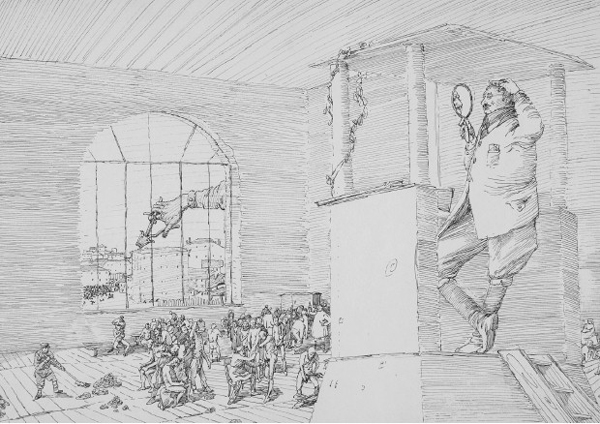
FIGURE 2. Boris Sveshnikov (Russian, 1927–1998), Untitled, n.d. Ink on paper 27.9 x 39.3 cm (11 x 15 1/2 in.). Collection Zimmerli Art Museum at Rutgers University, Norton and Nancy Dodge Collection of Nonconformist Art from the Soviet Union 2003.0872 / 21097. Photo by Jack Abraham.
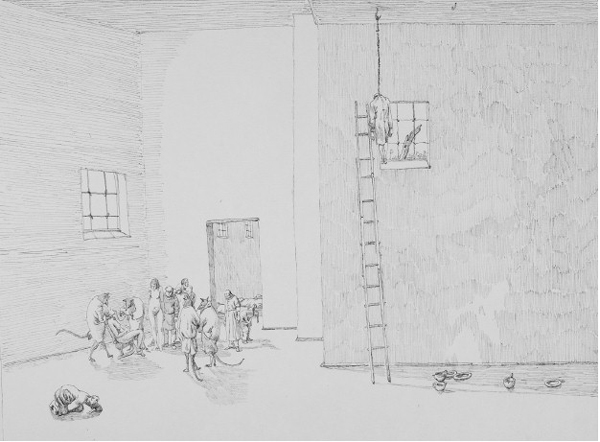
FIGURE 3. Boris Sveshnikov (Russian, 1927–1998), Untitled, 1949–1950. Ink on paper 28.3 x 37.8 cm (11 1/8 x 14 7/8 in.). Collection Zimmerli Art Museum at Rutgers University, Norton and Nancy Dodge Collection of Nonconformist Art from the Soviet Union D22301. Photo by Jack Abraham.
Let’s look at one of his paintings, which presents the camp experience in a strikingly unusual way. We see a dramatic confrontation between two men, one leading the other to an unknown destination, a service, perhaps, or an experiment. With a cross on his robe, the leader looks like a priest or monk. The contorted movement of his hands, which we see but the other man does not, betrays the leader’s tension and doubts. He appears to be wringing his hands, in despair or in supplication. With his twisted and restrained movement, the second man looks like a sacrifice in a ritual that the first man is performing, albeit reluctantly. The leader seems to look upon the victim with sorrow; the victim’s face is calm, as if he has accepted his destiny. He is dressed in a robe that leaves his back naked and defenseless; one might see some eroticism in this image. If we assume that the first man’s robe is of the same fashion, then the second man is looking at the naked bottom of the first man. They are looking at one another and we are looking at them; we are trying to grasp what the hell is, literally, going on here. The figures are set against the background of a northern landscape that looks like Sveshnikov’s camp, which he depicted in many drawings: the camp is cold, inhuman, and strangely elegant in these pictures.
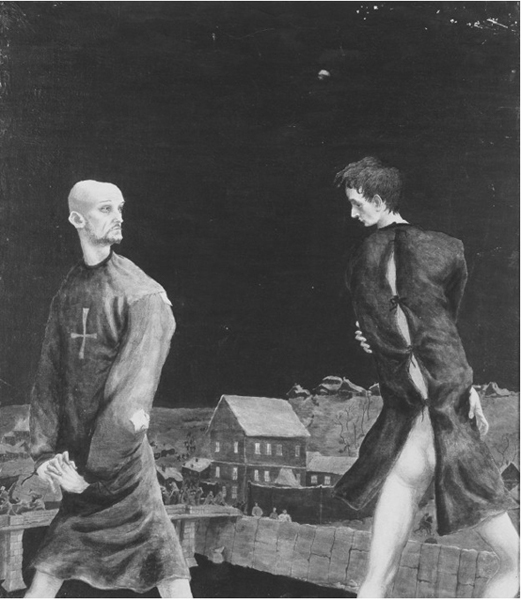
FIGURE 4. Boris Sveshnikov (Russian, 1927–1998), Encounter, n.d. Oil on linen on panel 80.1 x 70 cm (31 9/16 x 27 9/16 in.). Collection Zimmerli Art Museum at Rutgers University, Norton and Nancy Dodge Collection of Nonconformist Art from the Soviet Union. 2003.0750 / 21676. Photo by Jack Abraham
While some aspects of this image, such as the architecture of the camp, are historically correct, other aspects are fantastic. There is no doubt that crosses were not allowed in the gulag, and that the inmates’ winter uniforms were anything but sexy. Uncanny images of memory combine faithful representations of the past with deep, frightening transformations of that past. It is precisely in these transformations that the agent of memory invests his feelings about the past. The proponents of nonrealistic styles in art, such as expressionism or surrealism, made this discovery long ago: the subjectivity of the artist expresses itself in the distortions of the visual image. In fact, I think that human memory generally works in this way. We would understand it better by analogy not with realist art but with expressionism or surrealism, with their distortions for the sake of expression.
Walter Benjamin’s essay on surrealism (1929) helps to appreciate Sveshnikov’s art in the camp. Benjamin wrote this analysis of the French artistic scene after his visit to Moscow, and used a recognizably Russian term in its subtitle: “Surrealism: The Last Snapshot of the European Intelligentsia.” In this essay, Benjamin proclaimed the idea of the collective body as the key to the new poetics and politics. “The collective is a body, too,” claimed Benjamin, and cited Trotsky in confirmation of this idea. According to Benjamin, building a collective body needs ecstasy that may come from two sources, intoxication and revolution. Surrealists were too engaged in the former and too little in the latter, lamented Benjamin. But intoxication does not necessarily come from drugs, Benjamin said: the “most terrible drug—ourselves . . . we take in solitude.”25 Despite this melancholic clause, Benjamin’s essay is infused with sublime revolutionary hope. If Benjamin and some of his surrealist heroes called for revolution, Sveshnikov—also a visionary—found himself on the opposite slope of the historical pass from revolution to disenchantment. Many of his drawings are sharp criticisms of that very concept of the collective body that both Benjamin and Bakhtin ventured to glorify and mourn. Having drunk his fill of the “most terrible drug” of solitude, Sveshnikov developed an anti-utopian imagery that could be compared only with the great twentieth-century novels of this genre.
In a series of camp drawings and paintings, Sveshnikov presents scenes from a fabulous collective feast, with abundant food, drinks, sunshine, and flesh, a very Bakhtinian imagery in which the top and the bottom gleefully swap places. This carnival is set in an unidentifiable historical time, as if Sveshnikov did not hope to find it among his contemporaries and did not want to leave a clue any more specific than “world culture”; the gulag is surely one of the last places we would expect to find this sumptuous feast. Exaggerated, naked female bottoms are a permanent presence in these images. One can understand these almost all-female, sunny, hedonistic, and gregarious images in a structuralist way, as a binary opposition to the all-male, frozen and hungry world of the camp: a dreamlike compensation for the actual horror of life on the edge of death. But the light is too intense and the voluptuous bottoms too heavy, and we feel a healthy dose of self-irony in this man’s fiction. Sveshnikov’s fantasies of unavailable sex could be quite vicious, as in a drawing in which a naked woman is making love to a gigantic, bipedal fish, or one in which rats pump air into the naked bodies of pretty women. Sveshnikov’s friend remembers him as a person who was “invariably sad,”26 and his transgressive, carnivalesque feasts are disturbing rather than cheerful.
Sveshnikov’s camp pictures offer an endless variety of images of horror. In one frightening painting, we see two skaters, one of them with a grinning skull, the other still living. Compared to the previous couple, the monk and his companion, these two skaters have successfully adjusted to their environment. Accompanied by a devilish orchestra, they skate vigorously and in step, a gesticulating corpse and a man with steady eyes that look straight at us. The image is discomforting, as if he were begging us to hold his gaze, pleading to be remembered before he is taken away forever. Sveshnikov’s art set the uncanny images of the camp against a universal, pan-European background, which the artist borrowed mainly from Dutch and Flemish predecessors, gloomy witnesses of the Counter-Reformation and the Thirty Years War.
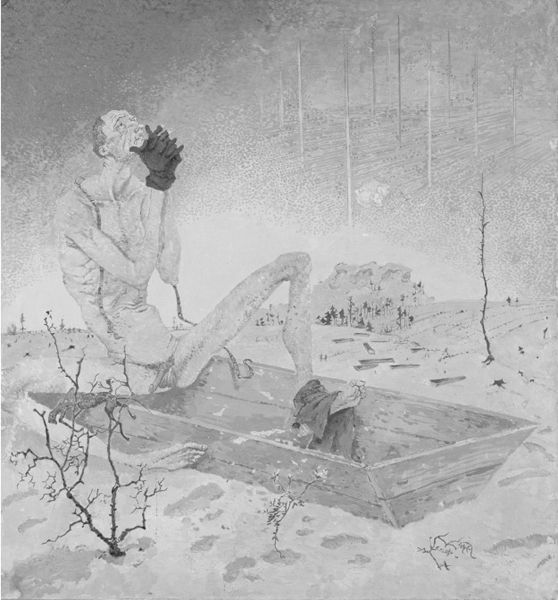
FIGURE 5. Boris Sveshnikov (Russian, 1927–1998), The Coffin Maker’s Workshop, 1961. Oil on linen 79.5 x 74.7 cm (31 5/16 x 29 7/16 in.). Collection Zimmerli Art Museum at Rutgers University, Norton and Nancy Dodge Collection of Nonconformist Art from the Soviet Union. 2000.1462 / 16784. Photo by Jack Abraham.
Sveshnikov told the story of the gulag from the perspective of its victim, of a goner. Later, in 1961, Sveshnikov portrayed this figure as a man already in the coffin; praying to the heavens, at the same moment he enjoys his still-erect penis, the only drop of color on his bloodless body. This is probably the best image of a goner, to which only some of Shalamov’s stories can add a thing or two. But with his baroque propensity for historical image-making, Sveshnikov presented the camp and the world in a way that was profoundly different from Shalamov’s minimalist stories. Unexpectedly, Sveshnikov feels closer to Bakhtin’s Europeanist imagery.27 Theirs was tortured life perceived through “longing for world culture.” Both Bakhtin and Sveshnikov were wise enough to see themselves alienated from their carnival scenes in the position of the outsider that, for better or worse, is intrinsic to both the historian and the artist.28
When the young historian of art Igor Golomstock saw Sveshnikov’s art for the first time in the late 1950s, he identified him as “our home-grown surrealist.” But he also thought that the sense of solitude that emanated from Sveshnikov’s pictures was different from European surrealism as he knew it. After meeting Sveshnikov, Golomstock learned that Sveshnikov had not even heard the word “surrealism” when he was arrested in 1946, and had elaborated his ideas and images independently, in the isolation of the gulag.29 At the time, Sveshnikov gave the impression of a person who “had not entirely melted after the camp.” Golomstock introduced him to Andrei Siniavsky, and Sveshnikov’s art became for this generation of mourners one of the very first sources of their imagery of the terror. Indeed, these uncanny fantasies became available to Golomstock, Siniavsky, and their friends before they read those texts, from Bakhtin to Shalamov, that help us today to understand both Sveshnikov and the gulag. It is no wonder, then, that Siniavsky should have gone on to author his own appreciative essay on Sveshnikov, though he did so only after he had served his own term in the camp. Siniavsky particularly admired the double meaning of Sveshnikov’s drawings, which both are and are not about the camp: “Anyone who didn’t know this was a camp would never guess it.”30 Siniavsky’s essay on Sveshnikov was clearly autobiographical: he eagerly identified his own camp memory with Sveshnikov’s much earlier one. No less informed about the camps (see chapter 6), Golomstock saw in Sveshnikov’s drawings and canvases “something akin to the post-apocalyptic: it was as if time curdled and the artist contemplated the still new, inexplicable offspring of human life.”31
Mourning Plays
In a recent essay, the anthropologist Alexei Yurchak describes a group of Leningrad artists who became active in the late 1970s and called themselves Necrorealists. They were focused on death, the dying body, and what they called “non-corpses.” They pored over medical atlases and luxuriated in the gory details of death by hanging and other, preferably slow, ways of dying. They owned a lifelike, uncanny-looking human mannequin, which they would beat in public spaces, shocking passers-by. In 1984, this group staged a brawl in central Leningrad on the fifth floor of a building, from which they were visible to the pedestrians below. Screaming, they continued their wrestling until their leather mannequin fell down to the street. Its head tore off, the crowd was furious, and the police arrived. Though the police saw this action as a “provocation,” they struggled to come up with an offense with which to charge the group. According to Yurchak, at first the Necrorealists produced these mimetic scenes as a kind of street theater or living installation. From early on, however, their performances developed into individual practice rather than public art. One of the group spent nights all alone in the forest, “as if becoming for a night neither a man nor an animal but both, like a folkloric werewolf.”32 Later, in the 1980s, the group wrote stories and produced films that developed its favorite theme of the dying, wandering non-corpses. Yurchak draws a parallel between this repetitive imagery and David Cronenberg’s movie Crash (1996), whose protagonists obsessively reenact car crashes; Cronenberg explained his film as “a metaphor for those people who undergo life-shattering experiences . . . and [are] finding strange ways to relive that experience and so come to understand it.”33
The leader of the group, Yevgeny Yufit, directed several “necrofilms” that feature werewolves, man-tree hybrids, and other mute, violent mutants that are by-products of some Soviet scientific experiment. As Yurchak writes, “The more the Necrorealists turned to artistic projects the more their texts, installations, and films became populated by human, semihuman, and hybrid life-forms.”34 Having discovered this fascinating group of lay artists and introduced them to the global audience, Yurchak interprets their actions in Agamben’s terms. The Necrorealists, he says, pursued a “politics of indistinction,” which aimed at suspending known political identities and exploring bare life. According to Yurchak, these artists purposefully created a space that made them indifferent to the Soviet system within which they had to live and experiment. In a larger study, Yurchak has elevated this zone of indistinction between the political and nonpolitical to being the leverage of the Soviet collapse.
At this point, it is worthwhile to recall Agamben’s original way of using these concepts, bare life and zone of indistinction: “Testimony [about the camps] . . . takes place where the silent and the speaking, the inhuman and the human enter in a zone of indistinction in which it is impossible to establish the position of the subject.”35 Like Eric Santner with his concept of creaturely life, Yurchak presumes the ability of bare life not only to express itself artistically but also to understand itself in creative, “bioaesthetic” ways that are incomprehensible to the sovereign state. This would be unimaginable for Agamben’s Muselmann or Shalamov’s goner. Yurchak is clearly talking about memories of bare life and mournful reenactments of suffering, which are cultural processes that involve contemplation and aestheticization, rather than about the actual experience of dying, which is largely incommunicable and foreign to anything aesthetic. Reading the explications that Necrorealists have given for their own actions, Yurchak follows them too closely. Like his subjects, he shuns a connection between their performances and a very specific situation of post-Stalinist Russia. He believes that the rich imagery of the Necrorealists is “interested not in death but in alternative forms of vitality,”36 a concern that he connects to biopolitical problems of clinical death, euthanasia, and other modern difficulties with distinguishing between life and death. It remains unclear why these Soviet artists of the late 1970s and early 1980s were “intuitively concerned,” as Yurchak puts it, with these issues years earlier than European intellectuals discerned their importance, and decades earlier than Russian intellectuals noticed them. Rather than connecting the cultural production of the Necrorealists to the global and distant future, I would rather link them to the immediate Soviet past.
Offspring of the uncompleted Thaw, Yufit and his followers performed the work of mourning for the victims of Soviet terror in a fresh, innovative idiom. Along with many late-Soviet artists, musicians, writers, and filmmakers, they played out their Victims’ Balls. Their mimetic reenactments of violence, victimization, and slow death followed the experience of the Soviet goners in literal and detailed ways. Like Bakhtin who refigured and sublimated his fear and mourning into a panhistorical concept of gothic realism, the Necrorealists also strove to explain their actions and concerns in ways that they found both challenging and appropriate. There are close parallels between the performances of the Necrorealists and the earlier work by Daniel, This Is Moscow Speaking (see chapter 6), the contemporaneous art of the Mitki, a group of artists from Leningrad, or the later prose and screenplays by Vladimir Sorokin (see chapter 11).
Revealing similar themes by purely textual means, Joseph Brodsky’s reminiscences provide an instructive commentary to the performances of the Necrorealists. When he was sixteen, Brodsky worked with corpses. The future Nobel laureate dropped out of high school and never studied at a university, but in 1956 he got a job as a dissector’s assistant in a Leningrad morgue. As he related about thirty years later, he “dissected corpses, removed their guts, and then sewed them back.” With obvious pleasure, Brodsky went into macabre detail: “an old lady’s corpse . . . yellow skin, very flabby, it bursts open, and your finger slips into a layer of fat. To say nothing of the smell.” Brodsky quit the job after a bizarre episode: “A gypsy came to see us in the morgue. I gave him his two children—twins, if I am not mistaken. When he saw them all cut up . . . he decided to pin me right where I was. . . . Jean Cocteau was a piker compared to the surrealism that went on there!”37 Whether this scene was taken from Brodsky’s fantasy or memory, his presentation competed with the “world culture” of French surrealism. But it was the local roots that provided this scene with its political and biographical meanings. “The morgue shared a wall with the Crosses,” Brodsky notes. The Crosses (Kresty) is a Leningrad prison that served as a filtration center of the Great Terror, a gateway to the gulag. It was an important site of memory both for Akhmatova, whose son was held in the Crosses in 1938–1939, and for Brodsky, who was imprisoned there in 1964. Brodsky admired Akhmatova’s Requiem, a poem that is set near the walls of the Crosses, where the mothers and wives of prisoners would stand and wait. It was there that Akhmatova spent many days in 1949 trying to pass food to her son and to obtain information about him, and where she wanted to be commemorated by a monument.
In the early 1950s, Brodsky’s parents were scared by the ongoing anti-Semitic campaign and were preparing themselves for “the long trip” to the camps in Siberia. Remembering 1956, the year when he worked in the morgue, contemplated the Crosses, and heard about Khrushchev’s revelations, Brodsky emphasized the communication that was established with the victims at that time: “Prisoners [of the Crosses] would toss notes out to us.”38 Indeed, fears of the Soviet Jewish Holocaust dissipated after Stalin’s death, but in 1956 Brodsky did end up making a “long trip” to the land of gulag. Right after his experience in the morgue next door to the Crosses, he volunteered to take part in geological parties to northern and eastern Siberia.39 Brodsky left no doubt that many of his peers in geological parties were ex-prisoners, that they often visited former camps during their trips, and that the mores in the expeditions were not much different from those of the gulag; he even used the term “picaresque” to describe his one-night stands with the former inmates of female lumberjack camps. As often happened to Brodsky, he moved against the current: this was the time of the mass release of prisoners from the gulag, and they were drifting in the opposite direction, from Siberia to European Russia. Five years of these Siberian expeditions—Brodsky’s chosen way to spend the time of the Thaw—provided him with the material for some of his earliest poems, including the famous “Pilgrims”:
past the world, and past sorrow,
past Rome, and past Mecca . . .
the pilgrims are trekking.
They are hunchbacked, they hobble.
They are hungry, half-naked . . .
birds screech to them hoarsely:
The world has not altered.
No. It has not altered.
It is what it has been.40
In my reading, this enigmatic poem is a synopsis of the poet’s pilgrimage to the sites of the gulag, and also of the gulag prisoners returning, “past arenas and temples,” to their homes, which, in some sense that they wanted to believe in, had not altered (see chapter 3).
Starting with the morgue, looking at the prison, and then surveying the geographical span of the gulag, this Brodsky monologue works as an elaborate, meaningful text of mourning. Driven by the spatial contiguity between the morgue and the Crosses and the essential proximity between terror and death, Brodsky’s monologue segues smoothly from his work with corpses through his Siberian pilgrimage to his own incarceration in1964: “The funniest part is that later, when I landed in the Crosses myself, I observed all this from the other side.”41
The German-American philosopher Theodor Adorno famously said that writing poetry after Auschwitz was a barbarity. Brodsky altered Adorno’s statement into “How can one write poetry after the gulag?” and added: “and how one can eat lunch?” Brodsky believed in his capacity to write poetry after both the Nazi Holocaust and the Soviet terror. Empowered by his poetic license, Brodsky testified to the fact that representing the unimaginable is an ordinary, indeed indispensable, human activity. He described his generation as “born precisely at the time when the Auschwitz crematoria were working full blast, when Stalin was at the zenith,” and he saw this generation’s mission in continuing “what, theoretically, was supposed to be interrupted” by the Nazi and Soviet camps. In his Nobel lecture, Brodsky mourned “the tens of millions of human lives destroyed by other millions,” with the Soviet camps’ death toll “far surpassing” that of the Nazi camps. “In the real tragedy, it is not the hero who perishes, it is the chorus,” said Brodsky: in contrast to the classical tragedies in which the surviving chorus mourns the perished hero, the mass tragedies of the twentieth century disposed of their choruses. It is the mission of the lonely survivors to mourn the perished masses.42
An indisputable part of world culture, Brodsky’s vision was both poetical and political. Stating with pride that along with his Russian contemporaries, he had produced a literature that was “neither a flight from history nor a muffling of memory,” he emphasized the formative role of his own, and other writers’, prison experience. “Prison is essentially a shortage of space made up for by a surplus of time.” This ratio, he said, echoes man’s situation in the universe. This is why incarceration is a metaphor of metaphysics and, “practically,” the midwife of literature. Poetry, he said, is the genre of choice in solitary confinement, while imaginative prose blooms in shared cells (he did not consider nonfiction, unfortunately). In the popular mind, he said, prison compares to death, and solitary confinement to a coffin. Relying on his experience, however, Brodsky advised the reader to follow these metaphors in the opposite direction: “prison writing shows you that hell is both man-made and manned by man.”43
Barracks Poetry
In 1954, Sveshnikov was released from the camp but, like many returnees, was still forbidden from settling in Moscow or other major cities. He joined his camp savior, Arkady Steinberg, in the town of Tarusa, not too far from Moscow. Overcrowded with returnees, this picturesque town became the intellectual and poetic center of the Thaw. Nadezhda Mandelstam wrote her memoirs there and interviewed the returnees about Osip. It was in Tarusa that Steinberg, after his eleven years in the camps, translated John Milton’s Paradise Lost and many other works by English, French, and Chinese poets.
A member of Steinberg’s circle, Sveshnikov also frequented another village near Moscow that became famous in the history of Soviet art and poetry, Lianozovo. After a camp on the local railway was dissolved, its barracks remained in place, and provided a shelter and living space for some returnees, vagrants, and intellectuals. A tower and parts of the fence of this former camp were still intact—an accidental monument to the bygone era of the gulag. The Kropivnitsky family led the local group of counterculture intellectuals. Lev Kropivnitsky, Sveshnikov’s classmate, was also arrested for the same conspiracy to assassinate Stalin. He served eight years of his term in the same camp as Sveshnikov and the remainder in Kazakhstan. Released in 1956, he joined his father, Yevgeny Kropivnitsky, an influential artist and musician, who lived near Lianozovo. When another young artist, Oskar Rabin, married Yevgeny Kropivnitsky’s daughter, the couple moved into a barrack of the former camp. This barrack—a living site of memory—became an intellectual salon and informal exhibition center that housed what became the most consequential among many “companies” of the Thaw.44
Like many ex-convicts, Sveshnikov drew a sharp dividing line through his life-story. Emphasizing the role that the camp played in his life and work, Sveshnikov divided his oeuvres into two periods, “in the camp” and “after the camp,” and marked many of his best pictures just by the name of the camp and a date. Unlike Mandelstam, who did not survive the camps, Sveshnikov lived long enough to find his communion with world culture. For many years, he worked as a book illustrator for a Moscow publishing house. He illustrated his favorite German tales by Hoffman, Goethe, and the Brothers Grimm, as well as many other books of fantasy and miracles. In his illustrations, frozen woods and Gothic castles look like improved versions of his aestheticized camp. He still saw himself as an ugly, estranged observer or dreamer who had no access to the life of the permanently feasting community. In a 1992 drawing, he portrayed a male figure against the background of the camp barbed wire, a person with no legs but with a gaze focused straight ahead and trained on the spectators. As in some of his camp paintings, this gaze makes us uncomfortable, as if by looking at us the protagonist demands more than we are willing to give. In another picture, the feast of world culture takes place on the upper floor while the only nonparticipant, a pathetic creature with whom the artist seemingly identifies, watches or dreams about it from the cellar. In this position toward the carnival that Bakhtin called “out-findedness,” the artist felt safe.
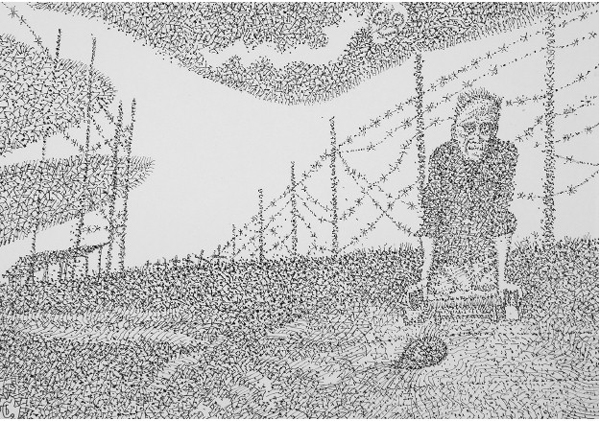
FIGURE 6. Boris Sveshnikov (Russian, 1927–1998), Last Alms, 1992. Ink on paper 30.5 x 42.8 cm (12 x 16 7/8 in.). Collection Zimmerli Art Museum at Rutgers University, Norton and Nancy Dodge Collection of Nonconformist Art from the Soviet Union. D22567. Photo by Jack Abraham.
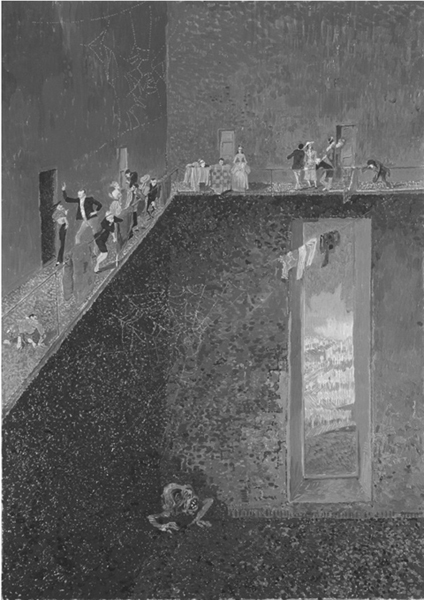
FIGURE 7. Boris Sveshnikov (Russian, 1927–1998), Spring Grove, 1957. Oil on linen 70 x 50 cm (27 9/16 x 9 11/16 in.). Collection Zimmerli Art Museum at Rutgers University, Norton and Nancy Dodge Collection of Nonconformist Art from the Soviet Union. 2003.0762 / 21677. Photo by Jack Abraham.
In Lianozovo, Igor Kholin, a former World War II officer who was imprisoned for a couple of years in the local camp and served in its internal security, wrote a new kind of poetry, which he called “barracks poetry.” He started to write these verses “standing on the camp tower,” as a friend of his would put it decades later. Then the camp vanished, but Kholin stayed on in the village, worked as a waiter, and wrote:
Isn’t it amazing,
This human ability
To cry
And appeal for pity
In such a strange way?
Why animals
Don’t cry,
And houses
And cars?
. . . . .
I want to tell you
About world-wide weeping
When the universe
Shudders
And everything merges into
A single scream,
A deep-drawn sigh.45
The human ability to weep and mourn is strange indeed. The magic of mourning turned the stinky attributes of the gulag life, things like a quilted jacket or a camp barrack, into subjects for poetic imagination or sacred worship. Among the unusual personalities who frequented this Lianozovo community was Eduard Limonov, who would become an émigré writer in the 1970s, a scandalous returnee in the 1990s, a prisoner in the 2000s, and a political figure in the 2010s. The writer Andrei Bitov remembers his own visit to Lianozovo as a trip to the end of the world; with awe, he describes a long path to the barracks that stretched along the barbed wire in the snow. The local memory of the camp was a leitmotif in many of the texts that were written by members of the Lianozovo group.46
The works of Leonid Chertkov, the leader of a poetic circle in Moscow that was cotemporaneous with the Lianozovo group, started in 1953 with a fascinating cycle, “The Salt of the Earth.” In these three poems, which one of Chertkov’s friends characterized as “cool like cannibals,” the narrator is part of a firing squad in an unidentified army. At times, this could be a modern Western colonial army or a Russian medieval one; at other times, we seem to be dealing with Soviet troops. “They always recognize us at a distance,” the narrator recounts; his squad suppresses a rebellion, captures a deserter, sets fire to a field, and rapes the town-folk. In some lines, the narrator and his comrades are imprisoned; a few lines later, they are burning, raping, and shooting again. These activities are described in regular, romantic verses, which bear the recognizable stamp of Kipling and early Soviet poetry. I read in these verses a rare attempt to imagine the world of the perpetrator and to mock it by parodying the language that this perpetrator would eagerly recognize as his own. Twenty years old when he wrote these extraordinary verses, Chertkov was an assiduous student of Russian literature and a translator of English poetry. As it happened, Chertkov’s work of mourning led him to mimetic self-sacrifice, and in 1957 he was arrested for anti-Soviet propaganda and went on to serve five years in the latter-day gulag. After release, he emigrated to France, where he continued to pursue his literary and historical studies. In an obituary, a perceptive observer grasped the meaning of Chertkov’s historical obsession: “His literary scholarship was of a romantic kind. He felt a lack of an actual literature for his studies. . . . He suspected that an unheard-of literature still existed somewhere and he searched for it in the archives.”47
In 1963, the KGB investigated the artistic community at Lianozovo and incriminated its patriarch, Yevgeny Kropivnitsky, who was duly expelled from the Union of Artists.48 It was probably at this point that the KGB experts coined the phrase the “Lianozovo school.” Two interrelated forces, cultural mourning and political protest, drove the consolidation of companies of local poets, artists, and returnees in places like Lianozovo, Tarusa, or Moscow. One such poet, Genrikh Sapgir, said: “We knew that prison was a threat to us, but we never talked about it. . . . There were many prisoners then, and many were released. . . . What we saw around us was life on the edge of death. And we needed to express this.”49 He sounds like a Necrorealist, though his poetics is very different. In 1964, Vsevolod Nekrasov, a member of still another group whose poetry would become known as “conceptualist,” wrote his best-known poem:
Freedom is
Freedom is
Freedom is
Freedom is
Freedom is
Freedom is
Freedom is freedom.
It is difficult to disagree with Nekrasov’s statement when it finally emerges, but in fact we do not know which freedom the author had in mind—freedom as a philosophical category, or freedom from jail, or (most probably) both. With time, this tautological minimalism would become a characteristic feature of the Lianozovo school. Retreating from the heights of world culture, the survivors and mourners of the Soviet terror focused their intuition on the intrinsic dignity of bare life. In a situation when the official culture denied the victims of the gulag their grievability, the cult of bare life emerged as an important, even crucial expression of mourning and protest.50 This cult did not need world culture; its point was to affirm the value of bare life as it is, in its inarticulate, primitive shape that is barely able to express itself. After all these megatons of torture, “The world has not altered,” as Brodsky’s pilgrims said to themselves. Referring to the German literary tradition, Eric Santner reveals the construal of creaturely—and also creative—life in the sublime poetry of Rilke and the prose of Sebald. In Russia, a similar discovery or invention came later and in a different way, among the generation who overcame both their trauma of the gulag and the longing for world culture. This break with the longstanding tradition of the intelligentsia brought an incredible popularity to the Mitki, an informal group of Leningrad artists and poets who, from the late 1970s to the 1990s, built a new version of a group subculture that practiced and worshipped a self-conscious primitivism, genial brutality, and humorous innocence. In various ways the Mitki presented their new civic ideal of a friendly alcoholic who enunciated aphorisms of pleasure and unworldliness. But they also produced some horror doggerel (uzhastiki) that in the late-Soviet period became a part of the popular, anonymous folklore.
A boy in the village found a machine-gun.
Now in the village there lives no one.51
Combining the childish innocence of the poetic form with the brutal or even sadistic cruelty of the story, these ironic, catchy replicas of the Soviet past should be understood as another genre of mimetic mourning. The pleasures of the creaturely, senseless, homeless life on the edge of death have never been celebrated with such directness. Consciously apolitical, the Mitki presented a startling contrast to the deep involvement of the intelligentsia in the perestroika processes that dominated this period. In contrast to the previous tradition, the Mitki did not produce a meaningful response even to the arrest and imprisonment of one of their leaders, the poet Oleg Grigoriev. In the 1970s, he spent about two years in prison, reportedly because a chief of the Soviet literature objected to his children’s rhymes.
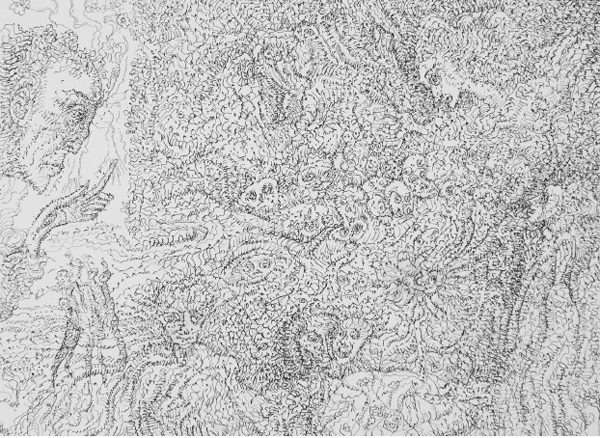
FIGURE 8. Boris Sveshnikov (Russian, 1927–1998), Untranslated, 1998. Ink and gouache on paper 28.4 x 38 cm (11 3/16 x 14 15/16 in.). Collection Zimmerli Art Museum at Rutgers University, Norton and Nancy Dodge Collection of Nonconformist Art from the Soviet Union. D22571. Photo by Jack Abraham.
The aging Boris Sveshnikov responded to these new tendencies in his own way. In one of his last pieces he showed an anarchic carnival composed of culture and nature together, in a kind of spiral whirling, which advanced dangerously close to the lonely hero. But he is still able to conjure it away by one of the strange, unearthly movements of hand that Sveshnikov presents so well. In these last pieces, when he became almost blind and his technique deteriorated, his horror returned to him, and he reverted to the imagery of the camp. It was as if he understood his new physical limits of his age and the approaching death in the terms and metaphors of his old—indeed, at this point fifty-year-old—memory of his life in the gulag.
“He who seeks to approach his own buried past must conduct himself like a man digging,” wrote Benjamin.52 This digger recovers facts like an archaeologist but also creates artifacts like an artist. It is all digging for him, and he does not separate the two roles—of the historian and the artist—that he plays in the process. In a postcatastrophic situation, the digger of the past—the historian-cum-artist—needs mechanisms of estrangement, with humor being the most important and frequent of these mechanisms. Materializing memory in the public sphere often entails fiction rather than truth, allegories rather than facts, and irony rather than tragedy. These allegoric images both retain their dependency on the past and affirm the present’s striking difference from it. Mimicking the past, they also assert that the past has passed. As long as the survivor survives, his obsessive remembrances of the catastrophe do not equal its actual return there, but rather constitute its disempowered, detoxified representations. Sometimes recognizable as traces of memory and sometimes so heavily distorted that the historical past is transformed beyond all recognition, these allegoric images work as mnemonic tools that revive the past and, simultaneously, as artistic devices that celebrate its death.