
7
In 1939, the famous filmmaker Grigory Kozintsev started work on a biographical film about Karl Marx. Eloquently and sincerely, he expressed his admiration for Marx, a prophet of the victorious revolution. But the film was never realized. There were rumors that Kozintsev fainted while giving a progress report on this film project to Joseph Stalin.1 An experimental, futurist filmmaker in the 1920s, a leader of the “cheerful generation that created the Soviet cinema,”2 Kozintsev embraced the theory and practice of the Marxist revolution in Russia. However, his disenchantment grew steadily over the subsequent decades. Like his Marxist beliefs in Stalin’s presence, Kozintsev’s early support for the socialist experiment did not survive the long decades of Soviet rule. In this chapter, I argue that mourning for the victims of the regime and mourning for revolutionary ideas were both crucial for the films that Kozintsev directed during the late-Soviet period. The next generation of intellectuals and filmmakers, who came of age during the Thaw, would go on to subvert this complex condition of double mourning.
Local Victims
Kozintsev is known most widely for his screen versions of Hamlet (1964) and King Lear (1970). These austere, black-and-white versions of Shakespeare in Boris Pasternak’s translation and with scores by Dmitry Shostakovich have been recognized as major cultural achievements of the Soviet period. At the end of his career, Kozintsev, a laureate of two Stalin Prizes and one Lenin Prize, was the most important filmmaker in Leningrad. By all indications, this success was genuine. While Kozintsev’s films were screened at Shakespeare events in England, a Tajik film studio produced a documentary about screening his Hamlet for mountaineers in Pamir.3 Clearly, Kozintsev had succeeded in finding a language that was comprehensible to various audiences on both sides of the Iron Curtain. He was a hugely influential figure in Soviet cinema, teaching the leading filmmakers of the later period, Eldar Riazanov and Aleksei German, and inspiring others such as Andrei Tarkovsky and Aleksandr Sokurov.4
From his eccentric experiments that made him famous in the 1920s, Kozintsev turned to ironic films in the 1930s and then to insipid biopics in the 1950s. Up to this point, the trajectory of Kozinstev’s career is unsurprising for the historian of Soviet film, but his Shakespearean turn in the 1960s was unique. Kozinstev was also unusual in that, apart from his lifelong filmmaking, he was a prolific scholar and author who wrote many volumes of essays and memoirs. While some of his books were published in the Soviet period and some were translated into English, many additional writings have been published after his death and some only after the collapse of the Soviet Union.5 In important ways, Kozintsev’s thoughts and feelings were parallel to those that were documented in the letters and conversations of his friend and associate Dmitry Shostakovich. Both managed to combine success in the Soviet artistic world with a consistent, self-conscious protest against the Soviet oppression, and both revealed their political sentiments within the established conventions of their arts. While the credibility of some of the Shostakovich reminiscences is controversial, the authenticity of the Kozintsev notes has never been questioned. Apart from the editors who assiduously prepared these documents for publication, scholars have paid little attention to these materials, a striking contrast with the furious debates generated by Shostakovich’s “Testimony.”6
Like Shostakovich, Kozintsev was not “repressed” himself, but was witness to many campaigns of Soviet terror and their impact on his family and friends. Kozintsev’s childhood friend and scriptwriter Aleksei Kapler was arrested for courting Stalin’s daughter, Svetlana, and spent eleven years in the camps. Kozintsev’s mother-in-law, Olga Ivanovna, a longtime secretary to Viktor Shklovsky, was arrested in 1937 and spent ten years in the camps. She was arrested again in 1949 and spent seven more years in the Arctic, near Vorkuta. As in myriad other cases, the circumstances of her second arrest were routine: “They called [Kozintsev] and said, pick up your child. We are coming after your mother-in-law.”7 For years, the family received two letters a year from her. At one point Kapler, who happened to be serving his second term in the same camp, saved her life by helping her to get an office job working for the camp administration.
Kozintsev was also friends with Solomon Mikhoels, an actor and theater director who shared Kozintsev’s interest in Shakespeare and was famous for his staging of King Lear. Mikhoels founded and led the Jewish Anti-Fascist Committee, an organization that helped Stalin to attract worldwide sympathy during World War II.8 Mikhoels’s assassination by the secret police in 1948 signaled the start of a major anti-Semitic campaign waged during Stalin’s last years. Kozintsev was also close to Ilya Ehrenburg, a charismatic writer who was married to Kozintsev’s sister. It was Ehrenburg who coined the term “Thaw” for Russia’s post-Stalinist condition.9
Born in Kiev in 1905, Kozintsev entered an elite gymnasium under the Jewish quota system; in his notes, he richly documented his hatred toward this school, which haunted him for many decades. A leader of the Soviet avant-garde, Nathan Altman, trained him as an artist. After the revolution of 1917, Kozintsev met Vsevolod Meyerhold and Sergei Eisenstein, the towering figures of the Soviet theater and cinema, respectively. Kozintsev adored Meyerhold, who was arrested and killed in 1940, and used to say that Meyerhold would have been the best person to play King Lear. In his memoir about Eisenstein, Kozintsev called him a friend rather than a teacher. Only seven years younger than Eisenstein, Kozintsev lived significantly longer and now seems more like our contemporary. He watched the ideological campaign against Eisenstein with disgust and took a risk by writing encouraging letters to him. Kozintsev was equally compassionate when another brilliant friend, Shostakovich, became a target of ideological attacks.
Throughout his life, Kozintsev was close to the leading Soviet literary scholars, whom he recruited to write screenplays for his films. Some of these people were arrested; the survivors were targets of ideological campaigns. Adrian Piotrovsky, a charismatic classicist who wrote screenplays for Kozintsev’s films, died in jail. The philologist Matvei Gukovsky, Kozintsev’s close friend, also died in jail. Yulian Oksman, another philologist who wrote scripts for Kozintsev, served ten years in the Kolyma camps. Yet another friend from the world of literary scholarship, the Renaissance scholar Leonid Pinsky, served five years. Kozintsev survived the successive waves of terror in 1937 and again in the campaign against the Jewish “cosmopolitans” in 1949, when many in his circle were arrested, hounded, or sacked. On dozens of films Kozintsev worked with the same cameraman, artist, composer, and even fencing instructor. Some of them world-famous and others unknown, they were randomly cut down by the terror along with the rest of the Soviet elite. Yevgeny Yenei, the artist who worked for Kozintsev on many films, was arrested in 1938 and also served years in the camps. Kozintsev saw his longtime friend and coauthor Leonid Trauberg scapegoated and sacked; Shostakovich, Ehrenburg, Tynianov, and many others were all under threat, until they were saved by Stalin’s death. When Kozintsev’s mother-in-law finally returned home in 1956, Kozintsev told his wife that they should never argue with her, given how much she had suffered.10 Observing the amazing events that followed Stalin’s death, Kozintsev wrote to his student in May 1956, after one of the chiefs of Stalinist culture, Aleksandr Fadeev, committed suicide: “An era of shame has started in the arts.”11
Kozintsev shunned official titles and never led a Soviet organization larger than his filmmaking workshop in Leningrad. At the peak of the Thaw, in June 1960, Shostakovich experienced a crisis when offered a position as chairman of the Union of Composers, on condition that he also enter the Communist Party. After desperate resistance, Shostakovich accepted the offer.12 Luckily, Kozintsev escaped making such a choice.
The Overcoat
Writing in the 1950s, a friend noted that the 1920s had endowed Kozintsev with his “snobbish, aristocratic nature”: in the disillusioned world of post-Stalinism, maintaining the values of the revolutionary years was perceived as personal vanity.13 But Kozintsev’s continued identification with that time was central to his artistic life. Many of his coauthors, such as Shostakovich, and his literary friends, the formalists like Yury Tynianov, were also “people of the twenties.”14
The most successful among Kozintsev’s early films, The Overcoat (1926), ridiculed the social hierarchy of the old regime. The film was based on Nikolai Gogol’s short story; Tynianov, an expert in Gogol who had authored pioneering studies of prototype and parody in the 1920s, wrote the script.15 In the film, as in the story, the protagonist cherishes a new coat, which is then stolen by thieves. Played by Aleksei Kapler, a Very Important Person refuses to investigate the crime. Deprived of his coat and illusions, the protagonist dies of sorrow. A hapless Oedipus who fails to resolve the puzzle of power, he is portrayed questioning the enormous Sphinx of St. Petersburg in one of the most expressive scenes of early Soviet cinema. With its obvious dependence on Weimar film, The Overcoat is human and funny. In the end, however, something shocking happens or rather, does not happen. The powerful ending of Gogol’s story is entirely omitted. At the end of Gogol’s The Overcoat, the protagonist rises from the dead and, as a gigantic specter, roams the streets of St. Petersburg, taking revenge on the city’s inhabitants. This wandering specter steals one overcoat after another and disappears only after he scares and robs the very same official who refused to help the protagonist in his last struggle. This scene, sentimental but subversive, contributed to the incredible popularity of The Overcoat in the Russian literary tradition. A Gogolian premonition of the revolution, the specter from The Overcoat (1842) has an organic place among the other great ghosts of world literature, from the ghost of Hamlet’s father to the specter of Communism haunting Europe in the Communist Manifesto (1848). The difference is, however, that Gogol’s ghost is not tragic or threatening but rather ironic, maybe even parodic. With subtle humor, Gogol presaged Marx’s image of the wandering specter of Communism by demonstrating the futility of this hope.
The 1926 film replaced Gogol’s public apparition, which is visible to the whole city, with the clerk’s private deathbed visions that have nothing to do with retribution. Whether the reason was technical limitations or ideological self-restrictions, the eccentric hallucinations of Kozintsev’s dying clerk were far inferior to Gogol’s unbridled imagery. Interestingly, Kozintsev’s friend, the literary scholar Boris Eikhenbaum, in his famous essay on Gogol’s The Overcoat (1919), also chose to omit its final scene from his analysis. The consistency of this postrevolutionary misreading of The Overcoat is striking.16 After the long-awaited revolution came to pass, it wiped out this last refuge of utopian hope, effectively rendering this key scene from Gogol off-limits. From now on, an overly faithful reading of Gogol’s story ran the risk of parodying the revolution itself.
Gogol’s imagery haunted Kozintsev for decades. In his later productions, he substituted Gogol’s self-mocking fantasy of ultimate retribution with Shakespearean tragic, self-sacrificial justice. However, at the end of his life, Kozintsev was preoccupied with plans for a new film, Gogoliada. In his later notes, Kozintsev returned to The Overcoat again and again, as if he thought that his debt to Gogol had not been paid: “It was difficult to think about the past as reality: the past felt like a mirage. . . . These [Gogol] stories strike us with their combination of plausibility and nightmare. . . . It was evident: the social structure resembles a nightmare, the state is dead.” When Solzhenitsyn’s famous story about a small man in the gulag first came out in a Soviet journal, Kozintsev compared it, as “equal in scale,” to Gogol’s The Overcoat.17
In several volumes of his published notes, Kozintsev was absorbed in classical Russian authors from Gogol to Tolstoy. In an entry from 1971, he acknowledged his increasing alienation from the contemporary cinema, both in the USSR and the West, and continued:
One day, and after much sorrow, I realized that I have inherited not the American 20th century, with comic characters fighting policemen and escaping across rooftops, but the Russian 19th century, with the unbearably sick conscience of its art, with the martyrdom of Gogol and Dostoevsky . . . with its feeling of co-responsibility, its enormous bleeding wounds.18
In the 1960s, Kozintsev’s project consisted of “re-reading Shakespeare after Dostoevsky” and not after Marx. He believed that Russian classical literature helped him to represent the scenes of suffering and desolation that were a major part of his Shakespearean films. Late in life, Kozintsev contemplated making a film about Lev Tolstoy’s final flight, a tragic story of his terminal going-to-the-people. His Shakespearean films show kings and princes, not the masses; when we do see “the masses,” the picture is usually a repulsive one. Disenchanted with the basic Marxist ideas such as class warfare or economic determinism, he did not use them in his essays and did not integrate them into his films. Arguably, there is more Marxism in John Madden’s Shakespeare in Love than in Kozintsev’s Hamlet.
The task that Kozintsev set for himself illuminated the ambiguous plotlines of the English Bard with the conscientious, guilt-ridden sensitivity of the Russian intelligent, who felt his responsibility for the suffering of millions of Soviets just as his nineteenth-century forebears felt their responsibility for the suffering of millions of serfs. However, Kozintsev did not repudiate the rationality and faith in historical progress that were intrinsic for Marxism. Like many of his friends, Kozintsev was a convinced atheist, a belief system that was necessitated not only by his Soviet allegiance but also by his hybrid Russian-Jewish experience. In its practical application, this post-Marxist but still secular framework resulted in a sublime understanding of high culture that was uniquely endowed with meaning that had previously been invested in religion and ideology. Secularizing both Shakespeare and Dostoevsky meant that their religious themes were interpreted in purely human ways, political and moral. In Kozintsev’s Hamlet and Lear, famous scenes became unusually earthly: ghosts are full-bodied, hesitations are resolved, wars are bloody and dirty, life is bare and meaningless, and the division of the state is a utopian project doomed to meet an ignoble end.
We do not know much about the extent to which censorship restrained the mature Kozintsev, and whether he would have made similar films if he had been perfectly free to define them. One of his friends, a much-experienced playwright, believed that Kozintsev had never been able to do what he wanted.19 Kozintsev’s own private notes do not corroborate this statement. In fact, the scale and financing of his Shakespearian productions were generous, and his use of Shakespeare to formulate his feelings about his life and the world was his choice. Inside of this framework he was not particularly restricted.
In his writings on Shakespeare as well as in his films, Kozintsev insisted that his ideal was not historical accuracy but rather a self-conscious modernization of the classical text. Having found in Shakespeare an adequate cultural idiom—resonant, cosmopolitan, and ambitious—Kozintsev used every chance to tell his audiences that his interest in Shakespeare was not antiquarian. Shakespeare is our contemporary, he wrote; in Hamlet and Lear, Shakespeare had found solutions to the “most important issues of our time.” These tragedies contain much that “resembles us” and much that does not; Kozintsev saw his task as highlighting the resemblances and downplaying the differences. After the success of Hamlet, Kozintsev was invited to spend a year in England to make another film. The trip never happened, but his widow remembers a revealing dialogue. Let’s go to England, she said, at least we will spend a year in decent conditions. But Kozintsev responded that he could never have made such a Hamlet in England. His wife rendered his explanation: “Indeed, he could do it only here, because his Hamlet was a direct response to our life.”20 The next film, Lear, was also a success: “a bloody melodrama,” Kozintsev wrote, in which blood poured “as if from a fireman’s hose.” This genre, melodrama, should return to the screen if cinema was to be true to the twentieth century: “Bloody melodrama has become routine; it has become our everyday existence; it is no more exceptional than drinking tea in Chekhov.”21
Interestingly, at the end of his life Kozintsev still understood his method as the legacy of the revolution. It was the revolution in Russia that “violated, exploded, leveled” the boundary between life and art. “The spirit of the new art was in the perfect merger of these spheres,” wrote Kozintsev; after the revolution, art and life were one.22 This is a distant echo of a thesis of total art, which aspired to transform all aspects of life in an act of artistic theurgy. In Kozintsev’s post-Stalinist version of this thesis, however, the focus shifted to the victims of this attempted transformation. “There should be no demarcation line between the people of Shakespeare and the people in our audience, between the suffering on the screen and the memory of suffering in life,” wrote Kozintsev in 1971.
From Remembrance to Vengeance
Watching Kozintsev’s Hamlet, one cannot fail to see the subversively ironic treatment of earthly power, embodied in Claudius. Living and dying among his portraits, Claudius is full of himself, always pompous and silly.23 I see in this Hamlet not only an allegorical protest against a criminal state but also a mourning play for its victims.
Hamlet is unusually decisive in this film, and so is the ghost of his father. Kozintsev was critical of the many attempts to produce Hamlet without the ghost. Providing historical examples, he argued that Shakespeare’s contemporaries understood the apparitions of ghosts as signs of coming catastrophes. “The ghost is the herald of national disasters. . . . Everything in Denmark is going to ruin.” Like Jacques Derrida but much earlier, Kozintsev connected the ghost of Hamlet’s father with the specter from the Communist Manifesto: “Marx recalled Hamlet speaking to the specter and purposely made it an image of the continual, subterranean work of history.” The ghost is memory, commented Kozintsev, and this “metaphor is literal”: in Hamlet, he speculated, those who remembered the dead king saw his ghost, while those who had forgotten the king did not. Contrasting Hamlet’s “spirit of Wittenberg” to Claudius’s “spirit of Elsinore,” Kozintsev espoused his own historical experience: “In many eras, the finest men knew despair and lofty dreams proved futile. The time came when the heavy cannon of Elsinore dispersed the ideas of Wittenberg.” Now, he wrote, a modern Elsinore was once again eager to enclose “humanity into concentration camps.”24
A political reading of the ghost of the father constituted the core of Kozintsev’s version of Hamlet. Wanting revenge for himself and redemption for his country, this armored ghost with a doubling visor is a symptom of the crisis but also a promise of overcoming it. From the ghost, Hamlet learns the truth that every son of a catastrophe wants to learn about his dead father—and ideally, from him. “The ghost reveals for Hamlet the truth about life, as if he lifts the curtain over Denmark the prison, and everything becomes clearly visible.”25
Like Derrida but much earlier, Kozintsev found it important that the ghost came to Hamlet in his combat armor. For Derrida, the ghost’s armor is prosthetic: “We do not know whether it is or is not part of the spectral apparition. . . . The armor may be but the body of the spectral artifact, a kind of technical prosthesis.” For Kozintsev’s film, historical armor was borrowed from a museum. It was so heavy that a champion wrestler was recruited to carry it. Moreover, Kozintsev chose an unusual helmet, with an open visor that had the shape of a human face. Derrida wrote about the visor that “even when it is raised,” it signifies “that someone, beneath the armor, can safely see without being seen,” which for Derrida is “perhaps the supreme insignia of power.” The visor that emulates a human face in Kozintsev’s Hamlet deepens this paradoxical, prosthetic function of the ghost’s armor even further. Again, this doubling of the face of the dead father matches Derrida’s dictum that ghosts do not come alone and that by its nature, a specter is “more than one.”26
Russian scholars deciphered Kozintsev’s message immediately after the film’s victorious premiere in Soviet and Western cinemas. “Life’s pretexts fade away, but their spiritual consequences do not,” wrote the aspiring film critic Maia Turovskaia. Appropriately called “Hamlet and Us,” her review was published in the same issue of the Novyi mir that discussed, in glowing terms, Solzhenitsyn’s One Day in the Life of Ivan Denisovich. According to Turovskaia’s masterful analysis, different tragedies emerged on the Soviet stage at different moments. In the 1930s, the Soviet theater presented Othello as the symbol of “a bloody but fair retribution.” At the time, Othello looked so wholesome that even the murder of Desdemona “did not look like a murder.” Despite his blind mistake, this Othello demonstrated, as Turovskaia put it, “the splendor of simplicity and the innocence of greatness.” While this Othello was the hero, Hamlet was accused of “Hamletism,” a form of bad nerves combined with the inability to act. Turovskaia juxtaposed two plays of revenge, Othello and Hamlet, by connecting them with two Soviet eras, Othello with the 1930s and Hamlet with the 1960s.27 “It was 1954,” wrote Turovskaia, “that became a breakthrough in the stage history of Hamlet” in the USSR. She explored the decade after Stalin’s death as the maturation of the Soviet Hamlet, from Kozintsev’s theater version of 1954 to his film version of 1964. “This Hamlet does not require particular erudition or volumes of commentaries.”28
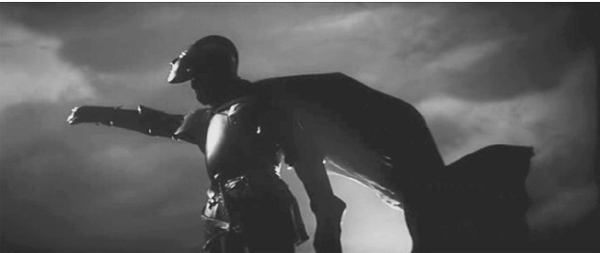
FIGURE 9. The ghost of the father in a helmet with a visor in Hamlet (1964), a film by Grigory Kozintsev.
Kozintsev imagined Hamlet as his compatriot who survived the terror to find himself a foreigner in his own country. “Hamlet is a pre-1937 man,” he wrote, using this year to signify the Great Terror.29 “Pre-1937 men” would also be a good description for the coauthors of this Hamlet, its director Kozintsev, translator Pasternak, and composer Shostakovich, all of whom miraculously survived the terror, physically and psychologically (the fourth member of their team, artist Yevgeny Yenei, had been arrested in 1938). Like Hamlet, they all had the energy to mourn their dead. As Turovskaia noted, Kozintsev was far from the Russian theatrical tradition of presenting Hamlet as a weak, hesitant embodiment of “Hamletism”: Kozintsev “does not argue with the 19th century concept of hamletism—he ignores it.”30 Played by Innokenty Smoktunovsky, a veteran of World War II who marched from Kursk to Berlin, this Hamlet was not young.31 In Shakespeare he is thirty years old, in some Soviet versions he looked eighteen, but Smoktunovsky was about forty and looked even older. In Hamlet, Smoktunovsky played himself—a survivor of the Great Terror, a soldier of a great war, a man who perceives his country as a prison though he does not know the reason or remedy for this state of affairs. He searches for both, and we watch this epistemological process, which is closer to a military reconnaissance than to a display of neurotic incapacity. This is a focused, intellectual Hamlet who creatively uses various tools, from the ghost to the theater, to crack the mystery of his fate. He does not hesitate to take revenge, but he wreaks it only after he accomplishes his task of learning. In Kozintsev’s film, Hamlet’s meditative monologues were largely omitted, a fact that surprised some critics. But the scenes of exploration and revenge were shown in detail, and with full sympathy.32
For Turovskaia, Hamlet lays claims to the “human right to spiritual complexity.” The decade after the death of Stalin, which was also the decade when Kozintsev transferred his Hamlet from the stage to the screen, was a time of tremendous growth in the perceived complexity of the world. Acknowledgment of this complexity had nothing to do with indecisiveness. The opposite was true; after the Thaw was over, it was simple minds in the Soviet leadership that manifested hesitation and indecision. Understanding the crimes of the past was the purpose of the Thaw, a time of exploration and mourning. Turovskaia claimed that Kozintsev’s Hamlet was neither a tragic hero nor a romantic one; he was an “intelligent hero.” But of course this Hamlet was not a typical representative of the Soviet intelligentsia; he was rather its collective ego-ideal. Succeeding in his heroic, self-sacrificial act of revenge, he was not only a scholar but also a warrior. It was in the double nature of the scholar-warrior, which Smoktunovsky rendered so beautifully, that the complexity of this Hamlet was rooted. Grieving the father and interrogating his ghost, Hamlet took revenge, an action that the Soviet intelligentsia was barely capable of contemplating in the 1960s. According to Stephen Greenblatt, generations of critics have observed the “startling Shakespearean shift from vengeance to remembrance” in Hamlet. Kozintsev’s film puts this shift into reverse. In many details, it choreographs Hamlet’s revenge against his uncle (revenge that, in the film as in the play, also destroys his mother, his beloved woman and her kin, his two friends, and the avenger himself) as a heroic but inescapable action, something that ought to happen in the given circumstances. It is in this call for remembrance and revenge that this Soviet Hamlet stands out in the long tradition of interpreting and performing the tragedy.33
Those who survive the bloody massacre, the local scholar who would tell the sad story and the foreign invader who would occupy the desolated land, seem to agree that this Hamlet is a hero and that his deed is justified. Together, they stage the high point of this Hamlet, its most successful scene, a funeral that lasts about ten minutes at the end of the film. Based on a one-line description in Shakespeare’s tragedy, this funeral is a product of Kozintsev’s fantasy. Fortinbras gives Hamlet military honors, as one soldier to another, and then the funeral starts, scored with Shostakovich’s music, which reaches the peak of its unbearable intensity in the last moments of the film. Kozintsev had in mind an even better story:
I had a good alternative for Hamlet’s finale: the wall of Elsinore . . . slowly, the ghost of the father is walking along and after him, proceeds Hamlet, i.e. the ghost of the son. Military patrols are saluting them.34
Even as staged, the final scene of Kozintsev’s Hamlet was a powerful, sublime mourning ceremony. Posthumously, Hamlet completed his work of mourning, which had remained tragically unaccomplished while he was alive. With this powerful scene, Kozintsev transfigured a Shakespearean orgy of revenge into a Soviet dream of mourning. It was his personal desire but it was also a collective project, a drive to give a decent funeral to the unmourned Soviet dead, one generation deferred.
The World after Catastrophe
Eagerly historicizing his work, Kozintsev wrote in 1968: “the year in which I was working on Lear: there was war . . . people were killed . . . whole districts were burnt down . . . students revolted . . . the tanks rolled into the town.” Responding with his Lear to the war in Vietnam, the Soviet invasion in Czechoslovakia, and the global student unrest, Kozintsev pursued the same strategy he had employed in Hamlet: the double movement of modernizing Shakespeare and interpreting the Soviet condition. In his private notes, Kozintsev also characterized his film as a new commentary on the Apocalypse. “The Sermon is over. What remains? The smell of ashes and the echo of crying.” His anxiety and mourning were intense and unmistakable, his imagery shocking: “Lear and Cordelia in captivity: the terror and humiliation of a concentration camp. Barbed wire, dogs, machine guns. Humanity, herded like cattle.”35
Kozintsev’s King Lear had a powerful predecessor: the 1935 version by the State Jewish Theater, with his friend Solomon Mikhoels playing the king. Mikhoels reinterpreted King Lear, driven by his insight about the resemblance between Lear and Lev Tolstoy. Lear left his kingdom as Tolstoy left his house, stated Mikhoels. His tragic Lear was hugely successful and, in hindsight, prophetic. Mikhoels’s murder on Stalin’s orders in 1948 signaled the collapse of state-sponsored Jewish culture in the USSR. Many arrests of Jewish activists and cultural figures followed, and rumors about the imminent deportation of Soviet Jews to newly built camps near the Chinese border started to circulate right after Mikhoels’s murder. When the news of Mikhoels’s “sudden death” became public, Kozintsev was staying in Moscow with Ehrenburg, who was also a prominent member of the Jewish Anti-Fascist Committee. The two men remained silent at the news, but Valentina Kozintseva ran around the room in a panic. Ehrenburg quipped, “No Jews are more orthodox than these Russian wives.”36 Looking at the photographs of Mikhoels as Lear, one immediately detects a strong resemblance to the Lear in Kozintsev’s film. Like Mikhoels, Kozintsev was fascinated by Tolstoy’s departure from home; in fact, he abandoned a film project about this event to shoot Lear instead, effectively swapping one for the other. The 1968 film became a monument to Mikhoels, who saw in his performance a monument to Tolstoy.
Kozintsev’s Lear continues the major themes of his Hamlet: the obscenity of power, the truth found in personal relations, and a finale starring a funeral of the central character. In Lear, this funeral became double, thus implementing Kozintsev’s unrealized plan for Hamlet’s finale: slowly, ceremoniously, the dead bodies of the king and his daughter pass by the military patrols. The slow action of the film develops the idea of Lear’s spiritual regeneration after his abdication, but then the focus shifts onto the broad picture of the collapse of the state and the catastrophe as experienced by the people. With his new experience of suffering, Lear starts to understand the world, the people, and his daughter. This is Shakespeare read after Dostoevsky, and also after Khrushchev.
The chain is broken, it could not be otherwise because order is already dead, an illusion. Underneath lies total collapse and everything is rolling, tumbling, turning to confusion. . . . Space and people are at one in this commotion.37
Combining Lear with Dostoevsky’s Notes from the House of the Dead, Kozintsev wrote, “The King of Britain has ended up in a hut on a penal settlement.” Unlike Hamlet, who dies as a prince, Lear suffers the full and complete collapse of his status. He descends from the very top to the very bottom of the social ladder, from king to pariah, from sovereign to bare life. This top-down transfiguration is symbolic: “Does it not happen in time of revolutions, coup d’etats, and wars, that those who held power find themselves behind barbed wire? . . . We can bear witness: this has happened . . . to many thousands.” This Lear is unusually interested in the depiction of the bottom: the hapless Lear, the poor Thom, and the blind Gloucester merge with those who have always wandered across the miserable land. In these long, slow scenes, Kozintsev showed the meaningless life of the people. Treated like cattle, they live like cattle; they can be killed but not sacrificed. Having been reduced to this bare life, Lear has been transformed; in fact, he is unrecognizable. This is why at the end of the play, the soldiers cannot find Lear: “the difficulty was not in finding Lear but in recognizing him,” Kozintsev wrote.
Here, at the very bottom of existence, the tempest has thrown one who was on the very top of the social pyramid. Here, in the midst of this miserable life that mixes dirt, straw, beggars and men, Lear asks his question, is it true that the bare man is just a bipedal animal?38
Kozintsev made a great deal of effort to modernize the action of Lear in line with his principle “Shakespeare is our contemporary,” and to provide it with a catastrophic, apocalyptic, twentieth-century dimension. There are no ghosts in this film, but human transformations are dramatic, eerie, and unjustified. Some characters undergo the full-range transition from the highs of power to the lows of misery; some characters lift themselves from the very bottom to the very top, only to fall again. People are unhappy, Kozintsev speculated, not because of the fate of humankind, an idea that he associated with “citations from Kafka and Camus, the jeans and the black sweater,” the symbols of existentialism. People are miserable because of the policies of the state, which he associated with barbed wire, handcuffs, and prison bars.39 In his private notes, Kozintsev explicitly stated that the dynamic that he saw in Lear was typical of Soviet life, with its banal and extraordinary character: “Much of what we have seen with our own eyes, of what is taught in schools, of what people talk about in the subway, is similar to the tragedy of Lear.”40 Both a victim and an agent of the crime, Lear triggered the catastrophe with his own action. The film presents Lear’s move to divide his kingdom as a well-meaning but ill-fated project, a study in the unintended consequences of utopian politics. In the course of the film, Lear comes to accept this responsibility, a lesson for the Soviet public.
“The world after catastrophe”—this is how Kozintsev described the physical setting where he wanted his Lear to be shot. He searched across the enormous Soviet space for this setting. Some scenes he shot on the wild rocks of the Crimea and others on the wasted mounds of shale in Estonia. In many ways, this Soviet Lear was an imperial production. Performed in Russian, the film featured very few Russian actors or landscapes. While scenes were shot in the exotic environments of Soviet colonial domains in the north and south, most members of the cast were Baltic—Lithuanian and Estonian—actors. Among those who played the central characters, only Lear’s daughters and the Fool were ethnically Russian. Astonishingly, the actor who played Lear did not even speak Russian and was dubbed. The set designer was Georgian, and the cameraman was Lithuanian (the composer was, as always, Shostakovich). Prophetically, Kozintsev imagined Lear’s decision to divide his kingdom as a premonition of the dividing of the Soviet Union, which he did not live to see. “The Duke of Cornwall and the Duke of Albany are rulers of particular, separate peoples, who resemble one another no more than the Georgians resemble the Lithuanians,” he wrote.41 In Hamlet, Kozintsev settled his accounts with the past; in Lear, he anticipated the future. As a result, we watch not only tragedies of mourning and revenge but also the drama of a changing political order, which leads to social catastrophe. But viewers associated Kozintsev’s Lear with the Soviet past: “our recent past with its bloody, scary events, war, fire, destruction, and suffering.”42 The future was unknown, and though in retrospect mourning so often feels associated with warning, contemporaries tend to respond only to the first part of this equation.
Beware the Fool
Though the action of Lear is generally clear, there are moments of complete irrationality in the film, bizarre action that cannot be explained or justified. Such is the scene of the funeral of the Duke of Cornwall, when his wife unexpectedly kisses his dead lips with an open mouth, as if she were a vampire from the Weimar films that Kozintsev adored in his youth. Paradoxically, Kozintsev believed that this subtle play on the edge of reality brings the action closer to the contemporary world.
I often see my task as transforming some consistent, logical scenes into nightmares. The meaning of these dreams is found not in their distortion of reality. This is the way to approach modern reality: the delusions of coup d’états, mass repressions, murders, and the degeneration of beliefs.43
Kozintsev appreciated Bakhtin’s idea of carnival, but in his Shakespearean films he created an atmosphere of misery and mourning that had nothing to do with humor. Hamlet’s jokes are never funny in Kozintsev’s film, and Lear’s Fool is sad. “The cry of grief reaches us through time. Grief integrated the people, kept them together. This is why we are making the film, to hear this cry.” The overwhelming atmosphere of Kozintsev’s versions of Shakespeare is one of sadness. With approval, he described how Shostakovich kept rewriting some of the music for his films so that “it would be even sadder.” In this he saw his poetic license: his right to screen this tragedy had been authorized by “the people’s misery,” he wrote. He wanted to show Lear’s tragedy, an extraordinary story by any criteria, in such a way that “everyone would understand: the same or something similar has also happened to me.” He wanted to immerse the action of Lear not in the beauty of decorations but in “the midst of the people’s misery.” The proper form of compassion, he said in the spirit of the Soviet 1920s, “means feeling hatred towards the source of misery.” But it was grief that he saw in all his favorite authors, in Dostoevsky as well as in Shakespeare: “I do not know what color grief is, or what shades suffering has,” wrote Kozintsev. “No matter where man goes, grief is bound to him. . . . The tragic power of history and the grief of everyday life are always inseparable.”44
This is why Kozintsev made his Shakespearean films black-and-white: the colors of mourning. These films are deadly serious, and even the Fool tells truths rather than jokes. The filmmaker’s notes articulate an idea to present the Fool as Lear’s hallucination, his exteriorized conscience; Kozintsev compares Lear’s conversations with this Fool to Alyosha Karamazov’s dialogues with the devil. Like the ghost of the father in Hamlet, sometimes this Fool is visible to everyone around and sometimes only to the king. He is a powerful performer, but he is never funny. Kozintsev wrote that this Fool was “a symbol of art under tyranny.” The filmmaker acknowledged that his Hamlet departed from the classical Shakespearean proportions by “weakening, or even eliminating, everything comic” in the play; the same was true of his Lear. Citing Marx, Kozintsev stated that history repeats itself twice, first as tragedy, then as farce. Working on Shakespeare, he added, “in the twilight of civilization, tragedies and farces mix in such a way that they become indistinguishable.”45 Kozintsev was probably wrong about Shakespeare: his comedies are distinct from his tragedies. But perhaps more surprisingly, it turned out that Kozintsev was also wrong when it came to Soviet cinema.
One of his students reformed Kozintsev’s mournful tradition and produced sparkling comedies, popular for their humor and clever in the ways they confront and reflect the Soviet twilight. This man was Eldar Riazanov.46 An experienced teacher, Kozintsev developed a problematic relation with this talented but underperforming student. Riazanov’s father was “repressed”; late in his life, Riazanov still talks about his own fear of “the Soviet authorities.”47 According to Riazanov’s memoir, Kozintsev was supportive but never warm toward him; upon graduation, they parted ways, not without rivalry it seems. In the symbolic year of 1956—the year of Khrushchev’s revelations—Riazanov screened his first commercial comedy, Carnival Night (1956).48 The film celebrates the victory of a group of artistic young people, the emerging post-Stalinist generation with its newfound buoyancy, over a parochial bureaucrat who tries to censor their New Year’s Eve festivities. With a characteristic ambivalence, Riazanov decided against inviting Kozintsev to the premiere of this film, in the hope that the teacher would come of his own accord. When it became clear that Kozintsev was not going to show, Riazanov telephoned him at the last moment and then postponed the show’s opening until Kozintsev arrived. When the screening was over, the master told Riazanov, “This is not what I taught you to do.”49
Riazanov said nothing about Kozintsev’s response to another very popular comedy, Beware of the Car (1966). He had good reason to be silent, as this film contains a parody of Kozintsev and, in particular, his Hamlet. The two films by teacher and student, Hamlet and Beware of the Car, share one actor, Innokenty Smoktunovsky, who plays Hamlet in both films, the first time as tragedy, the second time as farce. Throughout Beware of the Car, Hamlet is rehearsed and performed as a play within the play, a kind of latter-day Mousetrap in Shakespear’s Hamlet that reveals the secret of the larger story.
Set in Moscow, Beware of the Car shows a corrupt society where almost everyone benefits from illegal networks of connection and distribution, with a private car being the highest symbol of success and prestige. Smoktunovsky plays the charming maverick and belated utopian, Detochkin. A character whose name connotes childishness, he struggles against corruption and disenchantment by tracking down corrupted functionaries, stealing their cars, selling them on the black market, and sending the money to orphanages. When his schemes are eventually exposed, some condemn him as a criminal, and others dismiss him as crazily naive. Refusing to accept the dystopian message of latter-day Soviet history, this noble savage pursues the radical agenda of the bygone revolutionary generation: expropriation of the expropriators. Like Kozintsev, Detochkin is a man of the 1920s living in the 1960s. He is an anachronism, which makes him funny; but he is also shown to be resourceful, loving, and loved. On top of his robbing and driving skills, he is a talented actor. His auto thefts are interspersed with scenes in which we watch him playing Hamlet as part of an amateur theatrical troupe. Finally, he receives a public trial, a sign of the new era in Soviet justice. A handful of older characters stand by him, the last keepers of the revolutionary flame. His mother is among these outdated supporters; meaningfully, we learn nothing about his absent father.
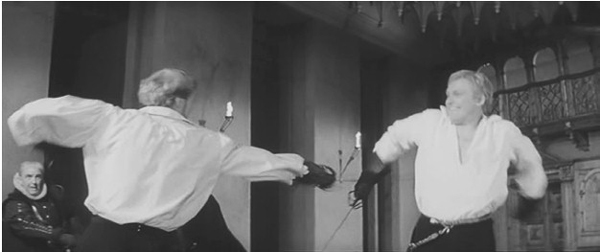
FIGURE 10. Hamlet and Laertes in Hamlet (1964), a film by Grigory Kozintsev. Innokenty Smoktunovsky is playing Hamlet.
A theme of friendship runs through the film. In a little episode, Detochkin asks for the Soviet cigarettes, Belomor, a popular brand whose name brought a lethal agglomeration of labor camps into everyday life. But the cheerful kiosk on a Moscow street has run out of Belomor, and Detochkin satisfies himself with cigarettes called simply Drug (Friend). Make friends, not camps—this could be the slogan of the Thaw, and Detochkin acquires friends even among the law enforcement officers who are investigating his crimes. In the end, of course, these friendships recede before the Soviet law, and Detochkin is sent to serve in the newest version of the gulag. But at the very end he returns to his friends.
Like Hamlet, Detochkin preserves the betrayed values of the generation of the fathers, which brings him into mortal conflict with his corrupted contemporaries. The play that the protagonists prepare, rehearse, and finally perform is Hamlet, which encapsulates the action of the film in miniature, just as the Mousetrap scene does in Shakespeare’s Hamlet. In the amateur theater that is run by two trade unions, the militiamen and the taxi drivers, Detochkin, who plays Hamlet, meets his nemesis, the state investigator who plays Laertes. Together they listen to a long, funny speech in which the director of this theater echoes Detochkin’s utopianism: is it not obvious, he asks the audience, that actors who are not paid for their performances do a better job than those who perform for money? Without further ado, the director announces his production of Shakespeare, whom he calls by his first name, just as Kozintsev did in some of his letters. To add to the fun, the director mispronounces William in a very Russian way, starting with V and stressing the second syllable. With his high-pitched voice and the aura of a pompous cultural manager, this director looks and sounds like Riazanov’s caricature of Kozintsev. The fact that Smoktunovsky, the actor who played Hamlet for Kozintsev, also played Detochkin playing Hamlet in Beware of the Car deepens the feeling of a blasphemous, even cruel parody on Kozintsev’s Hamlet.
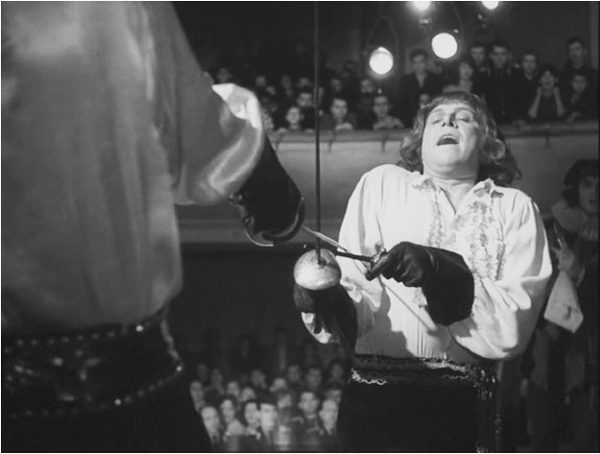
FIGURE 11. Hamlet and Laertes in Beware of the Car (1966), a film by Eldar Riazanov. Innokenty Smoktunovsky is playing Detochkin, who is playing Hamlet.
At the end, the film shows an on-stage duel between Hamlet and Laertes, accompanied by a loud, pathetically out-of-tune amateur orchestra—a truly vicious mockery of Shostakovich’s music in Hamlet. Then, we see a court trial in which the two duelists fight again, one as the suspect and another as the investigator. The latter gives a speech in which he acknowledges the complexity of the world in Hamletian terms that were remarkably different from the Soviet tradition: “He is guilty,” the investigator says about Detochkin, “but he is not guilty.” After deliberation, the court convicts Detochkin. But in place of Hamlet’s funeral in Kozintsev’s film, Beware of the Car features a happy ending. The aged, shaved, but recognizable hero returns from a camp and is reunited with his fiancée, who is waiting, unchanged. “I have returned”—these are Detochkin’s final words. Illuminated by Smoktunovsky’s beaming face, this iconic scene is an epitaph to the saga of the gulag returnees and to the decades of the Soviet experience.
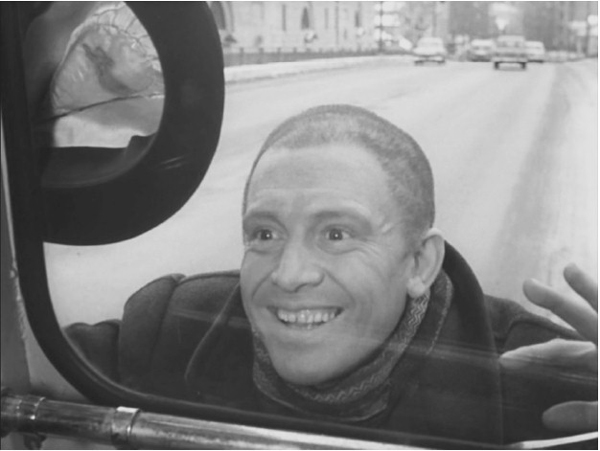
FIGURE 12. “I have returned”: the final scene of Beware of the Car (1966).
The film feels conciliatory. Though it exposes the endemic corruption of late-Soviet society, it also condemns Detochkin’s attempt to solve this problem using force. Even the punishment that this noble criminal receives from the Soviet court looks mild and fair. With its focus on an admirable but half-deranged avenger of social ills, the film shows the problems of late-Soviet society without offering easy solutions. In its creative mockery of Hamlet, the film singles out only one symbolic scene, Hamlet’s and Laertes’s mutual murder; we do not know how the trade-union theater performed other parts of Hamlet, such as the scene with the ghost. Apart from its passing reference to Belomor, the film does not mention and, in a sense, does not remember the victims of the Soviet state. Detochkin and several other characters mourn the lost Soviet ideals, but to many other Muscovites these ideals mean nothing, and the film presents this indifference as a sign of hope. It is the ability to enjoy the petit-bourgeois values—cars, friendship, loyalty, unchangeability—that the film celebrates as a fresh and promising, though contested, achievement.
Waiting for Goga
Everything would have flowed on as usual, but a huge barge is blocking the Moscow River from bank to bank, and a queue of vessels is waiting up the river. This is the first frame of the most popular production of the late-Soviet cinema, Moscow Does Not Believe in Tears.50 As we hear a sentimental song that plays with the odd title of the film without ever explaining it, the barge makes a slow, tortured U-turn, unblocking the river, history, and tears.
Starting in 1958 and ending sixteen years later, the action of this film presents a sad picture of late socialism. Three provincial young women come to Moscow in search of a better life. Moscow is bursting with newfound energy, and the women wander through some fascinating scenes. Playing himself, the leading poet of the Thaw, Andrei Voznesensky reads a poem to a crowd under the monument to the leading poet of the revolution, Vladimir Mayakovsky. Then, the three women come across an even larger crowd at the entrance to the first Moscow festival of French films, and Innokenty Smoktunovsky, also playing himself, tells them, “My name will tell you nothing. I am Smoktunovsky”: the joke here is that though the actor was a household name in the 1980s when the film was screened, he was still an unknown in 1958. Hosting a party, the women listen to a conversation typical for the intelligentsia “companies” at the time. An older man tells a group of youngsters, “It is easy to criticize now. Where were these critics in my time?” and a younger man responds, “We would not have kept silent,” while the women (and the audience) dislike them both. The film preserves our sympathies for another person, who will arrive on the scene much later.
The Moscow of 1958 is a place where three adventurous women invent false identities for themselves in their efforts to overcome the massive social inequality that they confront there—not exactly a picture of victorious socialism. Jumping forward to 1974, that social inequality turns into a reversed gender disparity. Watching the Muscovites who still do not believe in tears, we find males weak, despicable, or absent, and females taking the leading roles but feeling lonely and unhappy. Analyzing Moscow in gender terms, this melodrama even shows a dating agency that has stopped accepting women because there are so few men available. One of the three women, Katerina, is now a single mother and successful career woman. Craving a “real man,” she finds him, at the very end of the story, in Goga. Different from the other male characters in the film, he combines rare talents: he can win a street fight, cook a good square meal, and keep his word. He seems to have come to Moscow out of nowhere. He detests the authorities but cannot escape them, and when he leaves his fiancée at one point, her friend from the police tracks him down and brings him back. He has no name but Goga, and the characters play with this name as if it were a criminal alias (“This is Goga, also known as Gosha, etc.”). In contrast to the overachieving female protagonist, whom the film follows through decades and presents in exhaustive biographical and psychological detail, we know almost nothing about Goga’s past. Building on its persistent vision of Moscow as a world of suffering, strong women and incapacitated men, the film concludes with a clash between the realistic story of the female protagonist and an ur-romantic, dreamlike plotline centered on Goga, a clash that concludes with Goga’s flight and return. Goga is not ghostly; he is just unreal, a fact that is noted and discussed by several characters of the film.
Aleksei Batalov, the actor who played Goga, had a heroic aura; he previously played fearless soldiers and scientists. But this portrait of an urban noble savage, an embodiment of the intelligentsia’s fantasy of living through the Soviet system unscathed, was Batalov’s biggest success.51 Though it is probably true that this film is “the closest that Soviet cinema came to Hollywood,”52 Batalov made Goga more human, seasoned, and worldly than the conventional Soviet or Hollywood hero. Batalov said recently that he knew that the film needed Goga for an American-style happy ending; but, continued Batalov, the role of Goga also included certain “unhealthy deviations” that opened up a crucial space for the actor to inject life into his character.53 Raised among the Moscow intelligentsia, Batalov emphasizes the formative influence that his conversations with the returnees of the 1950s had on his worldview. All of his grandparents were imprisoned; his grandmother returned to Moscow after ten years in the camps. He was also connected to some of the celebrated survivors of the gulag, such as the World War II hero General Vladimir Kriukov and his wife, folksinger Lidia Ruslanova. In an interview, Batalov has said that he hated the Soviet state and realized early on that it was “a band of scoundrels and murderers.”54 His Goga emanates some of these feelings, and when the film won an Oscar in 1981, the Soviet state did not allow its authors and actors to attend the awards ceremony.55
Goga is loved but remains unrecognized. With all her connections in high places, Katerina could find out Goga’s whereabouts, but she could learn nothing about his past, and neither can the public. If we are to understand him as more than a dream of the frustrated heroine, where might such a Goga have come from? Under the romantic conventions of late-Soviet cinema, the most obvious answer would be: from the front of World War II. But Goga is too young for this. A distant relative of Hamlet, Goga keeps his secrets undisclosed, though we see how alcohol helps him to control his melancholy. Like a prince, he inherits Moscow but cannot escape its surveillance, which is presented as a parody of wellworn KGB techniques. Instead of fighting like Hamlet, Goga succumbs. “Does Katerina’s triumph mean that the USSR is officially feminist?” asked New York Magazine; the reviewer was surprised to find that the Soviets in this film looked so much like Americans, but seemed to make different choices.56
My hypothesis is that Goga came from the same place that Detochkin did at the end of Beware of the Car—from the Soviet prison. These two characters, late-Soviet machos who wage their hapless crusades against duplicitous Moscow, have much in common. Both films show their male protagonists endowed with similar qualities—shrewdness and naïveté, love of justice, working-class dexterity, and contempt for the rich and powerful. These qualities endear them to the Moscow women, but still, the two characters have no equals in their respective films. Though they do not look like probable friends, it is easy to imagine them as one and the same person. Indeed, Goga could easily be seen as Detochkin several years after his return from the camp to post-Stalinist, but still Soviet, Moscow. Both characters are Soviet survivors, the soloists of the long tragedy in which the chorus has perished. Apart from its title, however, Moscow Does Not Believe in Tears does not send this message with the clarity of the earlier Beware of the Car, with its homecoming scene, or of the later 500-ruble note. It is precisely this ambiguity that makes Goga such a wonderful character.57
For the generation that came of age during the Thaw, the Shakespearean way of mourning—one of the highest manifestations of the “longing for world culture,” a cosmopolitan key to the emotional makeup of the Soviet intelligentsia—seemed incapable of reflecting the historical process that had led to the deaths of their grandparents and parents and then to the disenchanted and merciless Moscow that was awaiting its perestroika. Now, Shakespeare seemed too earnest, austere, stiff; his gravity seemed laughable. Pragmatic, worldly success rather than the mythical world culture now became the magnet for creative efforts and energies, and exoticizing Moscow was a shorter route to this end than domesticating Shakespeare. History had to be grasped locally, by looking at mundane characters in their indigenous environment, and allowing these characters to reveal their routinely incredible stories through satire rather than tragedy.
In late-Soviet film, mourning for the lives, ideas, and energies that had been lost in the catastrophic past took comic and melodramatic forms. Riazanov’s long and productive career, which featured the most popular Soviet-style Christmas story, Irony and Fate (1975), and a forward-looking analysis of the complexity of social change, Garage (1979), proved that this comedian had mastered an art that he could not learn from his sublime teacher. But it was the dry-eyed and subtly absurdist film about waiting for Goga that won the cosmopolitan Oscar.