
Six

The bowhead whale was hunted in the Arctic after the depletion of the whales elsewhere. The bowhead, also known as the Greenland right whale or Arctic whale, can grow to 65 or more feet in length and has the largest mouth of any animal. (National Oceanic and Atmospheric Administration.)

This 1918 photograph show figureheads from old ships in Krum Bay Shipyard in St. Thomas, Virgin Islands. The image evokes the beginning of the end of the whaling industry, which started with the discovery of oil in Pennsylvania in 1859 and continued during the Civil War, with the Stone Fleet’s sinking of whaling ships for use as harbor blockades, and through various disasters in the Arctic and the decimation of whale populations worldwide. (National Oceanic and Atmospheric Administration; photograph by Steve Nicklas.)

The oil well at Pithole, Pennsylvania, was struck on January 8, 1865, and from it flowed 800 barrels of oil per day. The town of Pithole, which is now a ghost town, was the site of the first commercial oil well in the United States. Pithole was listed in the National Register of Historic Places in 1973. (Library of Congress.)
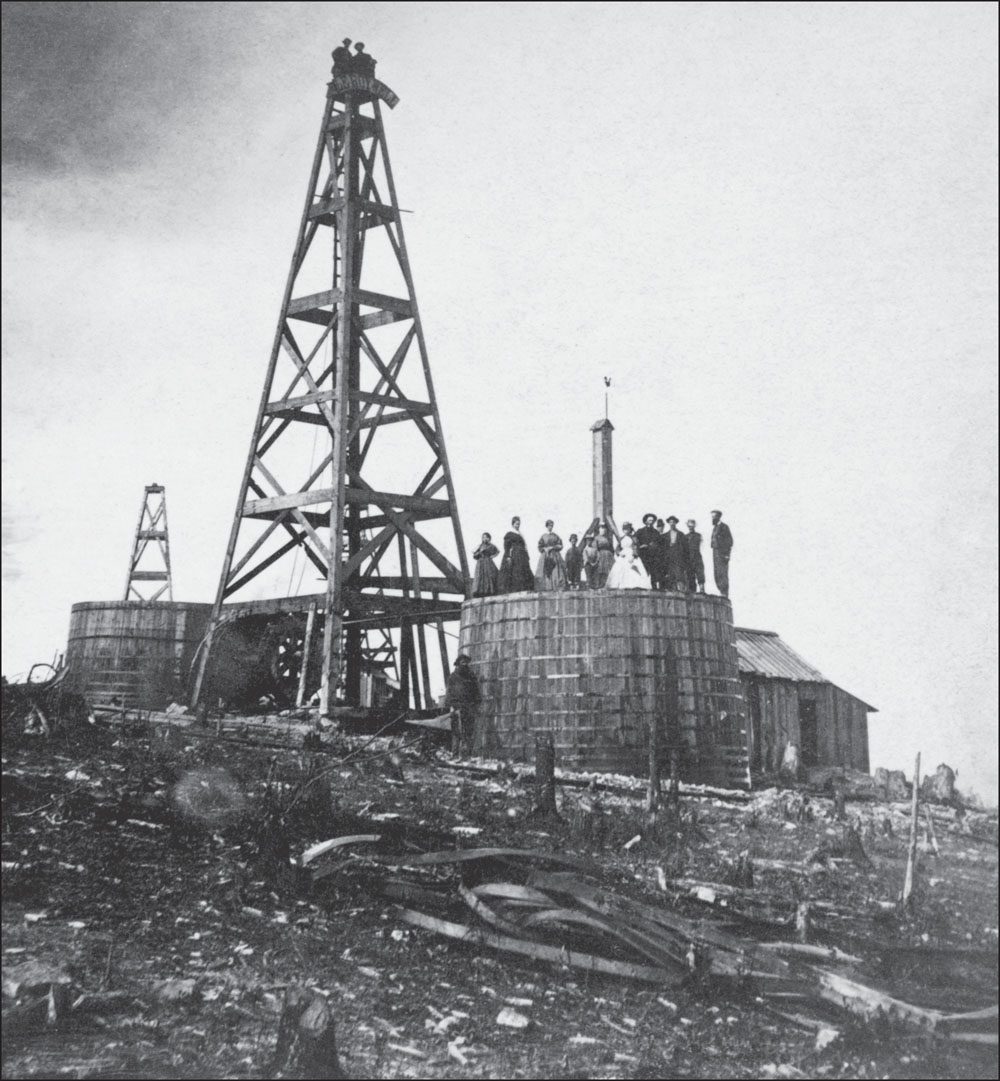
This half of a stereoscopic photograph from the 1860s shows people standing on an oil tank beside a derrick used to pump oil. The discovery of petroleum in the ground in Pennsylvania was the beginning of the end for the whaling industry. (Library of Congress.)

This April 20, 1861, cartoon from Vanity Fair shows whales at a party celebrating the “discovery of the oil wells in Pennsylvania.” In actuality, the discovery of petroleum caused an uptick in the taking of whales, since it was easier to kill whales for baleen, or whalebone, as opposed to for their oil. Processing whales for oil took many days of hard work, while getting the bone was simpler, and the carcass could be left to rot and sink. (Library of Congress.)

This 1865 photograph shows the Confederate ship CSS Shenandoah out of the water for repairs in Melbourne, Australia. The Shenandoah, with Capt. James Iredale Waddell as master, captured and sank numerous whaleships after the end of the Civil War. (US Navy.)

One of the saluting guns from the Confederate warship CSS Shenandoah is currently on display at the US Naval Academy Museum in Annapolis, Maryland. (US Navy.)

Confederate naval commander James Waddell poses for a portrait in his Confederate uniform in this c. 1860s photograph. Waddell is remembered for capturing and sinking whaleships after the Civil War was over; he and his crew were at sea when the war ended, and he was loath to believe the whaleship captains who informed him of the Confederacy’s surrender. (US Navy.)
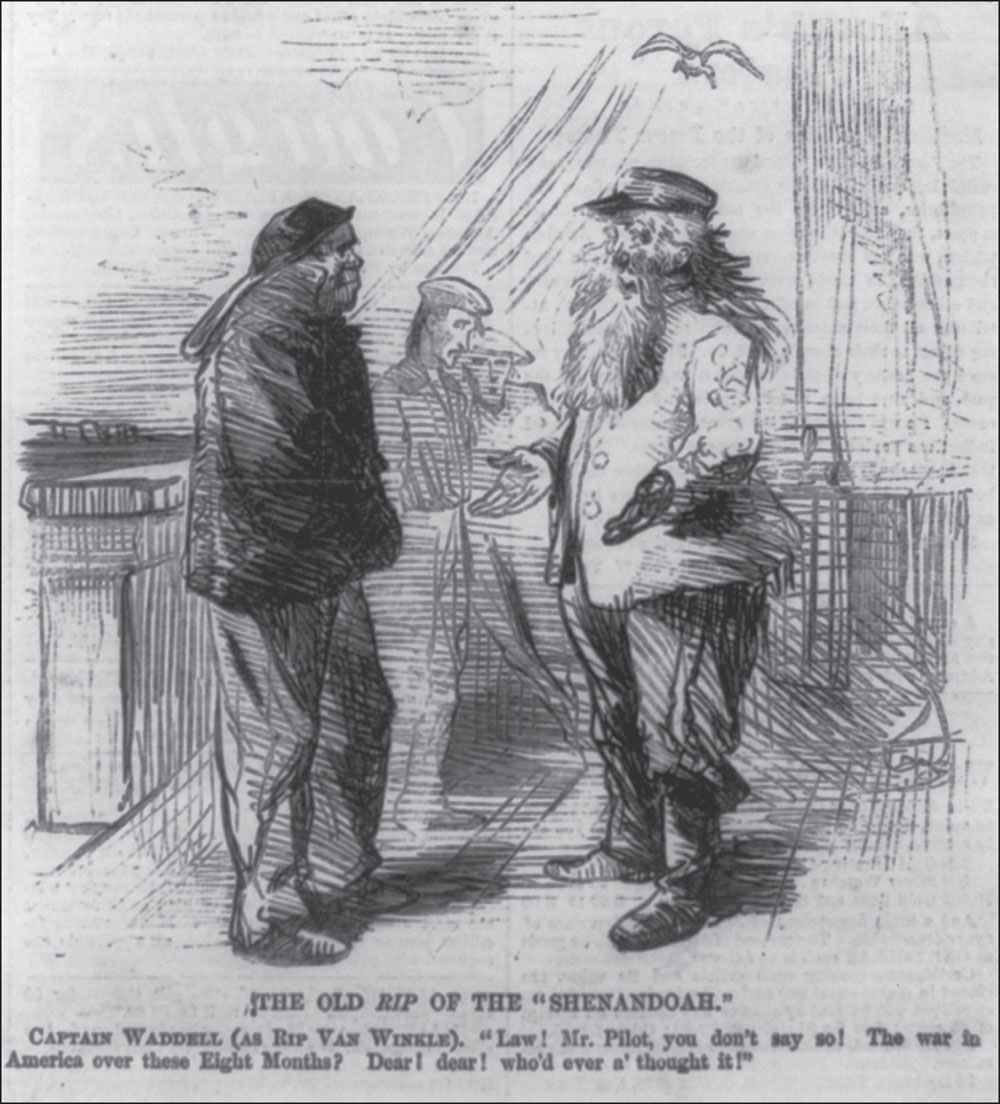
This December 9, 1865, Harper’s Weekly editorial cartoon shows Confederate captain Waddell of the Confederate warship CSS Shenandoah as Rip Van Winkle, saying to another man, “Law! Mr. Pilot, you don’t say so! The war in America over these eight months? Dear! dear! who’d ever a’ thought it!” (Library of Congress.)

This 2014 photograph shows the grave of Capt. Ebenezer F. Nye, who, as master of the whaleship Abigail, was taken prisoner along with his crew after the Abigail was sunk by Confederate captain James Waddell. Nye later escaped and set off in a whaleboat to warn the rest of the whaling fleet of the intentions of Waddell. Nye was later lost in the Arctic during a whaling expedition as the captain of the whaleship Mount Wollaston. (Photograph by Judith McAlister.)

This lithograph by Benjamin Russell (1804–1885) shows the destruction of the whaleships by Confederate captain James Waddell, head of the warship CSS Shenandoah. (Naval History and Heritage Command.)

This portion of J.H. Colton’s September 10, 1861, topographical map of North and South Carolina features an inset that shows Charleston Harbor. The drawings of ships offshore denote blockades created by the sunken whaleships of the Stone Fleet. (Library of Congress.)

Nineteen sea captains of the Stone Fleet gathered for this portrait around 1862. The Stone Fleet was a collection of old whaling ships that were filled with rocks and sailed to Charleston Harbor to be sunk as part of the Union blockade of the Confederacy during the Civil War. Herman Melville’s December 1861 poem “The Stone Fleet: An Old Sailor’s Lament” summed up the results with its last two lines: “A failure, and complete,/Was your Old Stone Fleet.” (New Bedford Whaling Museum.)

United States Geological Survey (USGS) researcher Benjamin Jones took this picture of a nearly century-old whaling boat in July 2007 along the Beaufort Sea coast near Lonely, Alaska. Some of the equipment used in whaling was simply abandoned when the industry dried up. Due to rapid coastal erosion, this boat washed away to sea just a few months later. (USGS; photograph by Benjamin Jones.)

This c. 1910 photograph shows a whaleship that has been stripped and left to rot away in Fairhaven Harbor. Once the industry began to wane, the older ships beyond repair were scavenged for wood and anything else of value. (Millicent Library.)
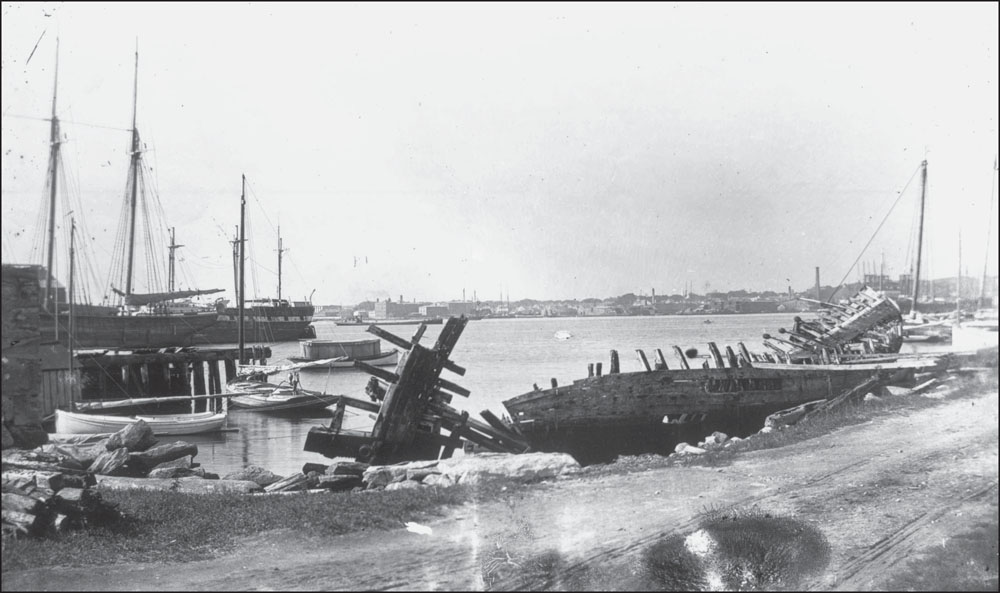
An old whale ship sits on the shore in Fairhaven harbor in a state of decay around 1910. Once a whale ship was stripped of all usable parts and wood, it was often left to rot. (Millicent Library.)

This old whaleship is shown on stays on Granite Wharf in Fairhaven, Massachusetts, in the 1880s. As the industry wound down in the early 20th century, many whaleships were scavenged for wood or simply abandoned after being determined to be unfit for repair. (Millicent Library.)

This pen-and-ink drawing shows natives surprising and killing walruses in the Arctic. Once the bowhead whale population in the Arctic was decimated, whalers began to go after walrus, which could be processed for oil and had added value because whalers could sell their tusks for various purposes. (National Oceanic and Atmospheric Administration.)

Natives use ropes and a pulley system to bring a walrus ashore for processing in this drawing. The whaling industry began harvesting walrus for oil when the whale population became decimated due to overfishing. Their tusks could also be sold to create some of the many products that used whalebone. (National Oceanic and Atmospheric Administration.)
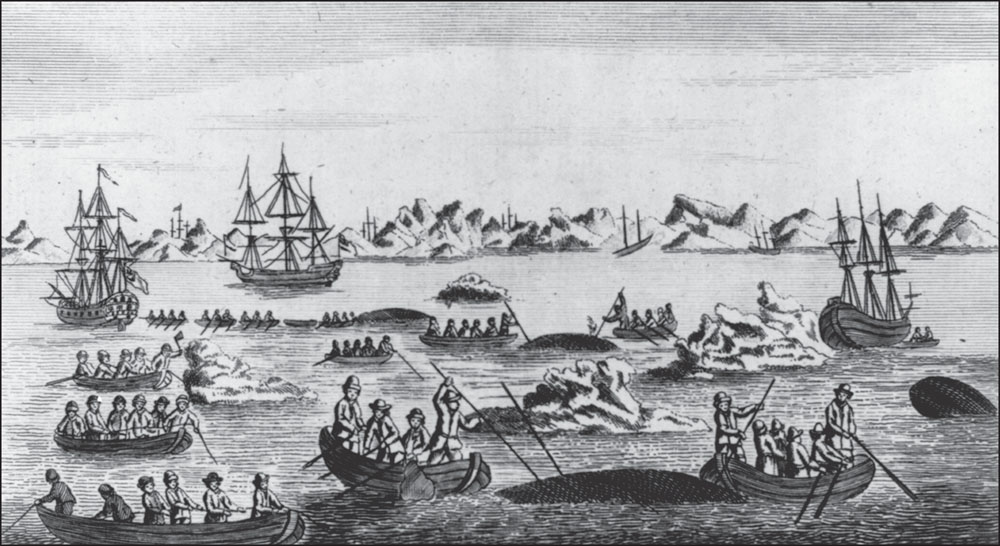
This image of whaling in the Arctic shows whaleships, icebergs, and men hunting and catching whales. The Arctic whale fishery proved lucrative after whales were fished out in other whaling grounds. After the Arctic bowhead whale population was decimated, whalers went after walrus for their oil and tusks. (Library of Congress.)

The crew of the US Revenue Cutter Bear pose on the ice near the ship while on patrol in the Bering Sea in the Arctic in 1900. The Bear captured public imagination during the Overland Relief Expedition of 1897, which saved more than 200 people aboard eight whaling ships that were trapped in ice off Point Barrow, Alaska. (US Coast Guard.)

As stranded, stricken whaling crews wait aboard their vessels in March 1898, a rescue crew from the US Revenue Cutter Bear brings in much needed supplies during the Overland Relief Expedition, one of the most famous rescues in Coast Guard history. (US Coast Guard.)

The crew of the US Revenue Cutter Bear work on the ice near the ship while on the Bering Sea Patrol in the Arctic in 1900. (US Coast Guard.)

This portrait shows the officers of the Overland Relief Expedition from the US Revenue Cutter Bear. From left to right are 2nd Lt. E.P. Bertholf, Dr. S.J. Call, and 1st Lt. David H. Jarvis. The US Congress awarded these officers with specially struck gold medals for their actions in saving the lives of more than 200 stranded whalers. (US Coast Guard; photograph by W.H. Stalee.)

This painting by maritime artist Charles Raleigh shows the steam whaler Orca, captained by George Bauldry of Monument, Massachusetts, taking in the head of the 28th whale caught on this voyage in the Arctic on October 2, 1887. The 177-foot bark with a 280-horsepower steam propulsion engine was built in 1882 and lost when it was crushed in the Arctic ice on September 22, 1897. The wreck was found in 1988 in some 100 feet of water in the Chukchi Sea. (Bourne Historical Society.)

These three items shown were found in the home of whaling captain George Bauldry in Monument (now Bourne) by current owner Peter Haney. They are the Bauldry home name plaque (left), a Book of Common Prayer inscribed to Captain Bauldry in 1875, and a piece of a sperm whale tooth that fell out of the ceiling and hit Haney on the head when he was doing some work in the house. The book might have been used by the captain to record deaths at sea, as the book contains the rites and sacraments needed to properly lay a person to rest. (Photograph by the author.)

A whaling fleet is going after right whales in the Bering Strait in this lithograph by Benjamin Russell. Whaling disasters in the Arctic were some of the major catastrophes that plagued the whaling industry in its final decades. (Library of Congress.)

The whaleship Wanderer, a day out from its last voyage in August 1924, is shown wrecked on the shores of Cuttyhunk Island off Cape Cod as the ship’s captain is being brought ashore. This was an inauspicious end and the last working voyage of a wooden whaleship. (New Bedford Whaling Museum.)

The Charles W. Morgan, shown here under sail in 1920, is the last remaining wooden whaleship of the United States–based whaling fleet that, at one time, numbered more than 2,700 vessels. She was launched from New Bedford on July 21, 1841, and typically sailed with a crew of 35. During its 80 years as an active whaler, the Morgan went on some 37 voyages, with most lasting three or more years. The Morgan is on view at her home berth in Mystic, Connecticut. (Bourne Historical Society.)