
PART I
1
Towards the end of the fourteenth century Hopcyn ap Tomas of Ynysforgan, near Swansea, commissioned the single most comprehensive surviving collection of medieval Welsh prose and poetry, a manuscript now known as the Red Book of Hergest.1 A highly cultured member of the Welsh gentry praised by poets for his interest in literature and history, Hopcyn became caught up in the last armed rising of the Welsh against English rule, led by Owain Glyndŵr (d. 1415), being consulted as a ‘maister of brut’ (political prophecy) on the prince’s prospects in 1403; two years later he was captured after fighting for Owain near Usk.2 Viewed in this context, the Red Book may be seen as a project of cultural affirmation. Central to its purpose was the conservation of what had become a canonical interpretation of the Welsh past, understood as no less integral to Welsh literary culture than the prose tales and poetry which occupy much of the manuscript.3 This opens with three texts, comprising about a quarter of the volume as a whole, which take us to the heart of historical writing in medieval Wales by supplying a narrative sequence extending from the Trojan War almost to the end of native rule in Wales in 1282: Ystorya Dared (‘The History of Dares’), Brut y Brenhinedd (‘The History of the Kings’), and Brut y Tywysogyon (‘The Chronicle of the Princes’). All were Welsh translations of Latin works: the sixth-century Historia de Excidio Troiae (‘History of the Fall of Troy’) attributed to Dares the Phrygian; Geoffrey of Monmouth’s De Gestis Britonum (‘On the Deeds of the Britons’)—better known as Historia Regum Britanniae (‘History of the Kings of Britain’)—completed c.1138; and a chronicle configured as a continuation of Geoffrey which focused on events in Wales from the late seventh century to 1282.
The connecting thread between the three texts was the making of the Welsh as a people who could claim descent from the Britons and, through them, the Trojans. Such an interpretation of the past meant that Welsh history was not only, or even primarily, a history of Wales, as crucial parts of the action had taken place in a remote past among ancestors of the Welsh on a European and, above all, British stage. This chronological and geographical emphasis was reflected in the space occupied by the three works at the beginning of the Red Book, all copied in the same highly regular hand, as the narrative down to the late seventh century provided by Ystoria Dared and Brut y Brenhinedd filled 230 columns of text compared to only 146 columns for the subsequent events over the following five centuries related in Brut y Tywysogyon.4 Nor was the emphasis new. Though the creation of this series of Welsh texts had been completed only in the early fourteenth century, their approach to the past originated in the early Middle Ages, as Geoffrey of Monmouth drew on Gildas and the early ninth-century Historia Brittonum (‘History of the Britons’), while Brut y Tywysogyon continued a tradition of Latin chronicle writing beginning in the eighth century.
The historical works that open the Red Book attest, therefore, not only to the place of history in Welsh-language literary culture but also to its Latin roots and its debt, in the case of Dares and especially Geoffrey, to texts that were widely influential in medieval Europe, often in the context of a similar shift from Latin to the vernacular.5 This in turn serves to highlight that historical writing in medieval Wales belonged to a wider European world. More particularly, its emphasis on the making of the Welsh reflected a widespread ambition to write the history of peoples and attribute to them distant, often Trojan, ancestry.6 Indeed, claims that the Britons were descended from the Trojans may have originally been influenced by seventh-century Frankish example (see Chapter 2). However, what is striking about the canonical view of the Welsh past presented at the beginning of the Red Book is its expression in a sequence of three discrete texts (the break between the end of Brut y Brenhinedd and Brut y Tywysogyon is shown in Fig. 1.1).7 While their combination signalled a desire to create a narrative of the Welsh from their origins in Troy to the end of native rule in 1282, it also highlighted the lack of any single history of the Welsh comparable to the numerous histories of peoples from their beginnings to the time of composition which were written elsewhere in medieval Europe.8 This task was first attempted with respect to Wales by Gutun Owain in the late fifteenth century, though significantly he combined the history of the Welsh with that of the English, as shown in Chapter 4.9 Viewed from a European perspective, then, medieval Welsh historical writing exemplified what some scholars have termed ‘national history’ in the Middle Ages—focused on a people, country, dynasty, or polity—to only a limited and partial extent.10
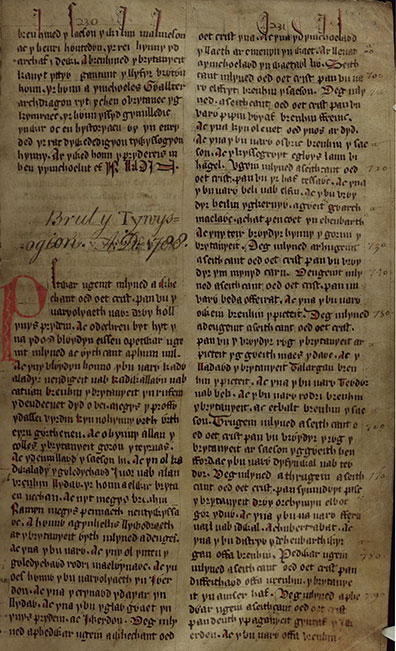
Fig. 1.1 Oxford, Jesus College MS 111 (the Red Book of Hergest), fol. 58r
In crucial respects the writing of history in medieval Wales was a response to conquest and loss: above all, the loss of much of Britain to the Anglo-Saxons in the post-Roman period, and the subsequent confinement of the Britons to kingdoms in the north and west of the island. The idea that the Welsh were the heirs of the Britons was fundamental to understandings of the past in Wales throughout the Middle Ages and indeed down to the nineteenth century. Welsh history was thus inextricably linked to the history of Britain. In large part, this was a matter of harking back to a glorious past and presenting the Welsh descendants of the Britons as the original proprietors of Britain. Such thinking offered not only solace but hope, as a prophetic tradition, attested from at least the tenth century, held out the promise that the Welsh would eventually recover the Britons’ sovereignty over the island, symbolized by ‘the crown of London’, a promise widely believed to have been fulfilled by the accession of the partly Welsh Henry Tudor to the throne of England in 1485.11 However, the need to place the history of Wales in a wider British framework also reflected the political realities of Anglo-Welsh relations, as kings of England asserted their overlordship over Welsh rulers, periodically by force, pressure intensified from the late eleventh century by piecemeal conquests—especially in southern Wales and along the English border—which led to the creation of marcher lordships and culminated in Edward I’s defeat of the remaining Welsh princes in 1282–3.12 It is no coincidence that a narrative tracing the history of the Welsh from their alleged Trojan origins was elaborated most fully after that final conquest.
If history writing in medieval Wales both appropriated and continued narratives of the Britons set on a pan-British stage, it did so within a fragmented Welsh political landscape which helped to shape not only the content of history writing, dominated by struggles for power within and between Welsh dynasties and their interaction with foreign conquerors, but also the contexts in which it was produced. In his Life of King Alfred, composed in Wessex in the early 890s, Asser of St Davids clearly had a sense of Wales as a distinct geographical space, though tellingly he called it Britannia (‘Britain’), a usage followed by Welsh writers of Latin until the twelfth century which implied that Wales represented the greater Britain the Britons had lost.13 Wales was conceived, then, in essentially ethnic and cultural terms—as the land of the Britons rather than a political unit. Indeed, Asser refers to five different kingdoms, and related that their rulers had all accepted the overlordship, not of any Welsh ruler, but of his master King Alfred.14 True, some pre-Norman Welsh rulers established extensive hegemonies, notably Hywel Dda (Hywel the Good; d. 950) and, above all, Gruffudd ap Llywelyn (d. 1064).15 Furthermore, the thirteenth-century princes of Gwynedd (north-west Wales)—the most powerful Welsh kingdom for the majority of the period down to 1282—sought both to establish their domination over the other Welsh rulers and to identify that domination explicitly with Wales, an ambition sanctioned by the English crown’s recognition in 1267 of Llywelyn ap Gruffudd (d. 1282) as ‘Prince of Wales’, ruling a ‘Principality of Wales’. However, Llywelyn’s principality was demolished after Edward I’s first Welsh war of 1276–7.16 Likewise all previous hegemonies were short-lived and failed to survive beyond the ruler’s lifetime; nor, apart from Gruffudd ap Llywelyn, did any Welsh ruler achieve dominance over the whole of Wales. Rather, regnal plurality remained the norm, while regions within individual kingdoms provided a further focus for identity that both qualified and complemented notions of belonging to the wider entities of Wales or Britain.17 This pattern was complicated, but not fundamentally altered, by the establishment of marcher lordships from the late eleventh century onwards, followed, after the Edwardian conquest, by the division of the defeated Welsh principalities into further marcher lordships in the north-east and the royal Principality of Wales in the north-west and south-west.18
A plurality of polities was, of course, not in itself inimical to writing the history of a particular people. This was especially true of the early Middle Ages. The Goths and the English, whose histories were written by Jordanes and Bede respectively in the mid-sixth and early eighth centuries, were divided between different kingdoms and dynasties, and the same was true of the Irish whose origins were traced in the eleventh-century Lebar Gabála (‘Book of Settlement’).19 The Historia Brittonum (‘History of the Britons’) composed in early ninth-century Wales was thus but one instance of a common phenomenon. While these early medieval histories show an interest in kings and dynasties, the fusion of ethnic and dynastic history became more pronounced as kingdoms developed greater coherence from the twelfth century onwards.20 In these cases, the origin legend of a people also served to legitimate its rulers. Thus, to take two notable examples, from the thirteenth century onwards, historians of both England and France attributed Trojan origins to a succession of royal dynasties culminating in the kings ruling over the undivided kingdoms of the writers’ own day.21 By contrast, in Wales, as in Ireland, historical writing retained a primarily ethnic focus throughout the Middle Ages and—with the important exception of genealogical texts—was both less concerned with royal dynasties and less connected with royal or princely courts than in many other parts of Latin Christendom.22
This probably resulted primarily from continuing political fragmentation and dynastic instability, which in turn contributed to the fluctuating durability of the courts of even the most powerful ruling houses. Moreover, in Wales, unlike Ireland (or Scotland), the creation of a ‘national history’ in the Middle Ages was also inhibited by the emphasis on descent from the Britons and identification with the island of Britain coupled, crucially, with the rival claims to that British inheritance by the English.23 Although attempts were made to put the past to the service of individual dynasties, individual kingdoms and dynasties provided an unstable framework for the construction of historical narratives, as contested successions militated against the smooth transition of power, and attacks by other dynasties or foreign conquerors threatened a kingdom’s territorial integrity or even existence.24
As elsewhere in medieval Europe, churches provided a vital institutional context for historical writing, by supplying not only authors and scriptoria but also continuity in the face of political vicissitudes and networks for the transmission of texts. To judge by the surviving works, until the thirteenth century historical narratives were usually written in Latin by churchmen, who adopted widely used genres, notably chronicles, histories, and hagiography, to offer an ecclesiastical perspective on the past. Their works were produced both in early medieval foundations such as St Davids and also, from the twelfth century, Benedictine monasteries, including those of reformed religious orders, especially the Cistercians. From the thirteenth century, however, two related shifts occurred, which again had parallels in other European societies and also mirrored wider changes in Welsh written culture. The first was the production of an increasing number of historical (as of other) works in Welsh. Some manuscripts of these works were produced in Cistercian scriptoria.25 Nevertheless, second, the adoption of the vernacular facilitated an increasing role for the laity as patrons, readers, scribes, and in a few cases authors of historical texts. Patrons were drawn from the gentry or squirearchy (W. uchelwyr), the local leaders of Welsh society after the demise of the native princes in the wake of the Edwardian conquest, and their interest in the past was an essential stimulus to the copying and composition of historical texts in later medieval Wales, as demonstrated by Hopcyn ap Tomas of Ynysforgan.26
Although it is uncertain how far, if at all, the Latin and Welsh works discussed in the first part of this book reached audiences beyond the restricted circles of churchmen as well as, by the later Middle Ages, poets and gentry, there can be little doubt that the deep sense of loss which was fundamental to their view of the past resonated widely in Welsh society and fed into hopes for the recovery of former glory. It is with the earliest literary expression of that loss, Gildas’s De Excidio Britanniae (‘The Ruin of Britain’), that the following discussion of history writing in medieval Wales will begin.
Writing Welsh History: From the Early Middle Ages to the Twenty-First Century. Huw Pryce, Oxford University Press. © Huw Pryce 2022. DOI: 10.1093/oso/9780198746034.003.0002
1 Daniel Huws, ‘Llyfr Coch Hergest’.
2 Prys Morgan, ‘Glamorgan and the Red Book’; Christine James, ‘ “Llwyr Wybodau, Llên a Llyfrau” ’, 17, 20–1; Gruffydd Aled Williams, ‘Gwrthryfel Glyndŵr’, 81–3.
3 Conversely, it has been suggested that the inclusion of the prose tales known as the Mabinogion reflected Hopcyn ap Tomas’s interest in history, as these presented a past in which British kings ruled over the island of Britain: Luft, ‘Commemorating the Past’, 80–4.
4 Oxford, Jesus College MS 111, fos. 1r–8r (cols. 1–30, l. 12: Ystorya Dared); 8v–58r (cols. 31–230: Brut y Brenhinedd); 58r–89v (cols. 230–376: Brut y Tywysogyon): Digital Bodleian: The Red Book of Hergest, http://image.ox.ac.uk/show?collection=jesus&manuscript=ms111 (last accessed 13 September 2021); see also Daniel Huws, ‘Llyfr Coch Hergest’, 4–5.
5 See e.g. Alamichel, ‘Brutus et les Troyens’; Wolf, Troja, esp. 131–6, 175–87; Poppe, ‘The Matter of Troy’, 258–82.
6 Reynolds, ‘Medieval Origines Gentium’, 375–7; Waswo, ‘Our Ancestors, the Trojans’; Wolf, Troja, 64–123; Pizarro, ‘Ethnic and National History’; Kersken, ‘High and Late Medieval National Historiography’, 181–215.
7 The title of the latter work was added by an unidentified reader in 1788. I am grateful to Robin Darwall-Smith, archivist of Jesus College, for the information that the reader’s hand occurs neither in the college’s borrowing register of 1775–98 nor among the entries written by each new Fellow and Scholar in the college register for the 1780s.
8 Cf. Kersken, Geschichtsschreibung, 9–11.
9 The Historia Brittonum comes closest to doing this, but its account essentially ends in the late seventh century.
10 For defences, albeit qualified, of the validity of applying the concept of ‘national history’ to works of the pre-modern period, including the Middle Ages, see Kersken, Geschichtsschreibung, 4–11; Goetz, Geschichtsschreibung, 381–7; Woolf, ‘Of Nations, Nationalism, and National Identity’, 77–81; Berger with Conrad, The Past as History, 29–31.
11 Glanmor Williams, Religion, Language and Nationality, 71–86; Prophecies from the Book of Taliesin, ed. and trans. Haycock, 2–3, 5–14; Gruffydd Aled Williams, ‘The Bardic Road to Bosworth’; Lynch, Proffwydoliaeth, esp. 17–42. For the close ties between history and prophecy in the Middle Ages see Guenée, Politique et histoire, 253–4.
12 The fullest general accounts of medieval Wales are Charles-Edwards, Wales, and R. R. Davies, Conquest. Shorter syntheses: Wendy Davies, Wales in the Early Middle Ages; A. D. Carr, Medieval Wales; Stephenson, Medieval Wales.
13 Asser’s Life of King Alfred, cc. 7, 14, 79–80, ed. Stevenson, 7, 12, 63–6; trans. Keynes and Lapidge, Alfred the Great, 69, 71, 93–4, 96; Pryce, ‘British or Welsh?’, 777–8; Charles-Edwards, Wales and the Britons, 1–4.
14 Asser’s Life of King Alfred, c. 80, ed. Stevenson, 66–7; trans. Keynes and Lapidge, Alfred the Great, 96.
15 Charles-Edwards, Wales, 508, 510–13, 561–7; Michael and Sean Davies, The Last King of Wales.
16 R. R. Davies, ‘The Identity of “Wales” ’, esp. 54–62.
17 Euryn Rhys Roberts, ‘A Surfeit of Identity?’.
18 Lieberman, The March of Wales.
19 Goffart, The Narrators of Barbarian History, 20, 62–8; Nicholas Brooks, Bede and the English, esp. 3–7, 10; Byrne, ‘Senchas’, 158–9; Carey, The Irish National Origin-Legend; Ó Corráin, ‘The Church and Secular Society’.
20 Pizarro, ‘Ethnic and National History’, 52, 56–7, 60–4, 71–2, 74–5; Reynolds, ‘Medieval Origines Gentium’, 381–7, 389–90; Goetz, Geschichtsschreibung, 119–20. Further examples of histories of peoples focused on royal courts and dynasties in Bagge, ‘Scandinavian Historical Writing’, 418, 424–5; Berend, ‘Historical Writing in Central Europe’.
21 Barron, Le Saux, and Johnson, ‘Dynastic Chronicles’, 32–5; Kersken, Geschichtsschreibung, 252–80; The Oldest Anglo-Norman Prose Brut Chronicle, ed. and trans. Marvin; Spiegel, The Past as Text, 106–7, 195, 201–2, 207–8. Anglo-Saxon royal dynasties avoided claiming Trojan origins: Elizabeth M. Tyler, ‘Trojans in Anglo-Saxon England’.
22 For Ireland see Ó Corráin, ‘Creating the Past’.
23 Notions of Scottish identity emphasized separateness from the rest of Britain: Broun, ‘Britain and the Beginning of Scotland’, esp. 119–31.
24 Cf. J. Beverley Smith, ‘Dynastic Succession’.
25 Daniel Huws, Medieval Welsh Manuscripts, 12, 14–15, 29, 52–3.
26 Cf. R. R. Davies, The Age of Conquest, 415–18.