
The death of King Marti (31 May 1410) led to a crisis within the states of the crown of Aragon. It was resolved in a radical fashion which has been the cause of debate ever since. Martl’s death brought to an end the dynasty founded with the marriage of the infanta Petronilla of Aragon to Ramon Berenguer, count of Barcelona, which had reigned uninterruptedly since 1137. The demise of the line was caused by Martl’s lack of legitimate heirs, after the death of his son, Marti (July 1409), during the military campaign in Sardinia, although, through Marti, the king did have an illegitimate grandson, the young Frederic, count of Luna. Marti I’s fondness for Frederic did not blind him to the problem of his illegitimacy, especially since there were other claimants to the crown whose rights were beyond dispute. The strongest of these was Jaume, count of Urgel, who had been appointed first lieutenant and later governor-general by the king himself, who thus almost appeared to be naming him his heir, giving rise to constitutional questions among the Aragonese. On his father’s side, Urgel was descended from a junior line of the family of Alfons IV ‘the Benign’. A member of the powerful Catalan family, he was disliked by the minor aristocracy and was strongly opposed by the patrician class of Barcelona. Louis of Anjou, duke of Calabria, and Fernando ‘de Antequera’, the infante of Castile, were more closely related to Marti, but through the maternal line, Violante, the mother of Louis, being the daughter of King Joan I, Martl’s elder brother and his immediate predecessor, while Fernando’s mother, Elionor, was Martl’s sister and wife of Juan I of Castile.
Given the nature of the problem Marti I, a scrupulous observer of constitutional traditions, made strenuous efforts to involve the kingdom in the discussion, requesting the corts to send him delegates with whom he could discuss the question. He also sought the advice of legal experts on such basic problems as the limits of his decision-making powers on this matter, and the extent to which kinship lines were considered legally valid. But the delegates’ slow deliberations failed to produce solutions, so that to the captious, insinuating deathbed question put by Ferrer de Gualbes, a councillor and leader of a delegation from the city of Barcelona, as to whether the king agreed that his thrones should now be inherited by whoever had the best claim by the via dejusticia, Martl’s affirmative reply was as a feeble ‘hoc’, repeated in Catalan. On the day following the king’s death, arrangements were put in hand to resolve the question of the succession in the best-qualified and largest forum available: a general cort of the three principal states in the crown of Aragon: Aragon itself, with Valencia and Catalonia. But the fierce conflicts between the noble factions — Urrea and Luna in Aragon, Centelles and Vilaragut in Valencia — brought the plans to nothing. Another solution was therefore sought, that of agreements between selected commissions and delegations nominated by the assemblies which, in the interregnum period, had become the only recognised form of authority in the land. The candidates to the throne, however, stepped up the pressure on these representatives. Along with foreign candidates, such as the French and the Castilian, the count of Urgel in particular even went so far as to apply military pressure. In January 1412, in Alcaniz, faced with the internal divisions of the other assemblies and their paralysing obstructionism, the Aragonese assembly firmly declared Aragon to be ‘superior to the other kingdoms and lands of the royal crown of Aragon’ (‘cabega de los otros regnos e tierras de la real Corona de Aragon’), and decided that, in the absence of any agreement from the other assemblies, it would now proceed to declare alone. As a result, the Aragonese corts submitted to the Catalan assembly a list of nine people, three for each of the three states in the kingdom, to whom the choice of the new sovereign should be entrusted. This solution was enthusiastically endorsed by the Aragonese pope, Benedict XIII, who hoped that strong support from the monarchy would regain for the Papacy the obedience lost during the Great Schism.
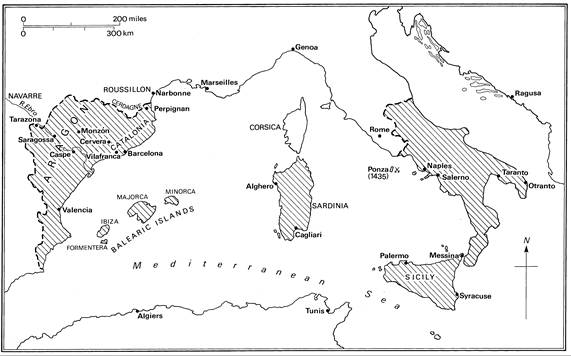
Map 12 The Aragonese dominion
The commission met in the castle of Caspe, in Aragon, and, after examining the titles of all the candidates to the crown, pronounced its decision on 24 June 1412. The successor to Marti I would be Fernando, the infante of Castile, by right of his close blood ties with the late king and by the rights inherited from his mother, the daughter of Pere IV ‘the Ceremonious’. The role of Vincent Ferrer, the Dominican friar and one of the compromisarios, was decisive in the election, but Bernard de Gualbes, mayor of Barcelona and spokesman of the Catalan middle classes, also voted for Fernando, who gathered six votes against the one and a half for the count of Urgel. The Aragonese compromisario who had voted for the duke of Gandia and the count of Urgel was later forced to admit that Fernando was the candidate best suited for the throne, given the disorder and public paralysis resulting from the long interregnum, thus refuting future Catalan theories that the decision had been forced on their state.
Aragon
The Compromise of Caspe cannot be reduced to a mere matter of the rights of succession limited, furthermore, to the kingdom of Aragon alone. The decision had far-reaching repercussions. During the two-year interregnum, there was great activity in the constitutional bodies of all the ‘states’ of the kingdom, and considerable emotional involvement by the populace, the latter planting the seeds of the deep tensions which would later emerge. This does not mean that what followed was a fully fledged election in the modern sense which laid the basis for a people’s self-determination. None the less, it was a form of election and was seen as such by the legal experts of the time. In a difficult situation the Aragonese ruling class, unlike its Catalan counterpart, was able to produce and follow a politicalplan. Theindecision of the Catalans (‘claudicacio de Catalunya’, as it has been defined) had ethico-political origins, and was not simply the result of a socio-economic crisis. Catalonia was not, in effect, forced to submit to any injustices; she had merely to adapt to a solution proposed by others and which met the requirements of the hour. Fernando de Antequera was a member of a powerful baronial clan with far-reaching ambitions which had recently acquired the throne of Castile. He represented all the demographic, military and economic potential of a country which, far better than the old sea-trading Catalonia, was able to meet the challenge of a new and different type of power politics.