
Towards the end of the fourteenth century the Scandinavian countries were recovering from the effects of two crises. The earlier of these was at least partially caused by a deterioration of the climate, c. 1300. As a consequence of this farms and even villages, often those situated on less fertile soil, became deserted. This happened in Norway and in Denmark, whereas Sweden, colonised later, only felt the crisis after the middle of the fourteenth century. The Black Death (1349—50) struck the whole of Scandinavia except Iceland; in Norway, in particular, its effects were aggravated by subsequent epidemics, smallpox in 135 9—60, plague in 1371. In both Norway and Denmark the results of the agrarian crisis — deserted farms and redundant peasants — were counterbalanced by the effects of the diseases. In certain regions, however, they were to create a lack of manpower.
Other effects were the formation of large estates belonging to the Church or to the aristocracy, and an increase of the share of animal husbandry in the rural economy. In certain parts of Norway the desertion of farms could be avoided by supplementing rural activities with fishing or forestry. At the end of the fifteenth century water-driven sawmills were founded at many river estuaries in southern and western Norway; this was to become a source of economic growth during the early modern centuries.
In Finland, at least in the south-west, agriculture was sufficiently developed to offer a living to the peasant and his family; nevertheless, the change in climate rendered difficult the cultivation of certain cereal crops. In the interior and in Ostrobothnia, a complex economy prevailed, combining agriculture with animal husbandry, fishing and the hunting of animals for their furs. In the east, burnbeating was widespread, and here, too, subsidiary sources of income (especially from furs) were important. Although the epidemics did not spare Finland, the complexity of her economy facilitated its adaptation to the new conditions which were to develop.
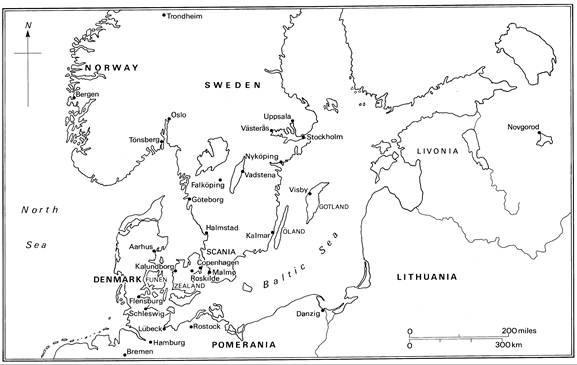
Map 16 Scandinavia and the Baltic
Sweden also suffered from the Black Death, but her agrarian crisis, with its desertion of farms, belongs to the century after the plague. It is difficult to see, however, whether this fact reveals a crisis of manpower (because of the epidemics) or whether it had independent causes. The response to the new conditions was a concentration on animal husbandry in regions less suitable for the growing of cereals, and the desertion of farms founded in the less fertile districts during the early medieval colonisation. Moreover, subsidiary activities such as fishing, hunting animals for furs and mining must have been important in the regions outside the fertile belt around the great lakes in central Sweden.
Iceland, the only Scandinavian country to remain untouched by the Black Death, none the less suffered severe outbursts of plague in 1402—4 and again in 1495. Such scanty evidence as survives indicates some desertion of marginally situated farms, a movement probably aggravated, but not caused, by the epidemics.
Denmark was the only country to have a fairly large number of towns, most of them being rather small. Although the advance of the Hanseatics after the middle of the thirteenth century had repelled Danish ships from long-distance trade and navigation, Norwegian traders still called at English ports in the late fourteenth century. During this century, Bergen became the centre of Norwegian foreign trade, but most of it was in the hands of others, Hanseatics, Englishmen and Scots. Nevertheless, after the union of the Norwegian and Danish crowns in 1380—1, the sea between southern Norway and Stralsund came to be regarded as one on which local ships and long-distance traders were active. Similarly, the eastern — and interior — parts of the Baltic formed a region where Hanseatic, Swedish and Finnish vessels undertook the transport of goods. In each it was the aim of the Hanseatics to obtain as large a share of the trade as possible and, consequently, it was often Scandinavian policy to support Dutchmen, Englishmen or Scots against their Hanseatic rivals.