
Central and eastern Europe in the late Middle Ages was home to many ethnic, cultural, political and social systems. During the fourteenth and fifteenth centuries this region, whose character had been taking shape over a number of centuries, experienced an increase in settlement density, especially in the kingdom of Poland and certain areas of the grand duchy of Lithuania. Together with the growth in rural settlement there came a slow but steady advance in population.
Demographic estimates for the period before statistics merely represent orders of magnitude. About 1370, the kingdom of Poland had 2 million inhabitants with a population density of 8.6 persons per square kilometre. By contrast with western Europe, which was adversely affected demographically and economically by the Black Death, the outbreak of plague in Poland did not have the character of a catastrophe, as can be seen from the increase in internal developments and quite intensive colonisation of the fourteen and fifteenth centuries.
After the personal union of the kingdom and the grand duchy of Lithuania in 1385 and the annexation in 1466 of Royal Prussia and Warmia (Ermland) at the cost of the Teutonic Order, both the Polish and Lithuanian states governed by the Jagiellonian dynasty covered an area at least five times greater than Poland under her last Piast king, Casimir III the Great (1333—70). Poland—Lithuania now had an area of about 1,240,000 square kilometres. At the beginning of the sixteenth century the population was in the range of 7.5 million split more or less evenly, even though Lithuania was three times larger geographically than the kingdom and the Rus'ian territories of the Polish crown. Poland had fifteen inhabitants per square kilometre while the population of the grand duchy did not exceed five persons per square kilometre. The evidence of the economic indicator lends credence to a significant rise in population in fifteenth-century Poland, while the same was happening in the grand duchy of Lithuania, especially in her north-western territories.
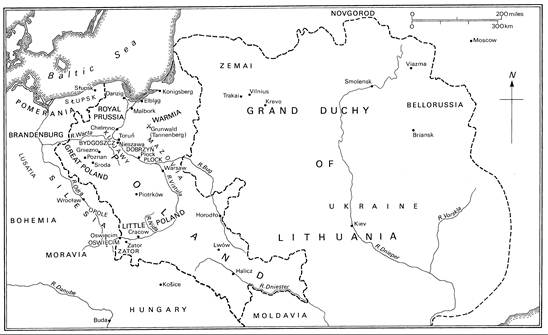
Map 18 Poland and Lithuania
Information on climatic fluctuations in this part of Europe at that time is so sparse that we may have to rely upon general European weather conditions in the fourteenth and fifteenth centuries, supplemented by the data of dendrochronology made available from excavations in Rus'. As we know from many places in Europe, the thirteenth century and the first half of the fourteenth underwent some cooling of the climate compared with the favourable conditions of preceding centuries. The probable improvement at the end of the century appears to have been only temporary; the fifteenth century again experienced severe climatic conditions, although these were much less harsh than the little ice age which struck from 1550 well into the seventeenth century. Various types of weather and regional variation certainly afflicted a wide band of central and eastern European territory. From the itinerary of Wladyslaw II Jagiello (Jogaila), king of Poland and grand duke of Lithuania, we may deduce that winter began early in November when the king drove in his sled for his progress around Lithuania which would last several months. There were still hoar frosts at the end of May and the king fell victim to one of these.