
The Latin communities in the east were composed predominantly of minority groups of westerners settled, permanently or temporarily, in the eastern Mediterranean, largely in consequence of earlier movements of Latin expansion. These developments were closely connected to the crusades which had conquered Jerusalem and Constantinople together with territories and islands in Greece, in the Aegean and on the Asiatic mainland. Some of these outposts were still in Latin hands in 1400, though the Ottoman Turks had by then secured considerable areas of Anatolia and the Balkans while the Mamluk regime, based on Cairo, was governing in Egypt and in what had before 1291 been Latin Syria. This presence in the east, whether in places under direct western rule, in Latin communities established in Greek lands, or in other Christian or infidel parts, comprised three varying and often overlapping classes: indigenous Latin settlers born and bred in the Levant; long-term expatriates in commercial, administrative, military or ecclesiastical posts; and merchants, sailors, mercenaries, missionaries, pilgrims and others stationed or travelling in the east for shorter periods.
The cosmopolitan world of scattered Levantine ports and islands was united by its seas, by its shipping and by the extensive trade which the Latins moved across them. This milieu was at the mercy of winds and currents, while much of the region was cold and snowy in winter. Lengthy and dangerous sea journeys took the westerners to the coastal termini supplied by the overland caravans arriving from the Asiatic east. The larger islands were mini-continents on which the quality of life could compare with that of the western Mediterranean mainlands, but the small islands were bleak, depopulated and miserable, without towns and amenities. These islands, all situated in a Greekspeaking area formerly within Byzantium, were dominated by small groups of Latins. Whether the administration was conducted by a monarchy as in Lusignan Cyprus, a metropolitan power as on Venetian Crete, a local Italian oligarchy as on Genoese Chios or a Latin military order as on Hospitaller Rhodes, the patterns of government were broadly similar. The Italian mercantile powers and other European rulers had economic and political interests in these possessions in which they needed to create and develop substantial multi-racial but predominantly Christian societies capable of resisting Turkish assaults. By 1400 there was little serious question of further Latin territorial expansion in the area, but throughout the fifteenth century most of the Aegean islands, except for the Negroponte which was virtually attached to the mainland and for Lesbos and its dependencies which lay close to the Ottomans at Gallipoli, remained in western hands. It was on the mainland that the Latins were over-run and expelled by the Turks.
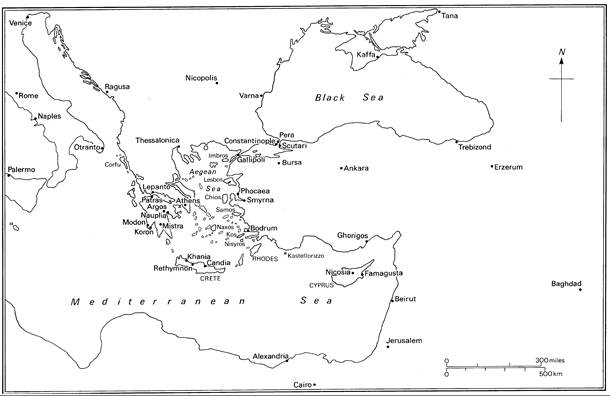
Map 21 The Latin east
Latin Levantine outposts and activities depended for their survival upon an overall naval superiority which Ottoman or Mamluk fleets could seldom match. However, western seapower had its limitations and the continuing necessity for the Latins of Ainos, Naxos, Phocaea and elsewhere to pay considerable sums as annual tribute to the Turks reduced the profits of colonial investment; and almost everywhere this tributary status was eventually replaced by outright annexation. Latin naval predominance was furthermore repeatedly jeopardised by clashes between Venetian, Genoese and lesser Latin maritime powers. The Catalans were active in the east as merchants and pirates, and from 1422 the Florentines maintained galleys at Pisa which occasionally sailed eastwards to Constantinople or Alexandria. The oared light galley, which could be heavily armed, was a speedy fighting unit capable of carrying precious cargoes while the great merchant galley and the round sailing ship had much greater capacity. The Venetians organised their galleys through a state-regulated system of convoys, the mude, which gave them a measure of control over military matters, prices, sailing dates, destinations and movements of trade. Latin shipping linked the Levantine harbours and islands to one another and integrated them into the western economic orbit, protecting and provisioning them while moving both their local produce and the long-distance trade which constituted their prime importance. Earlier conquests and settlements had developed estates and sources of revenue which supported a Levantine Latin population. There was a regional system of trade in local agrarian products, but it was the lucrative traffic in Asiatic spices and other luxuries which chiefly sustained western interest in the Levant. There were direct routes from Chios and elsewhere in the east to Atlantic ports such as Bruges and Southampton; in 1401, for example, thirty-four Genoese merchants chartered three Genoese ships at Alexandria for a voyage to Flanders.
The nature and volume of commercial exchanges naturally affected western policies as well as the prosperity and politics of the Latin Levant itself. Despite its political diversity, the extensive area from the Crimea to the Red Sea formed an economic zone which was primarily agricultural and often technologically backward, so that it became increasingly an underdeveloped region in which the Latins could dump their western industrial products. The Latin east exported its grain, wines, currants, honey, wax, cheese and other agrarian produce. Sweet red Cretan malmsey was much appreciated in the west, and mastic from the island of Chios, alum from the mines of Phocaea and sugar from the plantations of Cyprus were especially valuable. A considerable local cabotage was carried in small vessels, many of them Greek. By the fifteenth century the Asiatic spice trade had largely shifted to Alexandria but caravans travelled overland from Tabriz via Erzerum and from Baghdad through Syria to Bursa in north-west Anatolia where Genoese, Venetians and Florentines went as traders. Constantinople remained a centre for local, regional and transcontinental exchanges. The Black Sea, essentially an extension of the Aegean, retained some importance. Venetians and Genoese traded at Trebizond, Sansun and Sinope on the Pontic coast; they purchased waxes and skins in Bulgaria, and brought furs, fish, cereals and timber from Kaffa in the Crimea, and slaves from Tana in the Sea of Azov, part of the trade in slaves and wood moving along a north-south route to Mamluk Egypt. From the west came manufactured articles in metal, glass, paper and above all Italian, Flemish, Catalan, French and English woollen cloth.
At Constantinople the Venetians had their own quarter with two churches, twenty-five houses and various storehouses directed by a bailli who was a government official with wide jurisdiction. The Genoese had an important colony at Pera across the Golden Horn which operated as a useful observation post. Both these Italian powers had secured extremely lucrative customs exemptions from the emperor. The ledgers of a merchant such as Giacomo Badoer, a Venetian trading at Constantinople from 1436 to 1440, recorded a variety of affairs including commissions on purchases, sales and shipments, and it showed the importance of his Black Sea and Egyptian operations. In Egypt plague, depopulation, agrarian crises, technological stagnation and governmental interference interacted to produce a serious decline in textile production. Enormous payments of Venetian coin drained precious metal supplies from Europe into Syria and Egypt. The Venetian ducat became common currency in the Levant and even in India and beyond; in 1442 the Florentines had to counterfeit ducats for their Egyptian trade. Large profits were made from pepper, cinnamon, brazil wood and other luxuries arriving from India and south-east Asia through the Persian Gulf and the Red Sea, while the Venetians in particular carried pilgrims to Jerusalem and brought back Syrian cotton. Some westerners, such as the Cretan merchant Emmanuele Piloti at Cairo, spent years within the Mamluk domains acquiring, and subsequently reporting to the west, extremely shrewd perceptions of economic and political realities there. Latin notaries and local interpreters served visiting merchants at Beirut, Alexandria and elsewhere but western piracy and eastern extortions often led to tense relations with the Mamluks. The financier Jacques Coeur, who was based on Montpellier, himself went to purchase spices at Damascus in 1432 and subsequently he exported French copper and silver to the east. The southern Levant trade was not a Venetian monopoly but Venice increasingly assumed the predominant role in it after about 1410, while the hitherto considerable presence of Genoese, Catalans and other westerners diminished. After 1422 Sultan Barsbay responded to western exploitation of Egypt’s weaknesses by using his control of Jidda to regulate and lower protection costs imposed in the Red Sea. He then sought to establish a pepper monopoly in Egypt and to double the sale price to the Venetians; in 1436 the Venetian consul was expelled from Alexandria and western merchants withdrew to Rhodes, but patient diplomacy eventually restored the Venetians’ position.
Latin—Mamluk relations occasionally deteriorated into outright war. A Cypriot crusade had inflicted terrible long-term destruction on Alexandria in 1365, and in 1402 a Genoese fleet under the French Marshal, Jean de Boucicault, was prevented by bad weather from attacking Egypt but instead raided the Syrian coasts while also attacking Venetian property at Beirut. In 1403 the Hospitallers at Rhodes attempted, unsuccessfully, to establish a treaty with the Mamluk sultan which would have given them commercial advantages and a quasi-monopoly of the pilgrim trade. The Mamluks’ seapower was not wholly negligible and in 1426 Sultan Barsbay invaded Cyprus, took King Janus to Cairo and reduced the kingdom to tributary status, but Mamluk attacks on Rhodes were beaten off between 1440 and 1444 and an equilibrium re-established. The last Cypriot mainland possession at Ghorigos on the southern Anatolian coast fell to the emir of Karaman, despite Hospitaller intervention from Rhodes, in 1448. Cyprus was debilitated by endless internal conflicts, the balance changing only in 1473 when the Venetians effectively secured command there; in 1489 Caterina Cornaro, the Venetian widow of the last Lusignan ruler, made the island over to Venice.
Maritime interests interacted with continental developments. Ottoman expansion in both Anatolia and the Balkans provoked a major Franco-Hungarian crusade which was crushed at Nicopolis on the Danube by the Sultan Bayazid and his Serbian vassals in 1396; John of Nevers, future duke of Burgundy, was taken prisoner to Bursa in Anatolia. The west lamented this overwhelming disaster which, however, may well have saved Constantinople from the Turks. Then, while the Emperor Manuel II was travelling as far as London on a largely ineffectual fund-raising tour, his capital was reprieved once again when the great Mongol conqueror Timur defeated Bayazid near Ankara on 28 July 1402. Timur advanced towards Constantinople, took Smyrna castle from the Hospitallers of Rhodes and restored various Anatolian emirs to the lands from which Bayazid had ousted them; he then withdrew to Samarkand, leaving the devastated Ottoman domains divided by fratricidal conflicts between Bayazid’s three sons. Timur had no fleet, yet the Venetian and Genoese captains greedily sacrificed the opportunity of crippling Ottoman power when they ferried many fleeing Turks across the waters from Asia into safety in Europe; the Latins then concluded with two of Bayazid’s sons separate treaties designed to oppose Timur and to secure western commercial advantages. The westerners had already come to envisage a Turkish power as an integral part of the Levantine establishment. The Ottomans were enabled to reconstitute their shattered regime and, after about 1420, to recommence their Balkan and Anatolian expansion.
The west had political and religious concerns in the Levant. Christian opposition to the Ottomans in the Adriatic and the Balkans, which culminated in the unsuccessful Varna crusade of 1444, did not involve the Latins on a large scale, though a Venetian fleet sailed to the Dardanelles to collaborate in it. The long-delayed bartering of aid for Byzantium in return for Greek recognition of Roman religious supremacy was belatedly agreed after much theological haggling at the Councils held at Ferrara and Florence in 1438 and 1439. Alfonso V, king in Aragon, Naples and Sicily, had grandiose but unrealisable claims and aspirations in Byzantium and the east; in 1450 he acquired the strategic offshore islet of Kastellorizzo between Rhodes and Cyprus and defended it with a new castle. The Venetians defeated a large Ottoman fleet off the Gallipoli peninsula in 1416; they acquired Thessalonica in 1423 but lost it in 1430; they made a peace with the Ottomans in 1430 and then blockaded Genoese Chios. The Latin powers did not oppose the Turks consistently and they afforded little aid to Constantinople where small groups of Venetians, Genoese and other Latins fought valiantly in the final siege of 1453; other western help set out too late.
Forms of colonisation varied, but throughout much of the east the Latins were largely restricted to the coastal cities which were their centres of long-distance communication and commercial interchange. Huddled within town walls for solidarity as well as for safety, the western expatriates remained a largely separate governing class which dominated and often exploited an indigenous and mainly rural populace. On the Greek mainland the Latin principality of Achaea, conquered after the crusade of 1204, lay closest to the west, yet it was in full disintegration by 1400 when its Navarrese ruler Pedro de San Superan controlled only portions of the western Peloponnese. The weakness of its Neapolitan overlords and its own internal conflicts had delivered Latin Achaea and Glarentsa, its principal city, into the hands of an obscure group of predominantly Navarrese mercenaries who could not prevent repeated raids by Ottoman armies advancing overland. The ancient Latin baronage was reduced to a few insecure families and the archbishop of Patras; Athens remained under the government of the Florentine family of Acciaiuoli until 1456. Centurione II Zaccaria, formerly baron of Arkadia, became prince of Achaea in 1404 and prolonged the principality’s existence until 1430 when the Greeks under Thomas Palaiologos, despot of Mistra, secured control over almost the entire peninsula. Effective resistance to the Turks came only from the Venetians whose concern for their long-distance trade forced them to defend their vital naval bases at Coron and Modon in the south-west, and to reverse their policy of avoiding the expenses and complications of occupying and administering extended mainland positions. Venice acquired direct control of Corfu in 1386; of Nauplia, and also of Tinos and Mykonos, in 1390; of Argos in 1394; and of Lepanto in 1407. Western predominance on the mainland had evaporated. The old Assizes de Romanie, the feudal lawcode of Latin Greece, remained in effect, in Venetian translation, only in Negroponte, certain Aegean islands and Corfu. The Latin Chronicle of the Morea was never extended beyond 1377, and when the Neapolitan family of Tocco, who were despots of Epirus from 1418 to 1449, produced a chronicle it was in Greek verse. Only on Cyprus and Crete was a western chronicle tradition maintained.
The westerners were notably more successful on the islands. Cyprus, in Latin hands since 1191, had been an adjunct of the western establishment in Syria from which its nobility and governmental institutions fundamentally derived; in fact its Latin rulers continued to be crowned as kings of Jerusalem. Cyprus was a large and prosperous island where the inhabitants, though mainly Greek in speech and religion, remained surprisingly loyal to the Frankish dynasty. It derived much wealth from the trans-shipment of oriental trade, but the dynasty was weakened by its members’ personal deficiencies, by an unruly nobility and by Genoese predominance in the principal port at Famagusta. Cyprus was increasingly exploited as an Italian colony, especially after the Genoese reinforced their hold on Famagusta in 1402/3 and pressured the crown into paying the very considerable sums it owed them. In 1426 the Mamluks captured King Janus in battle at Kherotikia, and his ransom and the tribute imposed on the kingdom further weakened the royal government. Decades of complicated quarrels ensued. Janus’s son, John II, died in 1458; the latter’s daughter, Charlotte, became queen but was defeated in 1464 by her halfbrother, John II’s illegitimate son who became king as James II. In 1460 James II even called in an Egyptian fleet. He died in 1473 as did his baby son James III in 1474, leaving as titular ruler James’s widow, the Venetian Caterina Cornaro. In 1489 she formally handed Cyprus, in effect a Venetian protectorate since 1473, to Venice, a transfer requiring the formal consent of the Egyptian sultan as the island’s overlord.
As elsewhere, the Latins on Cyprus reserved political power and fiscal advantages to themselves, maintaining a social distance from the Greeks which was rooted in religion and culture. The Roman Church, both secular and regular, served to bolster and institutionalise the Latins’ collective identity and solidarity. Theoretically, the Greeks were not schismatical orthodox but uniates under Roman jurisdiction. A Latin nobility of perhaps a hundred families held small hereditary estates from which its incomes largely derived, and its male members were normally knights who were royal lieges and members of the ancient high court of Cyprus. The small ruling class was largely born locally, but it received a continuing influx of western merchants, mercenaries and others who acquired estates and titles through service, purchase or marriage. Some Catalans, Syrians and others, including a very few Greeks, entered this nobility during the fifteenth century. The government functioned through a royal council and an administrative and financial office, the secrete. After 1489 the Venetians ruled in Cyprus through a bailli appointed in Venice; they curtailed the nobility and replaced the high court with urban councils to which non-nobles were admitted, while Venetian subjects acquired lands, offices, incomes and, in certain cases, noble titles. By offering advantageous terms to settlers, including some from Corfu and the Peloponnese, Venice successfully repopulated towns and villages, transforming Cyprus into a genuine colony which it exploited but to which it brought security and prosperity, with cotton gradually replacing the island’s sugar which was unable to compete with the cheaper sugar from the Atlantic islands.
Crete, acquired by the Venetians after 1204, was never self-governing. Instead, its Italian settlers were strictly controlled by a metropolitan machine regulated through a duca, or doge, of Candia and through other officials who were often appointed and directed from Venice, the procuratores et sindici ad partes Levantis. This Latin administration and its strongly established Roman Church made Crete the most considerable of western colonies and a notable centre of Latin culture. Northern Italian settlers had been installed as feudatarii who held property from the state and owed military service to it, and there were local councils with limited powers. With its agrarian produce, its slave traffic and its harbours at Khania, Rethymnon and Candia, the modern Herakleion, Crete was the hub of Venice’s Levantine empire. Interference from Venice often proved clumsy, with written instructions frequently taking months to arrive; the Latin settlers themselves were angered when the central government taxed them heavily for defensive expenditures made partly in the interests of the metropolitan mercantile class. There was less antagonism between Latins and Greeks in the fifteenth century as intermarriage and proximity eroded barriers, as Greeks were employed in government service and as indigenous Cretans sat on local councils and were sent as envoys to Venice, but after 1439 there were rebellions and conspiracies, imprisonments and expulsions, provoked by the issue of Greek acceptance of Roman religious supremacy. Crete remained prosperous so that the area under cultivation was extended and the population rose; it continued to send wine, oil and above all much grain to the other colonies as well as to Venice. Though the Constantinople and Black Sea trade declined after 1453, Crete retained its importance as a vital stage on the routes to Cyprus and Alexandria.
The Genoese, with no single major colony, controlled a string of Levantine trading stations with a looser and more flexible system of bureaucratic direction and metropolitan defence than the centralised rigidity of Venice. Pera apart, their chief Aegean base and entrepot was the offshore island of Chios which was valuable for its mastic and the alum of nearby Phocaea. Chios had been acquired in 1346 through a pact made by a mahona, a joint-stock company financed by individual Genoese but supported by their metropolitan government. That was how colonial positions were occupied and maintained; after 1453 Genoa’s state bank, the Casa di San Giorgio, directly administered its Black Sea colonies. In 1400 there were on Chios some 10,000 Greeks and perhaps 2,000 Latins, the latter largely resident in the city except for a few soldiers controlling outlying forts and towers. Such outposts had relatively small Latin communities; at Venetian Coron there were only eighty Latins in 1401. Agriculture on Chios was left to the Greeks. There were some mixed marriages, usually involving Greek women. The indigenous elite did retain certain of its privileges and there were Greek notaries, bankers and shippers, some of them responsible for the grain supply. A podesta, chosen in Genoa after the government had presented a list of names to the mahonesi, governed Chios with a council of Latins. The mahona exercised a monopoly on alum, mastic and salt, and generally maintained fair relations and an element of co-existence based on a community of interest with the leading Greeks. In 1480 Laonikos Chalkokandyles described the Genoese as behaving ‘with the greatest moderation’. Further north, four successive generations of the Genoese family of Gattilusio, which had acquired Lesbos in 1355, apparently married Byzantine princesses; they also ruled Imbros, Samothrake and other places. The Gattilusio maintained their family contacts in Genoa but were really Byzantine dependants who spoke Greek, favoured the Byzantine Church and avoided conflict with the Turks who, however, ousted them between 1455 and 1462.
After 1204 Rhodes and its dependent islands had remained largely Greek until occupied by the military-religious order of the Hospital of St John between 1306 and 1310. There too the Latins came relatively late and made a pact giving the Greeks religious and other guarantees. They imported settlers, Greeks as well as Latins, and provided security and prosperity. The Hospitallers relied upon the resources of the European priories and commanderies which were in a sense their colonies, while Rhodes was their centre and headquarters which, technically, they held from no superior but the pope. The brethren’s continuing function, the very justification for their existence, was the holy war against the infidel, and on losing Smyrna to Timur in 1402 they established a new mainland outpost in the isolated castle which they built during 1407/8 at Bodrum on the coast just north of Kos, thus creating a haven for Christian slaves escaping from the Turks. As the Ottomans secured a permanent hold in Anatolia, Rhodes became increasingly isolated and defensive. Its small navy faced the Turks at sea; its harbour developed into an ever more secure and important western entrepot which sheltered Catalan and other pirates as well as a cosmopolitan merchant community. For example, in an act drawn up in 1417 by a Venetian priest, who acted as notary with Catalan and Cretan witnesses, a Provencal inhabitant of Rhodes empowered a merchant from Ancona and another from Genoa to recover his credits abroad. That profits could be made was demonstrated by Niccolo Tron, elected doge at Venice in 1471, who had become rich during fifteen years spent as a merchant at Rhodes. Licensed privateering, the official corso, also brought in significant earnings. The city’s defences were continually strengthened. Mamluk attacks were resisted between 1440 and 1444, but Turkish pressures on the outlying islands grew stronger after 1453 and culminated in the great Ottoman siege successfully resisted by the Master, Pierre d’Aubusson, in 1480. After 1482 the Hospitallers were secured against the Ottoman sultan through their custody of his brother Djem who eventually died in Italy in 1495. Though a moderately prosperous Greek business class developed there, Rhodes had no Greek nobility and there were very few hereditary Latin landholders to exploit a peasantry much of which was virtually free. The Hospital, paternalistic and restrained over matters of religion, was not seriously resented by the Greeks, who fought bravely to resist the Turks in 1480.
Western society was itself affected by its overseas activities. Particularly in Venice and Genoa, family and business groupings jockeyed for position in the special offices and committees which manipulated Levantine policies and appointments. Influence derived from eastern wealth and possessions was exerted at home by a new ‘colonial’ class as well as by established metropolitan families such as the Cornaro of Venice or the many Genoese clans with members established in eastern outposts. The Genoese were numerous on Rhodes and Cyprus as well as at Pera and on the other eastern Aegean islands close to the Anatolian coast. Venice sought to protect Crete and its other colonies, and it firmly superintended the petty Latin lords of the western Aegean islands who were Venetian citizens. The most important of these were the Crispi family which ruled Naxos as dukes of the Archipelago. In theory they were vassals of the princes of the Morea whose lawcode, the Assizes de Romanie, did apply in their islands, but in practice appeals could be made to Venetian courts. In about 1400 Naxos was a base for Catalan and Basque pirates; its Latin settlers were relatively humble men who owed military service as galley oarsmen. Merchants from Barcelona, Florence, Ancona, Ragusa and other places without colonies of their own traded throughout the east, travelling on shipping of other powers. The Catalans, once strong on Rhodes and Cyprus, largely disappeared from the Levant after the 1460s.
There were numerous small Aegean islands which lacked water, fuel, communications, administration and even human contact, and were constantly at the mercy of drought, bad weather, Latin pirates and Turkish razzias; some had very small populations while others had none. The more than 100 isles in the Cyclades covered just over 2,000 square kilometres, of which 15 per cent was arable; only twenty of these islands were still inhabited in 1420. By 1500 about a fifth of the population on the Cyclades followed the Latin rite but many of these were Greeks. Some smaller islands, such as Amorgos and Nisyros, had Latin rulers but very few Latin inhabitants. Others received occasional Latin visits when ships were blown ashore or wrecked on them, and such visitors reported on the appalling conditions of the Greek islanders. Early in the fifteenth century Giovanni Quirini moved families from Tinos and Mykonos to settle them on his island of Stampalia, while the Gozzadini lord of Kythnos repopulated his island. Kastellorizzo, between Rhodes and Cyprus, had a Latin garrison but only a few permanent inhabitants who worked the saltings there. The economies of these small islands were precarious, though some had special exports, such as stone from Paros or sulphur from Nisyros, or they sent fruit and vegetables to markets on larger islands nearby.
No ethnic group could escape a range of natural disasters and other difficulties. Travellers often had trouble finding ships and many suffered terrifying storms, piracy and shipwreck. In about 1420 Cristoforo Buondelmonti was saved after seven days on an islet near Samos where he had prematurely scratched on a rock, in Latin significantly: ‘Here the priest Cristophorus died of terrible hunger.’ Plague was recurrent almost everywhere. Earthquakes caused enormous destruction throughout the region; that at Rhodes in 1481 was said to have done more damage than the Turkish siege of the previous year, while another at Kos in 1493 provoked emergency measures at Rhodes to send food, medicines, doctors, planks and other supplies, and above all to ensure the defence of those places where the walls had collapsed. Pirates, whether Latin, Greek or Turkish, took slaves, devastated coastal zones and pushed up commercial insurance costs. Disruption was widespread, and attacks on shipping and merchandise provoked reprisals and prolonged litigation. No one was ever safe at sea.
In the face of Ottoman advances, the Latin east shrank considerably during the fifteenth century, yet its society became more cohesive and its internal economies and the oriental trade made it more prosperous. The Latins’ advantages depended on effective Italian-style governmental systems and on comparatively reasonable arrangements with their Greek subjects as well as on their advantages at sea. No single power could entirely dominate the area with a fleet of galleys since these could stay on station at sea for only a limited time, but the Latins maintained their general naval predominance over the developing Ottoman fleet. Galleys and oarsmen were particularly costly, and defence was a major expenditure for the Venetians. Shipping was mostly built in the west but the larger eastern ports were equipped for repairs and refitting. Land defences consisted of coastal watch-towers and inland castles to which the population could retreat from danger; fire signals sent warnings from one island to another. Fortresses and large ports had Latin garrisons, and the Hospital’s mercenaries in the garrison of Bodrum castle actually formed a corporation of socii with its own written statutes. However, stone was cheaper than manpower and throughout the Latin east fortifications grew lower, broader and stronger as cannon became increasingly powerful. Thus the Rhodes of 1400 with its comparatively thin curtain and tallish projecting towers was transformed into a fortress protected by low, thick walls and an extensive system of barbicans and bastions which just resisted Ottoman bombardments and assaults in 1480 and almost did so again in 1522. Domestic and ecclesiastical building was mostly in a Mediterranean Gothic style with some major monuments, such as the cathedral at Nicosia, the great hospital begun at Rhodes in 1440, and a number of abbeys in the Morea, on Cyprus and elsewhere. Latin churches often had frescoes and panel paintings, sometimes in the western manner and occasionally, as on Crete and Rhodes, in an eclectic blend of Latin and Greek styles.
The Latins were established predominantly in urban coastal centres and, except on Cyprus and Rhodes, they were mostly Italians. Western commerce stimulated an astonishing development of harbour towns such as Famagusta, Rhodes and Chios in which moles, arsenals, pontoons, warehouses, churches and public buildings proliferated. In these outposts Latin minorities shared western Mediterranean ways of life, customs and culture, spoke romance tongues, and were governed under Italianate town statutes and the regulations of the Roman Church. They retained essential command of political power. Small groups of Syrians, Jews, Armenians and others sometimes occupied intermediate positions, but if Greek elites were occasionally granted a limited measure of power and responsibility, they were not fused with the Latin settler class; Greek resistance was often passive and cultural. A modus vivendi with a class of urban Greeks took a variety of forms. On Cyprus, and marginally on Rhodes, there were arrangements involving fiefs and military service, but in the Morea this ‘feudal’ structure had effectively collapsed by 1400. Elsewhere, government was centralised, especially in areas under Venetian rule which were administered by metropolitan officials appointed usually for two years and subject to rigorous accounting controls; justice and taxation belonged to the government, though taxes were often farmed out. Levantine westerners, termed latini and franchi, were legally free; even in the fifteenth century many Greeks remained paroikoi or villani, that is subjects or serfs of very varying status who were broadly subject to a range of taxes and obligations which often derived from Byzantine practice. Many Latins, and even others, were entitled civis or burgensis, or they were described as habitator which implied temporary residence; thus, for example, some men were citizens of Genoa or of its Ligurian riviera, while other Genoese subjects were simply inhabitants of Genoese Chios or Pera who enjoyed a certain fiscal or juridical status. The authorities naturally tended to resent those Greeks, Syrians and others, who escaped their jurisdiction by acquiring some form of western citizenship.
Religious differences remained profound. Many Latin churchmen in the Levant had been born in the west, and the bishops, canons and other higher clergy who held the richer benefices were often absentees; ordinary priests were few, even for the relatively scanty Latin congregations. The formal machinery of cathedral and parish operated mainly in the towns, while in the countryside Latins sometimes spoke Greek and worshipped in Greek churches. The Latin Church held ecclesiastical property, mainly confiscated from the Greek Church, and it raised tithes. Though compelled by circumstances to a notional subjection to the Roman pope, the Greeks firmly maintained their own rite and language which characterised their fundamental resistance to Latinisation; thus as late as 1435 and 1445 two inscriptions commissioned by Greek priests for small Cretan churches mentioned the Byzantine Emperor John VIII Palaiologos in their dating clause. On the smaller islands the Latin bishop was frequently elsewhere, leaving a Greek protopapas, technically a delegate of the bishop who appointed him, to administer the Greek Church and its possessions according to Greek law and to represent the Greek population. In 1439 the Council at Florence approved a form of union but outside Latin domains that agreement had little effect in the east. Latin convents were scattered throughout the east, but the Dominicans and Franciscans at Pera, Jerusalem and elsewhere aimed to serve Latin minorities or to take missionary work into Asia rather than to convert Greeks. Venetian Tana, essentially a fortified counter at the mouth of the Don, was devastated in 1395 and on subsequent occasions. By the fifteenth century the disintegration of the Mongol empire with its secure road system had greatly reduced the penetration of western merchants and missionaries beyond the Mediterranean shores and had cut off contacts with the far east. Venetian merchants increasingly concentrated on Alexandria and the Genoese looked to the Atlantic.
Latin crusading enthusiasm undoubtedly survived, but it was often diverted to holy wars in the Balkans or in the west. Jerusalem itself retained a powerful spiritual attraction for men and women; pilgrimage there offered spiritual rewards and relics as well as travel, escape, adventure. In Cairo, pilgrims occasionally found westerners from as far away as Germany and Denmark who were stranded there as Mamluk soldiers. Many pilgrims sailed from Venice in well-regulated excursions; the land journey from the Syrian ports and visits to the holy places were managed by the Franciscans who also provided hospices. Accounts such as that of Felix Faber, who extended the standard itinerary to visit Mount Sinai and Cairo, helped to preserve the western consciousness of the east. An extensive literature of chronicles, poetic laments and reports on Levantine events and disasters was encouraged by the spread of printing, while a keen, if distorted, literary interest in the Turks circulated information on their religion, their government and, especially, their armies. The medallion of the young Mehemmed II made for the Burgundian noble Jehan Trieaudet or Gentile Bellini’s portrait of the same sultan constituted visual equivalents; in 1480 Bellini also decorated Mehemmed’s palace at Constantinople with erotic scenes. The Latins developed a respect for the Turks which went back at least to Jean de Boucicault’s three-month stay at the court of Sultan Murad in 1388 when he offered to fight for the Ottoman sultan against an infidel enemy, just as Chaucer’s fictitious knight served one Anatolian Muslim emir against another.
Western interests were also stimulated by humanist concerns for Antiquity, by the teaching of Greek in Italy and eventually by printed editions of classical texts. Thus in about 1420 the Florentine priest Cristoforo Buondelmonti spent several years continuing his Greek studies on Rhodes and purchasing classical manuscripts in the east; his Liber Insularum Archipelagi was widely copied in the west, its maps forming the basis of a long-lasting cartographical tradition. Buondelmonti described many classical remains, recounting his efforts to use shipping tackle to raise a fallen statue of Apollo on Delos and Jacomo Crispi’s attempt to measure the depth of the crater at Santorini. His major successor as Hellenic traveller, Ciriaco of Ancona, was more scientific in his copying of sculptures and inscriptions; he reported how Crusino Summaripa, the Latin lord of Paros, excavated marble statues there. By the end of the century Isabella d’Este of Mantua was employing collectors to send ancient sculptures to Italy where such importations played a significant role in artistic developments. The Hospitallers burned many ancient marbles for lime but they also decorated the walls of their castle at Bodrum, the ancient Halikarnassos, with classical reliefs dug up from the Mausoleum.
Not only did a Greco-Latin culture thrive on Crete but Greek emigres, estimated at 4,000 by 1478, made Venice a centre of Byzantine civilisation and had a profound effect on western intellectual life. The larger islands had their own schools, but men had to go west, often to Padua, for university study; the Greek Franciscan Peter Philargos, who was elected pope as Alexander V at Pisa in 1409, had degrees from Oxford and Paris. Latins sometimes knew Greek but only rarely Turkish. A petition of 1510 on Rhodes which called for a schoolmaster to teach both Latin and Greek to Latin and Greek boys, rich and poor, was signed in one script or the other by leading Rhodians, both Latin and Greek. Scholars from Constantinople and elsewhere reached Crete and their manuscripts were copied there. Students and bureaucrats took cultural interchange back and forth so that western poetic themes inspired Cretan literature; icons, furniture and other items were exported westwards. In Cyprus Leontios Machairas and Georgios Bustron produced chronicles of Latin rule in Greek. The Valencian Joannot Martorell set much of his romance Tirant lo Blanch in the Latin east, about which he was quite well informed. Yet in reality many westerners were not at home in the Levant. In a copy of the Latin lawcode, the Assizes de Romanie, a homesick chancery clerk wrote ‘Oh, when shall I go to the land of Venice’ (‘O, quando andar nella tiera di Venexia’).
Constantinople fell to Mehemmed II on 28 May 1453, the Straits and the Black Sea passing under Ottoman control. The Genoese at Pera maintained an ambiguous neutrality during the siege but survived only as a Latin community under Turkish control, while in 1454 the Venetians made a treaty which allowed them a colony and commercial privileges in Constantinople. The Aegean Latins, in the Rhodian islands for example, felt the new Turkish threat almost immediately, and in 1461 Trebizond and the Greek towns along the Pontic coast were taken. The Latins lacked firm undivided leadership. Pope Pius II’s schemes for an eastern crusade under his personal command collapsed in 1460, but from 1463 Venice fought the long and enormously expensive war of Negroponte in defence of its colonial positions, making initial conquests in the Morea, campaigning on the Aegean and the coasts of Cilicia, and negotiating or collaborating with the Karaman Turks and others. One effective ally, the Albanian Skanderbeg, died in 1468 and the fall of Negroponte in 1470 was a major loss. In the Black Sea, Venetian Tana and Genoese Kaffa were taken by the Turks in 1475. The Turks advanced overland to within sight of Venice. Peace in 1479 brought the further loss of Argos in the Peloponnese and of Scutari in Albania; the Venetians were forced to pay 10,000 ducats a year for the right to trade in Ottoman territories but thereafter their remaining northern Levantine colonies did prosper. The Turks turned elsewhere; in 1480 they temporarily took Otranto in Apulia but were repulsed at Rhodes. Ottoman advances continued yet the Latin islands were increasing their wealth and population, especially in the case of Cyprus which the Venetians transformed into a prospering colony on their route to Alexandria. The Hospitallers exploited their custody of the sultan’s brother, Djem, to conduct an ambiguous policy of co-existence designed to exploit the position of Rhodes on trade routes running both east-west and north-south. They balanced their island’s agrarian deficit through trade in Anatolia and investment in a carefully regulated and limited quota of piratical aggression.
The Latin strategic position in the Aegean inevitably worsened after 1453. No Venetian galley set out for the Black Sea thereafter and none for Constantinople between 1453 and 1479. The Venetians switched their operations southwards, retaining Crete, acquiring Cyprus and securing enormous profits at Alexandria where they were able to exploit Mamluk fears of the Ottomans. Genoa and Florence lacked the economic hinterlands necessary to provide a spice market on the scale of that enjoyed by Venice, and they could scarcely muster the precious metal available to the Venetians or match the organised tenacity of Venice’s regulation of its shipping and merchants. The Genoese kept Chios but lost Famagusta, Pera and the Black Sea outposts. As they successfully concentrated their activities in the western Mediterranean and the Atlantic, the volume of their eastern trade fell sharply. Venice’s mainland expansion which began in 1405 did not undermine its Levantine colonies; it could still mobilise the determination and resources necessary for the major Turkish war which opened in 1463. The Venetians’ annual investment in Egypt and Syria probably reached over 600,000 ducats by 1500, while that of Genoa in the southern Levant perhaps averaged only about 75,000 ducats. The dramatic rise of pepper prices in 1499 was due not to the arrival of news that the Portuguese had reached India but to a new Venetian-Ottoman war in which the Turks disrupted the Venetians’ Levantine communication network by taking Lepanto in 1499 and then Modon and Coron in the south-west Peloponnese in 1500.
European discoveries in the Atlantic and Pacific were to reduce the importance of the Levant to western Europe but, as the fifteenth century closed, the Latins were maintaining themselves on almost all the islands, having created on them societies and economies which were able to survive if afforded adequate military protection. The novel interaction of Mediterranean and more universal affairs was accompanied by the collapse of the Mamluk regime when the Ottomans took Cairo in 1517 and then advanced across north Africa. In the Levant the Turks normally expelled Latin settlers while reaching accommodations with the Greeks, but western merchants, pilgrims and others continued to trade and travel in the Levant as the Ottomans captured Rhodes in 1522, Chios in 1566, Cyprus in 1571 and Crete, following lengthy resistance, in 1669; Corfu was never taken.