
‘A city is a multitude of men bound together by a certain bond of society.’ Any historian who approaches the towns and cities of fifteenth-century Europe in the hope of imposing a more precise and helpful definition than that offered by St Augustine is sooner or later doomed to disappointment. Even if, which has increasingly come to seem uncertain, an urban community ever provides an intelligible social construct for historical analysis in its own right, it is often painfully difficult to know how to discriminate between the smaller towns and larger villages of late medieval Christendom. Such problems of definition as well as the vagaries of record survival still make it impossible — and perhaps pointless — to try to estimate the total number of urban communities in late medieval Europe as a whole. Thus, although the total number of towns in fifteenth-century Germany has sometimes been estimated at as many as 3,000, by Italian, Flemish or even English standards most of those towns were very small indeed. More seriously still, recent research has demonstrated as never before that the political and economic fortunes of most fifteenth-century cities were endlessly volatile, rising and falling from decade to decade and even from year to year. ‘The historian contemplating the economic evolution of this period has the impression that he is watching a relay-race, with the torch being taken over in turn by one town after another, and sometimes returning to its starting-point after one or two generations.’ Ironically enough, even the dramatic increase in the quantity of surviving original evidence produced by fifteenth-century towns and townsmen themselves, ranging from the unrivalled taxation records of Florence to the massive civic registers at Barcelona and the guild archives of many of the greater cloth-producing centres in the Low Countries, can sometimes add to these problems by making it more rather than less difficult to detect the most significant long-term urban trends.
Accordingly, and despite many attempts to do so, it has proved impossible to make the towns of fifteenth-century Europe conform as a whole to the many and usually contradictory general hypotheses to which they have so often been subjected in recent years. How far were those towns the victims of sustained and continuous economic decline, of a less protracted demographic crisis followed perhaps by an apres-crise, or of ‘the great bullion famine of the fifteenth century’? Were their inhabitants essentially conservative in their attitudes, the incidental rather than deliberate beneficiaries of a supposed coincidence between ‘hard times and investment in culture’? Or did the fifteenth century witness the rise of a distinctively bourgeois ideology of a genuinely new type? So insoluble, or at least unproven, are the many current theories of European urban development during the later Middle Ages that the historian of the fifteenth-century town must inevitably rely less upon certainties than upon impressions. Of the latter, not the least significant are the enthusiastic responses of innumerable modern tourists at their first encounters with the surviving medieval buildings of cities as different from one another as Florence and Toledo, as Bruges and Prague. The spectacular surviving historical monuments of these and other major late medieval towns still remain, obviously enough, the most tangible of all memorials to the fact that the fifteenth century witnessed not only a remarkable display of architectural creativity but also the culmination of ‘the first — and perhaps only — age of the western city’. In their very different ways, the house of Jacques Coeur at Bourges, the cloth halls of the Netherlands, the Hallenkirche of Germany and Brunelleschi’s Foundling Hospital at Florence were the unrivalled products of that unique period when large numbers of wealthy townsmen throughout Europe felt themselves sufficiently free from external intervention to pursue their own aims in their own fashion.
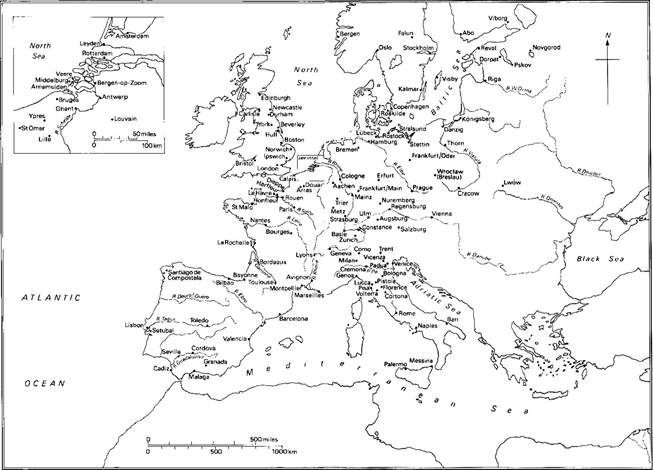
Map 1 European towns in the late Middle Ages
Such corporate and individual freedom, never of course absolute and sometimes inherited from an even more emancipated fourteenth-century urban past, was at its most concentrated within the north Italian triangle formed by Venice, Genoa and Florence and, to a lesser degree, among the northern French and Netherlandish towns scattered between the rivers Seine and Rhine. Elsewhere in Christendom, among the bonnes villes of Valois France, the parliamentary boroughs of late medieval England and even the more or less ‘free’ cities of the German Reich, urban political initiatives often took the form of ‘self-government at the king’s command’ and were therefore more limited or less sustained for that very reason. Even so, in these less propitious regions, too, several fifteenth-century towns were sufficiently large and self-possessed to create an urban society capable of articulating its own communal values in religious, ceremonial, literary and artistic form. Given the intense centrifugalism and fragmentation inherent within the retailing and manufacturing processes fundamental to any large medieval town, such common civic purposes were often harder to achieve than might be thought. Ironically enough, the prospects of achieving a high degree of urban splendour and self-assuredness were nearly always greatest in those towns dominated by a mercantile oligarchy whose horizons stretched far beyond the local city walls. It is with these, most interesting but in some ways most exceptional, major towns that the following survey will naturally need to be primarily concerned.