
Naturally, these systems continued to be based in large measure on structures inherited from the thirteenth and fourteenth centuries. By about 1400, in the case of universities, there existed around thirty functioning studia generalia endowed with imperial and papal privileges which clearly defined their status. Of these studia generalia only three ceased to exist during the course of the century. The rest varied greatly in importance: the oldest (Bologna, Paris, Oxford, Salamanca) remained the most prestigious, the only ones capable of becoming luminaries on the international stage and of attracting really significant numbers of students — it has been calculated that by about 1450 there were likely to have been almost 2,000 students at Oxford, with twice as many in Paris.
Universities of more recent foundation were of an altogether inferior standard. In some cases, particularly among the small legal universities in Mediterranean countries, they were antiquated institutions lacking vitality, attracting merely a few hundred local students (sometimes but a few score, as at Cahors or Orange in France), and at the mercy of all the hazards of the prevailing situation such as war and epidemic. However, of these newer universities others seemed to enjoy a period of ascendancy in the fifteenth century, though sometimes after difficult beginnings: not overburdened by traditional structures, they were able to engage celebrated lecturers and to offer courses of study which, influenced to a greater or lesser degree by humanism, broke new ground. Hence they expanded their catchment areas and competed openly with the older institutions. For instance in England, Cambridge doubled in strength (from 700 to almost 1,400) and so, having lagged behind Oxford for centuries, gradually made up leeway. The earliest Germanic universities (Vienna, Heidelberg, Cologne) took advantage of declining Parisian influence in the Empire, itself a consequence of the Great Schism. Prague, and subsequently Cracow, made their mark as important centres of intellectual life in central Europe. On the Italian peninsula the relative stagnation of studies at Bologna allowed a few enterprising universities (Padua, Perugia, Siena) to attract in their turn a by no means negligible complement of students from beyond the Alps no less than from the peninsula.
This overall picture of development, together with the increasing desire of princes to acquire for their own purposes both national and regional universities, explains the increase in new university foundations during the fifteenth century — and this in spite of all the difficulties of the period. Between 1400 and 1500 there were thirty-four of them (in addition to four whose university status is open to debate and four reopenings of defunct universities). In effect the number of European universities more than doubled in the course of one century.
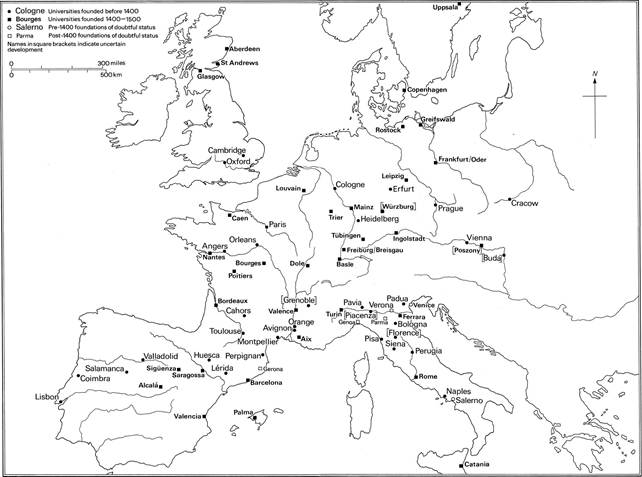
Map 5 The universities of Europe in 1400 and 1500
While it is true that few of these new foundations ended in total failure (though there were some still-born schemes), most, at least before 1500, never rose above middling importance. A dearth of celebrated lecturers, catchment areas and spheres of influence that were essentially regional, and small student bodies, at best a few hundred strong, were common to all. Some very quickly stagnated; others, by contrast (one thinks of Caen and Bourges in France, of Louvain, of the new German or Scottish universities), enjoyed a period of fruitful development. The geographical distribution of these new foundations is a point to bear in mind. They were not to be found either in England or, except on the fringes (Turin, Catania), on the Italian peninsula, where demand must have been satisfied by the existing system. Seven studia generalia were founded in the second half of the century on the Iberian peninsula; all, though, were doomed to remain mediocre, with the exception of Alcala, which became the bridge-head of humanism in the Spain of the Catholic monarchs. The eight new universities created in fifteenth-century France, soon to be frequently linked with provincial parlements, were in towns (for instance, Poitiers, Nantes, Bourges) that were asserting their authority as regional capitals. It was, however, in central and northern Europe (Germany, Scotland, Scandinavia) that the university movement attained its greatest intensity. The foundations there, financed and promoted by princes and towns, were an obvious manifestation of the vitality of these ‘emergent countries’ at the end of the Middle Ages and also testimony of their desire for full integration into a European culture whose predominant centres had previously been on the Italian peninsula, in France and in England.
The vitality of universities in the fifteenth century is not to be measured solely in terms of this wave of new foundations. One must also remember that in the period some old universities were endowed with new faculties, particularly of theology (Avignon in 1413, Montpellier in 1421, Lerida in 1430, Valladolid in 1436). Above all, the fifteenth century witnessed, in institutions previously accustomed to uncertainty in the supply of material necessities, an increase in the number of suitable buildings and of libraries. It witnessed, too, the foundation of numerous university colleges: the concept was, of course, an old one, but the social and cultural role of colleges, a point to which we will return, was strengthened, and with it grew the size of the buildings housing them, thus imposing their presence on the urban environment. Although college foundations were somewhat fewer than in the fourteenth century in Paris (twelve instead of thirty-seven) and in England (nine as against twelve), they were on occasion lavish (All Souls and Magdalen at Oxford, King’s and Queens’ at Cambridge); above all their numbers increased in the new universities in the countries that comprised the Empire (twenty-seven colleges founded in the fifteenth century), in central Europe (three), in Scotland (three) and on the Iberian peninsula (six).
Universities formed the top tier of educational establishments in Europe during this period: it was in contemporary eyes the most prestigious, and remains for us the best known. The other tiers, which lacked the benefit of either royal or papal privileges, inhabited a world where diversity not consistency was the rule. Recruitment of masters was determined by fluctuating criteria; numbers of pupils, like their social origins, remain largely a mystery to us; the dearth of archival material prevents the recovery of facts about the financing and administration of such establishments; information is imperfect on the instruction actually provided, though no doubt it was a simplified counterpart of university courses.
First, there were the traditional ecclesiastical schools, to be found in large numbers in the vicinity of cathedrals, main collegiate churches and urban monasteries. Although primarily intended for young clerics or monks, they were able to accept external lay students as well; sometimes they were flanked by small colleges that served as lodgings for poor students. The importance of these traditional establishments should not be underestimated: St Paul’s cathedral school in London was the most important one in the city; while in 1469 the school of the old Benedictine monastery of St Giles in Nuremberg numbered an impressive 230 pupils. The education meted out in such ecclesiastical establishments, usually under the responsibility of the chancellor or precentor, was of different kinds: there was the simple choir school for choristers; there were lessons in grammar, and there were, too, courses on philosophy, theology and sometimes canon law intended principally for future priests.
Even more numerous throughout western Europe were the institutions that may be classified under the general headings of ‘small schools’, ‘Latin schools’, ‘grammar schools’. Their level varied enormously: priests might give lessons to a few of the parish children; elsewhere schoolmasters — sometimes priests, sometimes merely tonsured clerics or even laymen — set themselves up in a private capacity and entered into agreements with families to teach their children, on occasion taking them as boarders. Other schools were financed by religious foundations (one finds many examples in England) or by municipal grants; even so they were seldom entirely free of charge.
Numbers of pupils in a particular school might be as many as several hundred, but in most cases did not exceed a few score. Although several ‘schoolmistresses’ are known, for example in Paris, pupils were mainly boys, usually aged between nine and fifteen. The background and qualifications of teachers were extremely varied, and the control in theory exercised over them by the ecclesiastical or municipal authorities was often nebulous. Only a minority of these masters possessed a university qualification (Master of Arts or Master of Grammar). Teaching was focused primarily on ‘grammar’, that is the study of Latin (reading and writing) to a more or less advanced level, supplemented by rudimentary arithmetic. It is difficult to judge to what extent the vernacular featured in this education. The clientele of schools might come from relatively humble backgrounds and include sons of artisans or peasants. As for the nobility and patriciate, they frequently preferred the solutions afforded by private tutoring.
Without doubt it was in the fourteenth century that the number of grammar schools started to increase appreciably in a number of western countries. This expansion continued in the fifteenth century, by which time it was not uncommon to find such schools not only in sizeable towns, but even in small market towns and in villages. In the second half of the fourteenth century in England, at least seventy-two localities are recorded as having a school; in the second half of the fifteenth century the figure rose to eighty-five.
One must be careful, however, not to paint too rosy a picture. In the fifteenth century all towns on the Italian peninsula, even small and averagesized ones, financed one or several municipal schools, but north of the Alps it was a different story. Even if there, too, most important towns had several schools, it was far from being the norm in less significant localities. In the diocese of Chalons-sur-Marne in Champagne only thirty-seven parishes out of 300 are certified as having had a school during the fifteenth century. Furthermore, many schools appear to have existed only intermittently, and their standard frequently must have been third-rate. Most were not destined to rise above an elementary level, and rare indeed were schools capable of imparting a sound grasp of Latin and of preparing pupils for possible study at university. The majority of the male population, and more particularly the female, was therefore condemned to illiteracy, and the invention of printing was to make only a very gradual impact on elementary education.
This education, it must be said, was not as yet attracting the attention of either princes or the Church. Schoolmasters, unlike doctors of the universities, did not enjoy a high social standing — even early humanists scarcely referred to them except to denounce their brutality or ignorance. The responsibility for primary education devolved upon municipalities and families, whose financial capacities were limited. The fifteenth century did, however, produce some interesting innovations in education and witnessed outside, or on the fringes of, traditional milieux (cathedrals, monasteries, universities) the appearance of reputable establishments receptive to new ideas.
Not to be considered here are the studia of the mendicant orders which had been in existence since the thirteenth century and where those orders’ future lectors and preachers received what was virtually a university education. It is possible that sometimes secular students were accepted. In the universities themselves some colleges, following a movement of fourteenth-century origin, continued to develop their own courses in competition with the faculties, particularly of arts; increasingly autonomous, these colleges de plein exercice (that is to say providing a complete course) were thus able to open their doors to such humanist disciplines as Greek and rhetoric; for example, the Sorbonne in the 1460s, and Magdalen College, Oxford, in the closing years of the century.
During the fifteenth century some university colleges initiated grammar courses in annexes, so that future students could be better prepared. In like manner grammar schools in Oxford and Cambridge enjoyed an excellent reputation, because although they remained external to the universities, they were supervised and fostered by them.
Other institutions were completely independent of the universities. On the Italian peninsula in particular, where as early as the beginning of the century humanists such as Pier Paolo Vergerio and Leonardo Bruni had stressed the importance of deficiencies in education, and where arts faculties offered only limited possibilities, new grammar schools and schools of philosophy of a high standard were founded in some towns. So, in Venice, a city lacking a university, the fifteenth century saw the birth of the Rialto school (philosophy) and the School of San Marco (studia humanitatis) for young patricians destined for state service. Mention must also be made of the ‘humanist colleges’ (contubernia) set up at the instigation of communes or princes by Gasparino Barzizza in Padua (1408), by Guarino da Verona first in Verona (1420) and later Ferrara (1436) and by Vittorino da Feltre in Mantua (1423). These institutions, whose clientele was fairly aristocratic, were characterised both by the broad-minded discipline to which pupils were subject and by curricula imbued with new ideas (the importance of rhetoric, direct access to classical texts, the study of Greek).
Outside the Italian peninsula a few similar initiatives can be found; although infinitely fewer in number and less innovatory, they did express an identical awareness of the deficiencies of traditional education in arts faculties. In England the colleges founded by Bishop William of Wykeham at Winchester (1382) and by Henry VI at Eton (1440) were designed to give future Oxford and Cambridge students a solid grounding in grammar. The school of Selestat in Alsace (1450) likewise was a nursery for teaching masters of grammar and rhetoric in the Rhineland universities (Basle, Freiburg).
As regards scholastic reform the most important movement beyond the Italian peninsula in the fifteenth century was that of the Brethren of the Common Life. This religious reform movement (the devotio moderna) was born in the Low Countries at the end of the fourteenth century and soon adopted as one of its fundamental objectives the creation of grammar schools able to provide for pupils both a stable environment and effective teaching. The atmosphere was austere and very religious, but the educational principles (streaming of pupils into classes according to ability; direct approach to the text of the Bible and the church fathers), which echoed humanistic ideas, proved to be of immense importance in the future. The principal school of the Brethren in the fifteenth century was at Deventer in Gelderland, where Nicholas of Cusa, Erasmus and Rudolf Agricola were students. From there the movement spread rapidly. The Brethren opened a large school in Louvain adjacent to the university, and at the end of the century Jan Standonck, by reforming the college of Montaigu (1490), even introduced the principles of this educational system to Paris. Standonck subsequently settled in Louvain, where in 1499 he set up his domus pauperum within the university itself.
Medieval schools and universities had abandoned to apprenticeship what might be termed vocational training; the usual milieux for this were families, merchants’ shops and, for the sons of the nobility, princely courts. During the fifteenth century one does, however, find here and there, and in embryonic form, the rudiments of vocational training, probably an indication of a rise in cultural expectations even among craftsmen, scribes and legal practitioners, for whom a university education seemed out of reach or inappropriate. One finds a few ‘masters of the abacus’ referred to on the Italian peninsula, particularly in Tuscany — they taught the basics of arithmetic and accountancy to the sons of merchants. In London the Inns of Chancery and Inns of Court, which date from the fourteenth century, achieved full maturity in the fifteenth: they were essentially private schools, where chancery and common law practice was taught. They trained, in a more practical way than university civil law faculties, a significant proportion of the administrative and judicial personnel of the monarchy. They enjoyed genuine prestige, and jurists of the calibre of Sir John Fortescue emerged from them.