
To speak of ‘Germany’ in the fifteenth century is an anachronism. Until late in the century the sources invariably refer to the ‘German lands’; even the seemingly singular Deutschland, which became current in the sixteenth century, may in fact derive from a plural form. But what made these lands German? Recourse to geography, or ethnicity, or language quickly reveals more contradictions than congruences. To take the most obvious example: in the west the Rhine from Roman times had separated Germania from Gallia, but in the midfourteenth century the Strasburg chronicler Fritsche Closener could note that the archbishop of Trier possessed political authority in that part of Gallia which lay ‘on German soil’ (in tutschem lande). In the early sixteenth century Alsatian humanists became locked in a bitter controversy over the historical roots of German identity west of the Rhine, in which Thomas Murner (1475 —c. 1527) derided as naive the contention of Jakob Wimpfeling (1450—1528) that Alsace had always been both geographically and politically ‘German’ since the days of the Roman Empire. On occasion, it is true, writers chose to distinguish Alemannia (west of the Rhine) from Germania proper, but at other times the terms Alemannia, Theutonia and Germania were used interchangeably. Further afield, the German lands east of the Elbe were, in ethnic terms, by the very fact of colonisation admixed with Slavs. In the north-west, the Frisians settled along the North Sea coast, though within the German lands, were not strictly speaking German, whereas by the close of the Middle Ages their neighbours to the west, the northern provinces of the Netherlands, were gradually ceasing to be reckoned part of the German lands, even though they were indubitably Germanic. Linguistically, the evidence at first sight seems less ambiguous. Throughout the fifteenth century the ‘German tongue’ was used to stamp a linguistic community set apart from foreign (welsch) speakers. But that community was itself divided by the late thirteenth century into distinct areas of Low and High German, not always mutually comprehensible. Within the Low German area a standard form of speech evolved, as the Lubeck dialect came to predominate on account of its diffusion through the Hanseatic League. But to the south, even the invention of printing by moveable type failed to achieve more than an approximation of the various High German dialects before 1500: that only came about in the course of the next century as Luther’s German Bible made its impact. Nevertheless, ‘tongue’ (Gezpnge) comes closest to marking a German identity in this period; in the reform plans of the 1450s ‘tongue’ was regularly used to translate the Latin natio.
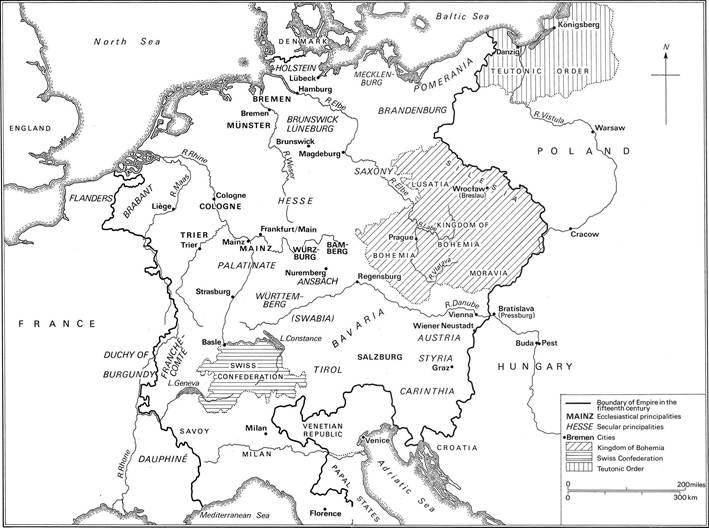
Map 6 Germany and the Empire
By the end of the century, indeed, the singular ‘German nation’ had displaced the plural ‘German lands’. That shift, however, owed more to the artifice of high politics than to any organic growth of a popular national consciousness. Demands after mid-century by the three ecclesiastical prince-electors for independence from Rome and its exorbitant taxation of the German clergy were presented as the gravamina et turbaciones provinciarum et nacionisAlmaniae. That particular sense of German nationhood had been amplified after 1400 by attempts to heal the Great Schism. Not only did the calling of two General Councils on German soil (Constance 1414—18, and Basle 1431—9) help bring the category of nationes, once used to categorise university students but then extended to distinguish those attending the councils, into wider political discourse: it reaffirmed also the sacred mission of the Germans to protect Christendom and preserve Christian unity. That spiritual task, traditionally expressed in the struggle to convert the heathen, took on a new urgency by the fifteenth century, as the Germans bore the brunt of combating heresy in Bohemia and repulsing Ottoman advances in the Balkans. Such responsibility derived ultimately from the doctrine of the translatio imperii, symbolised in Charlemagne’s coronation, so that German nationhood from the outset was indissolubly linked to and defined by the sacred character and function of the Empire. By the mid-fifteenth century these two elements were fusing into a new entity, the ‘Holy Roman Empire of the German Nation’, although the term itself was not officially recorded until 1492. Yet the equation of a once universal Empire with a specific national identity was bound to have practical political consequences as well.
The campaigns against the Hussites were launched as European crusades with papal sanction, but their military organisations and financial burden drew members of the Empire into closer and more frequent consultation. From the exigencies of the Hussite wars stemmed the first imperial quota list (Matrikel) of military contributions (1422) and the earliest attempt to impose a general poll tax on all inhabitants of the Empire (1427). The intensification of political and constitutional life was attended by myriad proposals for imperial reform which, though seldom more than blueprints, fuelled public debate among the estates of the Empire and so helped create a national public opinion with a sense of common fate and shared purpose. ‘Nation’ was thus applied to the political nation, the estates of the Empire. When Maximilian (r. 1493—1519) appealed to the ‘German nation’ at the Diet of Worms in 1495, the king was not invoking an imaginary Volk but addressing his constitutional counterparts (or adversaries). None the less, Maximilian was more than willing to harness the humanists’ preoccupation with German history as propaganda for his own imperial schemes. The rediscovery of a copy of Tacitus’ Germania in the abbey of Hersfeld in 1455 and its subsequent printing in Nuremberg lent credence to the notion of a German fatherland of heroic antiquity. At the hands of the arch-humanist Conrad Celtis (1459—1508), who planned to bring out an illustrated edition of Germania, such a belief could soar to extravagant nationalist enthusiasm or plummet into polemical racism. If the German nation had taken on the mantle of the Roman Empire, as one pamphleteer in 1500 could boast, the substance of the Empire might appear to have shrunk to a purely German kingdom. Efforts to preserve the title rex Romanorum in the face of rex Germaniae or rex Alemanniae were indeed finally abandoned: the monarchy had become not only German but identified with a territory (whatever its bounds) rather than with the community of Latin Christendom. Earlier, it is true, Fritsche Closener had used the formula Deutscher Kaiser, but his understanding was still that of an emperor of Germanic race or of the Germans, not the ruler of ‘Germany’. By the fifteenth century, however, regnum and imperium (once both translated as Reich) began to pull apart. Regnum came to mean the increasingly institutionalised (German) Reich, whose members participated in a constitutional dualism with the monarchy, whereas imperium was upheld as a general affirmation of imperial authority over subjects within and without Germany who owed feudal allegiance to the emperor.
Notionally, the frontiers of the Empire still remained those of the high Middle Ages, reaching well beyond the ‘German lands’. In the west they encompassed the Arelate, the ancient kingdom of Burgundy stretching from the Jura to the Mediterranean. By the end of the fourteenth century, however, Provence had been lost to the house of Anjou and the Dauphine to France, while in 1378 the Emperor Charles IV had conferred the imperial vicariate over the kingdom of Arles upon the dauphin, later Charles VI. As part of his arrondissement of the western borders of the Empire with France, Charles IV at least succeeded in bringing the county of Savoy under imperial sovereignty in 1361. But pressure from France, all the greater once it had gained Provence from Anjou in 1481, finally induced the dukes (raised from counts in 1416) to remove their residence from Chambery to Turin in Piedmont in 1536; by then the house of Savoy had long since ceased to play a part in imperial affairs. Burgundy in the narrower sense, that is, the duchy and county (Franche-Comte), straddled the Franco-imperial border. On the death of Charles the Bold, the last duke of Burgundy, in 1477 his inheritance should have passed in its entirety to Maximilian, by virtue of his marriage to Charles’s daughter Maria, but France laid claim to the duchy, which had been held as an appanage of the French crown. Imperial sovereignty over Franche-Comte and the other Burgundian lands lying within the Empire — Luxemburg and the Low Countries — was not finally recognised until the Treaty of Senlis in 1493; by its provisions France even had to cede francophone Flanders and Artois to the Empire. After the death of the Emperor Charles V, however, the Burgundian inheritance fell to the Spanish Habsburg dynasty, but during his lifetime Luxemburg, although linguistically and ethnically in part a ‘German land’, was no longer ruled as part of the Reich, while Franche-Comte, though adjacent to the Outer Austrian territories in Alsace which were ultimately accountable to Innsbruck, was administered as part of the Spanish Netherlands. Between the two lay Lorraine, but its dukes, although imperial vassals, effectively detached themselves from the Empire in the wake of Charles the Bold’s failure to conquer the duchy, and aligned themselves to the French crown.
Well before the fifteenth century many Swiss communes, both rural and urban, had declared themselves independent of their feudal overlords, in particular the Habsburgs, and were refusing to acknowledge imperial obligations. The Habsburgs’ accession to the imperial throne in 1438, far from arresting the whittling away of their possessions in eastern Switzerland, brought a local struggle between feudal lordship and communal autonomy into the arena of high politics. The threat from Burgundy in the 1470s led to a brief rapprochement with Archduke Sigismund, the Habsburg ruler of Tirol and Outer Austria, yet by the terms of the Perpetual Accord (Ewige Richtung), concluded on 11 June 1474, Sigismund was obliged to renounce all Habsburg claims within Switzerland. Out of that agreement grew the Lower Union, a defensive league of lords and cities on the Upper Rhine, whose alliance with the Confederates in the League of Constance inflicted three defeats in quick succession upon the Burgundian forces. When Maximilian tried to revive the Lower Union in 1493, however, as the vehicle of his imperial-dynastic designs in the west, he failed: the readiness of the Swiss to co-operate with the monarchy was never more than temporary. The Swiss (or Swabian) War of 1499, fought almost as a civil war by the south German and Austrian nobility against the ‘republican’ Swiss, confirmed their undimmed mutual distrust. Its outcome, a sweeping victory for the confederates, sealed their separation from the Empire in fact if not in law. Yet the Swiss had no desire to leave the Empire in its manifestation as imperium, a juridical corporation embodying a universal salvific purpose. What they rejected was any attempt at integration into the more state-like configuration of the regnum with its financial and constitutional obligations. Beyond the Alps, imperial power in Italy had long been more shadow than substance. Apart from the broken-backed campaign against Milan by the anti-king Rupert of the Palatinate in 1401— 2, no German monarch of the fifteenth century made any concerted effort to reassert imperial rights in Lombardy or Tuscany until the Italian Wars after 1494 ushered in a struggle for European hegemony between Habsburg and Valois. Apart from the powerful bishopric of Trent, only the patriarchate of Aquileia and the county of Gorz (Gorizia) on the Adriatic held loyal to the Empire. Venetian claims upon Trent and Gorz were rebuffed, until Maximilian inherited the county in 1500 and was able to incorporate it into his Habsburg patrimony.
The eastern frontier of the Empire in the fifteenth century was at least clearly established. It took in the eastern Austrian lands (Carniola on the Adriatic, Styria and Upper Austria), the kingdom of Bohemia with the neighbouring Luxemburg possessions of the margraviate of Bohemia and the Silesian and Lusatian duchies, and the territories of Brandenburg and Pomerania. Yet at the same time it was undoubtedly the most troubled border of the Empire for much of the century. Heresy, dynastic rivalries and the Turkish menace absorbed the energies of the three emperors who spanned the century — the Luxemburg Sigismund (r. 1410—37), and his Habsburg successors, his son-in-law, the short-lived Albert II (r. 1438—9), and the exceptionally long-lived Frederick III (r. 1440—93). The Hussite movement in Bohemia severed that kingdom from the Empire for much of the century; its virtual independence was underscored by the election of a ‘national’ king, George of Podebrady (r. 1458—71). To the south, Styria and the Austrian duchies came under repeated attack from another ‘national’ king, Matyas Corvinus of Hungary (r. 1458—90), forcing Frederick at one stage to flee his capital Vienna in 1485. Behind the complex manoeuvrings over the crowns of Bohemia and Hungary can, however, be discerned a wider struggle for political hegemony in the Balkans, of which the Habsburgs — against all the odds — were the ultimate beneficiaries. The cornerstone of their success was laid by the Emperor Frederick III in the Treaty of Bratislava (PreBburg) on 7 November 1491, which recognised Maximilian as pretender to both thrones if their ruler, Vladislav, from the Polish house of Jagie'lo, should die without heirs. When, after several dynastic vicissitudes, Maximilian’s grandson, Archduke Ferdinand of Austria, was finally able to make good these claims in 1526, the outcome was not, as might be expected, the augmentation of the Reich, but rather the creation of a separate Austro-Hungarian Empire ruled patrimonially by the house of Habsburg.
In the north, the limits of the Empire were naturally defined by the North Sea and the Baltic, but between them lay the Danish peninsula where feudal and territorial claims straddled the imperial frontier, just as in Burgundy. Traditionally, the county of Holstein marked the boundary with Denmark, but from 1386 its rulers, the counts of Schauenburg, also held the duchy of Schleswig immediately to the north as a Danish fief. On their extinction in 1460 both Schleswig and Holstein fell to King Christian I of Denmark (r. 1448—81), yet in terms of feudal law Holstein (elevated to a duchy in 1474) remained under imperial sovereignty. Within its northern frontiers, but quite remote from imperial authority for much of the Middle Ages, lay Dithmarschen and Frisia. These coastal communities had developed a strong sense of local independence in a manner reminiscent of the Swiss. Dithmarschen, which could look back on a long struggle against its titular overlord, the archbishop of Bremen, was given in fee to the crown of Denmark by Frederick III, but managed to regain its autonomy in 1500, only to be absorbed into Holstein in 1559. Frisia, on the other hand, was the object of determined efforts by the Emperor Sigismund to reassert imperial authority. An imperial charter of protection in 1417 was followed more significantly in the 1420s by a series of fiscal demands, designed to document Frisia’s participation in the Reich as a political nation. It was only at the end of the century, however, that Maximilian saw fit to appoint an imperial governor for Frisia, Duke Albert the Brave of Saxony. In the north the Empire also embraced one distant fief, Livonia, which had passed to the Teutonic Order in the fourteenth century. The Teutonic Knights rounded off their jurisdiction in the Gulf of Finland by buying Estonia from the Danish crown in 1346. These territories, corresponding to the present republics of Estonia and Latvia, were geographically remote from the Empire, but could easily be reached by sea across the Baltic. Indeed, Riga and Reval (Tallinn) had been founded as German colonies at the beginning of the thirteenth century, and subsequently became leading members of the Hanseatic League. Between Livonia and the duchies of Brandenburg and Pomerania lay Prussia, the heartland of the Teutonic Order, which lay outside the Empire. However, both by recruitment and by religious mission the Order was closely allied to the universal monarchy of the Empire; though not of the regnum, it was certainly of the imperium. That link was indeed invoked after his accession by Frederick III, who issued summonses to the High Master to attend imperial diets. After mid-century, however, the emasculating conditions of the Second Peace of Thorn (Torun) obliged the Order to submit to Polish sovereignty (though neither Frederick nor Maximilian ever recognised the claim), thus effectively severing its connection to the imperium. Certain towns in the Prussian Union (the political opponent of the Order) — Thorn, Danzig (Gdansk) and Elbing (Elblag) — still found themselves pressed to pay imperial taxes: Danzig indeed brushed aside Polish protests at this affront to its authority by declaring that it belonged directly to the Empire (on mittel zum beyligen Reich geborig).
To ‘belong to the Empire’ meant to acknowledge its monarchical authority: the Empire derived its reality not from territoriality but from the particular character of the monarchy and its links with the Papacy. Before the papal coronation of the emperor, however, lay the election and coronation of the king of the Romans by the German prince-electors. By the fifteenth century the fact of election and coronation as king in Germany outweighed the expectation of coronation as emperor. Frederick III was the last emperor to be crowned in Rome by the pope. His son, by contrast, in a delicious twist, simply proclaimed himself ‘elected Roman emperor’ in Trent in 1508, with neither coronation nor anointing. While the need for election had been a source of weakness for the medieval German monarchy, both Charles IV (r. 1346—78) for Wenceslas in 1376, and Frederick III for Maximilian in 1486, persuaded the electoral princes to co-elect their sons during their own lifetimes, thereby ensuring an undisputed succession; much earlier the Capetians had used exactly the same device to establish their dynastic authority in France. Moreover, as the Habsburgs were ostensibly to demonstrate, a dynasty powerful or rich enough could buy or bribe its succession to the Roman crown and so reduce election to a formality. In any case, the seven electors — the three prince-archbishops of Mainz, Cologne and Trier, and the four secular princes, the Count Palatine, the margrave of Brandenburg, the duke of Saxony and the king of Bohemia — had no right to depose the king-emperor, as the terms of the Emperor Charles IV’s Golden Bull of 1356, which remained the constitutional foundation of the Empire until 1806, made clear. By the fifteenth century both depositions and double elections had in fact become rare. Rupert of the Palatinate (r. 1400—10) was the last anti-king; 1410 saw the last double election. These are pointers to the growing consolidation of the Empire, in which other constitutional forces sought to participate in the Reich as the political nation alongside the electors and so curb their often autocratic exercise of power. Plans to depose Frederick III — on account of his alleged neglect of the Binnenreich (the Empire excluding his dynastic lands) — foundered precisely because a recognised constitutional framework was firmly in place by midcentury.
The increasingly consolidated Reich, though it might have lamented the monarch’s failings and baulked at his extravagances, dared not throw into question the institution of the monarchy as such, for its members derived their own legitimacy from its feudal character. However weak the king might be, fiefs, privileges and patents of nobility were by right his alone to bestow; the crown was seen as the dispenser of justice and patronage, rather than as the source of political power. And yet the monarch could still command political allegiance, in an Empire dominated by the high aristocracy, in his capacity as supreme liege lord. A startling instance occurred as late as 1487, when Frederick III brought the proceedings of the Diet of Nuremberg to an abrupt close by declaring that the decisions of the royal council (Hoftag) took precedence over the deliberations of the Reichstag, and went on to demand that his vassals there assembled, in accordance with their oaths of fealty, follow him to war without delay against Matyas Corvinus of Hungary. That, admittedly, was the last fling of a monarch wedded to a monistic view of his sovereignty which brooked no form of constitutional dualism; it underscores, nevertheless, the essentially personal and feudal, rather than institutional, character of the German monarchy, whose authority, therefore, depended heavily upon the king’s presence. Prolonged absences from the Binnenreich — Sigismund’s absorption with the affairs of his Hungarian crown lands, Frederick III’s sedentary preoccupation with the difficulties of his Austrian duchies — could not help but erode that authority. On the death of Sigismund there were already plans to appoint an imperial vicar to oversee the Reich if the monarch would not do so. Frederick Ill’s concentration on Danubian affairs was so pronounced that it grew increasingly hard to raise support from the Reich for policies which appeared to serve dynastic rather than imperial interests. The Ottoman menace was indeed a concern of the Empire as a whole, but Frederick’s claims upon the crown of Hungary could less obviously be justified on the grounds of imperial necessity. When, at the end of the century, Maximilian invoked a sense of imperial destiny in his repeated attempts to gain subsidies for his campaigns in Italy, the blank refusal of the estates in almost every instance to comply showed how divergent the perceptions of imperial necessity had become.
Although the peripheral nature of the monarchy for much of the century (until the age of Maximilian, at any rate) undoubtedly weakened the emperors’ personal authority, they could still expect to make their presence felt in those areas of the Empire which had close ties to the monarchy as an impersonal dignity. Those who were placed directly under the Empire (reichsunmittelbar) — for example, the imperial abbeys, counts, knights and cities — were part of the ‘king’s body’ and clung to the monarchy as a guarantee of independence and a source of protection against the princes’ aspiration to subjugate them to their territorial jurisdiction. These ‘immediate’ subjects of the Empire were often concentrated on old crown lands which had been administered through bailiwicks (Landvogteien), notably those in Swabia and Alsace. By the fifteenth century the cities, in particular, had succeeded in emancipating themselves from the jurisdiction of the bailiffs, but their loyalty to the crown remained intact. During the Hussite wars, for instance, several imperial cities and convents in Swabia responded willingly to Sigismund’s appeal for troops, but insisted that they would serve under the bailiff only in his capacity as imperial military commander. Broadly speaking, the regions of royal influence were spread across central and southern Germany, particularly Franconia, southern Hesse, the Middle and Upper Rhine, and parts of Swabia. In the Wetterau north of Frankfurt/Main, for instance, lay a congeries of diminutive estates held by imperial courts, who formed a union of mutual protection in the early fifteenth century. The imperial knights, whose corporate identity was recognised in a privilege from Sigismund in 1422, were concentrated in Franconia along the Main and its tributaries, in the Kraichgau between Rhine and Neckar, and throughout much of Swabia, where many imperial abbeys were also situated. The imperial and free cities, numbering around sixty-eight in 1500, were mainly located along the Middle and Upper Rhine (in Alsace, ten alone in the league of the Decapolis), above Lake Constance, in northern Wurttemberg and in Franconia. These regions may therefore be described as being ‘near to the king’ (konigsnah). From them (as well as from their dynastic lands) the monarchs drew their courtiers and officials; to them, especially to the cities, they turned for troops and taxes. These were predominantly regions of fragmented lordship: where the greater princes were consolidating their own territories — a process in full swing during the fifteenth century — the royal writ scarcely ran. Such areas encompassed not only the geographically remote north, but also the one large and powerful principality of the south, Bavaria. Between areas ‘near to’ and ‘distant from’ the crown lay others with fewer personal ties to the monarchy while none the less remaining potentially open to royal influence. The Upper Rhine is the leading example, for there, apart from the imperial cities (some of them in truth little more than villages), royal rights were vested in the bailiwick of Lower Alsace, but it remain pawned to the Palatinate for most of the century. These regional variations in royal influence diminished, however, in the course of the century, as the consolidation of the Reich, evident above all in the establishment of quota lists for imperial contributions, gradually placed all its members, near and far, on an equal footing in their dealings with the monarch.
The growing dualism of the Empire, expressed in the formula ‘Konig und Reich’, is reflected most vividly in the supersession of the looser usage ‘members’ (Glieder) of the Empire by the term estates (Reichsstande) towards the end of the fifteenth century. Though the estates saw themselves as individuals rather than representatives, the shift towards a corporate identity had been foreshadowed in the development of curial deliberation and decision making by the electors at the start of the century. All the members of the Empire shared a duty to defend it, but the Golden Bull of 1356 had imposed a particular responsibility upon the electors to safeguard its integrity and to further the commonweal. Royal incompetence or absence encouraged the electors to make the most of that responsibility. It was a league of the electors (Kurverein) which had deposed King Wenceslas (r. 1378—1400) in 1399, leading to the installation of Rupert of the Palatinate as anti-king. During his reign Sigismund tried to bring the electors to heel by granting the electoral vote of the margraviate of Brandenburg to his ally, Frederick VI of Hohenzollern (r. 1415/17—40), burgrave of Nuremberg, in 1415, and thereafter by conferring the Saxon electoral dignity, on the extinction of the Ascanian dukes in 1423,to the margraves of MeiCen from the house of Wettin. In neither, alas, did he find a reliable partner; rather, the electors banded together once more against the crown in the Bingen Kurverein of 1424. The search for a corporate identity and purpose in these years can also be observed in the electors’ organisation of imperial armies to fight the Hussites, as well as in the decision, taken collectively, to declare themselves neutral in the name of the Empire in the conflict between Pope Eugenius IV and the Council of Basle, which had set Germany at loggerheads during the short reign of Albert II in 1438. Frederick III’s separate negotiations with Eugenius, however, exposed the deep political divisions within the electoral college, which the stance of neutrality had been designed to conceal. After mid-century the position of the electors, although constitutionally impregnable, was further undermined by the relative decline of the three western ecclesiastical prince-electors, as well as by the rise of the secular territorial princes as rival players on the imperial stage.
That stage was provided by the king’s diets, which were the outgrowth of the court assemblies (Hoftage) of the king’s major vassals. Early in the century it looked for a time as if the electors might usurp the royal prerogative, for they began to summon diets of their own accord, initially in 1394 when Wenceslas was held prisoner by his Bohemian subjects. Thereafter the 1420s and 1430s saw the heyday of ‘diets without the king’ (konigslose Tage), convoked at the behest of papal legates to combat the Hussites while Sigismund was otherwise engaged in his Hungarian lands. Such diets, of course, had no standing in imperial law; nevertheless, they demonstrated the need for a forum in which the political nation could articulate its will without depending on a summons to the royal council at the monarch’s pleasure. Even those diets which were summoned by royal writ met for much of the century in the monarch’s absence, although in theory his presence was still regarded as essential to their legitimacy. Not surprisingly, therefore, the participants came to see themselves as independent of the monarch, as constitutional players in their own right. As a consequence, what had once been the ‘king’s diet’ became known from the 1470s as the imperial diet (Reichstag), that is, the assembly of the Reich, though the term only entered official parlance in the recess of the great reforming Diet of Worms in 1495. More significant than nomenclature, perhaps, was the prin ciple, adumbrated at the Diets of Vienna in 1460 and again at Nuremberg in 1481, that the emperor had no choice but to summon all the estates of the Empire if the Reichstag were to be held competent to discharge imperial business.
Yet the Reichstag was very far removed from a parliament. The monarchs avoided attending the diets (pleading dynastic emergency or shortage of money) precisely in order that their presence be not construed as lending weight to the proceedings. For their part, the estates’ attendance was at best patchy. Of the estates, only the electors could exert real influence in the diets until after mid-century. The secular territorial princes who were not electors, by contrast, distrusted the diets almost as much as the monarchs, for they feared that their influence would be marginalised in an assembly attuned to those whose raison d’etre was defined by their imperial status — the electors, and the immediate nobles and cities. Not until 1487 did the secular princes appear as a corporate body, a curia, alongside the electors. Beneath the princes, the imperial and free cities, because they were regarded as part of the ‘king’s body’, had little chance of raising a distinctive voice. They had no separate vote in the Reichstag (that was only conceded in 1648); instead, they were expected to fall in with the princes’ decisions. In one notable instance, Frederick III ordered the imperial cities in 1471 to abandon their attempts to link financial contributions to a guarantee of public peace and to adjust their response to that of the estates with full voting rights. The cities hardly helped their cause, moreover, by insisting that their emissaries refer all proposals back for approval (Hintersicbbringen). Despite their reluctance to commit themselves politically, the cities none the less were able to develop constitutional activity of their own within the penumbra of the imperial diets. Separate urban diets (Stadtetage) are recorded from 1471. These met before the full diets to co-ordinate policy: their impetus derived from the extraordinary burden of taxation necessary to fight the Turkish wars, which fell disproportionately upon the cities. The very profusion of urban diets — thirty-one in the first twenty years of their existence — is testimony to incessant political activity by the estates of the Reich, though earlier Aeneas Sylvius Piccolomini (1405—65), Frederick III’s secretary and later Pope Pius II, had mocked that one diet merely begot the next. The effectiveness of the Reichstag was certainly impaired by the fact that majority voting was unknown until 1497, when the legal fiction was introduced that a summons to the diet of itself constituted acceptance of its ultimate decisions, regardless of whether the member actually attended. What power the Reichstag had lay essentially in its passive right to withhold men and money; it never arrogated to itself prerogatives which lay with the monarch and his court, above all the dispensation of justice as the highest court in the land. The Reichstag, therefore, was but one element of the institutionalised dualism of the Empire, in which the Reich, the political nation, was ranged alongside the monarchy vested latterly in the Habsburg dynasty, a distinction neatly illustrated by the fact that the estates of the Austrian crown lands did not sit in the imperial diet.
The dualism of the Empire is reflected in the two issues which remained running sores throughout the century: on the one hand, the need for the kings to establish a dynastic power base (Hausmacbt) strong enough to enable them to rule effectively as emperors; on the other, the concern of members of the Reich to establish public order and the rule of law within Germany. For the former, foreign policy, not least relations with the Papacy, claimed primacy; for the latter, domestic politics were paramount. On neither count were the omens favourable as the century began.
The Wittelsbach Rupert was elected (anti-) king in Rhens on 21 August 1400 by the four Rhenish electors alone (the three prince-archbishops of Mainz, Cologne and Trier, and his own vote as elector Palatine). Throughout his brief reign he was rejected by the three eastern electors (Saxony, Brandenburg and naturally by Wenceslas himself as king of Bohemia). The Palatine territories in the west controlled the Middle Rhine and its important toll-stations, but around half the lands were held as imperial mortgages and thus subject to reversion. Rupert’s only major gain was the reconquest of the Upper Palatinate around Amberg and Sulzbach, pawned by the Wittelsbachs to the Luxemburgs, with its extensive reserves of iron ore, which may have yielded as much in revenue to his exchequer as the Rhine tolls; certainly, wealthy merchants from Nuremberg and Regensburg helped finance Rupert’s ill-fated campaign in Italy in the prospect of gaining lucrative mining concessions from the king. The campaign was intended to demonstrate Rupert’s commitment to the welfare of the Empire (and therefore his rightful claim to be king) by ousting the upstart Giangaleazzo Visconti of Milan (r. 1395—1402), whose elevation to a dukedom — and prince of the Empire — by Wenceslas had provoked outrage and contributed significantly to the latter’s deposition. Thereafter Rupert hoped to win recognition from the Roman pope, Boniface IX (r. 1389—1404), whom he supported against the rival Avignonese pope with French backing, Benedict XIII (r. 1394—1417), as a prelude to bringing the Great Schism to an end. But Rupert was beaten back at Brescia (21 October 1401), and his meagre forces retreated in disarray over the Alps. Boniface’s belated recognition of Rupert (in the Approbation of 1 October 1403) was an empty gesture, couched, moreover, in language which sought to revive earlier papal pretensions to interfere in royal elections.
On his return, Rupert broached the subject of a public peace in several diets, but quickly ran up against the hostility of the very prince who had been most instrumental in his election, the archbishop of Mainz, John II of Nassau (r. 1397—1419). As arch-chancellor of the Empire, John was slighted by the king’s refusal to grant him any real say in the running of the chancery; moreover, he suspected Rupert of pursuing territorial ambitions under the cover of his newly won crown. John of Nassau was able to put together a formidable coalition, the League of Marbach (14 September 1405), including seventeen imperial cities in the south (who were opposed to Rupert’s fiscal demands), with the purpose of hobbling the king’s power. The rivalry of Mainz and the Palatinate — which lasted throughout the century — serves to illustrate exactly why the issue of public peace was so intractable in late medieval Germany. As territorial neighbours of roughly equal standing when the century began neither could hope to dominate the other (though the Palatinate certainly tried), yet both had to remain constantly alert to any infringement of their sovereignty, which provoked feuding and reprisals. Rupert was driven on to the defensive by the League of Marbach, unable to discharge his imperial duties. In local conflicts he was powerless to intervene, most notably in the wars between Appenzell and the imperial abbey of St Gallen, which raged from 1401 to 1408, sucking in the Swabian nobility and the cities along Lake Constance. Although Rupert was finally able to mediate a peace at Constance (4 April 1408), the victorious Appenzellers had already allied in the ‘League above the Lake’ in 1405, which prompted the Swabian lords to form their own knightly association of the Shield of St George two years later. Such unions for mutual protection (Einungen) were the only recourse if imperial authority was too weak or too distant to maintain the peace. At the same time, however, the profusion of regional alliances of self-help ran the danger of raising the feud to a new and corporate level. In foreign affairs, too, Rupert was reduced to the role of onlooker. He watched helplessly as the cardinals of both observances convoked a Council at Pisa in 1409 on their own initiative, while he maintained his support for the Roman pope, then Gregory XII (r. 1406—15). However justified his suspicions of the cardinals as partisans of the French crown, Rupert found himself isolated as his opponents, not least Wenceslas himself, hurried to recognise the authority of Pisa. The Council declared both existing popes deposed and elected in their stead Alexander V (r. 1409—10), but the refusal of the Roman and Avignonese popes to withdraw left Christendom briefly blessed with three pontiffs. Rupert struggled to uphold the Gregorian obedience, but died on 18 May 1410 as he was preparing for a showdown with Mainz, which had raised the stakes in their princely rivalry by recognising Alexander.
The succession of Sigismund, the last Luxemburg to wear the Roman crown, heralded the most turbulent generation of foreign politics in the fifteenth century. They consumed the monarch’s attention to such a degree that Sigismund spent little more than two years of his twenty-seven-year reign in Germany itself. The emperor was beset on all sides by conflicts actual or potential. As king of Hungary he faced aggression along his eastern and south ern borders from the Turks (who had routed the crusader armies at Nicopolis on the Lower Danube in 1396), rivalry with the Venetians over access to the Adriatic (which embroiled him in Italian politics), and possible Polish claims to the Magyar throne (through the last Angevin princess, Jadwiga (Hedwig)). In Bohemia, where royal authority was increasingly paralysed by the Hussite rebellion, Sigismund could only make good his inheritance after Wenceslas’s death in 1419, but at his coronation in Prague in 1420 the estates were only prepared to recognise him as king of Bohemia, not as king of the Romans, though he was accepted in the neighbouring Luxemburg territories of Moravia, Silesia and Lusatia. In the Binnenreich his dynastic power was nugatory. The duchy of Luxemburg itself was ruled by his niece, Elizabeth of Gorlitz, widow of Anthony of Brabant, until, in spite of the Estates, she ceded it to Philip the Good, who took it irrevocably under Burgundian control. The remaining inheritance, the margraviate of Brandenburg, a remote and unruly territory, Sigismund was to confer upon Frederick of Hohenzollern, who had served the Palatine cause under Rupert but who switched his allegiance to the house of Luxemburg on Rupert’s death. Sigismund’s election was itself a bizarre affair. One elector, the duke of Saxony, still held true to Wenceslas, but a majority of the electors chose Sigismund’s cousin, Jost of Moravia, ruler of Brandenburg and therewith holder of an electoral vote. Quite illegally Sigismund claimed this vote by proxy for himself, so that for a few months of high farce there were three claimants to the Roman crown, all from the same family. Jost’s early death on 18 January 1411, and Wenceslas’s infirmity, however, spared the Empire from a possible catastrophe of intrigue and civil war; even so, Sigismund was unable to attend his coronation in Aachen until 1414. Within eight weeks of Rupert’s death another crisis struck, when the army of the Teutonic Order was routed by King Wladyslaw of Poland (r. 1386—1434) at the battle of Grunwald (Tannenberg) on 15 July 1410. Not only the imperium but also Sigismund’s position as king of Hungary was threatened by this defeat, for his brother-in-law Wladyslaw (who as grand prince of Lithuania had married Jadwiga and accepted the Polish crown on his conversion to Christianity) nursed a claim to the Magyar throne himself. In the subsequent (First) Peace of Thorn (1 February 1411) the Teutonic Order received more favourable terms than it deserved — aside from substantial ransoms, it only had to surrender Samogitia lying between Livonia and Prussia — and in the following year Sigismund reached an accommodation with Wladyslaw designed to secure Polish attendance at a General Council of the Church.
Sigismund was quick to spy the benefits which would accrue to the imperium by revivifying royal rights of stewardship over the Church in order to promote the cause of reform. Unlike his predecessor, however, he had no qualms about defying the Papacy by placing himself at the head of the conciliar movement.
The Pisan Pope John XXIII (r. 1410—15) bowed to pressure from Sigismund by summoning a Council to Constance, which he was obliged to attend in person (the only anti-pope to do so). John’s deposition in 1415 and the election two years later of Oddo Colonna as Martin V (r. 1417—31) restored the unity of western Christendom and marked the high point in the Church’s attempts at reform from within: first, by the declaration that decisions of a General Council were binding on all Christians, the pope included (in the decree ‘Haec Sancta’ of 6 April 1415), and then by the provision for regular assemblies to carry forward reform (in the decree ‘Frequens’ of 9 October 1417). The Council at Constance represented a remarkable affirmation of Sigismund’s authority as emperor and guardian of the Church. In terms of the Reich, however, Sigismund’s triumph was altogether more equivocal. By assembling on German soil the Council certainly demonstrated the emperor’s ability to mobilise a region ‘near to’ the crown in his interest, and its outcome went some way to counteracting the preponderant influence of French and Italians over the Papacy. But the Council had also burnt Jan Hus as a heretic (6 July 1415), which not only transformed a localised movement for religious renewal into a quasi-national revolution, but thereby estranged Bohemia from the Empire and vitiated any hope of effective rule by Sigismund in his kingdom for the next twenty years. Meanwhile, Sigismund, by declaring forfeit the western Habsburg lands of Archduke Frederick IV of Tirol (r. 1406—39) for abetting the deposed anti-Pope John XXIII, opened the prospect of restoring royal rights in southern Germany and northern Switzerland: for a time, the Austrian towns in Swabia and on the Upper Rhine were placed directly under the Empire. But in the end Sigismund was too weak to prevent the escheat being reversed; Frederick regained control of his lands north of the Rhine, but the Habsburg lordships to the south passed irretrievably into the hands of the Swiss.
Sigismund’s further forays into European politics enjoyed moderate success at best. He did contrive to hinder the formation of a pan-Slavic alliance of Poland—Lithuania with Bohemia by investing the Lithuanian Grand Prince Vytautas (Vitold) with a royal title of his own in 1429, despite having been incommoded in the early 1420s by the dynastic schemes of his chosen lieutenant, Frederick of Hohenzollern, who had married his second son to the Polish heiress, Jadwiga. By contrast, his intervention in the turbid waters of French politics during the civil wars and the ascendancy of Joan of Arc was inept. Sigismund’s attempts to play France, Burgundy and England off against one another brought no diplomatic advantage; rather, they failed to prevent the annexation of imperial fiefs by Duke Philip the Good of Burgundy (r. 1419—67), who between 1429 and 1433 acquired Brabant, Limburg, Hainault, Namur, Holland and Zeeland. A despairing effort to raise an army against Burgundy in 1437 petered out in a brief sortie into the duchy of Limburg. This feeble response to Burgundian expansion exposed the deficiencies of the Empire’s military organisation, which the Hussite campaigns had done nothing to improve. Sigismund himself only took part in the first crusade in 1420; the mounting of the four subsequent campaigns, which culminated in ignominious defeat at Domazlicc (Taus) on 14 August 1431, devolved by default upon the electors, whose Kurverein of Bingen (17 January 1424) was designed to present a united front against the Hussites, who were at that time raiding into Saxony, Franconia and Lower Bavaria. But the electoral college was rent by internal divisions, not least the continuing hostility between Mainz and the elector Palatine, Louis III (r. 1410—36), who objected to Sigismund’s provocative nomination in 1422 of its new archbishop, Conrad of Dhaun (r. 1419—34) as imperial vicar in his absence, an office which Louis with some justice regarded as a Palatine prerogative. As a result, the Hussite campaigns were ad hoc affairs; launched somewhat archaically as crusades, they brought no advance in military organisation or technique. Out of them there never developed an imperial standing army — in marked contrast to France where in these years Charles VII (r. 1422—61) created standing companies of cavalry in response to the excesses of the mercenary bands of ecorcbeurs. The contribution of the Hussite wars to the consolidation of the Reich lay elsewhere: in the establishment of quota lists, and in the plans for a general imperial poll tax, to be paid by all Christians over the age of fifteen, and by all Jews. These financial reforms (though not implemented) marked the first faltering steps on the long path to the Common Penny, the universal tax agreed at the Diet of Worms in 1495.
The weakness of royal authority in the regnum under Sigismund is graphically revealed in his plans to promote justice and the public peace. The king’s own high court (Hofgericht) was too distant to be effective, for it accompanied the monarch on his itinerary; the electors and major princes had, in any case, long since secured exemption from citation before it. Instead, Sigismund chose to encourage plaintiffs to have recourse to the welter of private courts of appeal, known as the Veme, which had spread from their origins as the courts of free counts in Westphalia. Because their sessions were held in secret, these courts rapidly acquired a sinister reputation; in truth, the danger lay much more in their proliferation, which resulted in conflicting and apparently arbitrary judgements. The Veme became the target of growing hostility from princes and cities alike. Its courts declined from the 1430s, as their function was taken over by the royal chamber court (Kammergericht) which was acquiring institutional identity at the end of Sigismund’s reign. Its development must largely be credited to the king’s treasurer, Konrad von Weinsberg, who deployed it in the first instance to retrieve alienated imperial fiefs and mortgages in Swabia and Alsace. This policy of ‘revindication’, as it was termed, was only one aspect of a wider determination by Sigismund to reassert sovereignty over the immediate lands and subjects of the Empire. On the one hand, he put an end to the mortgaging of imperial cities (although their revenues were still on occasion pawned); on the other, he selected the imperial knights to act as agents of royal power in regions ‘near to’ the crown, most notably in 1430, when he sought to bring about a grand alliance of the Swabian knights of the Shield of St George, the Franconian lesser nobility and the Bavarian League of the Unicorn. These attempts to create a bulwark against the expanding territorial principalities, it must be said, were no more successful than Sigismund’s greater use of outlawry (Acbt) earlier in his reign against overmighty subjects such as Frederick of Tirol. The issue of public peace was not addressed in detail by Sigismund until 1434, when he set forth a programme of sixteen articles which took up earlier proposals to divide the Empire into four circles for the administration of justice. Because these circles would have impinged upon the princes’ territorial jurisdiction, the scheme fell by the wayside. Counterproposals advanced by the princes three years later at the Diet of Cheb (Eger), which took territorial sovereignty as their starting-point, incurred in turn royal displeasure. Both emperor and princes had their attention distracted by the wranglings of the Council of Basle, which by renewing the struggle between conciliar and papal authority brought to the surface the old tensions between the secular and ecclesiastical princes in Germany and the monarchy. Before these issues could be resolved, Sigismund died at Znojmo (Znaim) in southern Bohemia on 9 December 1437.
Although Sigismund had nominated his son-in-law, Duke Albert of Upper and Lower Austria, as his successor, his election was by no means a foregone conclusion. The ageing Frederick I of Brandenburg, as the elector of the greatest stature, had some hopes of the crown, while the western electors, led by the archbishop of Cologne, toyed with the idea of offering the throne to Philip the Good of Burgundy. Albert’s election owed as much in the end to the likelihood that the difficulties of his Hungarian and Bohemian inheritance would prevent him from interfering too closely in the affairs of the Binnenreich as it did to his undoubted personal qualities after the vainglorious and erratic Sigismund. And so it proved. Albert was elected by the Hungarian magnates and crowned at Szekesfehevar (StuhlweiBenburg) on 1 January 1438, but had immediately to deal with a massive Turkish irruption across the Danube; in Bohemia, by contrast, his election was disputed by a minority who pinned their hopes on a Polish king. These problems in the crown lands were to plague his successor for the rest of the century. During his twenty months on the throne Albert never visited the interior of the Empire. He sent instead his Bohemian chancellor, Kaspar Schlick, to listen to the electors’ proposals for imperial reform at a diet in Nuremberg, but in the negotiations it is significant that Albert’s own dynastic lands, including the Austrian duchies, were not on the agenda. Before any agreement could be reached, Albert died on 27 October 1439 of dysentery contracted while fighting the Turks in Serbia.
The unanimous election of his cousin Frederick, ruler of the remote provinces of Styria, Carinthia and Carniola, as king of the Romans pointedly underscored the electors’ desire to place a safe distance between themselves and the monarchy, notwithstanding their constant lament that the emperors wilfully neglected the affairs of the Binnenreich. In that they succeeded, for Frederick devoted only a small part of his fifty-three-year reign to western affairs. How divergent the respective spheres of activity of dynasty and regnum became in those years is illustrated by the establishment of separate royal chanceries, one for the Austrian crown lands, the other an imperial chancery for the remaining territories of the Reich. Frederick’s claims to the Bohemian and Magyar crowns were complicated by the posthumous birth of a son, Ladislas, to Albert’s widow three weeks after Frederick’s election. For the next twelve years the emperor kept Ladislas a ward at his court (a prisoner in all but name) to be used as a pawn in the intricate quadrille of Danubian politics. But his primary concern was the strengthening of his shaky grasp on Austria itself. The partition of the Austrian lands into two lines, albertine and leopoldine, in 1379 had been followed in 1411 by the division of the latter into Styrian and Tirolean branches. Frederick was faced, therefore, with claims on all sides, which had already given rise to virtual civil war between the rival branches. He could administer the albertine lands — the duchies of Upper and Lower Austria — pro tempore as Ladislas’s guardian, but in the leopoldine lands he had to contend with the ambitions of his younger brother, Albert IV, upon whom he was obliged to confer the governance of the Outer Austrian lands (Vorderosterreich) in 1446. Nor were his relations with the Austrian estates any easier. Within a year of his accession he was confronted with an uprising in Vienna over his plans to offload King Albert’s debts on to the estates of the duchy. In 1452, the estates, resentful of a Styrian who, they believed, had abandoned them to anarchy, laid siege to Frederick in his residence of Wiener Neustadt (then part of Styria). Nine years later the populace, egged on by Duke Albert, again besieged Frederick in Vienna. Only the deaths of Ladislas Posthumous in 1457 and Duke Albert in 1463 allowed Frederick to assume control of the Austrian heartlands. Even then, Tirol and the outer lands remained under the rule of the hapless Archduke Sigismund, until he was finally pensioned off in 1490. These domestic difficulties are essential to the proper understanding of a monarch whose motives and policies have often been regarded as elusive and ambiguous. That the dynastic consolidation of the house of Austria informed all his thinking is incontestable, even if his pen chant for the grandiose motto Austriae est imperare orbi universo in the cabbalistic monogram AEIOU should be put down to a personal conceit. Yet Frederick did not marry — the precondition of any dynastic policy — until 1452, when he was already thirty-six. His bride Eleanor, from the Portuguese royal house of Avis, brought him no visible advantage except a rich dowry; the marriage, moreover, had been contracted after Frederick had rejected more promising alliances with France, Savoy and Luxemburg. By contrast, to blame Frederick for his neglect of the Empire (discounting the two-faced attitude of the electors) misses the point that his reign fell into several distinct phases, in only one of which, from 1452 to 1471, can he be said to have retreated entirely into his Styrian homeland. Yet that withdrawal is all the more perplexing since Frederick, newly wed, had just been crowned emperor in Rome by Nicholas V. Up to 1452 Frederick was certainly active in imperial affairs, even if he failed to visit the Binnenreich after 1444.
Frederick, who by temperament took a lofty view of his sovereignty, sensed that his imperial authority would be better served by an accommodation with the Papacy than by espousing the conciliarist cause, which was by then increasingly discredited and on the wane. Despite their declared neutrality, the majority of the electors inclined towards the anti-pope favoured by the conciliarists at Basle, Felix V (r. 1439—49), who, as the former Count Amadeus of Savoy, was a fellow prince of the Empire, but cautiously Frederick nudged them towards acceptance of Eugenius IV. Negotiations reached a successful conclusion under Nicholas V (r. 1447—55) in the Concordat of Vienna in 1448, which in time was accepted by all the estates of the Empire and remained in force until 1806. Though its terms were much more favourable to the curia than the equivalent Pragmatic Sanction of Bourges for France in 1438 — papal provisions were not abolished, while the clergy in most sees continued to pay annates and first fruits to Rome — the Concordat confirmed Frederick’s right of nomination to the bishoprics of his Austrian lands, agreed three years earlier, and paved the way for the secular princes to exercise the same prerogative in their own territories. Frederick had turned the vexed issue of Church-state relations skilfully to his advantage: the Concordat had been achieved without the direct involvement of the estates; it prepared the ground for his investiture as emperor four years later; and it saw his secretary and trusted adviser during the negotiations, Aeneas Sylvius Piccolomini, subsequently elected pope as Pius II (r. 1458—64). Where the Concordat failed, however, was in initiating any thoroughgoing reform of the Church in the German lands; ordinary layfolk chafed at the feudal power of the ecclesiastical princes, who in turn continued to nurse their own grievances against Rome.
Frederick’s freedom to attend to the affairs of the Reich was bedevilled from the outset by a chronic lack of money. The Emperor Sigismund had earlier complained that his income from the royal domain (Reichsgut) amounted to a mere 13,000 guilders (fl.) a year, but he at least was the reigning monarch of a rich kingdom, Hungary. Frederick had no such resources — though his accommodation with Eugenius IV had brought him the assurance of papal coronation and a payment of 100,000 fl. in 1446. In his own duchies he promoted iron and lead mining in the Carinthian Alps and the brine-pits at Aussee, but the much vaster regalian revenues from the Tirolean mines were never at his disposal during his lifetime. Frederick’s income from the Reichsgutis difficult to estimate. He continued Sigismund’s policy of revindication and redeemed many of the pawned revenues of the imperial cities. At the same time, he embarked on a calculated policy of fiscalisation, charging, for instance, much higher fees to the cities for the renewal of their liberties, and granting additional privileges only against a share of the revenue. But income from the imperial cities and taxes on the Jews — in effect, the only royal revenues left in Germany — were often pledged to his own councillors, or else promised to creditors. The remuneration of the hereditary imperial marshal, Heinrich von Pappenheim, alone is reckoned to have consumed a good part of the regular income from the crown domain. Offices of state were often farmed to their incumbents: Kaspar Schlick paid 10,000 fl. per annum for the chancery, but even then still had to agree a division of the spoils from chancery business with the emperor himself. As his reign wore on, Frederick became increasingly dependent on irregular sources of income. He sold feudal titles, patents of nobility, judicial rights and administrative offices on a grand scale. He granted exemption from military service in return for hefty payments: in 1470, for example, Frankfurt/Main offered 2,500 fl. to avoid raising a contingent against the elector Palatine, but Frederick demanded 8,000 fl. (in the end he received only 1,500 fl., described as a ‘loan’). He was even willing to cancel proclamations of outlawry if the price was right. By these various means Frederick acquired considerable wealth during his reign, but he also lost it. Much of the revenue stuck to the hands of his officials, and the rest was consumed by the campaigns against Charles the Bold of Burgundy and Matyas Corvinus of Hungary. It is doubtful whether Frederick’s annual income ever matched that of the richer German princes — the electors Palatine or the dukes of Bavaria—Landshut — let alone the French crown or the Burgundian dukes. Fiscalisation, however, exacted its own high price: the greed and corruption of his councillors, and Frederick’s shameless profiteering, harmed both the standing of the monarchy and the prestige of justice.
Yet in the opening years of his reign Frederick had been far from indifferent to public order and the commonweal in Germany. At a diet in Frankfurt in 1442 he put forward comprehensive plans for an imperial peace ordinance, known as the Reformacio Friderici, which would transcend the regional peace treaties policed by the Einungen. In its enforcement the imperial cities were to be accorded an advisory role, which they promptly used to lay claim to full membership of the estates (Reichsstandschaft), though without success. The failure of this initiative lay in the emperor’s unwillingness to contemplate any institutionalised form of law enforcement, which would derogate from his authority as the fountainhead of justice. When the electors put forward a counterproposal in mid-century for an imperial council (Reichsrat) to act as a permanent court of appeal, along the lines of the Parisian parlement or the papal rota, to be financed by imperial taxation, Frederick’s only response was to declare yet another Perpetual Peace (Ewiger Landfriede), which he enshrined in imperial law in 1465. The logic of his own conception of royal justice led Frederick instead to a much more drastic proclamation of public peace two years later, whereby law-breakers would be held guilty of lese-majeste, with the automatic penalty of outlawry and confiscation of property. The implications of this measure were so far-reaching, however (if enforced, it would have put in jeopardy the princes’ consolidation of their territorial power), that Frederick was obliged to rescind the decree in 1471. Thereafter, the preservation of public peace reverted to regional responsibility, most markedly in the attempts by the Swabian estates, counselled by the emperor’s closest adviser, Count Haug von Werdenberg, to check Bavarian expansion, which culminated in the formation of the Swabian League of princes, prelates, knights and cities in 1488 .
The Swabian League was significant because for the first time it brought (somewhat uneasily, it is true) princes and cities together in a common defensive alliance; the lawlessness in the Empire, which had reached a new height in mid-century, turned largely on rivalry between princes and cities. In those struggles the princes were not always the aggressors. The attempts by the archbishop of Cologne, Dietrich of Moers (r. 1414—63), to assert his territorial authority throughout north-west Germany had begun with the installation of several of his brothers in the neighbouring sees of Paderborn, Munster and Osnabruck, but his expansionist drive only led to open war when the territorial town of Soest in Westphalia defied his jurisdiction in 1443. The ensuring feud lasted until 1449, exhausting both parties, when Soest passed to the duchy of Cleves. But that did not prevent Dietrich from embarking on another, equally futile, campaign to retain control of the see of Munster after his brother’s death in 1450, which again ended in defeat for Cologne and the establishment of Cleves’s authority over the bishopric. Meanwhile, southern Germany was seized by a conflict between Albert Achilles of Brandenburg (r. 1437—86) and the city of Nuremberg, whose rural territory separated the margravial lands of Ansbach and Bayreuth. The powerful cities of Franconia and Swabia were a thorn in the princes’ flesh because of their readiness to grant burgher’s rights to the lords’ feudal subjects; the cities, in turn, complained of interference in their trade, highway robbery and excessive tolls. Already in 1466 thirty-one cities in the south had formed a league of mutual assistance, but the so-called Second Cities’ War (1448—53) exposed their inability to sustain a united front: they were, after all, commercial rivals themselves. After mid-century it was the territorial ambitions of powerful Wittelsbach princes such as Duke Louis the Rich of Bavaria—Landshut (r. 1450—79) and Elector Frederick the Victorious of the Palatinate (r. 1451—70) which most threatened the fragile political stability of the Empire. Indeed, the emperor declared Frederick an outlaw and his electoral dignity forfeit in 1471, though the edict was never carried out. But however serious the rivalry between principalities, that did not preclude the effective enforcement of law and order within individual territories, as elector Frederick II of Hohenzollern (r. 1440—70) demonstrated in his quelling of the fractious nobility of the margraviate of Brandenburg after 1440.
The emperor’s neglect of the Binnenreich in the two decades after 1450 had given rise to several schemes for his deposition. As an alternative, the councillor of the archbishop of Mainz, Dr Martin Mair (or Mayr) (c. 1420—80), proposed in 1457 that Frederick the Victorious of the Palatinate be elected Roman king, an act which was quite improper except in the case of the monarch’s son. In the dynastic lands, however, the emperor’s policies bore some fruit. After Ladislas Posthumous’s death, Frederick had been able to secure his royal title to the crown of Hungary by the Treaty of Wiener Neustadt (17 August 1463), which further promised him succession to the throne, should Matyas Corvinus die without legitimate issue. But in 1471 the balance of power in central Europe tilted decisively away from the emperor, as the Turks invaded his homeland of Styria, and Corvinus occupied the eastern provinces of the crown of Bohemia. Frederick felt compelled in his extremity to summon support in person from the estates gathered at the Diets of Regensburg and Augsburg. Simultaneously, the emperor was confronted in the west by the naked aggression of Charles the Bold of Burgundy (r. 1467—77) against the bishopric of Liege, the duchy of Guelders and the county of Zutphen. It was entirely in keeping with his character that Frederick chose at first to avert the danger by intricate negotiations, not force of arms, in which he dangled before Charles the bait of the Roman crown, or else the creation of an independent kingdom of Burgundy as an imperial fief, in return for the marriage of Maximilian to Charles’s daughter, Maria. But once the negotiations had stalled at Trier in 1473, Frederick displayed unsuspected energy by raising a feudal host of 40,000 men to relieve the Burgundian siege of NeuB, west of Cologne, having publicly declared that Burgundy was threatening the ‘Holy Empire and the German Nation’. The power of the emperor to mobilise the patriotism of the political nation when its immediate interests were at stake had been triumphantly reaffirmed — but the victory was fleeting, for Frederick failed to convert that enthusiasm into practical support against the much more distant Corvinus, whose open warfare against Austria itself after 1477 forced the emperor to flee his homelands, leaving him isolated and destitute in the east. The initiative passed to Maximilian, whose struggle to secure his inheritance in the west finally vindicated the old emperor’s dynastic vision by creating a Habsburg Burgundian—Austrian empire of truly European stature.
The question of public authority in the Empire exercised contemporaries throughout the fifteenth century. In addressing the issue of imperial reform clerics, jurists and political writers held up a mirror to the age in countless tracts and manifestos. Yet in that mirror was reflected more often a typically Renaissance fascination with utopian models of state building than any real understanding of what the constitutional dualism of ‘Konig und Reich’ implied. Schemes for imperial circles governed by imperial vicars can be traced from the anonymous author of the Reformation of Emperor Sigismund (1439) through the De concordantia catholica (1433) of Cardinal Nicholas of Cusa (1401—64) back to proposals put forward in 1417 by the Palatine jurist, Dr Job Vener (1370—1447), and even earlier to the late fourteenth century. In a similar vein, the administration of justice was to reach down into the localities in a pyramid of courts whose tiers expanded in symmetrical progression. These administrative blueprints were essentially schemes for better government, not clarions of social rebellion. Only the Reformation of Emperor Sigismund (possibly composed by a cleric attending the Council of Basle) went further by demanding the secularisation of the ecclesiastical principalities, the prohibition of capitalist practices and the abolition of serfdom. It lay unheeded, however, until its first printing in 1476, though a spate of editions thereafter suggests that it had struck a popular chord among the German populace at large. The abiding concern of such visionary writings, from the Reformation of Emperor Sigismund through the welter of prophetic literature after mid-century to the extraordinary Booklet of One Hundred Chapters of the so-called Revolutionary of the Upper Rhine around 1500, was the strengthening of the monarchy: a new emperor would arise to sweep away the arrogant and selfish princes and prelates, and so restore prosperity and peace to the German nation. It took a more sober voice to appreciate that the problem of political authority lay elsewhere: not in a simple antithesis between monarch and political nation, but in the competing claims of different estates within the Reich for political representation — and, it may be added, of different regions competing for centrality. At the start of the century, reform proposals had concentrated on the appropriate relationship between the king—emperor and the electors; by mid century, however, Martin Mair had recognised that the Empire could not be ruled without the involvement of the territorial princes as a whole. In his scheme for a general imperial tax in 1458 he acknowledged that its success would depend on the four main dynasties of the Empire — Habsburg, Wittelsbach, Hohenzollern and Wettin, who ruled both electoral and non-electoral lands — acting in concert. The absence of the three ecclesiastical electors from his scenario shows how far their influence had dwindled in the course of the century.
In the consolidation of the greater secular principalities fifteenth-century Germany displayed some of the constitutional and political features which elsewhere in Europe marked the emergence of nation-states. But that consolidation was rarely the outflow of deliberately ‘territorial’ thinking, based on the purchase or conquest of land; rather, the princes pursued the much more traditionally dynastic aim of augmenting their patrimony through enfeoffments, marriage and inheritance treaties, and also mortgages. To take one example: the minor landgraviate of Hesse advanced during the century to a major principality by bringing the county of Ziegenhain, which had separated Upper and Lower Hesse, into feudal dependence in 1450, and by gaining the county of Katzenelnbogen, which controlled strategic toll-stations on the Rhine, by inheritance in 1479. The princes continued to regard their assorted lands as a patrimony, to which all male heirs had a claim. Partitions were frequent, and primogeniture seldom prevailed before the sixteenth century. Yet it was less the fact than the circumstances of partition which weakened the principalities. In the south, Bavaria, which had been divided until 1445 into four, then three, was ruled thereafter by the two Wittelsbach lines of Landshut and Munich. But that did not prevent the duchy of Bavaria—Landshut, a territory rich in agriculture, from playing a vigorous part in imperial affairs, situated as it was on the borders of the Habsburg lands and regions ‘near to’ the crown. The venerable Welf (or Guelph) dukes of Brunswick in the north, by contrast, saw their lands crumble into fragments through repeated partitions, which left only Luneburg, the senior line and imperial vassal, of any consequence; furthermore, Brunswick was too remote from the heart of the Reich to wield much political influence. Partition, in any case, did not need to disturb existing administrative practices or impede co-operation between the joint lines over matters of mutual concern. In Saxony, for instance, the establishment of separate central and local administrations, each with its own exchequer, after the civil wars of mid-century remained in place in both the albertine and ernestine duchies after the partition of the Wettin lands in 1485. A joint diet of both houses, moreover, was convoked at Naumburg in 1499 to hear grievances against the Saxon bishops and consider proposals for church reform. Although primogeniture had been established in only one German territory before 1500 — in Wurttemberg, by the Treaty of Munsingen which reunited the Stuttgart and Urach lines in 1482 — princes sought by other means to keep their territories intact. In 1473 Margrave Albert Achilles regulated his succession in the Dispositio Achillea in such a way that the margraviate of Brandenburg, to which the electoral dignity attached, should remain undivided in the hands of his eldest son, while Ansbach and Bayreuth were to fall by lot to his two younger sons; formally, indeed, primogeniture did not become binding in Brandenburg until 1599. In the Palatinate (which as an electorate should have been impartible according to the Golden Bull of 1356), Frederick the Victorious was driven to a more desperate device. In the Arrogation of 13 January 1452 he declared himself elector regent by adopting his nephew Philip, the heir to the title, who was still a minor, while undertaking to remain single and without issue himself — a constitutional conjuring trick which was accepted by the other electors but steadfastly rejected by the emperor, who sought to depose him.
Partition, of course, bore no threat to the ecclesiastical territories, which knew no principle of dynastic succession. Though the machinations of Dietrich of Moers in Cologne indicate that the principle was not absolute, the ecclesiastical princes succumbed in the longer term to de facto mediatisation, whereby secular territorial rulers, in an extension of their own dynastic policy, installed their kin or leading councillors in neighbouring sees. The classic example is the Palatinate, where the chancellor, Matthias von Rammung, was appointed bishop of Speyer in 1464, and his successor, Johann von Dalberg, became bishop of Worms in 1483: both men retained their secular offices! In Cologne, Frederick the Victorious secured his younger brother Rupert as archbishop in 1463 after the demise of Dietrich of Moers. Far from restoring its fortunes, however, Rupert plunged the archbishopric into turmoil by inviting Charles the Bold to intervene against his rebellious cathedral chapter, which led to the fateful siege of NeuB in 1474—5. In the case of the other two ecclesiastical electorates, the sprawling primatial see of Mainz had been weakened by the intrigues of the counts of Nassau earlier in the century; thereafter it spent vast sums defending its territories against secular predators (chiefly Hesse and the Palatinate), until by mid-century it was all but bankrupt (as was Cologne). The engagement of its famous archbishop, Berthold of Henneberg (r. 1484—1504), in the cause of imperial reform at the end of the century may well have sprung from the need to retrieve or conceal the collapse of Mainz’s power. The third ecclesiastical electorate, Trier, enjoyed a much calmer passage through the century, but was too small and too exposed to Burgundian influence to make much impact in imperial politics. The episcopal territories in general were handicapped, moreover, by their elective character. Conflicts between bishops and their chapters could capsize into wider political instability, as the numerous episcopal feuds (Stiftsfebden) of the century testify. In sum, while the absence of partition saved the ecclesiastical territories from sinking into insignificance, the lack of a dynastic policy prevented them at the same time from augmenting their power in open competition with the secular princes. The Teutonic Order suffered a rather different fate. With Lithuania’s conversion to Christianity, the Knights had lost their raison d’etre; increasingly the Order became a refuge for the younger sons of noble families in the south and south-west of the Empire. The defeat at Grunwald cost the Order vast sums in ransom money, which could only be raised with the help of the estates. But the mentality of the Knights, backward-looking and exclusive, made it difficult to frame a constitution which would grant a political voice to the native nobility and towns. The thirteen years’ war between the Knights and the estates, which ended in 1466 with the Second Peace of Thorn, brought the Order under Polish sway and led to the division of its territory into two unconnected halves, ‘western’ Prussia, the original homeland, and Livonia, which was governed by an independent High Master. After the secularisation of the Prussian territory in 1525, the office of Teutonic High Master was assumed by the German Master, the superior of the German Knights of the Order who led a separate existence within the Empire, organised into twelve bailiwicks.
However, the political disintegration of the Teutonic Order in the fifteenth century should not obscure its pioneering achievements in book keeping and estate management, without which territorial consolidation was hardly possible. The Order’s Great Rent Book (compiled between 1414 and 1422, and again from 1437 to 1438) may have been an epitaph to vanished rents and abandoned holdings, but its scope and accuracy were unprecedented. Soon there followed in many German territories, notably Saxony and Bavaria, the institution of the office of receiver-general of domanial revenues (Rentmeister), though the establishment of a treasury (Kammef) usually came later. The princes’ attention during the century broadened, moreover, from the narrowly fiscal and financial — taxes, tolls, mines and coinage — to wider issues of public welfare, enshrined in economic and social legislation, known in contemporary parlance as ‘good police’ (gute Polizei). By 1500, thirteen territories had promulgated ordinances to improve the administration of justice and to promote the commonweal, and many more followed in the next century. Such ordinances presupposed, in turn, a network of officials in the localities and at the centre of government capable of supervising and enforcing their provisions. The development of territorial bureaucracies staffed by salaried officials is indeed a hallmark of the age, but it needs to be remembered that such clerks were at the bottom of the pecking order at the princes’ court; the written records which they began to generate in such profusion must not be taken as a true reflection of the exercise of power, which still flowed through verbal instructions by the prince to his closest aristocratic councillors expressed in confidential audiences. Nevertheless, the rise of professional bureaucrats, many of bourgeois origin, and often trained in codified civil law (‘Roman law’) rather than German customary law, is unmistakable. To provide such trained men for their chanceries the princes founded universities within their territories: between 1380 and 1480 twelve high schools were established in the Empire (in relation to population a figure exceeded only by Scotland in this period), and several more were attempted. It was only in the mid-fifteenth century, however, that civil, as opposed to canon, law came to dominate the curriculum.
The concentration of princely power was matched in many cases by the growth of territorial estates, who were often the stoutest defenders of territorial integrity against mortgages and partitions. In the ecclesiastical principalities the estates were usually dominated by the powerful and aristocratic chapters. In Cologne, for example, in the aftermath of Dietrich of Moers’s misrule, the chapter even managed to set up a permanent territorial council in which it held an equal share of power with the archbishop in the governance of the territory (hence Rupert of the Palatinate’s assault on his chapter in the 1470s). In the secular principalities the composition and competence of the estates varied greatly. Where the prince could rely on his own revenues, whether from domains and tolls (as in the Palatinate) or from regalian rights (as in Saxony), he could frequently dispense with the need to summon the estates to vote taxes: in such cases the estates remained politically weak. Temporary opportunities to assert their influence could present themselves during minorities or partitions, but on the restoration of unity and firm rule the estates’ power receded, as in Hesse under Landgrave Philip the Magnanimous (r. 1518—67) after his long minority. In Bavaria, where the nobles’ estate had dominated the ducal council in the years of partition, the nobles saw their influence wane, as the reunited duchy after 1503 created a strong central administration which over-rode their rights of feudal jurisdiction in the localities. In Wurttemberg, by contrast, the gross misrule of Duke Ulrich (r. 1503—19; 1534—50) roused the estates to active political participation, which was formally recognised in the Treaty of Tubingen (8 July 1514).
Wurttemberg was one of several German territories, situated mainly in the south, where towns and peasants were fully represented in the estates. The commons’ estate (Landschaft) in Wurttemberg was based on the administrative division of the duchy into districts (Amter) which comprised a small town and its surrounding countryside, though only the urban notables, rather than the commons at large, had an effective say in the territorial diets. Elsewhere the commons formed a political estate in the ecclesiastical principality of Salzburg (where the Landschaft rebelled against the archbishop in 1462), in the margraviate of Baden (where the third estate comprised only peasants), and in the Austrian county of Tirol (where there were four estates in all, with the towns and rural commons each constituting a separate estate). It is no accident that commons’ membership of the territorial estates was concentrated in southern Germany, for there the rural commune (Gemeinde) as a political association was most highly developed. Indeed, in the course of the fifteenth century many rural communes in the south were actively seeking to extend their authority by taking control of parish administration as well. These communal rights were fixed in custumals (Weistumer), in which dues claimed by the feudal lords but denied by the peasants were excluded. Where custumals were rare, as in much of northern and eastern Germany, the village as a political community was weak, and the Landschaft absent (except, of course, in Frisia and Dithmarschen). In the smaller principalities of the south, such as the monastic territories which lay strewn across Swabia, peasants by the end of the century had in some cases succeeded — after years of resistance to feudal obligations — in negotiating treaties of lordship (Herrschaftsvertrage) with their overlords, which made considerable concessions to communal demands. In the fragmented and diminutive jurisdictions which characterised much of southern Germany there was, however, no territorial framework in which the commons could express their will as a Landschaft. Accordingly, in those instances they looked instead to the looser forms of corporative—confederal association which were the hallmark of the Swiss Confederation. That may serve as a pertinent reminder that the constitutional dualism of monarch and estates which marked the political consolidation of the Empire in the fifteenth century was not the only road down which Germany might have travelled into modern times.