
Along with Moravia, Silesia and Upper and Lower Lusatia, the kingdom of Bohemia was one of five provinces united under the crown of St Wenceslas. The population of these lands consisted of a mixture of Czechs, Germans, Poles, Lusatian Serbs and Jews. In Bohemia, by the beginning of the fifteenth century, the Czech language was used by noble courts and town councils to record business, by chroniclers to describe the past and by religious writers to inspire the faithful. The Czech language came increasingly into its own during the revolution as theologians used it to express delicate turns of phrase and abstract concepts. Others were to use it to arouse people to fight for reform and revolution, and to create a national consciousness among the common people. At the beginning of the century, most Germans lived in the border regions, although in some interior towns, such as Kutna Hora, government remained in German hands even though Czechs made up the majority of the population. In Prague, some crafts and trades followed ethnic lines, but both groups were about equally represented in the important textile trade. The government in Old Town Prague was in German hands, although this caused no resentment until 1408 when it frustrated the efforts of Hus and his friends to reform the Church.
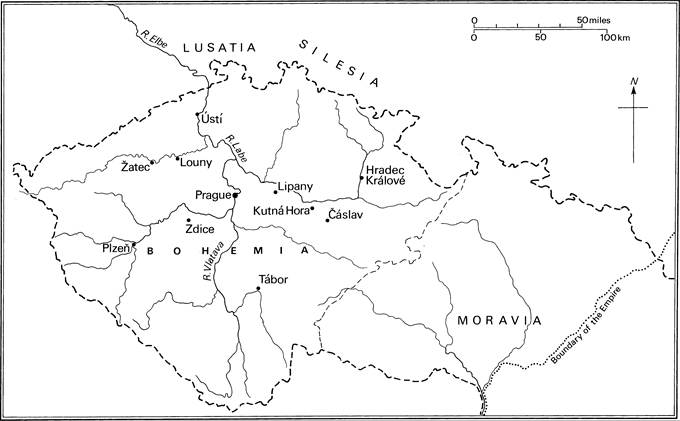
Map 7 Bohemia
The fundamental fact of economic life was its subsistent character. Bohemia had been spared the worst effects of the Black Death in the mid-fourteenth century and the calamitous drop in population which had so often followed. None the less, destructive waves of the plague did hit Bohemia in 1380, 1395 and 1413—15, resulting in overall population decline between 1380 and 1420. In particular, this was to hurt agricultural producers whose prices did not rise at the rate of their labour costs. A drop in consumption also affected commerce and artisanal production. The struggles for power within the royal family, as well as between king and archbishop and king and nobility, also harmed the economy. When the German princes deposed Wenceslas as head of the German Empire in 1400, the imperial court left Prague and no longer patronised its entrepreneurs and artisans. Growth in the economy depended mainly on internal trade, since few Czech products were exported. Prague and lesser towns such as Plzen produced cloth for domestic markets: Prague exported some military weapons and some hides left Plzen for foreign countries. To pay for what they imported, Czechs sold the silver mined at Kutna Hora; they also deliberately debased the Prague groscben, whose value, in the first two decades of the century, declined by 20 per cent by comparison with the currency of neighbouring Hungary. Debasement of the heller, the coin in which most day-labourers and peasants were paid, was even more rapid. To make matters worse, in the decades before the revolution, tax burdens on royal and ecclesiastical estates rose relentlessly. In 1418, one of the worst years for taxation, residents of New Town Prague were asked seven times for contributions.
Those clergy with prebends were among the wealthiest people, but there were also many poor priests. Before the revolution, the Church owned about 28 per cent of the land overall. Prelates such as the canons of St Vitus enjoyed an annual income of some 18,000 groschen, or almost fifty groschen a day, in strong contrast with the single groschen owed to the holder of an altar or with the two or three groschen earned by the skilled labourer. Furthermore, among the clergy, only some 4,000 of the 20,000 who sought ordination between 1395 and 1416 found a parish or other living. The clergy were encountered in many aspects of daily life, both as spiritual guides and as secular lords. By the fourteenth century, lay religious groups such as the Waldensians were active in southern Bohemia, Hradec Kralove, Prague and Zatec, and would supply recruits for the Hussite cause.
The nobility’s domination of political life depended on its military skills and experience and on the ownership of land and castles, these symbolising the power which it exercised over the countryside and its population. Nobles and members of the gentry exercised right of patronage to some 60 per cent of the country’s parish churches, a figure which reflected their share of landowner-ship. Nobles ranged in wealth from the Rozmberks, whose extensive domains in the south rivalled those of the king, to the Svamberks, pressured by urban and royal expansion near Plzen Yet they were far from being a united group, as was shown by a great baronial landowner, Cenek of Vartemberk, who helped the Hussite movement in a crucial way between 1415 and 1419 by leading a public protest against the execution of Jan Hus by the Council of Constance, and by organising the defence and ordination of Hussite clergy.
Because they owned land and could formally register it, members of the gentry (vladykove or zemane) were part of the ruling community. They also fought in war. At the beginning of the fifteenth century there were about 2,000 such families in Bohemia. Together they formed two groups: the upper group, called rytin (milites) or knights and esquires, and the lower group called panose (clientes, armigeri) or mere gentlemen. While a few built themselves small castles, many lived in simple farms which scarcely raised them above their tenants. Study of the gentry from 1395 to 1410 shows that close on 80 per cent had rental incomes between 120 and 600 groschen, paid by three to five peasant families. Since 600 groscben was about subsistence level, these gentry families needed to find other incomes. Some augmented their livelihoods by serving powerful lords; others simply reverted to robbery. While some gentry entered the circles of power as individuals because king, baron or Church needed their particular skill, by the beginning of the fifteenth century the baronage was increasingly restricting access to its group. In response, the lesser nobility was to develop a sense of its own political identity.
The political experience and prestige gained by the lesser nobility was to contribute to the success of the radicals between 1420 and 1434. Jan Zizka’s brilliant military innovations, the success of his revolutionary armies and his leadership in seeking a politically realistic settlement are well known. He was not alone: Nicholas of Hus constituted an example of a man prepared to risk worldly achievements for the sake of Hussite ideals. A member of an impoverished family, he had a successful career as burgrave in a castle belonging to the canons of the Vysehrad chapter. By joining the radicals, however, he turned his back on all that. In July 1419 he made his experience available to the radicals when he successfully negotiated on behalf of a crowd which had gathered to ask the king for the right of children to be given communion.
Peasant society included great variations of wealth which differed according to region. By the beginning of the century most labour services had disappeared, and many peasants paid their rent in money, freeing them to work their own lands and sell surpluses for profit. Generally speaking, the wealthiest 4 to 5 per cent worked some 20 to 25 per cent of the land. Most peasants held modest-sized holdings, and there seems to have been no great hunger for land. In the late fourteenth century an entire village was deserted in the estate of Chynov, near Tabor, later to be the centre of radical peasants. Nevertheless, in their struggle for existence peasants as a group were confronted by uncertainties, humiliations and mistreatment. When promised a new dignity, they joined the Hussite call for a new Church and a new society. These former servants and cottars served with radical enthusiasm and self-confidence in Taborite armies, fighting side by side with bailiffs, stewards and even gentry with whom they were brothers in faith. Back in the village, however, little changed. Here they were again dependants, owing rents and obeisance to their lords who, in some cases, were the officials of Tabor itself. Throughout the century of war, peasants also faced the added burden of supplying the permanent armies of the revolution from the hard-earned produce of their land. The urban author of the Old Czech Annalist described vividly how prices had increased in the 1460s. Just as the peasants prepared to harvest, soldiers came and burned the crops; as peasants began to plough, so soldiers prevented them from doing so. It was soldiers, too, who repeatedly ordered peasants to pay levies in the name of the country’s competing authorities.
In royal cities and towns wealthy burghers held the status that the nobility enjoyed throughout the country. Townspeople had considerable freedom to govern themselves, although the king could intervene and appoint magistrates if he wished. Urban revenues came mainly from trade, industry and the interest arising from debts and rents. The people used their wealth to buy land in the countryside, something which the nobility viewed as a threat. The wealthy elite monopolised the politically powerful positions on the town councils. Their piety was reflected in the support which they gave to Czech-language preachers, to the production of vernacular translations of the Bible and to the provision of hospitals, public baths and other material aid for the poor. Their patronage played an important role in helping the reform effort get under way in the late fourteenth and early fifteenth centuries.
In smaller towns a majority of residents lived off agriculture and rents from their holdings, while artisan manufacturers and tradesmen earned their living by meeting local needs. Tariff records show a healthy local trade in goods ranging from grain and cattle to iron and pottery. The poor and propertyless, exempted from taxation, could not participate in the public lives of their communities. Both peasants and urban commoners heeded the Hussite call to a life based on apostolic models of prayer, sexual purity and generosity. Preachers gave the laity the right to decide whether their priests were morally qualified or not. When the revolution broke out in 1419, commoners played an essential political and military role in preventing King Sigismund from taking the throne.