
In 1521, Francis I of France visited Dijon, where he was shown the skull of John the Fearless, duke of Burgundy. The Carthusian monk who accompanied the king was alleged to have said ‘my lord, that’s the hole through which the English entered France’. He was referring to the wounds sustained by the duke from the axe-blows which felled him on the bridge at Montereau in September 1419. The shadow of that assassination fell over much of the succeeding period, which saw a profound crisis of Valois monarchy in the face of English invasion and French civil war. John the Fearless’s death was clearly a product of the internal strife which had plagued the higher echelons of French society since the murder of Louis of Orleans by his Burgundian enemies in 1407. Henry V’s successes were partly based upon his ability to exploit the internal divisions of the French nobility to his own ends. The Valois monarchy’s very survival was for a time thrown into question and it was not until the late 1430s and 1440s that positive signs of recovery were clearly visible.
In the aftermath of Henry V’s invasions of Normandy in 1415 and 1417 the kingship of Charles VI had suffered a series of severe setbacks. The king’s intermittent madness had allowed the factions associated with the houses of Orleans and Burgundy to wage war around the throne and had led to Burgundian supremacy in 1418—19. The Dauphin Charles was forced to flee from Paris in 1418, taking his supporters with him, and this group was to form a long-standing source of support for the embattled Valois monarchy. It included civil servants, lawyers, churchmen and nobles, among whom the Jouvenel des Ursins, the Harcourt, the Cousinot and the Tancarville were prominent. The systematic reduction of Normandy to English obedience between 1417 and 1419 drove the higher nobility of the duchy into exile with the dauphin. Paris was in Anglo-Burgundian hands, supplied from Normandy by means of the Seine, and the so-called ‘Armagnacs’, or Orleanists, were subjected to physical violence, dispossession and confiscation of their property. The most assertive of the Parisian merchants and tradesmen supported the Burgundian interest, largely because of their commercial contacts with the Burgundian Low Countries, and the Dauphin Charles’s cause was at a very low ebb in the city. Henry V’s campaigns of 1419—22 brought the Seine valley into Lancastrian (or Anglo-Burgundian) allegiance, and the push southwards towards the Loire was already under way.
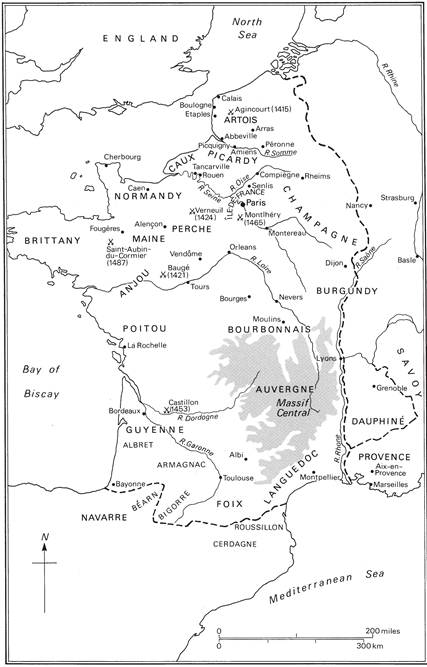
Map 8 France
In May 1420, oaths were taken by some of the greatest French princes — such as Burgundy and Brittany — to pledge their allegiance to a Lancastrian succession to the throne of France after the death of Charles VI. All territories in the hands of the ‘so-called dauphin’ were to be reduced to obedience under the terms of the Treaty of Troyes. A Lancastrian dual monarchy of England and France was in effect created on the deaths of Charles VI and Henry V within months of each other in 1422. It was the most serious threat to the power of the Valois monarchy since Edward III had claimed the throne of France in 1340.
Dynastic rivalry was fuelled by self-interest. The higher nobility of France — and many of the lesser seigneurs — found that they might profit from a choice of allegiance and played off one side against the other. This was a role perfected by Philip the Good, duke of Burgundy, pledged to avenge his father’s murder by aiding the Lancastrian cause against the dauphinists. Valois power gravitated towards the regions south of the Loire — Poitou, Berry, Auvergne and the Languedoc — while the central heartlands of the old Capetian monarchy in the Ile-de-France, Champagne, Perche and Picardy were in Anglo-Burgundian hands. It was a reversal of the process whereby the French monarchy had originally built up its authority under Louis VII, Philip Augustus and Philip the Fair. Normandy and Aquitaine lay outside Valois dominion, and the possibility of a recreation of the Angevin empire, in which Maine, Anjou and Poitou fell to the Lancastrians and their allies, was not out of the question. The consequences of this displacement of Valois power from the Parisian basin were long-lasting and important. The valley of the Loire became the stronghold of the monarchy, and the disinherited Dauphin Charles (acclaimed king by his supporters as Charles VII on 30 October 1422) spent his time at Bourges, Poitiers, Amboise, Chinon and Tours. While the regent of France for Henry VI, John, duke of Bedford, ruled from Paris and Rouen, the ‘kingdom of Bourges’ was established by the dauphinists, drawing its support from more southerly possessions.
A separate administration was set up at Bourges and Poitiers by Charles VII’s officers. This included a parlement, as supreme court of appeal, a chambre des comptes, chancery and household administration. Analysis of the Poitiers parlements records has suggested that it was a viable and effective organ of justice, served by able and skilled personnel. The household of Charles VII at this time was not the shabby and penurious institution of historical caricature, as access to the resources of southern France, and to the commercial and maritime networks created by the port at La Rochelle, enabled the court to survive with some degree of credibility. Grants of taxation on a regular basis from the estates of Languedoc ensured the funding of the regime, and frequent (though illicit) trafficking with the ‘enemy’ on the frontiers brought considerable benefits to the regions under Valois rule.
A significant diplomatic gain was made in 1425, when the allegiance of the great southern house of Foix was secured by Charles VII in return for the grant of contested territories, including the long-disputed comte of Bigorre. After Henry V’s death, Lancastrian diplomacy had failed to win the greater southern families and ecclesiastics to its side. With the exception of the house of Armagnac, the allegiance of the great families of the Languedoc tended towards the Valois cause, while the important towns of the Toulousain, the Albigeois and the senechaussees of Beaucaire-Nimes and Carcassonne also acknowledged Charles VII as ‘true heir and king of France’. Charles was also aided by the house of Anjou’s support in his time of greatest need.
The death of Henry V in August 1422 delivered a severe blow to the Lancastrian war effort. Lancastrian military supremacy had been virtually unchallenged before that date, with the exception of the defeat and death of Henry’s brother Clarence at Bauge on 22 March 1421. This was, however, only a temporary setback, and the great victory over the dauphinists and their Scots allies at Verneuil on 17 August 1424 demonstrated the continuing strength of Lancastrian arms. Normandy was now secure, and the extension of the pays de conquete began in earnest. To annex regions such as Champagne to the dual monarchy’s dominions was not too difficult a task: the problem lay with areas further south which formed the point of entry to dauphinist strongholds south of the Loire. The estates of Normandy were prepared to underwrite the Lancastrian regime with subsidies (at least until 1428) and Burgundian aid was an essential prerequisite for the conquest and occupation of northern France. But outside Normandy and the Burgundian sphere of influence the Valois cause was doggedly espoused by power groups allied to the Orleanist or Armagnac factions. Hatred of the Burgundians and their allies was as powerful an incentive to resist the Lancastrian war effort as any sense of nascent French nationalism. Pressing forward to besiege Orleans in 1428 Anglo-Burgundian forces encountered resistance of a kind to which they were unaccustomed.
‘The seige of Orleance [was] takyn in hand God knoweth by what avys’, wrote the duke of Bedford in 1434. Despite the self-justificatory tone of his memorandum on the subject, Bedford’s observation may represent a more realistic view of the limitations of Lancastrian power in France than that held by some of his contemporaries. Without whole-hearted Burgundian support (which was lacking in 1428—9) the expedition against Orleans was unlikely to succeed. The appearance of ‘a disciple and leme of the fende called the Pucelle, that used fals enchantement and sorcerie’ (as Bedford described Joan of Arc in 1434) brought the Lancastrian monarchy up against a species of ideological warfare which was unprecedented in the course of the Hundred Years War. To elevate the conflict into a religious war was no easy task, and it was a measure of Joan’s success that the credibility of the Valois monarchy was so rapidly enhanced. For her mission was essentially a symbolic and ideological one: Charles’s coronation and sacral unction at Rheims on 17 July 1429 vastly outweighed the military benefits of her short career. To have raised the siege of Orleans was a notable achievement, for which Charles’s captains were largely responsible; but to have secured the elevated status of a properly crowned and anointed sovereign for the dauphin dealt a profound body-blow to both the moral and tangible authority of the Lancastrian crown of France.
After the coronation at Rheims, as Joan herself acknowledged, her mission was at an end. The events of 1430—1 demonstrated that she had outlived her usefulness. The leading members of Charles’s own entourage — Regnault de Chartres, archbishop of Rheims, Georges de la Tremouille, Robert le Magon and Raoul de Gaucourt — were all too ready to deny her support once the journey to Rheims had been accomplished. Captured by the Burgundians at Compiegne in May 1430, sold by her captor — Louis of Luxemburg — to the English administration, she was delivered (at the request of the University of Paris) into the hands of the Inquisition. Her divinely inspired vocation had not won any significant victories for her dauphin after Orleans, and Normandy remained firmly in Lancastrian hands. Hence her trial took place at Rouen, where a tribunal (overwhelmingly French in composition) presided over by Pierre Cauchon, bishop of Beauvais, condemned her to death as a relapsed heretic on 30 May 1431. The trial revealed the extent of active collaboration between the Anglo-Burgundian regime, the University of Paris and the clergy of northern France at this time. But Joan’s achievement — apart from the outstanding example of devotion, courage and fortitude which she gave to future generations — lay largely in the moral sphere. The hastily prepared coronation ceremony which the child Henry VI underwent at Paris on 16 December 1431 exemplified the fact that the Valois monarchy had received consecration by the time-honoured and proper means at Rheims. This propaganda victory was to play its part in the gradual process by which the disaffected were won over to the cause of Charles VII.
Although the Lancastrian position in Normandy remained secure, the same could not be said for relations between England and Burgundy. Philip the Good had many reasons for complaint about the manner in which the Lancastrian regime in France had behaved towards him: he had not received a lieutenancy in the kingdom of France; appeals from his Flemish lands still went to the parlement of Paris; the marital affairs of both Humphrey, duke of Gloucester, and Bedford himself, after the death of his first wife (Philip’s sister, Anne of Burgundy), did not promote Burgundian aims; and the refusal of the regent to grant the comte of Champagne to him progressively alienated Philip from Henry VI’s cause. By 1432 it seems that he had resolved to detach himself from the Anglo-Burgundian alliance. This was to be fatal to the survival of the Lancastrian dual monarchy. Some Englishmen, such as Cardinal Henry Beaufort and Sir John Fastolf, tried in their different ways to salvage the Burgundian alliance, but incentives to reach a reconciliation with his father’s murderers became too strong for Philip and his counsellors to resist by 1435. Handsome bribes were offered to the chancellor Nicolas Rolin and other prominent Burgundian courtiers by Charles VII’s government in July 1435. Favourable legal opinion which justified a revocation of the Treaty of Troyes was secured by Philip from the masters of Bologna University and a reconciliation with Charles VII was finally reached at Arras in September 1435. Although the Burgundian volte-face of that year has been dismissed by some historians as a less significant action than had been previously supposed, it undermined the foundations of Lancastrian power in northern France. Burgundy was no longer the ally essential to the fulfilment of Henry V’s war aims: a reorientation of both English and Burgundian ambitions was henceforward inevitable. Philip the Good had already distanced himself from French politics and was accumulating extensive territories in the Low Countries; Henry VI’s government found itself increasingly forced to fall back upon Normandy and Maine, and this was reflected in the events which followed the fateful meeting at Arras.
The beginnings of Valois recovery soon became evident. Paris was regained in April 1436, and Lancastrian power in northern France steadily became confined to Normandy and its marches. Another setback had already been experienced by the death of Bedford in 1435. But the war continued, despite the moral victories of the Valois cause. Burgundian efforts to capture Calais in July 1436 were thwarted by Gloucester’s forces, and the vested interests of English captains in Normandy and Maine were all the more fiercely defended under the threat of dispossession. Valois successes were therefore largly diplomatic rather than military at this stage. The turning-point in the diplomatic history of the Hundred Years War at this time fell during the period between the Arras conference of 1435 and the Anglo-French negotiations at Gravelines in 1439. The first indications that the Lancastrian government might be prepared to renounce Henry VI’s title to the throne of France in exchange for substantial territorial gains appeared at that date. This was a reversion to an older formula of English claims which long predated Henry V’s reign. Cardinal Beaufort continued to underwrite the English war effort with his loans, but was concerned to improve the territorial position in both Normandy and Guyenne, partly as a bargaining counter in negotiations. The issue of the crown of France, however, proved divisive within the Lancastrian council: Gloucester accused Beaufort and his supporters of betraying Henry V’s war aims. Factional strife around the feckless and incompetent Henry VI tended to reproduce the political conditions previously suffered in France under Charles VI. Charles VII could only benefit from the disintegration of his increasingly implausible rival’s authority both in England and in Lancastrian France.
Yet the process of recovery was very gradual. Charles VII, though demonstrating considerable political acumen, was unable to control his own magnates. The ambitions of self-seeking courtiers such as Jean Louvet or Georges de la Tremouille which had bedevilled his early years now gave way to a revival in the power of the princes and higher nobles. The return to France in 1440 of Charles, duke of Orleans, imprisoned in England since his capture at Agincourt in 1415, simply provided a focus for magnate resistance and the outbreak of the so-called Praguerie, or noble rebellion, in 1440 ensued. There was little evidence at this time that the greater magnates felt inspired to drive the English out of France, as Joan of Arc had urged them to do. Burgundy supported the Praguerie, and plotted against Charles VII, lending little support to the Valois war effort against the English. Orleans and Anjou pursued their own ends, turning towards Italy, where both houses possessed territorial claims, in the mid-1440s. Bourbon’s participation in the Praguerie was in part determined by the unwelcome intervention of royal officials within his lands, especially by the royal baillis of Montferrand. Unless very substantial concessions were made to them, the higher nobility were reluctant to further Charles VII’s campaigns against Lancastrian France, in either the north or the south of the kingdom.
Charles VII successfully put down the Praguerie, but to win the nobility’s confidence involved more than mere repression. The lure of territorial gain could always be offered. To recover Normandy, Maine and Guyenne necessitated the grant of captured lands to faithful supporters of the Valois cause. But the picture was clouded by the confiscations of the period 1417—35. Were those who held titles to confiscated lands in 1429 (the date of the edict of Compiegne which regulated confiscation and dispossession) to be restored to them and in what state were those lands to be returned? How were long-standing pillars of the Valois monarchy, many of whom had lost all their lands and movable goods to the Anglo-Burgundians, to be rewarded? Such questions exercised the minds of Charles VII’s counsellors and the lawyers who served the regime. However, an advantage enjoyed by his government in this respect was increasing financial stability. As the Lancastrian war effort became embroiled in what has been called the ‘vicious spiral of Lancastrian insolvency’ Valois fortunes tended to improve. One reason for this was the ability of Charles VII’s government to raise taxation. The inhabitants of many provinces, especially those on the frontiers of war, were apparently prepared to underwrite the Valois regime in order to be free of the worst excesses of the soldiery — or so they hoped. Some localities were prepared to be directly taxed through the apparatus of royal elus who levied and collected the revenues. In others, the estates were prepared to vote grants of taxation — the taille, the aides and the gabelle — to enable Charles to raise a more disciplined army and to rid the countryside of roving bands of ecorcheurs and of the garrisons of freelances who subjected them to ransoms and protection money. In 1439 a royal ordinance decreed that the crown possessed a monopoly in the raising of troops — a significant act which, although very difficult to enforce, attempted to outlaw private armies and freebooting bands. Valois efforts to reduce military excesses contrasted with the increasing difficulties experienced by the Lancastrian administration in Normandy and Maine. Peasant revolts in the pays de Caux and disaffection throughout the southern parts of the duchy were a response to the problem of brigandage and the exploitation of the countryside by unpaid English garrisons.
Charles VII’s military reforms have secured a prominent place in historical textbooks. Between 1445 and 1448 a force of 12,000 mounted troops was created, known as the companies of grande and petite ordonnance. Each company of this army consisted of 100 lances, or units of six men, headed by a heavily armoured man-at-arms. There were twenty of these companies, providing both a field army and a garrison force for the crown. They were never intended, at their inception, to be a permanent standing army. Their purpose was to reduce military disorder and to drive the English from France. In 1448 a militia of francs-archers, raised by levy upon all hearths in the kingdom, was formed to provide infantry. Other groups of men-at-arms, not recruited to the companies, were declared to be illicitly raised and were to be disbanded. It was easier to enact such edicts than to enforce them. The models for this new army — although many of its members were already professional soldiers, some being ‘nothing more than old ecorcheurf — were derived from both English and Italian example. Above all, the practice of muster and review, perfected by Henry V’s and Bedford’s military administration in Normandy between 1417 and 1424, and regular pay mediated through civilian pay clerks, was adopted by the French standing army. Companies were regularly inspected to ensure that they were up to strength, properly equipped and not defrauded of their wages by their captains, who let them live off the country. The relationship between military disorder and civil unrest was clearly perceived by Charles VII’s treasurers for wars and other financial officials, some of whom had previously served the Lancastrian regime in occupied Normandy. A tendency towards greater stability of personnel in the companies serving the French crown has been detected at this time, and careers in the service of a given captain became longer. An elementary esprit de corps appears to have been born and, by making the crown the sole paymaster of the troops, magnate influence upon the behaviour of the companies was much diminished. The risk of private armies being formed from the compagnies d’ordonnance was low under Charles VII. Yet their cost was high: Philippe de Commynes estimated that Charles raised about 1,800,000 francs a year. Over 50 per cent of this sum was spent on the army. But it absorbed an element which had plagued the provinces of France and provided occupation for men who had formerly terrorised the countryside. By establishing permanent garrisons, some measure of control — exercised through the prevol des marecbaux and his archers — was established over a volatile and disorderly body of soldiery.
The creation of the standing army had been preceded by a period in which positive gains were made by Charles VII’s forces, especially in the southern territories of the Lancastrians. Between 1441 and 1443, the king had taken the initiative in Guyenne and recovered important strongholds such as Dax and La Reole from Anglo-Gascon forces. The abortive negotiations for a marriage between Henry VI and the count of Armagnac’s daughter (1442) reflected the decline of Lancastrian authority in this region. Defections by some members of the Gascon nobility, who had traditionally supported the English cause — especially in the Landes — undermined the regime and the negotiation of a truce at Tours in May 1444 gave both sides in the conflict a breathing space in which to retrench and consolidate their positions. A major problem encountered by the Valois war effort now lay in the strength of regional and localised resistance. In the north, the entrenched interests held by certain English captains in Normandy and Maine hampered all efforts to dislodge them; in the south, the traditional resistance of the Gascons to Valois authority, particularly at Bordeaux and Bayonne, and its attendant taxation, was an even more formidable obstacle to the annexation of territory to the crown. In Normandy and Maine, the landed interest of English knights and nobles was dominant, and led to the refusal of men such as Matthew Gough and Fulk Eyton to surrender the comte of Maine to the French crown as a result of the treaty made with Charles VII by Henry VI’s lieutenant, the duke of Suffolk, in March 1445. In Guyenne, economic connections with England and a very long-standing loyalty to the English crown rendered the position very different from that which prevailed in relatively recently occupied Normandy. Yet in both regions, the continuance of the war spelt economic dislocation and a certain degree of devastation. Normandy experienced greater damage: the destruction of mills, the wasting of standing crops and burning of villages were frequent occurrences even during periods when full-scale campaigns were not in progress. The random and sporadic effects of brigandage and looting by unpaid English troops, or by Normans professing to be in the service of Charles VII, were keenly felt in the duchy. Yet Thomas Basin’s famous picture of a totally devastated province, in which no cultivation took place and no animal population was to be found, was clearly exaggerated. The effects of war could be very severe indeed, but they were very localised and intermittent. It was only after 1449, when large expeditionary forces were launched by Charles VII against Normandy, that the level of economic damage rose to intolerable heights. Even then, it lasted for a relatively short time, for the capacity of medieval armies to cause enduring damage was limited.
It can be argued that the 1440s was a decisive decade in which the balance of political, diplomatic and military power shifted in favour of Valois France. In March 1449, the taking of the Breton frontier fortress of Fougeres by Francois de Surienne, an Aragonese mercenary in English pay, broke the truce negotiated at Tours five years previously. Urged on by a powerful Breton faction at his court, Charles VII decided upon the reconquest of Normandy. The war was resumed on 31 July 1449. Within fifteen months, all of Henry’s V’s and Bedford’s conquests in Normandy and Lancastrian France fell to Valois arms. The way had been prepared during the previous decade. Charles VII had been aided by the failure of the Italian ambitions of great magnates such as Charles of Orleans and Rene of Anjou. The crises of the years between 1442 and 1449 which opened up opportunities for the prosecution of their territorial claims in the peninsula — using French troops — were now at an end. There was nothing to stop the French crown from moving into Normandy except the stubborn resistance of English captains and the ever-present problem of finance. The latter question was to some extent solved by the exercise of force majeure: in July 1451 the vast assets of Jacques Coeur, Charles VII’s argentier, responsible for the supply and provisioning of his household, were confiscated by crown agents. Jacques Coeur had risen from humble origins to dominate the credit finance of the kingdom, lending huge sums to the crown. Arrested on trumped-up charges of treason, his fortune contributed directly to the recovery of Normandy and Guyenne. His assets totalled some 3,500 florins (the Medici Bottega di Sieta had about 5,000 florins) and his plate was melted down to strike coin so that the troops in Guyenne might be paid in July 1453. Taxation from the estates of both Languedoil and Languedoc also contributed to the financing of the last phase of the war and the magnates were content to serve the crown, for they benefited from substantial concessions of royal taxation levied within their own lordships. A combination of effective siege artillery, deployed by the brothers Bureau, bribery, ruse, incitement of the local population and buying off of English garrisons won Normandy for Charles VII by August 1450, when Cherbourg — the last remaining bastion of resistance — fell to French troops.
In Guyenne, the French succeeded in taking Bordeaux, Bayonne and the remainder of the duchy by August 1451, largely by means of sieges. The major strongpoints, both towns and seignorial castles, surrendered either after bombardment by the heavy artillery of the Bureau brothers, or as a result of negotiated agreements to surrender. Aid from England did not arrive to succour the loyal inhabitants of the duchy. Yet the terms imposed by Charles VII were generous and Gascon liberties and immunities were to be respected. The position was abruptly changed, however, by the rising of a group of Gascons, some of them exiles in England, others representing the mercantile and shipowning community at Bordeaux, against French occupation. In this instance, help from England appeared in the person of John Talbot, earl of Shrewsbury, who, with an expeditionary force ‘for the keeping of the seas’, descended upon Bordeaux in October 1452. The coastal regions of the duchy were temporarily recovered for Henry VI but this reversal of Valois fortunes was not to endure. Talbot was not reinforced from England, and a French expeditionary force, consisting of a field army as well as a siege train, defeated and killed him at Castillon on 17 July 1453. Bordeaux held out until 19 October, when it capitulated to the French for the second time. Heavy penalties were then levied by Charles VII’s government upon the recalcitrant Gascons. These were not to be lifted until Louis XI’s reign, when the king granted the duchy its own sovereign court — theparlement of Bordeaux — in 1462, and set in motion a process for the canonisation of the saintly and pro-English archbishop of Bordeaux, Pey Berland. With the establishment of a delegated appellate jurisdiction for the duchy in 1454—5 — the Grands Jours — Guyenne was to be gradually, but thoroughly, brought into line with French judicial and administrative practices. French taxation was imposed upon the region; its yields were soon visible in the accounts of the constables of Bordeaux. Gascon privileges in the wine trade with England were revoked and a period of economic hardship set in for Bordeaux and Bayonne.
This picture of the onward march of Valois victory was somewhat tarnished by two related problems: the role of the Dauphin Louis, and the attitude of Philip the Good of Burgundy to Charles VII’s successes. Since taking up residence in the Dauphine in 1446, the dauphin had intrigued against his father. In 1456, he fled to the Burgundian lands, where he was harboured by Philip the Good at Brussels and Genappe. Burgundy had taken no part in the campaigns against Normandy and Guyenne between 1449 and 1453. A state of ‘cold war’ has been discerned between France and Burgundy at this time, represented by Charles VII’s favouring of Flemish dissidence from the Burgundian regime. Had his armies not been campaigning in Guyenne in the summer of 1453, there was a distinct possibility that they might have supported the Ghenters in their bitter war with Philip the Good. Charles’s agents had created instability within the Burgundian lands by encouraging Flemish appellants at the parlement of Paris, while the harbouring of the dauphin, against his father’s will, carried the risk of treason charges being levelled against Burgundy. A critical point was reached in October 1458 when Jean, duke of Alengon, was tried for lese-majeste before Charles VII and the parlement at Vendome. Philip the Good was not present at the trial, and Chastellain reported that men feared that he would not be exempt from a similar prosecution. In the event, intermediaries such as Jean, count of Nevers, worked to prevent a further escalation of Franco-Burgundian tension and the storm did not break until after the accession of Louis XI.
An assessment of the state of the French kingdom at the death of Charles VII in 1461 must take account both of striking achievements and deep-seated uncertainties. The war with the English had in effect been won. Although there were apprehensions about a further revival of English war aims (as occurred, for instance, in 1475) the disturbed political condition of Lancastrian and Yorkist England militated against a concerted policy of intervention in France. Calais remained the sole English possession on the European continent. Charles VII’s title to the French throne was secure. The civil war among the French nobility had been largely quelled. The crown had subdued the count of Armagnac by coercion (in 1445), the duke of Alengon by indictment for treason (in 1458) and the duke of Brittany by compromise over his homage to the monarchy (in 1446 and 1450). Factional conflict, exemplified by the Armagnac/Orleans—Burgundian feud, had ceased to tear the higher nobility of France apart. Charles VII’s servants could legitimately claim that a form of social and political peace had been restored to French society. The recovery of Normandy, Maine and Lancastrian France, and the annexation of Guyenne, brought economic as well as prestigious gains to the crown. In 1461 Guyenne yielded 30,000 livres tournois in aides, and 70,000 livres tournois in taille. Both taxes were innovations introduced after the French conquest. In the autumn of 1452, the Norman estates already considered taxes to be excessive and petitioned for a restoration of ancient privileges and institutions. Herein lay the danger of over-zealous activity by French royal officers in recently recovered provinces. But such measures were the price to be paid for peace and for integration into the kingdom of France. The English occupation of Normandy had ‘witnessed a revival of local patriotism and local institutions which helped to create an institutional dimension to local sentiment’.
Similarly, enquiries launched by the crown into regional customs, in the wake of the great judicial ordinance of Montils-les-Tours in 1454, could lead to a recrudescence of regional sentiment and a heightened awareness of ancient privileges.
In 1461, the problem of regionalism was to some extent compounded by the continuing power of the higher nobility. Regional sentiment could join forces with seignorial, or princely, independence to arrest the territorial consolidation of the kingdom. At the very top, uncertainty over the future attitudes and behaviour of the Dauphin Louis, estranged from his father and from many members of the group who governed France, caused disquiet. The close association of Louis with Burgundy also gave rise to fears of a Burgundian coup which would displace the old and loyal servants of the Valois monarchy from their places in the sun under Charles VII. Burgundy formed a potential focus of opposition for the discontented and disaffected. Philip the Good had achieved an independent status as ruler of most of the Low Countries. The war with the English had in fact prevented Charles VII’s government from effectively tackling the problem of Burgundian expansionism and state building. Valois resources had been stretched to their limits by the war effort and by the need to provide ample rewards to both nobles and bonnes villes for their support against the Lancastrians. The need to compensate the faithful for their losses also taxed the patience and ingenuity of Charles VII’s officers and lawyers, although they often profited from cases of dispossession and resettlement. The fortunes of the great dynasties of Parisian parlementaires — the d’Orgement or the Cousinot — were in part made in the aftermath of war. Many purchased estates in the region of the capital and elsewhere, often from impoverished petty nobles, while the parlement’s fundamental role in administering the land settlement reinforced an existing tendency towards a rise in the status of its members. ‘To be a king’s counsellor or even an advocate at the parlement was to vivre noblement. The notion of a noblesse de robe was established.’ The principle of resignation from office in favour of a named relative, and of covert venality, began to entrench itself within the ranks of the legal, as well as the financial, bureaucracy. This was soon to pose problems of control by the monarchy of its own legal apparatus.
The burgeoning of the lawyers and financiers in the crown’s service was illustrated in many ways. Upward social mobility lay in office holding, lubricated by access to liquid capital. In the aftermath of the war, fortunes could be made (and lost) through the accumulation of legal and financial offices. The law was a safer avenue of social ascent than finance. Jacques Coeur’s fate was a salutary warning to merchants and financiers who sought to promote them selves and their families through lending to the crown and the nobility. Legal fortunes were perhaps harder to make, but the volume of legal business thrown up by the war — above all in civil litigation and property disputes — ensured a steady source of income for the counsellors and advocates of the Paris and provincial parlements. The temptation to invest in land and to set themselves up as seigneurs — around Paris, in the Toulousain or in the Bordelais — appealed greatly to these men. Their legal profits served to guarantee solvency and thereby offset the tendency for land-locked fortunes to yield low returns. The collapse of the senior branches of a family such as the Ysalguier of Toulouse, who had risen as creditors of the monarchy in the fourteenth century, stemmed from the shifting of all their assets from trade and commerce to land. Diminishing returns conspired with the effects of war damage to render them unable to meet the expenses of ‘living nobly’ and of providing adequate dowries for their daughters to maintain their position in Toulousain society.
In the prevailing economic climate, marked by what has been called a ‘bullion famine’ in the mid-fifteenth century, the need to maintain and increase liquidity was all-important. Mercantile fortunes had often to be channelled through office holding if steady social ascent was to be sustained. It was in this way that the great commercial fortune of Giovanni Arnolfini, Lucchese merchant residing at Bruges (d. 1472), patron of Jan van Eyck, descended to his nephew, Marc Cename, lord of Luzarches and elu of Paris. Arnolfini had lent money to the dauphin, Louis, during his Burgundian exile and was created conseiller sur le fait des finances by Louis, as king, in 1462. A balance between office holding, landownership and the accumulation of liquid capital was thus essential for the survival of a recently ennobled family among the ranks of the nobility.
The revival of the Valois monarchy under Charles VII was also expressed through the arts. In danger of eclipse by the brilliant court culture of Burgundy, the court and household of France displayed a marked tendency to patronise the visual arts and literature with renewed emphasis during the 1440s. Around the king was an entourage, castigated by moralists such as Thomas Basin for its corruption and jobbery, which included Jean Juvenal and Guillaume Jouvenel des Ursins, Etienne Chevalier, Laurent Girard and Simon de Varie. All these servants of the crown are known to have patronised the arts: Jean Juvenal des Ursins, archbishop of Rheims, was himself a chronicler and a distinguished writer of exhortatory treatises. Lesser men, such as the Norman notary Noel de Fribois, produced propagandist histories, celebrating the victories of Charles VII and vehemently arguing for the legitimacy and moral supremacy of Valois kingship over its rivals. Fribois’s Chronique abregee (1459) contained the memorable assertion that ‘whenever I come to something con cerning the English, I cannot control my pen’. Others were less passionate in their detestation of the ancient enemy. A voluminous literature of panegyric emerged from the circle around Charles VII in the 1440s and 1450s: Thomas Basin’s discordant voice of resistance and protest was exceptional. A chorus of near-unanimous eulogy praised Charles VII, the roi tres-victorieux, after 1453, and the court (now permanently located in the towns and castles of the Loire valley) was presented as a focus of loyalty and centre of patronage.
Those responsible for presenting an image of Charles VII’s kingship were assisted in their task by the visual arts. Efforts to exalt the dignity of the monarchy at royal entries into the bonnes villes, and at other royal ceremonies, such as plenary sessions of the parlement, were recorded by artists. The work of the painter Jean Fouquet, born in Tours (c. 1420—80), forms an invaluable iconographical source for the milieu which surrounded Charles VII. The king himself was portrayed by Fouquet in ceremonial contexts — at the trial of the duke of Alengon at Vendome in 1458, sitting in majesty surrounded by higher clergy, secular nobles, members of the parlement and royal officers, or as the eldest of the Magi performing their homage to the infant Christ in the Hours of Etienne Chevalier (c. 1452—5). The king’s unprepossessing features were transcended by the dignity of his office and Fouquet’s art exemplified the contrast between the king’s mortal body and the immortality of the sovereignty of France. Among Fouquet’s patrons, the civil servants were well represented. Guillaume Jouvenel des Ursins, chancellor of France, commissioned a splendid portrait, depicting him in a rich furred robe in front of a gilded, Italianate architectural background. Etienne Chevalier, treasurer of France, invested his profits of office in a lavishly illustrated Book of Hours, noteworthy for its use of Italianate motifs. Laurent Girard, an officer in the Chambre des Comptes, owned the Boccaccio manuscript, now at Munich, in which the Alengon trial forms a topical frontispiece recalling the fall from grace of great men. Simon de Varie, brother of Guillaume de Varie, factor of Jacques Coeur, commissioned a recently discovered Book of Hours (1455) from Fouquet in which this financial official (ennobled in 1448) is represented kneeling, in full armour, before the Virgin and Child on the Obsecro te page, with his heraldic achievements prominently displayed beside him. New nobility was thus expressed visually — even vulgarly — and the predilection of his civil servant patrons for Fouquet’s style, with its gestures towards a novel Italianism, was perhaps indicative of an arriviste mentality. The illuminated manuscripts and panel paintings produced for Charles VII’s courtiers and officers demonstrated that the shift in art patronage from northern France (particularly from Paris) towards the Low Countries after 1420 had been partially reversed. The dominance of artists from Touraine after 1445, however, meant that Parisian production never again achieved its previous levels of quantity or excellence.
France in 1461 was not yet a united monarchical state. The monarchy was simply not powerful enough to create the institutionally centralised organism beloved of nineteenth-century historians. It could be argued that this was not in any case the primary purpose of the crown in the later fifteenth century. Dynastic loyalty and a recognition of the crown’s theoretical sovereignty was as much as could be expected from many of the kingdom’s inhabitants. Divided by law, language and custom, France was not a ‘nation’ in the modern sense in 1461. Despite the encroachment of northern French upon southern dialects, linguistic uniformity was not established, either in law or government, until Francis I’s edict of Villers-Cotterets in 1539. The strength of regionalism had led to a widespread devolution of royal authority: poor communications alone militated against effective government from the centre. With the creation of provincial parlements, a further phase in the decentralisation of justice and administration began, from which strongly regionalist corporate bodies were to emerge. The mould from which the ancien regime was to be cast was in part created as a direct consequence of the war with the English. The taxation system, the standing army, which to a large degree justified the taxes, the system of justice and the greatly reduced role of representative assemblies were already evident by the death of Charles VII. The gradual and difficult progress towards absolutism had begun.