
On 27 April 1404, Philip the Bold, duke of Burgundy, died in the town of Hal, south of Brussels. A contemporary, Christine de Pisan, described the event in terms of the ideal death which should be associated with a prince. On his deathbed the duke gave his three sons, John, Anthony and Philip, the benefit of his final thoughts, advised them to remain faithful to the crown of France and divided among them the lands which he had patiently assembled under his authority during his forty years of rule. This partitioning was to be subject to certain conditions, and would be fully effective only after two years. On his father’s death his eldest son, John ‘the Fearless’, inherited the duchy of Burgundy and the county of Charolais: less than a year later, in March 1405, on the death of his mother, Marguerite de Male, he was to pick up the major part of his maternal inheritance, namely the counties of Flanders, Artois and Burgundy (Franche-Comte). His brother, Anthony, was not formally involved in the partitioning of Philip the Bold’s legacy for, in 1403, Philip had arranged with Jeanne, duchess of Brabant (who had no heir), that he would succeed her; in 1404, he took over the regency of Brabant and, on Jeanne’s death in 1406, he assumed the title of duke of Brabant. Philip the Bold’s third son, also Philip, received the counties of Rethel and Nevers, which had formed part of his mother’s bequest.
Such a procedure avoided the territorial break-up of Burgundian territory; the new duke held the most important lands bequeathed by his parents. As for Anthony’s accession to Brabant, it would be seen as an example, achieved posthumously, of Philip the Bold’s policy of expansion. Burgundian influence would now be felt within the Empire, where a network of alliances was already proving useful. The late duke’s matrimonial policy had, in effect, led to the marriage of three Burgundian princesses to princes of the Empire: in 1385, Margaret of Burgundy had been espoused to William of Bavaria, heir to the counties of Hainault, Holland and Zeeland, whose sister, Margaret, had at the same time married the future John the Fearless. Some years later, in 1393, Catherine of Burgundy would marry Leopold IV of Habsburg, duke of Austria, while in 1401 Mary of Burgundy was to marry Amadeus VIII, count of Savoy.
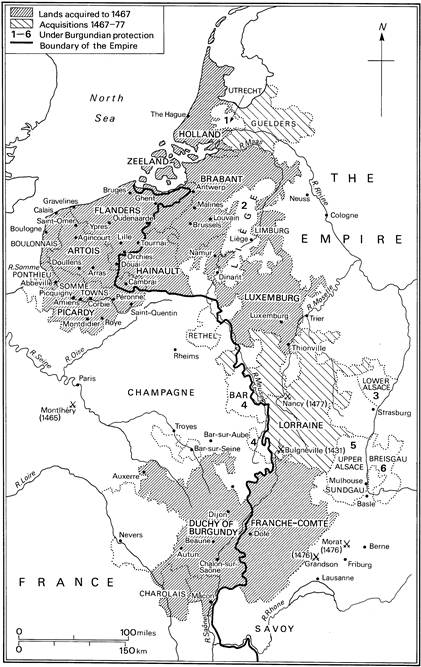
Map 9 The Burgundian dominion
None the less, the position of Duke John in 1404—5 was, in some respects, unsatisfactory, for although the extent of his territorial authority could not be denied, his financial position was far from sound. Ever since his father’s time the whole matter of the duchy’s finances had been closely linked to the role played by the duke of Burgundy at the heart of French affairs. Between 1395 and 1404, when the annual ducal revenue was in the order of 450,000 livres tournois, some 30 per cent of this came from gifts and pensions granted by the king of France, Charles VI, to his uncle of Burgundy. This figure reflected the dominant position occupied by the duke at the French court. On Philip’s death, however, this source of revenue dried up immediately, and his son, John, could rely only on the resources of the two Burgundies (duchy and county) and, after March 1405, upon those of Flanders and Artois, respectively 12 and 43 per cent of the sums raised by his father between 1395 and 1404. The new duke was immediately forced to borrow where he could, soliciting loans from government employees of every kind, from the towns of his principalities, from the richest of his subjects and, quite naturally, from his supporters, both merchants and financiers, such as the Lucchese, Dino Rapondi, and the Parisian, Guillaume Sanguin. The loss of influence felt by the duke of Burgundy at the heart of royal government in 1404 (all to the advantage of Louis of Orleans, the king’s brother) and the financial effect caused by the loss of almost a third of the ducal revenues weighed heavily upon Burgundian policy as it sought new avenues to follow.