
Richard II was unusual, indeed unique, among medieval English monarchs in making two visits to Ireland in the course of his reign. Within Ireland, the results of royal intervention were disappointing. Before the end of 1399 the acting chief governor of Ireland reported to the English administration that the ‘Irish enemies’ were ‘strong and arrogant and of great power’, that they were aided in their assaults on the king’s loyal subjects by ‘English rebels’ with the result that ‘the law cannot be executed and no officer dares to attempt to execute it’; for there were no soldiers and no resources to pay soldiers to protect the king’s subjects against these attacks.
Ultimately, the king’s expeditions achieved little, but Richard II had at least attempted to go beyond the normal objective of military containment and to formulate proposals for a more lasting political settlement. He could not but be aware of the ethnic division within Ireland which, as we have seen, could lead the administration in Dublin to categorise even its foes on the basis of their real or supposed descent as ‘English rebels’ (opponents of English stock) or ‘Irish enemies’ (hostile Gaelic Irish). This cleavage between the posterity of the settlers of the twelfth and thirteenth centuries and the progeny of the older indigenous population, between, as the Irish annalists put it, the foreigners (Gaill) and the natives (Gaedhil) had been accorded statutory recognition in the legislation passed by the Irish parliament at Kilkenny in 1366. The Statute of Kilkenny, having noted in its preamble that the abandonment of English social, legal and cultural mores could lead to political disaffection, sought to protect the colonial population (the English-Irish or Anglo-Irish) from further contamination through the adoption of customs and habits taken from the ‘Irish enemies’ (the Gaelic Irish). Hence it insisted that the colonial population should use English language and law, dress in English clothing and ride horses after the English fashion, with saddle and stirrups. To prevent the erosion of ‘Englishness’ among the Anglo-Irish severe limitations were placed on contacts between them and the Gaelic Irish and, in particular, intermarriage between the two ethnic groups was formally prohibited, an unusual example of a ban on marriage between two avowedly Christian groups.
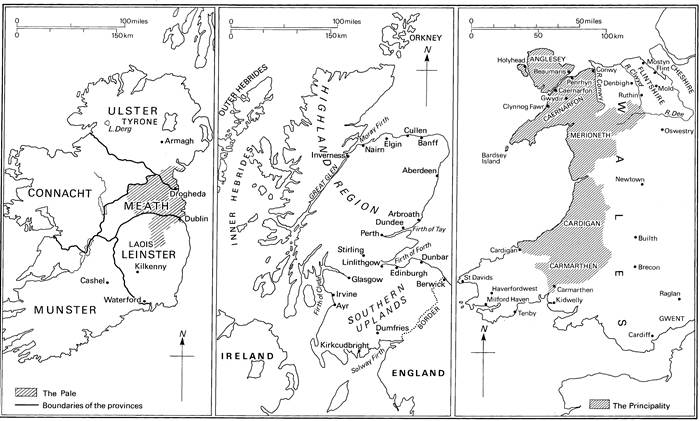
Map 10 The Celtic world
Richard II seems to have envisaged the reversal of this policy of segregation. In the submissions made to the king in 1395 many Gaelic lords undertook to attend the king’s council or parliament when summoned to do so, an indication that Richard II wished, by introducing the Gaelic aristocracy to institutions from which they had hitherto been precluded, to comprehend both ethnic groups within the lordship’s governmental framework. It had always been open to individual Gaelic Irish to secure charters of denization which would allow them to have the same legal status and entitlements as the Anglo-Irish. In 1395 Richard II was poised to extend equality of status to the whole Gaelic Irish community or, at least, to those who wished to have it, thus giving substance to an ordinance of 1331 which had proclaimed such an extension of English law and making loyalty, rather than ethnic origin, the yardstick by which a subject’s fidelity could be measured. Opposition from within both groups frustrated the king’s plans to make equality of treatment the basis of an enduring settlement, and the re-enactment of the Statute of Kilkenny in 1402 marked the triumph of older official policies. Not until the reign of Henry VIII would another serious effort be made to bring the leaders of Gaelic Ireland within the ambit of English governmental structures.
There is little doubt that the colonial settlement had declined in size, security and revenue since its peak in the thirteenth century. Inflated estimates of the Irish lordship’s former profitability fuelled Richard II’s ambition to extend royal authority over the whole island so that it might again become a source of revenue for the crown. After 1399 it became even clearer that Irish revenues were totally insufficient to mount any campaign to extend the colonial settlement; indeed, they were hardly adequate to the task of preserving it. Any advance in Ireland must therefore be financed from England, where there was a general reluctance to sanction large-scale expenditure on Ireland. The Commons in the English parliament of 1406 complained, with some justification, that the money spent on war in Ireland had brought little improvement in the situation. It was their view that in Ireland, as in other disturbed areas, such as the Welsh borders, defence needs should be met by local magnates and local resources. The reopening of the French war in 1415 reinforced Ireland’s low position on the scale of English priorities, a point tellingly illustrated in financial terms by the sums allocated to various areas in 1421 when Calais received £19,100, the defence of the Scottish borders £9,500 and Ireland a mere £i,666. The complaints about lack of resources and dire predictions of the consequences which emanated from Ireland lost force through repetition and may simply have confirmed the English administration’s assessment of the intractability of the problems of the lordship. Certainly there was no support for the view advanced by the earl of Ormond in the 1430s that, if what was spent on one or two years’ warfare in France was applied to Ireland, a conquest of the whole country could be made. Naturally preoccupied with the Anglo-French conflict, the government regarded Ireland as an undoubtedly subordinate theatre of war which offered little prospect of profit or glory.
In keeping with the view that Irish problems should be the responsibility of Irish resources, the English government enforced Absentee Acts which required those holding lands in Ireland either to reside there and defend them or to provide for their protection. Lower down the social scale, depopulation in England caused by successive outbreaks of plague had combined with disturbed conditions within Ireland to encourage emigration from the lordship to avail of the beckoning opportunities across the Irish Sea. In 1394 Richard II ordered back to Ireland all Irish-born residents in England reflecting the opinion advanced by one chronicler that ‘such a great number of Irish had come to England to earn money that that region was devoid of men and women. The result was that the pure Irish, the enemies of the English-Irish, devastated the part of the island which obeyed the English king without resistance.’ That the order was enforced is clear from the fact that over 500 Irish-born residents paid fines to the crown for the right to remain in England. In September 1413 the desire to replenish the colonial population and to secure quiet and peace within the realm of England resulted in a proclamation that all Irish-born residents, with some specified exceptions, were to return home by Christmas Day 1413. Similar repatriation orders were issued in 1431,1432 and 1439, and these were paralleled within Ireland by statutes which attempted to curb emigration without licence from the administration in Dublin. The comment of Archbishop John Swayne of Armagh in 1428 — ‘there is mo gone out of the lande of the kyngis lege pepyll than be in’ — would suggest that neither set of measures was effective in bolstering the colonial population, and schemes for recolonisation briefly espoused under Richard II were not to be considered again until the sixteenth century.
For those charged with the responsibility of governing Ireland lack of financial rather than human resources was normally a more pressing problem, either because of the inadequacy of their stipend or their inability to gain payment of it. Rule of Ireland was usually entrusted to the king’s lieutenant with power to serve the office by deputy and, more often than not, it was the deputy who actually presided over the administration in Dublin. In cases of emergency where the lieutenancy or deputyship was vacated by the death or departure of the holder, or where the appointment lapsed owing to the death of the king, a temporary chief governor, termed ‘justiciar’, was appointed to head the administration until new arrangements were made. In the second half of the fourteenth century lieutenants had been granted at least £6,000—£7,000 per annum from England. By 1408 the annual grant had been scaled down to 7,000 marks (£4,666), and on Henry V’s accession the allotment to the Irish lieutenant, now Sir John Stanley, was further reduced to 4,000 marks (£2,666) for the first year and 3,000 marks (£2,000) per annum thereafter. All subsequent appointees to the lieutenancy under the Lancastrian kings were granted similar sums, and by 1453 these figures seemed to be established as the fixed rate for the job. However, if the lieutenant was an absentee, even the payment of his full salary might bring little financial benefit to the lordship since neither deputy lieutenants nor justiciars had direct access to such revenues. Deputies tended to make their own financial arrangements with lieutenants, but the indications are that they were expected to defray most of their expenses from local resources. Justiciars traditionally received a salary of £500 per annum and, on occasion, were also provided with a small defence force of twelve men-at-arms and sixty archers, but both the salary and the cost of the force had to be derived from Irish revenues. On many occasions, therefore, effective defence of the colonial settlement depended upon the chief governor’s ability to tap local resources.
In the first half of the fifteenth century there were ten appointees to the Irish lieutenancy. Nine of these were English men varying in rank from the king’s son, Thomas of Lancaster, duke of Clarence, to knights like Sir John Stanley or Sir John Grey. The exception was the Anglo-Irish magnate, James Butler, fourth earl of Ormond. His first appointment in February 1420 was motivated, in part at least, by the belief that he could exploit local resources more effectively and thus decrease dependence upon the English exchequer. In contrast to his English predecessors, Sir John Stanley and John Talbot, Lord Furnival, who had left behind many unpaid debts, Ormond gave a firm undertaking to the Irish parliament in 1421 that he would make due payment for anything he required. Indeed, he went further and pledged the rents from certain of his lands as satisfaction for any debts outstanding at the end of his term of office. The same parliament formally thanked the lieutenant because ‘he abolished a bad, most heinous and unbearable custom called coigne’, a reference to the forced billeting of troops upon the countryside, a practice to which previous chief governors had resorted because of the inadequacy of their financial support. Ormond’s renunciation of this method of supporting an army was clearly welcomed by the Anglo-Irish community, but it did not lead to the abolition of ‘coyne’ or ‘coyne and livery’ which persisted into the sixteenth century, when it was aptly described as ‘takeing horsse meate and mannes meate of the kinges poore subgettes by compulsion, for nought, withoute any peny paying therefor’.
Ormond also differed from English lieutenants in his relationship with the Gaelic Irish, particularly with the learned classes who enjoyed a quasi-clerical status and immunity in Gaelic society. Stanley’s blatant disregard of this status in his attacks upon the bards in 1414 resulted ultimately in his own death, in the view of one annalist. For the master-poets reacted to his onslaught with such powerfully venomous verses that he died within five weeks of their composition. Talbot, his successor, continued the assaults upon the poetic order, perhaps in an attempt to demonstrate by his own survival the inefficacy of such poetic tirades. Against Ormond, however, no such charges were made. As a member of a long-established Anglo-Irish aristocratic family, his attitudes towards Gaelic culture and society were markedly different. His father’s skill in the Irish language had enabled him to act as an interpreter between Richard II and Gaelic Irish leaders in 1395. Ormond employed a Gaelic legal expert (brehon) in his own territories and was himself a recipient of laudatory verses from a Gaelic poet. His enemies even charged him with having Gaelic Irishmen illegally elected to parliament as knights of the shire.
Smaller than its English counterpart, the Irish parliament also differed in its composition since it included among its elected representatives proctors from the diocesan clergy who, in England, were now comprised within the provincial convocations of Canterbury and York. As the main forum for the expression of opinion by the Anglo-Irish community, it often petitioned the English crown for greater royal intervention in Ireland with predictions of dire consequences if such was not forthcoming. The parliament contained no representatives of the Gaelic Irish community with the exception of occasional Gaelic Irish bishops who could attend by reason of their office. Hence the charge of illegality against Ormond, itself an outcome of the long-running feud between the earl and John Talbot.
Shortly after Talbot’s arrival in Ireland in 1414 a quarrel broke out between himself and Ormond, which was to continue for almost thirty years and led to the disruptive growth of two factions within the colony. The divisions caused by the dispute within the administration and the community as a whole contributed to the decline of the colonial settlement, a decline now frequently delineated in territorial terms. In the 1420s Archbishop Swayne of Armagh maintained that the territory under the effective control of the Dublin administration amounted to little more than one shire. The author of the gloomy report to the king in 1435 reckoned that within the four counties of Dublin, Meath, Louth and Kildare there was only an area thirty miles in length and twenty miles in breadth where it was safe to go in response to royal instructions; and the same point was made in a more succinct way by the Libelle of Englyshe polycye when it claimed that
oure grounde there is a lytell cornere
To all Yrelande in treue comparisone.
The concept of a geographically defined limitation on English authority, an ‘English Pale’, had already emerged, though the earliest official use of the term occurs only in 1495 when the Irish parliament ordered ‘diches to be made about the Inglishe pale’.
The contrast between the Pale and the rest of the country should not be overemphasised. There remained many areas of English language and loyalty outside the Pale. Almost all the major towns fall into this category, but most had now to rely on their own resources to provide for their defence as the administration in Dublin could not assist them. For example, travel between Waterford and Dublin had become so hazardous that the mayor of Waterford was exempted from the requirement to take the oath of loyalty to the crown at Dublin, and in 1448 the administration formally acknowledged Waterford’s military isolation by authorising the city to organise its own defence forces. By permitting these to march against any rebels ‘with standards displayed’, the government in Dublin was effectively licensing private warfare by the city against its enemies. In other parts of the country, too, the growing influence of Gaelic customs and traditions could be resisted. A recent study of the Kilkenny/Tipperary region has distinguished between areas which were conquered but not colonised and those districts which had been densely settled. In the former, ‘Gaelicisation’ proceeded apace either through the recovery of lands by indigenous families or the adoption of a Gaelic way of life by a thinly spread settler group. In the latter, however, there was strong and successful resistance by the settler community to the threats to their lands and their traditions, and they continued to resolve their disputes not by brehon or Gaelic Irish law but by reference to the hundred or manor courts. Beyond the Pale the colonial settlement had certainly fragmented but it had not disappeared. Hopes for its revival still centred on intervention by the English king. If he could not come himself, then he should send some great lord from England. The appointment of Richard, duke of York, as lieutenant in 1447 seemed an answer to that plea, and the extent of the welcome he received when he came to Ireland in 1449 was a measure of the optimism that he might restore the fortunes of the colony after the decline of the previous half-century.
York was an obvious potential focus of the opposition to Suffolk, Henry VI’s chief counsellor, and it is not surprising that contemporary chroniclers interpreted his nomination to the Irish lieutenancy as banishment or exile, ‘on the malicious advice of the duke of Suffolk’. It was not, however, until July 1449 that York came to Ireland. The initial submission of many Gaelic Irish leaders so impressed one of York’s followers that he expressed the view in the autumn of 1449 that ‘with the myght of Jesus ere twelvemonth come to an end the wildest Yrishman in Yrland shall be swore English’. By the following spring the renewal of hostilities by Gaelic Irish lords combined with the delays in paying York’s stipulated salary to dissipate such euphoria. In June 1450, in a letter to his brother-in-law, the earl of Salisbury, York stressed his dire need of ready cash. If he did not receive his promised salary, then he would be unable to retain Ireland in the royal obedience and would be forced to return home; for he would not have it said that Ireland had been lost through his negligence. The latter protestation is an indication of York’s concern that he should not be held responsible for surrendering territory in Ireland at a time when Henry VI’s government faced mounting criticism because of its abandonment of former English possessions in France. Suffolk paid the supreme penalty for failure when he was murdered on his way into exile in April 1450, and the government’s continuing unpopularity was underlined by the rebellion of Jack Cade in the summer of that year. One of the rebels’ demands was that York should be recalled from Ireland, and there were even rumours that York would replace Henry VI on the English throne. There is no evidence to link York directly with the Cade rising, but it was inevitable that he should be suspected of some involvement with it. The rebellion was speedily quelled and Cade himself killed, but knowledge that accusations of treason were being made against him may have been one of the factors that determined York to leave an unpromising situation in Ireland towards the end of August 1450.
York’s sojourn in Ireland had brought little benefit to the colonial settlement; but it did consolidate a link between Anglo-Ireland and the Yorkist cause which was to last for over forty years and exercise a sporadic but occasionally crucial influence on the course of relations between England and Ireland. One link that did not survive was that between York and the earls of Ormond. Shortly before his departure from Ireland, York reached an agreement with the earl of Ormond whereby the latter pledged himself to York’s service in return for an annual payment of 100 marks. And it was Ormond whom York chose to act as deputy lieutenant during his absence from Ireland. The death of Ormond in August 1452 not only removed a dominant figure from the Irish political scene but also conferred the title on his absentee son, James Butler. He had married Eleanor Beaufort, daughter of York’s leading opponent, the duke of Somerset, and had been raised to the ranks of the English nobility by his creation as earl of Wiltshire in 1449. Unlike his father, the new earl of Ormond and Wiltshire was firmly attached to the faction which supported the king, the Lancastrians, and the deepening divisions between them and Yorkist supporters was reflected in Ireland in the appointment of Ormond to replace York as lieutenant in the spring of 1453. York disputed Ormond’s appointment and in February 1454 the confusion caused was such that it was decided that the sums of money assigned to Ireland should be paid to the treasurer of England until it had been legally determined ‘who is and ought to be lieutenant’. In the following April, York, now protector of England during the king’s insanity, was able to have the dispute resolved in his favour.
The deteriorating situation in England, which saw the antagonism between Lancastrian and Yorkist factions erupt into open warfare at the battle of St Albans in May 1455, allowed York little opportunity to intervene in Ireland, despite pleas to do so. When York did return to Ireland he came, not as a saviour, but as a refugee from military and political defeat in England in the autumn of 1459. His eldest son, Edward, earl of March, and his chief supporter, the earl of Warwick, may also have intended to come to Ireland but eventually ended up in Calais. Thus in 1459—60 while Henry VI retained control in England, both ‘English Pales’ — in Ireland and France — were in the hands of his opponents.
In November 1459 the English parliament attainted York of treason and all his offices, including the lieutenancy of Ireland, were stripped from him. But the Irish parliament summoned by York to Drogheda in February 1460 confirmed York’s tenure of the lieutenancy and made it a treasonable offence for anyone to challenge his authority. The parliament then proceeded to a definition of its own powers. It was claimed that Ireland was and always had been a distinct entity and that it was not bound by laws made in England unless they were accepted by parliament in Ireland. Further it was asserted as a consequence of the fact that Ireland was ‘corporate of itself’ (corporate de luy mesme) that no one could be summoned to answer charges outside Ireland unless such a summons was made in proper form, namely under the great seal of Ireland.
At one level these measures can be seen simply as legal devices to safeguard York’s position inside Ireland. The claim that Ireland was bound only by the laws accepted by its own parliament meant that the English legislation convicting York of treason could be considered inapplicable in Ireland. The concurrent enactment invalidating all writs summoning people to answer charges outside Ireland unless they were endorsed by the Dublin administration legalised York’s own refusal to obey such a writ ordering his arrest. The measures gave a legal veneer to clearly treasonable behaviour while stopping short of openly rejecting the crown’s authority over Ireland.
Yet the legislation also reflected a body of opinion within Anglo-Ireland which sought greater autonomy for the colonial settlement. A subsequent act of the same parliament establishing a distinct Irish coinage reinforced the point. The justification for the measure was that the land of Ireland, though it was under the obedience of the realm of England, was separated from that realm and from all its statutes, except those that were freely accepted by Irish parliamentary assemblies. More generally the enactments can be seen as the outcome of the growing consciousness among the Anglo-Irish of the distinctiveness of their own traditions and institutions and of the difference between themselves, ‘English by blood’, and those born in England, ‘English by birth’. For those Anglo-Irish going to England the difference was underlined by sporadic repatriation orders, restrictions on the right of entry to the universities and the Inns of Court and, most tellingly, by the formal classification of the Irish-born as foreigners in 1440 to bring them within the scope of the poll tax imposed on aliens. The protests from the Dublin administration, ultimately successful, against this categorisation included the plaintive request that the colonial population in Ireland should have ‘suche fredomes . . . lyke unto English men borne within his said noble roaume’.
Nevertheless, the immediate beneficiary of the legislation was the duke of York, whose position within Ireland was secure enough to allow Warwick to visit him there in the spring of 1460 to concert plans for the overthrow of Henry VI. The government in England seems to have attempted to counteract York’s influence by enlisting Gaelic Irish aid. Parliamentary measures against four men, accused of having brought letters from England inciting the Gaelic Irish to rise against York, tend to confirm the veracity of a charge made in a Yorkist propaganda manifesto that Henry VI had been persuaded ‘to wryte letters under his privy seale unto his Yrisshe enemyes, which never kyng of England did heretofore, whereby they may have comfort to entre in to the conquest of the sayd londe’.
If true, the accusation suggests that Henry VI’s government, in the peculiar circumstances obtaining in 1460, was prepared to sacrifice control of Ireland in order to retain its grip on England. However, York’s position was never seriously threatened in the period prior to his departure to England in the autumn of 1460. There the situation had been radically altered in his favour by Warwick’s successful invasion from Calais and his defeat of the Lancastrian army on 10 July at the battle of Northampton. In October a compromise was reached whereby Henry VI was to retain the throne for his life but was to be succeeded by York and his heirs. This unsatisfactory settlement pleased neither side, hostilities were resumed and York himself was killed in battle at Wakefield in December 1460. But the Yorkist cause did not die with him, and victory at the battle of Towton in the following March ensured the succession to the throne of York’s eldest son as Edward IV.
The victory of Edward IV ended the possibility of a continuing confrontation between a Lancastrian England and a predominantly Yorkist Anglo— Ireland. Yet the events of 1460 had clearly demonstrated how Ireland could be used as a base from which a defeated English faction could launch a counteroffensive. The lesson was not lost on recalcitrant supporters of the Lancastrian cause.
One of the casualties of the Yorkist triumph was the earl of Ormond and Wiltshire, executed after the battle of Towton. His brothers, Sir John, the claimant to the earldom, and Thomas Butler, were both convicted of treason in November 1461 and thus forfeited all their lands, including their large Irish possessions, to the crown. Sir John Butler’s invasion of Ireland in 1462 was an attempt both to regain his own inheritance and to mount an effective Lancastrian challenge to Edward IV himself. The administration in Dublin had insufficient resources to counter the threat and it was Thomas Fitzgerald, soon to be seventh earl of Desmond, who inflicted a decisive defeat on Butler forces at the battle of Piltown, near Carrick-on-Suir. His reward was appointment as deputy lieutenant of Ireland in the spring of 1463.
Of the three great comital families in late medieval Ireland, Kildare, Ormond and Desmond, the Fitzgeralds of Desmond were most closely linked with the Gaelic Irish. Almost a century had elapsed since an earl of Desmond had occupied the office of chief governor, and the selection of the seventh earl was a new and, to some at least, hazardous departure. Desmond’s capacity to quell a potentially dangerous Lancastrian resurgence in Ireland relieved Edward IV of the trouble and expense involved in personal intervention, but there were obvious risks in entrusting the rule of Ireland to one who had such close connections with the Gaelic Irish. In a personal letter to the earl at the time of his appointment the king warned him that he must govern Ireland in accordance with its traditional laws and statutes and specifically enjoined him to stamp out ‘that dampnable and unlawful extortion and oppression . . . called coyne and liverie’. At the same time Edward IV also wrote to other members of the Irish council urging them to control any possible waywardness on Desmond’s part.
Opposition to Desmond’s rule soon surfaced within the Pale. There were accusations that he had extorted coyne and livery in County Meath, and that he was under the influence of rebels and traitors, and clashes between his followers and those of the English-born bishop of Meath, William Sherwood, resulted in nine deaths. Desmond survived a summons to England in the summer of 1464 and retained the deputyship, but a change of chief governor, mooted in 1465, was finally implemented in 1467 with the appointment as deputy of John Tiptoft, earl of Worcester, one of the king’s most trusted agents. Within four months of his arrival in Ireland, Worcester had a bill passed through the Irish parliament charging Desmond, Kildare and Edward Plunkett, a member of a prominent Meath family, with treason. When Desmond came to Drogheda to answer the accusation, he was arrested, kept in custody over the week-end and on Monday, 15 February, summarily beheaded.
The main consequence of the execution was the complete alienation of the Desmond family from the administration in Dublin. Sixteen years after the event, Richard III attempted to regain the loyalty of the executed earl’s son, James, the eighth earl, by admitting that the death of his father had been a mistake. Appealing to James to let bygones be bygones, he urged him to abandon Gaelic Irish ways and to renew his allegiance to the crown; he even sent him items of English apparel which would enable him to dress in the English fashion and abandon the wearing of Gaelic Irish clothing. There is little evidence that the appeal had any effect. As late as 1533 the earl of Ossory could remark that the earls of Desmond ‘have suche a cankerid malicious rebellion rotid in theym, evyr sithens the putting to execucion of oon Thomas, erle of Desmond at Droghedaa, that they ben asferr seperated from the knowlege of any duetie of alegeaunce ... as a Turke is to beleve in Christ’.
One of the factors in the downfall of the seventh earl of Desmond was his relationship with the Gaelic Irish, the ‘Irish enemies’ in a rigorous interpretation of the official government policy of segregation laid down in 1366. An unflattering stereotype of the Gaelic Irish already existed in England, drawn mainly from the twelfth-century writings of Gerald of Wales. His works remained popular throughout the Middle Ages and were often drawn upon by other writers thus giving wider currency to a depiction of the Gaelic Irish as lazy, backward, irreligious, immoral and barbarous. Outside observers also distinguished between the two ethnic groups within Ireland. In the country, according to one chronicler, there were
two races speaking two languages; the one speak bastard English and dwell in the good towns, cities, castles and fortresses of the country and in the seaports . ..; the other are a wild people who speak a strange language ... and dwell always in the woods and on the mountains of the country, and have many chiefs among themselves of whom the most powerful go barefoot and without breeches and ride horses without saddles.
The term ‘wild Irish’ (sylvestres Hibernici) was increasingly used from the late fourteenth century onwards to describe the Gaelic population and distinguish them from the Anglo-Irish. In London in 1401 an Augustinian friar from Ireland suffered temporary imprisonment on the charge that he was ‘un wilde Irisshman’, and in 1422 it was claimed that many crimes in Oxford and the surrounding counties were committed by students from Ireland ‘of whom some were lieges of the king, but others were enemies to him and his kingdom called wylde Irishmen’.
Geographically and culturally Gaelic Ireland certainly lay outside the mainstream of western Europe, the edge of the known world until the discoveries of Columbus. It had little to attract visitors from outside — with the exception of the famous pilgrimage centre in Donegal, the Purgatory of St Patrick. Those who entered the cave or pit on an island in the middle of Lough Derg were supposed to be able to get in touch with the dead. The Catalonian knight, Ramon de Perellos, made the long journey from Avignon to Ireland in the autumn of 1397 in hope of discovering the fate in the next world of his recently deceased king, Joan I of Aragon. On his way back from St Patrick’s Purgatory, where he claimed he had succeeded in contacting King Joan, Perellos spent Christmas with the leading Gaelic Irish lord in Ulster, Niall O’Neill. Many of the customs and practices he encountered struck him as strange. He noted the predominantly pastoral nature of Gaelic Irish society in the north with its concentration on cattle as a source of wealth and the tendency of those looking after the herds to move with them from one pasture to another. Milk and butter figured prominently in the general diet of the people with beef as a food for special occasions, and at Christmas O’Neill gave alms to the poor in the form of ox-meat. Dress, too, attracted Perellos’s attention. Cloaks or Irish mantles were worn by men and women from all classes of society. The great lords favoured a hooded version covering a tunic cut very low at the neck; they wore neither breeches nor sandals and put their spurs upon their bare heels when riding in the usual Irish fashion, mounted upon a cushion rather than a saddle. The Catalonian knight clearly found Gaelic Irish society very different from that to which he was accustomed. Yet he also recounted how in conversation with Niall O’Neill (in Latin, through an interpreter), ‘it appeared to me from his words that they consider their own customs to be better than ours and more advantageous than any others in the whole world’.
The distinctive character of Gaelic Irish society was obvious and the division between Gaelic and Anglo-Irish, Gaedhil and Gaill, was an enduring feature throughout the later Middle Ages. Mutual antagonisms persisted, well illustrated by two coincidental events in 1421. One of the petitions to the king from the Irish parliament of that year was that he should request the pope to launch a crusade against the Gaelic Irish on the grounds that their leaders had broken the oaths of allegiance given to Richard II and had not paid to the Papacy the money pledged as a penalty for default. Around the same time the Gaelic Irish archbishop of Cashel, Richard O’Hedian, was charged by one of his own suffragans that he ‘made very much of the Irish, that he loved none of the English nation, and that he bestowed no benefice upon any English man, and that he counselled other bishops not to give the least benefice to any of them’.
The latter incident is an illustration of the effects of ethnic rivalries upon the Church. Within the archdiocese of Armagh the division between the two ‘nations’ was formally recognised in the later Middle Ages by the partition of the diocese into a northern section among the Gaelic Irish (inter Hibernicos), and a southern part lying within the Pale among the Anglo-Irish (inter Anglicos). Houses among a number of religious orders were segregated along ethnic lines, in accordance with one of the provisions of the 1366 Statute of Kilkenny. That same statute’s ban on marriage between the two ‘nations’ could not always be enforced but that opposition to intermarriage was not confined to the legislators is made clear by the record of a marriage case in the Armagh ecclesiastical court in 1448. Mabina Huns sought a nullification of her marriage to John Brogeam on the grounds that John, at the time of his contract with Mabina, was already validly married to a Gaelic Irish woman called Katherine. In evidence it was stated that John, an Anglo-Irishman, had married Katherine in a clandestine ceremony in 1436. Many of his friends were displeased by the marriage since they believed that it was not fitting that ‘the son of a good father should take as his wife such a Gaelic Irish woman (talem Hibernicam). Some persisted in their efforts to rescue John from what they clearly regarded as a most unsuitable match. After nine years they succeeded and went on to arrange a marriage between John and Mabina, which was celebrated in the parish church of Stackallen in County Meath, and witnesses claimed that Katherine was still alive at the time of the second match.
Yet the rivalries and antagonisms between the two groups should not be overstressed. The very fact of proximity made compromise and some assimilation inevitable. A revealing injunction was laid down by the parliament of 1447 to cope with the problem that similarity in dress between Gaelic and Anglo-Irish on the Pale borders made identification difficult. Any man who wished to be accounted of English descent was to shave his upper lip at least once every two weeks so that he would not have a moustache. Those who failed to comply with the order were liable to be treated as ‘Irish enemies’. In 1463 a petition from four Munster towns to remove the legal barriers to trade with the Gaelic Irish claimed that ‘the profit of every market, city and town in this land depends principally on the resort of Irish people bringing their merchandise to the said cities and towns’. And a recent study of trade in Ireland has concluded that while the island may have been composed of two ‘nations’ in the political sense, economically it was one. The ecclesiastical diocese and province of Armagh were divided but the archbishops could and did rise above ethnic rivalries and achieve ‘a remarkable modus vivendi between the ecclesia inter Anglicos and the ecclesia interHibernicos’. Repeated bans on the reception of Gaelic Irish into Dublin and the wearing of Gaelic Irish dress within the city show that not even the capital of the Anglo-Irish colony was immune from Gaelic influence. The relationships between the two groups were much too complex to allow them to be reduced to a simple formula of consistent antipathy and estrangement.
The most striking feature of Ireland outside the Pale and the English towns was its political fragmentation. Its extent may have been exaggerated by the writer of a report on the state of Ireland c. 1515 which claimed that Ireland was divided into ninety separate ‘countries’, fifty-eight ruled by Gaelic Irish lords, thirty-two by leaders of English descent. Nevertheless, the exercise of power was localised and a number of lords conducted their affairs with only sporadic reference to the administration in Dublin. Alliances were formed and hostilities undertaken on the basis of local advantage rather than ethnic origin. In the north, the persistent struggle for control of Ulster between the O’Neills of Tyrone and the O’Donnells involved occasional incursions of Scottish troops from the western isles, and the northern part of the Pale usually had to pay a substantial ‘black rent’ or bribe to the O’Neills to prevent attacks by them. In the west, branches of the O’Connors vied for supremacy with the Gaelicised Burkes (formerly de Burghs) of north and south Connacht. The domination of the south-west by the earldom of Desmond was occasionally challenged by the McCarthys and O’Briens, and the Ormond lordship, straddling the border between Munster and Leinster, was weakened by the absenteeism of the earl between 1452 and 1461, the forfeiture of the earldom after Edward IV’s victory at Towton and, to a lesser extent, by the continuing non-residence of the earls after the restoration of the title in 1477. The claim to the kingship of Leinster had been revived by the McMurroughs, and other families like the O’Connors of Offaly or the O’Mores of Laois were also powerful enough to extract black rents from the Pale as the price of their non-aggression.
A chief governor from England who wished to enforce royal authority beyond the Pale could do so only with the support of a substantial and expensive military force. An Anglo-Irish magnate, on the other hand, could use local resources and familiarity with the complex politics of the area to exercise a far greater influence at much less cost to the crown. It is not surprising, therefore, that in the half-century after 1470 Englishmen occupied the office of chief governor for only five years and that for most of the other forty-five the administration in Dublin was headed by the earls of Kildare, natural leaders of the Anglo-Irish community in the absence of the earls of Ormond and the alienation of the earls of Desmond.
In 1478 Gearoid Mor Fitzgerald succeeded his father as eighth earl of Kildare and chief governor of Ireland. Having successfully resisted the challenge of a rival appointee, he was confirmed in office as deputy lieutenant by Edward IV in 1479 and was to remain as the king’s chief representative in Ireland for all but four of the remaining thirty-four years of his life. Combining the delegated royal authority with his own widespread contacts and influence in Gaelic Ireland, Kildare achieved an unparalleled political dominance within the country, one previously approached only by the fourth earl of Ormond. In part his ascendancy depended upon the willingness of Edward IV and Richard III to allow him a good deal of latitude within Ireland. The new Tudor king, Henry VII, seemed equally willing to continue him in office, but the accession of a king of Lancastrian descent evoked a recrudescence of the Yorkist sympathies so apparent in 1460 among the Anglo-Irish aristocracy. When the Yorkist pretender, Lambert Simnel, arrived in Ireland in 1487 he was welcomed as Edward, earl of Warwick, the legitimate Yorkist aspirant to the throne, crowned king as Edward VI in Christ Church Cathedral, Dublin and formally recognised as such by a parliamentary assembly summoned by Kildare. And the earl’s brother, Thomas Fitzgerald, was among those who perished in the vain attempt to place Simnel on the English throne at the battle of Stoke in June 1487.
Though Kildare had prudently remained at home in the summer of 1487, his lack of direct involvement in the military struggle could not detract from his openly treasonable behaviour towards Henry VII. Yet, such was the weakness of the Tudor king’s position that he could not afford to confront him, and it was only in June 1488 that a special royal commissioner, Sir Richard Edgecombe, was despatched to Ireland to obtain firm guarantees of future loyalty from the Anglo-Irish lords. In line with the bonds and recognisances which Henry VII had extracted from members of the English aristocracy, Edgecombe demanded that Kildare and the other Anglo-Irish leaders take an oath of loyalty to Henry VII with the attached stipulation that failure to observe it would result in the automatic forfeiture of their lands to the crown. In defiantly rejecting this demand, Kildare and his followers stated that, rather than accept such an oath, ‘they wuld become Irish every of them’. The threat to ‘go native’, effectively to follow the example of the earls of Desmond, may have been a hollow one, but Edgecombe could not ignore it. In the end he had to be content with simple oaths of loyalty sworn on a consecrated host.
It was the arrival in Ireland in 1491 of a second Yorkist pretender, Perkin Warbeck, which finally spurred Henry VII to more decisive action. Kildare was not directly linked to the conspiracy to replace Henry VII with the supposed younger son of Edward IV, but his failure to act against those who were involved led to his dismissal from office in June 1492. And in the autumn of 1494 the king finally assigned the rule of Ireland to one of his own most trusted servants, Sir Edward Poynings.
Poynings spent just over a year in Ireland as deputy lieutenant. At the outset a quarrel between himself and the earl of Kildare led to the latter’s arrest and subsequent imprisonment in London on a charge of treason. In the summer of 1495 his army forced the departure from Ireland of Perkin Warbeck who had reappeared to lay siege to Waterford. In the interim Poynings held a parliament which significantly strengthened royal control over the Irish administration. Specifically rejected was the assertion made in 1460 that residents in Ireland could not be summoned out of the country by writs issued in England. All royal commandments from England were to be obeyed, notwithstanding any pretended privilege claimed in 1460. In the act, which became known subsequently as Poynings’ Law, it was laid down that in future no parliament was to be held in Ireland without the king’s explicit permission, and any legislation to be enacted must first be inspected and approved by the king and council in England. The basic objective of the act was to ensure that no Irish parliament could pass measures which were contrary to the interests of the English king as had happened in 1487 when parliamentary recognition was accorded to Lambert Simnel as King Edward VI.
Poynings had succeeded in dissipating the Yorkist threat from Ireland, but at a cost which was not covered by the increased revenues generated from within Ireland. The maintenance of an English chief governor and army in Ireland was still a temporary expedient rather than consistent policy. In 1496 the charge of treason against Kildare was dropped and he was restored to office. Loyalty to the Yorkist cause had ceased to be a factor in Anglo-Irish relations. Kildare and Anglo-Ireland had accepted that the Tudor dynasty had come to stay.
For the rest of Henry VII’s reign Kildare remained as chief governor of Ireland, and if the policy of delegating royal authority to a great Anglo-Irish magnate had its dangers, it also allowed postponement of any serious consideration of alternative methods of governing the lordship.