
In many respects Italy in the fifteenth century was becoming a more coherent political area and it is hard to confine discussion to the northern part of the peninsula, without reference to the pope or to the king of Naples. The interrelationships between increasingly powerful and organised states are a key part of the history of the period. Even the tensions and fears that seemed to grow in the second half of the century as outside powers, France, the Spanish kingdoms, the emperor, and above all the Ottomans, gathered their strength, were felt by all the Italian states. Thus, while this chapter will focus on the Milanese, Venetian and Florentine states and the smaller satellites around them, the wider Italy, increasingly sharing the same experiences, expectations and fears, cannot be excluded.
A main cause of uncertainty, and even gloom, both amongst contemporaries and amongst recent historians, has been the economic condition of the Italian states. An ‘economic depression of the Renaissance’, following the demographic disasters of the fourteenth century and lasting through much of the fifteenth century has been seen as accompanying, and indeed possibly contributing to, the extraordinary cultural flowering of Italy in this period. An atmosphere of cautious economic pessimism is thought to have resulted from a steep decline in Genoese trading activity, an apparent dramatic collapse in Florentine woollen cloth production and a lowering of levels of investment in banks. These are issues which have been much debated without any very clear consensus emerging. There have undoubtedly been exaggerations in the depressionist arguments; Genoa’s retreat from the eastern Mediterranean was matched by renewed advantage for Venice. Venice’s sense of economic wellbeing in the 1420s is expressed in the famous death-bed oration of Doge Tommaso Mocenigo, and all the evidence points to an expansion of economic activity in the Republic in the first half of the fifteenth century. Genoa itself was finding new outlets for economic enterprise in the western Mediterranean, and in seeking to develop interests in the Iberian peninsula created a new rivalry with Aragon. Florence’s woollen cloth industry moved towards a more luxurious and profitable product, and a growing interest in the manufacture of fine silk also helped to offset any fall in the level of output. At the same time the occupation of Pisa in 1406 and Livorno in 1421 opened the way to the sea, and the creation of a maritime enterprise which took the Florentines into competition with the Venetians in the ports of the Levant and northern Europe. Milan and many of the cities of Lombardy benefited from links over the Alps with the expanding economies of the south German cities in the first half of the fifteenth century.
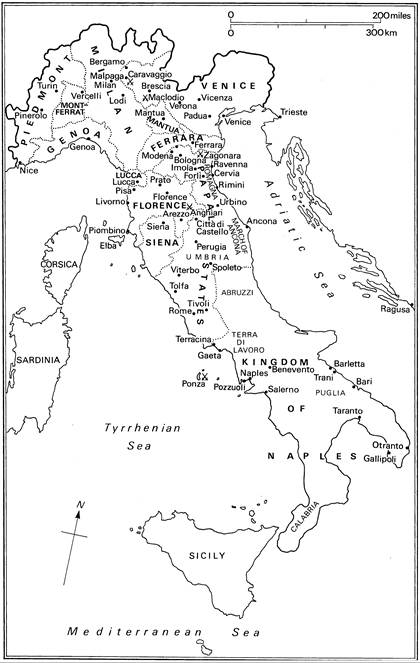
Map 11 Italy
All this suggests that too gloomy a view of the economies of the northern Italian states in the late fourteenth and early fifteenth centuries is unjustified. There was undoubtedly rising competitiveness, but this stemmed as much from the expansion of the states and of economic opportunities as it did from restraints in traditional areas.
There are, however, two further points to be made about the economic context. In the first half of the fifteenth century the Italian state system emerged with the expansion of Florence and Venice into regional states, and the establishment of the Aragonese dynasty in Naples. The extension of central control implicit in these developments created new economic strength. Florence undoubtedly benefited from the subjection to its rule of Arezzo, Prato and Pisa even if the emergence of a coherent regional economy was scarcely perceptible. The main purpose of Venetian expansion was to gain political control over the trade routes of north-eastern Italy and to encourage the flow of traffic to and from Venice on the landward side. Milan’s periodic control over Genoa drew Milanese merchants into the commercial world of the western Mediterranean. There was an inevitable drift of resources and manpower towards these new capital cities, and towards the centres of the smaller states, Turin, Mantua, Ferrara, which stimulated their economies.
At the same time it has to be said that the costs of government and of defence tended to spiral and always to outrun the resources. The real problem for fifteenth-century Italy lay not so much in reduced economic activity as in vastly increased demands on the resources available. Rising levels of taxation and borrowing, increasing expenditure on state enterprises, both military and cultural, eroded the instinctive capitalistic interests of individual entrepreneurs and distorted the economies of the Italian states. In Florence the costs of war in the first half of the fifteenth century were more than three times the normal revenue of the state. Attempts to spread this burden over the expanded state were frustrated both by the centralising tendencies in the economy and by a real lack of centralised power. There has been a tendency to exaggerate the growth of the Renaissance state in Italy in the fifteenth century. Whether they were princely states like Milan, or republican states like Venice and Florence, the Italian states lacked the resources, and indeed the will, to centralise power effectively. Compromises with localism abounded and this will be one of the main themes of this chapter.
In the early fifteenth century the hegemonic aspirations of first the Visconti and then Ladislas of Naples appeared to be the controlling factors in Italian politics. Giangaleazzo Visconti, having received the title of duke of Milan from the emperor in 1395, aimed at control of Tuscany through the subjection of Pisa, Siena and Bologna. His sudden death in 1402 brought relief to beleaguered Florence, and, together with the similar death of Ladislas in 1414 as he was pushing Angevin—Neapolitan power northwards towards Tuscany, gave the Florentines some justification for thinking that God and good fortune were on their side. A deep-rooted civic pride and republican patriotism was given a new impetus by these events and by the subsequent temporary decline of Milanese and Neapolitan power. In the duchy of Milan centrifugal forces took over; the ambitions of Giangaleazzo’s condottieri, linked to the continuing yearnings for autonomy of the Lombard cities, led to a collapse of Visconti centralisation. Giovanni Maria Visconti was just beginning to make some headway in restoring order when he was assassinated in 1412. His young brother, Filippo Maria, started a more sustained revival of Visconti authority by marrying Beatrice Tenda, the widow of his father’s most powerful condottiere, Facino Cane. At this moment the death of Ladislas led to a renewal of Angevin—Aragonese rivalry in Naples and the temporary removal of hegemonic threats from the south.
The vacuum created in northern Italy by the weakening of Visconti power provided the opportunity for Florence and Venice to expand and arm themselves more effectively against future threats. Florence’s occupation of Pisa in 1406, and subsequent extension of control of the Tuscan coastline with the purchase of Livorno from Genoa in 1421, was a key moment in the life of the Republic. Venice’s extension of its previously limited foothold in the Italian terraferma by the destruction of the Carrara signoria and the occupation of Verona, Vicenza and Padua in 1404—5, and large parts of Friuli by 1420, gave an entirely new dimension to the political and economic interests of the Serenissima. In both cases military force had been a significant factor in the expansion, although there was also a strong element of smaller communities surrendering themselves to the influence and protection of the larger states. However, more importantly, the greatly enlarged states now needed more permanent and more effective defensive systems. There was already a growing tendency in the late fourteenth century for links between the states and the mercenary captains to be strengthened and permanent nuclei of troops to be established. After 1406 Florence’s first preoccupation was the fortifications of Pisa, while Venice quickly deployed large permanent forces to defend its newly gained territories. The defence of far-flung frontiers imposed very different military, and subsequently fiscal and organisational, problems than a reliance on the walls of the city and the waters of the Venetian lagoon.
In this move towards increasingly permanent and expensive defence commitments, Venice had considerable advantage over Florence. Expenditure on permanent naval defence was already a part of Venetian government policy and the normal income of the state was substantially larger than that of Florence. But perhaps more significant was the immediate situation in the early decades of the fifteenth century, in which while in northern Italy the move towards standing military arrangements was clear-cut, in the south the opportunities for captains to secure lucrative temporary employment in the highly volatile political situation remained the dominant factor. Florence, on the frontier between north and south, found it both more difficult to retain the services of captains and easier to dispense with them, knowing that it would be possible to recruit when necessary. It was Italy from Umbria southwards which was in the third decade of the fifteenth century the battleground for the two great schools of condottieri, the Sforzeschi and Bracceschi, from which the traditions of late medieval Italian warfare grew. To the north of this line the stable military power of Milan and Venice was steadily growing.
Of the three main states of northern Italy it is Florence which has attracted most interest from historians in the first half of the fifteenth century. This is partly because of the dramatic and influential cultural changes which took place in the city, and partly because of greater dynamism and variety in the political scene than was apparent in either Milan or Venice. The two factors are not unrelated. The rapid expansion of the Florentine state to a position of dominance in Tuscany, leaving only Lucca and Siena independent, but with little prospect of territorial advancement, has already been discussed. This was undoubtedly a major factor in a growth of Florentine self-confidence and assertiveness. The successful defence of the Republic against the aggression of the ‘tyrannical’ rulers of Milan and Naples has also been identified as a source of self-congratulation and pride. But most attention has been focused on internal political and social changes which gradually transformed Florence from a factious and volatile commune into a stable and coherently directed state. Traditionally, much of the credit or, in the eyes of some, blame for this change has been allotted to the Medici family, and 1434, the year of Cosimo de’ Medici’s return from brief exile in Venice, has been seen as a turning-point. But recently the three decades before 1434 have received more careful study and the basic continuities in Florentine history now tend to be emphasised.
Florentine republicanism was edging gradually towards oligarchy in the later years of the fourteenth century. The checks to economic and demographic growth were a part of this, but it was also an acceptance of political and social realities. The regime which emerged in the aftermath of the Ciompi uprising in 1378, and the brief experiment in popular republicanism which followed it, was self-consciously oligarchic. While the republican values of liberty and wide participation in public affairs were still ostentatiously proclaimed, real power shifted towards an inner regime of some seventy senior politicians in each generation. The public offices, ranging from the Gonfalonier of Justice, the titular head of state, and his eight priors, appointed every two months by a process of drawing from bags filled with the names of eligible guildsmen (sortition), to judicial and fiscal officials dispatched throughout the expanding state, continued to be filled in the traditional way. Access to office remained a crucial part of civic life and a component of social status, alongside wealth, family connections and life style. But behind the scenes, manipulation of the lists of eligibles and the names which were actually placed in key sortition bags, increasing resort to special and carefully chosen emergency councils (balie) to make decisions on particular issues, and continuous use of a permanent body of informed experienced advisers (thepratica) as the main forum for policy discussion, all tended to stabilise power in the hands of an inner elite dominated in the early years of the century by the Albizzi family. However, this was not yet an aristocratic elite; access to it, which to some extent depended on family links and traditions, was conditioned by experience in public affairs, wealth and neighbourhood influence. The members of such a regime not only sought ways to enhance their individual status, but collectively emphasised the importance of civic and republican values in order to create loyalty to the regime in the rest of the community. Cultural projects, whether the embellishment of public buildings, the patronage of particular works of art or the encouragement of the writing of patriotic histories and literary propaganda, were of great importance in this situation. They served to transmit the self-confidence and commitment of the elite to the whole city.
A growing concern for the wider state was also reflected in new taxation proposals instituted in 1427. The Catasto was a complete survey of all households in the state in terms both of human components and wealth on the basis of which both taxes and forced loans could be applied. The emphasis was more on property than on business interests and it revealed the extent to which wealth was by this time concentrated in Florence. Two-thirds of the wealth in the state was held by Florentines who made up only one sixth of the population. The need for a more equitable taxation system had for long been a source of friction between the oligarchic regime and its critics; the wars of the late 1420s which made the new taxes necessary, and particularly the concern of the regime to continue the expansion of the state and absorb Lucca, added to the internal conflicts. At the heart of opposition to the Albizzi regime was the Medici family which, with its rapidly rising wealth, its links with the Church and papal banking, and a consciously populist attitude towards the problem of the distribution of power within the state, seemed to stand for traditional republican values. This contrast between an elitist and increasingly aristocratic tendency in Florentine society, and a strong yearning and support for a more egalitarian tradition was reflected in the cultural trends of the period. But it would be wrong to press the links between politics and culture too far. The Medici relied as much on effective manipulation of a political faction and the building up of support within the elite as they did on any popular appeal. The attempt by the regime to destroy them in 1433 failed because it was carried out inefficiently and was not ruthlessly followed up. Medici supporters were able to regroup and gain control of the key committees in the following year, and the recall of Cosimo from exile led to the creation of a more effective oligarchy.
The apparent change of direction for Venice in the early fifteenth century, with the creation of a regional state in Italy and a new commitment to mainland politics, was even greater than that for Florence. But in fact the change was less striking than it seemed; there was no sudden decline of interest in the eastern Mediterranean; the stato di mar was continuing to expand and trade with the Levant appeared to be booming in the 1420s; Venice at this stage seemed able easily to hold its own with the advancing Ottomans. On the other hand, the mainland interest was not new; the security of the river routes of Lombardy and the roads to the Alps and to Germany had been a preoccupation for more than a century. The lesson of the war of Chioggia (1378—81) was that an alliance between the commercial rival, Genoa, and increasingly powerful hinterland signori, like the Carrara, was an immense threat to both the security and the prosperity of Venice. The post-Chioggia generation of politicians, led by Carlo Zeno and Doge Michele Steno, was increasingly alert to events on the mainland and the dangers of expanding political power strangling Venice’s flimsy influence.
Thus the decisive moves westwards in 1404—5 as far as Verona, and eastwards over Friuli in 1419—20, represented the more effective application of well-established policies. Inevitably, Venetian interests switched to some extent to the new mainland horizons; a new committee of savi, the savi di terraferma, was added in 1422 to the traditional savi del consiglio and savi agli ordini who steered business through the Senate and acted, along with the doge and the ducal councillors, as the heart of Venetian government. Posts became available to Venetian patricians as captains andpodesta in mainland subject cities, and as bishops of mainland dioceses; a tendency to acquire mainland estates gradually accelerated. A factional interest within the ruling class which focused on mainland issues and international relations within Italy became apparent.
But these changes, obvious in the long run, came about slowly. Venice, while insisting on clear dominance over its new subject cities and on maintaining a distinction between the Venetian patriciate and the ruling elites of those cities, had little interest in organising the day-to-day affairs of the mainland state. The institutions of cities of Roman origin, like Padua and Verona, were quite different to those of the Venetian Republic, and much of their administration and that of their hinterlands was left in the hands of the local elites. A small number of Venetian officials became responsible for security, good order and equitable justice; the new provinces were expected to pay the costs of their own administration and defence, but not to contribute significantly to central state funds. Venice, unlike Florence, was little concerned with economic exploitation or close supervision of the new state. As a result the links between the terraferma and Venice were fewer and created less impact than might be expected.
Nevertheless Venice was not the unchanging, balanced, harmonious society portrayed in the famous ‘myth of Venice’. The myth was already well-established by the early fifteenth century, and compared to Florence Venetian society was indeed less competitive and more stable. The creation of a fixed political class through the so-called ‘serrata’ (the closing of the Great Council) started in the late thirteenth century, and the traditions of public service and the subordination of private interests to a collective good were now already well established. By 1432, 732 government posts a year were available to members of the patriciate, including membership of the main policy-making body, the Senate. The five new savi di terraferma and the new rectors of the terraferma cities were but a small proportion of these office holders. But in Venice all these appointments were elected and not drawn by lot; there was a far greater emphasis on continuity and proven experience in Venetian office holding than there was in Florence, and this created a more formal elitism.
Venice was a consciously aristocratic society headed by the doge, elected for life, whose formal authority was tightly prescribed, but whose informal influence was immeasurable. Thus, while lip-service was paid to the principles of equality, and even anonymity, within the patriciate, in practice there were marked gradations of influence, status and wealth. Deliberate avoidance of public office, vote-rigging in elections, factionalism in politics, were all part of the Venetian scene. The fact that significant political office could only be achieved by senior mature men of proven experience meant that there was always division between the older politicians and the young patricians crowding into the Great Council at the age of twenty-five or even younger. This split, known as that between giovani and vecchi, tended to emerge over almost any controversial issue, particularly in foreign policy. It was exemplified in the 1420s when Francesco Foscari (1373—1457) was elected doge at the unusually young age of forty-nine. Foscari with his commitment to terraferma affairs and intervention in Italian politics represented a faction of young politicians who rejected the conservative, cautious, defence of maritime interest, policies of the senior politicians of the time. At almost the same moment Antonio and Marin Contarini challenged another orthodoxy with their building of the flamboyant Ca’ d’Oro palace on the Grand Canal. Here was a society in which tradition was being constantly challenged in the fifteenth century as Venice was gradually drawn into the mainstream of Italian political and cultural development.
The great commercial rival of Venice in the previous centuries, Genoa, was experiencing very different fortunes in this period. To a large extent eclipsed by Venice in the struggle for dominance of eastern Mediterranean markets, the merchant families of Genoa were engaged in creating new commercial contacts in the western basin. The strong emphasis on external commerce at the expense of internal unity and growth was primarily the result of the physical and political barriers to the expansion of a Genoese state on the Ligurian coastline. The institutions of the state remained weak in the face of the great clans which dominated Genoese society and its economy. The one centralising institution, which on occasions acted almost as the state, was the Banco di S. Giorgio, a sort of super guild of merchant and banking families. But the very presence of the Banco as a focus of the economic activities of the Genoese elite seemed to impede the development of any socio-political coherence in the city, or any major role in Italian political affairs.
The second quarter of the century was dominated by wars; wars fought not so much for hegemony in Italy, as for living and breathing space. The starting-point of these wars was the recovery of Visconti power in Milan. Filippo Maria Visconti had gradually rebuilt the integrated duchy of his father. In 1421 he occupied Genoa and reclaimed Brescia from the control of Pandolfo Malatesta. He was thus in a position to challenge the mercantile powers and had moved forward to a common frontier with the new Venetian state in the centre of the Lombard plain. Filippo Maria had achieved this revival with the help of a single dominant military captain, Francesco Bussone, count of Carmagnola, and of the Milanese financiers, like the Borromeo family. Now, in 1424, like his father, he sought to extend Visconti influence south-eastwards towards Bologna and the Romagna. Florence, fearful and jealous of its own influence in the Romagna, opposed the move but was defeated at Zagonara.
The new power of Visconti Milan quickly produced an alliance of northern states to contain it. Carmagnola, dissatisfied with the rewards offered him by the suspicious Filippo Maria Visconti, turned to Venice and stimulated the already wakening concern of the Foscari regime. By the end of 1425 an anti-Visconti alliance had been forged between Venice and Florence. This was joined in the following year by the duchy of Savoy, Milan’s western neighbour, where Amadeus VIII had succeeded in creating a substantial state on both sides of the Alps by uniting Savoy and Piedmont, winning an outlet to the Mediterranean with the occupation of Nice, and gaining in 1416 the title of duke from the emperor.
The coalition proved too strong for Milan. In the wars that followed, Venice gained Brescia and Bergamo and moved its western frontiers up to the line of the Adda. Carmagnola won a crushing victory at Maclodio (1427), while Amadeus VIII, through the intervention of the emperor, secured a redrawing of his frontier with Milan to include the acquisition of Vercelli by Savoy as the price for his withdrawal from the coalition. Florence alone gained little advantage; its attempts to occupy Lucca as a preliminary to encroaching on the Milanese position in the Lunigiana were frustrated by Milanese armies coming to the aid of the little Tuscan republic. At this point there emerged the figure of Francesco Sforza who was to dominate the northern Italian scene for the next thirty-five years. Francesco was the son of Muzio Attendolo Sforza and succeeded his father as the leader of the Sforzeschi military companies. The military opportunities in northern Italy soon attracted back many of the captains who had been occupied in the south in the first half of the 1420s, and by the end of the decade Francesco Sforza had become the chief captain of Filippo Maria Visconti. To ensure his loyalty the duke offered his natural daughter and heiress, Bianca Maria, to the captain as bride, and encouraged him to create a satellite state in the Marches. With Sforza, and to a lesser extent Niccolo Piccinino who was now consistently linked to the Visconti cause, Filippo Maria had the military strength he needed to turn the tide against him. This was even more the case when, in 1432, the government of Venice lost patience with Carmagnola’s imperious ways and suspect fidelity, and executed him.
At this point much hinged on the ambitions of Francesco Sforza. His consistent loyalty to the Visconti would have secured for them military predominance and led probably to the recovery of some of the territory in Lombardy to which Milan attached so much importance. But Filippo Maria was not a man who encouraged and inspired consistent loyalty, nor was Sforza a man prepared to wait to take the political limelight. His base in the Marches gave him the possibility of intervening in central and southern Italian affairs, and left little time for furthering Milanese interests in the north. But the dramatic victory of the Genoese fleet over the Aragonese at Ponza (1435) gave a new advantage to Filippo Maria as overlord of Genoa. He used it to forge an understanding with Alfonso of Aragon linked to an alliance with Savoy. Despite the revolt of Genoa from Milanese rule which followed, Filippo Maria now seemed to be poised to reassert Milanese predominance in northern Italy. The threat reactivated the Venetian—Florentine alliance with papal support, and Francesco Sforza, fearful that a more confident Filippo Maria would repudiate his marriage agreement, joined the allies as their captain-general.
For three years (1438—41) war raged over the land between Brescia and Verona, and in the Romagna. Despite a long siege the Milanese failed to take Brescia, and with dramatic marches and counter-marches Sforza and Gattamelata were able to save Verona for Venice. A Milanese attempt to break out into the Romagna was frustrated by a Florentine-papal victory at Anghiari (1440). By 1441 Filippo Maria Visconti was ready to come to terms with his son-in-law, and the peace of Cavriana was accompanied by the formal celebration of the marriage of Sforza and Bianca Maria. But the rivalries stimulated by the disputed lands in central Lombardy, still held by Venice, and by the quest for influence in the Romagna, persisted; nor were Francesco Sforza’s suspicions of his father-in-law assuaged.
When Filippo Maria Visconti died on 13 August 1447 confusion reigned. There were persistent rumours that he had left a will bequeathing his state to Alfonso of Aragon following the understanding forged after Ponza. At the same time Francesco Sforza had in the last weeks finally rejoined Milanese service and was already on his way to Milan. Florence and Venice feared the possibility of an Aragonese take over even more than that of a Sforza succession. But at this point an alliance of Milanese aristocracy and popular feeling stood out against all the foreign influences at work and set up an Ambrosian Republic. Sforza, not wishing to impose himself by force on Milan, was content to wait, took command of the army of the Republic and defeated the Venetians at Caravaggio (1448). His patience was rewarded; the business interests in Milan soon perceived that the Republic was too weak to give the security that they needed; Cosimo de’ Medici, for similar reasons and increasingly fearful of Venetian power, finally broke the long-term alliance between Florence and Venice, and supported Sforza’s bid to claim the duchy. On 26 February 1450 Francesco Sforza was invited to enter Milan and take control.
The next four years saw a culmination of the wars which had beset Italy since the beginning of the century. The fighting itself was perhaps less intense than in some previous moments, but the implications of political confrontation and rivalry, and the costs of constant preparedness, were now fully apparent. Florence and Pope Nicholas V continued to support Francesco Sforza and his new regime in Milan; Venice and Alfonso V, now firmly established in Naples, came together as unlikely allies. Venice had opposed the Sforza take over in Milan to the end, fearing that it would inevitably lead to a more determined effort to recover the lost territories in central Lombardy. Initially, this clearly was one of Francesco Sforza’s intentions; in 1451 he succeeded in winning over Bartolomeo Colleoni, one of Venice’s leading military captains, and two years later Milanese and Florentine diplomats persuaded Charles VII to support an Angevin bid to topple the Aragonese in Naples by sending troops to Italy to help the triple alliance. Meanwhile a Neapolitan army was operating in southwest Tuscany as an indication of the new-found intentions of Alfonso V to extend his influence into northern Italy.
By 1453, however, the pace of the war was slackening and an almost universal interest in peace became apparent. Francesco Sforza had failed to persuade the Emperor Frederick III to invest him with the title of duke of Milan during his coronation journey to Rome in 1452, and this validation now became a more important objective of Sforza policy than territorial expansion. The fall of Constantinople to the Turks sent a tremor round Europe, but particularly disturbed Nicholas V and Venice who both saw peace in Italy as an essential preliminary to a Christian riposte. All the states were financially exhausted and none more so than Florence, compelled to defend itself from the Neapolitan threat from the south as well as provide subsidies for its allies. The spectre of large-scale foreign intervention in Italy was raised by the presence of French troops in Lombardy. All these factors were at work in creating the basis for at least a temporary cessation of the fighting. Peace talks started in Rome in November 1453 under the aegis of Pope Nicholas V, but it was practical realities in the spring of 1454 that actually led to peace. The potential costs of renewed mobilisation, Venetian success in once more drawing Colleoni on to its side and a real threat that Charles VII was preparing to change sides and join Venice in a dismemberment of the Milanese state led to the Peace of Lodi agreed between the northern states on 9 April 1454. Venice gained Crema and recognised Francesco Sforza as duke of Milan. The end of fighting was followed by a gradually expanding series of negotiations to organise the peace which produced, by January 1455, the so-called lega italica — the Italian League.
A territorial status quo was recognised and mutual obligations amongst the major Italian states to assist one another in the event of attack were reinforced by an endorsement of certain levels of standing military forces. Each of the powers nominated its adherents and allies amongst the minor states and lordships thus theoretically drawing them into the protective net — but at the same time clearly identifying politically dangerous overlaps in spheres of influence. The agreement was signed for twenty-five years and undoubtedly contained an element of Italian states seeking to draw together in the face of external threat — whether Ottoman or French. But the internal rivalries could not be ended so easily nor the power balance regulated so artificially.
One of the key figures in the creation of the more settled political order in Italy in the mid-1450s was Cosimo de’ Medici. By his personal financial support, and the influence which he exercised in providing Florentine diplomatic support, Cosimo had done much to ensure the success of Francesco Sforza in taking over in Milan. In doing so he created a Florentine—Milanese entente that was to last for most of the rest of the century. This in itself says much about the changes which had taken place in Florence since the heady days of the early Quattrocento; republican Florence was now firmly allied with ducal Milan.
A part of this change was the expanded Florentine state. New physical horizons meant new institutions and new responsibilities; senior Florentine politicians were likely to spend more time holding office outside the city, patronage networks widened, economic opportunities expanded and diversified. But these were adjustments that were slow to change fundamental political attitudes. The continued dominance of Florence and the Florentine political elite within the territorial state ensured that attitudes towards that state changed only slowly. The main preoccupations and interests of the elite remained focused on the political and familial life of the city itself. However, it was within that narrow political elite that expansion had its limited effect. It served, in a sense, to provide more space for the elite whether as merchants and economic entrepreneurs, as office holders, or as landowners. It enabled some to extend their personal influence; it released others of the tension of traditional rivalries and suspicions; it provided a new identity of interest for the Florentine elite.
At the same time real changes were taking place within Florentine society as a whole. Florence was no longer a boom city; there were plenty of opportunities for economic success but they lay in the production of high-quality wool and silk cloth with a limited and skilled workforce and heavy investment of capital in raw materials and unsold products, and in the careful calculation of risk in the economic and financial fields. Large-scale immigration was discouraged from the 1380s onwards; social mobility tended to decline; respect for wealth became increasingly respect for old, established wealth; a commitment to participate in public affairs had become a major component of social status, but increasingly it was high political office and major cultural benefactions that gained esteem. The gaps between social groups were widening, the barriers rising; dowry inflation was both contributing to and resulting from this situation. In brief, the elitist trend in Florence was accelerating through the middle years of the century; and this is the background to the growing ascendancy of the Medici.
The other fundamental factor which conditioned the style of Florentine politics by the mid-fifteenth century was the general acceptance by the political class of the need for greater continuity and greater expertise in the conduct of public affairs. The expanded state, the growing role of fiscalism, the pressures of external relations, all pointed in this direction. A greater emphasis on secrecy, smaller and more informal councils, the continuous presence of experienced politicians at the heart of the regime, were the signs of an inevitable change of political style. They fostered oligarchy as well as being instruments of oligarchy. Continuity of leadership was an essential part of this pattern of development.
From the moment of his return from exile in 1434 Cosimo de’ Medici became the acknowledged leader of the regime. The exiling of more than seventy political opponents stifled faction and a relatively coherent oligarchy was able, in a time of prolonged external crisis in the 1430s and 1440s, to exploit already time-honoured devices for the focusing of political authority within an apparently republican system. Distortion of the traditional constitutional practices took two main forms. On the one hand the initial scrutiny and sortition processes which qualified citizens for public office and distributed office were subjected to much closer control by permanent accoppiatori whose role it was not only to ensure that the names of the politically suspect were excluded, but that high offices were filled, when necessary, by appropriately qualified candidates. The other device employed was extensive use of the traditional mechanism of creating a specially selected council with wide powers (balia) to deal with an emergency situation. The war years between 1434 and 1454 were dominated by government by balia, and the membership of the inner political elite can be confidently defined by examining the lists of the successive balie that were created in these years. When, after 1454, political emergency could no longer be used to justify the balie, the regime turned to the creation of new permanent councils, the Council of One Hundred in 1458 and the Council of Seventy in 1480, to provide the same cores of assured support within a formal constitutional framework. The Council of Seventy with its membership for a five-year term, renewable, and its powerful sub-committees for external and domestic affairs, represented a complete absorption of oligarchic trends into constitutional forms.
The northern Italian states
The role of the successive heads of the Medici family in these constitutional developments remains a matter of debate. It has been argued that Cosimo, Piero and Lorenzo de’ Medici were aiming at establishing the family permanently at the heart of Florentine politics and society and were engaged in preparing the way for princely power; that the constitutional changes were engineered by them personally for this purpose; and that any sense of unanimity and collaboration that emerged was with a Medici faction rather than a Florentine elite. On the other hand it can be suggested that Medici ascendancy in the fifteenth century was essentially an alliance between the family and a reasonably broad cross-section of the Florentine elite; that, for example, the Council of Seventy was not just a caucus of Medici sycophants but a real expression of oligarchic solidarity; and that Medici influence depended more on a wide range of patronal activity than on specific political mechanisms. Cosimo de’ Medici was clearly accepted as the first among equals by a generation of experienced politicians who had grown up with him and shared the difficult years of the 1430s and 1440s. Lorenzo, on the other hand, succeeded to leadership of the family as a man of twenty surrounded by the leaders of his grandfather’s generation. That he was able to establish a precedence and authority which seemed to exceed that of Cosimo was perhaps as much due to the changing nature of the times as it was to his own undoubted skills and personality. In a world increasingly dominated by princes, Lorenzo was bound to be seen by some as a prince and to behave in some respects like a prince; but it is the restraints imposed on this tendency both by the circumstances of Florence and by his own political intelligence which are the more interesting phenomena.
The social transitions taking place in Florence in the second half of the fifteenth century were not peculiar to that city. Throughout northern and central Italy the same tendency towards elitism was apparent. To some extent this was a question of expanded frontiers and consolidation of power, but much criticism has been levelled, in recent years, at the idea of the ‘Renaissance state’ in Italy as a centralising construct. The example of Milan under the Sforza dukes has been much explored. Here the focus on Milan as a capital city undoubtedly increased in the second half of the fifteenth century; new public buildings, powerful ducal officials such as Cicco Simonetta, refurbished constitutional mechanisms like the consiglio segreto, all seemed to reflect the growing authority of the duke and at the same time the essential alliance between the dukes and a Milanese elite. But in reality ducal power was not just a matter of the creation of central facilities and mechanisms; it depended on a series of compromises with persistent traditions of local self-government. Ducal decree did normally take precedence over municipal statute but usually after a process of negotiation; the duke did appoint the podesta in Lombard cities, but his choice was usually a local magnate; new taxes and new tax levels were decreed in Milan, but the ultimate distribution of the fiscal burden was decided at local level based on local custom and local knowledge. The authority of the duke depended on creating alliances and loyalties throughout the state. Many ducal officials came from outside Milan, the old feudatories were crucial allies and a process of refeudalisation helped to widen the circle of the elite. The new feudalism did not carry the overtones of judicial and jurisdictional authority associated with traditional forms, but it conferred wealth through lands and local influence on favoured condottieri, bureaucrats and merchant bankers. It was part of a clientage network which was an essential feature of princely rule in fifteenth-century Italy.
Similar reservations have to be expressed about the authority of the dukes of Savoy and other princes in this period. The duchy of Savoy, divided as it was by the Alps into westward-facing Savoy and eastward-facing Piedmont, presented particular problems of control. The dukes deliberately refrained from establishing a fixed capital, moving their court when seasonally possible between Chambery, Thonon, Pinerolo and Turin after it had been inherited from the Acaia branch of the family in 1418. The death of Amadeus VIII in 1451, followed as it was by a succession of less effective and more short-lived reigns, led to a period of stasis in the development of ducal authority. Local privilege and the authority of traditional elites were given a prolonged reprieve. The smaller princely states like Mantua and Ferrara were somewhat different cases. Here the ruling families of the Gonzaga and the Este were becoming gradually more entrenched and accepted. Giovan Francesco Gonzaga acquired the imperial title of marquis of Mantua in 1433, and his successors in the sixteenth century became dukes. Borso d’Este was made duke of Modena by Frederick III in 1452, and gained the title of duke of Ferrara from the pope in 1471. These were important confirmations of authority, but the true basis of the authority lay in the creation of an effective and supportive elite, in a reasonable regard for a wider public opinion and the principles of good government, and in maintaining substantial wealth, as much through military contracts and landed income as through taxes. The court became the focus of power in these small states, but the emphasis was on real power exercised collectively rather than on the much-publicised authority of the prince.
In Venice the principles of collective responsibility and the sharing of power within a relatively narrow political elite were well established and the constitution had evolved in this direction. Nevertheless, by the mid-fifteenth century the pressures for a narrowing of the elite and for more effective and confidential decision-making processes were also apparent here. A gradual widening of the competence of the Council of Ten to include foreign policy and defence issues, and a growing emphasis on the day-to-day running of affairs by the collegio, were characteristic of the second half of the century. The doge was a member of both these groups, but so were the six ducal councillors, elected from among the most senior politicians in the city. Personal influence becomes more effective in a smaller caucus and it increasingly becomes possible to attribute policies and decisions to the influence of particular individuals, as with Francesco Foscari and terraferma expansion, Cristoforo Moro and the war with the Turks (1463—79), Francesco Michiel and the war of Ferrara (1482—4). Two of these were doges, Michiel was never more than a savio di terraferma. But despite these glimpses of personal political roles, the system continued to function as a collective one, even if an inner political elite was gradually identifying itself.
The political tendencies of this period were reflected in the life styles and culture of the new elites. Leisure and the pursuits of leisure became a major preoccupation of men who had already detached themselves sufficiently from professional or commercial activity to take on the greater commitment to public affairs. Country living, villas and villeggiatura played a growing role in this life style. For the Florentine elite the maintenance of a country property had always been a significant part of the way of life. However, in the second half of the fifteenth century the villa became not just a simple place for summer retreat and a source of cheap provisions, but an object of pride and prestige, a place of entertainment and a focus of political influence. Horses, hunting dogs, falcons and even prize herds of cattle became objects of everyday concern and a part of elite iconography. The rebuilding and decoration of villas increasingly occupied the time of architects and artists. It became necessary for the busy politician to have not only a country villa, but also a second property close to the city for weekend enjoyment. Ambassadors in Florence began to bemoan the fact that political decisions were delayed by the absence of all the key committee members at their villas. But this was as much a reflection of a new urgency in decision making as of a changing life style of the elite.
For the Venetian elite such a trend was a novelty, only beginning in this period. But in a sense the Venetian political class had less need of a distinctive life style; membership of the Great Council was by now the traditional mark of distinction, but the emergence of elitist trends within the patriciate was beginning to encourage new cultural traits.
It has been argued that the social and political trends of the second half of the fifteenth century encouraged a switch of intellectual interest away from the societal ideas of early humanism, heavily influenced by Aristotle, towards the more introverted, individualistic emphases of Platonism. While there is a hint of this in the intellectual enthusiasms of the circle who met around Marsilio Ficino in Florence, it is not an idea that should be pressed too far. What distinguished the elites of the later fifteenth century was a growing respect for and involvement in learning and humanistic interests of all sorts, in building up libraries, in sponsoring editions of classical texts and the work of early printers, in philosophical debate. Humanism was ceasing to be an avant-garde movement in the strictest sense of the word, and becoming the emblem of the political and social elites. It moved to court and into the universities; it pervaded the programmes of the new fresco cycles of villas and palaces. Those fresco cycles themselves became representations of an increasingly narrow social world; Botticelli’s banquet scenes and nativities, the court cycles of Mantegna and Cossa, the processions and miracles of Gentile Bellini and Carpaccio, all focus on an elite society.
The corollary to this emergence of class and cultural division within the individual societies of Renaissance Italy was a tendency for the elites to seek links with each other. Exiled members of a ruling elite were welcomed in neighbouring states; intermarriage became more common; lists of godparents of children of the elites reflected a growing Italian emphasis. Travel became a more frequent feature of the life style of the elites, and this was in large part due to a dramatic increase in diplomatic activity in the second half of the fifteenth century. As external affairs played an expanding role in political debate, diplomatic experience and external personal contacts became of crucial importance to aspiring politicians. Information, exchanged through letters and dispatches, was becoming a much-valued commodity and the gathering of it a main function of the burgeoning clientage networks. Led by humanist chancellors and secretaries, the emphasis of rhetoric switched from oratory to correspondence as the audience became more extensive and dispersed.
The years 1454 to 1494 have often been described as the period of the ‘balance of power’. Insofar as this title suggests that external affairs were the main preoccupation of the Italian states it still has some validity. It was not the constructive balance conferred by the Italian league and the far-sighted efforts of a few Italian political leaders, which has sometimes been suggested. Nor was it a balance which seemed to be leading towards greater unity of interest and purpose amongst the states. There were contemporaries who spoke of the need for a single leader in Italy as did the Florentine politician and diplomat Angelo Acciaiuoli in a letter to Francesco Sforza in 1447: ‘I have said to you on other occasions that it was necessary for you to create a signore in Italy who would be powerful enough to protect you from all others.’ But there was little chance of any such unity; harmony and serenity were not the keynotes of the period, but rather suspicion, self-interest and opportunism. The need for balance, for some degree of mutual support and protection, for caution, was accepted by all the Italian states, crippled by the long wars and fearful of the growing strength of external powers. But this acceptance was reflected in the emergence of a series of opposed and balanced leagues rather than in any long-term adherence to the concept of a general Italian League.
The rising pressures from outside Italy were obvious. Following the fall of Constantinople (1453) an expansion westwards of Ottoman power under Mehemmed the Conqueror seemed inevitable. Venice fought a lonely war for sixteen years (1463—79) to protect its empire and its trading interests. Negropont, and many lives and ships, were lost; attempts to hold back the advancing Turks in Dalmatia and the Morea largely failed; Turkish horsemen invaded Friuli and ravaged the countryside to within sight from the bell towers of Venice itself. In 1480 the blow fell on Otranto and it was the turn of Naples to suffer. The death of the great sultan in the following year did, indeed, relieve the pressure, but not the fear.
Meanwhile the end of the Hundred Years War (1453) led to a renewal of French interest in Italy. In 1458 Charles VII won the support of the Genoese and established his lieutenant in the city. He actively promoted Angevin claims to Naples and Orleanist claims to Milan. The style of Louis XI was somewhat different; he had little time for the ambitions of his princely subjects and preferred to advance his own role as broker and arbiter in Italian politics. He surrounded himself with expert advisers on Italian affairs and with fawning diplomats from the Italian states. French ambassadors intervened, often in a peremptory manner, in every Italian crisis.
These pressures did little to create unity in Italy. Venice and Naples shared an apprehension about the Turks — but little else. Venice’s problems in the eastern Mediterranean were seen by the other Italian states as a merciful diversion of feared resources. Milan and Naples shared a fear of French intervention and a suspicion of French motives, but Angevin and Orleanist claims were rarely concerted in this period. Florence and the Papacy, on the other hand, tended to be pro-French, as did Venice. All were prepared to intrigue with France in their own interests, or indeed intrigue with Charles the Bold of Burgundy in order to divert French attention. Meanwhile, a Spanish interest in the affairs of the peninsula gradually revived with the union of the Spanish crowns and the active European policies of Ferdinand of Aragon.
Nevertheless, the crux of continued Italian disunity lay within the states themselves. For the new Sforza dynasty in Milan the key issues were achievement of imperial recognition and consolidation of the regime within the duchy. Frederick III’s determination to withhold recognition from Francesco Sforza and his successors was a last flicker of active imperial interest in Italy, and it contributed to the continued instability of the Sforza. The duchy, which could have been the solid bulwark against French intervention and the leader of a strong and permanent coalition against possible Venetian imperialism, was riven with uncertainty. The Sforza dukes focused on the local issues: control of Genoa, won at huge cost in 1461 and lost again in 1478; superiority over Savoy, won with the exclusion of the latter from the Italian League in 1454, but lost in 1468, when Venice insisted on Savoy’s inclusion in the renewal of the League; intrigue along the southern frontiers, in the Lunigiana, in Bologna and in the Romagna. These were all issues which created suspicion and enmity in Italy. The Aragonese kings of Naples resented and feared Milanese control of Genoa; the Florentines contested Milanese pretensions in the Lunigiana and the Romagna; Venice was suspicious and alert. But Venice remained largely on the defensive throughout this period. Its preoccupation lay with the advance of the Turks, with its eastern Mediterranean empire and the routes of trade and food supplies, and to a lesser extent with its relations with the Austrians and Hungarians beyond the Alps. As long as Bartolomeo Colleoni held sway as permanent captain-general in his base at Malpaga there was little to fear from Milan, but the Po routes, Ferrara and the Romagna remained of great interest to Venice. Ravenna was already in its hands and the acquisition of the salt pans of Cervia in 1463 added to the fears of its neighbours and the confidence of some of its politicians.
Florence, militarily the weakest of the major Italian states, depended more than any other on peace and the support of alliances. It shared a long frontier with the papal states and this generated a particular suspicion of the temporal aspirations of popes and their nepots. It depended largely on alliance with Milan for its military security and the maintenance of the Medici regime. A growing subservience to France and an erratic hostility to Venice were the results of policies which were largely aimed at preserving commercial prosperity.
At this point the analysis requires that the two halves of Italy should be brought together. The general Italian League did at first serve most interests. Following the temporary aberration of Calixtus III’s attempt to overthrow the Aragonese dynasty in Naples, Pius II, Francesco Sforza and Cosimo de’ Medici worked to maintain that dynasty against its Angevin rivals. But by the mid-1460s and ‘succession’ crises in both Florence and Milan, it was becoming apparent that the natural alliance systems were Milan, Florence and Naples on one side, and Venice and the Papacy on the other. This created the natural counterbalance to Venetian strength and papal instability, although the Milan—Florence—Naples axis was also subject to considerable internal tensions and suspicions. There was a major realignment in 1474 when Florentine suspicions of Sixtus IV’s policies were fuelled by Neapolitan support for the pope’s eviction of Niccolo Vitelli from Citta di Castello. This, together with Venice’s urgent need of help against the Turks, led to a league of the northern powers and eventually to the alignments of the Pazzi War (1478—80). In this war Florence was largely defended against papal—Neapolitan attack by Milanese and Venetian troops. But the tensions in the alliance were very apparent and in late 1479 Milan and Florence were looking for peace without any reference to Venice. Similarly King Ferrante of Naples was seeking to distance himself again from the pope who opposed the growing Neapolitan influence in southern Tuscany, one of the main results of the war. This was the background to Lorenzo de’ Medici’s famous journey to Naples which culminated in peace and a new alliance system along the, by now, traditional lines.
The Milan—Florence—Naples axis survived for the remainder of this period. It succeeded in halting Venice’s attack on Ferrara (1482—4), aided by a volte-face on the part of Sixtus IV who abandoned his alliance with Venice in the face of pressure from the axis and from Ferdinand of Aragon. It was successful in preventing the overthrow of the Aragonese dynasty in Naples by the revolt of the Neapolitan barons, supported by the pope (1485—6).
One of the causes of the more settled political atmosphere in Italy by the second half of the 1480s was the ascendancy which Lorenzo de’ Medici succeeded in establishing over Innocent VIII, with the marriage of his daughter Maddalena, to the pope’s son, Franceschetto Cibo, and the elevation of his son, Giovanni, to the cardinalate. The new prestige and influence which Lorenzo personally derived from this entente, and the new political alignment of four of the five major Italian powers, gave these last years before 1492, and the deaths of both Lorenzo and Innocent VIII in that year, the appearance of serenity and prosperity so persuasively argued by Guicciardini in the opening chapters of his Stoma d’ltalia.
But it was not just the appearance of external solidarity that was misleading in the 1490s. By this time many of the regimes themselves were in difficulties. To talk of rising popular unrest is always a difficult generalisation to sustain, particularly when more efficient policing was one of the policies of the oligarchic regimes and this in itself both constrained unrest and further identified it. But in Florence and Venice in particular there is clear evidence of a sort of political disillusionment with oligarchy, a yearning for the more traditional, open politics. This manifested itself to some extent in political debate, but more clearly in private correspondence, diaries and memoirs. An undercurrent of resentment of the Medici regime and of the growing authority of the Council of Ten in Venice can be clearly charted although it had relatively little impact on the surface of politics.
What was more apparent, and not always easy to separate from anti-oligarchic feelings, was the resentment of traditional elite groups excluded from the new regimes. The position of Ludovico Sforza, despite his growing authority as regent for his nephew, Giangaleazzo, after 1480, was threatened not just by the traditionally anti-Sforza Milanese Guelphs, but increasingly by leading Ghibelline magnates on whose support Ludovico had relied. The estrangement of a figure like Gian Giacomo Trivulzio was an indication of the increasingly personal nature of the Sforza regime and its consequent fragility. The example of the Neapolitan barons, in outright revolt in 1485 because of heavy tax burdens and exclusion from involvement in government, is the most obvious one of this phenomenon.
Exile was the standard solution to such problems, and this was frequently employed by the regimes of the later years of the century. Fieschi and Adorno exiles from Genoa, Noveschi exiles from Siena, Sanseverino exiles from Naples, Acciaiuoli exiles from Florence, plotted and intrigued against the regimes which had ousted them, creating internal tensions as well as external pressures. The concentration of Neapolitan exiles in France by the late 1480s when the new king of France, Charles VIII, had inherited the Angevin claims, was particularly ominous.
Such opposition would have been a good deal less dangerous had the regimes been stronger in financial terms. But the 1480s were difficult, if not hard, times. The Pazzi War and the War of Ferrara left considerable legacies of debt. King Ferrante of Naples owed huge sums to Florentine bankers, and Italian banking as a whole was in difficulties in this decade. The trading conditions on which banking depended were unfavourable; a decline in the supply of English wool because of restraints imposed by the English crown on exports unbalanced the trade with the north, while the growth of Turkish naval power undoubtedly threatened east Mediterranean trading interests. Florence abandoned its attempts to run a state monopoly galley system in 1480 and enthusiasm in Venice for the trade of the galleys was beginning to decline. At the same time there seemed to be an increase in rural poverty as population and prices rose, and wealth moved towards the towns. These trends had little to do with any ongoing ‘economic depression of the Renaissance’; they were associated with overall growth in economic activity and rising competition.
But the real problem was less economic constraint than the inability of Italian regimes to contemplate the large-scale taxation necessary to give them financial stability. With relatively little progress made towards the internal organisation and cohesion of the northern Italian states, a high tax policy was both impractical and dangerous. With wealth moving towards the major cities and the hands of the elites, loans, even forced loans, were a more acceptable recourse than taxation, and governments weakly bowed to this postponement of the problem. Fiscal policy therefore inevitably exacerbated social antagonisms and further discouraged the growth of any real unity in the states.
There was also evidence of rising religious and spiritual ferment in northern Italy. This was particularly apparent in Florence where a lay piety trend linked up with dislike of the increasingly ostentatious life style of the Medici elite and a resentment of the spiritual failings of the Church. Anti-papalism and anticlericalism also gathered strength in Florence at this time because of the long political confrontation with Sixtus IV. Inevitably the Church in country areas suffered from being associated with the central regime of the state, as Florentine, Venetian and Sforza bishops assumed diocesan responsibilities over the subject areas.
Much has been written about the French invasion of 1494 and the subsequent ‘crisis of Italy’. Enough has been said already to indicate that neither the invasion nor the ‘crisis’ were entirely unpredictable. Certainly the deaths of Lorenzo de’ Medici in April, 1492, Innocent VIII later in the same summer and King Ferrante of Naples in early 1494 had their consequences. Mutual suspicions within the main Italian League noticeably hardened as Naples and Florence intrigued against the new pope, Alexander VI, whose election had been supported by Milan and whose natural affiliations lay with Spain. Ludovico Sforza’s clear intention permanently to dispossess Giangaleazzo and his Neapolitan bride, Isabella, the grand-daughter of King Ferrante, made collaboration between Milan and Naples increasingly unlikely as her father succeeded her grandfather on the throne. Piero de’ Medici inherited a new and dangerous situation which would have been beyond the political skills of his father to control.
But Charles VIII’s decision to invade Italy was not primarily the result of appeals by Italian princes, or even of a perception of the disunity of Italy; it was part of an emerging power struggle in Europe. Nor was the striking and immediate success of the invasion the result of crushing military strength on one side or anachronistic and effete soldiery on the other. The Italian states had indeed learnt to rely too much on diplomacy in the years since 1454, but their armies were large and well equipped. There was, of course, no general Italian League ready to oppose Charles VIII but that was no longer even a gleam in the eyes of Italian politicians. More immediate and damaging were the profound divisions within the existing alliance system, and particularly the complete breach between Milan and Naples. However, the real failure, and indeed the real crisis for Italy, was the failure to create effective centralised states with coherent elites and a will to survive. It is striking that the efforts of Italian diplomats, politicians and soldiers were undermined by the surrender of key subject cities like Pisa in 1494 and Verona in 1509, and betrayal by factions and individuals of the elites. While many of the essential mechanisms of state building and interstate relations had been developed in Italy in the fifteenth century, the development of harmonious societies for those states had been compromised and neglected.