
10
Agincourt was the high-water mark of English military supremacy. England possessed a mobile army of professional soldiers who dismounted to fight on foot supported by longbowmen and were commanded by an experienced and capable officer class; the combination had proved unbeatable. Furthermore, with a popular and successful king, there was little incentive for internal strife or rebellion, and there was a parliament that was happy to fund English ambitions. If only Henry had lived.
As it was, Henry’s crossing to Dover on 16 November 1415 took all day – the weather was appalling and the chroniclers remark on his immunity to sea-sickness. From Dover he went to Barham, then to Canterbury, on to Eltham and eventually, on 23 November, to London. The citizens of London, and indeed of the realm as a whole, had heard nothing after the siege of Harfleur; they knew that the army was heading for Calais, but that was all and rumours of disaster and defeat abounded. When on 29 October the news of the great victory of Agincourt reached London and was carried to all parts of the kingdom by heralds on fast horses, joy knew no bounds. The king’s welcome by the Londoners was rapturous: he was escorted into the city from Blackheath, the streets were hung with flags and bunting, the mayor and aldermen paraded in full fig, as did the clergy and the city guilds; and on London Bridge he was greeted by a troupe of dancing virgins while the common people lined the route and cheered.
Agincourt was a great boost to English prestige and it terrified the French, who, for the time being at least, would avoid facing the English in open battle, preferring instead to lock themselves up in castles and fortified towns. It was not, however, a great strategic, as opposed to tactical, victory. Had the English army been larger, it could have struck for Paris immediately after Agincourt and won the war, but a professional army is necessarily a small army, and the huge disparity in populations meant that, to have any realistic chance of subduing the whole of France, Henry would need to find allies. In the meantime, the French had appointed Bernard of Armagnac as constable of France in succession to Charles d’Albret, who had been killed at Agincourt, while in the same year the ineffectual dauphin Louis died, to be replaced as heir apparent by his almost as ineffectual brother, Jean of Tourraine.
Henry spent most of 1416 in England while the French attempted to regain Harfleur. They managed to ambush a foraging party under the captain of Harfleur, Thomas Beaufort himself, and very nearly captured him, but were finally beaten off near the outskirts of the town. Meanwhile, peace negotiations dragged on, with both the Holy Roman Emperor and the count of Hainault attempting to mediate. The emperor, the German Sigismund, was trying to finally heal the schism in the church: the existence of two popes, each supported by different warring factions, made mediation by the Holy See impracticable. If he could broker a peace between England and France, then together they could resolve which pope was the legitimate one. Sigismund arrived in England in April 1416, to be sharply reminded on landing by Humphrey, duke of Gloucester – the brother of the king who, having recovered from his near-death experience at Agincourt, was even more xenophobic than most Englishmen – that the imperial writ did not run in England. Sigismund tried to arrange a meeting at Calais between Henry V and the new dauphin, but the new constable of France convinced his master that he could defeat the English and the meeting never happened. In the end, Sigismund realized that he could not achieve peace between England and France – the French would not offer more and Henry would not demand less. He seems to have broadly accepted the merits of Henry’s claims, and in August the emperor and the king signed the Treaty of Canterbury, which, while giving England little of significance, did further isolate France.
As Sigismund was deliberating with Henry and his council in England, the French made another attempt to recapture Harfleur, by blockading the port with their fleet. On 15 August, John, duke of Bedford, another brother of the king, set sail with a relieving army said to number around 4,000 archers and 3,000 men-at-arms. The troops were transported mainly in balingers – small, single-masted and square-rigged boats of around 100 tons, equipped with oars for inshore work and able to carry forty soldiers – and probably two or three carracks, the ocean-going ancestors of the galleon, each with three or four masts and high platforms front and rear, and able to carry 200 or so men. The chronicles say that Bedford had 100 ships and, if three of them were carracks, then the size of the army would probably have been around 5,000. As this was going to be a sea battle, the ratio of archers to men-at-arms was less than it would be on land, as what was needed was men to board and fight hand to hand, with less reliance on missile support. The French had obviously forgotten the lessons of Sluys (which had admittedly been fought a long time ago): although outnumbered, had they come out to sea, the greater manoeuvrability of their galleys might have given them a fighting chance, or at least allowed them to withdraw unmolested. But, as it was, they stayed in the mouth of the Seine and allowed the English fleet to close. Once the grappling irons had pulled the ships together, the French had no chance: the English men-at-arms stormed aboard and the massacre began. The French were said to have lost around 1,500 men killed, the English less than half that. The remnants of the French fleet fled across the estuary to Honfleur, where shoals and sandbanks prevented the English from following.
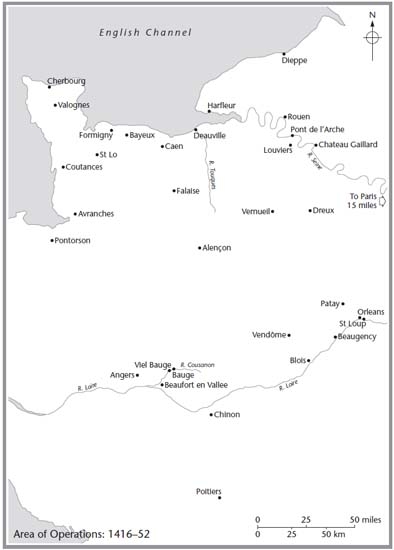
In November 1416, Parliament met and agreed with the king that another expedition would be necessary to force the French to see justice. This time Henry would subdue France piece by piece, beginning with Normandy. The money was voted, taxes imposed, loans raised, and in the spring of 1417 recruiting of soldiers and impressment of ships began. Henry was well aware that after Agincourt no French army would face him in open field. If he was to bring Normandy back to its true allegiance, he would have to do it by capturing the cities, and that meant large quantities of siege engines and cannon with the requisite ammunition. Cannon-balls were still mostly of stone, but a primitive form of incendiary shell had been developed consisting of a hollow iron ball stuffed with tow soaked in pitch.
In June 1417, the earl of Huntingdon was despatched with a naval squadron to chase off some Genoese ships in French service based in Honfleur. Once he had sunk, captured or caused them to flee, the main army of around 10,000 all ranks, in the rough proportion of three archers to one man-at-arms, embarked at Southampton on 30 July and landed at the mouth of the River Touques, just north of Deauville, on 2 August. Progress was swift and Henry was aided by a resurgence of civil war between the Armagnac and Burgundian factions. The Armagnacs, supporting the dauphin, would not treat with England, but Jean the Fearless, duke of Burgundy, was ambivalent: he would not openly side with Henry but he would not attack him either, unless it looked as if his interests were threatened. From the bridgehead at Touques, the English navy ferried men, stores and siege engines along the coast and up the River Orne, and the siege of Caen began in mid-August 1417.
Long sieges did not suit the English way of waging war. England relied on mobile, rapidly moving armies that could march out of trouble if faced by far larger but ponderous enemies, and in any case being static for long periods attracted sickness. English siege commanders cut corners – they had to – and, as soon as there seemed to be the slightest chance of success, they tended to order an assault, always assuming that the garrison could not be persuaded to surrender first. After blocking all routes in and out of Caen and bombarding the city, the English army assaulted over the walls on 4 September. Then began the usual horror suffered by a civilian population in a town stormed by English soldiers, as the men, fired up by the lust of battle and the adrenalin of the attack, took revenge for the dangers they faced and the death of their comrades on anyone who was foolish enough to be on the streets. If there was nobody on the streets to rape, plunder and kill, then the houses were broken into and anything movable was appropriated and anyone resisting (and many who were not) slaughtered. The garrison had evacuated the town and taken refuge in the citadel and, once the English army had been brought under control once more, that too was invested. On 21 September, the garrison, bereft of any hope of help from Paris, surrendered.
There was always a problem with English soldiers, who, once they had stormed a town, saw plunder and rapine as their right. As, however, Henry maintained that the citizens of France were his subjects, he had no wish to make war upon them. Those citizens who resisted, on the other hand, could be considered traitors and dealt with accordingly, and that formed the basis of some sort of excuse, albeit a rather feeble one, for the treatment meted out to civilians. The fate of Caen was, however, salutary: other towns smaller or less well fortified drew the obvious inference and surrendered before they were invested. By November, a wide swathe of territory between Verneuil and Alençon had been taken; in the middle of the month, the dukes of Brittany, Anjou and Maine signed a treaty of neutrality with Henry, to last for ten months. Falaise, the well-fortified birthplace of the Conqueror, held out but fell after a three-month siege on 16 February 1418. By the end of March, Bayeux, St Lô, Coutances, Avranches and Pontorson had either surrendered or been captured, and Cherbourg, at the end of the Cotentin peninsula, capitulated after a five-month siege on 27 September. During all this time, the Armagnacs were far too busy with the Burgundians to offer any respite to their embattled and besieged compatriots, while Henry studiously avoided any provocation to the duke of Burgundy and was careful not to appear to be threatening Paris, which was held by the Armagnacs but coveted by the Burgundians.
In June 1418, Louviers fell, a siege personally supervised by the king himself, and as a cannon-ball from the defenders had gone right through the royal tent, the gun crew responsible were duly hanged. The capital of Normandy, Rouen, still held out. It was not only a political objective but also an enormously rich town which housed the main French shipyards, and, although mastery at sea was now firmly in the hands of the English, it was important to keep it so and this meant the capture or destruction of the yards. In late July, Henry took Pont-de-l’Arche, just upstream of Rouen, and established an outpost there with a huge chain stretched across the river. With the English already controlling the mouth of the Seine, this meant that Rouen was cut off from any relief by water. The town was the strongest yet tackled by the English: the walls were five miles in circumference, the gates were well fortified by barbicans in good repair, and there were towers housing cannon at regular intervals. The garrison, said to be 4,000 men-at-arms – probably a lot less but still a very powerful force – was commanded by Guy Le Boutellier, an experienced and determined soldier. Well aware of what was happening in the rest of Normandy, he had ample time to prepare the city for a siege. He had levelled the suburbs outside the wall to offer no cover for the besiegers, the ditch around the walls had been deepened and the excavated earth used to construct a bank along the inside of the walls to absorb the shock of cannon fire, and rations and water had been stockpiled. So confident was he of holding out that refugees from all over Normandy had been allowed in, and many of the civilian population had been armed with crossbows.
By now, the English were expert at siege-craft, even if they would much rather not get tied down in doing it. The king’s army surrounded the city with the siege lines divided into sectors, seven on the northern side of the river and one on the south, each commanded by a senior officer. Four main redoubts were dug and connected by trenches, and the English engineers threw a pontoon bridge across the river downstream. All routes in and out were cut off and the bombardment began. Le Boutellier was confident that, even if he could not be relieved by river, an army from Paris would surely move across country to his aid. Unfortunately for him, nobody in Paris was in the slightest bit interested in his plight, or, if they were, they were unable to do anything about it. In 1417, Dauphin Jean had died, to be replaced by another, as yet unprepossessing, brother Charles. There was still no strong single central authority, and, in 1418, the Burgundians had managed to spark off a popular uprising in Paris that threw out the Armagnacs and lynched the new constable. The French chroniclers say that by the autumn the occupants of Rouen were reduced to eating horses,96 and, when these were all gone, dogs and cats, followed by rats, were next.
Those who had previously sought refuge in the city were now considered useless mouths, and several hundred men, women and children, already half-starved, were expelled. King Henry would not allow them to pass through his lines, nor would he provide them with food – as he rightly said, ‘I did not put them there’ – although he did relent on Christmas Day 1418, when he sent one day’s rations into no-man’s-land. The expulsion of the non-effectives in order to make the rations stretch a little further was too late, however, and, on 31 December, a group of French knights appeared on the battlements asking for parley. Henry kept them waiting, but, on 2 January, negotiations were opened and the garrison commander agreed that, if no relief force appeared by 19 January, then he would surrender the city and accept the English terms – which were surprisingly generous. Although an indemnity of 300,000 crowns (£50,000) was to be paid, the garrison could march out to safety, without their weapons and having sworn not to take up arms against the English for one year, and civilians who took an oath of allegiance to Henry would not have their houses or property plundered. No relief force appeared, nor was there any likelihood of one, and so the city of Rouen passed into English hands. Henry spent two months repairing the damage and then continued the subjugation of the rest of Normandy. By the end of the year 1419, the whole of the duchy was once more in English hands.
The military conquest of Normandy was only the first step in reestablishing sovereignty there, and Henry was assiduous in setting up an administration to govern it and make it self-supporting as far as possible. Normans who would not swear allegiance had their lands confiscated and awarded to Englishmen, but those loyal to the English cause were kept on as wardens, bailiffs and justices. In general, the most senior appointments went to Englishmen, but otherwise the existing civil service, such as it was, was re-employed. Normans who took the oath could, for a payment of tenpence (£0.04), be given a certificate which was supposed to protect them from molestation by English patrols or checkpoints. As with Calais, Henry wanted to encourage English settlers, and several thousand, mainly of the minor gentry or the merchant classes, would migrate to Normandy in the years to come. Many of them married Norman girls and over the centuries became absorbed into the native population, and, while some of their descendants are still there today, with names rendered into French approximations, any sense of Englishness has long gone. While not all of Normandy welcomed English rule, and the taxes levied to make the duchy independent of English subsidy were much heavier than those imposed before (or perhaps were collected more efficiently), there was surprisingly little resistance. A few brigands led by dispossessed Frenchmen hid in the woods, and were duly hanged when caught, but the Norman bureaucrats stayed loyal and the English garrison left in Normandy was tiny – had the English presence been unpopular, an uprising could easily have expelled them. The fact that Normandy remained English for another thirty years would indicate that, however oppressive some aspects of English rule might have been, it was preferable to that of the French.
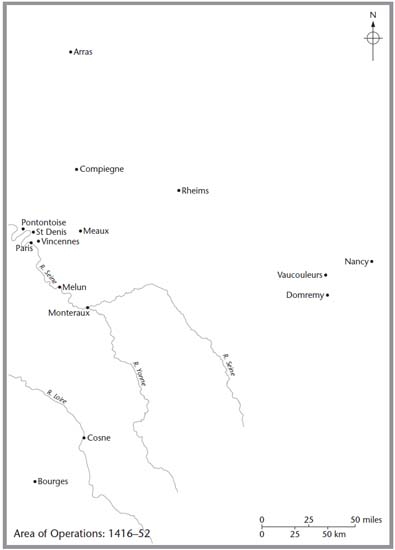
Then came a stroke of luck for England, and Henry got his ally. Despite the fierce enmity between the Burgundian and Armagnac factions, Jean the Fearless, duke of Burgundy, was increasingly concerned by English military successes. He had no time for the dauphin or his Orléanist supporters, but neither did he want English rule over the whole of France – that was something he coveted for himself, in due time. Negotiations between the two opposing French camps were opened, and it appeared to the Burgundians that, despite the appalling fate that they themselves had meted out to the Armagnacs in the Paris uprising, when hundreds of the latter were killed out of hand, some form of compromise agreement might be arrived at. On 10 September 1419, at Montereau on the River Yonne, forty miles south-east of Paris, the duke of Burgundy arrived to pay homage to the twenty-year-old dauphin. As he knelt, the Armagnacs, who had no intention of forgetting or forgiving, struck and Jean was hacked to pieces, his right hand being cut off first, to stop him raising the devil. It was claimed by the Burgundians that the dauphin had personally given the signal for the attack and, true or not, the murder sent shock waves throughout France, with many in Paris and the north blaming the dauphin for all the ills that the war had brought upon them. Duke Jean’s heir, Philip, a mature man of twenty-five, was horrified and immediately made overtures to the only man who could help him to exact revenge – Henry V of England. In December 1419, a formal treaty of alliance between England and Burgundy was signed, whereby Philip would recognize Henry’s claim to the French throne and Henry in turn would not interfere with the Burgundian territories other than as the feudal overlord.
From now on, it would be Anglo-Burgundian armies that would campaign to conquer Dauphinist France, and a combination of the threat of a now far larger military opposition, general war-weariness and disgust at the murder of Philip’s father persuaded the supporters of the mad King Charles VI to make peace with Henry. The result was the Treaty of Troyes, which was signed on 20 May 1420 and granted Henry almost all that he and his forefathers had asked for. Charles may not have known what he was signing, but the treaty was ratified by the parlement and Henry was recognized as Charles’s heir to the French throne. (Queen Isabeau, who had long presided over an alternative court in Burgundian territory, had conveniently declared her son Charles, the dauphin, the product of an adulterous affair and therefore a bastard.) Normandy was to remain an English possession until Henry became king of France, and he was to receive the homage of Brittany. The two kingdoms were not to be amalgamated but ruled separately, albeit by the same man, and Henry was required to conquer that portion of France not already pledged to him – which effectively meant south of the River Loire. In the meantime, Henry was declared the regent of France and betrothed to Katherine of Valois, the nineteen-year-old daughter of Charles VI. While this was intended as a dynastic marriage pure and simple, it seems that it developed into a genuine love match, and Katherine would eventually become a much-loved queen and queen-dowager of England.
The marriage took place within a fortnight of the treaty being signed, for Henry had no time to waste, and after a brief consummation the combined armies marched off to besiege Montereau, the scene of Duke Jean’s assassination. Now any pretence on Henry’s part of being an essentially kindly soul was abandoned: anyone resisting his armies was a traitor and would be dealt with accordingly. Prisoners were hanged outside the walls of Montereau, thus encouraging a swift surrender, and the army moved north to Melun, halfway between Montereau and Paris. Here the task was much harder: the town was well situated for defence – the citadel was on an island in the Seine – and the garrison commander was a particularly determined Gascon, Arnaud de Barbazon. The siege dragged on, with the English trying bombardment of the walls and, when that failed, mining. The French counter-mined and there were ferocious little battles by glimmering torchlight underground, but still the defenders held out, until at last in November there was no food left, nor a dog, cat or rat, and the town surrendered. Henry was determined to hang de Barbazon, who as a Gascon was doubly a traitor – to him as king of England and overlord of Aquitaine and to him as king of France – but the wily soldier escaped death by quoting a rule of chivalry that said, if a man fought with a king, he was therefore his equal, and de Barbazon claimed to have fought Henry in one of the scuffles in the tunnels. There was no such objection to Henry’s hanging of Scots soldiers in the Melun garrison. Their king, James I, while in fact a prisoner in the Tower, was officially a guest and ally of Henry, so any Scots in arms against England were traitors.
In September 1420, Henry made his ceremonial entrance into Paris to general acclaim: the citizens might not have liked the English, but, if the price of peace and stability was turning out to cheer the traditional enemy, then so be it. Henry spent Christmas 1420 in the Louvre and then left a garrison in Paris to guard against any revanchist tendencies before setting off for England with Katherine. She was crowned queen of England by the archbishop of Canterbury in Westminster on 21 February 1421, and then the royal couple set off on a progress throughout England, partly to show the people their new queen and partly to enforce the collection of more taxes to support the war. Monies raised in Normandy and France were not yet sufficient to make the continuance of the struggle self-supporting, and, while individuals from great nobles to humble archers had done very well out of the war, the English treasury had not. Although there were grumbles, Parliament nonetheless agreed the necessary subsidies.
While the royal progress was going on, news arrived of the first English defeat for many a year, at the Battle of Baugé on 22 March 1421. The king’s brother, the duke of Clarence, was campaigning along the River Loire and intended to invest Angers, but he found that town too strong for his force of, perhaps, 1,500 men-at-arms and 4,500 archers and withdrew to Beaufort-en-Vallée sixteen miles east of Angers. Archers out foraging took some Scottish prisoners who were on the same errand, and, when they were interrogated, they reported that the Franco-Scottish army of around 6,000 men was in the area of Viel Baugé, eight miles to the east-north-east of Beaufort. The chronicles are hazy about exactly what happened, but it appears that Clarence disregarded the advice of his senior commanders, forgot everything the English had learned from decades of campaigning in France and, instead of waiting until his archers returned from foraging, set off with his mounted men-at-arms – probably around 800 or so – in the hope of surprising the French. He seems to have charged uphill on marshy ground against considerably greater numbers, and the result was predictable: he was forced back against the River Couasnon and charged in turn by the Scots under the earl of Buchan. Clarence himself was killed, as were a number of his officers, including Sir Gilbert d’Umfraville, who had advised against the foray, while others were taken prisoner. Only the arrival of the archers under the earl of Salisbury prevented a defeat from becoming a massacre; Clarence’s body was rescued and eventually sent back to England and buried in what is now Canterbury Cathedral near the tomb of his father, Henry IV. Clarence must have known that what he was doing was foolish in the extreme, but, unlike his other brothers, he had not been at Agincourt and dreary sieges held little appeal. He may have thought that here was a chance to win glory for and by himself in a real battle, and that his mere arrival on the field would so frighten and disorganize the French that he could gain an easy victory even against far greater numbers. Had the enemy been entirely French, that might have been the case, but the Scots were experienced mercenary soldiers and quite happy to learn from the English and meet a mounted charge with a battle line of determined infantry. The result of the battle gave some much needed cheer to the Dauphinists but had little or no strategic consequences. What it did do, however, was to make Jean of Brittany have second thoughts about his own position; and despite the debt he owed to English arms – without which he would not have become the duke – he began to make plans to change sides.
In June 1421, King Henry returned to France with another 6,000 troops. He took Dreaux forty miles west of Paris, then went south, taking Vendôme, and then east to Beaugency. Having reduced those towns, he next considered Orléans, but, concluding that a siege of that heavily fortified town with a strong Armagnac garrison would take too long, he bypassed it to the north. In October 1421, he laid siege to Meaux, eighteen miles east of Paris, hoping that it could be taken before the winter set in. Alas, that was not to be, and, as the weather got wetter and colder, dysentery and an outbreak of smallpox hit the army. Even the king fell ill and specialist physicians had to be summoned from England to tend him. He appeared to recover, and the siege went on, the only good news being the announcement of the birth of a healthy son to the king and Queen Katherine at Windsor on 6 December. Henry spent Christmas in Paris with Charles VI and his now reconciled queen Isabeau before rejoining his army in the field. Then finally, on 9 March 1422, the garrison of Meaux abandoned the town and withdrew into a well-defended locality in the suburbs known as the market, where they held out until 10 May. Henry was so exasperated that he had the garrison commander beheaded and his body exhibited upside down on his own gallows.
The English army marched on, responding to a cry for help from the Burgundian town of Cosne, 112 miles south on the Loire, which was being besieged by the Armagnacs, when quite suddenly Henry found he could not ride. He developed a high fever and was transferred to a litter and taken to his castle at Vincennes. The finest medical brains in England and France could do nothing, and, although still completely lucid, he knew the end was near. After summoning his council and laying down the way in which he wished his two kingdoms to be governed and his infant son to be brought up, he died on 31 August 1422. The greatest Englishman that ever lived (at least in the opinion of this author) was no more. He was only thirty-four.
On his deathbed, Henry V nominated his thirty-three-year-old brother John of Lancaster, duke of Bedford, as regent of France and guardian of his eight-month-old infant son, now Henry VI, and his youngest brother, thirty-two-year-old Humphrey, duke of Gloucester, as regent of England. At first all went well, and, when Charles VI of Valois died two months later, it seemed that a smooth succession of Henry VI of England as Henri II of France would be achieved, and the baby was duly proclaimed as such. Anglo-Burgundian armies continued to press south and the dauphin, whose court moved between Poitiers, Chinon and Bourges, was generally considered to be of little account – even by those loyal to his cause. Bedford was not only a competent soldier but also an excellent administrator, and he was well aware of the need to win what in a much later age would be called the campaign of hearts and minds. After he had purged the French civil service of Orléanist sympathizers, it worked loyally for him, and, despite the provisions of the Treaty of Troyes, Normandy was still run as a separate territory. Militarily, Bedford was ably assisted by Thomas Montague, fourth earl of Salisbury, and his second-in-command Richard Beauchamp, thirteenth earl of Warwick. Salisbury’s father had been involved in the plot to murder Henry IV in 1399 and was killed by the mob as a result, but Thomas had proved his loyalty to the Lancastrians over and over again; he was an artillery expert and was said to have been Henry V’s favourite general. Warwick had been brought up a Ricardian, but, when Richard II had turned against the family, they were saved only by Henry Bolingbroke’s assumption of the throne; he had served in most of the Lancastrian wars and been on pilgrimage to Jerusalem. Between them, the pair, both in their early forties, directed operations to recover the rest of France. Under them there were a host of thoroughly competent commanders, men who were by no means all of noble blood but had earned their rank and position by professional ability in the field. All did well out of the wars, most became immensely rich, and many acquired French titles and lands which, by and large, they administered fairly and well.
At the height of English power, the whole of Normandy, the valley of the Seine, the Île de France (Paris and its environs), Picardy, much of Maine and Anjou, Aquitaine, Calais and its surroundings, and part of Champagne were under English rule. But however benign that rule was to begin with – and Bedford did his best to keep it so – there were problems. The English parliament was becoming reluctant to raise the money to fund the war, thus taxes in English France, particularly in Normandy, had to rise. There was a sales tax (effectively VAT), a hearth tax (council tax), the pattis (road tolls) and an ever-increasing tax on alcohol. On top of the officially levied taxes, there were the depredations of routiers, highwaymen and gangs of brigands, and the unofficial enterprises of many English garrisons, which ran what were effectively protection rackets. Feelings among the peasantry, initially thankful for an English victory that would bring peace and stability, began to turn. Nevertheless, Bedford intended to mount a major campaign in 1424 to subdue the rest of Maine and Anjou and then push south to Bourges and end the war once and for all. Before the operation could be launched, however, there was the distraction of Verneuil, an English-controlled town sixty miles west of Paris on the borders of Normandy. A Scots army had persuaded the town to surrender without a fight by convincing the garrison commander that there had been a battle and that the English army had suffered a major defeat.97 Bedford duly set off to retake the town with a force of around 1,500 men-at-arms and 4,500 archers. Arriving before Verneuil, he formed up in the usual English way: himself commanding the right-hand division of dismounted men-at-arms and Salisbury the left, archers on each flank and a reserve of mounted archers behind. He then waited for the French – a force of around twice his number, composed of Scots and French infantry, Italian mercenary cavalry and crossbowmen.
The Scots were too canny to attack an English body of men formed up, however small it might be, and from first light until mid-afternoon the two armies looked at each other. Eventually, Bedford gave the order to advance at a slow pace. The lines crashed into each other and the hacking and slashing began. At first it looked as if the Scots might win: their cavalry outflanked the archers and attacked the baggage-train, and some of Salisbury’s archers ran away; but experience and leadership told, and, when Salisbury swung his division round and attacked the Scots in flank, the balance swung in favour of the English and the Scots were driven back and the slaughter began. The English were accustomed to fighting the French and thought little of it, but to be attacked by Scots was a very different matter, and many Englishmen had a genuine hatred of their northern neighbours. Few prisoners were taken and the Franco-Scottish dead may have numbered as many as 2,000. In the aftermath of the battle, a captain of archers by the name of Young, who had panicked when the Italian cavalry swept around them and run away, taking some of his men with him, was duly hanged.
Now matters in England began to distract Bedford from the planned campaign. His brother Humphrey had got himself involved with Jacqueline, countess of Hainault, who was now estranged from her thoroughly unpleasant husband, and had taken a contingent of troops to Flanders to enforce her rights. The expedition was a disaster, which might not have mattered too much except that it infuriated the duke of Burgundy, who had ambitions of his own for Flanders, so Bedford had to return to England to get a grip of his brother and then use all his diplomatic skills to preserve the alliance – a task in which he was hardly helped by Burgundy making (unreciprocated) amorous advances towards the earl of Salisbury’s young wife, a granddaughter of Geoffrey Chaucer. Returning to France, Bedford now began a methodical reduction of Armagnac towns on the Loire. It was not without setbacks, including a defeat for the duke of Burgundy, the loss and recapture of Pontorson in 1426, and a revolt in Maine in 1427 sparked by excessive taxation and English arrogance, but by 1428 all had been resolved and a major offensive could begin. By mid-August, the combined Anglo-Burgundian armies under Salisbury had captured forty towns and fortified places en route to and in the area of Orléans, the jewel of the Loire. And, on 12 October 1428, they laid siege to that town, the capture of which would give England control of the Loire and would trap the dauphin between Aquitaine to the south-west, Burgundy to the east and English France to the north.
Then there occurred one of the most extraordinary episodes of an extraordinary age. The adventures of the Maid of Orléans, Jeanne d’Arc, Jehanne La Pucelle, the Witch of Orléans, to give only some of her names, had been largely consigned to myth, legend and French folk memory until 1920, when, in the aftermath of the First World War – in which France had found herself on the winning side but with her heart and soul ripped out and desperately seeking something of glory and pride in her distant past – Joan became Saint Joan. Jeanne was probably born in 1412, the fourth child of five, in the village of Domrémy (now Domrémy-la-Pucelle) on the borders of the Holy Roman Empire twenty-five miles south-west of Nancy. She was certainly not a simple peasant. Her father was a minor official responsible for the collection of taxes, the maintenance of law and order, and the general administration of the surrounding area, and he owned, rather than rented, a fifty-acre farm with a substantial stone-built house. The transcript of her answers to questions at her eventual trial would suggest that she had an education of some sort, but whether any of her letters were actually written by her or dictated to a clerk is uncertain. All those questioned at a subsequent investigation twenty-five years after her death are adamant that she was given a good grounding in the Catholic faith and that she was unusually assiduous in attending church.
Sometime around the age of twelve, Jeanne began to hear voices, which she claimed were from various saints and then from God himself. It is not entirely uncommon for girls going through puberty to experience emotional turmoil, but Jeanne was convinced that she really was the recipient of divine instruction and sometime in 1428 tried to obtain an interview with the captain of the nearest French garrison, Robert de Baudricourt at Vaucouleurs, ten miles to the north. After several failed attempts, she was eventually seen by Baudricourt, who, after a number of meetings, became convinced that she did indeed hear the voice of God and that she could help in expelling the English. Baudricourt gave her an escort and sent her off to Chinon to see the dauphin, who also thought that there might be something in what she was saying and sent her on to Poitiers in March 1429 to be examined by a team of churchmen, an interrogation that went on for eleven days. By now, Jeanne was claiming that God had instructed her to go to Orléans, where she would lift the siege. It was around this time that she took to wearing men’s clothing, a fact that was subsequently held against her, but which may initially have been a simple ploy to avoid molestation on the road, and later was part of her persona as a soldier.
While one’s first reaction today might be to write Jeanne off as a mentally disturbed teenager, there must have been far more to her than that. Medieval man may have been superstitious but he was not stupid, and to convince a hard-baked cynical soldier like Robert de Baudricourt, the dauphin (admittedly described at this time as ‘a graceless degenerate’45) and a host of suspicious churchmen inherently reluctant to grant the right of audience with the Almighty to anyone but themselves would have required extraordinary powers of persuasion. In the modern age, people who hear voices are generally considered to be mentally unbalanced and may be confined in psychiatric hospitals, so, assuming that, whatever the voices Jeanne heard were, they were unlikely to be those of God, the question arises whether she was mad or whether she invented the voices to lend force to her arguments for a military revival. While there are some signs of religious mania in what we know of her character, she does not appear to have exhibited any other symptoms of insanity – but then modern murderers who claim to have killed on the instructions of a supernatural voice are not necessarily obviously mad either. The conclusion must be either that her affliction was confined to the voices, or that she was inventing them. What motivated a country girl at the fringes of what would become France to set out to revive, or ignite, French patriotism, we cannot know at this distance, but patriot she surely was.
Meanwhile, the English had surrounded Orléans, and within a few days had driven the French away from the Les Tourelles, a towered fort that guarded the southern end of the bridge across the Loire. Then, on 27 October 1428, when Salisbury was observing the town from the towers, a lucky cannon shot from the walls took away half his face. He lived in agony for a week and died on 3 November. Command passed to William de la Pole, earl of Suffolk, another example of social mobility in medieval England. Suffolk’s great-grandfather, also a William, was but a merchant, albeit a wealthy one, when he became banker to Edward III, then anxious to escape the clutches of Italian money-lenders. So successful was he that Edward made his son a knight, and later the first earl of Suffolk. The current William, like many younger sons, sought a career as a soldier and went to France with Henry V in 1415. When his father, the second earl, was killed at Harfleur, where he himself was wounded, and his elder brother killed at Agincourt, he became the fourth earl at the age of nineteen. Suffolk’s later career – his involvement in Henry VI’s government when English fortunes in France had long been in decline and his extra-legal beheading as a so-called traitor in 1450 – has given him a bad press, but he was a perfectly capable and experienced military commander, albeit not of the calibre or reputation of Salisbury, whose widow he married in 1430.
The siege dragged on into winter and rations were running short for both besieged and besieger when, on 12 February 1429, an English supply convoy with a military escort of around 1,500 men commanded by the forty-eight-year-old Sir John Fastolf was intercepted by a Franco-Scottish force of perhaps 4,000 or 5,000.98 In what became known as the Battle of the Herrings – the convoy included rations to last the army over Lent99 – Sir John ordered the wagons into a circle and put his men within it. Attack after attack was broken up by the archers, and the French were driven off. The skirmish illustrated once again the inadvisability of attacking an English army with a strong component of archers standing in a defensive position of its own choosing.
Fastolf’s reinforcements allowed Suffolk to tighten the cordon around Orléans, but that was soon nullified when the duke of Burgundy quarrelled with Bedford over the eventual control of the town, flounced out in a fit of pique and left the siege along with his men. Suffolk was able to control the west side and the south bank but could only patrol around the eastern approaches. Then, on 22 March 1429, a letter was delivered to the English camp signed by Jeanne and addressed to ‘You king of England, and you duke of Bedford who call yourself regent of the kingdom of France. Surrender to the maid who is sent here from God, the king of heaven, the keys to all the good cities that you have taken and violated in France’.46 As nobody had any idea who this maid was, the letter was ignored, but copies survive. On 29 April, Jeanne herself arrived at Orléans, probably in a convoy of boats bringing supplies (the English had omitted to place chains across the Loire) which were unloaded on the north bank and taken in by the Burgundy gate, which was unguarded by the English. Jeanne seems to have had no problem convincing the garrison commander, the illegitimate son of the murdered duke of Orléans,100 that she was the answer to his prayers, and, clad in armour and carrying a standard that had been blessed in the church of Saint-Saviour in Blois, on 4 May, she accompanied a French sally to occupy the fort of Saint-Loup, two miles east of Orléans on the north bank. There was nobody in the fort, but this could be attributed to God’s work and was a much-needed morale boost for the French. Thursday, 5 May was Ascension Day, when Christians were not supposed to fight, but, on 6 May, the French, egged on by Jeanne, came out of the Burgundy gate, crossed the river, and attacked the fort of Saint-Jean le Blanc on the south side of the river and the fort of the Augustins just south of the bridge. This latter gave them a jumping-off line for an attack on Les Tourelles, which they duly attacked and captured next day. During this action, Jeanne was wounded in the shoulder by an arrow (as the voices of various saints had predicted), but she crossed the bridge and entered the town. The next day, Sunday, 8 May, the English withdrew and the siege of Orléans was over. The French were convinced, then and now, that it was all due to the Maid.
It was, of course, nothing of the sort. The English withdrew because they had bitten off far more than they could chew, they were running out of rations, the Burgundian contingent had gone, money and reinforcements were slow in coming from England, and Bedford needed the army elsewhere. To suggest that Jeanne was a military commander who planned the movement of troops and led them into battle, as some historians do (mainly French but some British ones too), is surely not believable. While the potential for leadership may be inborn, the execution of it requires training and practice, and it is not remotely credible that a farmer’s daughter, however intelligent, with no involvement or previous experience of war, could possibly have acquired the skills needed to direct the activities of large bodies of troops. It was not Jeanne d’Arc who drove the English out of France but money, population, defecting allies and political in-fighting at home. There can be little doubt, however, that Jeanne was an inspiration to the French troops, who had become accustomed to being beaten by smaller but far more professional English armies. The French resurgence would have happened anyway, once the dauphin’s supporters stopped fighting among themselves and concentrated on raising the funds to prosecute the war – and Valois France, which had not been fought over time and again, was potentially far richer than English France.
French forces under the duke of Alençon – a fervent believer in Jeanne – now began to try to recover English positions along the Loire, and, on 18 June 1429, 2,000 archers under John Talbot, the forty-two-year-old first earl of Shrewsbury – another younger son who had made his name as a professional soldier – and a contingent of 1,000 Parisian militiamen in English pay under Sir John Fastolf were surprised at Patay by an Armagnac army of perhaps 7,000. Talbot was forming up his archers when the French attacked in flank, dispersing them. The Paris militia broke and ran, Talbot was captured, and only Fastolf with some archers got away. It was an embarrassment to the English for which Jeanne got all the credit, whereas in reality it was caused by Talbot’s overconfidence. Now many Frenchmen were convinced that God, so long on the side of the English, had switched allegiance.
Mad King Charles VI having died in 1422, Jeanne’s next ploy was to suggest to the dauphin that he should be crowned in Rheims, the traditional coronation site of French kings, and by carefully avoiding English armies and garrisons – and in spite of the fact that much of the necessary regalia was in Paris – the dauphin was duly crowned as Charles VII by the archbishop of Rheims in July 1429. Militarily, this might have made no difference whatsoever, but it had an enormous propaganda effect and persuaded the duke of Burgundy to sign a truce with the French. When the Armagnac army moved towards Paris, egged on by Jeanne, many towns opened their gates to them and they got as far as Saint-Denis before Bedford drove them back and Charles ordered the army to disperse for the winter. Jeanne was furious and constantly urged the resumption of the war. She managed to persuade some of Alençon’s men to accompany her and a few minor towns were taken and then lost again.
Jeanne’s usefulness to Charles VII had, however, now run its course. She had inspired French armies to great things, she had been the motivating spirit for the march to Rheims and the coronation, and French soldiers had got almost to Paris with her name on their lips. But she was becoming an embarrassment; more and more she was excluded from council meetings and her supposedly God-given advice ignored. When in May 1430 Burgundian troops were laying siege to Compiègne, despite the supposed truce, she was captured during a French retreat back into the town from an unsuccessful sortie. It has been suggested that the French commander of the Compiègne garrison deliberately closed the gate in her face and allowed her to be captured.
Jeanne was transferred between various Burgundian prisons – and made several attempts to escape – before the English bought her for 10,000 francs (£1,600) and put her on trial in Rouen, the heart of English Normandy. The English had to destroy Jeanne’s reputation, and, while most Englishmen seemed to believe that she was a witch, it was not for that that she was put on trial, but on the far more serious charge of heresy. There was some tolerance of witchcraft in England and in France, but not of heresy, which, if not abjured, carried the death penalty by burning. It was vital that Jeanne be found guilty, for by association the inference could be drawn that Charles VII was a heretic too; and vital, too, that the churchmen who tried her were French and not English. The first trial, before a French bishop, a French Dominican monk and a number of clerical assessors, opened in January 1431 and ended on 24 May. Jeanne conducted herself well, was careful not to incriminate Charles VII, refused to relate any conversations they had had and, when faced with a difficult question, fell back on invoking the will of God. She denied all charges but finally signed a disavowal of her voices and agreed to stop wearing men’s clothing. To the fury of the English, she was sentenced not to death but to life imprisonment. Four days later, however, the English demanded the court take note that Jeanne had relapsed by once more cutting her hair short and wearing men’s clothing, and, on 30 May 1431, she was burned at the stake in the Place du Vieux Marché in Rouen. Her last prophecy, which was probably invented in hindsight, was said to be that within seven years the English would suffer a greater loss than that of Orléans and that they would eventually be driven out of France.
With the witch burned and the Valois resurgence only just held, the English had to do something to restore prestige and emphasize Bedford’s claim that he was the rightful regent for the rightful king. So, in December of the same year, 1431, an English bishop crowned the ten-year-old Henry VI of England as Henri II of France in Notre Dame Cathedral in Paris. It was not lost on the populace that the crowning was carried out by an Englishman and that it was not in Rheims. There was now a military stalemate and once again both sides turned to negotiation, overseen by representatives of the pope, who was now, following the ending of the schism in 1417, in Rome. In 1435, the interested parties gathered at Arras and the horse-trading began. It went on for weeks but neither side would budge, and the only result of significance was that the duke of Burgundy formally withdrew from the Treaty of Troyes and renounced his allegiance to Henry as king of France. This was seen by the English as a disgraceful act of betrayal – as indeed it was – and from now on Burgundy would either stay neutral or, if he fought at all, would do so on the side of the French. Burgundy’s relations with Bedford had been difficult for some years, exacerbated by the death of Bedford’s childless wife, a sister of the duke’s, and his somewhat rapid remarriage. It may be, too, that Burgundy realized that, once the magnates of Valois France stopped their internecine quarrelling, a far smaller and less rich England could not hold the vast tracts of France to which she laid claim.
The negotiations abandoned, the campaigning went on and, in 1435, the French managed to recapture Harfleur and Dieppe. The loss of Harfleur was particularly serious for it meant that river traffic to and from Rouen would have to run the blockade of French ships, and the loss of Paris the following year was not only a propaganda blow but also added weight to those who believed Jeanne d’Arc’s prophecy of five years previously. A far greater blow than the loss of Harfleur, however, was the death of the duke of Bedford in Rouen on 14 September 1435, at the age of only forty-six. We do not know how he died – the Brut Chronicle simply says that he took sick – but he was hugely overworked and could have fallen prey to any of a number of possible diseases. With him went the last realistic hope of securing an English France: a consummate diplomat who was genuinely popular, particularly in Normandy, he understood and respected French culture, was a sound strategist, and managed to maintain reasonably civilized relationships with most factions, including those of his enemies.
Even had Bedford lived, the problem for the English was that their forces were vastly overstretched, trying to hold a frontier of 350 miles with Valois France south of the Loire, and another 170 or so miles along the eastern border of Aquitaine. Without allies and without sufficient funds to pay mercenaries, there were simply not enough English soldiers to provide the frontier garrisons to guard against inroads. Mobile English expeditionary forces seeking out French armies and defeating them was one thing; holding the territory thus taken was a very different matter. Further negotiations in 1439 failed, this time over the position of English settlers in Normandy whom England would not dispossess to restore their lands to the original owners, and, in 1441, Pontoise, the last English stronghold in the Île de France, twenty miles north-west of Paris, fell. In 1444, a truce was agreed and the marriage of Henry VI and Henri II to the fourteen-year-old Margaret of Anjou, whose aunt was the wife of Charles VII, was arranged. As it turned out, she was a far stronger character than her husband, who would eventually fall prey to the Valois madness inherited from his mother, but even at this stage Henry was much more inclined to peace at (almost) any price than his great father would ever have been.
Henry VI as a child had been under the control of his uncles, but as he grew older he began to take more and more power into his own hands, as indeed he was entitled to do. A wise king, however, would consult with his council and the great men of the realm, and, even if he need not always follow their advice, he should at least seek it. The problem was that Henry was kind, generous, pious and abstemious; he hated bloodshed of any sort and only very reluctantly agreed to executions, frequently pardoning criminals from murderers to petty thieves; he desperately wanted peace with France and would go to great lengths to get it. While all these qualities would have been excellent in a country parson, they were not the qualities of a king, and both the in-fighting that went on in the English court as rival blocs jockeyed for power and the king’s own clumsy attempts to make peace under the Francophile urgings of his wife inevitably had an impact on the war.
At some stage during the dialogue prior to Henry VI’s marriage, Suffolk, now a duke and the chief negotiator, promised to restore Maine to Charles VII, a pledge he made with Henry’s knowledge but without telling the rest of his advisers. The result was the king’s government following one policy – sovereignty over all of France – and the king following another. When the news got out, the London mob was furious, blaming Suffolk, and of course the precedent was now set: if the English would give up Maine without a fight, what about the other territories? It took another three years for the French to get Maine, as the English garrisons held on regardless of what their king might have promised, but finally they had to be surrendered. Normandy at least was thought to be secure: the population was genuinely loyal to their duke, the king of England, and a whole generation had grown up knowing nothing but English rule. The military garrison was tiny, however, and made even tinier by long delays in paying the soldiers, which encouraged desertions, and, when Charles VII sent his army into Normandy in the summer of 1449, there was little to stop them swiftly capturing the cities and towns, including Rouen, where they captured Talbot (taken prisoner at Patay in 1429, he had been exchanged for a French nobleman in 1433). Now only the Cotentin peninsula was held, and that was under immediate threat.
The French military revival came as an unpleasant shock in England. At long last, Charles VII had decided to be a king and had rooted out the incompetent and corrupt administrators and replaced them with hard-faced accountants who were able to raise the taxes that had hitherto gone uncollected. With much of this money he created a new, professional army. At long last, the French were beginning to learn the lessons of defeat by the English: instead of going to war with an army of well-bred nobles leading a half-trained rabble, there would be battalions of paid men-at-arms, archers, crossbowmen and light infantry, who would not be disbanded at the end of every campaign but retained as a permanent force. In addition, he spent money on developing and greatly enlarging the artillery arm. Now tiny bodies of English professionals would no longer find it so easy to beat far larger French armies: the era of English total military supremacy was coming to an end. English soldiers were still better trained, better led and better equipped, but the margin was steadily decreasing and there were not nearly enough of them.
Something had to be done to redress the situation in Normandy and, in October 1449, Sir Thomas Kyriell was ordered to assemble an army at Portsmouth to sail to France. Kyriell, a Kentish man of fifty-three, a knight of the Garter and a knight banneret, had started his military career as a man-at-arms under Sir Gilbert d’Umfraville and had won ennoblement and promotion by military prowess. There was no doubt of his abilities as a soldier and a commander, but there was always a cloud hanging over him. He had been suspected of corruption and of fraudulent conversion of his soldiers’ pay, although this was never proved, and his personal conduct left much to be desired. In Portsmouth, he allowed his soldiers to run amok – they even lynched the bishop of Chichester, who was bringing their pay – and the time it took to restore discipline, combined with an unfavourable wind, meant that he did not reach Cherbourg until mid-March 1450, with around 1,500 archers and 500 men-at-arms. Instead of marching straight for English-held Bayeux, as he had been ordered to do, Kyriell decided instead to lay siege to Valognes, a town of little strategic significance about ten miles south-east of Cherbourg, the only possible justification for this breach of instructions being that the garrison of Valognes might conceivably have been able to cut off Kyriell’s supply route from the sea and his line of retreat. The delay allowed the French to bring up more troops, so, when Kyriell eventually marched for Bayeux, reinforced by another 1,500 archers from the Cotentin garrisons, he found a French army of about the same size commanded by the count of Clermont advancing down the road towards him. Kyriell did everything that he should have done. He formed his men-at-arms into line along a ridge near the village of Formigny, about ten miles north-west of Bayeux, where he had a stream to protect his rear. He put his archers on the flanks with some in the centre, and ordered them to plant their stakes and dig anti-cavalry holes in front. It was a classic English tactical position and Kyriell waited for the French to attack, confident that he could slaughter the lot.
Clermont knew better than to attack the English on their own ground and instead brought up two light cannon, intending to blow the archers away. The guns opened fire and the archers did indeed leave their position, but only to charge the guns, capture them and drag them back to the English line. This would have been the time to unleash the arrow storm, but instead Kyriell did nothing, perhaps through overconfidence, and that gave the French time to reconsider. At this stage, the constable of France, Richemont, arrived from St Lô with his division of 1,200 men and immediately threw them into a flank attack from the south on the archers. With enemy in front and enemy to the left, Kyriell could only form his men into a rough semi-circle and hope for the best. The French closed and engaged the English in savage hand-to-hand fighting and numbers began to tell; the English were forced back against the brook and the killing began. Kyriell was captured and many of his men butchered, with only a handful managing to escape to Bayeux. It was the first major English defeat for nearly forty years. In June of the same year, Caen fell, followed by Falaise in July, and finally, on 12 August 1450, Cherbourg surrendered and Normandy, except for the offshore islands, was gone. A relief force commanded by Sir John Fastolf never left England.
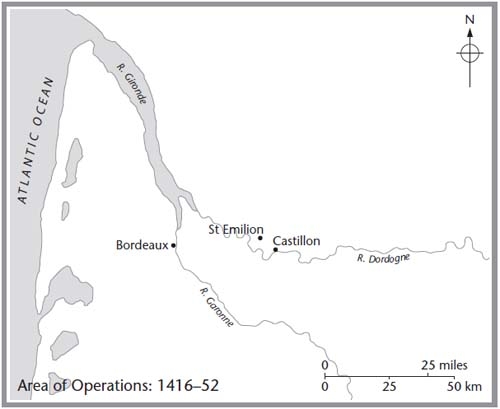
Now only Aquitaine was left, and, sure enough, in late 1450, the French invaded. Initially, there was resistance; Aquitaine had been English since the twelfth century and most Guiennois had no wish to change that, but, in the absence of a sizeable English army, garrisons began to fall. The following year, another French army attacked, and, on 30 June 1451, Bordeaux fell, Bayonne following on 20 August. The new French tactics of cannon and bribery of minor nobles were working, and in England there was dismay and confusion. There the magnates were at odds with each other and with the weak king; the rebellion in Kent led by Jack Cade – a far more serious affair than the so-called Peasants’ Revolt of 1381 – had only just been put down, money was short, and charge and counter-charge as to who was to blame for the French debacle were being flung around, sometimes with violence. There was only one man whose reputation was unsullied and who could restore the situation: John Talbot, earl of Shrewsbury, now an old but still vigorous man of sixty-six, who had been released from French captivity with his ransom paid. In September 1452, he was ordered to take an army to Aquitaine and restore English rule.
Talbot landed at the mouth of the River Gironde on 17 October 1452 with around 2,500 men and marched on Bordeaux. There the citizens rose in revolt, expelled the French garrison and opened the gates to the English. The rising spread, as much against French oppression and taxes as in loyalty to the old regime, and at first it seemed that the status quo ante might be restored. Reinforcements for Talbot arrived and a Gascon contingent was raised. But Charles VII spent the winter concentrating a new army, and, in the spring of 1453, he launched it into Aquitaine. On 17 July 1453, Talbot marched to the relief of the town of Castillon with around 8,000 men and attacked the French artillery redoubt, a deep ditch with a bank behind it on which were mounted cannon – no longer the old bar-and-hoop type but with barrels cast in bronze or brass and a few even in iron.
The recent invention of the powder-mill meant that the gunpowder used was far more reliable and allowed a much higher muzzle velocity than that available in the earlier years of the war. And, as the guns were sited to produce cross-fire, the result was a murderous hail of iron and stone at a very short range. Even then, the fighting went on for nearly an hour as Talbot’s men tried desperately to cross the ditch, climb the bank and get at the cannon, but, when a Breton force of around 800 infantry suddenly arrived and attacked Talbot’s right flank, the end was only a matter of time. Talbot was an easy target: he was the only mounted man, he was not wearing armour (one of the conditions for his release from captivity), and he had an obvious tabard with his coat of arms. A cannon-ball felled his horse, and he was killed by a French infantryman with an axe. Large numbers of English were killed and the pursuit went on as far as Saint-Émilion, thirty miles away. Although nobody would have forecast it at the time, it was the last battle of the Hundred Years War. There were no more troops to send from an England riven with internal strife, and, on 19 October 1453, Bordeaux surrendered. Now there was only Calais, and the great adventure was over.