
7
The Treaty of Brétigny marked the culmination of Edward III’s twenty-four years of campaigning in France and the end of the first phase of the Hundred Years War. The king had stated his claim to the French crown aged twenty-four and he was now forty-seven. Poitiers was a great victory and told the world, if the world needed telling, that the English had moved from being backward amateurs in the waging of war to being the foremost practitioners of it. The combination of professional soldiers fighting on foot with archers on the flanks was unbeatable, and the mobility of English armies meant that the French could neither trap them, nor fight them other than on ground which favoured the English, nor starve them out – although sometimes the latter was a close-run thing. Certainly, the Black Prince had been unable to take Rheims or Paris in 1356, but he had accepted that fact rather than become bogged down in a lengthy siege which would have forced him to remain in one place long enough for the French to concentrate against him. Given their inability to defeat the English militarily, the French had little option but to sue for what terms they could get: the economy was in ruins, the government had broken down, the fields could not be tilled, the population yearned for peace at any price, and Jean would promise virtually anything to gain his freedom. From the English point of view, the gains were enormous: it was true that the claim to the French throne had been abandoned, but a third of the kingdom definitely assured was better than the whole of the kingdom as a possibility. No one, French or English, could have predicted that in a mere fifteen years almost all the English gains would be lost.
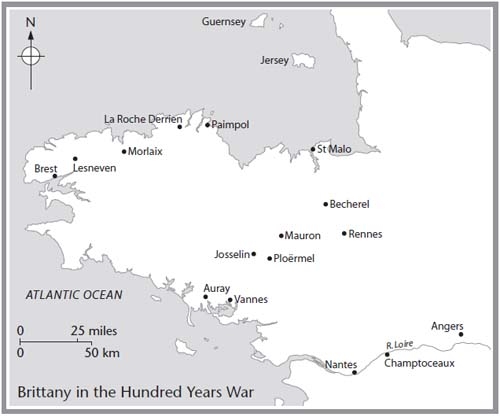
The Treaty of Brétigny did not stop war by surrogacy from continuing. In Brittany, the struggle between the Blois and Montfort factions was finally settled with the death of Charles of Blois at the Battle of Auray in September 1364, when the English army was commanded by Sir John Chandos with Sir Hugh Calveley as his second-in-command. One of the prisoners taken at Auray was to make a habit of being captured by the English and subsequently ransomed, in this case the sum agreed being paid by the French king. He was Bertrand du Guesclin, a Breton born of impoverished gentlefolk who was the exception to the rule of French social immobility. He had come to the attention of the dauphin during the earlier fighting in the Breton wars, and eventually – although with no great ability as a general – he would become a great French hero in a land badly needing heroes, be made constable of France and prove a constant thorn in the side of the English. On the English side, Calveley was yet another who had risen to prominence on the strength of his ability as a soldier. A native of Cheshire, he first fought under Sir Thomas Dagworth in Brittany, and in the guerrilla war that followed he was twice captured and ransomed, once at the Battle of the Thirty in 1351 and again as the captain of the garrison of Bécherel. He was a captain of archers at Poitiers and subsequently commanded a mixed force of men-at-arms and archers which became in effect a free company after the Treaty of Brétigny. Calveley and his company served in Spain as mercenaries in the army of the king of Castile, who was an ally of Edward III’s, before returning to Brittany. At some stage, Calveley was knighted and success at Auray brought him the grateful thanks of John de Montfort, now duke of Brittany, and a large annual pension.
In 1361, the Black Prince, now thirty, married his childhood friend Joan, countess of Kent and widow of Sir Thomas Holland, described by the Chandos Herald as a ‘lady of great worth’ despite the fact that until recently she had been stony broke. This was in many ways an extraordinary match. No heir to the throne had taken an English bride since the Norman Conquest. Dynastic marriages with members of foreign royal families were major diplomatic instruments in the hands of English kings, and not only did Joan have a racy past, as we have seen, but she was also the same age as the prince and already had four living children, two sons and two daughters (a fifth, a daughter, had died in infancy). It seems, nonetheless, to have been a genuine love match, and, surprisingly perhaps, to have been approved of by King Edward, for he instigated a petition to the pope for a dispensation to allow the marriage (the couple were cousins).
That same year, the plague returned, and, while (as in its first visitation) it had a less destructive effect in England than in France, it nevertheless slowed down the complex and inevitably bureaucratic process of transferring lands to English rule. In England, the first outbreak of the pestilence had hit the aristocracy less severely than the common people, probably because of the cleaner living conditions and better food of the former. This time, the mortality rate was reversed. Overall, the death rate was lower: in Bishop’s Waltham, fifty-three tenants died this time compared to 264 in 1348/9, although there were, of course, fewer tenants to start with in 1361. In Yorkshire, ‘only’ 14 per cent of priests died this time, whereas 22 per cent of tenants-in-chief and 24 per cent of the lords of Parliament were taken.33 It has been suggested that the class disparity in the mortality rate points to the 1361 outbreak being of a different disease to the previous epidemic, but the contemporary chronicles all say that the symptoms in 1361 were identical to those of the earlier plague. Rather, it may be that the lower orders had acquired some immunity, which could have been passed on to their children but was denied to their betters, who had not been in contact with the disease on its first appearance.
In July 1362, the Black Prince was confirmed as the ruler of Aquitaine, in return for an annual payment to the king of one ounce of gold. Prince Edward, Joan and Joan’s four Holland children all moved to Bordeaux. While English officials and garrison commanders were appointed to the more senior posts, there was little interference with the local administration at the grass roots. It was hoped that the duchy could be entirely self-supporting, and, given that a long period of peace was now expected and that the wine trade, already lucrative, would presumably become more so, this was a reasonable assumption to make. It had not taken into account the intentions of the dauphin.
The cause of the death of Jean II in London in 1364 is unknown. It may have been a last flicker of the plague, although rich food and an abundance of alcohol may have had something to do with it. In any event, Jean was only in his forties and his reign could not in any sense have been described as successful. The dauphin now ascended the French throne as Charles V. Known to the French chroniclers as Carolus Sapiens (Charles the Wise) in tribute to his library of over 1,000 books in the Louvre, he was sickly, of insignificant appearance and no soldier, but he was no fool either. He had no intention of accepting the new status of the English in France, but was too much of a lawyer to attempt to oppose it openly. Rather, he would whittle away at English possessions and try to undermine their government rather than attempt to confront them militarily, which he was experienced enough to know he could not do – at least not yet. He was a far greater threat to the English than either of his Valois predecessors. The problems facing Charles were reduced when Duke John of Brittany, now put in place by the English, accepted that he held that duchy as a fief of the king of France (as in law he did) and paid homage to Charles for it. In Brittany, at least, there would be relative stability. That left the problems of Charles of Navarre (who had by now acquired the soubriquet ‘the Bad’), the routiers (free companies) and the shortage of funds in the national treasury.
Charles of Navarre was a constant threat because he held lands near Paris and could block the routes into and out of that city. He had vacillated between opposing Charles when he was dauphin and making alliances with him, and was very much a man who looked to the main chance, whatever the rights or wrongs might be. Infuriated by Charles V’s bestowal of the duchy of Burgundy on his son Philip and insisting that his claim was much stronger than that of the Valois, Charles of Navarre raised a largely mercenary army, consisting of routiers, Navarrese, renegade Frenchmen and the Captal de Buch and his Gascons, and marched on Paris, only to be roundly defeated by the king’s forces and forced to retreat back into Normandy. He had no option but to sue for peace in 1365 and had to surrender all his lands near Paris to get it.
The routiers were a far greater problem. Owing loyalty only to themselves, they were well organized, well led and well equipped, and preyed on vast tracts of the French hinterland. To the French, they were all ‘English – the scourge of God’, whereas their companies were in fact made up of Spaniards and Germans and occasional Bretons and Normans as well as Englishmen, and the majority in their ranks were Gascons. Nonetheless, most companies were commanded by officers who had held commands in the English army and were now demobilized – men like Sir Hugh Calveley, Sir Robert Knollys, who was of Cheshire yeoman stock and had started his military career as an archer under Calveley, and Sir John Hawkwood, the son of a London tanner and another ex-archer. The routiers had strict rules on the division of spoils, a proper chain of command and in most cases a uniform. They had become accustomed to life as soldiers and to being able to burn and plunder as they liked, and saw no reason to stop doing so just because there was now peace between England and France.
As far as Edward of England was concerned, provided the routiers did not profess to act in his name, he was perfectly happy that they should exist – and, given that they did exist, it was better that they should ply their unpleasant trade in France than in England. Although each of the many routiers was nominally independent, they did occasionally combine into ‘great companies’, sometimes numbering several thousand, which allowed them to indulge in undertakings even more ambitious than mere large-scale brigandage. At one time, a great company under Sir Robert Knollys advanced on Avignon and menaced the pope, while another carried out a chevauchée around Lyons. Charles V’s France was in no state to put them down by force and more often than not local dignitaries and city authorities simply bought them off. Then a recurrence of the war by proxy gave Charles V his chance to rid France of the routiers.
The Iberian peninsula in the 1360s was divided into the kingdom of Portugal, with borders more or less where they are today, Castile and Leon covering central and northern Spain, Aragon south of the Pyrenees and east to the Mediterranean, Navarre bordering on Aquitaine to the north and sandwiched between Castile and Aragon, and the last Moorish kingdom, Granada, in the south. The king of Castile, Pedro the Cruel, was in dispute with his half-brother, Enrique of Trastamara, who claimed the throne, a dispute that escalated into civil war. Enrique appealed to Charles V for help, and Charles, seeing a chance of striking a blow at the pro-English Pedro and getting rid of his own troublesome routiers at the same time, ordered Bertrand du Guesclin to gather together the greatest company he could and take them into Spain to fight for Enrique. Bertrand did just that. He assembled perhaps 10,000 men, a mixture of English, Gascon and Navarrese free companies, French men-at-arms and mercenary crossbowmen, and crossed into Castile, where he collected Castilian supporters of Enrique, deposed Pedro and placed Enrique on the throne. Up to this point, the Black Prince was not overly concerned: Pedro was generally regarded as a nasty piece of work and the prince did nothing to stop the free companies and his own Gascons from marching off to join du Guesclin. In England, King Edward took a different view. However unpleasant a character Pedro might be, it was not in England’s interest to have a French client state controlling the north of Spain: Castilian galleys had menaced the English coast and the routes for the Bordeaux wine trade in the past and might well do so again. When Pedro invoked the treaty of alliance with the English, signed in 1362, King Edward ordered his son to put Pedro back on his throne. The Black Prince began to collect an army which would consist of his own retinue of professional English soldiers, Gascons lately in the pay of du Guesclin and Enrique, and a contingent from England, mainly archers, commanded by the Black Prince’s younger brother, the twenty-seven-year-old John of Gaunt, duke of Lancaster since 1362.58
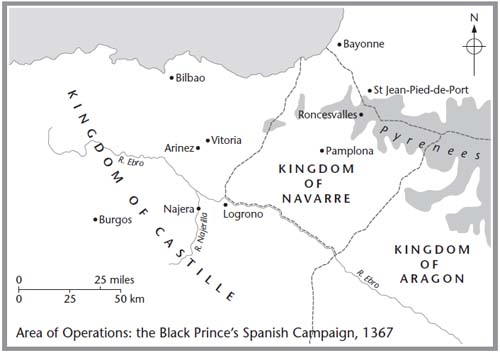
If the English were to support Pedro with an army from Aquitaine, then they would need to cross the Pyrenees, and that meant getting Charles of Navarre, who controlled the mountain passes and could easily close them, on their side. This was achieved by Pedro promising him Castilian territory that would allow Navarre an outlet to the sea and a cash grant of £20,000. As Pedro had no money and little of value save the crown jewels that he brought with him when he fled from Castile to Bayonne and threw himself on the Black Prince’s mercy, the money was lent to him from the coffers of Aquitaine. In Castile, Enrique, now that he was on the throne, saw no need to retain the huge and expensive army that had put him there, so he paid off the free companies except for du Guesclin’s Bretons and a force of around 400 English archers commanded by Sir Hugh Calveley. With their severance pay in their knapsacks, the companies either returned to Aquitaine, where they promptly took service with the Black Prince’s army – they had been well paid to put Enrique on the throne and were quite happy to be well paid to knock him off it – or headed east into Aragon, where there was employment in guarding the frontier area against Castilian incursions.
When Enrique heard from French spies that the Black Prince was marshalling an army to come against him, he realized that neither Calveley nor his archers would fight against the Black Prince. But if he could prevent the English from getting into Spain, he would be safe, so, at some time around Christmas 1366, he approached Charles of Navarre, who was persuaded to turn his coat by Enrique’s promise to match everything that Pedro would give him, with the added bonus of the fortress town of Logrono and £11,000 in cash. Satisfied that the invasion would not now take place, Enrique paid off Calveley, which was sensible, but also du Guesclin’s Bretons, which was not. Once the Black Prince heard the news that Navarre was now in Enrique’s pocket, his immediate reaction was to send messengers to Sir Hugh Calveley, who was in northern Castile on his way back to Aquitaine, ordering him to invade Navarre from the south. This put the wind up Charles of Navarre to the extent that he personally hastened to meet the Black Prince to explain that it had all been a most unfortunate misunderstanding and that he would of course support the cause of Pedro and supply a contingent of 400 men-at-arms.59 Once Enrique realized that the passes would not, after all, be closed to the English, he hastily recalled du Guesclin and any mercenary troops that he could contact.
In mid-February 1367, the prince’s army of around 8,000 men started its march up the traditional invasion route from Saint-Jean-Pied-de-Port through the pass of Roncesvalles. Roncesvalles can be treacherous even in summer, and now it was the middle of winter, with thick snow, temperatures well below freezing, and not a blade of grass for the horses nor an ear of corn for the men to be found. It says a very great deal for the logistic arrangements of the army that they traversed the pass and reached the plains north of Pamplona in good order. We do not know the names of the quartermasters who worked out how much fodder and rations needed to be carried, and who hired the mules and the carts to transport it, but, with experienced men like Sir John Chandos, Sir Robert Knollys and Sir William Felton,60 it was an army well accustomed to campaigning in difficult terrain and in foul weather. From Pamplona, the Black Prince’s objective was Burgos, the capital of Castile which sat on the main communication routes north and south. Enrique did his best to block the river crossings, but by March the English had reached the plains before Vitoria.
The Black Prince hoped for a decisive battle at Vitoria. The army was arrayed in battle formation and various challenges were sent out, but, if Enrique had not fought the English in France,61 du Guesclin and his French officers certainly had and their advice was bolstered by a letter from Charles V of France, who advised Enrique that he should on no account be tempted into a set-piece battle, which the English would win, but rather that he should delay until the English ran out of food and fodder and had to retreat. What the Castilians could do was fall upon patrols and scouts, and it was in one of these minor skirmishes that Sir William Felton was killed. He was in command of a foraging party of around 300 mounted men-at-arms and archers west of Vitoria when he was surprised by a much larger French force. Taking up a position on a knoll near the village of Arinez, Felton’s little group held off all comers until Felton was killed and the archers ran out of arrows, whereupon they had to surrender. For centuries afterwards, the knoll was known as Inglesamendi – the Hill of the English.62
The advice to Enrique not to force a battle was sound, and sure enough, in mid-March, the Black Prince had to move, heading south-east and then south-west to approach Burgos from the east, reaching Logrono on 1 April 1367. But politics forced Enrique’s hand. Towns and fortresses on the English approach route were declaring for Pedro; there were mutterings in the ranks of the army, from the Castilians who thought Enrique was behaving in a cowardly fashion, and from the French and the mercenaries who wanted a battle so that they could be paid. Against all his better judgement and against du Guesclin’s strongly worded urgings, Enrique decided to fight, for, if he did not, he would forfeit his throne by default as the population increasingly turned to Pedro.
The Trastamaran army took up a blocking position east of the village of Najera on the main road to Burgos. In front of them was a tributary of the River Najerilla, which flows into the Ebro to the north, while behind them was the Najerilla itself and then the village. There was one narrow bridge over the Najerilla, and to the west of the village there was (and is) a line of sandstone cliffs, difficult to scale without weapons and armour, impossible with them, and lacking any route for a horse. It may be that Enrique, or more probably du Guesclin, chose the position for the very reason that the army would thus find it difficult to run away. It was in any event a good defensive position for an army that was probably outnumbered by that of the Black Prince, who would have to attack – and thus reduce the effect of the archers – if he wanted to force the road to Burgos. But the prince had no intention of doing what his enemy wanted. Well before first light, the army left Logrono and made a wide flank march to form up on the north (left) flank of the Franco-Castilian line. The first indication the troops of Enrique had that the English were anywhere in the vicinity was when they saw banners and pennants fluttering away a few hundred yards on their left.
Du Guesclin desperately issued orders to the whole army to swing round to face north, while the English dismounted and formed their usual line of men-at-arms with the archers on the wings. The left-hand French division managed to wheel round reasonably quickly, but in the rest of the army panic set in, with the second division dissolving into a mass of men running for the village, while some of the Castilian light cavalry decided to desert to the English. Du Guesclin realized that he had no option but to abandon any idea of standing on the defensive: his only chance was to attack the English and hope that his men could run the gauntlet of the arrow storm. They could not. The Castilian heavy cavalry refused to dismount and paid the penalty in dead, wounded and maddened horses, while the light infantry could not stand. The whole thing was over in a matter of minutes, with fleeing Frenchmen and Castilians trying to get across the one bridge over the Najerilla and trampling and crushing each other in the process. The English rearguard slaughtered them as they were trapped by the river or struggled to reach the bridge, which was now blocked by the bodies of their own men. It was a complete rout, with du Guesclin and nearly all the senior commanders captured. The next morning, the heralds claimed to have counted over 5,000 bodies of Enrique of Trastamara’s men. English losses were negligible.
Now began the accounting for prisoners and the calculation of ransoms. Many of the prisoners, du Guesclin and Marshal Arnaud d’Audrehem among them, had been captured by the English before and had not paid the ransoms promised then, and some heated discussion ensued. Enrique himself had not been captured – although unhorsed, he had fled on a horse taken from one of his knights, and eventually crossed the border into Aragon and got away into France. For Pedro the matter of who owned which prisoner was academic – he wanted to slaughter the lot as being the sure way to prevent any further trouble from them. The Black Prince demurred: the prisoners belonged to those who had captured them, who were in turn entitled to the ransoms, and in any case the knightly code prevented the killing of prisoners – or at any rate the killing of rich prisoners.
The Spanish campaign culminating at Najera was a spectacular success militarily: a professional English army had crossed inhospitable terrain in the depths of winter and once again had defeated a French-sponsored enemy with few casualties of its own. Politically and economically, however, it was a disaster. Pedro began to renege on all that he had promised; he failed to hand over the Basque country around Bilbao, he was unable or unwilling to pay for the cost of the campaign, as he had agreed, and he could not even repay the loan made to him to buy off Charles of Navarre. Most of the Castilian knights had no intention of paying the ransoms promised, and in some cases legal arguments in the courts of Castile and Aragon went on for years. In the event, Pedro’s Spanish practices did him no good at all, for only two years later he was again dethroned and murdered, stabbed to death by Enrique of Trastamara himself, who was helped by those whom Pedro had failed to have executed after Najera. From 1369, Castile with its navy was therefore firmly in the French camp.
If Pedro was not going to keep his word and pay for the campaign that restored him, then the Black Prince would have to raise the money from Aquitaine, where there were already grumblings about the expense of maintaining what was seen as his lavish court in Bordeaux. As even higher hearth taxes (roughly equivalent to rates or a form of poll tax) were announced, some in the population began to wonder whether being protected from French occupation was worth the cost. Some of the Gascon magnates decided, rather shrewdly, to appeal to the French king Charles V against the hearth tax. To allow such appeals was entirely contrary to the Treaty of Brétigny, so for the moment Charles simply collected the appeals without doing anything about them. In the meantime, he was restocking the French treasury – the extra taxes imposed to raise the ransom for his father were retained – and building up an army.
By January 1369, Charles was ready to make his move: he announced that he was going to hear appeals against Edward’s taxation policies, and, when challenged that this contravened Brétigny, he replied that France had never ratified the renunciation of sovereignty over Aquitaine. King Edward, more politically aware than his son, advised the prince to drop the hearth tax, but Prince Edward could see no other way of restoring his finances. When in June 1369 war broke out once more and Charles announced that he had ‘confiscated’ Aquitaine, the Black Prince was both furious and caught by surprise. He was in any case incapable of taking the field personally, as he had contracted some sort of disease – possibly dysentery, possibly malaria, possibly both and possibly while campaigning in Spain – which had led to further complications and necessitated him being carried everywhere in a litter.
Charles V had taken note of the lessons of Crécy and Poitiers, and well understood that to fight the English in open battle was to lose. Rather, he instructed his commanders, including Bertrand du Guesclin, whom he appointed constable of France in 1370, to whittle away at English power by selective targeting and what in modern parlance would be called guerrilla warfare. Towns with only a small English garrison could be attacked, foraging parties ambushed, supply convoys destroyed, and inhabitants persuaded, bribed or coerced into changing sides. The English did not have the manpower to put garrisons large enough to hold out in every town, and the only answer was to resort to the chevauchée. Sir John Chandos was recalled from his estates in Normandy but was killed in January 1370 in a skirmish at Lussac-les-Châteaux. He was wearing a long surcoat and slipped on the frozen ground. He was either not wearing a helmet or, if he was, had the visor up, and a French esquire stabbed him in the face. His was a serious loss as not only was he a highly competent military commander and strategist, but he was also well liked in Aquitaine and noted for his diplomacy. John of Gaunt led an expedition through Normandy, but, while he created a great swathe of destruction, he met no French armies. Sir Robert Knollys burned and plundered his way to the very gates of Paris, but still Charles avoided battle and Knollys could only retire.
In the same year, 1370, the citizens of Limoges transferred their allegiance to the French, a move that particularly incensed Prince Edward, as their leader, the bishop of Limoges, was godfather to the prince’s son and had always been considered a personal friend. Such betrayal could not be tolerated and the Black Prince’s army of over 5,000 men (according to Froissart, but probably nearer 3,000) laid siege to Limoges. After a month of mining and counter-mining, the English collapsed the walls and the soldiers poured in. The prince from his wheeled litter ordered a massacre of the population. As the contemporary chronicler puts it:
Men, women and children flung themselves on their knees before the prince crying ‘have mercy on us gentle sir’. But he was so inflamed with anger that he would not listen. Neither man nor woman was heeded but all who could be found were put to the sword including many who were in no way to blame. I do not understand how they could have failed to take pity on people who were too unimportant to have committed treason. Yet they paid for it, and paid more dearly than the leaders who had committed it... more than three thousand people were dragged out to have their throats cut.34
They had indeed paid more dearly than their leaders,63 for many of the nobles who had instigated the change of allegiance were allowed to surrender and were subsequently ransomed, while the bishop of Limoges, who should in all conscience have suffered a traitor’s death, was handed over to the (French) pope. The numbers of the slain may, of course, have been wildly exaggerated, but, if the slaughter did happen, it lends weight to the theory that it was the French who coined the nickname ‘the Black Prince’.
But, although Limoges had been recovered, at least for the time being, English France was falling fast. In 1371, the Black Prince, now crippled by his illness, returned to England, leaving John of Gaunt as ruler of Aquitaine and the other English territories, but he could not stop the rot either, and, as the husband of the daughter of Pedro the Cruel, he was particularly disliked in Castile by the ruling Trastamara faction. In 1372, du Guesclin marched into Poitiers when the citizens threw open the gates in defiance of the English garrison commander, and La Rochelle fell when blockaded by the Castilian fleet and attacked on land by du Guesclin. The last real opportunity to recover the situation came when King Edward mustered an army of 4,000 men-at-arms and 10,000 archers to be transported to France in 400 ships from Sandwich in August 1372. Although Edward was old, ailing and in the grip of a greedy mistress,64 he himself embarked, as did the Black Prince, who was carried on board on a stretcher, but the weather conspired against them. The fleet spent weeks being buffeted to and fro and was never able to make landfall until eventually, after the ships had been blown back to England yet again, the adventure was called off, at enormous cost.
The following year, John of Gaunt mounted another chevauchée from Calais, and, although he created a great band of devastation through central France as far as Bordeaux, he lost most of his horses through hard riding and lack of fodder without meeting a single French army, du Guesclin contenting himself with cutting out foraging parties, stragglers and small patrols. By the end of 1373, most of Aquitaine had gone, with only the county of Guienne, around Bordeaux, and the coastal strip as far as Bayonne holding out. The French had overrun most of Brittany, whose duke had taken refuge in England, although they could not take Brest, which remained firmly in English hands, while in the north only Calais and a few garrisons in Normandy remained of the great holdings confirmed as a result of the Battle of Poitiers. The French tactic of guerrilla war and piecemeal reduction was working, but the task of invading Guienne was formidable and, despite increasing French and Castilian strength in the Channel, Calais, supplied by English ships, could hold out for far longer than Charles V wanted to spend on a siege. In 1375, negotiations for a truce began.
On Trinity Sunday, 7 June 1376, the Black Prince died in England at the age of forty-six. Had he escaped the illness that killed him, he would surely have been as great a king as his father, who followed his son to the grave a year and two weeks later. By the time of his death, Edward III was sixty-five years old and senile, cantankerous and losing much of his earlier popularity. Nevertheless, he was a great king, perhaps one of our greatest: he had dealt with Scotland, recovered English lands in Europe, presided over a genuine revolution in military affairs, renewed faith in government after the unstable years of his father and then of his mother and Mortimer, stabilized the currency, expanded English trade, and made England a power to be feared and respected. That it all began to fall apart in his later years does not detract from his essential greatness.
England has always been at her weakest when there is a disputed succession, an incompetent monarch or a child king. The successor to Edward III was the ten-year-old second son of the Black Prince (the older son, another Edward, had died in 1369 aged six), Richard of Bordeaux, who would reign as Richard II. The real power was to be exercised by a council, chosen from Lords, Commons and Clergy, until Richard came of age, with the whole edifice supervised by the king’s uncles, John of Gaunt and the younger earls Edmund of Cambridge and Thomas of Buckingham. Gaunt was frequently suspected – then and later – of harbouring ambitions for the throne himself, and, had primogeniture for the English succession not been firmly established by then, he would surely have succeeded. All the evidence, however, shows that he was a genuine supporter of royal legitimacy and of his nephew, whose magnificent coronation he arranged, at enormous expense.
Despite the wishes both of the ruling council of England and of the French king Charles V for some form of truce, there were too many vested interests in mayhem and murder for fighting to stop completely. While there were no great battles for the next few years, raids, sieges and encounters at sea went on, and, although the English no longer got the best of all these skirmishes, the seemingly unstoppable French advance was slowed and then halted. The efforts of those wishing a permanent peace suffered a setback when the French pope Gregory XI died in 1378 and the conclave of cardinals elected an Italian, Bartolomeo Prignano, as Urban VI. The French refused to accept his election and put forward their own candidate, Cardinal Robert of Geneva, who, although Swiss by birth, had spent most of his time in France, and acclaimed him as Pope Clement VII. Thus began the Great Western Schism, with Urban in Rome recognized by England and Clement in Avignon supported by France and Scotland. Previously, while the popes were regarded with great suspicion by the English, they did at least provide a forum for peace negotiations, but now with the schism that option was gone and there was no professedly disinterested single body to act as a go-between.
Richard II was in many ways a tragic figure. As the younger son, he would not have been raised to be king, and, although his mother had considerable (and generally beneficial) influence on his early education and subsequent development, he had little contact with his father, who was frequently away on campaign, and his senior uncle, Gaunt, was unpopular in the country. This unpopularity was, of course, partly engendered through envy: the dukedom of Lancaster was immensely rich and in many aspects was independent of the central government. But Gaunt’s frequent quarrels with various bishops (usually over the question of sanctuary in churches),65 his obvious disdain for public opinion, and his lack of charisma (perhaps surprising given his genes) as a military commander did not help his reputation.
It was an unfortunate start to the reign that the truce negotiated in 1375 ran out only a few days after Richard’s accession. It was even more unfortunate that the French had used the brief peace to prepare for war, by embarking on a major ship-building programme based in Rouen, while the English, short of money, had been much less energetic. In the summer of 1377, French fleets, aided by the Castilian galleys of Enrique, raided the English Channel ports from Rye as far as Plymouth. They would land, loot what they could, set fire to anything that looked as if it might burn and set sail again. They landed on the Isle of Wight and extracted a ransom before departing; attacked Southampton, where they were bloodily repulsed by local forces under Sir John Arundel, a younger son of the third earl of Arundel; raided Poole; and tried (and failed) to effect a landing in Folkestone. On the continent, the French admiral Jean de Vienne blockaded Calais by sea while the duke of Burgundy laid siege on land. Fortunately for the Calais garrison, commanded by Sir Hugh Calveley, although some of the outer defences fell, bad weather and heavy rains made mining and the movement of siege engines impossible and the French withdrew, giving Sir Hugh an opportunity to sally out, attack Étaples further down the coast, and remove the large quantities of wine stored there. Meanwhile, in the Dordogne, the duke of Anjou was steadily reducing English-held towns. He captured the seneschal of Aquitaine, Sir Thomas Felton, father of the Sir William who had been killed in Spain, and threatened Bordeaux, only to have to turn back when he found pro-English forces in his rear. Brest was under siege, but was reinforced from England in January 1378, although English attempts to capture Saint-Malo and to initiate a campaign in Normandy failed.
Then, later in the year 1378, an opportunity to hit back at the French by proxy presented itself when Charles of Navarre re-entered the frame. Charles had once again fallen out with Charles V of France, for much the same reasons as Edward III had with French monarchs over Aquitaine: Charles of Navarre was a king in his own right, but also held Navarre as a vassal of the French king, and, when Charles of France declared Navarre forfeit, Charles of Navarre appealed to England. The council was very happy to support Charles of Navarre on the grounds that any enemy of France was a friend of England, and contracted to send 1,000 men for a period of four months, in exchange for the port of Cherbourg. This was agreed and the English duly occupied Cherbourg.
By the time the English army arrived in Navarre, however, delayed by bad weather and shortage of shipping, the situation had been resolved. Enrique of Castile had invaded Navarre on behalf of his French ally, but, when he heard that an English army had landed in Aquitaine and was on its way, he wisely withdrew. As the English troops, under Sir Thomas Trevet, who was at this time only in his late twenties but had fought for the Black Prince at Najera, were no longer required to defend Navarre, they embarked on a foray through Castile, reducing numerous Castilian towns, damaging Enrique’s reputation considerably and acquiring large quantities of booty before returning to England. Charles of Navarre, meanwhile, made his peace with the French, who retained the Navarrese lands in Normandy. While the tactical achievements of Trevet’s expedition were minor, the acquisition of Cherbourg was a major strategic gain: along with Brest, Bayonne, Bordeaux and Calais, England now had an outpost line of strongly fortified ports with which to counter French naval ambitions and which could serve as springboards for invasions of France.
Charles of France, having at least gained the Normandy possessions of Navarre, decided to try the same ploy in Brittany, and in 1379 declared that he was confiscating that duchy. This time he went too far and the Bretons, touchy about their independence and with no wish to be part of France, took up arms and demanded the return of Duke John from England. Having secured a promise of English military support, John returned to Brittany, where he was welcomed with acclamation at Saint-Malo. The English army to support him had been agreed at 2,000 men-at-arms supported by the same number of archers for four and a half months from 1 August, but, when the English council discovered that they could not afford to pay and transport so many, the size of the contingent was reduced to 650 of each arm.66 They were to be under the overall command of Sir John Arundel, the defender of Southampton, who had been part of the relieving force sent to Brest in 1377 and was in Cherbourg in 1378.
The troops duly mustered at Southampton, but the weather and problems in finding troop transports delayed their departure and Sir John is said to have billeted his immediate retinue in a convent, dismissing the mother superior’s protests that the presence of such a large number of young men might lead to ‘an unforgivable sin which would bring shame and disgrace to the nunnery’.35 The unforgivable sin duly occurred. Arundel did nothing to stop it (commanders of other units in the area managed to keep their men under control), and it extended to the soldiery looting the silver from a local church and generally behaving like their modern successors on a Saturday night in a garrison town. When ships were finally found, Arundel’s men took some of the nuns along with them, no doubt to sew on buttons during the journey, and divine retribution caught up with them when a violent storm raged in the Channel. Most of the ships carrying horses sank, either off the coast of Cornwall or off Ireland, and in an effort to lighten the troop-ships the men are said to have thrown most of the nuns overboard. When that had no effect, the ladies were followed by the accumulated plunder of Hampshire. Arundel’s own vessel ran aground off Ireland in December and he was drowned. Sir Hugh Calveley and most of the other captains survived.
While the French assault on what was left of English France had been halted, lack of coordination between the various expeditionary forces on land and at sea meant that much of the expenditure on men, ships and weapons was to no great purpose. When Edward III was alive, there was a strong king who made decisions, supported by an administration that could carry them out. Now rule was by committee, never a recipe for strong government, and, although decisions were made in the king’s name, they were too often a distillation of conflicting opinions resulting in weak compromise. Dissatisfaction with the way the war was being conducted and the tax burden imposed to pay for it eventually boiled over in 1381.
The catalyst was the decision in June 1380 to send another expedition to help the duke of Brittany. The king’s uncle, the twenty-six-year-old duke of Buckingham, would be in command with around 5,000 soldiers, probably 3,000 men-at-arms and 2,000 archers, all to be mounted. Given the difficulty of finding enough ships and the ever-present threat of storms in the Channel, the troops would be ferried by the most direct route from Dover and Sandwich to Calais, from where they would make a chevauchée to link up with Duke John at Rennes. On 24 June, the army marched from Calais, creating the usual swathe of destruction as it went across the Somme, to Rheims, south of Paris, and then to Rennes, but without meeting a single French army, Charles V having instructed his commanders that on no account were they to offer battle. Buckingham was now running short of money, and a request was sent back to England asking for sufficient funds to maintain the army throughout the winter and to continue campaigning in the spring. At home, the treasury was empty and, after much argument, it was decided by Parliament that the government’s demand for £150,000 – to cover the expenses of Buckingham’s army and the maintenance of the fortress ports (where the garrisons had not been paid for months), with possibly a little to be secreted for John of Gaunt’s ambitions in Spain and Portugal (he intended to pursue a claim to the throne of Castile by reason of being married to Pedro the Cruel’s daughter) – was too much. They would agree to find £100,000: two-thirds from the laity and one-third from the church. And then Charles V died, Duke John came to terms with his successor, and Buckingham’s army was left high and dry with no option but to go home. It was to be the last major English expedition of the fourteenth century.
In England, the imposition of yet another poll tax caused widespread discontent. It had last been levied in 1377, when the amount was graded according to rank and ability to pay, with the basic rate being one groat or four pence. Now it was to be a flat rate of one shilling – three times as much and with no concessions according to income. Since the death of Edward III, there had been a number of levies but with very little to show for them: English possessions in France were being whittled away, the seas were no longer safe, and, despite the huge reduction in population caused by the various outbreaks of plague, many magnates were insisting on the imposition of manorial rights and duties that were no longer relevant nor seen to be fair. When the time came to collect the tax, there was widespread avoidance, evasion and fraud, with householders hiding their wives and children or taking to the woods to avoid the commissioners or simply refusing to pay. In May, a commissioner was set upon in Essex, and, when the Chief Justice of Common Pleas was sent to investigate, he too was set upon. By the end of the month, widespread rioting had broken out in Essex and in early June it had spread to Kent. There had often been outbreaks of local indiscipline in the past, but they had always been contained; this time it was serious, the most serious attack on authority in England of the fourteenth century. As usual the rebels were blaming the king’s evil counsellors and, under the watchword ‘King Richard and the True Commons’, they demanded the heads of those they called traitors. With the army still away in France or on the Scottish borders, it was a good time to stage a revolt, and the government was slow to react.
Although these events are known to history as the Peasants’ Revolt, the name is misleading. While many of those who embarked on widespread hooliganism were indeed peasants – probably the majority – a great number were tenant farmers, small-holders, owners of land in their own right and local government officials – jurors, reeves, bailiffs and constables. There must also have been large numbers of demobilized archers in their ranks. The fact that the various rebel groupings were able to communicate with each other and were reasonably well disciplined would indicate that there were enough men of education and accustomed to leadership to provide a cadre of officers of sorts.
As disorder and rebellion spread, the king, the royal family and the king’s counsellors took refuge in the Tower. One of the party was the king’s cousin, Henry Bolingbroke, son of John of Gaunt, who was the same age as the king and who would eventually supplant him and rule as Henry IV. The king was persuaded to meet the rebels, who were now in the London suburbs with the gates of the city closed against them, and on 13 June the king left the Tower by barge and was rowed downriver to Rotherhithe. There he addressed the rebels from the boat, his advisers having considered that it was too dangerous for him to disembark. The demands of the rebels were presented to the king: the heads of John of Gaunt, the Chancellor (the archbishop of Canterbury), the Chief Justice and the Treasurer – to which the king gave the diplomatic reply that they should have whatever heads they liked subject to the law, whereupon he was rowed back to the Tower.
The rebels were now running out of supplies and the obvious place for them to get them was London. Moving along south of the river, they looted the archbishop’s palace at Lambeth and released the occupants of Southwark prison. Then, despite the orders of Lord Mayor Walworth, somebody lowered the drawbridge over London Bridge and opened the gate. The rebels poured in and – their movements clearly organized – looted John of Gaunt’s Savoy Palace and the lawyers’ offices at the Temple, released prisoners from the Fleet and Newgate, and, almost inevitably, slaughtered any foreigners (mainly Flemings) who could be found. The king could only watch form the Tower as the plumes of smoke rose over the city. By this time, the acknowledged leader of the revolt was Walter the Tiler, or Wat Tyler, whose origins are obscure. He may have been from Kent or from Essex, his home may have been in Maidstone or in Colchester, and he was probably indeed a tiler, although there are suggestions that he may have been of the Kentish gentry.
The king agreed to meet the rebels again, at Mile End on 14 June, and now their demands went way beyond just the heads of those whom they disliked. There were political issues too: the abolition of serfdom and villeinage, a fixed rent of fourpence an acre for land, equality of all men below the king (abolition of the lords and knights) and an amnesty for all involved in the revolt. The king announced that he would grant all the demands and returned to the Tower, to discover that during his absence another group of rebels had forced entrance, dragged out the Chancellor, Archbishop Sudbury, and the Treasurer, Sir Robert Hales, and beheaded them both on Tower Hill. Henry Bolingbroke was fortunate not to have suffered the same fate. Whether the murders were at the instigation of Tyler, who may or may not have been present at Mile End, we do not know. Most of the rebels now dispersed and began to make their way home, satisfied that the king had granted their demands, but a hard core including Tyler remained, and the king agreed to meet them the next day at Smithfield.
On Sunday, 15 June, the king rode out from the Tower, escorted by 200 mounted men-at-arms, some of his household and the Lord Mayor. At Smithfield, the king’s party lined up at one end of the field and the rebels at the other. Tyler was summoned to speak to the king and rode across the field on horseback. What happened then is disputed and depends on which chronicler you believe. Tyler may or may not have got off his horse. He may have seized the king’s hand, called him ‘brother’ and failed to remove his hat. He may have added to the previous day’s demands the disestablishment of the church and the abolition of the offence of outlawry, and he may have demanded a flagon of wine to quench his thirst. He may have drawn a dagger and threatened the Lord Mayor, or he may have been accused of being a thief and a knave by a squire of the king’s household. Alternatively, it may have been the intention all along to arrest or kill Tyler, a plan to which the king may or may not have been privy. What is not in dispute, though, is that Tyler was stabbed, probably by Mayor Walworth, and fell to the ground. Some of his men, former army archers, seeing their leader felled, strung their bows, whereupon the young king, showing considerable courage (or perhaps, given he was a spoilt child, it never occurred to him that he might be in danger and he simply had no fear), cantered over to them, drew his sword, and invited them to look upon him as their captain and to follow him to Clerkenwell, where he would grant them all that they had asked. The rebels set off to Clerkenwell and the king and his escort made their own way, while Mayor Walworth may or may not have galloped back to the city and called out any available soldiers, knights and citizens accustomed to bearing arms. The resulting group, numbering 1,000 according to Walsingham but probably several hundred, set out for Clerkenwell, where they may or may not have surrounded the rebels and forced them to drop their weapons, or the rebels may have simply been persuaded to go home and escorted to the city gates by knights of the king’s household. What is not in doubt is that the dying Tyler was rushed to Tyburn and hanged under the auspices of the Lord Mayor.
With the death of Tyler and the dispersal of the rebel armies that had converged on London, the revolt collapsed, although mopping up took a little longer. Initially, it was the government’s intention to promote reconciliation. There were few executions and, as a result of legal arguments over what exactly defined treason, those that were carried out were mainly for felony, until there was a renewed flaring up in Essex. This time, there would be no mercy and anyone remotely suspected of rebellion was tried and hanged or beheaded. The king did not, of course, keep any of his promises to the rebels, and the lesson of successful deceit was not lost on him, nor did he fail to notice the rebels’ touching faith in him personally. Although the king avoided having to grant concessions on this occasion, later in his reign there was some reform of the administration, forced upon him by the members of Parliament and the money-granting power that they and they alone had, one which they guarded jealously.
In France, too, there was revolt caused by excessive taxation, but ruthless and immediate action by the duke of Burgundy put it down. However much some elements in both countries wanted to continue the war, neither could afford to do more than engage in inconclusive skirmishes at sea, and a threatened French invasion of England in 1386 was called off because of bad weather and an exaggerated French view of the reception that they might get.67 While a continuance of the war by England would undoubtedly have been attractive to her soldiers, who saw it as the only way to make a name and a fortune, it had cost the treasury dear: shipments of wool or wine could now only be carried in armed convoys, which made them hideously expensive, and the pay of the garrisons in English France was reduced to an extent that the men had to rely on ransoms and extortion to survive. That ransoms and extortion were a good source of income is evidenced by the fact that desertions and mutinies as a result of the reduction in pay were very few.
Richard II was now growing up and increasingly resenting the control exercised by the various councils established to govern the realm. When his uncle Gloucester and the earl of Arundel demanded the sacking of the chancellor Richard de la Pole, earl of Suffolk, because of his disastrous foreign policy – one which had failed to prevent the French gaining control of Flanders and had lost England the support of John of Brittany – the king arrogantly said that he would not dismiss a scullion from his kitchen on their say-so. When Gloucester reminded the king that monarchs had been deposed before and pointed to the case of his own grandfather, Edward II, Richard then overreached himself by saying that his subjects were in rebellion against him and he would ask his brother the king of France’ to aid him. But, rather than instigate outright opposition, Richard now backtracked; Suffolk was dismissed and impeached, and a new council with Gloucester and Arundel as leading members was installed. Nonetheless, Richard’s insistence on the appointment of court favourites to lucrative offices and his failure to prosecute the conflict with France very nearly led to civil war, with Gloucester, Arundel and their associates and armed retinues on one side and the king and soldiers paid by him personally on the other.
The Lords Appellant,68 as the opposition termed themselves, won the only battle, at Radcot Bridge in December 1387, and the following year the so-called Merciless Parliament sentenced five of the king’s friends to suffer the death of traitors, with the full panoply of drawing, hanging and quartering. However much they may have deserved it, theirs was judicial murder all the same and the king would have his revenge – but not just yet. His first move came the following year, 1389, when he announced that henceforth he would reign in his own right, which, at the age of twenty-two, he was fully entitled to do. He was crafty enough not to change many of the court appointments that the Lords Appellant had forced upon him, nor to upset the lords themselves. With the national coffers empty, the crown jewels pawned, large loans due to be called in and Scottish raids on the increase, Richard desperately needed to bring the war with France to a close. He needed peace and genuinely seems to have wanted it, and this view was shared on the other side of the Channel. So, in 1389, a temporary truce was agreed while negotiations for something more permanent could take place. England gave up Cherbourg and Brest, which brought murmurings from the Lords Appellant but did not disturb a sort of peace that endured for the next few years. During this time, Richard made his court as glorious – and as expensive to finance – as any in Europe and quietly began to recruit soldiers, mainly from Cheshire, who wore his livery of the white hart badge rather than the accepted English cross of St George.
In 1396, Richard married for the second time (his first wife, Anne of Bohemia, whom he married in 1382, had died in 1394). The bride was Isabel, the nine-year-old daughter of Charles VI of France, and during the marriage ceremony at Calais Richard made a statement repugnant to all levels of English society. He promised that he would work with the French to depose Pope Urban and have Pope Clement at Avignon recognized as the only legitimate heir to the keys of St Peter. In England, there was outrage, not only among the clergy, who saw themselves abandoned by their king, but also among the laity, who saw it as playing into French hands. Richard cared not a jot. His dowry from the French on marriage was £170,000, enough for him to recruit even more soldiers and take the next step to avenge the deaths of his friends nine years previously. In July 1397, he ordered the arrest of Gloucester, Arundel and Warwick, the senior members of the Lords Appellant. Gloucester was conveyed to Calais and quietly murdered, probably by smothering – he was, after all, the son of a king – while Arundel, Warwick and their adherents were tried before Richard’s equivalent of the Merciless Parliament, with John of Gaunt presiding. In September, Arundel was sentenced to death and executed, while Warwick was awarded life imprisonment. Henry Bolingbroke, Gaunt’s son, had at one stage joined the Lords Appellant, but, although he had been pardoned on the grounds that he had moderated their demands, he was now seen as a potential threat and exiled, banished for ten years.
Opposition grew as Richard’s rule descended into a tyranny of disregard for the laws and customs of the realm and the raising of forced loans to fund ever more extravagance at court. The king insisted that he ruled by God’s will and not by leave of the people and adopted the title ‘majesty’ – never before used by an English king. John of Gaunt had himself raised no objection to the fate of his brother Gloucester, nor to the exile of his son, at least not in public, and, as far as we can tell, he remained a loyal supporter of the crown to the end – although what he might have told his son and how he may have advised him can only be supposition. Then, in 1398, Richard at last got what he wanted and needed in his foreign relations, when a twenty-eight-year truce was agreed with France. But, after John of Gaunt’s death the next year, the king finally went too far: he extended Henry Bolingbroke’s banishment from ten years to life and confiscated the duchy of Lancaster with all its castles, lands and titles. This was the final straw for the magnates, for, if the king could do this to the duchy of Lancaster, whose lands might be next? Unaware, or uncaring, of the reaction in the country to his arbitrary actions, Richard set off for Ireland – that unhappy country was once more in a state of unrest – and Henry Bolingbroke saw his chance. He had spent much of his exile in Paris, and elements of the French nobility were more than ready to help and support him. With only about fifty personal retainers, fellow exiles and men-at-arms, Henry took ship at Boulogne sometime in June 1399, having given out that he was off on a pilgrimage to the Holy Land, and landed somewhere in the Humber estuary at the end of the month.
As Henry moved through Yorkshire, knights and magnates declared their support for him and joined him with their retinues. At this stage, he does not seem to have had any intention of deposing Richard, only of regaining his Lancastrian heritage and removing Richard’s ‘evil counsellors’. Once the earl of Northumberland and his son, Henry Percy or ‘Hotspur’, came over to him, Henry was assured of the support of the north. With the defection of Edmund, duke of York – the king’s uncle and regent during his absence in Ireland – and the submission of the Ricardian stronghold of Chester without a fight, Richard’s spies knew that the situation was serious. In Ireland, the king was indecisive, and even when ships were found to embark his army, he changed his mind about the port of departure, and the unloading and then loading of men and horses wasted more time. Eventually, Richard landed in Wales and his soldiers began slipping away. With a few trusted advisers he took refuge in Conway Castle, and, when the earl of Northumberland arrived as Henry’s emissary, the king was persuaded to give himself up and was taken to London and lodged in the Tower.
At some stage, probably when the duke of York had gone over to him, Henry elected to aim for the throne itself, rather than just regaining what he considered to be his rightful due. Knowing how duplicitous Richard could be, he presumably decided that he could not risk leaving Richard on the throne plotting revenge, but the question was how to assume the crown in a manner that could be portrayed as legal. The deposition of Edward II was not a true precedent, as he had been replaced by the next in line, his son Edward III. Richard’s immediate heir was not Henry but another cousin, the eight-year-old Edmund Mortimer, fifth earl of March, whose mother Philippa was a daughter of Lionel of Antwerp, Edward III’s second son, whereas Henry was the son of the third son. As the English claim to the French throne was based on inheritance through the female line, Edmund’s claim could not be dismissed on those grounds, and the justices strongly advised Henry against claiming the throne by right of conquest, this being quite the wrong message to send to other potential usurpers. Eventually, on 29 September 1399, Richard’s twenty-two-year reign came to an end when he was persuaded to relinquish the crown to Henry, although there was much legal fudge to justify it. Henry was acclaimed by Parliament and duly crowned on 13 October – he would reign as Henry IV. Richard was despatched to the Lancastrian stronghold of Pontefract.
Sometime in December, a conspiracy to restore Richard was discovered. Of the chief plotters, Salisbury was lynched by a mob in Gloucester, Despenser murdered in Bristol, and Huntingdon caught and beheaded in Essex. As long as Richard lived, he was bound to be the focus for those who opposed the new regime, and, like Edward II’s, his demise would be convenient, and the sooner the better. Only one chronicle suggests that Richard was murdered, by being hacked into pieces; others variously claim that he was starved to death by his jailers, that he deliberately starved himself or that he died of grief. His corpse was removed from Pontefract to London, and, as there were regular stops on the way so that it could be exhibited to the public, the hacked-into-pieces theory can be discounted. Nobody actually dies of grief and, as death by starvation, whether forced or self-inflicted, can take an inconveniently long time, we may reasonably suppose that Richard II was done to death in the usual way when the body of a high-born personage must be exhibited – by suffocation. And, as it was in Henry IV’s interests that Richard should die, we may suppose that he ordered it.
The death of Richard II ended a period of vacillation and weak government which precluded any serious resumption of the campaign to realize the cause of English France. On the face of it, Henry IV – young, healthy, outgoing and popular – was just the man to revive it, but events were to take a different turn and it would be another generation who reignited the flame of English conquest.

King Henry IV from his tomb in Canterbury Cathedral. In a (presumably unintended) touch of irony it is opposite that of the Black Prince, for the death of whose son (Richard II) Henry was almost certainly responsible.