
A Frankish principality in central Greece, established after the overthrow of the Byzantine Empire in 1204 by the Fourth Crusade (1202-1204).
The conquest of central Greece by a small army under Boniface, marquis of Montferrat, took place between October 1204 and February 1205. The Greek chronicler Niketas Choniates was shocked by the ease of the conquest and the way in which the conquered people had looked upon the Franks as liberators. This suggests that the new rulers had brought a promise of stability to the region. The La Roche family became lords of Athens and half of Thebes, and these two cities emerged as the centers of the lordship, with a palace and an archbishop in each town, although, regrettably, little is known about what was actually there in terms of Frankish buildings in the early years of the thirteenth century.

Ancient Athens viewed from the port of Piraeus. (John Clark Ridpath, Ridpath’s History of the World, 1901)
It was in the period 1260-1311 that the La Roche family and their heirs emerged as players on the broader political scene of Frankish Greece, a process that initially began with an unsuccessful resistance to the ambitions of the rulers of Achaia. According to the Chronicle of the Morea, at the time of the conquest of central Greece Boniface of Montferrat had granted the lordship of Athens to William of Champlitte, the future ruler of Achaia. However, nothing was heard of this claim until a dispute between William of La Roche and William, prince of Achaia, in the late 1250s. Its occurrence at this time may well have ensured its entry into the Chronicle of the Morea. The dispute concerned the inheritance of Carintana dalle Carceri (the second wife of William of La Roche, who had died in 1255), which included the northern part of the island of Negroponte (Euboea). In the years 1255 to 1258, there was virtual civil war in Frankish Greece between the rulers of Athens, backed by the Venetians, and William of Villehardouin.
In May 1258 the La Roche family was signally defeated at the battle of Mount Karydi, between Megara and Thebes, and blockaded in Thebes. The subsequent compromise peace obliged Guy I of La Roche to visit the court of King Louis IX of France in Paris in order to receive judgment on his action against the Villehardouin family. While he was absent from Greece the political situation changed dramatically: William II of Achaia was defeated at the battle of Pelagonia and imprisoned in Constantinople, and Guy returned to become bailli (regent) of Achaia in William’s absence. In Paris Guy may have been granted the formal title of duke and the right to mint money modeled on the French denier tournois (penny of the standard of Tours). However, there is no numismatic evidence to show that either the title or the right of coinage was exercised before 1280. Nonetheless, the 1260s marked a distinct shift in the role of the (now) dukes of Athens. They became rulers who were prepared to assume the mantle of the Villehardouin family as the suzerains of Greece and at the same time proponents of the Frankish rulers of Greece against the demands and ambitions of the Angevin rulers of Naples. The latter, since the battle of Pelagonia, had sought to exploit the political and military difficulties of the Villehardouins in order to establish their own power base in Greece as part of a larger claim to the Byzantine Empire.
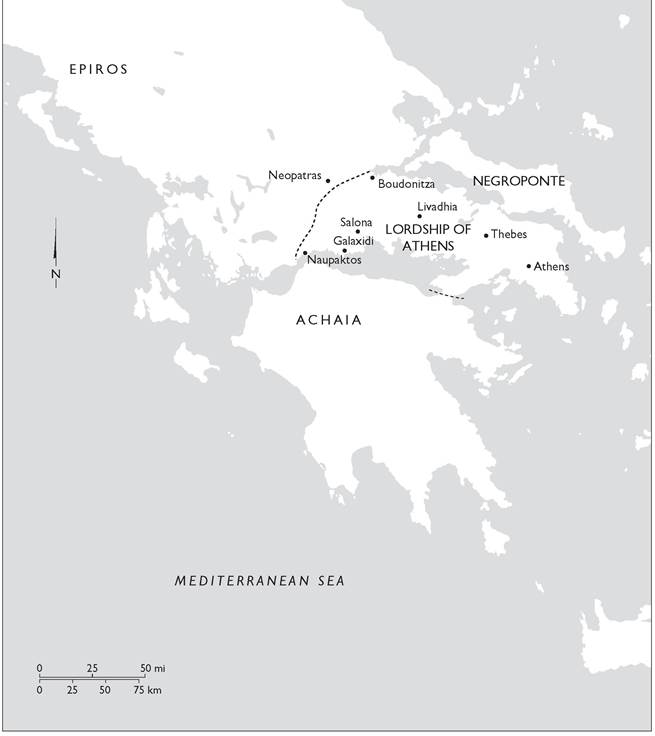
The Duchy of Athens and its neighbors
During the 1290s there was a second dispute between the rulers of Achaia and Athens, once again concerning the status and independence of the duchy with regard to the principality of Achaia. It was Florent of Hainaut, the consort of Isabella of Villehardouin, who reasserted the Achaian claims, soon after their marriage in 1289. The claims dated back no further than the late 1250s but were embellished with a longer pedigree. At the time, Guy II (Guyot) of La Roche was a minor, and the regent of Athens—his mother, Helena Angela Doukaina—was forced to concede Florent’s claims.
However, the situation eased when Florent died in 1297 and seemed to be reversed in 1301, when Guy II became betrothed to Florent’s daughter Mahaut, heiress to Achaia. They were married in 1305, and two years later Guy was appointed bailli of the Morea, but he died on 5 October 1308, bringing the La Roche line to an end.
The duchy passed to Guy’s cousin Walter I of Brienne, who in 1310 employed the Catalan Grand Company, a band of mercenaries that had served various employers in the Aegean region since 1303. The Catalans obtained a number of striking successes for Walter in Thessaly, but when he proposed to disband them without arrears of pay he had to resort to force. Walter’s army of mounted knights was annihilated by the Catalans at Halmyros on 15 March 1311, and he was killed, leaving his claims to his young son Walter (II). After a number of unsuccessful attempts to recover the duchy, Walter II was himself killed at the battle of Poitiers during the Hundred Years’ War in 1356.
The Catalans took over the duchy, giving the title of duke to the king of Aragon, but in practice remaining their own masters under warlords such as Alfons Fadrique, who was vicar general for the absent king. Under Fadrique the Catalans gained control of territory in southern Thessaly, setting up the duchy of Neopatras. The Catalans were perceived as a serious military and economic threat by their Venetian neighbors on Negroponte. The Venetians used their influence in Rome to secure frequent papal bans of excommunication against the Catalans for employing Turkish mercenaries or for failing to respond to calls for a crusade against the Turks. During the 1360s, various Catalan leaders in the duchy warred among themselves, but they were able to resist an attempt to recover the duchy by the Enghien brothers, nephews of Walter II of Brienne, in 1370-1371. The affairs of the duchy passed into obscurity and apparent dissolution as the Catalans lost ground to another band of mercenaries, the so-called Navarrese Companies, which captured Thebes in 1379 and Livadhia in the following year. In 1388 Nerio Acciaiuoli took control of the Akropolis at Athens. The duchy was ruled by his descendants until Francesco II Acciaiuoli was deposed by the Ottomans in 1458.