
On 27 November 1095, toward the conclusion of a major ecclesiastical council at Clermont in Auvergne, Pope Urban II (1088-1099) launched an appeal for a military expedition to liberate the Christians of the Near East and the Holy Sepulchre at Jerusalem from Islamic domination. His appeal was successful, and this expedition established in the Near East a Frankish kingdom of Jerusalem, together with the county of Edessa, the principality of Antioch, and (later) the county of Tripoli. Because these states were greatly resented by Islam and needed Western support, out of the success of 1099 arose the crusading movement, which powerfully influenced the history of Europe and the Islamic world right down to the seventeenth century.
The trigger for the appeal of 1095 was a Byzantine imperial delegation that met with Urban II during the Council of Piacenza (1-7 March 1095). The Byzantine emperor, Alexios I Komnenos, had seen that the outbreak of a bitter and complex succession struggle in the ruling family of the Great Saljûq Empire offered a golden opportunity for him to recover Asia Minor, which the Saljûs and other Turks had captured in the 1070s. Alexios hoped to enlist Western mercenaries, and this was the nature of the appeal made at Piacenza. Earlier, in 1074, when the Turkish conquest was under way in the aftermath of the disastrous battle of Mantzikert in 1071, Pope Gregory VII (1073-1085) had tried to persuade the peoples of the West to rally to the cause of the embattled Eastern Christians, and even to capture Jerusalem. His hope, undoubtedly a factor that also influenced Urban, had been that in return the Byzantines would accept the authority of the Holy See. But Urban was moved by other factors. He had cultivated Alexios lest he ally with Henry IV of Germany (1056-1106) in the struggle between empire and papacy known as the Investiture Contest. Undoubtedly Urban saw in this appeal an opportunity to assert papal leadership in the war against the infidel, traditionally the task of the Holy Roman (German) emperor.
However, there was more than self-interest at work, for Urban had supported the Christian reconquest of Spain and seems to have been anxious to roll back the tide of Islam, which had conquered much of the old Roman world since the seventh century. Yet he must have known that Gregory’s appeal had failed, and so Urban’s problem was to attract support for his project. First and foremost he was anxious for the support of the arms bearers, the aristocracy and knights, because they dominated society and their support would draw in others. He could certainly count on a mood of confidence in an expanding Europe, but most of Europe’s growth had hitherto been at a local level, with frontier lords annexing adjacent territory. The Norman conquest of southern Italy appears different, but was actually a slow process built on gradual implantation and alliance with native elites. What Urban proposed was on a scale and at a distance without precedent. Nor, outside the Reconquista (the reconquest of Muslim Iberia by the Christian kingdoms of the peninsula), was there any real tradition of such expansion having an ideological dimension, and even in the Iberian Peninsula, Gregory VII’s attempt to interfere in local affairs had been resented. However, the later 1080s had seen more lords from northern Europe participating in the Spanish wars; the Investiture Contest had accustomed some to serving the papacy in an ideological conflict; and naval raids by Italian cities on Muslim lands had taken on a sacred character. Moreover, the papacy had developed a new awareness of the value of holy war.

The First Crusade: the march to Constantinople
Urban was a skillful diplomat. He eschewed the self- righteous extremism of Gregory VII, and his journey to France was intended to win more friends for his cause. He prepared carefully for his appeal at Clermont. After sending out the summons for the council from Le Puy around 15 August 1095, he turned south into the lands of Raymond of Saint-Gilles, count of Toulouse. It can be no accident that Adhemar, bishop of Le Puy (later the pope’s legate on the crusade), was the first person, and Raymond of Saint-Gilles the first major magnate, to take the cross. Born as Odo of Lagery into a French noble family from Châtillon-sur-Marne around the year 1042, Urban knew the kind of people he needed to attract. This European elite was deeply catholic and profoundly hostile to any kind of outsider. Islam was no threat to them, and the Christians of the East were of little interest. At the same time, however, French lords were increasingly taking an interest in the wars in Spain. They were very aware that their military style of life, greed, and acquisitiveness were deeply at odds with the spirit of monasticism that was reckoned to be the most perfect form of the Christian life, whose exponents, especially the Cluniac Order, often had great influence with the more pious amongst them.

Ancient church of St. Peter in Antioch, where the supposed Holy Lance was unearthed by the pilgrim Peter Bartholomew during the First Crusade. (Courtesy Alfred Andrea)
At the Council of Clermont Urban appealed to Frankish pride of race. He urged the restoration of God’s land, the Holy Land, and especially the Holy Sepulchre, a notion that resonated with an elite deeply concerned with landed property. They saw pilgrimage, above all to Jerusalem, as a vital way of expiating their sins, and Urban cast his expedition in the form of a pilgrimage. Above all he offered them an indulgence, forgiveness of all their sins, if they undertook this fighting pilgrimage to the most sacred of shrines. They were to be God’s pilgrims, the chosen of the Lord for the Lord’s sacred task. In token of their status they would wear crosses and enjoy the protection of their lands by the church during their absence. Forgiveness of sins was confined to the statement that “whoever, for devotion alone, and not to gain honour or money, goes to Jerusalem to liberate the Church of God, can substitute the journey for all penance” [Canon 2 of the Council of Clermont, in Riley-Smith and Riley- Smith, The Crusades, p. 37]. However, Urban’s project by its nature involved conquest in a land proverbially flowing “with milk and honey” (Josh. 5:6 and Deut. 31:20) and therefore also embodied powerful material incentives.
Urban II’s appeal was transmitted to a wider world by the bishops present at Clermont, by the monks, who were strongly propapal, and by preachers. Urban wrote letters, such as those to Flanders, to Bologna, and to Genoa, soliciting support. No pope had ventured north of the Alps since Leo IX (1048-1054), so Urban’s long journey through France excited enormous interest. Still, all this only partly explains the enthusiasm generated across Europe. The success of the appeal was that it came from a man and an institution (the papacy) that increasingly commanded respect and that it came at a time when the notion of fighting for God was becoming more widespread and when instability in the East was making itself felt in difficulties in reaching Jerusalem. At the same time, expansionism had engendered a sense of confidence and opportunity. Urban seemed to have suddenly opened a gateway to salvation, and many were ready to enter therein. We may surmise that the most pious of the aristocrats and knights were the first to join. Urban’s appeal to the elite drew in their wake their followers—knights, and even humble men, servants, and peasants: the crusade was an embodiment of Western society with its hierarchies and patronage groups. However, his message also appealed to large numbers of unattached noncombatants, and we can only suppose that they were taking the opportunity to make a pilgrimage.
We are very badly informed about what Urban II intended his expedition to do. It is possible that Jerusalem was not mentioned at Clermont, or mentioned only in a minor key, and that the pope’s real intention was simply to express the Byzantine request for mercenaries made at Piacenza, but that public opinion focused on the liberation of Jerusalem and the project took on a life of its own. Since the work of H. E. J. Cowdrey, however, such ideas have had little currency among scholars in the field, and it is now generally thought that Jerusalem was always central to Urban’s message. For long it was considered that the lure of riches was the fundamental reason why people took up the cross, but Jonathan Riley-Smith [The First Crusade, pp. 31-57] has convincingly made the case that the movement was fundamentally a religious one, although John France [Victory in the East, pp. 11-16] has more recently stressed that gain was a factor. Among the leaders, very great men like Raymond of Saint- Gilles and Robert II of Flanders seem unlikely to have been moved by hopes of profit. By contrast, for Robert of Normandy and Godfrey of Bouillon the expedition offered an escape from acute political difficulties, while Bohemund of Taranto seems to have been simply out for gain, and younger men like Tancred and Baldwin of Boulogne probably wanted to make their fortunes.
The first expeditions to reach Constantinople (mod. Istanbul, Turkey), the appointed concentration point, were those of the so-called People’s Crusades: they were different from the later armies in that none of them were led by a great prince, and they probably contained a smaller proportion of arms bearers. In Northern France an army gathered around a charismatic preacher, Peter the Hermit; in the Rhineland he attracted more followers, and the mood of religious excitement triggered a persecution of the Jews. Although Peter’s force marched peacefully down the Danube, some of the later bands were poorly disciplined and clashed with local forces in Hungary. Peter’s men had their troubles over food supply in the Byzantine Empire, but they were well received by Alexios Komnenos at Constantinople. Once in Asia Minor they joined Germans and Lombard groups and ravaged the countryside. Without strong military leadership these forces, though substantial, were easily defeated in late October 1096 near Nicaea by Qilij Arslān I, the Saljûq sultan of Rûm.
The princely armies took various routes to Constantinople and departed at times of their own choosing. Hugh, count of Vermandois, the brother of King Philip I of France, was the first major leader to leave, taking a traditional pilgrim route to Italy. He crossed from Bari to Dyrrachion (mod. Durrës, Albania) in October 1096 with the intention of taking the old Roman road, the Via Egnatia, to Constantinople, but he was shipwrecked and his army scattered. Bohemund of Taranto, the leader of the Normans of south Italy, crossed on 1 November 1096. He had participated in the attempt of his father, Robert Guiscard, to conquer the Byzantine Empire in 1081-1085, and was anxious to avoid friction with Byzantine forces concentrated at Dyrrachion, so he landed to the south and cautiously marched to Constantinople, not arriving until 1 April 1097. Contingents from northern France, Normandy, and Flanders were led by Robert Curthose, duke of Normandy, Robert II, count of Flanders, and Stephen, count of Blois and Chartres. These only arrived in southern Italy in late November 1097; Robert of Flanders risked an immediate passage, but the others wintered in Italy, crossing in the spring and arriving at Dyrrachion only on 14 May 1097. Godfrey of Bouillon, duke of Lower Lotharingia, departed in August 1096 with troops from his own duchy and northeastern France, marched down the Danube Valley, and arrived at Constantinople before Christmas. Raymond of Saint-Gilles and Adhemar of Le Puy, the papal legate, led a huge army drawn from southern France and Provence, which seems to have marched across Lombardy and down the Dalmatian coast, arriving at Dyrrachion in early February 1097.

The First Crusade: the march from Constantinople to Antioch
These were the main armies, but we hear of other smaller forces of whose journeys we know nothing. What arrived in the East in the spring of 1097 was not a single army, but a loose aggregation of armies. There was no overall commander, though the papal legate, Adhemar, seems to have enjoyed a preeminence. The various contingents evidently accepted the command of the major leaders, but they retained considerable freedom: Gaston of Béarn, originally attached to the forces of Toulouse, later changed his allegiance and helped the northern French with their siege equipment at Jerusalem.
The lack of any structure of command first became an obvious problem when the princely armies approached Constantinople in the spring of 1097. They needed to establish a relationship with Alexios Komnenos, but because they arrived separately, the emperor was able to deal with them as individuals. Adhemar fell ill and did not arrive at Constantinople until long after the others. Urban II wanted to aid Alexios, but it is unlikely that the emperor ever promised to lead the crusaders to their goal. Most of the princes, accustomed to wide freedom of action in the West, were wary of relations with the Greeks and unwilling to accept any subordination. Raymond of Saint-Gilles had actually conferred with Urban, but even he did not seriously suppose that Alexios would become their commander. Despite some incidental skirmishes, inevitable when large armies were passing through Byzantine territory, all the leaders ultimately took oaths to Alexios to be his men and to return to him any former Byzantine lands, though the extent of these was never defined.
The working relationship with Byzantium was quickly put to the test at the siege of Nicaea (mod. Iznik, Turkey), lasting from 14 May to 19 June 1097, which saw the individual contingents gathered as one army for the first time. The size of that army is a matter of dispute. France [ Victory in the East, pp. 122-142] has argued for 60,000 participants, including 6,000-7,000 knights, but this has been contested by Bernard Bachrach [“The Siege of Antioch: A Study in Military Demography,” War in History 6 (1999), 127-146] who argues for 100,000. The sultan Qilij Arslān I was away from the city when the siege began, and his attempt to relieve it on 16 May was driven off. The siege was energetically pressed, and casualties were heavy. Because there was no single leader, a committee of the most important princes controlled the army, and as a consequence their assaults were poorly coordinated. Alexios supplied the crusaders with food and equipment, and sent boats to close the Ascan- ian Lake, on which Nicaea stood, a decisive move, which meant that the Turkish garrison was now isolated and had to face attacks on all sides. Alexios’s generals negotiated the surrender of the city to Byzantine forces, but he seems to have been generous to the crusaders. The capture of the city was a triumph for the alliance, and in its wake Alexios attached Byzantine troops to the army and advised them to open negotiations with the Fātimids of Egypt. By the spring of 1098 crusaders and Egyptians had reached some kind of modusvivendi, presumably on the basis of mutual hatred of the Saljūq Turks of Syria; this understanding was important because Egypt was a strong military power and controlled the only Muslim fleet in the Mediterranean.
The crusader army set off across Asia Minor on 26 June 1097, but divided command led to its separation into two groups, which gave Qilij Arslān the opportunity to attack its vanguard, led by Bohemund, at Dorylaion (mod. Eskiflehir, Turkey) on 1 July 1097. The Turkish mounted archers outnumbered the Frankish knights, and they drove them back and besieged them in their camp. The Turks were then drawn into a fight at close quarters, which gave the main crusader force time to arrive and attack them in the rear. The Turkish tactics of enveloping their enemies, showering them with arrows, then exploiting gaps and weaknesses in their line, were an unpleasant shock to the divided and uncoordinated crusader army. But the battle of Dorylaion broke Turkish resistance in Asia Minor, even though the crusader army was sapped by climate and disease, and had lost the bulk of its horses. Guided by Byzantine troops, the crusaders marched via Caesarea in Cappadocia (mod. Kayseri, Turkey) in order to free Armenian centers in the mountains and thus secure a friendly base for the attack they now intended upon the city of Antioch on the Orontes (mod. Antakya, Turkey), where they arrived on 20 October 1097. This policy of friendship toward the Christian Armenians culminated in an invitation to Baldwin of Boulogne, brother of Godfrey of Bouillon, to take over the city of Edessa (mod. Şanlıurfa, Turkey), which in March 1098 became the center of the first Frankish principality in the East.
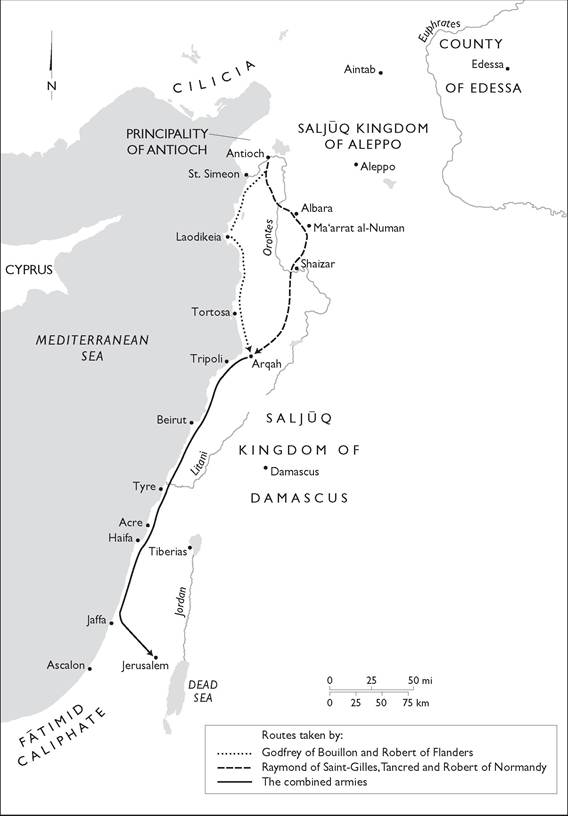
The First Crusade: the march from Antioch to Jerusalem
Turkish-controlled Syria was divided between the Saljûq princes Ridwân of Aleppo and Duqāq of Damascus, and the rivalry between them had enabled cities like Antioch to establish a fair degree of independence. Alexios Komnenos had judged his moment for an assault well, and so the crusaders faced no coordinated Islamic counterattack. Even so, Aleppo and Damascus could raise strong military forces and posed a severe threat to the depleted crusader army. Antioch had strong walls, and it was too big for the army to surround or storm. The crusaders established a close blockade, but this exposed them to harassment from enemy outposts nearby and to the threat of a relief force. Their major problem was food supply. They could draw on the Armenian lands to the north, and Raymond of Saint-Gilles had established an outpost at Rugia in the Syrian plain before the siege began. Most importantly, an English fleet, probably with Byzantine support, had captured St. Symeon (the port for Antioch) and nearby Laodikeia (mod. Al-Lādhiqīyah, Syria) even before the crusaders arrived, which opened up communications with Byzantine Cyprus. In November 1097 a Genoese fleet arrived with timber and skilled labor, enabling the crusaders to fortify their camp. The Byzantine alliance was working well, and it was reinforced by the good ecclesiastical relations that Adhemar had established with the Greeks.

Conquest of Antioch by the Crusaders. (Archivo Iconograpfico, S.A./Corbis)
Even so, by Christmas the army was starving, and a large force, commanded by Bohemund and Robert of Flanders, was sent to forage in Syria. Near Albara, on 31 December, they defeated a relief force sent by Duqāq of Damascus. Although the Damascenes retreated, the crusaders were unable to forage, and the crisis in the army deepened when it became known that a Turkish relief force from Aleppo was approaching. In this emergency the leaders finally agreed to appoint a single commander, choosing Bohemund, whose military reputation stood high after his victory over the Damascenes. Although they could raise only 700 cavalry, the crusaders ambushed and crushed the army of Aleppo on 9 February 1098, a victory that impressed the Egyptian envoys who were then in Antioch. Shortly afterward a second English fleet arrived, enabling the crusaders to tighten the siege with new fortifications, and the coming of spring eased supply problems. Antioch was betrayed to Bohemund, who was by now the most famous of their leaders, by a tower commander on the night of 2/3 June, though the crusaders were unable to seize the citadel. On 4 June a huge Turkish relief army arrived under the command of Karbughā, lord of Mosul, trapping the crusaders in Antioch. Despite terrible hardships the crusaders fought off enemy attacks. Morale was revived by a series of visions, and the finding of a relic that was identified as the Holy Lance (the spear with which Christ’s side was pierced during the Crucifixion), and on 28 June 1098 the crusaders sallied out and defeatedKarbughā at the Great Battle of Antioch.
After the victory against Karbughā, the crusade leaders sent envoys to ask Alexios Komnenos to take possession of Antioch, in fulfilment of the oaths they had taken at Constantinople. This action is indicative of their adherence to the oath and of the value they attached to Byzantine help, which had been so important during the siege. However, by autumn they had learned that duringKarbughā’s siege, Alexios had been told about the army’s plight by Stephen of Blois, who had deserted from Antioch, and had then turned back from coming to its aid, in the belief that all was lost. In a letter of 11 September 1098 to Urban II, the leaders expressed their anger at this turn of events. When they gathered at Antioch on 1 November to resume the march, Bohemund claimed the city.
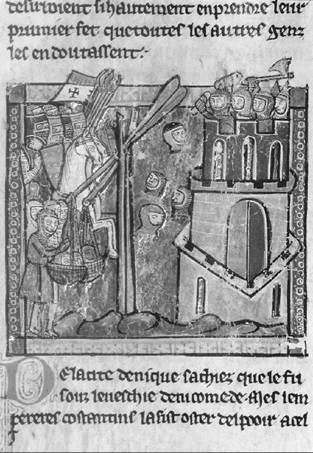
Crusaders bombard Nicaea with heads in 1097, from the History of William of Tyre, thirteenth century. (Bibliothèque nationale de France, Paris/Bridgeman Art Library)
Raymond of Saint-Gilles stood by the Byzantine alliance, but the other leaders were inclined to favor Bohemund. In the subsequent quarrels, personal feelings and old scores came to the fore; Adhemar, who might have been a moderating force, had died of plague (1 August 1098). As a result of this dispute, the army stalled in north Syria after capturing Ma’arrat al-Numan in December. Bohemund demanded that Raymond should abandon his strong points within Antioch and sought recognition of his control of the city. Not until 13 January 1099 did Raymond march south, but as only Tancred and Robert of Normandy would accompany him, it seems unlikely that he intended an immediate attack on Jerusalem. His army settled down to besiege Arqah on 14 February, while Bohemund remained at Antioch, from which he evicted the garrison left by Raymond. Many knights, despairing of the delay, preferred to stay with Bohe- mund or joined Baldwin at Edessa. However, popular pressure from within their contingents forced Godfrey of Bouillon and Robert of Flanders south; when they joined the siege of Arqah, they were sullen and resentful. Divisions opened further when an imperial embassy asked the crusaders to delay their march so that Alexios could come to their aid, a development welcomed by Raymond but opposed by the other leaders.
In early May a Fātimid embassy arrived from Egypt. The Fātimids had seized Jerusalem from Saljûq control in July 1098 and had no intention of conceding it to the crusaders, who rejected anything less than full possession of the city. The leaders, divided as they were, and deeply concerned by the limited manpower available resulting from casualties and the partial breakup of the crusade at Antioch, now rallied the army and marched into Fātimid territory in a determined thrust to Jerusalem, which they invested on 7 June. The siege was a race against time, because the crusaders knew that a Fātimid relief expedition was in preparation. On 13 June they launched an initial assault, despite having only a single siege ladder. This assault failed, but the arrival of a Genoese fleet on 17 June brought timber, which enabled the construction of siege engines. Forces led by Godfrey of Bouillon began construction work at the northwestern corner of the city. They had to build a ram that would clear a way through the outer wall along the north perimeter of the city, while a tower was intended to dominate the strong inner wall and so to make possible assaults by siege ladders. The defenders observed this activity and strengthened the threatened part of the city’s defenses, but on the night of 9/10 July the northern French transported their equipment to a weak spot on the northeastern section of the north wall, which critically undermined the preparations of the defenders. Raymond of Saint-Gilles prepared another tower to attack near the Zion Gate on the southwestern section of the wall, and on 13 July a systematic attack from north and south began. On 15 July 1099 the crusaders broke in across the northern wall and massacred many of the Muslim and Jewish inhabitants (the Christians having previously been expelled by the garrison): this was the normal fate of any city that fell by storm. Not without much dispute, Godfrey of Bouillon was elected to rule the city, and on 12 August he led the crusaders to victory over the Fātimids at the battle of Ascalon (mod. Tel Ashqelon, Israel).
The First Crusade was an astonishing success. As Alexios Komnenos had intended, the crusaders had taken advantage of the divisions of their Islamic enemies and exploited them skillfully. Their own army partially disintegrated because of serious disagreements, but the Muslim powers were never able to exploit them. The crusaders faced formidable military powers, but they triumphed because the longer they survived, the more coherent and effective they became as an army and the better they adapted to the tactics of their enemies. They enjoyed the support of Byzantine and Armenian allies, while Western fleets, in alliance with the Byzantines, commanded the sea and helped to supply them. Islamic and Western armies were on a par technically. Although Western horses were bigger than Eastern ones, they died very quickly and were replaced by local stock, and the victory over Karbughā was largely the victory of an infantry army. Other crucial factors in achieving victory were good military leadership, especially by Bohemund, and the profound religious conviction of the crusaders, who saw themselves as a pilgrim army, the chosen of God. Yet crusader success was limited: they had established only the nuclei of viable states at Antioch, Edessa, and Jerusalem, which would need further support. Moreover, the breach with Byzantium meant that there was no land bridge from the West to the Holy Land, so that the future of the new settlements in the East would depend very heavily upon sea power.