
Throughout most of the twelfth century, there was a constant need for maritime traffic and naval forces to bring military support and pilgrims to the newly established Frankish principalities inOutremer. After the conquests of Saladin in the wake of the battle of Hattin (1187), all major naval expeditions were directed against Egypt, which came to be seen as the key to the Christian possession of the Holy Land. As a result of experience gained over the period 1100-1200, naval expeditions from one end of the Mediterranean to the other, which had posed logistical problems of great magnitude at the time of the First Crusade (1096-1099), became routine by the turn of the twelfth and thirteenth centuries.
At the death of the first ruler of Jerusalem, Godfrey of Bouillon (1100), the Franks held only a few pockets of territory in the Near East. These were around Edessa (mod. Şanlıurfa, Turkey) in northern Syria and Upper Mesopotamia, Antioch (mod. Antakya, Turkey) in northwestern Syria, and Jerusalem and a few towns in Judaea and Galilee. They also had a tenuous hold on a strip of territory extending to the coast at Jaffa (mod. Tel Aviv-Yafo, Israel), which was a shallow open roadstead with no harbor. Galleys could be beached at Jaffa, but sailing ships had to anchor off exposed beaches; in 1102 over 20 ships were blown ashore and wrecked. The Franks had desperate need of better ports.
The Pisans had returned home, and the Venetians were to serve only until 15 August. Haifa fell with their help shortly after Godfrey’s death, but it also had no port. Over the subsequent decade, successive fleets of Italian, Occitan, and northern crusaders enabled the Franks in Outremer to secure most of the coast. Sieges undertaken without naval support failed: Arsuf (1100), Acre (1103), Sidon and Tripoli (1108), and Tyre (1111). By contrast, Genoese squadrons participated in the capture of Arsuf and Caesarea (1101), Tortosa (1102), Gibelet (1103), Acre (1104), Tripoli (1109), and Beirut (1110). There may have been Pisan ships at Beirut also. Men from an English fleet that reached Jaffa in 1102 helped King Baldwin I of Jerusalem win the battle of Jaffa. Sigurd Jorsalfar of Norway and the Venetians both helped capture Sidon in November 1110. By the end of 1110, the Franks controlled all the ports of Palestine and Syria except for Tyre (mod. Soûr, Lebanon) and Ascalon (mod. Tel Ashqelon, Israel).
In 1122 Venice mounted a new crusade with her own forces, as well as crusaders from elsewhere in Italy and the North. The chronicler Fulcher of Chartres commented that the Venetians, “having left their own land the year before, wintered on the island called Corfu, awaiting a favourable season. Their fleet was of 120 ships, not counting small boats or skiffs, of which some were beaked (Lat. rostratae), some indeed were transport ships, and some were triremes. . . . In which [ships] were 15,000 armed men, Venetians as well as the pilgrims joined to them. In addition they conveyed 300 horses with them Sailing by short stages, by day and not by night, by necessity they put in daily at the ports which they found frequently, lest both they and their horses, suffering lack of fresh water, be oppressed by thirst” [Fulcheri CarnotensisHistoria Hierosolymitana (1095-1127), ed. Heinrich Hagenmeyer (Heidelberg: Winter, 1913), pp. 656-658].
The Venetians took around two months at an average of only around 0.85 knots to reach Outremer from Corfu (mod. Kerkira, Greece), suggesting that they did indeed sail only by day and that they landed wherever possible to take on water. They were the first to transport horses to Outremer, a circumstance that is to be attributed to the problems involved in doing so. After putting in to Acre (mod. ‘Akko, Israel), they won a great victory over the Egyptians off Ascalon and then joined a successful assault on Tyre. In the series of paintings of Venetian victories in the Sala dello Scrutinio of the Doges’ Palace in Venice, the second and third are of the battle of Ascalon and the storming of Tyre: these were remembered centuries later as great episodes in Venetian history.
The fall of Tyre left the Fātimids of Egypt with Ascalon as their sole possession north of the Negev Desert and when that fell in 1153, Fātimid squadrons found it virtually impossible to operate off the coasts of Outremer. Even before that it had been difficult. In 1126 the Fātimids sent a squadron north to raid. Fulcher of Chartres reported the Egyptians as “having passed by Farama and also El-‘Arish and Gaza, Ascalon and Jaffa, Caesarea, and Acre, Tyre and Sidon, exploring and lying in wait along the sea coast as far as the city of Beirut, hunting and searching from port to port to see if they could find an opportunity for themselves which would be injurious to the Christians. But since from lack of fresh water they were then thirsty and tormented, they were compelled to land in order to fill their buckets from streams and springs and assuage their thirst. However, taking this ill the citizens . . . straight away came out against them boldly. . . and our knights with lances and our bowmen with arrows pressing into the sea unexpectedly put them to flight. They however, having hoisted sail without delay, made their way by sea sailing towards Tripoli and then Cyprus” [Fulcheri Carnotensis Historia Hierosolymitana, pp. 803-805].
The major problem for galley fleets was to cram water supplies for large crews into narrow and shallow hulls. Western bireme galee (galleys) of the twelfth and thirteenth centuries could carry up to 7.5 metric tons of water, enough for six to seven days. A cruising speed of 2 knots was at the high end of the spectrum, giving a range of around 530-630 kilometers (c. 330-400 mi.). Of course, all factors were variable, and weather and oceanographic conditions, along with endurance, toughness, and skill, made all the difference. But galley fleets cannot normally have ranged more than around 580 kilometers (c. 360 mi.) without watering. The range of Egyptian galleys would have been less than that because they used amphorae for water, which were at least 30 percent less efficient than the barrels used in the West. Their range may have been less than 400 kilometers (c. 250 mi.) if their galleys were still modeled on Byzantine dromons and had a bank of oarsmen below deck. Byzantine dromons using amphorae could carry water supplies for no more than three days, a range of only around 270 kilometers (c. 170 mi.) at 2 knots. The distance from the Nile to Beirut was around 560 kilometers (c. 350 mi.), and the Egyptian squadron of 1126 would certainly have been out of water by then.
From the loss of Tyre (1124) to the aftermath of the battle of Hattin (1187), Egyptian squadrons’ ability to harass supply lines of Outremer remained extremely limited. East of Dami- etta, theFātimids held only Farama, El-‘Arish, and (until 1153) Ascalon. Farama had no water and was dependent on rain cisterns and water from the Nile. El-‘Arish and Ascalon had wells, but watering large fleets was difficult. Western shipping usually made landfall at Paphos in Cyprus, coasted its south coast, and crossed from Cape Greco to Tripoli or Beirut. Watchers south of Beirut kept lookout for shipping coming down the coast. To intercept incoming Western ships (unless they were blown south toward Egypt), Egyptian squadrons faced a round trip of around 320 kilometers (c. 200 mi.) even from Ascalon to the waters between Cyprus, Tripoli, and Beirut, allowing little time on station. After the loss of Ascalon, cruises from Egypt became virtually impossible. In any case,Fātimid naval capabilities declined from around 1110 through to their overthrow by Saladin (1171), and such parameters help explain why Outremer could be supplied and reinforced from the West with impunity. They also explain why the Frankish principalities never found it necessary to develop naval forces of their own. Immigration, pilgrim traffic, and maritime commerce flourished. The pilgrim Saewulf counted 30 large naves (sailing ships) at Jaffa in 1102. Another pilgrim, Theoderic, counted 30 at Acre at Easter, probably in 1169. Ships left the West in mid-March, agglomerating off Outremer around Easter, in what was the spring transit, the first of two annual transiti mentioned by William of Tyre; the second occurred in late September and early October.
Pilgrimage became a mass traffic during the twelfth century, and the hospital of the Order of St John in Jerusalem could house around 1,000 sick pilgrims and up to 2,000 in an emergency. The deck space specified by the municipal statutes of Marseilles of 1253 for pilgrims and crusaders, 6.5 by 2.5 palmi (1.68 by 0.63 meters), was what was customary and probably also the norm in the twelfth century. Two-masted, three-decked ships such as were becoming common by mid century could carry 500-550 pilgrims in such conditions. The 30 naves seen by Theoderic at Acre could have brought up to 16,500 pilgrims to Outremer in a single transit.
Outremer became of major importance for Western commerce. In the first half of the twelfth century, the Byzantine Empire remained Venice’s major sphere of commercial interest, but her commerce in Outremer increased many times over, while Egypt remained a much lesser sphere. These patterns remained much the same in the second half of the century, although Venice’s attention shifted toOutremer after her expulsion from Byzantium in 1171. For Genoa, Outremer became the destination of up to 54.5 percent of Genoese commerce in some sources, the average being around 30 percent. In the thirteenth century, Outremer remained a major destination for Venetian commerce, although Venetians increasingly did not specify destinations of voyages. Between 1233 and 1259, the value of Genoese trade with Outremer ranged from 71 percent in 1233 to 11 percent in 1256, with an average of 47.5 percent [Abulafia, The Two Italies; Balard, “Les Génois en Romanie entre 1204 et 1261”, pp. 467-502].
Smaller Western maritime powers also became engaged. According to the cartulary of Giraud Amalric of Marseilles, in 1248 the value of Marseillese contracts with Outremer was £16,750, as opposed to £11,395 for all other destinations. Between 14 March and 28 July of that year, 17 ships bound for Outremer passed through Marseilles and another 3 belonged to the Hospitallers [Pryor, “Commenda”; Pryor, Business Contracts of Medieval Provence: Selected Notulae from the Cartulary of Giraud Amalric of Marseilles, 1248 (Toronto: Pontifical Institute of Mediaeval Studies, 1981)].
Where there is a will, there is a way. In 1177 Saladin ordered a new Egyptian fleet constructed, and by spring 1179 he had 60 galleys and 20 taraid (horse transport galleys) at Alexandria. Squadrons were employed to raid commerce, and also made a raid on Acre in 1179. In the same year 2 Christian butash (large sailing ships) were taken and 1,000 prisoners brought to Egypt. Cruises resulting in the capture of further butash occurred in 1182 and 1183. However, when Saladin attempted to use both the fleet and land forces against Beirut, the result was disastrous. The fleet was driven back to Egypt by a scratch fleet of 33 galleys raised by the Franks. The seamanship and fighting qualities of Egyptian crews left much to be desired.
Saladin’s victory at Hattin on 4 July 1187 quickly delivered most of Outremer to him, and the first phase of the Third Crusade (1189-1192) became a struggle to recover Acre. In the event, superior naval strength saved Outremer for another 104 years. In the first instance, King William II of Sicily sent Margaritus of Brindisi with 50 galleys and 500 knights to Outremer in spring 1188. Margaritus probably saved Tripoli and Tyre and reinforced Antioch, enabling the Franks to survive until other crusader forces arrived. Guy of Lusignan, king of Jerusalem, encamped before Acre on 28 August 1189 accompanied by 52 Pisan ships. During the autumn massive reinforcements arrived from the West, and when Saladin himself arrived in early September 1189, the chronicler ‘Imād al-Dīn al-Isfahānī declaimed that Christian ships had transformed the beaches into a forest of masts.
The siege of Acre became a complex struggle between besieged, besieging, and encircling forces in which the Christian besiegers controlled the maritime approaches to Acre but could not prevent break-ins. Medieval galleys could not stay at sea on blockade, and sailing ships could not force other sailing ships to engage. Maritime sieges were matters of beaching galleys near a city, rotating patrols at sea when weather permitted, and launching galleys if relieving ships were sighted. But for galleys to intercept sailing ships coming in with following winds was difficult. Prevailing winds in the afternoon at Acre are strong southwesterlies, and sailing ships coming in with them would drive straight into the port.
On 26 December 1189 Saladin’s admiral Husām al-Dīn Lû’Lû’ fought through with 50 shawâm (galleys). A second relief fleet fought through on 13 June 1190. However, these efforts exhausted the capabilities of the Egyptian fleet because the ships remained there, their crews being committed to defend Acre. A captured Christian batsha (large sailing ship) came in from Beirut on 24 August 1190, and 3 more from Alexandria also made it through on 17 September 1190. Saladin managed to slip occasional ships in during the winter of 1190-1191, and 7 grain ships from Egypt arrived on 11 January 1191. But the die was cast when Richard the Lionheart, king of England, intercepted Saladin’s last great supply ship from Beirut as he himself approached the coast. The Muslim garrison was doomed and surrendered on 14 July 1191.
In spite of his best efforts, Saladin was never able to rival the maritime power of the Christians and admitted as much to the Almohad caliph Abû Yusûf Ya‘qûb al-Mansûr (19 February 1189-8February 1190). He lamented the poor performance of Muslim seamen, said that Christian losses were soon replaced by Western reinforcements, and asked the caliph to send the Almohad fleet against Sicily. Yet, because Acre harbor was closed by a chain from the Tower of the Flies at the head of the eastern mole to another at that of the northern mole, Christian forces could not break into the harbor to attack the city’s soft underbelly. In an attempt to destroy the chain, the Tower of the Flies was attacked by the Pisans on 25 September 1190. They were beaten off, but the battle raged until 6 October, when galleys from the port destroyed their floating siege tower. Thereafter no further attempts to assault the Tower of the Flies to destroy the chain were made because so many Egyptian galleys were now in port that any assault could be beaten off.
The Third Crusade’s failure in the face of the enormous resources Saladin threw against it taught everyone that Jerusalem could never be recovered without conquering Egypt, and that was not unrealistic. In the 1160s and 1170s, this conquest had been contemplated by King Amalric of Jerusalem and Emperor Manuel I Komnenos. Alexandria and Damietta were the keys to Egypt, and if they could be occupied, Cairo would fall. Saladin had destroyed the Fātimids’ Negro and Armenian infantry regiments and incorporated the Turkish, Kurdish, and other Fātimid cavalry into his forces. The native Egyptian populace was militarily powerless, and the country was ruled by a foreign elite in any case. A Frankish elite would not be greatly different from a Kurdish and Turkish one.
The envoys who negotiated transport for the Fourth Crusade agreed with Venice in 1201 that the target would be Egypt, specifically “Babylon” (i.e., Cairo), “because they could better destroy the Turks by way of Babylon than by that of any other land; however, in the hearing [of others] it was said that they would go to Outremer.” [Geoffroy de Villehardouin, La conquête de Constantinople,ed. and trans. Edmond Faral, 2nd ed., 2 vols. (Paris: Les Belles Lettres 1961), 1:30]. Robert of Clari reported that the Venetians would take them wherever they wished, whether to Babylon or to Alexandria, and Gunther of Pairis said that the destination was Alexandria because there was a truce in Outremer.
The contract called for the transport of 4,500 knights and horses, 9,000 squires, and 20,000 foot soldiers. In addition, Enrico Dandolo, the doge of Venice, offered to supply 50 galleys crewed and armed at Venice’s expense. Horses and squires were to be carried on horse transports (Lat. uisserii, Fr. uissiers), and lords and their men on sailing ships. Transports were to be available for up to a year from departure on 29 June 1202. Venetian commerce was suspended while the fleet was being made ready.
Some 7,500 men would have sailed in the battle fleet. For 4,500 knights and 20,000 foot soldiers, perhaps around 40 first-rate sailing ships would have been needed; proportionately more smaller ones would be required if larger ships were unavailable. Around 4,500 sailors would have been needed for a fleet with a capacity of 24,500 passengers. Venetian uissiers of 1202-1204 probably required around 130 men each, or 19,500 men in total. In the end not all the ships and men were needed, but the Venetians did not know that. The fleet that assembled had 50 war galleys and around 150 uissiers, with total crews of around 27,000 men, plus an unknown number of sailing ships with crews of around 4,500, a massive commitment.
That a battle fleet not originally sought by the crusade leaders was offered affords insight into the Venetian reaction to the envoys’ requests. They believed in the crusade and embraced the envoys’ proposals, but they also considered their own interests. The agreement spelled it out: they would share equally in any conquests. Ever since the First Crusade (1096-1099), personal and communal gain had accompanied the recovery of Jerusalem. What is at issue in historical scholarship is the objective that the Venetians had in mind.
The Byzantine navy had been decaying for twenty-five years, and the Venetians would have known this. The only target against which 50 galleys might be needed was Egypt. This was probably more than necessary, but Cairo was 160 kilometers (c. 100 mi.) from the coast, and the only viable approach was via one of the branches of the Nile. The Egyptians would have the advantage of terrain, logistics, and local knowledge. From campaigns fought in the time of King Amalric and intelligence gathered by merchants, the geography of the Nile delta must have been well known in Venice, but whatever branch was chosen, canals and branches would have to be crossed, and these could be used by the Egyptians to send reinforcements to wherever they were needed. The Fifth Crusade later foundered attempting to reach Mansurah (mod. El-Mansûra, Egypt) across the Bahr al-Saghir (the branch of the Nile south of the Damietta branch), and the Crusade of Louis IX failed besieging the town. Venice needed superior naval forces.
Uissiers were expensive, specialized ships, which would not have been ready at hand. If the destination had been Acre, cavalry could be carried far more efficiently on naves. A mix of uissiers and naves would be appropriate for Constantinople (mod. Istanbul, Turkey), although uissiers would certainly be useful for assaulting beaches in the Bosporus before entry to the Golden Horn could be forced. However, a fleet wholly composed of uissiers would be absolutely necessary for an amphibious attack on Egypt. Both the Rosetta and Damietta branches of the Nile were too shallow for large naves. Horse transports capable of following a battle fleet upriver in shallow water and landing cavalry on the left bank beyond the Farama branch within striking distance of Cairo would be needed. If the attack occurred in July-August, before the Nile began to flood and when prevailing winds were still from the northwest, an advance upriver ought not to be too difficult. The set departure date was 29 June, and Egypt was about a month’s voyage from Venice.
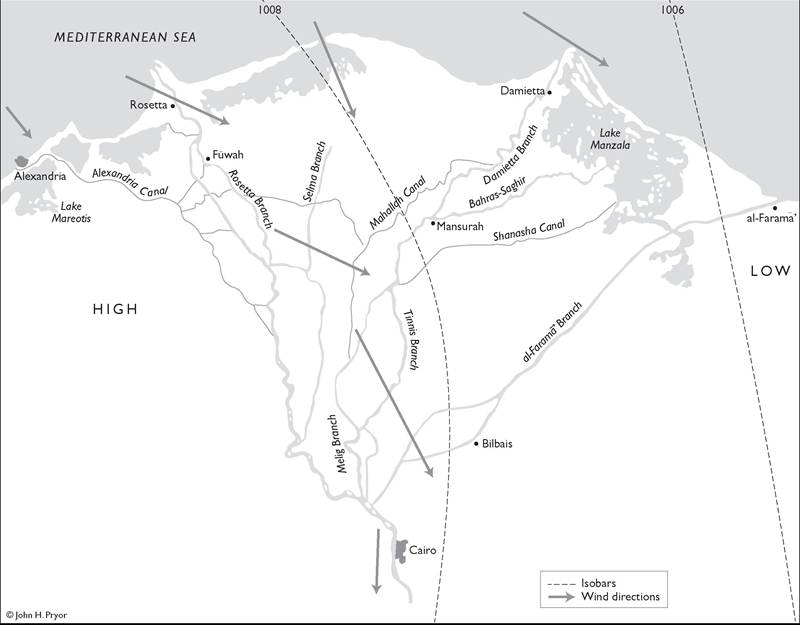
The Nile delta ca. 1200 with mean average barometric pressure and wind directions in July
Should Egypt fall, the profits would be astronomical. Venice would monopolize the oriental spice trade, and Pisa and Genoa and everyone else would have to deal with her. All the evidence suggests that in 1201 Doge Enrico Dandolo played for high stakes. He threw the resources of Venice into a gamble for a glittering prize. By the winter of 1202-1203, he realized that there were insufficient knights to attack Egypt and settled for second best when circumstances offered it, but Constantinople was not the original objective.
As it turned out, circumstances and exigencies drove the crusade from pillar to post to Constantinople. There the Venetian fleet played only a minor role. It arrived off Constantinople via the Sea of Marmara, crossed to Chalcedon (mod. Kadikoy, Turkey) on the Asian shore and entered the Bosporus and put in to Scutari (mod. Üsküdar, Turkey). Galleys and uissiers put out from Scutari early on 5 July 2003, with the galleys leading and towing the galleys’ boats (barges) filled with archers and crossbowmen to clear the beaches. The sailing ships stayed at Scutari, since there was little for them to do until the chain of the Golden Horn was broken. Having landed, they assaulted the tower of Galata, to which the northern end of the chain was connected. The chain floated on wooden pontoons, and what ships the Greeks had were drawn up inside to protect it. But the Venetians erected siege engines on naves, which they sacrificed and beached before the tower, which was assaulted by land and sea. It was taken on the third day, and once the chain was broken the fleet streamed into the Golden Horn.
After the initial assault on the sea walls by scaling ladders on 17 July, during which the Venetians managed to seize a section but had to withdraw, the fleet played little part in events until the assaults on 9 and 12 April 2004. Then it was flying bridges run from the mastheads of a few great naves that enabled Venetian warriors to surmount the walls, gain possession of some towers, and permit the rest of the army to scale the walls by ladder and open the gates.
Fourteen years after the Fourth Crusade, another crusade arrived off Damietta. The product of years of work by Innocent III and Honorius III, the Fifth Crusade (1217-1221) was a motley affair, muddled and misguided, lacking strategic direction and command, and bedeviled by conflict between ecclesiastical and secular authority. The forces that landed in Egypt on 27 May 1218 consisted of crusaders from Germany and Austria conveyed to Acre by the Venetians, forces of the kingdom of Jerusalem and the military orders from Outremer, and crusaders from Germany and Frisia who had come from the north by sea.
The initial phase of the crusade, which lasted until 24-25 August, was an assault on the walls of Damietta and a tower on an island in the river, from which a chain on pontoons ran across to the city. Eventually the chain tower was taken by assault from a great siege tower erected on two German cogs lashed together. Thereafter new forces arrived, including troops from Rome under Cardinal Pelagius of Albano, from England, and from France, carried in Genoese ships. Sultan al-Kāmil I blocked the river upstream from Damietta by sinking ships laden with rocks. In 1219 many crusaders sailed for home, but they were replaced by reinforcements, and Damietta fell on the night of 4-5 November 1219. Al- Kāmil then moved to Mansurah south of the Bahr al-Saghr. The crusaders had to either attempt to mount the river by ship and bypass the Bahr al-Saghr or force a crossing of it. However, they had nothing like the necessary battle fleet and the horse transports that would have made the first option possible. What they had was a miscellaneous collection of Northern cogs and busses (ships descended from Anglo- Norse transport ships [ON knerrir], with castles at bow and stern), Mediterranean sailing ships, and a few galleys. They had no oared horse transports at all.
There was no choice but to wait for Frederick II, Holy Roman Emperor and king of Sicily, who was expected in spring 1221. Count Matthew of Apulia arrived with 8 galleys in July 1220, and further forces under Duke Ludwig I of Bavaria and Bishop Ulrich of Passau reached Damietta in May 1221. Later Frederick claimed that they had carried instructions to await his arrival. He then sent 40 galleys under the command of Walter of Palear and Admiral Henry Pescatore to Damietta. Henry arrived in late August to find that Pelagius had led the crusaders to Mansurah on 17 July. He took the Sicilian fleet upriver but was too late to prevent the capitulation of the crusaders on 30 August. Frederick had appreciated that the crusaders had no hope of advancing on Cairo without a battle fleet to clear the river and had acted to remedy the situation. But Pelagius led the crusader forces to disaster. The miscellaneous collection of ships that went upriver could not engage the Egyptian galleys that came down the Mahallah canal to the Damietta branch below El- Baramûn (north of Mansurah), cutting the crusaders off from Damietta and forcing a retreat. Trapped in a flooded plain, Pelagius was forced to sue for peace. Only the arrival of Henry Pescatore induced the sultan to accept Damietta’s surrender and the evacuation of the crusade.
Frederick II was furious because his plans to fulfill his crusading vows had been brought to naught. Walter of Palear fled to Venice and Germany, while Henry Pescatore was imprisoned and his fiefs confiscated, but eventually Frederick realized that it had not been his fault and restored his honors. By spring 1224 the emperor was preparing up to 150 galleys and 50 usseria and clearly contemplating a return to Egypt. In July 1225 he agreed to provide transport for 2,000 knights, each with three horses and an entourage, as well as 1,000 of his own knights on a fleet of 100 chelandre (oared horse transports) and a battle fleet of 50 galleys.
Frederick eventually reached Outremer in July 1228, after originally sailing from Brindisi in Italy in September 1227 but turning back because of illness. It is impossible to know precisely what forces he had, but up to 2,000 knights may have been transported to Outremer during 1225-1226. Whether they were still there in 1228 is debatable. In July 1227 Thomas of Aquino, count of Acerra, sailed from Brindisi with an unspecified number of ships and men. When Frederick turned back in September, he placed his 50 galleys under the master of the Teutonic Order and assigned other chelandres and vessels to Duke Henry of Limburg to transport other crusaders. In April 1228 Richard Filangieri was sent to Outremer with another 500 knights. Then in June Frederick sailed with 40 galleys and up to 70 other ships, including taride (transport galleys) and naves. In Outremer he had very considerable naval forces, including galleys and oared horse transports, an ideal force with which to assault Egypt by sea. During the winter he also ordered Henry Pescatore to bring a further 20 galleys to Acre by Easter 1229. The threat these forces posed to Egypt may have been instrumental in persuading al-Kāmil to conclude the truce with Frederick that was signed on 18 February 1229.
Whereas Frederick planned his naval forces carefully, in the Venetian tradition, King Louis IX of France did not do so. This was inexplicable, because he put much planning into his crusade, established close relations with Marseilles and Genoa, and appointed two Genoese as admirals; he ought to have had good advice. In March 1246 Louis contracted with Genoa to lease 28 two-decked, two-masted naves, to build 3 three-decked naves, and also ordered 20 taride horse transports. In August he ordered 23 three-decked naves and 10 galleys from Marseilles. In October he leased another 16 two- decked naves from Genoa. In 1248 various Genoese contracted to build, lease, or supply 3 galleys, 2 taride, and 9 naves, the last of which were probably among those ordered in 1246. Of ships leased privately by nobles, all those about which details are known were sailing ships. To assault Egypt, Louis’s fleet was seriously unbalanced. As far as is known, he had only 13 galleys and 22 taride. These were augmented by 24 galleys and naves of William of Villehardouin, prince of Achaia, and some galleys of nobles of Outremer, the Templars, and probably the Hospitallers. However, for an assault on Damietta, there were far too many unsuitable sailing ships. Over the winter of 1248-1249 Louis realized this and had landing craft built in Cyprus.
Damietta was occupied early in June 1249, and Louis then faced the problems of a march upriver. He remained in Damietta until the flood had passed before moving upriver on 20 November, but by then south to southwesterly winter winds had set in. The river was too shallow for the large sailing ships, and the river fleet was composed of whatever ship’s boats, galleys, taride, and other miscellaneous craft were available. As in 1221, the Egyptians launched on the Mahallah canal 50 galleys, which sailed down to the main branch and destroyed or captured the fleet. Loss of the fleet and of the ability to supply the army from Damietta forced a retreat, which ended with the army surrounded and forced to surrender.
Some fifty years later, Marino Sanudo Torsello had no doubt about the naval forces necessary for an amphibious strike up the Nile. He recommended that flat-bottomed barges (Lat. plactae) should be used to transport horses and supplies and that the rest of the fleet should consist of war galleys (Lat. galee) and transport galleys (Lat. taride).
It was only Christian command of the sea that enabled the Frankish principalities in the Levant to maintain themselves for almost 200 years and that allowed the Latin West to maintain the practice of crusade, threatening the Muslim Near East for 150 years. Had the Muslims of Egypt or North Africa been able to challenge at sea effectively and to cut the commercial and pilgrim maritime routes to the Frankish principalities, those principalities would undoubtedly have fallen much earlier. Had the Latin West not developed the capability to transport by sea enormous forces of crusaders and their horses during the twelfth century, the Second or Third Crusade would in all probability have been the last. Sea power played only a minor role in the First Crusade and none at all in the Second. Yet it was instrumental in the success of the Third and Fourth Crusades, and the Crusade of Frederick II. Had it been handled with expertise, it is not beyond the realms of possibility that it might even have secured the success of the Fifth Crusade or the first crusade of Louis IX. That, however, was not to be, and in the end command of the sea was not enough.