
The capital (mod. Trâblous, Lebanon) of the Frankish county of Tripoli.
Before the First Crusade (1096-1099), the city of Tripoli, by then reduced to the peninsular part of the present city (al- Mina), was ruled by the qadi (magistrate) Fakhr al-Mulk ibn ‘Ammār, who had made himself independent of the Fātimids. He was able to hold Raymond of Saint-Gilles, count of Toulouse, at bay during the siege of Arqah (Febru- ary-May 1099), but Raymond returned in 1102 and started a siege by constructing the castle of Mont-Pèlerin (Arab. Qal‘at Sanjil) above the city. Tripoli capitulated to Raymond’s son Bertrand and his allies on 12 July 1109, suffering a certain amount of pillaging, in which the great library of the qadi was destroyed.
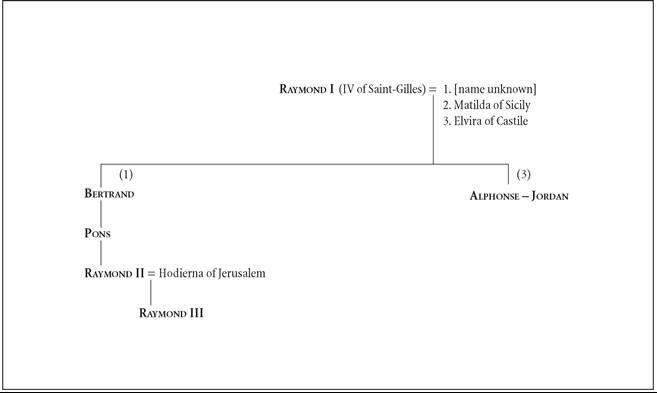
Succession to the County of Tripoli
As capital of the county of the same name, Tripoli attracted inhabitants originating from southern France and Italy who joined a primarily Christian local population. A Latin diocese was founded that combined the former sees of Botrys, Arqah, and Orthosias, and was directly subject to the patriarchate of Antioch (mod. Antakya, Turkey). The cathedral of St. Mary was destroyed by an earthquake in 1171 but was soon rebuilt. Several Latin religious institutions were established, both around Mont-Pèlerin and in the older town.
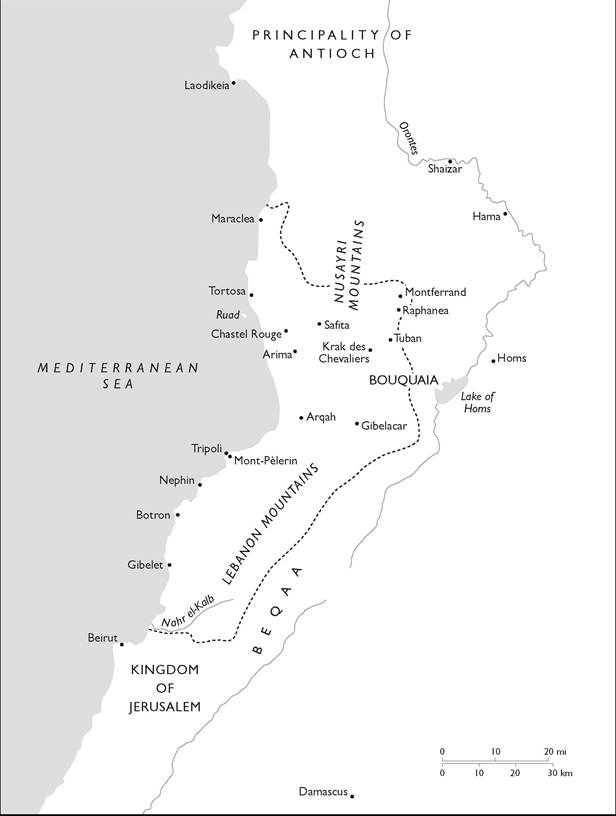
The County of Tripoli in the earlier twelfth century
The principal industry was silk weaving, which produced renowned fabrics known as camelines. The port had good communications with inland Syria and attracted merchants from Pisa, Venice, Amalfi, and Marseilles, all of whom established fondes (markets) there. Genoa was promised a third of the city at the time of the conquest, but this undertaking was never fully kept. The city was governed by a viscount, who presided over the burgesses’ court (Fr. Cour des Bourgeois). A medical school, which became famous in the thirteenth century, attracted many Syrian clerics, and the city became an important point of contact between the different churches. It was a cantor of the Latin cathedral, Philip, who translated the Secretum Secretorum, attributed to Aristotle, from Arabic at the request of his bishop.
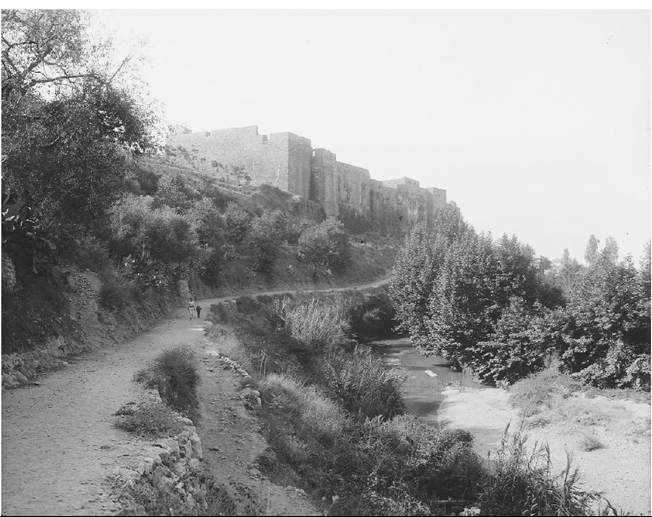
Castle at Tripoli, c. 1920. (Library of Congress)
From 1278 onward, the city increasingly suffered from factional strife. In 1282 the Templars tried to seize the town with the help of the lord of Gibelet, and in 1288, after the death of Count Bohemund VII, knights and burgesses who were hostile to the new regent of the county rebelled and formed a commune, choosing as their mayor Bartholomew Embriaco of Gibelet, who appealed to the Genoese for help. A settlement was negotiated with the new countess, Lucy, which confirmed the liberties of the commune and the autonomy of an enlarged Genoese quarter. However, certain Franks convinced the Mamlûk sultan Qalāwūn of the potential threat posed to Egypt by a Genoese base in Tripoli, and in violation of the truce then in force, the Mamlûks seized Mont-Pèlerin and besieged the city. Despite assistance from Acre and Cyprus, Tripoli fell on 26 April 1289, and those inhabitants who had not been able to flee were massacred. The city was razed to the ground, and a new town established around Mont-Pèlerin.
Counts of Tripoli |
|
Raymond I (of Saint-Gilles) |
1102-1105 |
Bertrand |
1109-1112 |
Pons |
1112-1137 |
Raymond II |
1137-1152 |
Raymond III |
1152-1187 |
Bohemund IV of Antioch |
1187-1233 |
Bohemund V |
1233-1252 |
Bohemund VI |
1252-1275 |
Bohemund VII |
1275-1287 |
Lucy |
1287-1289 |