
6
This chapter introduces those women who did not operate inside the approved circles of wives, nuns, and mothers because of their sexual habits, religious beliefs, or social activities. Since medieval society stereotyped women as less intelligent and more wayward than men, women in general may have benefited from laxer punishments and lesser requirements when they transgressed; similarly, however, activities that were permitted to men but not to women allowed women to be prosecuted for gender-specific crimes. Judicial courts developed a great deal across the Middle Ages as royal power grew and a higher population required clearer and more specific legal punishments. Church government also shaped punishments and ideas about right and wrong.
CRIMES AND INCARCERATION
People who broke the law in the Middle Ages seldom left their own impressions of their experiences. Our best sources are court records, which became more common beginning in the thirteenth century. Numerical data culled from these records may not be indicative of larger trends, given their spotty coverage and inconsistencies, but, in general, the number of women punished for crimes seems to have been significantly lower than the number of men. Women certainly committed petty crimes such as minor theft and violence, particularly violence against husbands and children. There were also crimes peculiar to women: yelling insults at someone or being a “common scold” could earn a woman public humiliation, probably to the satisfaction of her neighbors. The borough ordinance of Hereford, England, in the late fifteenth century stated that women damaged the peace of the city by “quarrelling, beating, defamation, disturbing the peace of the night, [and] discord frequently stirred between neighbors” (Goldberg 1995, 234). Such laws took advantage of the stereotype that women talked too much.
Women who committed minor crimes that were not sexual (we will discuss sex work below) often were publicly whipped or exhibited in a pillory or the stocks, the time calculated according to the gravity of the offense. People passing could insult or throw things at the convicted person or even cause them physical harm. In England, a pillory for women was called a thewe. Some communities also used a cucking stool or a ducking stool for minor transgressions like scolding. A cucking stool was a sort of chair that held the accused person in place so that passersby could see them, while a ducking stool was a chair that was lowered rapidly into water a number of times. Many of these punishments persisted through the early modern period into the eighteenth and nineteenth centuries. According to English records, the last time that a thewe was used was in 1817.
Theft was the most common property crime attributed to women. Small thefts in particular were often associated with sex work—a prostitute might filch some extra money or a small item from a customer. Women were also responsible for major thefts, which could carry a sentence of mutilation, as in branding on the cheek, or execution. A woman named Desiderata de Toryntone was convicted in 1337 of having stolen £40 worth of silver plate and salt cellars from a servant of Lady Alice de Lisle while he was staying in Salisbury. By the time she was arrested, Desiderata had already sold some of the plate but was caught with the rest and was sentenced to hanging (Labarge 1986, 207).
Medieval secular courts tended to punish people convicted of crimes physically or with fines or exile, while canon law courts punished them with religious penance, sometimes inside a church institution like a monastery. Imprisonment as a punishment in itself developed along with the Catholic Church, which emphasized isolation as one of the approved forms of penance. Such punishment was called detrusio, meaning an exclusion or thrusting away, presumably from society. In the Italian city-states beginning in the thirteenth century, urban authorities began building dedicated spaces for the incarceration of criminals. These required dedicated staffs of administrators, guards, cooks, and physicians to care for the people imprisoned there. Over the course of the late Middle Ages, prisons added women’s wards to their all-male institutions.
SEXUAL TRANSGRESSIONS
Criticisms based on sexuality were a prominent feature of most anti-woman writing in the Middle Ages. Women were alternately blamed in courtly literature for being cold and unwilling to have sex and criticized by religious writers as sexually promiscuous. Like most human beings, those who judged women in the Middle Ages were able to believe both these criticisms at once, without perceiving them to be at odds.
Adulterous Wives
Perhaps because adultery could interfere with the inheritance of property, legal authorities treated it as a particularly serious crime. Altogether, female adulterers received more attention and condemnation than male adulterers in the early medieval period, but in different places, the laws could vary widely. Roman law had generally understood adultery to be a crime against the men in the family. Any sexual activity outside of marriage for a free woman was forbidden. The Julian marriage laws of 18 BCE allowed a husband who surprised his wife with her lover to kill her lover without retribution, and a father who similarly caught his daughter with a lover was empowered to kill them both. Wives were not permitted similar rights with regard to their husbands and could not sue for divorce. There were some women who were exempt from charges of adultery: concubines, enslaved women, and prostitutes could not have legally valid marriages and, therefore, could not be prosecuted for betraying them. By extension, neither could the men who had sex with them, unless a man were trespassing on another man’s sexual territory (Brundage 1987, 31). Upper-class Roman women who had sex with lower-class men, however, could be sentenced to death. This double standard was persistent throughout the Middle Ages: men’s infidelity with their social inferiors was seldom punished, while women’s infidelity, particularly with a man of lower social station, was punished severely.
In Germanic law codes, as well, adultery was defined as a female crime. The first year of a Germanic marriage was a sort of trial period in which a husband could freely divorce his wife unless a pregnancy resulted. After the first year, a man might choose to divorce his wife for sorcery, adultery, or (strangely) tomb violation, but in the Burgundian code, a woman who wanted a divorce could be buried alive in mud. Unmarried fornication was regarded as less serious than adultery, because an adulterous wife could bring illegitimate children into her husband’s family. In many Germanic codes, the husband could kill both his wife and her lover if he found them in the act. Visigothic laws even extended this right to the woman’s father and brothers (Brundage 1987, 130–32).
In the Christian Roman empire, writers on morality attempted to make adultery a serious crime both for men and for women. According to the doctrine of the marriage debt (see chapter two), wives and husbands owned the rights to each other’s bodies. The writers of canon law (church law) forbade husbands with unfaithful wives from killing them, because that would constitute murder. Unfaithful spouses, male and female, were instead subject to excommunication and sometimes more physical punishments such as whipping. In Sicilian law, a man who learned that his wife was unfaithful was permitted to cut off her nose (Butler 2020).
Husband and wife might also be permitted to separate from one another, although neither could marry again. This kind of separation was called a divortium a mensa et thoro, a “divorce from bed and board,” meaning that the parties no longer cohabited and otherwise had no marital duties. Some canonical writers specifically forbade adulterous husbands from marrying their lovers if the betrayed spouse died. Others made the distinction between private adultery, revealed only in confession and punished by penance, and public adultery, which was a prosecutable crime. Local folk law and custom, however, still allowed betrayed husbands to kill their wives in practice; no court would prosecute a man for doing so (Brundage 1987, 208, 388). Johannes Teutonicus, a legal writer from the thirteenth century, noted that it had at one time been customary in his region to punish adulterous wives with head shaving, whipping, public humiliation, and sometimes even with death. He rejected these punishments, arguing that it was preferable, as in his own time, to make the accused adulteress enter a monastery, where she could do penance for her sin and be separated from her husband (and her lover) at the same time. The option of entrance into a monastery, however, would likely have been restricted to upper-class women. Decisions about how to punish an adulteress were shaped by class and position (McDougall 2014, 499–500).
Medieval Swedish secular laws from the thirteenth century provide interesting samples of instances in which adulterous women were punished more harshly than men. In general, Swedish secular laws understood adultery to be a crime against the honor of the woman’s husband. A betrayed husband could throw his wife out of the house and take her dower and personal property. She might be humiliated by having her cloak and skirt slit up the back so that her backside showed. There were also some shaming rituals that punished both man and woman. In one, a married man who had slept with an unmarried woman and could not afford the fine was sentenced to have a rope tied around his penis and to be led around the town by his lover, who was forced to wear two heavy stones and a chain around her neck (Ekholst 2014, 177–178).
The church generally oversaw prosecutions of unfaithful spouses in high medieval Europe. The idea that marriages, once made, were unbreakable pushed church authorities to seek reconciliation between spouses rather than separate them. Many religious writers argued that men and women who sinned equally should be equally punished. In fourteenth-century northern French church courts, such punishment took the form of fines, and more men were prosecuted than women. The church courts seemed to have believed that adulterous women who were under their husbands’ guardianship were their husbands’ responsibility to punish. Since both canon law and customary law recognized a husband’s right to beat his wife, the assumption may have been that beating was to be expected. The attitude toward adultery emphasized the husband’s moral dominance; when he strayed, he was made to pay, but he was also required to enforce the law in the household or be thought a weakling.
Local laws around Europe mentioned a number of other punishments for adulterous wives, including the traditional punishments of having their hair shorn, being whipped, and being paraded through town with their clothes torn. However, there are many cases in which accused adulterers were allowed to pay a fine rather than be publicly whipped. These fines ranged in amount depending on the ability of the sinner to pay—from as low as a few pennies (when a farm laborer might earn 35–50 pennies per year), to much more. Investigations into who was prosecuted and under what circumstances showed quite different patterns. In northern Europe, the records show a predominance of married men being arrested and fined for adultery. But further south, in Switzerland, women were more often prosecuted in adultery trials (McDougall 2014, 506–507).
Since adultery was frequently unprovable through the use of witnesses or other definitive evidence, some women in the High Middle Ages submitted to a judicial process called an ordeal. In an ordeal, the accused person, or his or her representative, agreed to undergo a physical challenge to allow God to reveal which of the parties was telling the truth. An ordeal might be unilateral (having one person involved) or bilateral (usually a duel). In a unilateral ordeal by hot water, the proband (the person undergoing the ordeal), after hearing mass and swearing an oath, plunged his or her hand into a pot of boiling water to take out a stone. In an ordeal by hot iron, the proband carried a red-hot piece of iron in his or her bare hand for a certain distance. In both of these situations, the proband then had the injured hand wrapped and left that way for three days. After three days, a panel made up of the local priest and other important people would view the hand and determine whether the wound showed God’s favor (by healing) or not (by becoming infected). A unilateral trial by ordeal might also require the proband to eat some dry bread without choking or walk across red-hot coals without being burned. Ordeals seem to have taken place throughout the early and High Middle Ages, but in 1215, Pope Innocent III (ca. 1160–1216) ordered priests to stop participating in trial by ordeal, and the practice of unilateral ordeals gradually died out. Duels lasted longer; we will discuss this below.
Adultery was a particularly serious accusation against a queen and could be challenged by the ordeal. Several queens are recorded to have been accused of adultery and proven their innocence by walking over nine red-hot plow blades. Kunigunde (ca. 975–1040), queen of Henry II of Germany, is the most famous, but there is a similar story about Emma of Normandy (ca. 984–1052), wife of King Aethelred of England. Both stories are probably later embellishments by writers who believed in the sainthood of both women. There were real instances, however, in which paternity was proven by means of the ordeal. In 1218, a woman named Inga of Varteid undertook the ordeal of hot iron in order to prove that her son was fathered by King Hakon III of Norway. The ordeal proved the boy’s paternity, and he became King Hakon IV (1204–1263) (Bartlett 1986, 20).
There are also some famous examples of adulterous wives who were tried by ordeal in medieval literature. For example, Queen Isolde, wife of King Mark of Cornwall and lover of the great Arthurian knight Tristan, cleverly manipulated the ordeal to prove herself innocent of adultery in the romance of Tristan, written by Gottfried of Strassburg in the twelfth century. Isolde asked her lover, who was disguised as a leper, to carry her on his back across a wet patch of ground. When asked to swear her innocence, she swore that no man had been between her legs but her husband and the leper who had carried her. Isolde’s manipulation of the ordeal process—since she was actually guilty—led Gottfried to remark in the romance that “Christ in his great mercy is pliant as a windblown sleeve.” This remark suggests that even in Gottfried’s time, some people felt the ordeal was an unreliable proof of guilt or innocence (Bartlett 1986, 17–20).
For upper-class people, trial by combat was also an option; women who chose trial by combat appointed a champion to represent their interest in a duel. This might provoke us to imagine situations in which armored knights battled for their ladies. This did sometimes happen, as in the rape case related by the chronicler Jean Froissart (see chapter one). Champions might also be chosen from among common people. In a 1063 case from the western French nunnery of Le Ronceray in Angers, a dispute over a piece of property was tried in an ordeal by battle in which the two champions were blacksmiths (Marchegay 1854, 3:125). Ordeal by combat was used as a proof later in history than the unilateral ordeal. Although many governments eventually made dueling illegal, the habit of dueling over matters of pride and honor lasted into the nineteenth century.
Toward the end of the Middle Ages, royal courts began to have more control over adultery cases as the structure of medieval justice became more secular. One justification for this change was the accusation that church courts were arresting innocent people for adultery and extorting money from them. Gradually, over the late fifteenth and sixteenth centuries, the prosecution of adultery changed focus from the husband to the wife. The jurists of the period restated the ancient legal doctrine that a wife’s chastity was more important than a husband’s purity because an unfaithful wife would interrupt the orderly inheritance of property from one generation to the other. By the mid-sixteenth century, Protestant and Catholic jurists accepted as given that women were temptresses whose unfaithfulness endangered both their husbands’ money and the moral state of all of society. The “double standard” was firmly established in European legal precedent (McDougall 2014, 514–516).
Homosexuality
Sex between men merited serious punishment in medieval Europe. Historians have observed that beginning in the twelfth century, church authors increased their condemnation of men who committed sodomy, by which they meant anal or oral sex. St. Colomban (543–615 CE), an influential author of one of the early medieval Penitentials, prescribed ten years of penance for a single homosexual act. Female homosexuality, meanwhile, merited much less attention. The Canons of Theodore, written in the late seventh or early eighth century, prescribed a penance of three years for a woman who “commits fornication with a woman.” The penance for female masturbation was also three years (Payer 1984, 41, 47). The lower punishment for women was possibly because the era’s dominant idea of homosexuality was phallocentric—church authors did not recognize sex that did not include the penetration of some bodily orifice as worthy of the same kind of condemnation. There were certainly writers who worried that women might use objects as replacements for the penis in sexual activities together. The ninth-century bishop Hincmar of Reims (806–882) was clear in his condemnation of women who “are reported to use certain instruments of diabolical operation to excite desire” (Murray 1996, 198).
Same-sex relationships between women are hard to discern in medieval sources: church sources were resolute in condemning same-sex eroticism, and firsthand sources for same-sex relationships are rare. Sometimes the sources clearly avoid discussing them. A fifteenth-century poet named Michel Beheim wrote a series of poems on the seven deadly sins in which sins of “unchastity” are all described in detail, except for a sin that is so terrible that he cannot even bring himself to discuss it; this terrible sin was left to the reader’s imagination, but it is not hard to imagine that he meant homosexuality (Puff 2013, 380–381). Such rhetoric, unfortunately, provides us unsatisfying information for what medieval people did or didn’t do between them. Frequently, what little we know comes from judicial records in which sexual behavior was either a factor or a corollary. For example, in the early fifteenth century, a woman named Laurence petitioned the royal court of France to release her from prison. She claimed to have been seduced by a woman named Jehanne and to have entered into a passionate sexual relationship. When Laurence tried to end the relationship, Jehanne attacked her physically, bringing the affair into public view. Laurence succeeded in getting herself released from prison by claiming to have been Jehanne’s unwilling victim; we know nothing of what happened to Jehanne (Bennett 2000, 18–19). This kind of judicial record is extremely rare. Literary historians, however, have found hints of same-sex eroticism in many medieval sources, even when sexual contact was not included. A Provençal poet named Bieris de Romans wrote a poem addressed to a “fair lady” named Maria in the thirteenth century; the text is much like comparable poems by men expressing their admiration for women, but the author is female (Dronke 1984, 98). Letters between nuns sometimes also contained intensely emotional, erotic language but in a celibate religious context.
Sex Work
Almost every culture in human history has had some instances in which people exchanged sex for money, property, or influence. In the Middle Ages, with its generally negative view of extramarital sex, religious leaders condemned prostitution as a form of fornication, and it was sometimes subject to harsh penalties. However, in certain circumstances, medieval society was willing to accept prostitution as a necessary evil. This ambiguity poses difficult questions for modern scholars. Not every person who exchanged sex for money or gifts would fit our modern definition of “prostitute” or “sex worker.” Many women (and men) were victimized in situations that we would classify as rape, for which the term “prostitute” would not be accurate in a modern sense but which, in a medieval context, was condemned as illegal or sinful.
The word whore (Latin, meretrix) can provide us with a starting point. The word appears in ancient and medieval documents, but it is not a description of a profession but, rather, a reflection on the sexual behavior of a particular woman or women: a whore was someone who publicly displayed her sexuality, whether for money or not. Women who offered their sexual services for money were called femmes publiques (public women) in French, meretrices publicae (public whores) in Latin, and “common women” in English. Women could become “common women” willingly, but it was also quite easy to fall into “whoredom” against one’s will. Whore could also be used for any women who transgressed social norms; since priests could not marry, their female companions were often called whores as well (Karras 1996, 27, 138).
Because medieval sex workers left no personal written sources for historians to explore, we are obliged to understand their lives by looking at court records and other legal documents that provide some clues. Some were itinerant, moving from place to place for clients, and some lived in hostels or in brothels. Some managed themselves, and some were under a bawd or pimp. Many made their living by working another job, like embroidery or wool working, and supplemented that income through prostitution. However, some laws, as in London in the mid-fourteenth century, prohibited sex workers from earning money by spinning or carding wool—probably to protect the livelihoods of women who worked wool (Karras 1996, 39). In rural areas, sex workers sometimes followed the progress of grape or grain harvests, where harvesters might be willing to hire them, or stayed in coastal towns to cater to men who traveled on the water (Rossiaud 1988, 3). In urban areas, where sex workers were numerous, demand was always high, and the need for new women was high as well.
We do not have much data telling us about the motivations of women who entered sex work. We might assume, probably correctly, that financial desperation played a role in some women’s decisions. We know a little more about women who became sex workers through trauma or coercion. It would be a mistake to say that rape was rampant in the Middle Ages. However, young women were often assumed to owe sex to men who were of higher social status than they were. Chambermaids and lower female servants, in particular, were often considered the rightful prey of men in a wealthy household. If the sexual relationship became public or if the woman became pregnant, she often lost her place as a servant and had little recourse to anything besides prostitution to support herself. A study of late medieval Dijon based on the testimony of seventy-seven women who were sex workers showed that only eleven of those women claimed to have entered prostitution voluntarily. The others came to prostitution through the procuration of a family member, poverty, family conflict, by force, or after a rape (Rossiaud 1988, 33).
Young women who came to large cities looking for work were sometimes kidnapped and sold to brothel keepers or recruiters who worked for the large brothels of the city. A young woman named Ellen Butler, when looking for a job as a servant in fifteenth-century London, was taken and placed in a brothel by its owner, Thomas Bowde. Bowde demanded that Butler pay him a large sum of money when she refused to work as a prostitute. This left her to make a terrible decision between going to debtor’s prison and entering sex work (Karras 1996, 57). Servants were sometimes sold into prostitution by their employers; some women were even sold by their families. Despite laws against this kind of sale, they continued all over Europe in cities where prostitution was big business.
When such cases ended up in law courts, it was rarely the actual clients who were convicted of crimes. Rather, the procurer, or bawd, whether male or female, was perceived as having “spoiled” a girl and could incur a penalty. This might be a monetary fine, or sometimes (if female), a physical sentence. Women in London could be sentenced to spending time in the thewe, a pillory that was reserved for the humiliation of women who committed minor crimes (Karras 1996, 57–58). Since procuring for sex work was regarded as a more serious crime than actually selling sex for money, laws sometimes allowed sex workers immunity from certain kinds of prosecution. A law of King Roger II of Sicily, dated about 1140, states that “known prostitutes” were to be considered immune to the laws that governed fornication and adultery. Prostitutes may have been “below the law, privileged in reverse,” because they exchanged the stigma of sex work for some forms of legal immunity (Pullan 2016, 29).
A large percentage of bawds were women, which may strike us as surprising, but the trade was lucrative and provided women with money that they could use to supplement other jobs. Running a bathhouse, for example, was an opportunity to provide sex for customers; many bathhouses had a reputation for selling sex as much as bathing. Some bawds provided places for lovers to meet in secret. Sex workers could also procure sexual clients for each other, brokering deals with men who were interested in a particular woman and claiming part of her earnings. None of these events necessarily took place in a brothel. For an individual woman, selling sex for money might form only a part of the activities she undertook in order to survive—for the poorest, manual labor, petty theft, or rag picking; for women better off, spinning or sewing to make ends meet.
Sex workers were increasingly subject to restrictions from local laws and governments from the thirteenth to fifteenth centuries. City authorities increased the connection between local prostitution and city government by passing laws that were designed to keep them in particular parts of the city or to maintain control over them through their bawds. In justification for doing so, they claimed that having access to sex workers would keep the young men of the town from raping or seducing respectable wives and daughters. Gangs of young men, for example, troubled late medieval Dijon by singling out unprotected women and raping them. The town fathers provided for sex workers to offer sexual services to keep the young men satisfied; local prostitution was thought to be a way to prevent attacks on virtuous women. Young unmarried men who committed such crimes were regarded with sympathy, since their sexual needs were thought to have overwhelmed them (Rossiaud 1988, 20–21).
Surprisingly, church officials generally agreed that sex work was a necessary evil. Augustine of Hippo, the major fourth-century religious author, had used the metaphor that prostitution was like the sewer in a magnificent castle; evil things had to have some place to go in order to keep the castle from filling with filth—by which Augustine meant that young men were likely to turn to rape or to homosexuality without another outlet for their sexual needs. This way of understanding sex work continued into the High Middle Ages (Pullan 2016, 30).
In many places in the twelfth and thirteenth centuries, courts and municipalities wrote laws that restricted sex workers’ clothing, living quarters, and activities. In Avignon, France in the 1240s, the municipal laws forbade them to live inside the city walls or to wear veils like respectable women. The statutes also forbade gambling after curfew in houses of prostitution. This indicates that there were houses of prostitution in Avignon and that sex workers were tolerated, even if they were regulated by the town. In Montpellier in the 1280s, after complaints from citizens about sex workers living in their neighborhoods, the bailiff of the king chose a street in a suburb of the city where they were required to live (Otis 1985, 18). Sex workers in London in 1351 were required to wear a hood of ray, a striped fabric, and were not allowed to wear fur linings in their garments (Karras 1996, 21). These laws represented steps toward the gradual municipal control of prostitution.
Municipal authorities had another reason for regulating prostitution: keeping the peace. Violence committed against sex workers was common. Some women had their heads shaved or their clothes torn; townspeople would break the doors and windows of their houses (Schuster 1994, 78). Many late medieval cities and towns built public or municipal brothels, a measure that was intended to protect, control, and manage sex work. These were usually funded by taxation and put under charge of a bawd, sometimes mockingly called an abbess if the manager was a woman. The abbess was responsible for recruiting women to the house and ensuring that they complied with any rules the city had for their conduct. Inmates of these official houses had to swear obedience to the town authorities, pay rent to the bawd once a week, pay the night watch protection money, and give money toward heating the house. Women who lived in these official houses of prostitution were sometimes a little older than women who were sex workers on their own. Most started their careers in their teens, sometimes as young as fifteen, while inmates of the official houses were often in their twenties. The existence of such “official” sex workers, of course, did not preclude other women from providing sex for money outside of state-sponsored brothels.
What happened to these women when they were no longer able to pursue sex work is a mystery. Some must have become bawds themselves. A few others entered real religious monasteries that were intentionally opened for reformed sex workers, particularly in the thirteenth and fourteenth centuries. Since medieval people understood Jesus’s companion Mary Magdalene to have been a repentant prostitute, the stereotype of the reformed, holy woman carried much symbolic significance. Some refuges were called “Magdalene houses” for this reason. Preachers sometimes encouraged men of the faithful to marry repentant sex workers, and some upper-class people gave money to repentant prostitutes as dowries they could take into marriage. In Prague in the late fourteenth century, a popular preacher named Jan Milich of Kromeriz (d. 1374) preached to the city’s common women with such success that he gathered a group of repentant women around him. Through donations, Milí could buy a series of properties around Prague to house his converts. The centerpiece of this community, which he named “Jerusalem,” was a chapel built over the ruins of the city’s largest public brothel. Milí’s success suggests that, in Prague at least, many women were eager to take advantage of the opportunity to leave sex work when their economic needs were met (Mengel 2004, 431). Such opportunities were rare.
It is not surprising that medieval people thought first of sexual sin when they thought of women. The overall rhetoric of gender, particularly attached to religion, guaranteed it. There were many other ways, however, in which medieval women might transgress society’s norms. Religious orthodoxy also demanded beliefs and behaviors that some women rejected, or simply were accused of rejecting, throughout the late Middle Ages.
WOMEN AND RELIGIOUS HERESY
Mysticism and the ideal of apostolic poverty brought some groups into conflict with Catholic doctrine, and, beginning in the twelfth century, women were active participants in heretical movements, or religious movements that the established church considered to be theologically wrong. The criteria that qualified thoughts as heretical were sometimes murky, and it is sometimes difficult to discern why one movement was called orthodox and one heretical. Individuals could be accused of heresy and be executed for it, but some believers also received lesser punishments from ecclesiastical authorities, such as penances on bread and water.
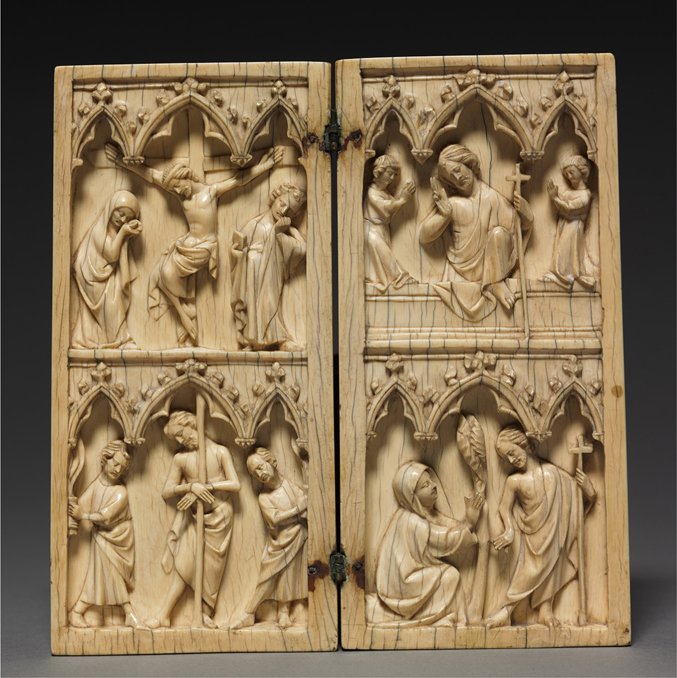
Medieval people believed that Mary Magdalene, a companion of Jesus, was a repentant prostitute. In this ivory carving, Jesus appears to Mary Magdalene after resurrecting. (Gift of Mrs. Chester D. Tripp in memory of Chester D. Tripp. The Cleveland Museum of Art.)
Historians have disputed whether heretical movements disproportionately attracted women away from orthodox practice because many movements featured expanded rights and positions for women. It is even possible that the church considered religious groups with female leadership as heresies from the start. However, other historians have pointed out that even when women joined heretical movements, they remained subordinate to the men in the sect; in most instances, women who joined heretical groups did not rise to higher office inside them. Because medieval society viewed women as gullible and given to error, they seldom held leadership positions. There were, however, a few notable exceptions.
An interesting example of a woman leader in a heretical sect is Guglielma (d. 1281), a daughter of the king of Bohemia, who gathered several dozen followers in Italy in the thirteenth century. Although she appears to have claimed to be an ordinary person during her lifetime, after her death, her followers, the Guglielmites, claimed that she had been the incarnation of the Holy Spirit, sent to convert Jews, Muslims, and pagans. Upon her resurrection, they believed, she would place a female pope, a “papesse,” at the head of the Roman Catholic Church and begin a new phase of civilization dominated by a woman-led church. The female pope was already chosen: her follower, Mainfreda da Pirono, was set to take up the office. This open feminization of the godhead and of the church hierarchy made the Guglielmites the most radically pro-woman Christian sect of the period. As such, the sect was also in conflict with Catholic orthodoxy. Two decades after Guglielma’s death, Sister Mainfreda and the other leaders of the sect were brought up before an inquisition. Three of them were executed, while Guglielma’s body was exhumed and burned (Newman 2005, 4–5).
A larger movement called the Waldensians, or the Poor of Lyons, also faced persecution for unorthodox beliefs and practice. They were founded by a merchant named Valdes in the late 1170s. The Waldensian movement began in France, spread across the mountains to Italy and to Germany in the fourteenth and fifteenth centuries, and persisted until the Protestant Reformation. Among their doctrines was the belief that the Bible should be translated out of Latin and into vernacular languages so that ordinary people could understand it, an argument that was later echoed by the Lollards in England, by the Hussites in Bohemia, and eventually by Protestant movements.
Like the Franciscans, Waldensians had an understanding of apostolic poverty that included both begging and preaching. What differed was that some Waldensian women could also teach and preach. These “sisters” often lived in houses called hospices where traveling Waldensians could stop and receive a meal and where local women could come for religious teaching. Hospices were supported by donations from their local communities, and the sisters spun, wove, and cooked very like their counterparts who were married and in households. The simple lifestyle of Waldensian believers convinced many poor people that they were less greedy and more faithful than the wealthy church officials whom they only occasionally saw. Later, inquisitors asked locals whether they had given alms or donations of food or money to the Waldensians. For many people, the answer was “yes.”
A study of the trial of four Waldensians, two men and two women, in Toulouse in 1319, has shown that the teachings that they believed in were gender-specific. Male Waldensians avoided venerating the Virgin Mary, discouraged visiting saints’ shrines, and emphasized the masculinity of God. But the two Waldensian women still maintained their veneration of Mary and their faith in the saints. These gendered beliefs would have been hard for a medieval woman to give up, despite preaching to the contrary; Mary and the saints were important objects of prayer from women. It is often difficult to tell how much, or how little, the average person would have understood about the charges of heresy. It is likely that some of the people questioned had no idea they were heretics until they were summoned before an inquisition (Shahar 2001, 100–101).
The Cathars (the root word is the Greek word for “pure”), who were also called Albigensians, in southern France, were the most prominent heretical sect of late twelfth- and early thirteenth-century Europe and persisted in secret for centuries afterward. The two names, however, are modern innovations; their name for themselves was “Good Christians.” Scholars have discussed whether Catharism was the theological heir of other heresies from earlier in the Middle Ages, or whether this particular sect was native to southern France, where it was most prominent. However, believers ranged significantly further afield as well: the Netherlands, Italy, and even, for a short time, in England (Peters 1980, 103). The basic theology of Catharism was dualist: followers believed that the world was a battleground between two gods, a good god and an evil god, who were equally powerful. The Cathars reasoned that since the world was so full of evil, it could have no connection with a benevolent and all-good God. They believed that humans had blessed souls whose natural place was heaven but that these souls were confined to their bodies by the Evil One. Death, therefore, was not something to be feared, and birth was not an occasion for celebration, because once the child cried, another angelic soul would be imprisoned in flesh (Brenon 1992, 94–95).
Cathars believed that male and female souls were theologically equivalent, no matter what body they were enclosed in, so both men and women were considered to be able to attain spiritual perfection. Both men and women could become Cathar priests, who were called perfecti, or perfects, by inquisitors. Perfects received a blessed meal called the consolamentum and, afterward, were required to be completely celibate. (Ordinary believers, who were called credentes, or believers, usually waited until they were about to die before receiving the consolamentum and did not normally practice celibacy.) Perfects practiced ascetic habits in meals and dress, rejecting any meat and refusing to kill animals. Cathar theology stated that the believer who died without the consolamentum was doomed to reincarnation, which could happen up to seven times, until the soul had fulfilled its penance and was ready to become angelic again (Peters 1980, 124). Asking suspected heretics to kill chickens or other animals was one technique with which the inquisition could uncover perfects hiding in the population.
Inquisitorial records that preserve the testimony of accused Cathars in southern France give us a picture of a rural everyday life affected by basic questions about Catholicism: whether the communion wafer was really Christ’s flesh; whether pleasure in sex was sinful or not; and under what circumstances souls would be allowed into heaven. A fourteenth-century priest in Montaillou, France named Pierre Clergue used Cathar beliefs to deceive and rape his female parishioners while reassuring them that extramarital sex was not sinful. One young woman, Grazida Lizier, twenty-one years old when she was interrogated, had a long sexual relationship with Clergue after she lost her virginity to him in a local barn. When she married, the relationship continued with the full knowledge of her husband. When asked if she thought her relationship with Clergue was sinful, Grazida replied that Clergue had told her, “To lie with a woman was no sin as long as it gave her pleasure.” She agreed with him, stating that “I still would not have thought it a sin, because of the shared joy of love.” In contrast, Mengarde Buscalh, who also had a sexual relationship with Clergue, claimed he had threatened her into having sex (Dronke 1984, 204–205, 210).
Mengarde’s testimony also included information about use of the consolamentum. She had a son about four months old who was ill and in danger of death. A Cathar perfect approached her about giving him the consolamentum so that, when he died, he would immediately become “an angel of God.” Mengarde refused, however, when she learned that after the ritual, she would no longer be allowed to nurse her son because his purity could not be violated through consuming food. “I said I’d never stop giving him my breast as long as he was alive,” she testified (Dronke 1984, 210).
While many heretical movements of the central Middle Ages were supported chiefly by lower-class believers, the Cathars were an exception: among the noble people attracted to Catharism was the countess Esclarmonde de Foix (ca. 1165–1215). Esclarmonde, widowed after having six children, became a perfect around 1200 and converted many people in her circle to Catharism. She attended a meeting in Pamiers in 1207 when a Catholic representative debated the Cathars on theology. She apparently spoke up so much that the Catholic legate told her, “Go to your distaff, madam, it is not proper for you to speak at such a gathering” (Labarge 1986, 211). Some of Esclarmonde’s family were also active Cathars, notably her sister-in-law, Philippa de Montcada, and her nephew, Roger Bernart de Foix. Besides the better-known noblewomen like Esclarmonde, numerous young girls and elderly women sought to become consecrated “good women.” Many of these women had passed their childhoods with good women, who might be their relatives, only to leave when they wished to marry (Pegg 2008, 86–87).
Esclarmonde died in 1215 of natural causes, but her relatives were soon caught up in the violent series of events that is known now as the Albigensian Crusade. This crusade was, in part, an attempt by Pope Gregory IX (1227–1241) to restore church power in southern France and to rein in the power of southern French nobles. In this conflict, the nobles of the region lost their power and holdings to the king of France, Louis IX (1214–1270). The papacy was then free to send in inquisitors to try to root out the heresy from the population. Repeated inquisitions, however, failed to entirely eradicate Cathar beliefs from southern France. Some scholars have posited that surviving Cathar beliefs were one of the reasons that southern France quickly became a Protestant stronghold during the Reformation.
MAGIC AND WITCHCRAFT
While popular culture today often identifies witchcraft with the Middle Ages, the most important period for witch trials and executions was the early modern period, between 1500 and 1700 CE. In modern times, some popular writers have promoted the belief that the witch trials were, in actuality, the persecution of an ancient nature religion that survived throughout the Roman period and the Middle Ages. No evidence exists for this point of view, however. Modern neo-pagans practice a number of rituals and beliefs that are based on ancient models, but there is no connection between these practices and medieval witchcraft as it is described in contemporary documents. Medieval beliefs about witchcraft existed firmly inside the medieval Christian worldview that Satan and his demons were constantly attempting to damn souls to everlasting torment. This was true of both accusers and defendants. While inquisitors were imagining the activities of witches, many people who were arrested believed in those activities as much as their accusers did, even if they were not guilty of attempting magic themselves.
Belief in magic—the belief that particular words, actions, or materials could cause visible effects on the natural world or on a person—was widespread during the whole of the Middle Ages. In Roman times, the use of magic was universal and not considered significant unless it was used against someone else, in which case it was labeled maleficium (literally “a bad deed,” often translated as “sorcery”). The person affected by maleficium could sue for damages. In Christian Rome, writers against magic identified the nature spirits (in Greek, daimones) who provided magic power with demons, evil spirits who were uniformly the tools of Satan (Bailey 2001, 963). Church authorities later ignored some magic, particularly the normal everyday magic habits of peasants, which they dismissed as superstition. A work called the Canon Episcopi (ca. 900 CE) stated with deep condescension that “Some wicked women are perverted by the Devil and led astray by illusions and fantasies induced by demons, so that they believe they ride out at night on beasts with Diana, the pagan goddess, and a horde of women” (Russell and Alexander 2007, 53). The canon writer’s intent may have been to dismiss superstitious fantasies but, over time, Diana was replaced with Satan, and widespread belief in such “shabbats” or Sabbaths grew (Bailey 2001, 961–962).
Old prejudices and stories that dated from the ancient world also reemerged and became identified with witchcraft, including accusations of cannibalism, orgies, and infant sacrifice. The early Christians and Gnostics of the first and second centuries had been the targets of such accusations, which probably originated in a misunderstanding of the Eucharist as an infant-killing ritual. The first medieval accusations of the kind were in 1022 in the city of Orléans, France, when a group of people accused of heresy were charged with participating in orgies and eating communion wafers made from the ashes of newborn babies. These accusations were easy to transfer onto accused witches. In the high Middle Ages as well, some learned upper-class men, some of them churchmen, were believed to be trying to affect the natural world through more complex magic that used astrology and alchemy. In 1326, Pope Innocent II issued a bull, Super illius specula, that condemned practitioners of all sorcery and commanded all papal inquisitors to seek out those who “enter an alliance with death and make a pact with hell” (Bailey 2001, 966).
By the early fourteenth century, folklore and theology had combined to create a shared belief in witchcraft that could then be used to punish people, especially women, who were, for one reason or another, transgressors of society’s expectations. From the eleventh century onward, the punishment for women who committed heresy was burning at the stake, which functioned as a sort of official punishment for all actions that were particularly heinous. These terrible executions increased in number as the central church expanded the work and scope of inquisitions, and witchcraft became a crime that was punished by burning as well (Russell and Alexander 2007, 64–66, 70).
Torture was an acknowledged part of the medieval justice system and was sometimes used on accused witches and heretics. In general, women were tortured less often than men, in part because they were considered to be physically and mentally weaker. In questions of treason, magic, and heresy, however, the crimes were thought to be so serious that torture was warranted. In the late fourteenth century, King Juan I of Aragon (1387–1396) accused his stepmother, Queen Sibilla of Aragon (d. 1406), of both treason and sorcery, alleging that she was making him ill through black magic. We know of this case because a well-known legal author of the period, Baldus de Ubaldis (d. 1400), was asked to give his opinion, particularly since the accused was a queen. Baldus wrote that torture should be used only in cases in which the evidence was particularly strong and that any testimony given under torture was not valid unless confessions were made not only during torture but afterward, when the fear of torture was no longer a factor. He mentioned that Sibilla was, in fact, tortured, but we do not know the outcome of the trial. Since Sibilla outlived her stepson, who died in 1396, she may have been exonerated (Pennington 2012, 2–4).
Two key facets of late medieval witch accusations are particularly important: the concept of a pact with the Devil and the belief in demonic sex. In 1233, Pope Gregory IX accused Waldensian heretics of selling their souls to the devil and of worshipping the devil at their meetings (Russell and Alexander 2007, 71). By the early fourteenth century, kings such as Philip IV of France used accusations of devil worship to discredit churchmen who tried to block their political agendas, and since condemned prisoners forfeited all their possessions, money gave prosecutors a considerable motive. Late in the fourteenth century, the University of Paris declared that all magic involved demonic power, and witchcraft was labeled a serious, Europe-wide problem. As with heresy, courts often used torture to elicit confessions from the accused. Secular authorities such as royal courts took responsibility for physical punishments of heretics, since officials of the church were forbidden to shed blood (Russell and Alexander 2007, 76–77). When church courts handed over convicted witches or heretics to secular courts, they avoided having the taint of bloodshed attached to them.
The trial of Alice Kyteler in 1324 is often cited as the first witchcraft trial in which a woman was accused of intercourse with a demon and of practicing sorcery (maleficium). Alice Kyteler was a wealthy moneylender who lived in Kilkenny, Ireland. She was married four times and was accused of heresy and sorcery by her stepchildren. She reaped financial benefits from all her marriages and used that wealth to support the career of her biological son, William, but not his stepbrothers and sisters. According to her accusers, Alice Kyteler had a familiar demon who appeared as a black man, dog, or cat and with whom she had sexual intercourse. This demon supposedly gave her both money and magical power. The stepchildren brought their accusation to the English bishop of Ossory, Richard Ledrede, who opened up a case against Alice, accusing her of maleficium and of devil worship, including leaving the parts of dead animals at crossroads to create magic power and denying Christ and the church. Local Irish officials (probably correctly) interpreted Bishop Ledrede’s action as an attempt to extend the power of the English church into Ireland, and fought back. The ensuing political morass led to Alice’s flight from Kilkenny, probably to England or to Flanders, the execution of her maid, and the trial and penance of her son, William Outlaw (Williams 1994, 20–24).
In Alice Kyteler’s case, we can see some of the trends that developed into a full-blown movement against witchcraft: accusations of devil worship and deliberate rejection of the church and descriptions of foul potions or mixtures that forced people to do things against their will. The growth of these beliefs led to the publication of the witch-hunter’s manual called the Malleus Maleficarum (Hammer of Witches). Published in 1486, this book was the work of two Dominican inquisitors, Joseph Sprenger and Heinrich Kramer, who laced it with vicious assertions that women were at the most serious risk of becoming witches. Their reasons included claims that women were more “stupid, fickle, lighter-headed, weaker, and more carnal than men” (Russell and Alexander 2007, 79). Papal approval and the newly arrived printing press helped the Malleus Maleficarum to be one of the most important books of the period, issued in print fourteen times between 1486 and 1520 in various languages.
The Malleus Maleficarum, although it was very important for shaping beliefs about witches and women, did not invent the misogyny that underlay witchcraft accusations. Its authors were parroting older views attached to women, their sexuality, and their intelligence. They may also have been influenced by the changes to the population before, during, and after the Black Death (the outbreak of bubonic plague that took place from 1347 to 1351). Although most women in the Middle Ages lived under the protection of a husband or of a male relative, in the thirteenth century, women who were unable or unwilling to marry could choose the monastic life or join a community of Beguines (see chapter six). During and after the Black Death, convents became closed to everyone except the rich by requiring higher dowries, and the Beguine movement gradually died out. This left a subset of women who, because they never married or were widowed, had no place to go and no male protectors. Some historians have suggested that this demographic twist accented and intensified popular views of solitary women as sexually promiscuous and dangerous. Such women were easy to accuse with little fear of criticism, and the arguments of the Malleus Maleficarum served to confirm misogynistic stereotypes with ecclesiastical backing (Russell and Alexander 2007, 113–115). Official propaganda about the dangers of witchcraft helped develop the “witch craze” of the sixteenth and seventeenth centuries.
There is no way of knowing how many people (many women, but some men as well) were accused or executed as witches in the entire period of the witch-hunts; there are no aggregate numbers that are reliable, and witchcraft accusations took place all over Europe and in the European colonies of the New World. Modern scholars have arrived at an estimate of around one hundred and ten thousand accusations and around sixty thousand deaths, some by burning and some by hanging or other methods (Levack 1987, 21). It is important to remember that the period of the witch-hunts lasted about three hundred years. Additionally, our knowledge of what happened comes from authorities who were responding to or making the accusations against witches. Sometimes courts obtained information about the accused through judicial torture, either of the accused or of witnesses, so even legal sources must be used with caution. Sources also survive unevenly in history; for some places, there are plentiful records to be investigated for witchcraft trials and, for some places, no sources survive at all.
CONCLUSION
Thus far in this book, we have traced some of the major ideas and experiences that shaped medieval women’s everyday lives. In the next chapter, we will look directly at some women whose writings we can still access. Although these women do not always give us the answers to our questions, they provide an exciting window into daily lives.