
After three decades in which the ambiguous status of the duchy of Aquitaine had poisoned relations between England and France, Philip VI of France decreed the confiscation of the duchy in 1337 and Edward III declared war. Edward’s initial strategy was to stir up the internal political tensions of France, encouraging rebellions against the authority of the French Crown with promises of military support. Between 1338 and 1340, the English King concentrated his efforts on Flanders where the revolt of the towns against their count, Louis of Nevers, provided him with a rich and powerful ally on France’s northernmost province. To provide the Flemings with a justification for making war on Philip VI and to encourage other provincial rebellions, Edward revived the claim which he had made at the beginning of his reign to be the rightful king of France through his mother (the eldest daughter of Philip IV of France). In 1340 he proclaimed himself King of France at Ghent. But apart from the famous sea-battle at Sluys in 1340, which resulted in the destruction of the French fleet, Edward III’s northern strategy was a failure which ended in military stalemate and bankruptcy.
The English King turned next to Brittany, where a war of succession broke out in 1341 between the house of Montfort, backed by England, and the French King’s candidate, Charles of Blois. Strategically, this was more productive. The English occupied much of Brittany, including the important coastal fortress of Brest. Finally, in 1346, Edward III landed in Normandy with a large English army to take advantage of an incipient rebellion among sections of the Norman nobility. The rebellion never materialised, but Edward marched through northern France and, confronted by the numerically superior army of Philip VI north of the Somme, defeated and largely destroyed it at the battle of Crécy. He went on to capture Calais in 1347 after a siege of eleven months. These events coincided with important developments in other theatres. In England, an attempt by France’s long-standing Scottish ally to mount a diversion in Edward’s rear ended with their defeat at Neville’s Cross in 1346 and the capture of the King of Scotland, David II. Henry of Lancaster took an army to Bordeaux in 1345, and over a period of some eighteen months recovered much of the territory in the lower valleys of the Garonne and the Dordogne which had been lost to the French in the early years of the war.
The following decade was dominated by the attempts of Edward III and the Prince of Wales to exploit the prolonged and destructive rebellion of Charles of Evreux (‘the Bad’), King of Navarre, which began with the assassination of the Constable of France, Charles of Spain, in 1354. In 1356, John II of France arrested Charles in Rouen castle, and put a number of his principal supporters to death. These events provoked the greatest civil war in France’s medieval history. As France subsided into anarchy, the English planned co-ordinated invasions of northern France by three English armies operating from Calais, Brittany and Aquitaine. The only part of this ambitious plan to be carried through to a conclusion was the southern invasion, which was conducted by the Prince of Wales with a combined English and Gascon army from Bordeaux. John II marched against the Prince, and caught up with him east of Poitiers in September 1356. The battle of Poitiers ended with the loss of John’s army and his own capture. It also led to four years of civil war in the course of which Paris was taken over by a revolutionary regime led by Charles of Navarre and the demagogue Étienne Marcel. Much of northern France was occupied by English garrisons, Navarrese armies, and German, English and Gascon free companies. This disastrous period in French history was brought to an end by the treaties of Brétigny (1360) and Calais (1361). By these treaties, John II obtained his own release and Edward III’s promise to abandon his pretension to be King of France. But in return he had to promise a crushing ransom and to cede about a quarter of the territory of his kingdom to create an enlarged duchy of Aquitaine, free of all feudal dependence on France. In 1363, the duchy became an independent principality, which was settled on the Prince of Wales.
The treaties failed to bring peace to France, mainly because it proved impossible to control the ravages of the English, Navarrese and Gascon companies still operating there. John II never formally renounced his sovereignty over Aquitaine, because Edward III continually put off his own renunciation of the title of King of France in the hope that the continuing threat that he might resume it would keep the French government compliant. But, with John II’s premature death in 1364, power passed to his son Charles V who set about unpicking the settlement of 1360–1. In 1367, the Prince of Wales invaded Castile in the name of King Pedro, who had been deposed and expelled by his illegitimate half-brother Henry of Trastámara with French backing. The Prince defeated Henry and his French allies at the battle of Nájera but the expedition bankrupted him. In an attempt to recover his finances the Prince imposed, with the support of the Estates of Aquitaine, a fouage or hearth tax on his subjects. Two principal noblemen of the southwest, the Count of Armagnac and the lord of Albret, took the opportunity to test the effectiveness of the settlement of 1360–1. They appealed to the King of France against the tax. Charles V’s acceptance of these appeals effectively repudiated the treaties of Brétigny and Calais. When the Prince declined to answer to the appeals Charles declared the duchy forfeited in May 1369. Edward III resumed the title of King of France three weeks later.
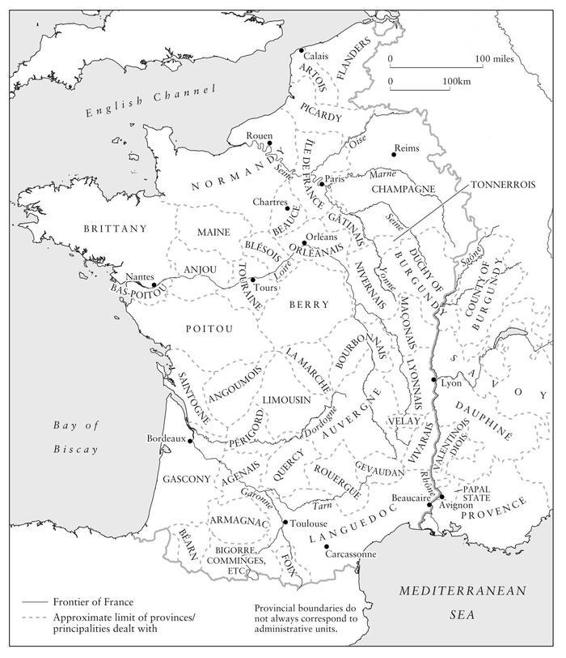
1 France