
3
Long before Eastern Shoshones rode across the Wyoming Basin, Snake River Plain, and western Great Plains on horseback, their ancestors traversed those expanses on foot. They were, like their Great Basin relatives, hunters and gatherers who maintained highly migratory lifeways that enabled them to capitalize on women’s foraging activities and men’s hunting efforts. Unlike their Basin relatives, though, they coordinated occasional buffalo “jumps” that could give them windfalls of dozens of bison to support immediate feasts, as well as provide dried meat for storage and materials for clothing, lodging, and myriad other purposes.1 Indeed, the rich and varied ecosystems of the Great Plains, Rocky Mountain, and Columbia Plateau regions afforded new opportunities for subsistence, social organization, and culture. And the establishment of Numu populations in such areas prior to 1690 CE contributed greatly to Wind River Shoshone ethnogenesis, for the ancestors of the Eastern Shoshones who inhabited such places as the Green River Valley, Snake River Plain, and, of course, the Wind River Valley became increasingly distinct from their Great Basin relatives as they adapted to new environments.
Although this was a critical period in the story of Eastern Shoshone ethnogenesis, historians have largely overlooked it while anthropologists once debated it. Ethnographer Robert H. Lowie, for example, downplayed the Shoshone presence on the Great Plains (both before and after the arrival of the horse), as well as the region’s influence on their cultural development, based on an absence of migration legends among the Northern and Western Shoshones, the prevalence of Basin-style material culture and technology among all Shoshone groups, and the relative simplicity of Shoshone social organization.2 Similarly, Alfred Kroeber concluded, based on linguistics, that it was unlikely that Shoshoneans inhabited the Great Plains prior to the horse.3 More recently, Åke Hultkrantz argued that Numu groups migrated into the Wyoming Basin and western Great Plains from their Great Basin homelands well before the equestrian revolution began in the late seventeenth century, referencing archaeological findings and written records that Lowie disregarded, highlighting the shortcomings of the linguistic evidence upon which Kroeber relied, and highlighting Eastern Shoshone traditions that suggest a pre-horse presence on the Great Plains. He contends that the pedestrian ancestors of the Eastern Shoshone people adapted their Great Basin culture to the grasslands environment, ultimately forming a composite Basin-Plains culture.4 George E. Hyde produced perhaps the most exhaustive if flawed treatment of the subject by a historian, arguing for a pre-horse Eastern Shoshone presence on the High Plains based on conjectural reconstructions of the past; that Hyde did not include source references is also problematic.5 More recent historical studies tend to give the subject cursory treatment before moving into the equestrian era.6
In the following pages, I aim to remedy this issue by pulling together information scattered throughout many ethnographic and historical works into an analysis of the dynamic relationship between culture and environment that casts light on the vibrant pedestrian Numu cultures that migrated throughout the Wyoming Basin and adjacent areas by the dawn of the eighteenth century. It appears that dynamic subsistence systems and overwhelming military power facilitated Numic migrations into the southern Columbia Plateau, Wyoming Basin, and western Great Plains regions prior to the equestrian revolution. Like their Great Basin relatives, the Numu groups that expanded beyond the Basin sometime before 1700 utilized remarkably diverse and flexible subsistence methods. And although many Numu groups that inhabited such places as the Wyoming Basin and western Great Plains began to place more emphasis on hunting because they enjoyed greater access to a variety of big-game species, women’s gathering activities, as well as group efforts to trap and hunt smaller wildlife, remained critical to group survival. And since gender complementarity characterized divisions of labor among the Numu who inhabited areas beyond the Basin and the women of those groups maintained many vital responsibilities, they wielded influence and status akin to that of their Great Basin counterparts. This system of gender complementarity, in fact, contributed to the military prowess of the Numu, for although hunting bison and other large game became a major point of emphasis among those groups, women’s work to support their families and communities enabled men to go to war. Sometime before the horse revolution, some Numu groups developed and deployed a formidable style of pedestrian warfare that allowed them to securely inhabit and utilize resource-rich areas beyond the Great Basin. While some scholars, such as Mark Sutton, have argued that their military power enabled the Numu to occupy a large stretch of the western Great Plains prior to 1700, I emphasize that their subsistence patterns and related social organization systems were critical components of that military might, for their evolving relationships with the land enabled them to live in larger groups, more frequently congregate with others, and thereby amass considerable manpower.7 So, although the Numu communities that resided beyond the Great Basin were similar to their Basin relatives in many ways, there were some major distinctions that set them apart, even before the reintroduction of the horse to this portion of the North American West.
The following pages therefore illuminate an important phase of Wind River Shoshone ethnogenesis. As Numic-speaking peoples adapted their lifeways to the diverse ecosystems of the Wyoming Basin, western Great Plains, and other lands beyond the Great Basin, they became increasingly distinct from their Basin relatives. Indeed, their evolving subsistence systems altered their lifeways, affecting their social organization, material culture, military activities, and, in many ways, their daily lives. In this stage of Numu history, the ancestors of the equestrian Eastern Shoshones that Anglo-Americans encountered during the nineteenth century developed characteristics that would deeply influence their descendants’ lifeways, including their subsistence, culture, and identity. And many of their traits as a people can be traced to their dynamic relationships with lands and resources in the Wyoming Basin and adjacent areas that began to develop before the horse returned to the North American West. Indeed, even before the horse revolution began, Numic-speaking peoples began to adopt Plains-style subsistence patterns and this, in part, explains the successful integration of horses into their lifeways.
It is not clear how long before the equestrian revolution Numic-speaking peoples began migrating into areas beyond the Great Basin. Some archaeologists, such as Sally T. Greiser, argue for a recent Numic expansion into the western Great Plains based on findings of distinctive Numic-style material remains, such as flat-bottomed pottery and steatite vessels as well as tri-notched obsidian arrow points and semilunate knives; Greiser concurs with ethnographer Demitri Boris Shimkin and others that Numic migrations into the grasslands may have begun as recently as 1500 CE.8 On the other hand, Hultkrantz asserts that “there is good reason to believe that the Shoshoni lived on the western fringes of these Plains for several thousand years.”9 Although the sources do strongly indicate a pre-horse Numic presence in such areas as the Wyoming Basin and western Great Plains of at least a century or two, no combination of evidence conclusively points to Numic roots lying any deeper than that; there are certainly material remains that point to an earlier indigenous presence, but it is not clear that those peoples were Numic speakers. So, just as I proceeded in the previous chapter based on where scholars agree, I do so here as well, working from the clear evidence that Numic-speaking peoples inhabited parts of the Columbia Plateau, Rocky Mountains, and western Great Plains prior to the onset of the equestrian revolution. It is entirely possible, of course, that Numic-speaking groups migrated into these areas beyond the Basin at different points in history, with some doing so several thousand years ago and others within the last five hundred years; the historical record is woefully incomplete. Regardless of when they began to arrive, though, the ancestors of the Eastern Shoshones adapted their Great Basin–style lifeways to the exigencies of new ecosystems, which opened up new opportunities in terms of sustenance, material culture, and social organization, thereby rendering those peoples increasingly distinct from their linguistic relatives in the Great Basin.10
Archaeological evidence suggests that there was a long tradition of Great Basin peoples migrating beyond the Basin into adjacent areas. The record, however, is not definitive regarding whether these were Numic-speaking peoples. Such findings indicate that as many as 9,500 years ago, a culture began expanding eastward from the Great Basin into the Rocky Mountains. These hunting-and-gathering peoples used some basic stone tools, including grinding implements that they likely used to process seeds and other plant matter, and they combined their foraging activities with small-game hunting efforts within what scholars call the “Mountain Tradition.” Evidence suggests that this forager culture endured until about 2500 BCE in the Rockies of what later became parts of Wyoming and Montana, while it persisted in the mountains of present-day Utah and Colorado until as recently as 1300 CE. Scholars do not know what became of these peoples, although some speculate that expanding Numu groups may have displaced and/or absorbed them into their communities.11
The changing climate of the North American West deeply shaped the environments that migrating Numu groups inhabited and utilized beyond the Great Basin, especially the ecosystems of the Great Plains region. Throughout much of their long human history, the bulk of it in fact, Basin-type foragers rather than big-game hunters dominated the grasslands of the western Plains. Beginning perhaps 10,500 years ago, human subsistence strategies on the grasslands transitioned from broad-spectrum big-game hunting to more specialized bison-hunting practices as various megafauna species went extinct during the close of the last great ice age. In the wake of these Late Pleistocene extinctions, bison bison, which survived its larger relatives, expanded throughout the grasslands and diversified to become short-grass feeders, thereby succeeding where larger species failed. The peoples who inhabited the grasslands utilized pedestrian hunting methods to capitalize on the thriving bison population. But about 7,000 years ago, during the Altithermal, bison numbers declined and their range diminished as a combination of decreased precipitation rates and higher average temperatures detrimentally affected their forage. Consequently, small, scattered hunter-gatherer groups akin to those of the Great Basin replaced the bison-hunting peoples, and their subsistence systems would characterize western Plains cultures for the next several millennia. These peoples may have been refugees from the Great Basin, where the Altithermal made the Basin environment an especially challenging one to inhabit. Archaeological sites in Wyoming and Montana dating to about 2000 BCE contain plant-milling stones and bone refuse that indicate that the people who produced those remains relied more on plants and small game than they did large mammals. The Altithermal ended around 2500 BCE, but it was not until about 500 CE that big-game hunting again characterized western Plains cultures. The onset of cooler temperatures and increased rainfall fostered the gradual recovery of the grasslands and, as a result, populations of large herbivores, especially the bison, rebounded, again making their pursuit a feasible option for humans. Consequently, the people who inhabited the Great Plains along the Rocky Mountain Front reoriented their subsistence activities toward the growing bison herds.12
More recently, a series of climate events again transformed the western Great Plains and influenced the ancestors of the Wind River Shoshones, who migrated beyond the Great Basin during this long period of climate change. The Little Climatic Optimum, which affected the Basin during the thirteenth century, also influenced the Plains environment at that time.13 It appears that drought conditions again contributed to a significant decline in the bison population and evidently compelled at least some of the region’s indigenous peoples to withdraw to the margins of the grasslands—such as the Rockies—and use the Plains proper only for seasonal hunts. The onset of the Little Ice Age in the fourteenth century, however, brought approximately five centuries of more temperate conditions to much of the Western Hemisphere, including the western Great Plains. Climatological studies indicate that as glaciers and ice caps such as those of the Rocky Mountains expanded, the grasslands experienced cooler average temperatures and increased precipitation. While climatologists observe that the Little Ice Age also brought greater variations in annual precipitation to the Plains, including summer droughts and especially harsh winters, those fluctuations were apparently more intense on the southern grasslands than those to the north. On the northwestern Great Plains in particular, annual precipitation generally increased. The Black Hills and the surrounding grasslands perhaps benefited the most from the onset of the Little Ice Age, and it was in that region that Numic-speaking peoples established a considerable presence during the century or so that preceded the equestrian revolution.14
The Little Ice Age in many ways made the western Great Plains an ideal home for adaptive hunter-gatherers such as the Numu. Despite its volatility, the Little Ice Age gradually rejuvenated the grasslands of the Great Plains, which had suffered during the Little Climatic Optimum, enhancing both the quantity and quality of forage and thereby increasing its carrying capacity. Conditions thus improved considerably for big game such as the bison; their populations grew and they enjoyed the ability to congregate in larger herds, especially for the annual rut. It appears that bison also settled into more predictable migration patterns on the northern Plains and, moreover, they often remained within smaller ranges than before as vegetation became considerably richer and denser, especially in the Black Hills region. With hunting prospects thus improved, the Numu were among the many indigenous peoples who increasingly inhabited and utilized the Great Plains environment. At the same time, some climatological evidence in the form of tree rings and ice cores suggests that the Little Ice Age may have exerted a detrimental effect on the Great Basin overall; vegetation might have suffered and already limited game populations perhaps declined as droughts continued to visit the Basin. If this was indeed the case, it likely encouraged Numic-speaking peoples who inhabited the region to seek subsistence elsewhere—such as the Rocky Mountains and western Great Plains. While there is no direct evidence to suggest that this, in fact, happened, climatological evidence bearing on the Great Plains and Great Basin regions suggests that something of a push-pull factor may have contributed to the Numic migrations that transpired during this very time.15
Just as the Little Ice Age revitalized the grasslands of the Great Plains, so, too, did it enhance forage growth in the mountains and valleys of what are now Wyoming, Colorado, Idaho, and Montana. This renewed vegetation supported larger populations of mountain bison, elk, and other game that inhabited the mountains as well as their foothills and valleys. The Numu and other peoples capitalized on this sheer abundance of game, which complemented their continued foraging efforts. It is unclear when exactly the Numu first inhabited and utilized the lands of the Greater Yellowstone Ecosystem, but archaeological findings in the form of distinctive soapstone vessels suggest that some did so at least five hundred years ago. Written and physical records indicate that the Numic speakers who became known as Shoshones and Utes established roots in parts of Utah and Colorado by the sixteenth century. Other Numu groups moved into the Salmon River country of present-day Idaho sometime before 1600 CE. Archaeological and anthropological studies suggest that at least some of these Numic-speaking peoples who inhabited the Rockies ventured further east into the Great Plains on at least a seasonal basis to hunt bison.16
It appears that at least some of these Numu groups developed annual migration cycles in which they spent part of a given year in the mountains and valleys of the Great Basin but for the winters traveled through South Pass (in what later became southwestern Wyoming) and other routes through the mountains to the eastern side of the Rockies. Indeed, it seems that Numic speakers began to claim debías in lands well beyond the Great Basin during this time. The Wyoming Basin in particular functioned as something of a natural corridor that connected the Great Basin and the Great Plains regions, providing indigenous migrants with relatively easy passage through the Rocky Mountains. In this Rocky Mountain–Great Plains ecological borderland, the Numu found relative shelter from the cold in the valleys tucked between mountain foothills, as well as plentiful supplies of bison, elk, and other game that congregated in their annual wintering grounds to forage.17 Thus the Numu capitalized on their position at the meeting ground of distinct ecosystems to produce what Pekka Hämäläinen described as a “flourishing and eclectic culture that belies the traditional image of the brutal, impoverished existence of Basin peoples.”18 Changing climate patterns that altered the floral and faunal complexion of the land—namely the Little Ice Age—contributed immeasurably to the ability of the ancestors of the Eastern Shoshone people to adapt their Great Basin traditions to the opportunities presented by new environments.
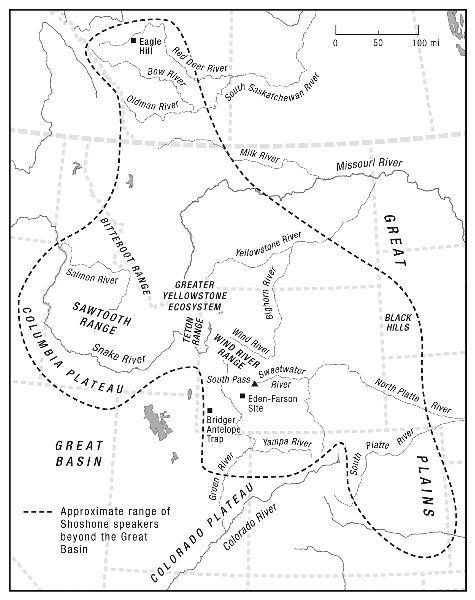
Figure 2. The Numu world beyond the Great Basin, ca. 1690. Erin Greb Cartography.
Some of the areas that the Numu inhabited beyond the Great Basin closely resembled their Basin homelands. That corridor through the Rocky Mountains that connected the Great Basin and Great Plains—the Wyoming Basin—presented the Numu with a collection of valleys and mountain ranges that enabled them to utilize subsistence methods not too different from those of their Basin relatives. Climatologists largely define these basins—such as the Green River, Big Horn, Wind River, Snake River, and North Platte River basins—as either cold desert or dry cold steppe regions. These areas are best classified as arid or semiarid, ones that typically feature high summer temperatures and low winter temperatures. Across the Wyoming Basin, rugged mountain ranges separate wide expanses of open plains, and climatologists generally classify these higher-elevation areas as cooler and wetter taigas. This mosaic of semidesert sagebrush or grass-covered plains interspersed with alpine mountain ranges and their sagebrush-covered foothills presented a diverse array of resources upon which the Numu capitalized with their migratory lifeways, and this would contribute to significant transformations in their subsistence systems.19
Several parts of the Wyoming Basin would become central to Shoshone history as debías and other important areas that the predecessors of the Eastern Shoshones visited on a seasonal basis. One of those was the Green River Valley, situated just west of the Continental Divide and the closest of the Wyoming basins to the Great Basin itself. Much of this valley receives little more than fifteen inches of precipitation annually, and so sagebrush, desert shrubs, and cacti dominate its landscape. Unlike the Great Basin, however, it historically supported significant populations of big-game animals, especially bison and pronghorn, in addition to jackrabbits and other small game that the Numu pursued. On the east side of the Wind River Range from the Green River basin sits the Wind River Valley, which was an Eastern Shoshone debía by the mid-nineteenth century. Although this area is physiographically classified as part of the Rocky Mountains, it has long been vegetationally similar to the Great Basin; it is a sagebrush country. Largely comprised of open although in many parts rugged plains, this area lies among the outlying broken mountain ranges of the Rockies, and its lands are drained by the Bighorn, Powder, and North Platte River systems into the Missouri River. The lower altitudes of the Wind River Basin are semiarid, but because of the region’s higher altitude it is generally not as dry as the neighboring Green River Valley or Big Horn Basin. The basin’s rather pleasant year-round climate, which features average summer temperatures in the low 70s, winter temperatures at about 20 degrees, and approximately 15–20 inches of rainfall annually, in tandem with its combination of high-altitude alpine forests, sagebrush-covered foothills, grassy plains, and riparian areas, supported resource-rich ecosystems. Here, Numu hunters found bison, pronghorn, deer, and a variety of small mammals in abundance, waterways that teemed with fish, and plenty of berries and other plant matter that women gathered. While ecologists classify the Green River and Wind River valleys as “dry cold steppe” regions, they define the Wind River Valley’s northern neighbor, the Big Horn Basin, as a cold desert region. Several major mountain ranges, including the Bighorns on the east and the Absarokas on the west, border this area, much of which receives an average of just six inches of precipitation per year. Nevertheless, it was historically home to a variety of small mammals, deer, pronghorn, and bison, while the neighboring mountain areas provided access to higher-elevation species such as bighorn sheep and elk. Bighorn sheep and elk likewise inhabited the mountains and foothills that framed the Green River and Wind River valleys.20
Thus, although the Wyoming Basin environment shares many similarities with the nearby Great Basin, it historically presented its indigenous inhabitants with some different resources to integrate into their subsistence systems. In particular, the relative abundance of large game in the Wyoming Basin allowed Numu bands to expand their hunting practices while the availability of a variety of roots, berries, and other plant matter supported the continuation of women’s foraging efforts. The close proximity of the Wyoming Basin—especially the Wind River Valley—to the game-rich Great Plains of eastern Wyoming gave the Numu the option of engaging in seasonal bison hunts, which some did before the advent of horses. The Big Horn Basin, cradled between the Bighorn Mountains and the area that one day became Yellowstone National Park, presented the Numu with access to many different big-game populations. Some of the Numu that inhabited that area reportedly lived year-round in high-altitude areas such as the Yellowstone Plateau while others only briefly visited after winter snows melted. The Numu found additional hunting grounds by traversing the mixed scrubland-grassland plains that extend north and east out of north-central and northeastern Wyoming into the grasslands of what are now eastern Montana and western South Dakota.21 The pedestrian ancestors of the Eastern Shoshones who visited or inhabited these lands, then, developed hybrid Basin-Plains cultures as they integrated new resources into their subsistence systems while continuing to focus on some old ones.
These Numu communities developed more diversified subsistence systems than their Basin relatives because, in part, they placed greater emphasis on big-game hunting as well as fishing. Although bison over time became the single most important resource upon which many eastern Numu groups depended, elk and fish also provided much of their food. The mountain streams and rivers of western Wyoming historically teemed with cutthroat trout, mountain whitefish, and other cold-water species. Shoshones primarily harvested these fish and others in the spring, when other foodstuffs were in short supply. In upland valleys and forested areas, especially the mountains of the western part of what became Wyoming, large elk populations attracted indigenous hunters. Many other mammals, such as the white-tailed deer, mule deer, moose, beaver, rabbits, squirrels, and groundhogs also served as sources of protein. Sage grouse and pronghorn were numerous in the drier, lower-elevation plains and semideserts. In the Green River Valley, Numic speakers also reportedly added lampreys, ants, locusts, crickets, and owls to their diverse diets. Vegetal foods remained a critical source of sustenance for these ancestors of the Eastern Shoshone people, as women gathered many types of roots, berries, and green plants to process into foodstuffs. In the late summer and fall, they picked strawberries, rose berries, currants, hawthorns, and gooseberries. In the spring and fall, they dug up camas, yampas, bitterroots, and other tubers. Although many of their Basin relatives relied heavily on seeds for nourishment, they were considerably less important to the Numu who inhabited the Wyoming Basin; for some groups, thistle and sunflower seeds were the only seeds of significance. Some Numu groups that inhabited the Green River Valley had access to piñon nuts, but those elsewhere in the Wyoming Basin did not. And as it had for centuries, plant matter fulfilled medicinal purposes. Traditional practices among the Wind River Shoshones include the use of wild geraniums to remedy stomach ulcers, selfheal to sharpen eyesight, and snowberry tea to help mothers recover from childbirth. Thus Numu subsistence beyond the Great Basin remained broad-based, and their expanded diets likely contributed to a growing population.22
The Numu groups that inhabited the Great Plains became even more oriented toward bison hunting. While the archaeological record does not indicate a definitive Numu presence on the western Plains prior to 1600, ancestors of the Eastern Shoshones hunted in the grasslands along the eastern foot of the Rockies before the horse revolution began. As the Little Ice Age revitalized the grasslands, enabling flora and fauna to recover from the prolonged dry period that had preceded it, intensive bison hunting again became a dependable means of subsistence for pedestrian hunters. Large groups of people would surround the bison and then drive them off a cliff (“jump”) or into a man-made corral or a natural trap of some sort (usually a ravine or canyon), after which the hunters dispatched the animals with spears, clubs, and other weapons. Shadowing the bison herds on foot, the Numu apparently used dogs outfitted with packs to help transport their goods; they likely adopted this practice from other Plains peoples. Pedestrian bison-hunting efforts, of course, demanded that human hunters become familiar with the lay of the land and the habits of the bison. The availability of the bison varied with the seasons, for the animals had migration patterns that made their presence “boom” or “bust” on the western Plains. As one response to this, Numic speakers and other peoples who visited the Plains smoked and dried a portion of the meat that they obtained, storing it for times when fresh meat was in short supply. But pedestrian peoples simply could not rely upon the bison year-round, which made continued foraging efforts as well as other hunting activities essential to their survival.23
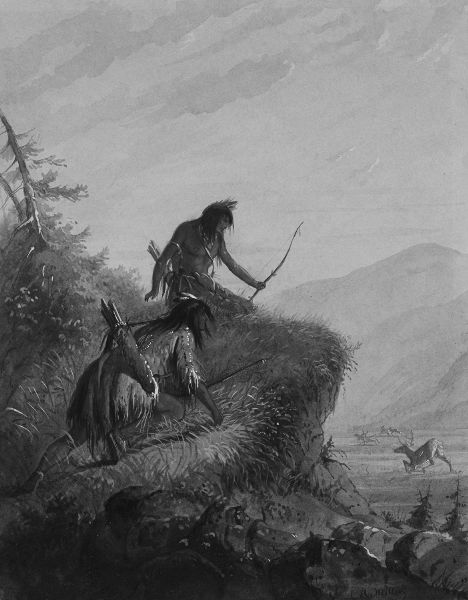
Figure 3. Snake Indians Shooting Elk. “Creeping with the stealthiness of a cat toward his prey, perfectly understanding the nature of the animal he has to deal with, watching his chances with great patience and perseverance, added to these his experience and subtlety, make the Indian a most successful hunter,—the game too is worth all the Trouble, the Elk being of the dimensions of a large-sized mule.” Alfred Jacob Miller, 37.1940.16, Walters Art Museum, Baltimore.
Moving toward specialized bison-hunting practices entailed some risk, and the efforts of the ancestors of the Eastern Shoshones to mitigate this risk influenced their lifeways and thereby further distinguished them from their Great Basin roots. Like other bison-hunting peoples, the Numu found that the ungulate’s presence in a specific place at a given time was never a certainty. Historically, bison tended to follow predictable seasonal migration cycles that enabled them to survive on the grasslands by utilizing various areas when they best provided for grazing animals. Bison tended to congregate during wetter, more vegetationally rich times of the year and diffuse into smaller groups as forage became sparser during drier times. Numu hunting groups generally mirrored the actions of their prey, congregating with others and splitting up as was necessary. The condition of the bison’s range at a given time, then, heavily influenced the subsistence activities of the Plains Numu. Sometimes, though, bison deviated from their migration patterns because significant changes in temperature and rainfall patterns could affect the nutritional value of forage in preferred grazing areas. Moreover, the activities of other indigenous groups might alter the behavior patterns of the bison and perhaps even drive them away from a group preparing to begin their own hunt. Thus environmental conditions and human activity alike might pose challenges for Numic-speaking hunters who pursued bison and counted the animals’ habits among their advantages over them. Maintaining diverse subsistence methods and carrying and/or caching supplies of dried meat and processed plant matter helped insure against bison shortages.24
The far northwestern portion of the Great Plains, a vast area that encompasses the grasslands of present-day Montana and Alberta, situated between the Yellowstone River on the south and the North Saskatchewan to the north, pulled Numic-speaking peoples northward along the eastern foot of the Northern Rockies because it afforded tremendous hunting opportunities. The region was generally dry, with the northern High Plains rarely receiving more than fifteen inches of precipitation per year. Its distinctive mixture of warm- and cool-season grasses, however, supported bison and other large game better than did the shortgrass Plains further south. The region’s many wide valley bottoms and depressions provided bison with cover from the elements, while riparian areas supplied much-needed winter forage and water. Small ranges of hills lay scattered across this portion of the Plains, affording shelter for humans and animals alike. Because of these features, the northwestern Plains historically supported extraordinarily large bison herds, perhaps the greatest population densities of those animals in the Great Plains. All of these factors together likely enticed Numic-speaking peoples northward along the eastern foot of the Rockies during the seventeenth century, as did the prevalence of geographical features that served as buffalo jumps. Indeed, archaeologists have discovered many well-used bison jumps throughout the region, especially in the upper Missouri, upper Bow, and Oldman River basins. Although evidence suggests that some of these sites were used for thousands of years, archaeological and ethnographic evidence indicates that the Numu were among those who did so at a later date. The Numu left evidence of their presence along the Milk River in what is now southern Alberta, where archaeologists have found rock art depicting pedestrian shield-bearing warriors that date to just before the equestrian era. Some archaeologists attribute them to Numic-speaking peoples, for similar pictographs produced at roughly the same time remain on rock ledges and canyon walls throughout lands that were Numu territory in Montana, Wyoming, Colorado, and Utah at the onset of the horse revolution. Additionally, findings of distinctive Numu-style tri-notched obsidian arrowheads and flat-bottomed ceramic vessels (Numic speakers began to adopt pottery about seven hundred years ago) as far north as the Milk River provide further evidence of a Numu presence in the northwestern Plains.25
Meanwhile, other Numic speakers pushed southward along the eastern foot of the Rockies toward the southern Great Plains. This migration contributed to the emergence of a distinct Numic-speaking people called the Comanches. One Shoshone oral tradition about this begins by explaining how Shoshones and Comanches were both once part of the same tribe. But one day, a Comanche hunter who had not killed any game that day was drinking water from a spring near Pike’s Peak when a Shoshone hunter carrying the body of a large buck arrived and he, too, began to drink. The Comanche, who introduced himself as Wacomish, grew jealous of his counterpart’s success and expressed frustration that the newcomer, Ausaqua, dared to drink from the spring above him. When the Shoshone explained that the Creator gave all of his children the same things to share and bent over to continue drinking, the Comanche jumped on him and held his head underwater until he drowned. Moments later, Wankanaga, the father of both tribes, emerged from a vapor cloud that issued from the spring and confronted Wacomish. Angered by the man’s actions, Wankanaga dealt a mighty blow to his head with his war club and killed him. The Comanche’s corpse fell into the spring, fouling the water and making it undrinkable. Not too far away, Wankanaga struck a rock with his war club to create a sweet spring in memory of Ausaqua and to give his people good water to drink. The account concludes by declaring that “a long and bloody war followed the murder of Ausaqua, in which many a Comanche lost his life. From that day to this, the two tribes have remained apart. The two springs, the bitter one and the sweet one, remain here in the mountains, an everlasting reminder of the murder of the noble Shoshone and of the stern justice of Wankanaga.”26 On the other hand, many Shoshone and Comanche traditions alike hold that although they were separate peoples, they maintained some friendly contact with one another through trade and other occasional meetings. Some historians believe that the people who became known as the Comanche were drawn to the bison herds of the central and southern Plains, where they, like their northern relatives, incorporated pedestrian bison-hunting methods into their subsistence systems. Their southward migration, moreover, would ultimately put them in position to benefit from the future center of horse distribution in the North American West: northern New Spain. This Comanche migration would prove critical to the development of equestrianism among the ancestors of the Eastern Shoshone people.27
On the other side of the Rocky Mountains, in what is now southern Idaho, other Numic-speaking groups claimed debías in such areas as the Snake River Plain, where they capitalized on the diverse resources available in the northern Great Basin and southern Columbia Plateau ecological borderland. Archaeological and ethnographic evidence points to a Numu presence in the Snake River country sometime prior to 1500, and these peoples apparently also ranged southward into what is now northern Utah. This was historically an arid region, as the eastern portion of southern Idaho received about ten to twenty inches of rainfall annually while, to the west, ten inches of rain or less per year was the norm. Precipitation patterns deeply influenced the resources found throughout the Snake River Plain, which, in turn, shaped the activities of the ancestors of the Northern and Eastern Shoshones who lived there. Until the mid-1800s, bison herds inhabited the Snake River Plain, a large stretch of sagebrush plains that featured some grasslands, especially in the eastern portion. Numic-speaking groups therefore hunted bison, and they visited the foothills and mountains that rimmed the northern and eastern reaches of the Snake River Plain to hunt elk and other big game. Fish and small game comprised a considerable portion of their diets, as, in addition to catching salmon, they also hunted or trapped jackrabbits, cottontails, groundhogs, squirrels, prairie dogs, and sage grouse. Some of these Numic-speaking groups ventured westward on a seasonal basis so women could dig up camas roots; they also gathered prairie turnips, berries, and sunflower seeds in different parts of the Snake River Plain. In general, these groups were less oriented toward migratory bison hunting than were their eastern relatives who inhabited such areas as the western Great Plains and Wyoming Basin as foraging and small-game hunting remained more central to their survival.28
Also during the pedestrian era, the ancestors of the Lemhi Shoshones established homelands in the Salmon River country north of the Snake River Plain. In this rugged area defined by the immense mountains of the Sawtooth, Bitterroot, and other ranges, as well as the canyons that divide those mountains, generally cooler and wetter climate conditions historically prevailed than those that occurred to the south. The Numu who inhabited lands drained by tributaries of the Columbia River made salmon central to their subsistence activities, but they also speared and caught other fish, such as trout and sturgeon, and gathered salmon eggs to eat. Groups of women gathered chokecherries, serviceberries, and other berries in the foothills of the mountains; they dried some of those with the fish that men caught. Although they were not primarily hunters, the ancestors of the Lemhi Shoshones also pursued mountain sheep and other game found at higher elevations, and they occasionally visited the Snake River Plain or western Great Plains to hunt bison. These Numic-speaking peoples designated local families or family groups by their choice food at a given time, hence, “sheep-eaters,” “salmon-eaters,” and so forth. These names changed periodically, often with the seasons, as individual subsistence units shifted their focus from one food type to another based on resource availability. Such a practice, which other Shoshone groups—including Eastern Shoshones—traditionally used, highlights the close and dynamic relationship between culture and environment.29
Overall, the adaptations of Numic-speaking groups to the ecosystems of the Great Plains, Wyoming Basin, and southern Columbia Plateau increasingly distinguished them from their linguistic relatives in the Great Basin. The abundance of some new resources—such as bison— and the absence of some Great Basin staples—such as piñon nuts and other seeds that the Basin Numu traditionally gathered and harvested—contributed to Eastern Shoshone ethnogenesis by opening up new subsistence opportunities and thereby contributing to cultural change. But the scope of this change should not be overstated. Although the pursuit of big game became an integral part of life among the Numu who inhabited the Great Plains and Wyoming Basin in particular, archaeological findings indicate that foraging remained essential to group survival. For example, material remains reveal that Numu women who resided in the Wyoming Basin and western Plains used stone mortars and pestles to grind up plant matter, while the historical record suggests that some of those Numu groups routinely visited such areas as the Yampa River Valley in what is now northwestern Colorado for the express purpose of harvesting yampa roots. On the other hand, that these groups apparently did not use such implements as seed baskets, parching trays, and seed knives suggests that they phased most seed processing and consumption out of their diets. Thus some similarities connected the Numu of the Great Plains, Rocky Mountains, and Columbia Plateau to their Great Basin relatives even as they tuned their lifeways to the environments that they used. These adaptations affected their culture in many ways, from their social and political organization to their gender dynamics and material culture.30
The sheer abundance of resources available in these environments beyond the Great Basin influenced the social and political organization of the Numic-speaking groups that inhabited those regions. During much of the year, the Numu who increasingly utilized the Great Plains and Wyoming Basin lived in extended family units that were a bit larger than those of their Basin relatives, perhaps numbering several dozen people. These family-based groups periodically gathered with others to trade, conduct communal bison hunts in which both men and women participated, enable women to gather roots, berries, and other plant matter in groups, and facilitate various ritual ceremonies. In general, the more resource-dense grasslands environment allowed Numic-speaking peoples to travel and live in larger groups than could their Basin relatives, and they could congregate with others more frequently and for longer periods. In fact, larger communities were now both more feasible and desirable. Engaging in pedestrian bison-hunting activities required significant-sized parties to drive, kill, and process game and, moreover, the resource-rich grasslands attracted many different peoples and therefore required larger camps for the sake of defense. Because they regularly lived in larger groups and more often gathered with others to form more substantial villages that often numbered in the hundreds, the Numu who inhabited the Wyoming Basin and Great Plains developed more complex systems of social and political organization. Larger communities required strong leaders to organize and direct them as they engaged in bison hunts and raids on other peoples, as well as to ensure order within villages and protection from outside threats. It seems that the dai’gwhani of the various Numu groups that congregated for these purposes collaborated on such governance issues, although if they happened to be within one’s debía, he would usually exercise greater influence than the others. More often than not, these leaders were men, although women certainly exercised considerable influence in informal capacities, as wives and elders. It is important to note that although band-level organization began to emerge among the Numu during their pedestrian days in the Great Plains and Wyoming Basin, it was not as developed as it would become after the onset of the horse revolution. At the same time, it is not clear if systems of rank for the men and women of these Numu groups emerged prior to the equestrian revolution, whether for military, police, ceremonial, or economic functions. Meanwhile, it appears that further west, in what is now southern Idaho, family groups remained the typical level of daily social organization among the Numic-speaking peoples of that region, although they occasionally gathered with others to hunt bison and engage in other communal activities. Consequently, their social and political organization did not change as much as that of their relatives to the east who began to adopt many Great Plains traits prior to the horse.31
A look at the gender dynamics of these pedestrian Numu communities highlights some of the interplay between environment and society. Women remained important and valued contributors to Numu groups that inhabited lands beyond the Great Basin, but a shift toward big-game hunting to some degree altered the composition of their workload on at least a seasonal basis. Women’s foraging efforts continued to be critical to group survival and gathering activities consumed much of their time and energy. The activities of some Numu communities in the spring, for example, revolved around women’s root-digging efforts, while during the late summer and early fall many groups visited foothill areas where women gathered berries prior to the major fall bison hunt. Moreover, they engaged in a wide variety of tasks relating to a family’s survival and comfort, including preparing meals, gathering water and firewood, making clothing, maintaining homes, transporting a family’s possessions, and bearing and raising children. However, a growing emphasis on men’s hunting activities in the game-rich Wyoming Basin and western Plains, especially during the communal hunts, immersed women in more work butchering animals, drying meat, and processing skins. The preparation of bison hides, which included repeated cycles of scraping a skin, soaking it in water, and drying it out, was hard and time-consuming work. Additionally, women’s contributions to communal jackrabbit drives among the Basin Numu and the fact that the women of many Great Plains cultures traditionally participated in cooperative bison hunts, at least during the pedestrian era, suggest that the women of the Numu groups that inhabited the grasslands also played a role in driving bison over jumps or into pounds. There is, finally, no historical evidence indicating that the Numu who inhabited the Great Plains and Wyoming Basin practiced infanticide like their Basin relatives. Although mothers occasionally gave up children for adoption for spiritual reasons or when times were tough for a family unit and a child would be better-off with a well-provisioned group, it appears that the abundance of these lands beyond the Basin lessened concerns about limiting population sizes among the Numu.32
While Margot Liberty and other historians assert that an increased emphasis on bison hunting and the development of more complex political and social organizations that emphasized men’s activities eroded the status of indigenous women, there is no historical evidence suggesting that the ancestors of the Eastern Shoshones relegated women to an inferior role as they became established in such areas as the Great Plains and Wyoming Basin.33 In general, it appears that Great Basin–style systems of gender complementarity remained intact even though women became more deeply immersed in processing the game and men assumed more influential leadership roles within communities. Numu women were not mere “drudge laborers” who worked on bison products and then surrendered the fruits of their labor to men; what they produced was theirs to use and dispose of as they wished. Indeed, it appears that women maintained much of their influence within families and communities by controlling the distribution of all food, whether they gathered it or men killed it, as well as material goods such as hides. This was of great importance, for they had to preserve and ration food supplies in a manner that would ensure their family’s survival throughout the year, including the difficult winter months when fresh food was often scarce. Moreover, women could gain social prestige through their medical work, especially by curing the sick and serving as midwives. The use of menstrual huts to seclude women from men in observance of social taboos might appear an oppressive practice on the surface, but such customs, in addition to berry-picking activities and other group efforts, provided women with distinct spheres of influence and solidarity. Furthermore, their proficiency in various crafts provided women with knowledge that was critical to group survival; men honored and respected them for their specialized contributions.34
Numu material culture transformed as the people adapted to environments beyond the Great Basin, especially the Great Plains and Wyoming Basin where hunting became a bigger part of their lifeways. Archaeologists have found many elements of Basin-style Numu material culture at sites scattered throughout the western Plains, including distinctive grinding implements, horn bows and arrows, skinning tools, pottery, and clothing. On the other hand, the integration of new resources into their lifeways contributed to the emergence of a more Plains-type material culture. As a case in point, it appears that the Numu of the grasslands initially used Basin-style grass lodges, but they adopted bison-hide tepees as they increased their bison-hunting activities as well as engaged in more intercultural interactions with Plains peoples. Men’s big-game hunting efforts likewise provided women with rich supplies of skins and furs to fashion into garments and blankets and, in addition to bison, women processed pronghorn, elk, bighorn sheep, bear, wolf, beaver, and other skins. The availability of such materials made some Basin staples, such as woven rabbit-skin robes and garments made out of sagebrush, uncommon among the Numu who inhabited the Great Plains because they were more time-consuming to craft or less effective protection from the elements. They also fashioned weasel skins, eagle feathers, and porcupine quills into headgear, with the first two providing protection from evil spirits, while some wore the tail feathers of the flicker to gain curative powers. The Numu of the grasslands also adopted one-piece buckskin moccasins, to which they began applying hard soles made from the tough neck of deer after Arapahos introduced them to that custom. Unlike their relatives to the east, the Numu who inhabited the southern Columbia Plateau inhabited conical grass huts into the equestrian era and they reportedly did not widely utilize large-game animal skins for clothing and shelter; they continued to mostly wear rabbit-skin attire and sage bark footwear. Numu women manufactured elk and other hides into bags that they used to store dried meats, and they made bison and other big-game bones and horns into eating utensils, scrapers, and other tools.35 In the early nineteenth century, artist Alfred Jacob Miller observed that Shoshone men made elk horns into “their most efficient bows.”36
The evolution of material culture in the form of vessels highlights the ingenuity of Numu women and points to a pre-horse Shoshone presence in the Greater Yellowstone Ecosystem. It appears that the women of some of these Numic-speaking groups that utilized lands beyond the Great Basin continued to craft and use distinctive flat-bottomed Basin-style vessels in the Rockies and Plains, although the adoption of locally available stone rendered their items distinct from those of their linguistic relatives in the Great Basin. In the Greater Yellowstone Ecosystem, including the Wind River and Bighorn ranges, they collected steatite (soapstone), which they shaped into vessels that largely replaced their ceramic ones. Although considerably heavier than their traditional baskets and pottery, these steatite bowls cooked more effectively than either and were more durable. Archaeologists have found these throughout much of the Wyoming Basin as well as at various sites in the northwestern Great Plains, primarily in what are now Wyoming and Montana, including a number that they associate with Shoshones and date to before 1700. Since soapstone vessels are especially heavy and women traditionally passed them down from one generation to another, findings in such areas indicate that the people who used them were permanent occupants rather than transitory visitors, thereby providing strong evidence for a Numu presence in the Wyoming Basin and western Great Plains prior to the reintroduction of the horse to the North American West.37
Numu adaptations to the lands beyond the Basin, especially the Great Plains, also transformed their ceremonial lives. Indeed, as they interacted with Plains cultures and more frequently congregated in larger groups on a seasonal basis, they integrated new customs into a growing cultural milieu. These new developments that predated the horse included vision quests. Unlike their Basin relatives who did not actively seek dreams that provided insight into their lives and purposes, the ancestors of the Eastern Shoshones sought out visions from the spirits at secluded spots in the mountains, in caves, or near springs, often after engaging in ritual deprivation of food and/or water for several days. Men usually participated in vision quests for the express purpose of gaining war powers. Such rituals provided men with routes to prestige and power while women generally could not pursue status in this way. The adoption of Plains-style rituals occurred gradually, and it is unclear just how many elements of Plains Indian ceremonial life the ancestors of the Eastern Shoshone people embraced prior to the equestrian era; some Plains-influenced war dances may predate the horse, but we cannot be sure.38
On the other hand, these Numic-speaking communities continued to exhibit many elements of Basin-type culture. What ultimately emerged was something of a hybrid Basin-Plains culture, one that included many Great Basin cultural elements—including some spiritual beliefs and practices as well as oral traditions and pieces of material culture—and a variety of material and social adaptations to grassland environments. That other Great Plains cultures, for example, traditionally identified Shoshones and their ancestors with their distinctive grass lodges points to their gradual adaptation to the grasslands environment. The ancestors of the Eastern Shoshones eventually adopted Plains-style tepees, but Crows and Hidatsas nevertheless referred to them as the “Grass Lodges,” Kiowas called them “Grass House People,” and Arapahos referred to them as “People-Who-Use-Grass-or-Bark-for-Their-Lodges.” These references might explain why the first Europeans who ventured into the Great Plains came to know them as the “Snake Indians,” for other indigenous groups made weaving motions with their hands (thus symbolizing their grass-weaved homes) to refer to the “Snakes” in sign language. Finally, many Numu petroglyphs found in Wyoming exhibit a blend of Basin-Plateau and Great Plains influences, especially at sites that contain multiple renderings dated to different periods.39
Similarly, one must be careful to not overstate the Numu transition to bison hunting. Especially before the reintroduction of the horse to western North America, an intensive focus on bison hunting was simply not feasible because the herds were far more mobile than the people who pursued them. Consequently, it should come as little surprise that archaeologists have discovered, at a number of sites in the Wyoming Basin and Great Plains, evidence of Basin-type hunting practices that predated the horse revolution. The remains of pronghorn traps at the Fort Bridger site as well as the Eden-Farson site in southwestern Wyoming have both, for example, been attributed to the ancestors of the Eastern Shoshones. Hunters built the former trap near two playas, in an area that historically attracted pronghorn herds, and, although the Numu typically built such structures out of sagebrush, this one was comprised largely of juniper. This site predates the arrival of European American trade goods into the region, as it contains a variety of stone projectile points and other lithic tools but no items of European manufacture. Despite the presence of such projectile points, experts believe that the hunters probably ran the pronghorn trapped in the enclosure to exhaustion and then beat them to death with clubs; firing arrows was simply dangerous and unnecessary in such traps. At the Eden-Farson site, researchers attribute the remains of over two hundred pronghorn to a single hunting season spanning late October and early November 1720 (±100 years). The complete absence of European American material goods at this site, too, points to an earlier rather than a later date. Archaeologists found no remains of a trap or corral at this kill site, but the presence of tall sagebrush in the area (which deteriorates more rapidly than juniper) suggests that the Numu may have built an enclosure out of that material. The absence of items of European American origin at both sites points to pre-horse hunting activities, as horses were but part of the mosaic of European trade goods that began to enter the Shoshone world as early as the late seventeenth century.40
Intercultural interactions—especially trade—provided the ancestors of the Eastern Shoshones with access to various material goods, facilitated cultural exchanges, and contributed to their distinctiveness as a people as their relationships with the physical world shaped their trade activity. While their linguistic relatives in the Great Basin engaged in significant interregional commerce, the Numu who inhabited lands east and north of the Basin significantly expanded their contacts. In fact, it appears that as early as the fifteenth century the ancestors of the Eastern Shoshones hosted an annual rendezvous in western Wyoming that other Natives attended from afar. This trade center linked the commercial operations that transpired in such places as the Mandan and Arikara villages on the upper Missouri River, the Dalles of the Pacific Northwest, and the Pueblo villages of the Southwest. Trade continued to flow through the Great Basin, but it appears that Numic speakers in the Wyoming Basin constituted the primary conduit between peoples who resided on opposite sides of the Continental Divide. At trade fairs, men conducted business with one another while women exchanged the fruits of their labor with other women, a custom demonstrating that both men and women exercised considerable economic autonomy. Although hides and other animal products became a major commodity that Numic speakers offered as they became established in the Great Plains and Wyoming Basin, obsidian probably remained the key commodity that they offered other peoples. They historically quarried rich sources of that useful stone in the Yellowstone and Snake River valleys, including Obsidian Cliff in what is now Yellowstone National Park. In the eighteenth century, Europeans found Natives on the upper Missouri, such as the Mandans, remelting glass items that they acquired through trade and recasting them as beads; they reportedly learned the practice from the Numic speakers who provided them with obsidian through trade. By all accounts, it appears that Numic-speaking peoples dominated the obsidian trade of the Intermountain West, to some degree controlling the distribution of an item that served military, hunting, and household purposes.41
Other intercultural interactions were hostile in nature as the ancestors of the Eastern Shoshones moved into the western Great Plains and competed with other peoples for access to resource-rich areas. Anthropologists once believed that intertribal warfare was virtually nonexistent on the Plains prior to the arrival of the horse, but scholars now believe that such conflict was endemic well before that time. In the western Great Plains, for example, the Numu came into contact and sometimes warred with Kiowa groups that resided in the Black Hills region, where bison and other game abounded. Numic-speaking groups located further north along the eastern foot of the Rocky Mountains fought with Assiniboines, Crees, and others who pushed into the grasslands from the Canadian Parklands to capitalize on the resource-rich northwestern Plains environment. In particular, during the seventeenth century Numic speakers became embroiled in an especially hostile relationship with the Algonquian-speaking tribes of the Blackfeet Confederation (Nitzitapi), which would in many ways dominate the world of the northwestern Great Plains until the late eighteenth century. Although the territories claimed by the separate divisions of the Blackfeet Confederacy overlapped, the Piegans (Pikuni) were the most southwestern group, with the Blackfeet proper (Siksika) the furthest northeast and the Bloods (Kainai) situated in between the two. At stake in the Numu struggle with the Blackfeet was nothing less than prime access to some of the best bison-hunting grounds in the entire Great Plains region.42
Pedestrian warfare between the Plains Numu and their enemies took two basic forms. The first type consisted of large-scale “formal” battles. This sort of fighting typically occurred after a large war party openly approached an enemy camp or village and that enemy responded by sending its warriors to meet that threat. The two sides then lined up opposite one another, bearing bison-hide shields, bows and arrows, bison-scrotum rattles, and such hand-to-hand weapons as stone clubs called pukamoggan. Warriors reportedly applied poison in the form of rattlesnake venom or a mixture of crushed ants and a rotten animal spleen to their projectile points on occasion. The fighting commenced with the groups of warriors firing arrows at their enemies, with both attempting to weaken their opposition in anticipation of making a charge. If warriors on one side or the other felt that they possessed superior numbers or some tactical advantage, they might rush at their enemy to initiate hand-to-hand combat. At that point, the battle became a frenzy of close-quarters fighting that ultimately resulted in one side or the other retreating, with the victors sometimes engaging in hot pursuit. More often than not, however, such encounters never moved beyond the relative posturing of a long-range bow and arrow engagement; the rawhide shields that the Plains Numu and their enemies used far outclassed their stone and (later) metal-tipped arrows and, therefore, defense tended to prevail. In the event of such a stalemate, the aggressors typically withdrew to their camp at nightfall.43
When a young North West Company trader named David Thompson visited a Piegan camp during the late 1780s, he communicated with an old Cree warrior named Saukamappee (Young Man), who recalled the days of fighting the ancestors of the Eastern Shoshones (whom he called the Snake Indians) before anyone used horses in combat. Historians estimate that Saukamappee’s account related events that occurred in approximately 1730 (after the horse revolution began), but it nevertheless captures the essence of large-scale pre-horse (and pre-gun, for that matter) intertribal warfare on the northwestern Great Plains. Saukamappee’s account, moreover, reveals how warriors on both sides integrated elements of the natural world into their weaponry:
The Peeagans were always the frontier Tribe, upon whom the Snake Indians made their attacks, these latter were very numerous, even without their allies; and the Peeagans had to send messengers among us to procure help. Two of them came to the camp of my father, and I was then about his age (pointing to a Lad of about sixteen years) he promised to come and bring some of his people, the Nahathaways [Crees] with him, for I am myself of that people, and not of those with whom I am. My father brought about twenty warriors with him. There were a few guns amongst us, but very little ammunition, and they were left to hunt for the families; Our weapons was a Lance, mostly pointed with iron, some few of stone, A Bow and a quiver of Arrows; the Bows were of Larch, the length came to the chin; the quiver had about fifty arrows, of which ten had iron points, the others were headed with stone. He carried his knife on his breast and his axe in his belt. Such was my fathers weapons, and those with him had much the same weapons. I had a Bow and Arrows and a knife, of which I was very proud. We came to the Peeagans and their allies. They were camped in the Plains on the left bank of the River (the north side) and were a great many. We were feasted, a great War Tent was made, and a few days passed in speeches, feasting and dances. A war chief was elected by the chiefs, and we got ready to march. Our spies had been out and had seen a large camp of the Snake Indians on the Plains of the Eagle Hill, and we had to cross the River in canoes, and on rafts, which we carefully secured for our retreat. When we had crossed and numbered our men, we were about 350 warriors (this he showed by counting every finger to be ten, and holding up both hands three times and then one hand) they had their scouts out, and came to meet us. Both parties made a great show of their numbers, and I thought that they were more numerous than ourselves.
After some singing and dancing, they sat down on the ground, and placed their large shields before them, which covered them: We did the same, but our shields were not so many, and some of our shields had to shelter two men. Theirs were all placed touching each other; their Bows were not so long as ours, but of better wood, and the back covered with the sinews of the Bisons which made them very elastic, and their arrows went a long way and whizzed about us as balls do from guns. They were all headed with a sharp, smooth, black stone (flint) which broke up when it struck anything. Our iron headed arrows did not go through their shields, but stuck in them; On both sides several were wounded, but none lay on the ground; and night put an end to the battle, without a scalp being taken on either side, and in those days such was the result, unless one party was more numerous than the other. The great mischief of war then, was as now, by attacking and destroying small camps of ten to thirty tents, which are obliged to separate for hunting.44
Saukamappee’s testimony suggests that the ancestors of the Eastern Shoshone people might have invented or introduced to the grasslands the rawhide shields that were so central to intertribal engagements between large groups on the Great Plains by the early 1700s. Moreover, it appears that the Numu also possessed superior bow technology, which constituted another significant advantage in the long-range combat that he described. Historically, Numu men most commonly made bows out of juniper (as did their rivals), which they enhanced by adding sinew backings (a Great Basin tradition that the Numu likely introduced to the Great Plains). Access to bighorn sheep and elk, as well as to hot springs such as those found in the Wyoming Basin, enabled the ancestors of the Eastern Shoshones to produce even better bows made out of horns backed with sinews (the hot springs made the horns more pliable and, therefore, easier to make into bows), which outperformed their juniper counterparts. Where and when, precisely, the ancestors of the Eastern Shoshones adopted or developed these instruments of war is not altogether clear, although anthropologist Mark Sutton asserts that the Basin Numu were the first peoples to deploy these warfare patterns. Regardless of their origins, the deployment of these weapons in tandem with effective tactics by large war parties enabled Numic speakers to become a force on the northwestern Plains during the late pedestrian era. As ethnographer Demitri Shimkin observes, Eastern Shoshones quickly developed “high competence” as a “militaristic” buffalo-hunting people on the Great Plains. Saukamappee’s account suggests that the “Snake Indians” possessed great numbers, but whether the Numu on the northwestern Plains simply outnumbered their Piegan Blackfeet rivals as a whole or their sociopolitical organization allowed them to send out larger war parties is unclear. Perhaps their efficient gendered division of labor contributed to Plains Numu military prowess, for women’s work in processing, preparing, and distributing food and various material goods (not to mention their myriad other tasks) allowed men to devote considerable time and energy to going on the warpath.45
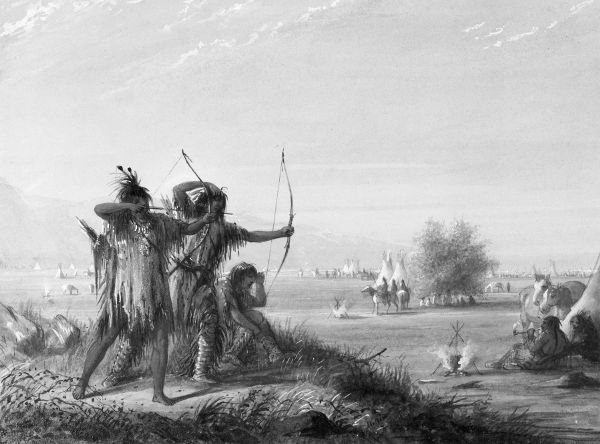
Figure 4. Snake Indians—Testing Bows. According to Miller, the powerful elk-horn bows that Shoshone men crafted could drive an arrow clean through a bison. Alfred Jacob Miller, 37.1940.60, Walters Art Museum, Baltimore.
Saukamappee’s account alludes to the second main type of warfare that transpired on the northwestern Great Plains during the early eighteenth century (and earlier). This consisted of smaller-scale activities, such as raids and ambushes. In such an event, a small party of warriors stealthily closed in on a usually small, isolated, and unsuspecting enemy village and then launched a surprise attack on its occupants before they had an opportunity to mount a defensive. Raiders ideally waited until most of a target camp’s men were out hunting or warring before making such an assault in order to ensure a greater chance of success. Whereas the larger-scale battles between lines of warriors often yielded minimal results, these smaller-scale assaults more frequently generated casualties and led to the capture of some goods and in some cases dislocated or destroyed entire camps. During the equestrian era, raiding parties usually killed grown men but took women and children captive; this may have also been the case during the pedestrian era. There is little historical evidence that provides insight into the fates of such captives prior to the mid-eighteenth century.46
Thus it appears that the military might of the ancestors of the Eastern Shoshones enabled them to claim a significant stretch of the northwestern Plains and limit the Blackfeet push into the grasslands from the north. Until sometime in the eighteenth century, then, the Numu presence on the Great Plains confined the Blackfeet to the fringes of the Plains-parkland environment in what is now Canada. Similarly, it seems that northward-migrating Numic speakers also pushed Kutenai groups out of the northern Rockies and into the high Plains, where they also came into conflict with the Blackfeet. The establishment of the Numu in the northwestern Great Plains during the pedestrian era, then, significantly affected the intertribal configuration of the region prior to the dawn of the horse revolution.47
West of the Rocky Mountains, in the Columbia Plateau, other Numu groups engaged in intertribal interactions that contributed to a growing diversity among Numic-speaking peoples. These peoples, who lived in such places as the Snake River Plain and the Salmon River country, largely interacted with Great Basin and Columbia Plateau cultures, although their occasional trips to hunt bison on the western Great Plains certainly included interactions with their linguistic relatives there and perhaps people of other cultures. In the Columbia Plateau, they became major players in intertribal affairs. Archaeological and ethnographic evidence indicates that they engaged in substantial trade with their neighbors, especially the Cayuse, Salish, and Nez Perce peoples. Hostilities would later develop between Numic-speaking communities of the Basin-Plateau region and the Walla Walla, Yakima, Cayuse, Salish, and Nez Perce peoples, but it is not clear if such conflict predated the equestrian revolution. In their interactions with these cultural groups (as well as the environments that they inhabited), the Numu of what is now Idaho (and adjacent areas of Utah, Oregon, and Montana) would adopt customs, material culture, and lifeways that would distinguish them from their eastern relatives, even though they—especially the communities that lived in the Snake River Plain—maintained significant contact with some eastern Numu groups. Thus, on the eve of the horse revolution, the Numu were a diverse linguistic family.48
By the late eighteenth century, Numic-speaking peoples inhabited and used a vast stretch of the North American West. Many remained in the Great Basin, where they typically lived in small family-based groups and subsisted through a combination of foraging and small-game hunting. But sometime prior to the equestrian revolution, a diverse collection of Numu communities established debías well beyond the Great Basin, in the central and northern Rocky Mountains, and on the western Great Plains. As a result of their interactions with the environments and cultures of these ecologically diverse areas, the lifeways of these geographically diffused Numu groups became increasingly varied. Depending on the resources available within the ecosystems that they became parts of, some were predominantly buffalo-eaters, while others became salmon-eaters, sheep-eaters, or root-eaters (as they would later refer to one another and themselves). Numu adaptations to these diverse grassland, mountain, and semidesert environments, moreover, influenced their material cultures and gendered divisions of labor. Both men and women remained integral to group survival in all of these areas, but to varying degrees their roles within families and communities transformed as the ways that they contributed to group subsistence shifted based on environmental considerations. Thus the myriad ecosystems that the Numu occupied prior to 1690 CE laid the foundation for the eventual formation of distinct band and tribal identities: the ancestors of the Northern, Eastern, and Lemhi Shoshones began to emerge as historically recognizable groups, even if the outlines of those groups were faint during the pedestrian era.49
The period of 1500 to 1690 thus constitutes a pivotal although often overlooked period of Eastern Shoshone history, as well as a critical phase of their ethnogenesis. Pedestrian Numic-speaking groups revolutionized their subsistence systems as they migrated beyond the Great Basin, and they employed what appear to have been highly effective methods of warfare. Sustained by diversified and highly efficient resource use and empowered by a dynamic system of gender complementarity, these ancestors of the Shoshone people established claims to vast stretches of territory beyond the Great Basin. Examining how the Numu adapted to the Wyoming Basin and western Great Plains in particular throws light on pre-equestrian Eastern Shoshone ethnogenesis while further highlighting the dynamism of pre-contact Native America.
Yet a great ecological and cultural event awaited these scattered Numu groups. Perhaps the single greatest period of transformation for the Numu (and for many indigenous cultures throughout the West) began when horses made their return to western North America by way of Spanish colonization. For the ancestors of the Eastern Shoshones, the arrival of the horse heralded the dawn of a new era, one in which changing relationships with the land, as well as its various animal and human inhabitants, would reshape their daily lives and contribute to the development of increasingly distinct cultural groups.