
5
In a June 1811 letter to William Clark, Nicholas Biddle wrote that he planned to deliver an oration in Philadelphia on Independence Day, “which in our heats is more fatiguing than an elk hunt among the Shoshonees.”1 Only five years earlier, Clark, Meriwether Lewis, and others had completed their expedition to and from the Pacific Ocean and had, among other things, begun to build a relationship between Shoshones and the U.S. government. Biddle’s comment, derived from the reports of Lewis and Clark, provides some insight into the lifeways of the Shoshones they met: their pursuit of game was challenging, and they did not necessarily focus on hunting bison. Indeed, the famed explorers did not encounter any Numic speakers on the Great Plains; they were likely ancestors of the Lemhi Shoshones who inhabited the mountain valleys of what is now eastern Idaho and ventured to the Plains each fall to hunt bison. Shoshones thus entered the American consciousness as inhabitants of the Columbia Plateau.
Shoshones encountered these explorers and others—their earliest documented contacts with European Americans—during an especially tumultuous period of their past. Already facing challenges as their enemies—especially the tribes of the Blackfeet Confederacy—pushed into their territory on the Great Plains from the north, the ancestors of the Eastern, Northern, and Lemhi Shoshones suffered great losses when they experienced their first known Old World disease epidemic in 1780. As part of the continent-wide smallpox pandemic of 1779–84, the epidemic that swept the Great Plains and adjacent areas in 1780–82 by all accounts devastated the Numic-speaking communities that it visited. Colin Calloway and other historians recognize that this outbreak of smallpox likely killed many Shoshones and contributed to the survivors’ withdrawal from the Great Plains, but no close analysis of the outbreak’s impact on the ancestors of the Eastern Shoshone people exists.2 Thus, in the following pages I cast light on this seminal event in the story of Wind River Shoshone ethnogenesis by exploring how the smallpox epidemic of 1780–82 affected the lifeways and culture of those who survived it.
In the aftermath of that epidemic, the ancestors of the Eastern Shoshones centralized in the Intermountain West, where they engaged in broad-based hunting and gathering activities. During this time, the Eastern, Northern, and Lemhi Shoshones began to crystallize as distinct peoples who, for the most part, resided in discrete although large and nebulous geographical areas. In the Wyoming Basin and adjacent parts of what are now northern Utah and southeastern Idaho, the ancestors of the Eastern Shoshones, many of whom had recently lived on the Great Plains and extensively hunted bison, refocused their subsistence activities to capitalize on the diverse ecosystems of such places as the Wind River Valley and Green River Basin. Although these Numic-speaking peoples seasonally visited the Great Plains to hunt bison, their subsistence systems more closely resembled those of their pedestrian ancestors, as they capitalized on the diverse array of resources available in the vast transitional area between the Great Basin, Columbia Plateau, and Great Plains regions. The pursuit of diverse resources profoundly shaped Shoshone society and culture, for it engendered military, economic, and sociopolitical transformations. Within this context, the material culture of the ancestors of the Eastern Shoshone people evolved, as did their gendered divisions of labor and intertribal affairs. Contrary to the claims of Åke Hultkrantz and other scholars, the Shoshone withdrawal from the Great Plains led not to “deculturation” but to the utilization of highly dynamic lifeways that integrated facets of the Great Basin, Columbia Plateau, and Great Plains traditions.3
For the ancestors of the Wind River Shoshones, this was a challenging time that required many adaptations. But it also presented some new opportunities as European Americans began to regularly visit Shoshone lands and interact with them. These visitors learned of their struggles; one Shoshone leader, Cameahwait, informed Lewis during an 1805 meeting that his people largely lived in the mountains and ate fish, elk, pronghorn, and roots and that this “would not be the case if we had guns, we could live in the country of buffaloe and eat as our enemies do and not be compelled to hide ourselves in these mountains and live on roots and berries as the bear do.”4 In hopes of alleviating their hardships, Cameahwait and other Shoshones largely accommodated the European American explorers and traders they encountered during the early nineteenth century, making friendly overtures and providing assistance in an effort to establish much-needed economic ties.
Drawing upon the writings of the non-Indians who visited Shoshone country, as well as anthropological, historical, and epidemiological studies, I examine the challenges that the ancestors of the Eastern Shoshones faced from 1780 to 1806, as well as how they responded to those trials. This was a transitional period in the story of Wind River Shoshone ethnogenesis, as their forebears’ struggles with smallpox epidemics and enemy pressures, as well as their efforts to tap into European American trade networks, transformed their relationships with the world around them and profoundly affected their culture and lifeways; their evolving subsistence systems, gendered divisions of labor, and intertribal relations reflected their efforts to survive and again thrive. Ultimately, Shoshones displayed remarkable flexibility that allowed them to endure and create opportunities by which they might launch a nineteenth-century resurgence.
Variola, the virus that causes smallpox, reached the Numic-speaking peoples of the Intermountain West and Great Plains during the late eighteenth century only after a long journey. The roots of the 1780–82 epidemic that devastated the ancestors of the Eastern Shoshones lie in the Spanish colonization of the New World and the Columbian Exchange within which variola was one of the organisms accidentally introduced to the Americas. The long overseas journey from Europe to the Americas and the fact that many conquistadores had acquired immunity to further infection delayed smallpox’s arrival in the New World until 1518. After reaching the Caribbean, the virus accompanied Spaniards to what is now Mexico, where it helped Hernán Cortés conquer the Aztec Empire before indigenous raiders and traders carried it southward and westward. Smallpox apparently did not yet spread northward; the low population density of what is now northern Mexico apparently slowed diffusion in that direction.5
The case of the Aztec Empire demonstrated just how deadly variola could be in the Americas. Smallpox was a disease that either killed its victims or left them with lifelong immunity. The parasitic virus therefore needed a constant supply of vulnerable individuals to become endemic among a population. Without susceptible individuals to infect, the disease would, in effect, kill itself off. So, all communities—Native American and otherwise—were susceptible to contracting the virus and enduring high mortality rates if it had never visited them or had not done so for decades. American Indians had no inherent biological weakness that rendered them especially vulnerable to contacting variola or dying from smallpox. Rather, they lacked the acquired immunity that came with exposure to endemic smallpox; throughout much of Europe, smallpox was a childhood disease. But smallpox was not indigenous to the Americas, nor were most Native populations large enough to enable the variola virus to become endemic once introduced. Thus the disease proved especially deadly in the New World.6
Smallpox could travel far with a little help. The variola virus had no known non-human vectors, so it largely spread through direct human contact. People usually contracted variola through the respiratory tract by inhaling tiny particles produced by infected individuals, although contact with contaminated food, drink, or fingers could lead to oral infection. Moreover, under favorable (cool and dry) conditions, variola could remain viable and, therefore, communicable, on bedding, clothing, and scabs shed by a victim for weeks after contact. Once an individual contracted variola, an incubation period of ten to fourteen days began, during which he or she exhibited no symptoms and was not infectious. The initial symptoms (headaches and general malaise) as well as communicability immediately followed the incubation period. The first lesions soon appeared, signaling the onset of the deadliest and most contagious stage of infection. During the two weeks or so between the emergence of the first lesions and the beginning of the recovery period, a victim was highly contagious, although infectiousness typically declined as the days passed. The entire course of smallpox infection ran about a month, and if one survived the ordeal, he or she gained lifelong immunity to the virus. Smallpox, then, could travel long distances, perhaps hundreds of miles, between the time an unknowing individual became infected and the time that symptoms emerged and he or she became contagious. The onset of the severest symptoms often immobilized individuals, but any further travel—on the part of a victim or by individuals who encountered an infected person—could carry the disease even further.7
Spanish expansion to the north during the seventeenth century facilitated the spread of the variola virus into what became known as El Norte. The development of the Camino Real, a road that connected central New Spain to its expanding northern frontier, and the founding of missions and mining settlements in El Norte enabled smallpox to diffuse northward. During the 1630s, smallpox reached Pueblo villages in what is now New Mexico, and by the 1660s most indigenous groups that resided in that region had encountered the disease. But it did not become endemic there, as periodic epidemics ravaged previously unexposed Spanish and Indian populations alike in what is now New Mexico and West Texas on several occasions between 1670 and 1706. From there, variola infiltrated the southern Great Plains; for example, the Caddos in what is now eastern Texas endured their first smallpox epidemic in 1690–91 after Spanish missionaries arrived. Then, in 1706, perhaps the worst epidemic to date struck New Mexico and Texas. This was the last of several smallpox outbreaks to strike the Jumanos, a powerful interethnic people whose villages stretched from eastern Texas into New Mexico. The epidemic apparently did not reach their Apache rivals or the Comanches who had recently arrived on the southern grasslands. The great distances that separated the Indian communities of the southern Plains apparently limited the spread of smallpox.8
Numu migrations into the Great Plains, paired with Comanche, Ute, and Shoshone interactions with one another, other indigenous groups, and European colonizers, enabled variola to diffuse well beyond the southern Great Plains. As Comanches migrated southward along the eastern foot of the Rocky Mountains and then into the grasslands during the late 1600s, they created a vast network of human contact. The emergence of the Comanche trade center in the upper Arkansas River Valley stimulated commercial and military activities from the Pueblo villages in New Mexico to the French colonizers in the Mississippi Valley and well to the north, including Shoshone communities in the Intermountain West and northern Great Plains, as well as the Saskatchewan River parklands. Even as ties between Numic-speaking peoples remained strong prior to the onset of the 1779–84 smallpox pandemic, European activities linked seemingly isolated Indian populations to distant places. French traders first visited Comanche country during the 1720s and thereby created connections between the upper Arkansas Valley and New Orleans by way of Native American middlemen and European traders. In northern New Spain, missions and silver mines functioned as centers of smallpox infection that channeled the virus into indigenous communities.9
Comanche territory buzzed with activity during the years preceding the 1779–84 smallpox pandemic. Comanches and Utes engaged in a complex relationship with New Mexico’s indigenous and Spanish inhabitants as well as one another that vacillated between trading and raiding. During the late 1770s, war between western Comanche groups and the Spanish engulfed New Mexico, but a decisive Spanish victory in 1779 ended the violence. Meanwhile, Comanches invaded Ute territory during the 1770s, pushing some Ute communities westward. By 1780, though, the tide turned against the Comanches and they withdrew from Ute country. Meanwhile, Comanches continued to push their Apache rivals further south and west in the Llano Estacado and Rio Grande areas. In the north, they warred with Kiowas, Pawnees, and Osages over trade and resources on the Great Plains. Also, during the late 1770s and early 1780s, Comanches raided Spanish settlements in Texas while also trading with Wichita middlemen who had ties to the French in the Mississippi Valley. All of this activity connected to the far-reaching Comanche trade center that had its nexus in the upper Arkansas Valley, which linked the widely dispersed Comanche divisions with one another as well as with other peoples.10 This busy Comanche world was simply ripe for a major smallpox epidemic should the variola virus arrive.
Likewise, intertribal warfare and commerce brought disparate groups into contact with one another in Shoshone country. The long-standing friendship between Shoshones and their Comanche relatives remained intact on the eve of the 1779–84 smallpox pandemic, for the same trade routes that had begun to convey horses northward prior to 1700 continued to shuttle goods from New Mexico to the ancestors of the Eastern Shoshones who resided in such areas as the Wyoming Basin and northern Great Plains. Shoshones still traded with Crows, Salish, and others, which extended the reach of the Comanche network east into the grasslands and west into the Columbia Plateau. Meanwhile, warfare between the Blackfeet Confederacy and Shoshones continued unabated while Shoshone warriors raided indigenous communities throughout the northern Great Plains, from the grasslands of what is now Wyoming north into Alberta, and at least as far east as the upper Missouri in what is now the Dakotas.11
In the Canadian parklands, the Comanche-Shoshone network overlapped with the growing fur trade of the Saskatchewan River Basin. Only loosely linked to eastern hubs of commerce—Hudson Bay and Montreal—prior to the 1770s, as Indian middlemen constituted the backbone of the Saskatchewan Basin fur trade, the system evolved during the 1770s and 1780s as European traders built a series of posts to truly capitalize on the resources of fur-rich western lands. It does not appear that smallpox spread westward into the Saskatchewan region from Montreal or some other distant place prior to the 1780s; the annual travels of a few indigenous middlemen over distances of hundreds of miles apparently did not enable variola to diffuse westward. Even Canada’s greatest smallpox epidemic—that which ravaged eastern Canada from 1755 to 1757—failed to reach far beyond the Great Lakes region. By 1780, however, trade networks had expanded and activity had intensified. And although the loose alliance between the Blackfeet, Crees, and Assiniboines had begun to erode by 1780, they continued to trade and send out joint war parties, many of which struck Numic-speaking peoples.12
This was the interconnected world that the variola virus entered in 1780. The smallpox strain(s) that engulfed much of the North American West between 1780 and 1782 can be traced to Mexico City and New Orleans. During the winter of 1778–79 the disease appeared in New Orleans, and in August 1779 it began to circulate in Mexico City; scholars do not know if it was a single strain or two separate strains of the variola virus. By mid-1780, smallpox spread to northern New Spain, striking mining camps as well as the missions and Indian villages of New Mexico; another wave of smallpox struck New Mexico in early 1781. Even before the disease diffused northward from Mexico City in 1780, it appears to have spread westward from New Orleans during that same year, reaching across Texas from the Caddos in the east to the Apaches in the west. Comanche raids on Spanish settlements abruptly ceased in 1781 and only resumed a year and a half later; Spanish officials later discovered that this had happened because smallpox devastated Comanche villages. Thus, by early 1781, the Mexico City and New Orleans smallpox outbreaks had merged on the southern Great Plains.13
Horses then enabled smallpox to reach the ancestors of the Eastern Shoshone people. By the winter of 1781, mounted raiders and traders had carried the variola virus north, where it struck Indian populations that resided in the Saskatchewan River basin. The epidemiological disaster on the northern Great Plains likely ensued after Shoshone groups contracted the disease, probably from their Comanche trade partners. Soon thereafter, Indians located throughout the northern Plains and Columbia Plateau contracted smallpox, as Shoshones unknowingly infected Crow, Salish, Blackfeet, and other communities through either commercial activity or warfare. Crow traders apparently then carried smallpox to the semisedentary villages of the Mandans, Hidatsas, and Arikaras on the upper Missouri, where Lakotas, Crees, and Assiniboines contracted it. Piegan warriors infected during raids on Shoshone camps carried the virus into the Saskatchewan parklands, where it devastated other Blackfeet bands, as well as Crees, Assiniboines, and others. By the end of 1782, smallpox had reached the Pacific Northwest and Hudson Bay by infiltrating far-reaching networks of trade and war.14
It is unclear how many ancestors of the Eastern Shoshones perished during this epidemic, but the meager evidence suggests that it hit them hard. Scholars agree that Shoshones likely sustained tremendous losses during the 1780–82 smallpox epidemic, as anthropologist Åke Hultkrantz, for one, writes that the epidemic “eradicated whole camps of Shoshoni Indians.” The most direct evidence regarding the impact of smallpox on Shoshones comes from Saukamappee, who in 1787 told Hudson Bay Company trader David Thompson of how the Piegans contracted the disease. According to Saukamappee, a Piegan war party spotted a large Shoshone village in the Red Deer River Valley in 1781. It was probably too large to raid under typical circumstances, but the scouts saw no people in the camp while the horses went unattended and bison grazed up to the very edge of the village.15 After further scouting, the Piegans determined to attack the camp, and what they found shocked them. As Saukamappee recounted:
Next morning at dawn of day, we attacked the Tents, and with our sharp flat daggers and knives, cut through the tents and entered for the fight; but our war whoop instantly stopt, our eyes were appalled with terror; there was no one to fight but the dead and the dying, each a mass of corruption. We did not touch them, but left the tents, and held a council on what was to be done. We all thought the Bad Spirit had made himself master of the camp and destroyed them. It was agreed to take some of the best of the tents, and any other plunder that was clean and good, which we did, and also took away the Horses they had, and returned to our camp.16
Unknowingly, the Piegan warriors carried the variola virus home as part of their loot. Before long, many of Saukamappee’s people became ill with smallpox; by his estimation, one-third of the residents of his camp perished. Piegans interpreted the illness as a sign that the Good Spirit was unhappy with their excessive warring and had allowed the Bad Spirit to visit them; they made offerings to the spirits to please them. And, unaware of the epidemiology of smallpox, Indian communities in the Canadian parklands used sweat baths and other rituals that ultimately intensified rather than alleviated their suffering. All three Blackfeet divisions—the Piegan, Blood, and Siksika—lost many people during the epidemic; up to half of the entire Blackfeet Confederation perished.17 Saukamappee indicated that the epidemic devastated his people:
War was no longer thought of, and we had enough to do to hunt and make provision for our families; for in our sickness we had consumed all our dried provisions; but the Bisons and Red Deer were also gone. . . . Our hearts were low and dejected, and we shall never be again the same people. To hunt for our families was our sole occupation and kill Beavers, Wolves and Foxes for trade our necessaries; and we thought of War no more.18
Because of a lack of historical evidence, we do not know how Shoshones understood or responded to smallpox, but considering how other Natives reacted raises some possibilities.
The confluence of environmental and human factors that produced the 1780–82 smallpox epidemic caused tremendous suffering among Shoshones and other indigenous peoples who contracted the variola virus. Smallpox, which was eradicated during the 1970s, inflicted tremendous pain on its victims and, by all accounts, horrified those who watched others suffer from it. The early symptoms of smallpox infection included high fever, vomiting, headaches, general body aches, and anxiety. The worst stage of illness, however, began when the lesions emerged, usually first appearing in the mouth, throat, and nasal passages, making it difficult to eat or drink. The rash usually then spread all over a victim’s body, often concentrating on the soles of the feet, as well as on the palms, face, neck, and back. Sometimes the pustules concentrated under the skin and hemorrhaged. In extreme cases, the lesions merged together and produced confluent smallpox, which was even more painful and deadly. Depending upon the severity of infection, smallpox victims might become delirious or even comatose as they became oozing, disfigured messes. The pain continued even after the pustules began to scab over; any movement produced agony, especially for those who developed confluent smallpox. In many cases, the course of smallpox infection physically and mentally ravaged its victims, as well as emotionally tested those who tended to infected individuals.19
Smallpox infection had many long-term effects on both individuals and communities. Victims might sustain permanent damage to their eyes, liver, intestines, lungs, and reproductive system; the results included blindness, infertility, and premature death. Because of the fertility problems that it could cause, as well as because it was reportedly deadliest among children and pregnant women, smallpox frequently inhibited the population growth of the communities that it struck. And although healthy adults tended to best resist variola infection as well as more often survive when they contracted it, epidemics often incapacitated so many people that there were few left to care for those who became ill. Mass infection affected a group’s ability to obtain food, water, and firewood, which, in turn, contributed to further suffering and death due to exposure, dehydration, or starvation.20
Many factors helped determine whether a given population might contract smallpox and how high the resulting mortality rates would be. One must examine three chief factors that comprise a “disease ecology” when examining a smallpox epidemic: the agent (or specific pathogen), the host, and the environment. First, it appears that the strain(s) of smallpox that swept the North American West between 1780 and 1782 was/were especially virulent, as European American traders and explorers observed that the disease simply devastated Indian camps. William Tomison, the factor at the Hudson Bay Company’s Cumberland House on the Saskatchewan, remarked that “there is something very malignant, that we ar[e] not sensible of, either in the Constitution of the Natives, or in the Disorder.”21 Explorer Alexander Mackenzie later visited the Canadian parklands and noted that smallpox had “spread its destructive and desolating power, as fire consumes the dry grass of the field. The fatal infection spread around with a baneful rapidity which no flight could escape, and with a fatal effect that nothing could resist. It destroyed with its pestilential breath whole families and tribes.”22 Second, whether a community had prior experience with smallpox heavily influenced whether an epidemic would occur and, if so, its severity. Also, malnourished or undernourished individuals were more susceptible to contracting variola, not to mention more likely to move about in search of food and thereby come into contact with the virus. Patterns of social and economic interaction, including camp sizes, travel, and trade, also influenced the probability and morbidity of an outbreak. Third, the physical environment—primarily seasonal conditions and climate patterns—played a role in smallpox epidemics. Smallpox was typically a disease of the dry season, which on the northern Great Plains was the long winter months that usually spanned October into March, although late summer and fall were also generally dry. Low humidity and cooler temperatures allowed the virus to survive outside of a host longer than did warm, humid conditions. Also, since weather patterns influenced human conditions—such as when periods of drought produced food shortages and, therefore, nutritional deficits—they could also affect the course of an outbreak.23
Using these concepts of disease ecology allows for a reconstruction of the conditions under which smallpox struck the ancestors of the Eastern Shoshone people. By all accounts, the strain of smallpox that reached Shoshone country was especially virulent. And since Shoshones had probably never encountered smallpox prior to 1780, they were all susceptible to infection.24 The virus apparently reached the northern Plains in the late summer or early fall, when Shoshone groups had gathered into larger bands to conduct communal bison hunts while others completed their final trading activities before the paralyzing cold and snow of winter arrived. So, the virulent pathogen arrived during the dry season on the northern grasslands and eastern foot of the Rocky Mountains, infiltrating communities of people who had high biological susceptibility to infection, engaged in large group interactions, and traveled extensively. In all probability, many ancestors of the Eastern Shoshones died as a result of the 1780–82 smallpox epidemic.
Moreover, the historical record reveals a parallel between this environmental and human calamity and the Shoshone withdrawal from the northern Great Plains. In the aftermath of the epidemic, Piegans reportedly sought out Shoshones so they could make peace for the sake of recovery, but they could not find them. As Saukamappee recalled, “[We] perhaps would have made peace with them for they had suffered dreadfully as well as us and had left all this fine country of the Bow River to us.”25 It appears that after the epidemic Shoshone groups had abandoned the bison-hunting grounds of the Saskatchewan and sought refuge in the mountains. They had most likely introduced variola to the northern grasslands and, since they may have, like the Piegans, construed the disease in spiritual rather than epidemiological terms, withdrawn from the northern Plains in their weakened state because they had no way of knowing that their enemies would likewise contract the virus. The Piegans and their other rivals, of course, were in no shape to immediately pursue the remaining ancestors of the Eastern Shoshones. Like the Blackfeet, the Cree and Assiniboine bands had sustained terrible losses and they, too, needed time to recover. Saukamappee, in fact, reported that the Piegans sent no war parties in search of the Shoshones over the next two or three years as they all but abandoned intertribal warfare. This afforded the ancestors of the Eastern Shoshones some respite.26
They apparently did not need long, for in the fall of 1783 or 1784, Shoshone raiders reignited their conflict with the Blackfeet Confederacy. About five lodges of Piegans separated from a larger village to hunt bighorn sheep on the upper Bow River. Other Piegans later discovered the camp destroyed and presumed all of its inhabitants either killed or captured. Sticks planted in the ground that bore images of snake heads suggested that the raiders had been Shoshones. A Piegan council determined that a war party should seek vengeance, but a prominent elder asserted that, with the recent smallpox epidemic in mind, the raiders should kill only enemy warriors—not women or children—so as not to anger the spirits. He also emphasized that taking captives would simultaneously weaken their enemies while boosting the Piegan population. Thus the long-time practice of intercultural captive raiding recommenced as Piegans and others tried to rebound from the recent epidemic. One of the war chiefs voiced additional words of caution: “The country where they now are is but little known to us, and if they did not feel themselves strong they would not have dared to come so far to destroy our people.” A scouting party returned after five days of fruitless search for a Shoshone village to raid. A war chief expressed concern about their inability to locate the enemy, but another elder brushed those worries aside, remarking that “the Snake [Shoshone] Indians are no match for us; they have no guns.” He nevertheless conceded that the Shoshones “always keep us on our guard” because they retained the ability to overwhelm small Piegan encampments.27
Although Shoshone and Blackfeet warriors reportedly engaged in no major battles between 1781 and 1786, the effects of the 1780–82 smallpox epidemic ultimately combined with ongoing disparities in gun ownership to weaken the Shoshone presence on the northern Plains. During the late 1780s, well-armed Piegan bands resumed the Blackfeet push southward along the eastern foot of the Rockies, compelling Shoshones, Salish, and Kutenais (all of whom still had few guns) to seek refuge in the mountains. Piegans and their allies also raided into the Rockies for Shoshone horses and captives, and they disrupted Shoshone attempts to hunt on the Plains. As one example, in 1787 the famed Piegan war chief Kootanae Appe (Kutenai Man) led a war party on a long journey that, although it yielded neither scalps nor captives, did capture about thirty-five horses and fifteen mules from a Shoshone village. That same year, David Thompson wintered at a Piegan camp about eighty miles south of the Bow River as their war parties entered the Missouri River drainage. By 1800, the tribes of the Blackfeet Confederacy claimed control of the grasslands and parklands from the North Saskatchewan to the Missouri, with their territory stretching hundreds of miles east from the foot of the Rockies. They occasionally hunted in areas as far south as the game-rich Yellowstone River country while their raiders sometimes ventured as far west as what became Idaho.28 One early nineteenth-century trader wrote that Blackfeet territory, much of which was once Shoshone country, “abounds in Animals of various kinds.” Indeed, by the early 1800s, Blackfeet communities enjoyed increased access to bison herds and other game at the expense of their Shoshone enemies.29
Two main factors contributed to Blackfeet expansion during the years following the 1780–82 smallpox epidemic. The first was that while they lost many to the outbreak, their population apparently rebounded quickly. As Alexander Henry of the North West Company noted in 1809 of the entire Blackfeet Confederacy, and of the Piegans in particular, “the Small Pox has destroyed great numbers of them. However they are still very numerous, and are increasing very fast every day.” He observed that women far outnumbered men (at a rate of about three men to every five women), likely because of war casualties and hunting accidents. It is likely that the growing practice of polygyny—fueled, in part, by intensified captive-raiding efforts that focused on female victims—boosted Blackfeet reproduction rates and aided their recovery from the smallpox epidemic.30 As a Piegan chief stated, when raiding enemies “the young women must all be saved, and if any has a babe at the breast it must not be taken from her, nor hurt; all the Boys and Lads that have no weapons must not be killed, but brought to our camps, and be adopted amongst us, to be our people, and make us more numerous and stronger than we are.”31 On the other hand, it appears that Shoshones struggled after the epidemic, in part, because they had less ability to effectively raid for captives to add to their communities.
The second factor was the further expansion of the Saskatchewan Basin fur trade, fueled by the depletion of beaver populations in the eastern Canadian parklands and by the impact of the 1780–82 smallpox epidemic on local Indian populations. The death of many Cree and Assiniboine middlemen initially hamstrung the fur trade, but both the Hudson Bay Company and North West Company responded by establishing a string of posts along the North Saskatchewan River. Their rivalry, as well as competition offered by several smaller companies, pushed both major operations toward the Rockies. Blackfeet bands had infrequent contact with fur traders prior to 1782, but between 1782 and 1806 the companies established a dozen or so posts on the fringes of Blackfeet country. The rivals often built their posts near one another, which attracted Native traders but drove down the rates at which both companies exchanged guns, ammunition, and other European-manufactured items for furs, meat, and horses that Indians brought to them. No longer dependent on Native middlemen, the traders bolstered their economic ties with Blackfeet bands who benefited from the improved prices and quality of goods that came with direct commerce. This development entailed challenges for the traders, however, as some hostility developed because Blackfeet bands did not want them to expand their operations into the lands of enemy tribes. Moreover, traders reported during the early 1800s that the tribes of the Blackfeet Confederacy, among others who participated in the Canadian fur trade, were becoming dependent on the fur trade. The replacement of bows and arrows with guns, and stone and bone tools with metal axes, knives, and other trade goods, posed problems when, for one reason or another, the fur trade failed to sustain access to those items.32
The growing fur trade, however, benefited the ancestors of the Eastern Shoshones by weakening the loose alliance between the Blackfeet, Crees, and Assiniboines. Piegans and other Blackfeet bands continued to trade with Crees and Assiniboines even as they engaged in direct commerce with European American traders, but they no longer depended on those middlemen. Because of this, as well as the reduced need for military cooperation against their disadvantaged Shoshone enemies, relations between the Blackfeet and their eastern allies were strained by the mid-1790s. Moreover, competition for the traders’ business, as well as the depletion of fur-bearing animal populations in Cree and Assiniboine lands in the eastern Saskatchewan parklands, added tension. Some Assiniboine and Cree bands, in fact, pushed south and west, seeking game in the Missouri watershed, where Blackfeet also hunted. Meanwhile, Crees and Assiniboines embraced a new role in the fur trade as they increasingly focused on procuring foodstuffs that they traded to European Americans who resided in the Canadian parklands that were home to considerably less game than the grasslands to the south. They engaged in what historians call a “pemmican complex” in which Indians of the Plains-parkland region harvested bison meat that they processed into pemmican, a mixture of dried and pounded meat, fat, and berries. They traded much of that to European American fur traders, keeping some as insurance against the “boom and bust” nature of bison availability; pemmican that women made and stored could be used when fresh meat was in short supply. Cree and Assiniboine bands likewise participated in the growing commerce in bison hides, which Natives exchanged along with pemmican for guns and ammunition. Although traders did not focus on acquiring bison hides during this time because of the combination of their relatively low market value and physical bulk that posed transportation problems, they did acquire some because they, when fashioned into robes, afforded excellent protection from the cold.33
As Crees, Assiniboines, and other parklands peoples increasingly utilized the northern Great Plains, they further crowded the region and put additional pressure on the ancestors of the Eastern Shoshones. During the late eighteenth century, the promise of equestrian bison hunting, as well as the depletion of beaver populations in the parklands, drew many Crees and Assiniboines onto the grasslands, at least seasonally. By 1800, Plains-oriented Cree and Assiniboine bands that specialized in bison hunting ranged as far south as the Missouri. In the early 1800s, trader Daniel Williams Harmon observed that these and other peoples who inhabited the grasslands south of the Saskatchewan thrived on “the wealth of their country,” which included “innumerable herds of buffaloes.”34 Well armed with guns and adding to their horse herds, Cree and Assiniboine groups reportedly sent regular war parties to the west, where they raided Shoshones and others who lived in the mountains and visited the western fringes of the Plains.35
The impact of the 1780–82 smallpox epidemic and the actions of their rivals marginalized the ancestors of the Eastern Shoshones in the world of the northern Great Plains. While their enemies largely benefited from the growing fur trade, Shoshones continued to acquire few firearms. The Blackfeet blocked Shoshone access to the Saskatchewan network and few guns made their way into Shoshone country from the upper Missouri (by way of Crows) or from New Mexico (from Comanches and Utes); the Spanish continued to prohibit trading guns to Indians. So, although Shoshones remained active in the horse trade, their many horses were at the mercy of better-armed enemy raiders. For these reasons, it appears that Shoshones gradually withdrew from the grasslands by the first decade of the nineteenth century. In the 1790s, Shoshones apparently frequented the far western grasslands of what are now Montana and Wyoming but no longer had a significant presence on the Canadian Plains. By 1805, they reportedly only visited the far western grasslands periodically, during either occasional trading expeditions or seasonal bison-hunting trips in such areas as the Three Forks of the Missouri River, often in the company of Salish or Kutenai bands, and the eastern Wyoming Basin.36
Another smallpox epidemic that struck in 1801–2 further weakened the ancestors of the Eastern Shoshone people and all but cemented their withdrawal from the Great Plains. We do not know how many Shoshones perished when smallpox revisited them, but the historical record indicates that Shoshones, Salish, and Kutenais contracted the disease while their Blackfeet, Cree, and Assiniboine enemies did not. It appears that, this time, the variola virus spread up the Missouri and then westward from the Arikara, Mandan, and Hidatsa villages by way of Crows, Arapahos, and Gros Ventres. Once this strain of smallpox reached the Rockies, indigenous travel and trade circulated it among peoples who resided west of the Continental Divide. These groups likely did not suffer as much as they had twenty years earlier, for the survivors of the first great epidemic had acquired immunity. Yet smallpox likely found plenty of new victims among those who had been born since 1782. This outbreak further inhibited the ability of Shoshones to raid their enemies and defend themselves from their enemies, let alone reclaim lost territory.37
Thus by 1806 most Shoshones maintained debías west of the Continental Divide. Early nineteenth-century explorers and traders interacted with them almost exclusively west of the Divide, as did other Indian groups. One map produced by a Gros Ventre in 1801, for example, placed Shoshones south of the Beartooth Mountains, near the headwaters of the Musselshell River, and southwest of the Wind River Range. This map, which, of course, should not be viewed as entirely accurate or complete, suggests that Shoshones were diffused throughout the Wyoming Basin and northern Rockies by 1800. Åke Hultkrantz and other anthropologists believe that “retreat groups” of Shoshones from the Great Plains migrated into and adapted their lifeways to several distinct environments in the Intermountain West, where they generally lived as discrete bands but occasionally interacted and even congregated with Numic-speaking communities that had long resided west of the Continental Divide. Although these peoples tended to refer to one another by their predominant subsistence activities at a given time, calling one another “buffalo-eaters,” “sheep-eaters,” “root-eaters,” and so forth, the many fluid bands of Shoshones who inhabited the Intermountain West by the onset the nineteenth century roughly comprised the ancestors of the Eastern Shoshones, Northern Shoshones, and Lemhi Shoshones.38
The Shoshone bands that maintained the closest ties to the Great Plains—the ancestors of the Wind River Shoshones—centralized in the Wyoming Basin and adjacent parts of what are now Idaho, Utah, and Colorado. Although some of these bands were “retreat groups” from the northern Plains, some descended from long-time residents of this portion of the Intermountain West. Other indigenous peoples and early nineteenth-century explorers reported that Wyoming Basin Shoshones maintained large horse herds that they used extensively for travel, hunting, warfare, and other activities. On a seasonal basis, they ranged throughout their debías in the Wyoming Basin, especially the Green River, Wind River, and Big Horn Basin areas, where they hunted a variety of large and small game as well as gathered roots and berries, and beyond, into the western fringes of the Great Plains to hunt bison, pronghorn, and other game. Their hunting and gathering trips occasionally took them north into the Yellowstone country, south into the Uintah Range, east into lands drained by tributaries of the Missouri River, and west into the Snake and Bear River valleys. Their travels included much longer trips, for they reportedly visited Camas Prairie in southwestern Idaho and the Bitterroot Valley of western Montana.39
Although their Numic-speaking relatives in neighboring areas called them Kō’gohue (Guts) because they primarily saw them as hunters, their subsistence systems were quite diverse. These ancestors of the Eastern Shoshones utilized Wyoming Basin environments that had not changed very much since the onset of the Little Ice Age in the 1300s. Climate conditions remained cool and wet, providing ample forage for bison, elk, deer, pronghorn, and smaller game that inhabited the region’s diverse ecosystems, which included desert, grassland, alpine, and foothill regions. Wyoming Basin Shoshones based their seasonal migrations on the cyclical production of those landscapes, as they inhabited resource-rich debías and routinely visited certain areas at the optimal time to harvest the resources that they offered. Utilizing a gendered division of labor based on complementarity, they capitalized on the many plant and animal resources of those ecosystems. They typically spent the long winter months in large camps, living on foodstuffs that women stored during the fall. In the spring, men usually caught trout and other fish as well as conducted a communal bison hunt; women spent that time gathering roots and processing meat and hides. With the onset of summer, Shoshone communities splintered into smaller groups to engage in a variety of hunting, gathering, and trading activities. As fall approached, those groups congregated as bands for the largest annual gathering, a bison hunt on the grasslands east of the Rockies. During this time, men primarily engaged in “running” bison and defending the villages while women processed the kill. Although bison constituted a major part of their diets, as some resided west of the Divide, in such areas as the Green River and Uintah basins, until the mid-1800s, the ancestors of the Eastern Shoshone people by no means depended entirely on that animal. Shoshones also traditionally hunted elk, which generally migrated on a north-south axis in what is now western Wyoming, ranging from the Green River Basin into the Yellowstone region. While buffalo hunting was largely a communal activity done on a seasonal basis, individual men or small groups of them hunted elk virtually year-round. Women and boys also hunted rabbits, prairie dogs, sage grouse, and other small game, often with the assistance of their dogs. Some small Numic-speaking groups that other Shoshones derisively called Tóyani (mountain dwellers) inhabited the Wind River Range and had few horses. They sometimes traveled with their relatives, but they mostly remained in the mountains where the men hunted bighorn sheep and women foraged. To some degree, then, the Shoshone groups of the Wyoming Basin reflected the diversity of the region’s landscapes and resources.40
Within nuclear families, which were the basic economic units of the Shoshone world, women remained integral to the people’s subsistence in the Wyoming Basin and adjacent areas. Like their forebears, Shoshone women prepared, stored, and distributed all foods. In addition to processing the game that men killed, Shoshone women capitalized on the wide variety of plant resources found throughout the Wyoming Basin. Although low-calorie, low-fat plant foods typically supplemented protein-rich meats in Shoshone diets, they effectively “balanced” that intake by providing vital nutrients and vitamins that meats did not. Bitterroots, yampas, camas, wild carrots, wild onions, currants, chokeberries, serviceberries, gooseberries, and other berries and tubers helped prevent malnutrition, boost immune systems, and otherwise enhance Native health by improving such things as blood pressure and eyesight. Like their relatives in the Great Basin, they used obsidian-sharpened sticks to extract roots from the ground. They washed, peeled, ground, and ate some of the roots immediately, often in a soup. Their families also immediately consumed many of the berries that they picked, although some were dried and pounded into meat. They dried and stored some of what they gathered, providing their families with reliable supplies of food for the long, lean winter months. Women usually did their gathering in small groups of about four or five while a couple of men guarded them. When they left their camp to forage, they did not quit until they filled their bags; as a result, they sometimes did not return to camp for several days at a time. Women, moreover, fashioned plant matter into various materials, including glue (derived from prickly pears) and rope (made out of Indian hemp). They also used many plants, including sagebrush, rye grass, and pine needles, for medicinal purposes. Shoshone women traditionally boiled sagebrush to make a tea that treated fevers and various cold symptoms. To treat infected wounds, they burned joint weed and then applied the smashed poultice to the injured area. Women’s work, of course, included the time-consuming and difficult process of preparing bison hides and other furs for use as clothing, lodge coverings, and blankets. They also completed many other basic yet vital tasks: they gathered firewood and water, maintained their homes, and reared the young. Productive, efficient, and resourceful, Shoshone women completed much work that was integral to group survival, and their status within communities reflected their contributions.41
Although nineteenth-century European Americans often remarked that Native American women were inferior to men, Shoshone social practices suggest that this was not the case. Among the ancestors of the Eastern Shoshones, women lived within a system of gender complementarity that accorded status to both men and women within their respective areas of expertise. Like their ancestors, Wyoming Basin Shoshones practiced matrilocal residence, whereby men joined and contributed to women’s families. Although men typically initiated marriage, usually giving gifts of horses to a prospective bride’s parents, the woman reserved the right to refuse marriage. Sometimes a young girl’s father might promise her to a man and accept a preliminary gift of horses. She then remained with her parents until she was older (usually about thirteen or fourteen), and when they married (if she consented) the groom gave the father additional gifts. Hopeful husbands had to prove themselves and earn the women they wanted to marry since a girl’s parents preferred a man who could contribute through hunting. But because warfare and hunting accidents took many men’s lives, men frequently took more than one wife, and they were usually sisters. On the other hand, women rarely had more than one husband; with gender ratios typically skewed toward women, polyandry was hardly practical. Meanwhile, women usually had limited roles outside of the family since most chiefs were men who had gained status through hunting and warfare; because hunting was the primary activity that sustained these Shoshone groups, the hunters—men—governed the camp. There was, therefore, little place in a group’s political realm for women. On the other hand, women earned respect and prestige through their work as foragers, midwives, healers, and hide-workers.42
The material culture of Wyoming Basin Shoshones at the turn of the nineteenth century exhibited many Great Plains traits. Although Shoshone women crafted a variety of animal furs and skins into garments for their families, they most commonly produced Plains-style buckskin and bison robes. Similarly, they built bison-hide tepees, which Numic-speaking groups that had recently inhabited the Great Plains adopted in place of grass lodges. Shoshone women in the Wyoming Basin, however, retained the ability to build grass lodges for when they were unable to set up tepees. On the other hand, unlike some Plains Indian cultures they rarely used the travois until the nineteenth century, instead utilizing packs that they strapped to animals’ backs and sides. Like their forebears, these Shoshone women made steatite vessels, bags and wraps out of rawhide, and eating and drinking implements out of bison and bighorn sheep horns; the ethnographic record is not clear as to whether they made baskets and used metates to grind up vegetal matter, as their ancestors had.43 Overall, the material culture of these ancestors of the Eastern Shoshone people reflected their adaptations to the Wyoming Basin, which shared many similarities in terms of environments and resources with the nearby western Great Plains.
Because of their dynamic relationship with the world around them, the social and political organization of the Wyoming Basin Shoshones was, in a word, fluid. They spent most of a year in small groups that might include several extended families (perhaps a few dozen people) that focused on one subsistence activity or another at a given time; they also gathered in larger groups or bands for bison hunts in the late summer (sometimes numbering a thousand or more). Several family groups typically established winter encampments together in a sheltered river valley. Thus during most of a year Shoshone communities were smaller than those of their predecessors had been on the Great Plains, but not so small as to render them defenseless. And like some of their linguistic relatives, these ancestors of the Eastern Shoshones tended to define one another by their primary subsistence activities. There were sheep-eaters, squirrel-eaters, dove-eaters, and so forth, although they were all at one time or another Kutsinduka (buffalo-eaters). This naming system reflected the dynamism of Shoshone life in the Wyoming Basin, for as their diets changed based on migration cycles and subsistence activities, so, too, did their group names. Because of their dynamic social organization, Shoshone political organization was simpler than that of the Numic speakers who had recently inhabited the Great Plains. Typically, a dai’gwhanee provided the necessary leadership, ensuring that his people obtained adequate sustenance. When multiple extended families gathered, especially during the annual bison hunts, a group of leaders—often several dai’gwhani—decided where the people hunted and camped. But positions of leadership were temporary and subject to the assent of the people; individuals and families left to join other camps as they wished. Indeed, many families historically migrated back and forth between bands in the Wyoming Basin, and some ventured west to live in the Snake River Plain of what is now Idaho with other Shoshone communities.44
We know little about the individuals who led the ancestors of the Eastern Shoshone people prior to the emergence of Washakie and others during the 1840s, but there was one chief, Ohamagwya (Yellow Hand), who stood out during the early nineteenth century. Ohamagwya was born a Comanche sometime between 1760 and 1765, and he emerged as a prominent leader during the 1780s. Precisely when and why he traveled north to live among the ancestors of the Eastern Shoshones remain a mystery, but traditions indicate by the 1820s he led some Wyoming Basin Shoshones. Ohamagwya continues to be a major figure in Wind River Shoshone history, as he is remembered for introducing a version of the Sun Dance after a wise bison (some accounts claim the spirit came as an eagle) appeared to him in a vision. Although the Sun Dance itself was a Plains Indian tradition, the Eastern Shoshone variation of that practice integrated elements of Great Basin rituals. Also known as the Fasting Dance, the Sun Dance was a communal event typically held during the late spring in which male dancers abstained from eating and, over several days of dancing, looked to the sky and prayed to Our Father, who gave the sun as a gift to enlighten the world. While the Shoshone Sun Dance did not include self-torture (as it did among some Plains cultures), it did incorporate elements of such Great Basin traditions as the Father Dance, a ceremony of thanksgiving during which dancers gave thanks for the previous year’s bounty and asked for continued blessings. Women did not participate in the Sun Dance itself, but they did engage in some of the rituals leading up to the event and they provided support for their husbands or other family members who participated. Perhaps their most valuable contributions came in the form of preparing important ceremonial feasts.45
It appears that some small Shoshone bands also inhabited the rugged mountain areas of northwestern Wyoming, southwestern Montana, and southeastern Idaho. Their Numic-speaking relatives often called them “sheep-eaters,” although they also sometimes used the derisive term “Tóyani” (Mountain Dwellers) in reference to these pedestrian peoples who claimed debías in the isolation of the mountains. Sheep-eaters likely inhabited high-altitude areas of the Greater Yellowstone Ecosystem prior to 1800 and were probably the only permanent residents of the mountainous areas that they called home. Some scholars, such as Susan S. Hughes, have challenged what they call the sheep-eater “myth,” arguing that the sheep-eaters were simply Wyoming Basin Shoshones who used high-altitude areas seasonally. In a more recent study, however, Richard Adams examined the distribution of Shoshonean soapstone vessels to demonstrate that some Shoshone communities permanently occupied parts of the region. The difficult terrain and climate of the high-elevation areas that they inhabited to some degree isolated them from other peoples, including their linguistic relatives in the Wyoming Basin that they would later join at Wind River Indian Reservation.46
These mountain-dwelling Shoshones employed diversified subsistence systems to capitalize on the wealth of resources found in the high-elevation regions they inhabited. The Greater Yellowstone Ecosystem afforded access to bighorn sheep, elk, bison, deer, smaller game, and fish, as well as roots, berries, and limber pine nuts. The sheep-eaters typically lived in small groups of two to five families that migrated in accordance with food availability cycles. Their social and political organization reflected their highly migratory lifeways and was simpler than that among Wyoming Basin Shoshones. Usually, one man led each group for as long as he ensured his people’s safety and their freedom from hunger. Marriage created economic units to ensure group survival. Women gathered various plant foods, crafted clothing and other material goods, maintained their families’ homes, and prepared meals while men hunted, defended their families, and maintained their weapons and other tools. Well into the 1800s, these Shoshones used dogs to transport their goods, which included soapstone vessels, digging sticks, wood and horn bows, and, later, metal axes, knives, and other trade goods. During the summer, they often sheltered in simple windbreaks, but for the cooler seasons women built brush wikiups that they reinforced with wood, stone, and earth. Because harvest seasons were generally more predictable than game migration patterns, sheep-eaters often depended more on vegetal foods and therefore based their movements on seasonal ripening cycles. Many berries matured during the summer, but roots allowed some flexibility; women could extract yampas, bitterroots, and camas from the spring through the fall. During the warm months, mountain-dwelling Shoshones used higher-elevation areas since they were nearly inaccessible until winter snows melted. There, they hunted bighorn sheep and other game and gathered nuts and berries. They wintered at lower altitudes in creek and river bottoms that provided shelter from the elements, and they ate stored foods while taking an occasional elk or other large animal. In the mountains, men built timber traps to help them capture bighorn sheep, and they reportedly used their dogs to chase and corner game. Although equestrian Shoshone bands would comprise the bulk of the Eastern Shoshone Tribe that later formed, the sheep-eaters and their mountain-oriented lifeways would contribute to the rich cultural heritage of Wind River Indian Reservation.47
Ancestors of the Eastern Shoshones and other modern Shoshone groups also inhabited lands in the transitional zone between the Great Basin and Columbia Plateau, in what are now southern Idaho and northern Utah. Equestrian Shoshone communities migrated throughout the Bear River and Snake River areas, where they utilized varied landscapes that required them to employ diverse and dynamic subsistence systems that blended Great Basin and Great Plains traits. The lifeways of these Shoshones in many ways resembled those of their linguistic relatives to the east, as they maintained large horse herds and hunted bison in such places as the Snake River Plain. Many Shoshone communities that maintained debías west of the Continental Divide trekked east to the Great Plains in late summer for a fall bison hunt. Some took a northern route across the Rockies, journeying through the Greater Yellowstone Ecosystem to the Three Forks of the Missouri area, often in the company of Salish and Bannocks. Others took a more southerly route through the Rockies, traveling through South Pass into the grasslands of eastern Wyoming, often with Wyoming Basin Shoshones and Bannocks. For this reason and others, such as periodic ceremonial and commercial gatherings, there was significant fluidity between the equestrian Shoshone communities scattered throughout the Intermountain West, even though the culture and lifeways of each remained distinct as they utilized specific ecosystems. To an even greater degree than their linguistic relatives in the Wyoming Basin, Shoshones who inhabited this region where the Great Basin and Columbia Plateau meet emphasized foraging. Although they hunted bison, pronghorn, sage grouse, and (sometimes communally) rabbit, these groups made various gathering activities focal points of their lives; for example, many traveled west each spring to dig up roots on Camas Prairie. Other Numic speakers known as “Walkers” also inhabited the region, especially the northern fringes of the Great Basin, where they maintained pedestrian lifeways that focused on procuring small game, fish, roots, and nuts within smaller territories. The cultures of these pedestrian groups in many ways more closely resembled those of their Great Basin linguistic relatives than their nearby equestrian relatives, for they, among other things, continued to use conical seed baskets and beaters.48
The gender, social, and political systems of the ancestors of the Eastern Shoshones who resided in what are now southern Idaho and northern Utah were like those of Wyoming Basin Shoshones. The extended family was usually the primary social unit, although equestrian groups occasionally came together as bands. Within extended family living units, women engaged in foraging activities, prepared all foods, maintained homes, and raised children while men hunted, fished, and made war. Although these Shoshones historically practiced both polygyny and polyandry, the latter fell into disuse by the 1800s because women generally outnumbered men. Like their eastern linguistic relatives, equestrian Shoshone communities in the Snake River and Bear River areas tended to identify one another by their primary food source, and those names also often changed with the seasons. By the late 1700s, these Shoshone groups began to intermix with Bannocks, Numic-speaking Northern Paiutes who migrated eastward from what is now Oregon. Mounted Shoshone-Bannock communities traveled extensively, spanning from the western Snake River Plain east to the western Great Plains and south into Utah; their annual migrations often covered 1,200 or more miles. Wyoming Basin Shoshones reported that visitors—whether individuals or larger groups—frequently came to them from the west. It appears that the political organization of the equestrian Shoshone groups that resided in what are now southern Idaho and northern Utah was no more developed than that of their eastern relatives. Dai’gwhani led extended family groups on a day-to-day basis, and only during the annual bison hunt on the western Plains, as well as such gatherings as those to harvest roots at Camas Prairie, was it necessary for groups of dai’gwhani to make joint leadership decisions. Leadership for the sake of defense was less vital among these Shoshones, for the Blackfeet and other peoples who harassed Wyoming Basin Shoshones were more distant and, therefore, less of a threat.49
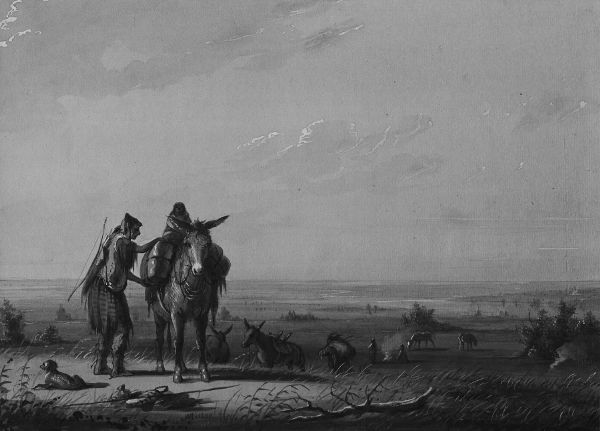
Figure 8. Root-Diggers. “These wanderers are a branch of the great tribe of Snake Indians. . . . They are very poor, and subsist mainly on the roots of the earth,—but a mild inoffensive race.” Alfred Jacob Miller, 37.1940.126, Walters Art Museum, Baltimore.
In the mountains to the north, two distinct Shoshone cultures emerged that would, in the late 1800s, coalesce to form the Lemhi Shoshone people. The lifeways of the Tukudikas (sheep-eaters) strongly resembled those of the Shoshone communities that inhabited the mountains of the Greater Yellowstone Ecosystem. They lived in small family groups, owned few horses, and primarily subsisted by hunting bighorn sheep and foraging. Some Tukudikas resided in the Sawtooth Range and other high-elevation areas almost exclusively while others joined their nearby linguistic relatives for seasonal bison-hunting trips. These Numic-speaking relatives were called Agaidikas (salmon-eaters) because they were known for fishing for salmon on tributaries of the Columbia River, especially the Lemhi and Salmon rivers. Whereas the ancestors of the Eastern Shoshones used Basin-Plains subsistence systems, the lifeways of these Shoshones reflected a Plains-Plateau influence as they focused on resources found in more temperate environments. Agaidikas usually fished in the spring, and once supplies of salmon slowed during the summer, they hunted elk and other big game as well as foraged for roots and berries in small groups. Each fall, some of these typically dispersed family groups congregated to hunt bison on the Plains with other Shoshone bands, Salish, and others, usually crossing over Lemhi Pass into the Three Forks area. Now called Kucundikas (buffalo-eaters), they procured much-needed supplies of meat for the long winter months before hastening back across the Divide. The forebears of the Lemhi Shoshones that Lewis and Clark met largely used skin tepees, although women built brush lodges when needed. Their attire consisted of a variety of furs and skins, although many were bison products. As was the case with other Shoshone groups, Agaidikas and Tukudikas had few guns by the early 1800s; they used bows and arrows, lances, clubs, and hide shields.50
Agaidika and Tukudika social and political organization was even more fragmented than that of their equestrian relatives, although their gender dynamics were similar. When not hunting bison to the east, they usually lived in small family-based groups; they engaged in subsistence activities that did not require large communities. Therefore, chieftaincy was less developed among these Shoshones than it was among equestrian groups. Gender ordered their everyday lives, and, despite the cultural bias of nineteenth-century Anglo-American observers, the many responsibilities of women reflected their importance to group subsistence and their status within their communities.51 Although Meriwether Lewis, for example, noted that Agaidika men “treat their women with but little rispect,” expecting them to forage, cook, dress skins, collect firewood, make all clothing, transport lodges and other items, and raise children, he did not realize that women controlled the distribution of most things.52 Fathers reportedly “disposed” of their daughters as they pleased, “selling” them at young ages for horses and then receiving more when they married as teens; here, Lewis did not understand the dynamics of matrilocal residence. He did note that since the Shoshones he met had many horses at their disposal, women were “seldom compelled like those in other parts of the continent to carry burthens on their backs.”53
All these Shoshone groups engaged in dynamic relationships with one another and their neighbors, many of which were friendly and mutually beneficial. As they had for generations, trade, joint hunting trips, intermarriage, and other interactions connected the various Shoshone communities of the Wyoming Basin, northern Great Basin, and Columbia Plateau. Wyoming Basin Shoshones continued to interact with Comanche bands in particular, for it appears that they regularly visited the Comanche trade center in the upper Arkansas Valley while some Shoshone families lived for extended periods of time among the Comanches and vice versa. This enabled Shoshones to connect with the Spanish; North West Company trader Francois Antoine Larocque wrote in 1805 that while he was on the Bighorn River “a Snake Indian arrived, he had been absent since the spring and had been part of his nation who trade with the Spaniards.”54 Although horses and various trade goods changed hands through these interactions, Shoshones acquired few firearms. Meanwhile, Shoshones developed even closer ties with an eastward-migrating Northern Paiute people now known as Bannocks. Their relationships extended well beyond trade, intermarriage, and travel to hunt bison on the Plains or forage at such places as Camas Prairie, as integrated Shoshone-Bannock bands emerged by the early nineteenth century. Shoshones also strengthened their relationships with other peoples who similarly suffered from the depredations of Blackfeet raiders, some of whom had also lost prime hunting grounds to their enemies. Among those were Kutenais and Salish who had once shared the grasslands of present-day Alberta and Montana with Shoshones (although not always peacefully), but by 1800 the Blackfeet had pushed them into the Rockies. Often in the company of Shoshones, they now visited the Plains only to hunt bison seasonally. And like their Shoshone contacts, Kutenais and Salish lacked access to the Canadian fur trade and, therefore, firearms.
The primary connection that Shoshones had to the trade of the northern Great Plains was through their Crow contacts. Although they did not have the same access to firearms that their mutual Blackfeet enemies had, that Crows had any at all attracted Shoshone traders, who likely acquired a few from them during the early nineteenth century. Shoshones and Crows reportedly traveled together to trade on the upper Missouri, as trader Pierre Antoine Tabeau reported in 1803–4 that “all these people come every year to the Mandanes with whom they trade horses for merchandises of various kinds, for guns and ammunition.”55 Larocque, meanwhile, noted in 1805 upon finding some twenty Shoshone lodges traveling with a Crow band that “this nation [Shoshones] as well as the Flatheads trade as yet no guns from the Ererokas [Absarokas, or Crows].”56 Finally, Shoshone participation in extensive trade networks, especially their own rendezvous in what is now southwestern Wyoming, maintained ties to far-off places like New Mexico, the Dalles of the Columbia River, and the upper Missouri. Bison and other big-game products, horses, fish, produce, shells, tobacco, obsidian, European American material goods, and other items thus continued to travel to and from Shoshone communities. In all, Shoshone groups in the Intermountain West maintained many beneficial relationships with other communities.57
Meanwhile, Shoshone communities scattered throughout the Intermountain West warred with other peoples. Even as the Blackfeet and other enemies raided Shoshone villages, the 1780–82 smallpox epidemic combined with American westward expansion to stimulate Native American population movements and intertribal warfare. Conflicts between displaced peoples most visibly revolved around captives and horses, but access to bison-rich areas also produced warfare. Something of a domino effect occurred as American expansion pushed eastern tribes westward into Sioux country even as the toll of the recent smallpox epidemic enabled Lakota Sioux and Cheyenne bands to push west of the Missouri into lands claimed by Crows and other peoples. Crows, in turn, moved westward into hunting grounds that Shoshones and others used. One area that Shoshones and Crows frequented was the Yellowstone River Valley, as traders who visited that area between 1802 and 1806 noted that it teemed with game that these peoples hunted. Larocque, for one, observed that “the country abounds so much in Buffaloes and Deer that they [Crows] find no difficulty in finding provision for a noumerous family.”58 Shoshones and Crows sometimes clashed over such hunting grounds, but, for the most part, they remained on peaceful terms because they shared common enemies. Indeed, Blackfeet warriors attacked Shoshone villages as far away as the Boise Valley and the Great Salt Lake during the early 1800s. Also by that time, Arapahos expanded into Shoshone country near the head of the North Platte, and although they sometimes traded with Wyoming Basin Shoshones they more frequently raided their villages. Cheyenne warriors also entered Shoshone lands from what are now western Nebraska and South Dakota, and they reportedly took many captives. Shoshones also had to be wary of Hidatsa raiders who ventured westward from the upper Missouri to capture their women, children, and horses. Even Indian groups that inhabited the northeastern Great Plains raided into Shoshone country; North West Company trader John McDonnell wrote in the 1790s that “most of the Red River Indians go to war . . . upon the Rocky Mountain Snake Indians or any of the nations at some distance from their own country upon which they first fall.”59
Meanwhile, Shoshones also clashed with peoples that resided west of the Rockies. Control over hunting and fishing areas produced conflict that compelled Yakima, Walla Walla, Umatilla, and other Plateau peoples to abandon some of their lands south of the Snake and Columbia rivers. And although Shoshones occasionally traded with Nez Perce and Cayuse bands, they sometimes raided one another or warred over resource-rich areas. It appears that Shoshones, unable to maintain the numbers of captives that they took from the Great Plains during the early eighteenth century, tried to compensate by raiding Plateau communities for captives to trade for horses and other goods. Plateau peoples, in turn, avenged those raids while at the same time expanding their horse herds by capturing some from Shoshone villages. As Plateau communities acquired more horses, they challenged Shoshones for control of resource-rich areas in what is now western Idaho. There was no shortage of conflict between Shoshones and their neighbors at the dawn of the nineteenth century, and that warfare was to some degree stimulated by the environmental catastrophe that was the 1780–82 smallpox epidemic.60
Although the ancestors of the Eastern Shoshones suffered economically and militarily because they lacked access to European American traders, they remained active raiders. The Rocky Mountains, which Arapahos believed that the “Man Above” had created to separate them and their Shoshone rivals, were an imposing but passable obstacle for determined enemy raiders. At a disadvantage as their enemies increasingly harnessed the power of horses and guns, Shoshones lost increasing numbers of captives and horses to Blackfeet, Lakota, Arapaho, and other raiders. Meanwhile, their limited offensive capabilities meant that their captive raids were generally less fruitful than those of previous generations. Their trade likely suffered as a result, for captives were the primary commodity that they traded to Comanches for horses and Spanish goods. This may have affected the labor of Shoshone men and women alike, for fewer captives and horses meant that the burden of labor had to be diffused among fewer people and they may not have had as many beasts of burden to help complete that work. At the same time, diminished supplies may have made men more greatly value both horses and female captives since there was still demand for both. Their disadvantages in military technology notwithstanding, Shoshone war parties still struck their Blackfeet and other enemies regularly as men sought prestige and captives. To mitigate against the casualties that their enemies’ guns could produce, Shoshone warriors avoided pitched battles, instead favoring small-scale attacks. They raided deep enough into Blackfeet country that they came close to fur-trade posts, and they sometimes inflicted heavy losses on their bitter rivals.61 Shoshone raiders still ranged far across the northern Plains, for when Charles Mackenzie visited a Hidatsa camp in 1806, he found that “the villages did not appear to be so gay as they use to have been—the reasons of these changes were that some of their young men had been killed by the Serpents, among whom there was the son of one of the Chiefs & all those who were able to Carry Arms had been gone to revenge the Stroak.”62
Meanwhile, events unfolded in the Saskatchewan River Basin that gave the ancestors of the Eastern Shoshone people a bit of a reprieve. The Blackfeet Confederacy was at or near the peak of its power at the turn of the nineteenth century, but its loose alliances with other tribes deteriorated after 1780 as their vulnerability to Shoshone raiders faded and the growing fur trade produced tension. No longer dependent on Assiniboine and Cree middlemen for firearms and ammunition as the Hudson Bay Company and North West Company founded posts in their territory, the Blackfeet had little reason to remain friendly with those groups. And since the Blackfeet were rich in horses compared to Crees and Assiniboines, the latter raided them constantly, especially as their trade declined. Harmon, in 1803, referred to an ongoing “bloody War” between the Blackfeet, Crees, and Assiniboines, and in 1806 he noted that a brief truce between those groups shattered when a joint war party “fell out on the way and fought a Battle” over some horses.63 These many conflicts pulled the tribes of the Blackfeet Confederacy in different directions, as Piegans primarily quarreled with Shoshones while Siksikas usually interacted with Assiniboines and Crees; Bloods split their attention between eastern and western tribes. Meanwhile, Crees and Assiniboines shifted their work as middlemen to the south, where they served as a conduit between the Mandan and Hidatsa villages on the upper Missouri and the European American traders in the Canadian parklands. This provided them with access to horses, but it also reignited a decades-old conflict with their Lakota Sioux enemies who were themselves pushing westward across the northern Plains from the upper Mississippi watershed. So, while assaults on the ancestors of the Eastern Shoshones continued throughout this chaotic period of intertribal affairs on the northern Great Plains, they probably lacked the force that they might have otherwise had if the alliance between the Blackfeet and other groups had remained strong.64
The ancestors of the Eastern Shoshones recognized that the loss of access to key hunting grounds was a great blow. Cameahwait, for example, explained to Lewis in 1805 that his people wanted to again “live in the country of buffaloe and eat as our enemies do and not be compelled to hide ourselves in these mountains and live on roots and berries as the bear do.”65 Harmon, meanwhile, observed how other Native communities prospered on the grasslands, writing that “these Indians who reside in the large plains appear to be the happiest and most contented People upon the face of the Earth. They subsist on the Flesh of the Buffaloe and of the Skins they make the greater part of their Cloathing, which is both warm and convenient.”66 It appears that the pervasive warfare between various Indian cultures on the northern Great Plains created havens for game, especially in hotly contested areas. Since no group could safely occupy some areas of the grasslands for a significant period of time, game populations that might otherwise decline because of hunting activities instead thrived. Moreover, the decline of Native populations that resulted from the 1780–82 and 1801–2 smallpox epidemics probably also lessened pressure on bison and other animals. The ancestors of the Eastern Shoshones benefited from this ecological development when they conducted their seasonal bison hunts on the western fringes of the Great Plains.67
Although few ancestors of the Eastern Shoshones encountered European American traders or explorers prior to 1800, some began to visit Shoshone country during the first decade of the nineteenth century. In 1792, Hudson Bay Company trader Peter Fidler reported that several Shoshone peace emissaries had recently visited a Piegan village and that some Piegans had subsequently made an eight-day journey by horseback to visit a Shoshone camp. Such overtures, however, apparently failed to establish a peace, and neither Fidler nor his associates (nor rivals) began trading with Shoshones. They remained isolated from traders; North West Company trader Duncan M’Gillivray wrote during the mid-1790s that Shoshones “inhabit the Rocky Mountains, unacquainted with the productions of Europe, and strangers to those who convey them to this country.”68 The first documented European American visitor to the ancestors of the Eastern Shoshone was a French Canadian named Charles Le Raye, who in 1802 or 1803 journeyed through the Yellowstone River Valley, where he met some Shoshones. He wrote:
On the 13th [of October] a large party of Snake Indians arrived. This nation resides principally on the headwaters of the Big Horn river, and in the most inaccessible parts of the Rocky mountains, where they have frequently to hide in caverns from their enemies. Owing to their defenseless situation they become an easy conquest to any nation disposed to attack them, and they are frequently attacked for no other reason than the pleasure of killing them. Their appearance bespoke their distressed situation to which they are reduced. The complexion of these Indians is dark, but their features are regular, although their visage is thin and their eyes pretty much sunk into their heads. Their bodies are frequently crooked, a thing rarely to be seen among Indians; of a small size, thin and slender. Both men and women have their hair hanging loose on their heads and only cut short over the eyes. Their dress consists only of mountain sheep, cabree [pronghorn], or deer skins thrown over their shoulders. The women sometimes wore a girdle of loose bark, tied round their middle, which was but an indifferent covering. Their ornaments consisted of white bears’ claws and a few beads. The men were armed with the Casoe-tite, or war club, a target or shield made of raw buffalo hides, a dagger made of bone, ten inches long, and a small bow. We were the first people that they or the Flatheads had ever seen. . . . The buffalo is not found on the west side of the Rocky mountains and there these people subsist on fish and roots.69
Le Raye thus depicted Shoshones as an impoverished people who lived in constant fear of their enemies. Yet, his highly racialized description of the Shoshone people provides insight into their relationships with their lands. They clearly utilized diversified hunting and gathering methods to procure sustenance, as foraging and fishing were bedrocks of their subsistence; Le Raye, however, likely downplays their hunting activities, as he errs in writing that no bison lived west of the Rockies. Moreover, their vulnerability to enemy raiders could, in part, be attributed to their lack of commerce with European Americans, which deprived them of guns.
Shoshones soon encountered more visitors who commented on their misfortunes as well as worked to integrate them into fur-trapping networks. In 1805, a party of North West Company traders visited the upper Missouri and then traveled with a band of Crows into the Yellowstone region to scout an area that reportedly abounded in beaver. One of the men, Charles Mackenzie, noted that prior to their departure from the Missouri, a Mandan chief had encouraged his Crow friends to “be kind” to the traders, observing that “we live better than our Fathers lived. Do your Neighbours the Serpent nation enjoy the Security and happiness we enjoy? If the white men could furnish the Serpents as they furnish us with arms, we should not carry away so many of the Serpents’ scalps.”70 Mackenzie wrote that another Mandan chief expressed concerns about what the growth of the fur traders’ operations would mean for his people; he “asserted that if the white people extend their dealings to the Rocky Mountains, the Mandanes would thereby become great sufferers—as they not only would lose all the benefit which they had hitherto derived from their intercourse with these distant tribes;—but in measure as these tribes obtained arms they would become independent and insolent in the extreme.”71 Although Mandans valued their place as middlemen and shared misgivings about French efforts to circumvent them, they accepted reassurances that they would continue to prosper and did not openly oppose the traders’ designs to journey westward. During their subsequent travels, the North West Company men encountered rivers that held many beaver dams and lands that teemed with bison, elk, deer, and other game. They also met a small group of Shoshones that traveled with the Crows, and Larocque acquired some of their furs. Although Larocque’s primary objective was to survey the fur-trapping potential of the Yellowstone country, he also worked to secure Crow loyalty for future commerce as the presence of Lewis and Clark on the upper Missouri by the end of 1804 signaled that American competition was imminent. So, upon his departure from the Yellowstone, Larocque asked his Crow and Shoshone contacts to kill beavers and other fur-bearing animals during his absence; they would be rewarded with guns, ammunition, and other trade goods in exchange for those when he returned.72
Even though few Shoshones met Lewis and Clark, the expedition was a seminal episode in Eastern, Northern, and Lemhi Shoshone history as it set events in motion that would integrate all of them into far-reaching fur-trade systems. Moreover, the peaceful interactions between the explorers and the Shoshones they met laid a foundation for several decades of largely amicable relations between Americans and Shoshone communities in the northern portion of the Intermountain West. When Lewis and Clark left their winter quarters at a Mandan village on the upper Missouri in the spring of 1805, Sacajawea, a young Shoshone woman about sixteen years old, was among them. Some five years earlier, she had been living in a Shoshone camp near the Three Forks of the Missouri when Hidatsa raiders struck. She was one of several women taken captive and she later married Charbonneau, a Frenchman whom Lewis and Clark hired as a translator. Sacajawea, however, would prove far more helpful to the Americans. She contributed to the success of the expedition as a guide, a translator, and, most importantly, a means by which the Americans established a friendly relationship with the Shoshones they met.73 From the Mandan villages, Lewis and Clark “set out in surch of the Snake Indians or Sosonees,” who were reportedly rich in horses and might be found between the Great Falls of the Missouri and Three Forks; they intended to travel as far as they could by water, but they anticipated they would need mounts to help them cross the Rockies.74 Early on, Lewis and Clark learned of the hardships that Sacajawea’s people faced; they wrote that “our Indian woman said & it is generally known that the Shoshonees Liatans & other Snakes of the Mountains formerly lived in the plains of this side & by war were obliged to take refuge in the mounts.”75
Sacajawea’s people, however, proved elusive. In July, Clark wrote that “we begin to feel considerable anxiety with rispect to the Snake Indians. If we do not find them or some other nation who have horses I fear the successful issue of our voyage will be very doubtful or at all events much more difficult in it’s accomplishment.”76 Even after they entered territory that Sacajawea recognized and then encamped near the Three Forks, they met no Shoshones. In early August, Lewis crossed the Continental Divide at the Beaverhead Mountains to seek Shoshones on a river that Sacajawea told him lay west of Lemhi Pass. Just before crossing the Divide several days earlier, Lewis had spotted a lone “Sosone” man on horseback but, much to his dismay, the man had ridden off in the opposite direction; he possibly feared that the Americans were enemies. Disappointed yet hopeful, Lewis led his contingent across the Divide on an “Indian road” and thence along the banks of the Lemhi River. A second Shoshone sighting proved as unfruitful as the first, as a group of three Shoshones fled at Lewis’s approach.77
On August 13, 1805, Lewis finally encountered his “Sosone” Indians. Soon after breaking camp for the day, Lewis spotted several women, whom he approached. Several fled, but he quickly befriended the others by giving them gifts. The women who had run away alerted a nearby camp and a party of sixty mounted warriors in full war regalia soon confronted Lewis and his men. Months earlier, Clark had expressed reservations about meeting Shoshones, observing that “not haveing seen the Snake Indians or knowing in fact whither to calculate their friendship or hostility, we have conceived our party sufficiently small [to send some of the men to report to St. Louis].”78 They need not have worried. The women Lewis met conveyed to the Shoshone chief, Cameahwait, that the explorers were friendly. A warm reception followed, and Lewis quickly tired of what he called their “national hug.” He noted that, except for three men who carried North West Company muskets that they had acquired from their Crow allies, the warriors carried bows and arrows, lances, and clubs. The Shoshones then escorted the Americans to their camp on the Lemhi River.79
Even though these natives were most likely ancestors of the Lemhi Shoshones, Lewis produced a rich body of ethnographic information that included some insights into the lives of the ancestors of the Eastern Shoshone people. Soon after their arrival, the Indians happily offered the hungry Americans some salmon and cakes made of serviceberries and chokecherries. Nearing the end of their summer subsistence cycle, these Shoshones were preparing to hunt bison on the far western Great Plains with their Salish allies.80 Their principal game west of the Divide consisted of pronghorn, elk, and deer, but they were hungry; on one occasion during his visit a disgusted Lewis watched the Natives “tumbling over each other like a parcel of famished dogs” to feast on an uncooked deer that his men had killed.81 Later, Lewis saw a Shoshone woman digging up yampas and remarked in a manner that reflected prevailing Anglo-American attitudes toward hunter-gatherer cultures that “it is really distressing to witness the situation of those poor wretches.”82 After Lewis gave Cameahwait’s people some of his supply of corn and beans, the chief reportedly expressed a wish “that his nation could live in a country where they could provide such food. [Lewis] told him that it would not be many years before the white-men would put it in the power of his nation to live in the country below the mountains where they might cultivate corn beans and squashes. [Cameahwait] appeared pleased with this information.”83 Lewis also learned that during the previous spring, a Gros Ventre raid on this Shoshone camp had resulted in twenty dead or taken captive, the loss of many horses, and the destruction of many of their skin tepees; most of the people now inhabited brush lodges. But Lewis did not despair of acquiring horses, as he noted that hundreds of horses and mules grazed outside of the Shoshone camp, many of which bore Spanish brands. The explorer also learned that Cameahwait’s people had hesitated to meet him because they thought that his party was in league with their enemies. For his part, the chief expressed no reservations about hosting the Americans and agreed to lead Lewis’s men to a rendezvous with Clark. But some of his people continued to harbor concerns and some tense moments followed as they traveled to meet the balance of the expedition.84
On August 17, a happy accident of history quelled any lingering concerns that the Shoshones had about the Americans. When Lewis’s contingent of the expedition met up with Clark and the others, Sacajawea reunited with her people, who were led by her brother, Cameahwait. The joyous event cemented Shoshone friendship with the explorers, and Lewis and Clark were therefore on solid footing when they met with Cameahwait to discuss their needs. When they inquired about a route through the mountains toward the Pacific, they learned about the lands that lay to the southwest and west, including the challenging environment of the northern Great Basin and the impassability of the Salmon River country, which the Shoshones called the “River of No Return.”85 Clark nevertheless decided to scout the Salmon River route even as, upon the Indians’ advice, Lewis prepared to lead the party northward into the Bitterroot Valley and then across the mountains by way of Lolo Pass. Cameahwait assured the Americans that his people would trade them some horses and provide them with a guide. When Lewis and Clark promised him that his people would be involved in the coming American fur trade, Cameahwait stated that he “was sorry to find that it must be yet some time before they could be furnished with firearms but said that they could live as they had heretofore untill we brought them as we had promised.”86 But Cameahwait was satisfied to learn that Mandans, Hidatsas, and others had promised the explorers that they would stop raiding Shoshone camps.87
While Clark explored the Salmon River, Lewis prepared for a probable journey into the Bitterroot Valley and produced more ethnographic material about his Shoshone hosts, including insights into their relationships with the world around them as well as their desire to trade. He wrote that although they “live[d] in a wretched stait of poverty,” he admired their “character.”88 He had described the Mandan and other peoples of the upper Missouri as dirty and extravagant, and the Assiniboines, Lakotas, and others as hostile and unreliable, but he liked the friendly, generous, and honest Shoshones. To some degree, Shoshones likely accommodated the explorers because they were eager for American trade, as Lewis noted that they had some metal knives, arm bands, buttons, and other trade goods but few firearms and no ammunition; several times, Cameahwait explained how badly his people needed guns and ammunition. Without them, they suffered from enemy attacks and had little choice but to spend most of their time in the mountains, where they lived on fish, roots, and berries; they wanted greater access to the hunting grounds on the Plains.89 Lewis provided further insight into the causes of Shoshone hardships when he noted that “these people have suffered much by the small pox.”90 He also learned that this particular Shoshone camp was preparing to join its Salish allies for their annual hunt on the western Plains but the Americans were delaying their departure. When a camp of fifty more Shoshones joined Cameahwait’s village, Lewis wrote that “I now learnt that most of them were thus far on their way down the valley towards the buffaloe county, and observed that there was a good deel of anxiety on the part of some of those who had promised to assist me over the mountains.”91 On one occasion, Cameahwait prepared to leave Lewis and guide his people toward their hunting grounds, but the explorer learned of his plans and reprimanded the chief, reminding him of his promise and asserting that guns and ammunition would only come after complete cooperation. Cameahwait acquiesced and further delayed the hunt.92
After Clark confirmed the impassibility of the Salmon River route in late August, Shoshones and Americans parted ways. Cameahwait kept his word, as his people traded twenty-nine horses to Lewis and Clark, proving to be shrewd businessmen; they reportedly traded at generous rates early on but made deals heavily in their favor by the end. They also provided the explorers with a guide named “Old Toby” to lead them into the Bitterroot Valley and through Lolo Pass. These contributions were crucial to the success of the Lewis and Clark expedition. For their part, the explorers renewed their promises of future trade.93 Several days later, the expedition entered the Bitterroot Valley, where it encountered a Salish camp “set out on their way to meet the Snake Indians at the 3 forks of the Missouri.”94 One cannot help but wonder whether they rendezvoused with Cameahwait’s people on the western Plains to hunt buffalo together.
At about this time, a Shoshone woman gave birth to a baby boy in the Bitterroot Mountains of what is now western Montana. The boy’s father was Salish and they lived among his people, so the baby received a Salish name. Years later, however, he earned a name that would become central to Eastern Shoshone history: Washakie. Distinguished in combat against Blackfeet, Crow, and other warriors, Washakie (whose name—“to rattle”—referenced the war rattles that Shoshone men used while on the warpath) would ultimately help the Eastern Shoshone people adapt to a rapidly changing world during the nineteenth century.95
The period of 1780 to 1806 was challenging for the ancestors of the Eastern Shoshone people. The great smallpox pandemic of 1779–84 had devastated them, killing untold hundreds and compelling the survivors to all but withdraw from the Great Plains. Thereafter centralized in the Wyoming Basin and adjacent areas of what are now Idaho and Utah, the ancestors of the Eastern Shoshones engaged in diversified subsistence methods that exhibited a blend of Great Plains and Great Basin characteristics. Their reduced military strength, a product of the pandemic as well as their struggles to engage in trade that afforded access to firearms and ammunition, left them vulnerable to enemy raiders, such as the Blackfeet, Arapahos, and Hidatsas. But the ancestors of the Eastern Shoshones proved dynamic and resilient, utilizing broad-based hunting and gathering methods, adjusting their social and political organization, maintaining and expanding intertribal relationships, and forging new intercultural connections to subsist in the Intermountain West.
The arrival of European Americans in their country heralded a new era of Shoshone history, one that would contribute to further changes in the ways that Shoshones interacted with their environments. Although their encounters with Le Raye, Larocque, and Lewis and Clark produced little immediate change, they foreshadowed a vastly different world in which Shoshones would participate in fur-trade systems as well as engage with the effects of American overland travel to the Far West. Although Lewis and Clark encountered but a small portion of the Shoshone language family, the secondhand information that they obtained from their indigenous contacts effectively introduced Shoshones into American popular imagination. The explorers divided all Shoshones, whom they numbered at a total of 20,000 people, into two broad groups: the “Alitans of the Plains” and the “Alitans of the West.” The former included Comanches and the Shoshone groups who resided in or visited lands east of the Rockies while the latter encompassed all Shoshones who resided west of the Divide. The “Alitans of the Plains” comprised Wyoming Basin Shoshones, as many of their linguistic relatives, including those whom Lewis and Clark encountered in the Lemhi Valley, associated them with the Great Plains.96
One of the ways that the Lewis and Clark expedition and others who ventured into the West during the early nineteenth century affected Shoshones was by confirming rumors that the headwaters of the Missouri were rich in beaver and other fur-bearing animals. In fact, their glowing reports of the region’s trapping potential preceded the Americans’ return to St. Louis, for during their journey down the Missouri in 1806 they met several parties of trappers heading upriver. One of Lewis and Clark’s hunters, John Colter, left the expedition near the Knife River to join two men who planned to trap far up the Missouri.97 More would follow, and their activities would deeply affect the ancestors of the Eastern Shoshones and their lands.