
1
Observers
Just as it is not always clear who provided explicit stage directions, it is similarly not always clear to whom medieval stage directions were addressed. Nor, indeed, are the purposes of such stage directions always transparent. On the face of it, many medieval stage directions appear to be addressed to the performer. This may be perceived to be so because of the practical information contained in them. However, as indicated in the Prelude, such practical details are often not sufficient to specifically direct the player or the action. The practical information generally exists because it has been witnessed in a previous performance, although its articulation is conditioned by descriptive incident of the kind that might be observable in performance but not as internal directives to the player. This implies that the writer of the stage direction may have observed the required outcome but not the means of its production. Thus it appears that the purpose of the stage direction is simply to record the details of earlier performance and, in doing so, fulfil official or religious requirements, and only by extension—if at all—to determine what could or should happen in subsequent performance.
In their introduction to the York Play: A facsimile of British Libray MS Additional 35290, Richard Beadle and Peter Meredith discuss the scribal progress of stage directions in the play and make the following distinction: ‘Stage directions, or perhaps it would be more accurate to call them descriptions of stage action, have been added to a number of the pageants by later hands, among them John Clerke’.1 This difference in the identification of stage directions may appear to be a simple one, but it is critical in determining the derivation, purpose and function of explicit medieval stage directions. Stage directions such as these exist by virtue of previously observed theatrical action. Thus, Beadle and Meredith’s ‘descriptions of stage action’ point to a much more accurate identification of stage directions brought about by earlier observed performance.
This recognition partly answers the question ‘Why were some stage directions written in Latin?’ They were presumably written in Latin because the observer knew Latin and/or was expected to be able to operate in Latin as part of his formal or commissioned duties. It was the duty of John Clerke at York, ‘seruaunt and deputy’ to the common clerk, Miles Newton, whose task it was in 1542 to check players’ performances against the city’s text or register:
Item paid to the seruant of the common Clerk for kepyng of the Register at the furst place where as ∧ ˹the play of Corpus christi˺ [play] was playd of Corpus christi day this yere accustomed xx d.2
John Clerke was responsible for including some of the stage directions or, more accurately, ‘descriptions of stage action’ in the York register.3 The same, or similar, role is recorded in the Smiths Accounts at Coventry through payment to John Harryes: ‘It’ paid to John Harryes for berying of þe Orygynall þt day vjd—1506. Resevyd amonge bredren and other good ffelowys toward the Orygynall ijs ixd in sums of 1d. & 2d each’.4 At Bassingbourn, Cambridgeshire, the Churchwardens’ Book for 1500/1 records payment towards a ‘playe book’: ‘Item paid uppon Wytson Mondaye for a playe book \iid/, the berer theroff \iid/, John Best clerk and taberer, the mynstrell \iiid/’.5 The apparent mistake in labelling ‘John Best’ as the ‘clerk’ does at least indicate the possible presence of a clerk, even if he is not John Best, with the task of bearing the ‘playe book’. The book bearer at Bassingbourn is more clearly identified in 1511 as the priest, John Hobard: ‘Item rec’ off John Hobard, preste, towardes theys costes in all out of his labour for beryng the play booke, with iiid for a bos’ of malte, summa [2s 8d]’.6 At Chester, the Cordwainers’ and Shoemakers’ Accounts for 1549–50 record payment to an unknown ‘Reygenall beyrer xii d.’. Later, in 1572–73 and 1574–75 at Chester, the Bowyers’, Fletchers’, Coopers’ and Stringers’ Accounts identify payment to ‘hugh sparke for rydyng [reading] of the Ryegenalle ij s.’ and ‘houghe sparke for redinge the regynall ij s.’.7 What were the respective purposes of ‘kepyng of the Register at the furst place’, ‘berying of þe Orygynall’, ‘beryng the play booke’ and ‘redinge the regynall’ at York, Coventry, Bassingbourn and Chester? It appears that the occupants of these roles were relatively well paid for their reading and observational functions. The relatively substantial amounts paid to Hugh Sparke at Chester ‘for redinge the regynall’ (ij s), John Clerke at York for ‘kepyng of the Register at the furst place’ (xxd) and John Harryes at Coventry for ‘berying of þe Orygynall þt day’ (ivd plus iis ixd from ‘other good ffelowys’) suggest their roles required them to follow the performance by reading the master copy of the play. Checking the players’ performances against the recorded text must have been the primary function, with the possible, but not inevitable, added task of prompting.8 John Clerke, John Harryes, John Hobard, Hugh Sparke and possibly John Best were named and well-paid observers engaged in formal roles to carefully observe their respective performances and, as such, were in prime positions to create stage directions from their observations. Most other observers were not named or even identified in their roles. Such observers may have come from diverse backgrounds and occupations, but their common task was a formal one, often requiring knowledge of Latin, determined and dictated by those who put on the plays or those from a larger authority who sanctioned the plays.
Optional Action
There are a number of stage directions that record optional opportunities as a means of realising their requirements. Such options seem to have existed because performance had been previously witnessed both with and without enactment of the discretionary action. The practical detail contained in the stage direction might initially suggest that it was the player who would most benefit from the direction, for it was he who was seemingly able to choose action from the options. However, the player was not the intended recipient of the stage direction. The purpose of the recorded stage direction appears to be simply that—to record previously witnessed action. In which case, the intended recipient of the stage direction appears to be someone with access to the manuscript, or, in Walter J. Ong’s and Linda McJannet’s terminology, the ‘producer’.9 It is not clear how the player was able to respond to the recorded options, although it is possible and likely that he was able to relate to customary practice as his guide.
The options are often conditional on the ability of the players or stage hands to produce the required action. For instance, in the Chester Goldsmythes Playe of the Massacre of the Innocents (Play 10), a stage direction records:
Tunc ibunt et Angelus cantabit, ‘Ecce dominus ascendet super nubem levem, et ingrediatur Egiptum, et movebuntur simulachra Egipti a facie domini exercituum’; et si fueri [fieri] poterit [cadet] aliqua statua sive imago.
[Then they shall go, and the Angel shall sing: ‘Behold, the Lord rideth upon a swift cloud, and is to come into Egypt; and the idols of Egypt shall be moved by the presence of the armies of the Lord’; and if it can be done, some statue or image shall fall.]10
The imperative that ‘some statue or image shall fall’ is contained in Isaiah 19:1, and the stage direction is clearly intended to respond to this stipulation in the biblical narrative. The staging option, ‘if it can be done’, indicates some uncertainty on behalf of the observer. What, therefore, produces this uncertainty? Is it the observer’s lack of knowledge or experience of the working of this effect? Or is it an expression of doubt as to the ingenuity and/or ability of the Goldsmiths to produce the effect on their pageant carriage?11 The implication from the stage direction is that the observer knows that this effect can be produced, presumably because he has seen it done previously, but is unsure of whether the Goldsmiths are capable of reproducing the effect. What might be regarded as constructional skill clearly plays a role in the possibility of producing this effect.12
The proviso, ‘if it can be done’, is again stipulated in a stage direction in the Chester Webstars Playe of the The Last Judgement (Play 24):
Finitis lamentationibus mortuorum [descendet] Jesus quasi in nube, si fieri poterit, quia, secundum doctoris opiniones, in aere prope terram judicabit Filius Dei. Stabunt angeli cum cruce, corona spinea, lancea, et instrumentis aliis; ipsa demonstrant.
[When the laments of the dead have ended, Jesus shall come down as if in a cloud, if it can be contrived, because according to the opinions of scholars, the Son of God shall give judgement in the air close to the Earth. The angels shall stand with the cross, the crown of thorns, the lance, and the other instruments; they display them].13
These qualifications of ‘if it can be done’ (Massacre of the Innocents) and ‘if it can be contrived’ (The Last Judgement) suggest doubt on behalf of the writer of the stage direction. In either case, the writer appears to be someone detached from or ignorant of the necessary understanding of the practical means of producing the desired result. Even so, he knows of the effect that is required to satisfy the needs of the biblical narrative and ‘doctoris opiniones’ and appears to have previously experienced the stated outcome.
A similar option is provided by another Chester play by the Waterleaders and Drawers of Dee play of Noyes Fludd (Play 3), where a stage direction stipulates: ‘And firste in some high place—or in the clowdes, if it may bee—God speaketh unto Noe standinge without the arke with all his familye’.14 The stage direction poses a number of interesting questions. First, does the pageant vehicle itself represent the whole of the ark? If it does, and this seems likely, to what does ‘standing without the arke’ mean? Where does Noah stand? The implication is that he stands in the street.15 If this is the case, then the position that God occupies ‘in some high place’ or ‘in the clowdes’ accentuates the height difference between God and Noah. The height of the ‘shipp’ (and not the pageant) is alluded to in the early Chester Banns (1539–40):
The water leders and drawers of dee
loke that noyes shipp be sett on hie
that you lett not the storye
And then shall you well cheue [do].16
A choice is apparently offered by the stage direction as to where God stands. I say ‘apparently’, for what God stands on may be the same platform but with or without clouds positioned at his feet. The suggestion here is that the clouds are represented two-dimensionally and attached to the front of the platform in some way (possibly, nailed). The option, ‘if it may bee’, seems to refer to the ability to construct a platform with or without ‘clowdes’. Another offered option to exercise judgement of a different kind is required in the Chester Wrightes Playe of The Annunciation and the Nativity (Play 6), where a stage direction offers the player the following opportunity: ‘Tunc Angelus cantabit “Haec est ara Dei caeli”; fiat notam secundum arbitrium agentis, etc.’ (Then the Angel shall sing ‘Haec est ara Dei caeli’; [Let the setting be according to the judgement of the performer, etc.]).17 Lumiansky and Mills propose that the choice ‘probably suggests a free form, perhaps a chant at the discretion of the performer’.18
The options described in the stage directions in the Chester Goldsmiths, Websters, Waterleaders and Drawers of Dee plays beg further questions as to the authority of the stage-direction writer. How does the writer or writers know of the possible options available in the individual plays? The writer of these stage directions is not likely to be the writer of the play. Where the author of a play is named and is recognised as being the authour, it is more likely that he wrote the stage directions. In the case of these Chester plays, the stage directions appear to have been created by an observer who had previously witnessed production of the plays both with and without enactment of the options. Although the observer knows of the accessibility of the options, he does not know of the judgement or skill involved in their selection and operation. This condition suggests that he is an official whose responsibility is to record the proceedings without any obligatory theatrical understanding. If these stage directions are written as observations of previous performances, then they must also have been added later to the exemplar text from which the remaining texts derive.19 There are five extant texts of the Chester plays, all compiled between 1591 and 1607, and thus published much later than the last recorded performances in 1575. Though copied from a common exemplar, none of these five manuscripts ‘can be shown to have been a producer’s copy or a “Reginall”, a civic master-copy’.20
David Mills discusses the significance of stage directions written in the manuscripts ‘in line’ with the text and those located in the margins and concludes that the marginal ones were added later. If the stage directions were recorded by observers of plays in performance, then even those laid out within the text of the play must also have been added later to the exemplar. Matthew Sergi’s recent careful analysis of the use of cues in the Chester plays also discusses the use and value of stage directions in the respective manuscripts. His conclusions similarly refer to the layering of qualitatively different kinds of information in the manuscripts, developed from separate lost exemplars through accumulative scribal and production processes:
The simplest explanation, given the frequency of copying and recopying at varying levels of formality necessary for ongoing traditional performances, is that lost exempla included some late short-hand additions alongside an array of earlier shorthand notes that had already been partially or fully absorbed—strongly suggesting that there were multiple distinct instances when Cestrian performances generated ad hoc additions, which were sometimes absorbed into the main text and given a more permanent look, in copy after copy.21
Although some of the stage directions in the Chester Cycle offer options as to production alternatives performed on pageant ‘carriages’, they are not the only ones to operate in this way. Recording of optional choices for action also occur in the Cornish plays when performed in the round at ground level. For instance, stage directions in the Cornish Ordinalia and Beunans Meriasek: The Life of St. Meriasek both record the opportunity for personages to ‘walk about the place’.22 In the Ordinalia de Origine Mundi of the Cornish Ordinalia, a stage direction states: ‘hic pompabit rex salamon si voluerit’ (Here Solomon shall walk about if he likes).23 A similar option is offered to the Crozier-Bearer in the Passio Domini Nostri Jhesu Christi of the Cornish Ordinalia: ‘et tunc iet ad principem annam et dicit crociarius et pompabit si velit’ (And then he shall go to the prince Annas, and the crozier-bearer speaks; and he shall walk about if he likes/wishes).24 Later, in the Passio Domini Nostri Jhesu Christi, Lucifer is similarly directed: ‘pompabit lucifer si placet’ (Here Lucifer shall walk about if he pleases].25 In the Beunans Meriasek: The Life of St. Meriasek, the Bishop of Kernou is also offered a motional option: ‘Hic pompabit episcopus kernov si placet’ (Here the bishop of Kernou shall parade if he likes).26
Clearly, the option, ‘if he likes’, outlined in these Cornish stage directions, offers players and their personages choices as to their actions. Although the options contained in these stage directions are those that are necessary for the player to act upon, the stage directions themselves do not appear to be addressed to the player. Like the stage directions in the Chester plays above, they appear to have been written by an official for other officials or some organisational figure who operated on behalf of or in conjunction with the player. It is also clear that the content of these stage directions implies knowledge of earlier performances where the options have been made available or taken up. Like the Chester writer[s] of the plays cited above, the writers of these stage directions appear to have witnessed the optional action in performance. Thus, by further implication, the stage directions display their principal function to be records of performance. Additionally, there is no evidence that medieval players read or responded to explicit stage directions in original manuscripts and thus are unlikely to have responded to stage directions in their written form.27 Players learned their lines from sections copied from original manuscripts that did not contain stage directions.28 These sections, known as ‘parts’, contained one player’s distinctive lines and cues. Further, there is no evidence that players received the lines of other players. The performed playing order of the players’ lines was established through responses to their respective cues.29
The theatrical term ‘cue’ is defined by the OED Online as ‘1.a. Theatre. The concluding word or words of a speech in a play, serving as a signal or direction to another actor to enter, or begin his speech’. The earliest example of the term in the OED Online is of’1553 in J. Strype Eccl. Mem. III. App. xi. 31 Amen must be answered to the thanksgevyng not as to a mans q in a playe’.30 In modern theatrical use, the cue is not soley determined by the ‘word or words’. It can also be activated by audible (non-verbal) and visual moments or signals. Again, in modern theatre, activation of the cue is the means of establishing, maintaining and developing the rate of development, or pace, of the play’s action. Pace is determined by the uninterrupted rate or flow of action governed and developed through the player’s timed response to the signal. The means of achieving appropriate pace is predominately through the incoming speaker ‘sitting’ his first word on the last word of the outgoing speaker, without any negligent gap between the words. If the cue is a visual or audible one of some duration, then prior agreement needs to have been established to determine the precise moment of delivering the cue. However, it is unlikely that the medieval English cue was intended to operate with such timed precision. There is no evidence of the timed enactment of the medieval English cue. The importance of the medieval cue appears to be concerned with its position, order, sequence and the incoming speaker’s ‘turn’ to speak.31 Although cues are important in today’s English theatre, they are not as important as they were to the medieval player. Without responsiveness to the medieval cue, the player was stranded unless prompted. So much is clear concerning the predominant English practice, although other conventions occurred in other countries. A French custom provided parts as ‘roole, rollet, roullet etc. They were rolls or scrolls of paper, which the actor unrolled as the play progressed […] They are designed for use at rehearsals (and perhaps even at performance)’.32 Some correspondence may be seen in accounts of players remembering, or not remembering, their parts in the Persian/Iranian Taziyeh Passion Plays:
As oral literature, the ta’ziya text is not memorized word for word. If a player forgets a part, he improvises. The text is written, as an aid to memory, but it cannot be checked against one written version that is correct. In oral literature, every version is correct. In ta’ziya, each copy (nuskha) is treated as correct: the composers, performers and spectators do not seek an authoritative version.33
Another option that occurs in a stage direction in the Beunans Meriasek: The Life of St. Meriasek is of a different kind and represents a staging convention not encountered elsewhere in the play. It reads: ‘Exulatores hic pompabunt vel vnus pro omnobus’ (Outlaws shall here parade, or one for all).34 The option that one outlaw should stand in to represent all the outlaws requires the terms of reference of this convention to be established for the audience in order that it may understand that this is what is happening. The stage direction may hide a representational convention whereby symbolic action of the kind outlined in the stage direction is clearly understood through the encouragement of ‘agreed pretence’. Parading around the playing space is a common convention found in all the extant Cornish plays, and, most frequently, the practice is a preliminary activity to the introduction of a personage before he speaks. He displays himself to the spectators by way of announcing his arriving presence.35
Another kind of option is provided for the prologue speaker, Poeta, at the end of the first section of The Conversion of St. Paul, where a stage direction states ‘Poeta—si placet’ (the Poet—if he wishes or it is agreed).36 The stage direction refers to the option offered to Poeta in delivering a concluding speech to ‘þis stac[y]on’—the first section of the performed play. Should the speech be offered or not? The reason for the option appears to be connected to the perceived success, or otherwise, of didactic intention. Was it considered that the audience needed further clarification of the process or not?37
In the N.town play of The Last Supper; The Conspiracy with Judas (Play 27), a slightly confusing stage direction offers yet another option as to implementation of the text:
Þan Judas xal gon ageyn to þe Jewys. And, yf men wolne, (the devil) xal mete with hym and sey þis spech folwyng—or levyn’t whether þei wyl—þe devyl þus seyng:38
As it stands, the stage direction is unclear in its intention. However, if it is made clear that it is ‘þe devyl’ who ‘xal mete with hym’, then the sense and the option become clearer. The option, ‘yf men wolne’ (if men will) is to ‘levyn’t whether þei wyl’, that is, to omit the following devil’s speech. Judas’s actions are associated with those of the Devil, as represented iconographically, and the stage direction permits an option as to whether the devil is alowed to offer Judas a priviliged place in hell. If the option to leave out the devil’s speech is taken up then, as Peter Meredith suggests, the devil acts ‘as John the Baptist does, simply as a prologue’.39
Staging Notes
Similar information of the kind contained in medieval stage directions is also to be found in what I shall call ‘staging notes’, delivered in different forms to those of stage directions, that are directed at organising figures of plays whose responsibility is to the overall structural and spatial presentation of the play and its organisation. At Norwich, in the Grocers’ Play (1533, 1565), alternative prologues are permitted depending on whether any other play might precede it in procession. Two stage directions are presented in the form of notes aimed at those in charge of the play’s production. These notes of recommendation do not refer to any internal requirements for action other than the contribution of the prolocutor:
Item. Yt ys to be notyd that when the Grocers Pageant is played withowte eny other goenge befor yt then doth the Proloctor say in this wise:
Note that yf ther goeth eny other pageantes before yt, the Prolocutor sayeth as ys on the other syde and leaveth owte this.40
The content of the alternative prologues reflects the different conditions laid out in the options outlined above. If no other pageant precedes the Grocers’ Pageant, then the prolocutor provides contextual information about the play and presumably the other pageants. These background details are not required if other pageants go before the Grocers’ Pageant. It seems likely that one or other of these pageants would have taken on the task of providing the necessary contextual detail and declaration of purpose on behalf of the other pageants.
In The playe of this tretye. or meditation off the buryall of criste and mowrnyng þerat (Christ’s Burial; c.1520), a similar option is recorded in a staging note of the kind made in the Norwich Grocers’ Pageant:
(This is a play to be played, on part on Gud Friday afternone, and þe other part opon Ester Day after the resurrection in the morowe, but at begynnynge ar certen lynes which not be said if it be plaied, which … [remaining words cut off at bottom]).41
Presumably the ‘certen lynes’ alluded to in this note, which should or should not be spoken, refer to those of the delivery of an optional prologue that advises its audience to be in awe of the ‘sorow of Mary’. Use of the option appears to be related to the nature of the composition of the audience to which the prologue is addressed, for the opening content of the prologue is clearly didactic in its targeted purpose:
A soule that list to singe of loue
Of Crist that com tille vs so lawe,
Rede this treyte, it may hym moue,
And may hym teche lightly with-awe
Off the sorow of Mary sumwhat to knawe42
If the prologue is brought into use, then this clearly lengthens the play; conversely, the play is shortened if the prologue is not used. This form of editing is straightforward enough. But reasons for including or excluding sections of text may occur for internal purposes of narrative manipulation or external ones where the playing time of the play needs to be taken into account. In A new iuterlude and a mery of the nature of the .iiij. elementes declarynge many proper poyntes of phylosophy naturall and of dyuers straunge landys and of dyuers straunge effectes & causis (1530?), a staging note offers the presenters of the play an option to shorten the play by omitting specific sections:
A new iuterlude [sic] and a mery of the nature of the .iiij. elementes declarynge many proper poyntes of phylosophy naturall/ and of dyuers straunge landys and of dyuers straunge effectes & causis/ whiche interlude yf ye hole matter be playdt wyl conteyne the space of an hour and a halfe/ but yf ye lyst ye may leue out muche of the sad mater as the messengers parte/ and some of naturys parte and some of experyens parte & yet the matter wyl depend conuenyently/ and than it wyll not be paste thre quarters of an hour of length.43
This staging note is contained as an elaboration of the title and is quite specfic in its recommendation of the means of shortening the play by 45 minutes. Speeches belonging to the Messenger, Nature and Experience are each targeted to produce a balanced cutting of the scenes. The understanding implicit in these suggestions is that of someone with the assured knowledge of the play and its construction. Such a person is likely to have been the author or someone overseeing a former production. The insights contained in these staging notes demonstrate a theatrical authority not often seen or shared with readers or instigators of presentations.
The staging notes contained in the staging plan of The castel of perseueraunse (The Castle of Perseverance; c.1400–40) contain a major option concerning delineation of staging arrangements (see Figures 1.1 and 1.2).
Performed in the round, the performance space is delineated by one of two options: either a ditch filled with water or a strong fence-type structure surrounding the round playing space. These options are clearly ones to determine the playing space and, more than likely, ones intended to affect audience conglomeration.44 To whom are these staging options addressed? Mark Eccles, in his edition of The Macro Plays that contains his interpretation of these notes, suggests that
The writing on the plan gives directions to the players about the placing of five scaffolds and the cupboard of Covetousness, the number of ‘stytelerys’ or marshals, the gunpowder to be used by Belial and the mantles to be worn by the Four Daughters of God.45
It seems that Eccles chooses ‘players’ as the supposed recipients of the staging notes, no doubt because of the practical nature of their content that may be aligned to the practical needs of players. However, the notes write of players but they do not write to them. The notes do not appear to be directives to players: they have more sense and purpose if seen to be directed to organisers and authority figures whose tasks are to establish staging conditions and audience configuration. The option as to whether the ‘place’ is surrounded by a ditch filled with water or strongly ‘barryd’ all about clearly exists because of previously observed action where both options, on different occasions, have been observed.46 Like the stage directions examined in this work, The Castle of Perseverance plan contains many recorded details drawn from earlier performance. Although there has been much scholarly endeavour, argument and conjecture in interpreting the plan as a drawing, there is no apparent dispute about the words in the plan.47 One exception concerns interpretation of the option alluded to above concerning the description written between two circular lines that states:
þis is þe watyr a bowte þe place if any dyche may be mad þer it schal be pleyed. or ellys þat it be strongly barryd al a bowt. & lete nowth ouyr many stytelerys be wyth Inne þe plase.
Although the two possible methods of demarcating the ‘plase’ as stated inside the two circular lines is clear, the point at issue appears to be concerned with that which the two lines encircle. Do the two lines simply circumscribe immediate space around the castle? Or do they delineate the larger playing place? The words within the two circled lines state that if a ‘dyche’ is employed then it operates ‘a bowte þe place’. I take the word ‘a bowt’ in this context to refer to the act of circumscribing ‘þe place’. This means that it surrounds the place.48 The alternative option is to let the same space ‘be strongly barryd al a bowt’, with the implication that the required ‘strength’ of the construction is so required in order to withstand potential spectator pressure. The optional ‘dyche’ and the presumed wooden barrier are alternative and optional types of construction intended to fulfil the same intention. There is no sense that the purpose of these options changes their function according to which is selected for use. Although the interpretation to encompass the castle with the ‘dyche’ or the ‘strongly barryd’ barrier may be made to service requirements of the play, the words between the two circular lines clearly state that the delineation exists ‘a bowte þe place’ and not specifically about the castle.49
Some dispute has focused on the intended purpose of the plan: is it a plan of a theatre space or a set design?50 My interpretation acknowledges elements of both considerations, and a forced discussion that reduces the identity of the plan to one or other of these distinctions is one brought about by modern perceptions and preconceptions that distinguish drawings of theatre form and set designs. The diagramatic plan clearly represents staging configuration and the means of dressing the space. The relevant OED Online definition of the term ‘plan’ states:’2. a. A drawing, sketch, or diagram of any object made by projection on a horizontal plane; esp. one showing the layout of a building or one floor of a building’. The earliest example of its use is from 1664. The notion of a plan is that it presents a view from above that looks down upon its subject. But the plan of The Castle of Perseverance also presents views as elevations of the ‘castle’ and the ‘bed’. Drawing conventions in which plans and elevations were formally arranged to reinforce dimensions of each other had not been established in 1425. The later convention and practice of orthographic projection as a system of drawing plans, front elevations and end elevations had not been formalised.51 Thus, The Castle of Perseverance plan presents a hybrid means of presenting a two-dimensional plan, a two-dimensional elevation of the castle and a poorly executed three-dimensional elevation of the bed. The mixture of recorded viewpoints in the Castle diagram provides signifiance to its value as a working drawing where the contained information and not the presentational convention conditions its primary purpose. As such, the plan is not to scale, nor does it depict its visual features with any precision. Edmund Malone, in his Historical Account of the Rise and Progress of the English Stage, might have described the plan as one containing ‘scenical direction’.52 The pyrotechnic accoutrements required of ‘he þat schal pley belyal’, while specifying his equipment, are not ones directed to the player: they are ones affected by the conduct of previous performance and directed to the role of ‘belyal’ and not the player.53
The use of options to realise authorial requirements is not one conventionally found in post-1560 stage directions. This is probably because it is increasingly the case that such stage directions are more particularly aimed at actors and people whose function is to oversee the event and those who create settings. The same condition does not apply to pre-1560 stage directions because the player does not appear to be the principal recipient of the direction.
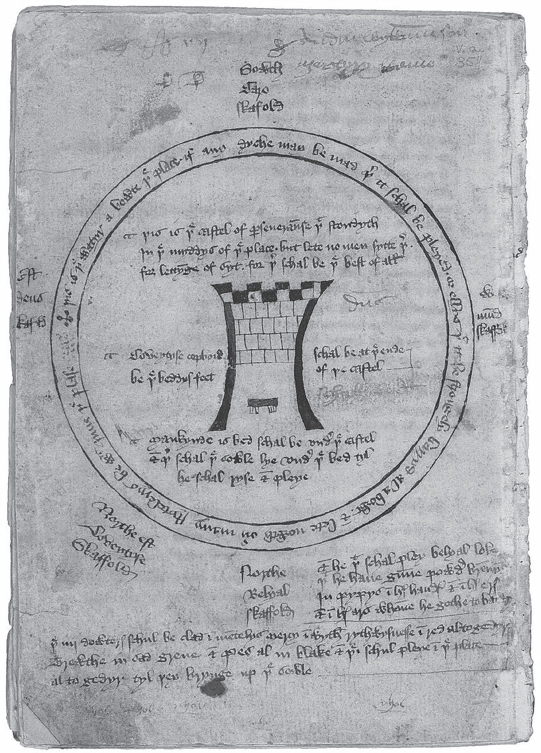 FIGURE 1.1 The castel of perseueraunse (The Castle of Perseverance). Folger MS.V.a.354 (formerly MS 5031), fol. 191v. Source: Used by permission of the Folger Shakespeare Library.
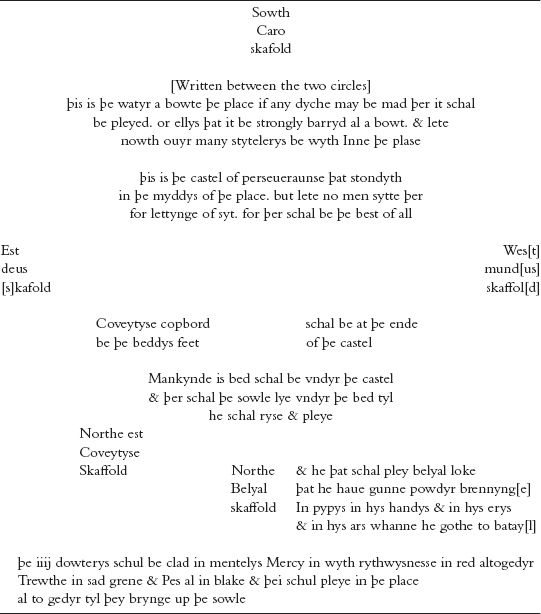 FIGURE 1.2 Transcription of Folger MS.V.a.354 fol. 191v.
Records as Stage Directions
Just as medieval stage directions and staging notes may be seen as records of previously played performances, so too may some records be seen to function in the manner of explicit stage directions. Although not presented within the variable range of stage-direction formats, the content of some records provides evidence of performance requirements of the same quality found in stage directions. For instance, in the 1433 indenture drawn up by the pageant masters of the York Mercers’ Guild in handing over responsibility of their Corpus Christi pageant and its properties to their successors, the document itemises all the assets belonging to the pageant and offers descriptions and theatrical reasons for their use.54 One of the many items is: ‘A brandreth of Iren þat god sall sitte vppon when he shall sty vppe to heuen With iiij rapes at iiij corners’.55 This could easily be the kind of content found in an explicit stage direction if it was simply organised as an observation. In the same document, additional items are recorded as:
a /Pagent with iiij wheles helle mouthe iij garmentes for iij deuels vj deuelles faces in iij Vesernes Array [masks] for ij euell saules [souls] þat/is to say ij Sirkes [shirts] ij paire hoses ij vesenes and ij Chauelers Array [wigs] for ij gode saules þat is to say ij Sirkes ij paire hoses ij vesernes & ij Che/uelers ij paire Aungell wynges with Iren in þe endes56
The detail outlined here offers not only a clear legal list of items belonging to the Mercers’ Guild, but also a record of the properties previously used in performance of the Guild’s play of The Last Judgement. It is in this respect that the function that these details perform is the same one as those of explicit stage directions that act as records of earlier performance. The same point may be made in respect of a financial account contained in the Skinners’ Renters Wardens’ Accounts (1519) to provide 13 children with hired beards and diadems for their part in the Skinners’ Pageant in the Midsummer Shows in London:
Paid to 13 children playing God Almighty and His 12 Apostles, at 2 pence the piece … … . 2s. 2d.
Paid for 13 beards and 13 diadems hired for (the children that represented) God Almighty and the 12 Apostles … . . 2s57
Since payments were made for items of ‘beards’ and ‘diadems’, it may be inferred with some legitimacy that the accoutrements were used in performance of the Skinners’ Pageant. In addition to explicit stage directions addressed to organisers and authority figures, the existence and purpose of some records in the form of authoritative financial accounts may be permitted to operate as formal ones that fulfil the same, similar, or additional functions as explicit stage directions. Given the content of these financial accounts, it would only require reorientation of them as records to qualify them as explicit stage directions. The intended recipients of such accounts, given their formality, legality or quasi-legality, may be the same or similar ones to those to whom more conventional explicit stage directions were addressed. Financial accounts of this kind also allude to previous performances.
Lists of stage items as contained in indentures, inventories and records are not fundamentally different from the kind of explicit stage directions under discussion: the principal difference exists in the recording of imperatives through words such as ‘shall’ in describing action. This condition is most apparent in some stage directions where it is recorded that someone ‘shall’ do something or that some action ‘shall’ take place. Use of the word ‘shall’ occurs in both English and Latin translation. The imperative contained in the word clearly refers to the possibility of intended action, although its instigation is as a result of previously witnessed action. Historically, there are many different meanings of the word ‘shall’, but contemporary understanding tends to revolve around ‘should’, ‘should be’, ‘ought’, ‘ought to be’, ‘is to’, ‘will’, ‘will have to’ and ‘must’.58 This nuanced range of meanings appears to have influenced changes in function of explicit stage directions from the thirteenth century to 1560. Such changes may be seen in the interchangeable use of verbs in the present indicative, the future simple and the subjunctive. Towards the end of this period, emphasis upon ‘will’, ‘will have to’ and ‘must’ seems to have become more dominant in intention, even though the word ‘shall’ remains with some ambiguity. ‘Shall’ also implies a sense of formal obligation derived from a recorded observation that ‘this is how the action has always happened’ and that ‘this is how such action should always be done’ in order to fulfil religious, civic or institutional purpose.59
Lists of play properties, fixtures and fittings do not, as a matter of routine, contain requirements for action, but some do imply it. In the Documents Relating to the Revels at Court in the time of King Edward VI and Queen Mary, payments are recorded in 1552 to:
The same Nicholas [Leveret] for a dragons head and a dragons mowthe of plate with stoppes [tow, oakum] to burne like fier .vs. for trymmyng of iiijor boxes with plate for the same .ijs. ij fyer boxes xijd. iiijor small cheines of yerne at xijd the pece .iiijs. xiiij yardes of ynglish wier great at ijd the yarde .ijs iiijd. and for vj dozen of hookes ijs in all for the furnyture of the pageauntes of the Tryvmphe of Cupide60
Again, a simple reorientation of this account as a direction to Nicholas Leveret to provide the items in the list would qualify it as an explicit stage direction, for the intention of the ‘stoppes to burn like fier’ determines the required action. Each of the listed items corroborates the others in describing the means of containing fire in metal boxes in the mouth of the dragon, which can be seen by the spectators when its mouth is presumably opened by ‘cheines of yerne’ and ‘ynglish wier’.
Another dragon’s head is featured in the Drapers’ Pageant at the Midsummer Watch in London in 1541. Two payments record the type of information encountered in stage directions for the production of fire in the dragon’s head:
payd for a galon of aqua vyte to bron in the dragons mowth iijs viijd
Item to hym that kept ffyre in the dragons mowthe xvjd 61
This account describes what was needed to create the desired effect. Like the dragon’s head provided by Nicholas Leveret, the fire appears to be contained in the dragon’s mouth: unlike Leveret’s dragon, the fuel is recorded as aqua vitae and not tow (oakum). Both fuels burn with different coloured flames. Aqua vitae burns with an almost colourless flame and would need to be mixed with a salt of some description to intensify its appearance. The respective accounts do not provide any indication or requirement to project fire, although maintenance of the fires is required by both accounts.62
Beneficiaries of Stage Directions
A rare type of description that would not normally be considered as an explicit stage direction occurs in instructions to maintain and operate a semi-automaton known as ‘The Iorge’. This was a working model that depicted the encounter between St. George and the dragon that was built by William Parnell of Ipswich, his son, John, and an apprentice, Wylliam Baker, in 1474 and housed in the church of St. Botolph, Billingsgate, London. These directions are precisely addressed to the would-be operators of the device and those whose responsibility it was to maintain its ability to work. The account reads as follows:
Yt ys to be remembyrd. how þ[at] ye schall take hed, to the ymage off seynt Iorge stondyng in thys fforeseid ϼrysch And off alle þ[at] longyth vnto hym/In proses off tyme yf ther breke any lynes or any poynt off Iementry// thorow necclygens or vermyn or weryng/ye schall vnderstand where ye schall A mende yt Consyder And se/ that ther ys vnder the hay[r]nys At the bak An hole there þ[ou] mayst nyppe owt the hole bak with a knyff and there thu schall se all the Iementry off the Armys off hym // Than loke vndyr the hors Croper vpon hys bak And there thu schall ffynd A lytyll dore Claspyd w[ith] a wyer And loke in there and þ[ou] schall se or ffele the Iementre off y[e] Iorges hede And off the horsys erys and hys tayle the whele lynes rynne down in the hynder [47r] leggs off the hors into the beme and ffrom thens to the Castell Also fferthermore loke in the myddys off the dragons Bak And turne on [one] of the pynnes and pluk yt vp & there ys A lytyll dore & there y[e] mayst fele & se the werke off the dragon ffastenyd w[ith] lyne the wich lyne rennyth vnder þ[e] planke þ[at] the hors stondyth on. to the Castell. And the lynes þ[at] doith the Mayde to turne & the kyng & y[e] quene steryth vpon ij. spendyls in the towrys./And in the Myddell off the fflower [floor]. of the Castell stondyth A Cranke ffor to turne the Iorge And the hors Crosse the beme /// And alle thes lynes þ[at] schuld be made for thys werke/yt most be made off ffyne stronge thred
And thys seid ymage was made in the yere of ower lord god M CCCC lxxiiij Set vp at the ffestefull day of Seynt botolphe.
And Alle thes foresaid werkes were wrowgt by the handwerk of wylliam ₽rnell & wylliam Baker hys prentys, & Iohn ϼrnell hys sonne Dwellyng in Epyswych in the schyre of Sowthffolke 63
Although these instructions present considerable detail, compared with other explicit stage directions, the necessary information to complete understanding of the model and its operation is incomplete. This is quite understandable if the writer assumed that the recipient of the instructions was able to confirm details against the model itself. How William Parnell became connected to the church of St. Botolph, Billingsgate, remains unclear. However, it seems possible and likely that his reputation went before him from his native Ipswich, as both a carpenter and an organiser of the ‘ornamenta’ (properties; see Chapter 8) for the Ipswich Corpus Christi procession.64 He had been employed as someone ‘qui frequentat prouidere subtila ludorum & stacionum’ (who regularly supplies ingenious devices for plays and stations) at the entry of Elizabeth Woodville to Norwich in 1469.65 The kinds of detail offered by these instructions appear to have been written by Parnell as the instigator and maker of the device and are equivalent to explicit stage directions that might have been later (post-1560) directed to players. The document is very clearly targeted at those who proposed to operate the device and those whose responsibility it was to maintain the work.
George E. Wellwarth recognised that stage directions in the Cornish plays did not contain instructions to players.66 He regarded stage directions to have been constructed and directed towards a prompter figure whose function he conveniently likened to the description of the ‘Ordinary’ in ‘The Guary Miracle’, as recorded by Richard Carew when he wrote: ‘the players conne not their parts without booke, but are prompted by one called the Ordinary’.67 Wellwarth assumed that Carew’s generic description of ‘The Guary miracle’ and the recorded functions of the ‘Ordinary’ referred to all the extant Cornish dramas, although Carew did not specifically refer to any of them. Thus, Wellwarth regarded the prompter figure as the principal recipient of the stage direction. Although the adoption of Carew’s ‘Ordinary’ and Wellwarth’s more particularised prompter may exemplify intended targets of stage directions, as responsible agents for production, there is no specific evidence concerning these named functionaries as intended beneficiaries of extant stage directions. In none of the investigations that I have previously conducted in relation to Richard Carew’s ‘Ordinary’ have I presumed that the Ordinary operated in any productions of the extant Cornish plays. Carew’s statement does not provide such evidence. However, both the Passio Domini Nostri Jhesu Christi of the Cornish Ordinalia and Beunans Meriasek: The Life of St Meriasek use the term ‘guary’ to refer to their respective plays: ‘an guary yw dywythys’ (The Play is ended: l. 3238) and ‘evugh oll gans an guary’ (Drink ye all with the play: ll. 2505, 4560; these references occur at the end of the first and second days). The Creacion of the World does not refer to itself as a ‘guary’, but it describes its process as: ‘leas matters gwarryes’ (Many matters played: l. 2534). Acceptance of the veracity of Carew’s account as evidence of the practice of prompting in full view of the audience does not depend upon the serendipitous survival of extant Cornish medieval play texts. However theatrically unusual or untypical to modern sensibilities might be the practice described by Carew, in both the Cornish and English contexts, his account still operates as first-hand evidence to which there is only superficial objection based on secondary evidence.68 Contemporary evidence indicates traditional practices of prompting in full view of the audience occurred in Spain, Argentina and Iran.69
In her excellent work The Voice of Elizabethan Stage Directions: The Evolution of a Theatrical Code, Linda McJannet discusses medieval stage directions as precursors to Elizabethan stage directions.70 In doing so, she examines the nature and composition of medieval manuscripts and their development. She discusses the implications of manuscript presentation and design, the use of different languages—both Latin and English—the intended benificiaries of the manuscripts and implications for performance. She acknowledges the work of Walter J. Ong in his Orality and Literacy when he says: ‘Manuscript culture is producer-oriented, since every individual copy of a work represents great expenditure of an individual copyist’s time’.71 In McJannet’s words:
Ong argues that most medieval manuscripts were ‘producer-’ rather than ‘consumer-oriented,’ that is, they were meant to be deciphered by other professionals (teachers, priests, and scribes), not the lay public. If we may stretch the term, medieval playscripts are also ‘producer-oriented’ in the theatrical sense: they are addressed to the person(s) in charge of a future production, not an individual player or lay reader.72
In saying this, McJannet is very definitely on the right track. Impressive as her analysis is, she draws the conclusion that so-called explicit stage directions are detailed in order to produce future activity. However, this is not the predominent purpose of medieval English stage directions as I shall demonstrate throughout this work. She is clearly correct in adopting Ong’s evaluation and extending it into the theatrical context. Play manuscripts were not written for ‘an individual player or lay reader’; they were written for a ‘producer’ (Ong’s terminology). Here, the term ‘producer’ is not intended to refer to the modern theatrical use of the term. By further extension of Ong’s and MacJannet’s arguments, it is clear that explicit medieval stage directions in plays, written for outdoor performance, arise from observations of previously played plays for the purpose of recording action. It is in this sense that such stage directions are compiled for ‘producers’. These kinds of explicit medieval stage directions are formal records of formerly observed action. And, as such, they are not intended for use by the player. It is conceivable that the player never even saw the text of the manuscript, for he learned his lines from a copied part that contained his own lines but not those of his fellow players. These parts did not contain explicit stage directions.73 The purpose of creating records of earlier action was to formalise it for religious, civic, guild or private bodies in order that it would be possible to demonstrate that ‘this is how it is done’, ‘this is how it has always been done’, ‘this is how it is conventionally done’ or ‘this is how it shall [should] be done’. Recording what were to become stage directions for outdoor performances amounted to the execution of religious or civic obligation or duty.
Notes
1. The York Play: A facsimile of British Library MS Additional 35290 together with a facsimile of the Ordo Paginarum section of the A/Y Memorandum Book, ed. by Richard Beadle and Peter Meredith and a note on the music by Richard Rastall (Leeds: School of English, University of Leeds, 1983), p. xxx; Peter Meredith, ‘John Clerke’s Hand in the York Register’, Leeds Studies in English: Essays in Honour of A. C. Cawley, ed. by Peter Meredith, n.s. 12 (1981), 245–71; repr. in Peter Meredith, The Practicalities of Early English Performance: Manuscripts, Records, and Staging, Shifting Paradigms in Early English Drama Studies, ed. by John Marshall (London, New York: Routledge, 2018), pp. 35–60.
2. REED: York, I, p. 280; the same function may have occurred at Newcastle: see John Brand, The History and Antiquities of the Town and County of the Town of Newcastle upon Tyne, 2 vols (London: B. White, 1789), II, p. 371: ‘Item to the clerk this yere because of the play 2s’.
3. Beadle and Meredith, The York Play: A facsimile of British Library MS Additional 35290, p. xxx; Meredith, ‘John Clerke’s Hand in the York Register’, 245–71; repr. in Peter Meredith, The Practicalities of Early English Performance: Manuscripts, Records, and Staging, Shifting Paradigms in Early English Drama Studies, ed. by John Marshall (London, New York: Routledge, 2018), pp. 35–60.
4. Thomas Sharp, A Dissertation on the Pageants or Dramatic Mysteries Anciently performed at Coventry, by the Trading Companies of that City (Coventry: Merridew, 1825), pp. 15 n. v, p. 36, n. e; REED: Coventry, p. 85.
5. The Churchwardens’ Book of Bassingbourn, Cambridgeshire 1496–c.1540, ed. by David Dymond (Cambridgeshire Records Society, 17, 2004), p. 41.
6. Dymond, The Churchwardens’ Book of Bassingbourn, pp. 73, 76.
7. Baldwin, Clopper and Mills, REED: Cheshire including Chester, pp. 138, 164; for a comprehensive list of the various denominations under which the master copies of plays were labelled, see my Staging Conventions in Medieval English Theatre, p. 181, n. 15.
8. It is presumably these twin tasks of checking adherence of the players’ spoken lines to the text and prompting that is referred to in an account of the Royal visit to Cambridge (1563–64) in John Nichols, The Progresses and Public Processions of Queen Elizabeth, 3 vols (London: John Nichols, 1823), I, p. 186: ‘This daie, after supper, about ixne of the clock at night, was plaid before her Grace, in the aforenamed Chapel, by the Students of Kinge’s Colledge onely, a Tragedie named “Dido,” in hexametre verse, without anie chorus. Whyle this was a handling, the Lo. Robert, Steward to the Uniṽtie, and Mr. Secretarie Cecil, Chancellor, to signifye their good wille, and that things might be orderlye done, vouchsafed to hold both books on the scaffold themselves, and to provide also that sylence might be kept with quietness’.
9. McJannet, The Voice of Elizabethan Stage Directions, p. 38; Ong, Orality and Literacy, p. 120. See the Prelude in this work, n. 18.
10. R. M. Lumiansky and David Mills, The Chester Mystery Cycle, I, p. 196; see the stage direction in The Killing of the Children in Baker, Murphy and Hall, Late Medieval Religious Plays, p. 105.
11. A memorandum was drawn up in 1531–32 to enable the ‘Vinteners & Diers’ and the ‘Goldsmythes & masons’ to share their pageant carriage. Such an arrangement therefore reaffirms redressing of the carriage for performance on separate days: Baldwin, Clopper and Mills, REED: Cheshire including Chester, p. 71.
12. A similar effect is recorded by an explicit stage direction in MS Digby 133, Candelmes day and the kyllyng of þe children of Israelle in Baker, Murphy and Hall, The Late Medieval Religious Plays, p. 105: ‘Here Mary and Joseph shalle go out of þe place, and þe goddes shalle falle, and than shalle come in the women of Israel, with yong children in ther armys, and than the knyghtes shall go to them, sayng as foluyth’. In the Digby MS 133, the words ‘and þe goddes shalle falle’ are added to the stage direction above a caret. See Baker, Murphy and Hall, The Digby Plays Facsimiles of the plays in Bodley MSS Digby 133 and e Museo 160, fol. 151v.
13. Lumiansky and Mills, The Chester Mystery Cycle, I, p. 450: see also II, p. 365 for biblical sources of this requirement; The Chester Mystery Cycle: A New Edition with Modernised Spelling, ed. by David Mills (East Lansing, MI: Colleagues Press, 1992), p. 426. See Chapter 8 for another function of this stage direction.
14. Lumiansky and Mills, The Chester Mystery Cycle I, p. 42.
15. See David Mills, Recycling the Cycle: The City of Chester and Its Whitsun Plays (Toronto, Buffalo, London: University of Toronto Press, 1998), p. 173; Peter Meredith, ‘Stage Directions and the Editing of Early English Drama’ in Editing Early English Drama: Special Problems and New Directions, ed. by A. F. Johnston (New York: AMS Press, 1987), p. 79.
16. Baldwin, Clopper and Mills, Records of Early English Drama: Cheshire including Chester, I, p. 82.
17. Lumiansky and Mills, The Chester Mystery Cycle, I, p. 122.
18. Lumiansky and Mills, The Chester Mystery Cycle, II, p. 98.
19. David Mills, ‘The Stage Directions in the Manuscripts of the Chester Mystery Cycle’, Medieval English Theatre, 3.1 (1981), 45–51.
20. Mills, ‘The Stage Directions in the Manuscripts of the Chester Mystery Cycle’, 45.
21. Matthew Sergi, Practical Cues and Social Spectacle in the Chester Plays (Chicago, IL, London: University of Chicago Press, 2020), p. 128.
22. Further analysis of these requirements is discussed in Chapter 5.
23. Norris, The Ancient Cornish Drama, I, p. 180.
24. Norris, The Ancient Cornish Drama, I, p. 266.
25. Norris, The Ancient Cornish Drama, I, p. 372.
26. Stokes, Beunans Meriasek: The Life of Saint Meriasek, p. 164; The Camborne Play, ed. and trans. by Myrna Combellack [Croome] (Redruth: Truran, 1988), p. ix: in this edition Combellack states: ‘I have not added to the stage directions, as I believe that the original medieval dramatist gave fair indication of what he expected from his players, and the “producer scribe,” who also wrote on the manuscript, did a good job of filling in detailed directions’, p. ix.
27. Philip Butterworth, “ ‘Parts’ and ‘Parcels’: Cueing Conventions for the English Medieval Player”, According to the Ancient Custom: Essays presented to David Mills, Medieval English Theatre, 30, 2 parts (2009), 99–120; Butterworth, Staging Conventions, pp. 61–77.
28. Tiffany Stern, with reference to post-1560 parts, claims that ‘actors parts did contain stage directions’, although it is the case that none of the extant pre-1560 parts contain stage directions: Tiffany Stern, ‘Stage Directions’, in Book Parts, ed. by Dennis Duncan and Adam Smyth (Oxford: Oxford University Press, 2019), pp. 179–89 (p. 185); Tiffany Stern, ‘Actors’ Parts’, in The Oxford Handbook of Early Modern Theatre, ed. by Richard Dutton (Oxford: Oxford University Press, 2009), pp. 496–512 (p. 500).
29. Butterworth, Staging Conventions, p. 71.
30. John Strype, Ecclesiastical Memorials, 3 vols. (London: S. Richardson for John Wyat, 1721), vol. III, pp. 30–31. There are three different title pages to the three volumes. The quotation appears at the end of Vol III in ‘A Catalogue of Letters, Speeches, Proclamations, Records, and other valuable MSS’ for 1553.
31. Butterworth, Staging Conventions, pp. 71–72.
32. Graham A. Runnalls, ‘The Medieval Actor’s Rôles found in The Fribourg Archives’, Pluteus, 4–5 (1990 for 1986–87); see also Graham Runnalls, ‘Towards a Typology of Medieval French Play Manuscripts’ in The Editor and the Text, ed. by Philip E. Bennett and Graham A. Runnalls (Edinburgh: Edinburgh University Press, 1990); Graham A. Runnalls, ‘An Actor’s Role in a French Morality Play’, French Studies, 42 (1988), 398–407 (400).
33. See Mahnia A. Nematollahi Mahani, The Holy Drama: Persian Passion Play in Modern Iran (Leiden: Leiden University Press, 2013), p. 29; Augustus H. Mounsey, A Journey Through the Caucasus and the Interia of Persia (London: Smith, Elder, 1872), p. 314; John Ussher, A Journey from London to Persepolis; Including Wanderings in Daghestan, Georgia, Armenia, Kurdistan, Mespotamia, and Persia (London: Hurst & Blackett, 1865), p. 618; Richard Wilbraham, Travels in the Trans-Caucasian Provinces of Russia (London: John Murray, 1839), p. 422; C. J. Wills, In the Land of the Lion and Sun or Modern Persia: Being Experiences of Life in Persia from 1866 to 1881 (London: Ward, Lock, 1891), p. 282; Peter Chelkowski, ‘When Time Is No Time and Space Is No Space: The Passion Plays of Husayn’ in Ta’ziyeh: Ritual and Populer Beliefs in Iran ed. by Milla Cozart Riggio (Hartford, CT: Trinity College, 1988), 13–23 (p. 18).
34. Stokes, Beunans Meriasek: The Life of Saint Meriasek, p. 107.
35. See Chapter 5 for further examination of ‘parading’; see also Butterworth, Staging Conventions, pp. 39–42.
36. Baker, Murphy and Hall, Late Medieval Religious Plays, p. 6.
37. See Chapter 7 for examination of Poeta’s introductory and concluding speeches.
38. Spector, The N-Town Play, I, p. 281: II, p. 500; The Passion Play from the N.Town Manuscript, ed. by Peter Meredith (London, New York: Longman, 1990), pp. 77, 187.
39. Meredith, Passion Play, p. 187; see also The N-town Plays and Medieval Picture Cycles, ed. by Patrick J. Collins, Early Drama, Art, and Music Monograph Series, 2, Medieval Institute Publications (Kalamazoo, MI: Western Michigan University, 1979), p. 13.
40. Davis, Non-Cycle Plays and Fragments, pp. 11–12; Roberta Mullini, ‘The Norwich Grocers’ Play(s) (1533, 1565): Development and Changes in the Representation of Man’s Fall’, in Staging Scripture: Biblical Drama, 1350–1600, ed. by Peter Happé and Wim Hüsken (Leiden, Boston: Brill Rodopi, 2016), pp. 125–48 (p. 131).
41. Baker, Murphy and Hall, The Late Medieval Religious Plays, p. 142.
42. Baker, Murphy and Hall, The Late Medieval Religious Plays, p. 141.
43. John Rastell(?), The Nature of the Four Elements, Tudor Facsimile Texts, ed. by John S. Farmer (London, Edinburgh: T. C. & E. C. Jack, 1908), sig. A.ir.
44. The creeping advance of audiences in street and open spaces upon demarcated playing space appears to have been quite normal spectator behaviour. This is recognised in the Proclamator’s opening speech in the Alsfeld Passion Play where he warns spectators that they will be severely punished if they encroach upon the playing area: The Alsfeld Passion Play, trans. Larry E. West, Studies in German Language and Literature, vol. 17 (Lewiston, Queenston, Lampeter: The Edwin Mellen Press, 1997), pp. 10–11.
45. Eccles, The Macro Plays, p. xxi.
46. See Richard Southern, The Medieval Theatre in the Round, 2nd edn (London: Faber, 1975), p. 21.
47. Three useful summaries of the respective interpretations of the plan occur in William Tydeman, English Medieval Theatre 1400–1500 (London: Routledge & Kegan Paul, 1986), pp. 78–85; Steven I. Pederson, The Tournement Tradition and Staging The Castle of Perseverance (Ann Arbor, MI: U.M.I. Research Press, 1987), pp. 2–10; Andrea Louise Young, Vision and Audience in Medieval Drama: A Study of the Castle of Perseverance (London: Palgrave Macmillan, 2015), pp. 23–54.
48. MED abŏute (n adv. 1.(e) ‘as measured around the outside, in circuit or circumference’; the same sense is to be found in The Riverside Chaucer, ed. by Larry D. Benson, 3rd edn, The Knight’s Tale (Boston: Houghton Mifflin, 1987), p. 50, l. 1887: ‘The circuit a myle was aboute,/Walled of stoon, and, dyched al withoute’; Churchwardens’ Accounts of S. Edmund & S. Thomas, Sarum 1448–1702, ed. by Henry James Fowle Swayne, Wilts Record Society (Salisbury: Bennett Brothers, 1896), p. 6: ‘It’ a Belle of silver wryttyn abowte with “Gloria in excelsis Deo” weyng xv unc’.
49. The Castle of Perseverance, ed. by David N. Klausner, TEAMS: Middle English Texts Series, Medieval Institute Publications (Kalamazoo: Western Michigan Publications, 2010), p. 5: in his Introduction, Klausner refers to the demarcation issue with reference to the adopted interpretation taken by David Parry in his 1979 production of the play in Toronto. Parry interpreted the ‘dyche’ to have circled the castle even though the plan states that it functioned ‘a bowte þe place’. Tydeman comes to the same hypothetical conclusion in his English Medieval Theatre 1400–1500, p. 83.
50. Natalie Crohn Schmitt, ‘Was there a Medieval Theatre in the Round? A Re-examination of the Evidence (Part 1)’, Theatre Notebook, 23.4 (1969), 130–42; Natalie Crohn Schmitt, ‘Was there a Medieval Theatre in the Round? contd., Theatre Notebook, 24.1 (1969), 18–25.
51. One of the early influences on the development of orthographic projection was that discovered to be used in the early constructional drawings of the London playhouses in the late sixteenth century. These parametric drawings consisted of a variety of shapes rather like modern chemical flasks with a round base and verticle necks or stems. In the drawings, the two-dimensional round bases consisted of many concentric circles criss-crossed with other straight lines: the necks contained vertical straight lines, circles and arcs. These lines represented horizontal, vertical, length and depth dimensions of London playhouses, which included the Globe and the Fortune. The fascinating story of the discovery of these drawings together with an appropriate analysis of the conventions that they represented is contained in Joy Hancox, The Byrom Collection (London: Jonathon Cape, 1992), pp. 57–94.
52. Malone, Historical Account of the Rise and Progress of the English Stage, p. 12.
53. See my ‘Gunnepowdyr, Fyre and Thondyr’, Medieval English Theatre, 7.2 (1985), 68–76.
54. Alexandra F. Johnston and Margaret Dorrell [Rogerson], ‘The Doomsday Pageant of the York Mercers, 1433’ in Leeds Studies in English, n.s. 5 (1971), pp. 29–45 (p. 29); Alexandra F. Johnston and Margaret Dorrell [Rogerson], ‘The York Mercers and their Pageant of Doomsday, 1433–1526’ in Leeds Studies in English, n.s. 6 (1972), pp. 10–35 (p. 15).
55. Ibid.; MED 1. (a) brandreth ‘A grate, gridiron, or trivet for supporting cooking utensils above a fire’. In this case the brandreth appears to be rectangle or square with ropes fastened to the four corners and large enough to contain a seated God when he is pulled up to heaven. The effort to raise God would presumably have been capable of tipping over the pageant vehicle if the patform had not been supported by props or stanchions beneath the playing platform; see Peter Meredith, ‘Stage Directions and the Editing of Early English Drama’ in Editing Early English Drama: Special Problems and New Directions, ed. by A. F. Johnston (New York: AMS Press, 1987), pp. 65–94 (pp. 86–87). See Chapter 8 in this work for further discussion of these arrangements.
56. Johnston and Dorrell, Doomsday Pageant, p. 29.
57. Records of The Skinners of London: Edward I to James I, ed. by John James Lambert (London: Joseph Clauston; Allen & Unwin, 1934), p. 148; Malone Society Collections III, ed. by Jean Robertson and D. J. Gordon (Oxford: Oxford University Press, 1954), p. 4.
58. OED Online shall, II. 2. ‘In general statements of what is right or becoming:= ‘ought’’. ‘Ought’ suggests the way things ‘should be’ but not necessarily how they will be.
59. MED shulen v. (1) 12. ‘As modal auxiliary expressing action or event expected, set, or appointed: to be scheduled (to do something), be due: (a) present form; also with past meaning.’
60. Documents Relating to the Revels at Court in the time of King Edward VI and Queen Mary (The Losely Manuscripts), ed. by Albert Feuillerat (Louvain: A. Uystpruyst, 1914), p. 108; OED Online stope, n. 1,1. ‘Tow for burning. 2. Oakum’; MED okom n. ‘Oakum, hards, tow’; Philip Butterworth, Theatre of Fire: Special Effects in Early English and Scottish Theatre (London: Society for Theatre Research, 1998), pp. 221, 223, 232.
61. A. H. Johnson, The History of The Worshipful Company of the Drapers of London, 2 vols (Oxford: Clarendon Press, 1914, 1915), II, p. 277.
62. For a fuller discussion of the potential methods of maintaining and projecting fire from the dragon’s head, see Butterworth, Theatre of Fire, pp. 81–82.
63. London Metropolitan Archives, P69/BOT3/D/001/MS00059 (formerly Guildhall Library, MS 00059), fols 46v–47r. The transcription offered here is mine. Details of the ‘The Iorge’ were first published by Colin Richmond, ‘Three Suffolk Pieces’, Christianity and Community in the West: Essays for John Bossy, ed. by Simon Ditchfield (Aldershot: Ashgate, 2001), p. 55. These instructions have been more recently included in Records of Early English Drama: Ecclesiastical London, ed. by Mary C. Erler (Toronto, Buffalo: The British Library, University of Toronto Press, 2008), pp. 292–93; for a full analysis of the working of this semi-automaton and its conjectured reconstruction see Philip Butterworth with Eric Williamson, ‘The Mechanycalle “Ymage off Seynt Iorge” at St Botolph’s, Billingsgate, 1474’ in Medieval Theatre Performance: Actors, Dancers, Automata and their Audiences, ed. by Philip Butterworth and Katie Normington (Cambridge: D. S. Brewer, 2017), pp. 215–38.
64. The Annalls of Ipswche: The Lawes Customes and Governmt of the same. Collected out of Ye Records Books and Writings of that Towne, By Nathll Bacon serving as Recorder and Town Clark in that Towne. Anno: Dom: 1654, ed. by William H. Richardson (Ipswich: S. H. Cowell, 1884), p. 143; Malone Society Collections, XI, ed. by David Galloway and John Wasson (Oxford: Oxford University Press, 1980), p. 174.
65. Philip Butterworth and Michael Spence, ‘William Parnell, Supplier of Staging and Ingenious Devices, and his Role in the Entry of Elizabeth Woodville into Norwich in 1469’, Medieval English Theatre, 40 (2018), 7–65 (p. 26).
66. George Wellwarth, ‘Methods of Production in the Mediaeval Cornish Drama’, Speech Monographs, 24 (1957), 212–28.
67. Richard Carew, The Svrvey of Cornwall (London: S.[imon] S.[tafford] for Iohn Iaggard, 1602), p. 71v.
68. See my ‘Book-Carriers: Medieval and Tudor Staging Conventions’, Theatre Notebook, 46.1 (1992), 15–30; ‘Jean Fouquet’s “The Martyrdom of St Apollonia” and “The Rape of the Sabine Women” as Iconographical Evidence of Medieval Theatre Practice’, essays in Honour of Peter Meredith, Leeds Studies in English, n.s. 29 (1998), 55–67; ‘Prompting in Full View of the Audience: The Groningen Experiment’, Medieval English Theatre, 23 (2002 [for 2001]), 122–71; ‘Richard Carew’s Ordinary: the First English Director’, in The Narrator, the Expositor, and the Prompter in European Medieval Theatre, ed. by Philip Butterworth, Medieval Texts and Cultures of Northern Europe, 17 (Turnhout, Belgium: Brepols, 2007), 329–45; see also Sydney Higgins, Medieval Theatre in the Round: The Multiple Staging of Religious Drama in England, Centro Linguistico (Camerino: University of Camerino, 1994), pp. 117–18; Will Coleman, Plen an Gwari: The Playing Places of Cornwall (Penzance: Golden Tree Productions, 2015), pp. 1, 37: ‘This is not an academic book and nor does it claim to be one. But there are ideas in here that academics should take seriously and develop further’ (Preface).
69. Philip Butterworth, ‘Prompting in Full View of the Audience: A Medieval Staging Convention’, in Drama and Community: People and Plays in Medieval Europe, ed. by Alan Hindley, Medieval Texts and Cultures of Northern Europe, 1 (Turnhout, Belgium: Brepols, 1999), 231–47; Edward Hale Bierstadt, Three Plays of the Argentine: Juan Moreira Santos Vega The Witches’ Mountain (New York: Duffield, 1920), pp. xxvii–xxviii; Peter Chelkowski, ‘Dramatic and Literary Aspects of Ta’zieh-Khani—Iranian Passion Play’ in Review of National Literatures: In Celebration of the 2500th Anniversary of the Founding of the Persian Empire by Cyrus the Great, ed. by Anne Paolucci and Javad Haidari, 2.1 (New York: St. John’s University Press, Spring 1971), pp. 134–35: see the text at note 38, Chapter 2, in this work.
70. McJannet, The Voice of Elizabethan Stage Directions, pp. 9, 30, 35, 38, 57–62, 134–35.
71. Ong, Orality and Literacy, p. 120.
72. McJannet, The Voice of Elizabethan Stage Directions, p. 38.
73. See Philip Butterworth, ‘Parts and Parcels: Cueing Conventions for the English Medieval Player’, in According to the Ancient Custom: Essays Presented to David Mills, ed. by Phil Butterworth, Pamela M. King and Meg Twycross, Medieval English Theatre, Part Two, 30 (2009), 99–120; Butterworth, Staging Conventions in Medieval English Theatre, pp. 61–77; see n.28 in this chapter.