
3
Earlier, I referred to the establishment of ‘agreed pretence’ in the relationship between player and spectator, and perhaps this phrase puts more stress on the agreement rather than the pretence. If so, what sort of pretence is indicated by this condition? Clearly, it is not the kind of pretence inherent in the principles and practice established by Stanislavsky, which is, more often than not, the default understanding before different medieval conditions are recognised, identified and accepted: naturalism is not the form to define medieval theatrical pretence. The relevant conditioning influence was that of representation. Players represented their personages; they did not ‘become’ them in the Stanislavskian manner or respond to the kind of modern stage directions defined as ‘affective stage directions [that] engage an actor’s body through their text, allowing actors to experience the feelings of their character as they occupy the same body onstage’.1 The fundamental condition of this medieval form of presentation is that of representing someone by being seen to stand in for him/her in such a way that the discrepancy is always observable by spectators. This is a different process from repeating something. In distinguishing between representation and the process of repetition, Peter Brook articulates the distinction when he says:
A representation is the occasion when something is re-presented, when something from the past is shown again—something that once was, now is […] It takes yesterday’s action and makes it live again in every one of its aspects—including its immediacy […] In other words, a representation is what it claims to be—a making present.2
It is this meaning of representation that matches the function of most medieval stage directions: they too represent action ‘that once was, [and] now is’. As indicated in the Prelude, this is why explicit stage directions are written in both the present and past tenses. The observer witnessed the action of the play by recording it in the present tense while his function was to record what happened in performance: he sometimes did this in the past tense. Use of the present and past tenses to record action is not consistent. Examples of stage directions written in the past tense are contained in Stokes’s edition of Beunans Meriasek: The Life of St. Meriasek, where two original stage directions record ‘surrexit circa placeam’ (he rose [and walked] round the place) and ‘Et sic emisit spiritum’ (And so he sent forth his spirit), and three further stage directions in the later hand state: ‘[exiuit de spelunca’ (She emerged from the cave); ‘[Surrexit ijus ducibus et omnes’ (Everyone arose with the two dukes); and ‘[And so he sent forth his spirit’ (And so he gave up the ghost). Again, in Beunans Meriasek: The Life of St. Meriasek, a stage direction in the imperfect tense states: ‘MERIADOCUS [in oratorio iacebat’ (MERIASEK [he was lying in the oratory]).3 Another example is contained in Bewnans Ke: The Life of St Kea: ‘Pen Ke a ve terrys bys i’n grogan’ (Kea’s head was broken into the skull).4 And two further examples are contained in the play of Wisdom: ‘Fyrst enteryde WYSDOME in a ryche purpull clothe of golde’ and ‘Her enteryd fyve vyrgynes in white kertylls and mantelys’.5 Some Latin stage directions written in the past tense occur in Mary Magdalen: ‘Hic aparuit angelus et presbiter cum corpus domenicum [corpore dominico]’ (Here appeared the Angel and the priest with the host) and ‘Hic aparuit Jhesus’ (Here Jesus appeared).6 Another stage direction in Mary Magdalen uses both the present and past tenses: ‘Tunc dissenditt angelus [descendunt angeli]. Primus dyxit’ (Then the angels descend. The first one said). Further stage directions are written in a mixture of tenses such as the past, the future indicative and the present. For example, Edwin Norris, in his The Ancient Cornish Drama, records: ‘tunc surrexit Ihesus a mortuis et iet ubicunque volverit et cantant angeli cristus resurgens [et postea dicit maria:]’ (Then Jesus rose from the dead, and he shall go wherever he likes, and the angels sing “Christus resurgens” [and afterwards Mary says]).7 Although many of the medieval English stage directions are written in the present tense because of the observer’s witness of the action, the existence of directions recorded in the past tense further supports the observer’s function.
The key elements of representation consist of carefully selected symbols and their targeted use.8 With regard to the player, his principal symbols were represented through his clothing, masks, headwear, beards and accoutrements such as swords, trade and domestic implements, books, or badges of office. In respect of locations and settings, items such as mountains, buildings and boats were identified and selected from biblical or other narrative sources. Objects and settings also represented their originals, although certain functional objects such as stools and chairs were no doubt brought into action for both their practical and symbolic value. For example, in the Passio Domini Nostri Jhesu Christi of the Cornish Ordinalia, a stage direction clearly determines representation of the power structure of those present when ‘hic paratur cathedra pro pilato et scabella pro aliis’ (Here a chair is got ready for Pilate, and stools for the others).9
Signs and Representation
Related to the use of selected symbols to promote representation is the practice of using ‘signs’. These operated in different ways through mime and the strategic use of objects. Signs were used to symbolise meaning, action and its direction and, although related, were different from the use of gesture.10 Reginald Pecock (c.1449) offers a colourful use of the term ‘signe’ when he writes:
Crist allowid and approued the deede of Marie Magdalen, in that that sche vsid the oynement as a seable and smelleable rememoratijf signe, and in that that sche vsid the dede of anoynting as a seable rememoratijf signe […] And so bi Holi Scripture of the Newe Testament the vce of sensible rememoratijf signes ben allowid.11
The same symbolic action is recorded in a stage direction in the Chester Corvisors Playe of Mary Magdalene; To Jerusalem; Judas (Play 14):
Tunc aperiet pixidem, et faciet signum unctionis, et rigabit pedes Jesu lachrymis et tergebit capillis suis.
[Then she shall open the box, and shall give an indication of anointing; and she shall wet Jesus’s feet with tears and shall dry them with her hair].12
The didactic use of signs is clearly recorded by stage directions in John Bale’s A Comedy concernynge thre lawes, of Nature, Moses, & Christ, corrupted by the Sodomytes, Pharysees and papystes:
Hic pro suo signo cor miuistrat [ministrat]
[Here he shows him a heart for his sign]
Hic pro signo lapideas dat ei tabulas.
[Here he is to give him stone tables for a sign]
Hic pro signo dat ei nouum testamentum
[Here he is to give him the New Testament for a sign].13
Although Bale’s conversion from Carmelite to Protestant in the early 1530s led to his development as a writer of plays, his dramatic technique still demonstrated his knowledge and likely experience of Catholic plays when targeted towards his polemical and satirical attacks upon the Catholic Church.14 His religious conversion was not mirrored by a theatrical conversion, as demonstrated by these congruent stage directions with Catholic-inspired plays. The first of these three explicit stage directions confirms the recorded action after Deus Pater says to Naturæ lex: ‘In token wherof, thys hart to the I geue’. Similarly, the text anticipates the second of these stage directions when it says: ‘For a syygne of thys, holde these same stony tables’. The text declares the significance of the third stage direction when Deus Pater says: ‘Take thys precyouse boke, for a token euydent./ A seale of my couenaunt, and a lyuynge testament’. These tangible objects symbolise their formal use in respect of the play’s narrative and also in respect of their didactic purpose. Presumably, potential spectators would know that signs were being used and could respond to their didactic function. The objects focus the meaning and relevance of their use and are no doubt displayed with deliberate and overt prominence to drive home their significance. Other uses of signs are recorded in stage directions that establish physical actions from players. In the Chester Waterleaders and Drawers of Dee play of Noyes Fludd (Play 3), a stage direction records:
Then Noe with all his familye shall make a signe as though the [he] wrought upon the shippe with divers instruements. And after that God shall speake to Noe as followeth.15
The requirement expressed in this stage direction may not be a simple one. Noah is recorded as having worked with ‘divers instruements’, and the required tools were presumably drawn from those needed to chop, saw, shape, plane, chisel, drill and hammer. Each of these processes could therefore involve simulated action of chopping, sawing, shaping with an axe or adze, planing, chiselling, drilling with an auger and hammering.16 Spectators would, no doubt, be familiar with the separate actions representing different processes and their mimed action.17 It is possible that Noah created the mime to be timed with the various stages of an actual fabricated construction. Here, the relationship between player and spectator may well have been a similar one to that of the current-day ‘signer’ for the hard of hearing where the literal translation may be affected by elements of mimed didactic explanation. The theatrical difference between medieval and current-day signing is likely to have been one of timing. Today, the timing of the signer is such that it inevitably lags behind the verbal or physical action, whereas the use of the medieval sign may well have been intended to precede action by way of a reinforced explanation of what was about to happen. In the Chester Barbers play of Abraham (Play 4), a stage direction records:
Here lett Abraham take and bynde his sonne Isaak upon the aulter, and leett him make a signe as though hee would cutt of his head with the sword. Then lett the Angell come and take the sworde by the end and staye yt, sayinge:18
This well-known moment in the biblical narrative needs to be timed by Abraham and the Angel, and presumably Abraham would make some practice strokes as a means of making the sign work towards heightening the dramatic tension of the moment.
Tools and their use as signs are again involved in the sign delivered in the Chester Cappers’ Playe of Moses and the Law: Balaack and Balaam (Play 5):
Tunc Moyses faciet signum quasi effoderet tabulas de monte et, super ipsas scribens, dicat populo: [Then Moses shall make a sign as if he were carving out the slabs from the mountain and, writing upon them, is to say to the people].19
Presumably, the sign was delivered with reference to a hammer and cold chisel to both retrieve the tablets and to carve the lettering. In the Chester Blacksmythes Playe of the Purification (Play 11), a stage direction records an involved action as a sign:
Tunc fabricabit librum quasi deleret hoc verbum (virgo); et post ponit librum super altare [altarem]. Et veniet Angelus et accipiet librum, faciens signum quasi scriberet; et claudet librum et vuanesset [evanescet]; et dicat Anna Vidua:
[Then he shall scrape the book as if he were deleting this word ‘virgin’; and then he places the book upon the altar. And the angel shall come and shall take the book, making a sign as if he were writing; and he shall close the book and disappear; and the widow Anna is to speak.]20
Symeon’s inability to accept the word ‘virgin’ in ‘my booke’, which he considers to have been ‘wronge written’, creates the basis for this action. Thus, he makes a sign as if scraping away the word ‘virgin’ and replaces it with the words ‘a good woman’. Then the Angel changes ‘a good woman’ back to a ‘virgin’. Symeon has another go at changing the wording back to a ‘good woman’ only for it yet again to be changed by the Angel to a ‘virgin’. Each time the wording is altered, it is done by an exaggerated mimed sign, and the miraculous result is presumably shown to the audience. The stage direction perfectly articulates the appropriateness of the mimed sequence of action to the intended meaning. It carries with it a simple narrative that is much more appropriately delivered through demonstrated action than by words. The sign, through its action, presumably needs to be measured, deliberate and repetitive in order to achieve its didactic purpose. The action needs to be performed in such a way as to enable spectators to know that they remain one step ahead of Symeon.21
Each of the above stage directions that stipulates the use of signs does so in relation to the pursuit of intended pretence. Most frequently, the kind of pretence being sought is that which is described as ‘as if’ or ‘as though’ something should exist or happen. The targeted likeness is not concerned with an indistinguishable copy but a form that represents similitude where representation is still paramount. In the Chester Gouldsmythes Playe of the Innocents (Play 10), a stage direction records:
Tunc faciet signum quasi morietur et veniet Demon
[Then he shall make a sign as if he dies and the Demon shall come].22
Here, the narrative requires Herod to die and the demon to take away his body. It is unclear how the death was theatrically conducted through making a sign, but spectator recognition of the purpose of the sign as a convention to demonstrate the death must have been the means of carrying the audience with the narrative. Use of signs was the means of legitimising significant theatrical action and establishing ‘agreed pretence’.
As outlined above, plays are frequently spoken of as ‘representations’, and the act of playing is similarly referred to as ‘representing’. In Dives et Pauper (1405–10), Dives asks: ‘In ryaltees as playes and daunces that are vsed in grete festes & in the sondayes/are they not lefull’ [permissable]. Part of Pauper’s response declares: ‘That for to represente in playnge at Crystmasse Herodes & the thre kynges and other processes of the gospelles bothe than & at Ester & other tymes also it is lefull and commendable’.23 The process of representation is extended to encompass the action of processions in the Speculum Sacerdotale (fifteenth century), where two separate processions are referred to as ‘representations’: ‘A-nother procession þat is made yche yere in the Sonday of Ramispalmarum in representacion of the procession that was made bi the peple and children of Jewys a-ȝeyn oure lord when he come vpon the asse’ and ‘the procession is made yche Sonday in representacion of that the whiche the apostles made to oure lord in the day of his ascencion when they come to-gedre to the Mounte of Olyuete’.24 In An Almond for a Parrat, Or Cutbert Curry-knaues Almes (1589), ‘Francattip Harlicken, who perceiuing me to bee an English man by my habit and speech, asked me many particulars, of the order and maner of our playes, which he termed by the name of representations’.25 Even into the early seventeenth century, plays were still being referred to as representations: ‘Hence are discouered as sinnefull, all reproofes of sinne by iesting, enterluding, and stage representations, in which fooles make a mocke of sinne, and open a publike schoole of all lewdnesse and iniquitie’.26
The choice of selected symbols to develop representation is determined by biblical and other narratives, but such symbols are also articulated by explicit stage directions. In the Ordinalia de Origine Mundi of the Cornish Ordinalia, as King Solomon’s temple is completed, Solomon promotes a counsellor to a bishop. Two stage directions specify the symbols of this action: ‘hic consultor induit vestimentum clic [clericum]’ (Here the counsellor puts on the clerical dress) and ‘hic dat metram episcopo’ (Here he gives the mitre to the bishop).27 Similarly, in preparation for the consecration of Meriasek as bishop in the Cornish Beunans Meriasek: The Life of St. Meriasek, a later-added stage direction determines that a ‘bagyll of syluer & myter aredy’ (A crozier of silver and a mitre ready).28 Not only are the crozier and the mitre symbols of the newly created bishops’ authority, but they are also symbols necessary to the theatrical representation of Solomon’s counsellor and Meriasek as bishops. An additional presentational convention is revealed here by the latter stage direction in respect of ‘readiness’.
Readiness
All the Cornish plays present stage directions that record staged action to be made ‘ready’. The extant Cornish plays are distinctive in that they all appear to have been performed in the round. This is not to say that they were the only plays to be performed in the round, but this form of staging is what binds them in their collective presentation. As is well known, both the Cornish Ordinalia and Beunans Meriasek record plans of theatre-in-the-round staging configurations in their respective manuscripts.29
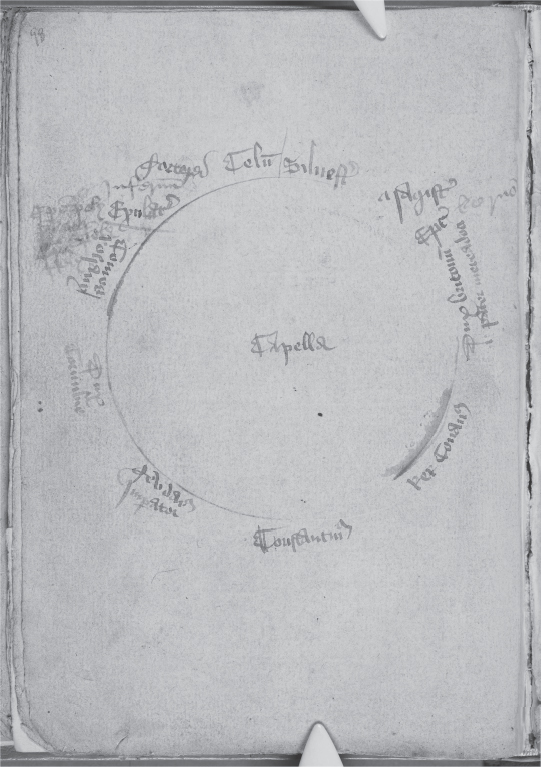 FIGURE 3.1 Plan of the first day’s staging arrangements for Beunans Meriasek. Source: Peniarth MS 105B, fol. 51v ©The National Library of Wales.
The same condition is not recorded with Gwreans An Bys: The Creacon of the World or Bewnans Ke: The Life of St Kea. However, two explicit stage directions in The Creacon of the World record, respectively, references to playing action in ‘ye playne’ and ‘in the plain’:
Let them fight wth swordis and in the end Lucyfer voydeth & goeth downe to hell apareled fowle wth fyre about hem turning to hell and every degre of devylls of lether & spirytis on cordis runing into ye playne and so remayne ther, 9 angells after Lucyfer goeth to hell.
And
Let the serpent wait in the plain.30
These references are equivalent to those that refer to the ‘platea’ in the Cornish Ordinalia and the ‘placea’ in Beunans Meriasek. Similarly, two further stage directions in Bewnans Ke: The Life of St Kea record: ‘Tunc ambulant circa theatrum omnes bini et trini’ (Then they walk round the theatre [the place] in twos and threes) and ‘Arthurus ambulabit cum suis in theatro.’ (Arthur will walk with his soldiers in the theatre [in the place]).31 Both of these stage directions strongly imply theatre-in-the-round staging, for the convention of parading around the place is typical of staging conventions in all the Cornish plays.
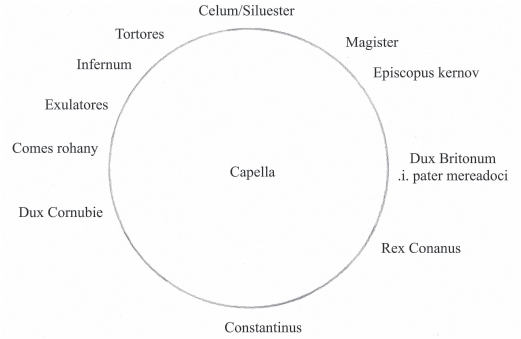 FIGURE 3.2 Transcription of the plan of the first day’s staging arrangements for Beunans Meriasek. Source: The National Library of Wales, Peniarth MS 105B, fol. 51v.
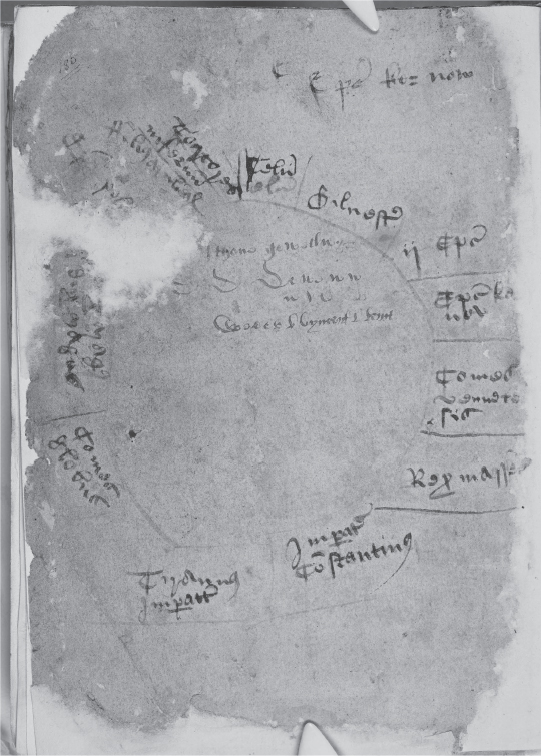 FIGURE 3.3 Plan of the second day’s staging arrangements for Beunans Meriasek. Source: Peniarth MS 105B, fol. 92v ©The National Library of Wales.
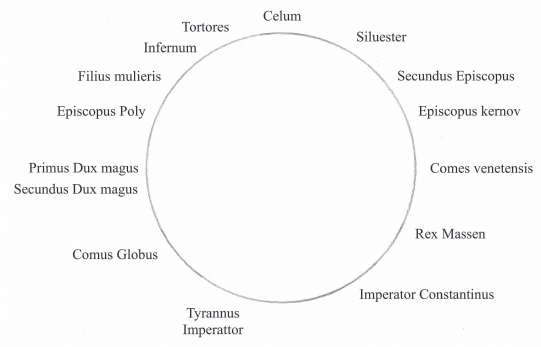 FIGURE 3.4 Transcription of the plan of the second day’s arrangements for Beunans Meriasek. Source: The National Library of Wales, Peniarth MS 105B, fol. 92v.
One of the attributes of the theatre-in-the-round form and its staging conventions is that it does not conventionally provide ‘on-stage’ areas or locations from which to mask or hide players from the audience.32 ‘Off-stage’ areas can still exist from which players can make appearances ‘on stage’ or ‘in the platea’, and these conditions can, of course, be modified by limited scenic or staging arrangements.33 Consequently, the form generally permits all staged activity to be visible and witnessable. This includes all activity by players and also any necessary preparation for action to be performed imminently. For example, in the Beunans Meriasek: The Life of St. Meriasek, two later-inserted stage directions record:
her y dragon aredy in ye place
[Here the dragon ready in the place].
Her a gonn yn y dragon ys movthe aredy & fyr
[Here a gun ready in the dragon’s mouth and fire].34
Positioning the dragon ‘in ye place’ and preparing the ‘gonn’ (probably a stickless rocket) in its mouth before setting everything in motion were achieved in sight of spectators.35 Such preparations were clearly not hidden from audience view that permitted, and possibly invited, dual attention to be given to the action of the play and preparation for further imminent action. This twofold action is not conceptually different from the inducement by some stage directions that record simultaneous action through the term ‘meanwhile’ (see Chapter 6 in this work). In modern practice, stage direction requirements to prepare something or to have something ready for use are the kind of information that might be found in stage managers’ prompt books.36 However, these stage directions are not like ones found in post-1560 stage managers’ prompt books, for they are not directed towards players as instructions to their actions or staging: they are recorded observations of preparation of readiness. Even though such requirements are concerned with prospective action in making something ready for use, the stage direction is still a retrospective declaration: it is still written after an earlier performance or performances. The writer of the stage direction has been informed of the preparation for readiness because he has observed it in the open staging form of theatre-in-the-round. Where stage directions have been added to manuscripts by a later hand, there is a strong implication that they have been included in order to clarify or change some actions previously created in performance. For example, the stage directions entered later into the manuscript of Beunans Meriasek: The Life of St. Meriasek by Scribe C (as recorded earlier in the Prelude) are ones containing records of earlier performances from which the need for readiness has been previously observed.
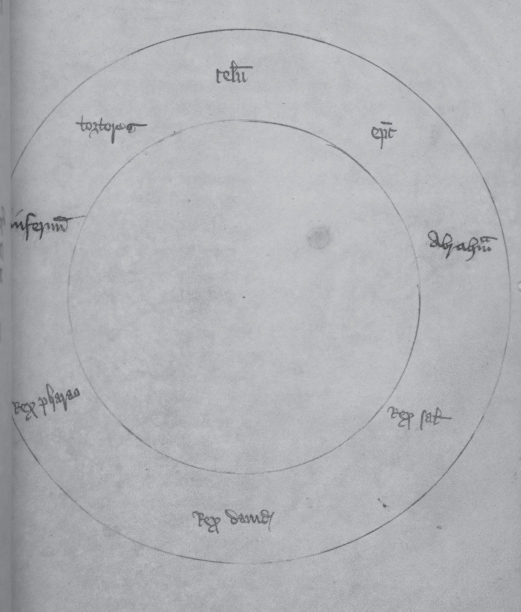 FIGURE 3.5 Plan of the staging arrangements for Origo Mundi of the Cornish Ordinalia. Source: Bodleian Library MS. Bodl. 791, fol. 27r. Photo: © Bodleian.
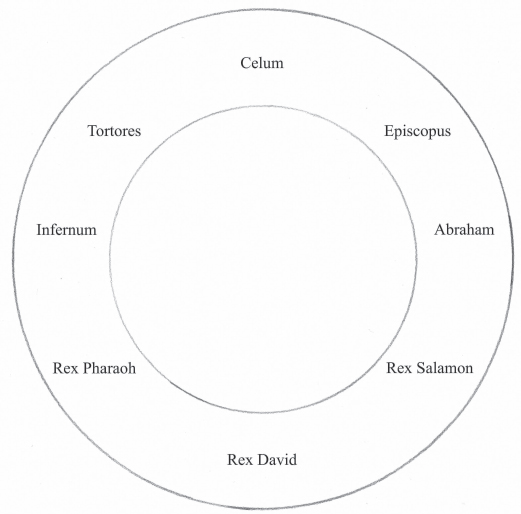 FIGURE 3.6 Transcription of the staging plan for the Origo Mundi of the Cornish Ordinalia
Stage directions that record preparation for action may be grouped as ones where players are ready to play, ones where stage action is made ready and ones that prepare objects ready for use. In the Passio Domini Nostri Jhesu Christi of the Cornish Ordinalia, a representative selection of later-added stage directions require personages to be ready to play:
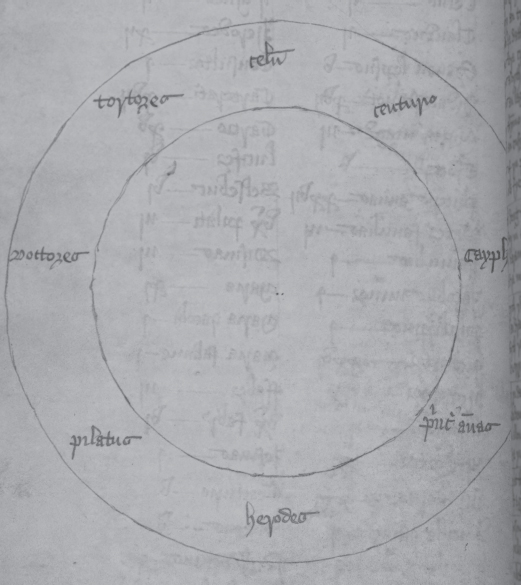 FIGURE 3.7 Plan of the staging arrangements for Passio Domini of the Cornish Ordinalia. Source: Bodleian Library MS. Bodl. 791, fol. 56v. Photo: © Bodleian.
hic Thomas sit presens et paratur ad ludum
[Here let Thomas be present, and ready to play].
Hic ancilla hostiarum sit parata ad ludendum
[Here let the portress be ready to play].
Hic pannarius et mercenarius sint parati ad ludendum
[Here let the cloth-dealer and the workman be ready to play].37
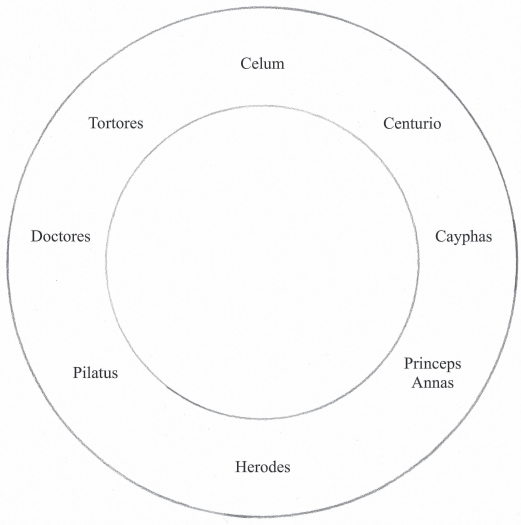 FIGURE 3.8 Transcription of the staging plan for the Passio Domini of the Cornish Ordinalia
Similarly, in the more recently revealed Bewnans Ke: The Life of St Kea of the Cornish oeuvre, additional stage directions also observe preparation of personages being made ready to play:
et ascendit rex et debet arator premuniri. Adsit arator
[and the king goes up and the ploughman must be made ready. Let the ploughman be present].
Tunc recipiunt legati et preparabunt reges
[Then the legates will retire and the kings will get ready].38
Further observations of personages being made ready also occur in Beunans Meriasek: The Life of St. Meriasek, where later-added stage directions declare:
ye wymmen aredy wt ther chyldryn
[The women ready with their children]
armatores aredy
[Armed men ready]
ye prest aredy
[The priest ready]
ye devyll aready by hys syde
[the devil ready by his side]
demens et paterfamilias paratus
[A madman and a head of a family ready].39
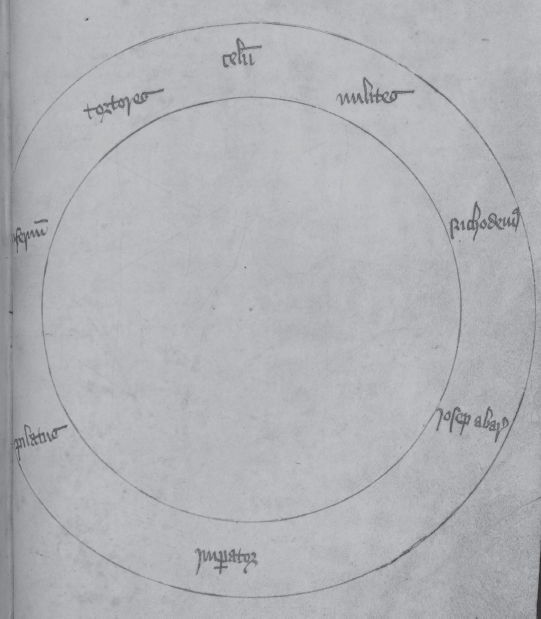 FIGURE 3.9 Plan of the staging arrangements for Resurrexio Domini of the Cornish Ordinalia. Source: Bodleian Library MS. Bodl. 791, fol. 83r. Photo: © Bodleian.
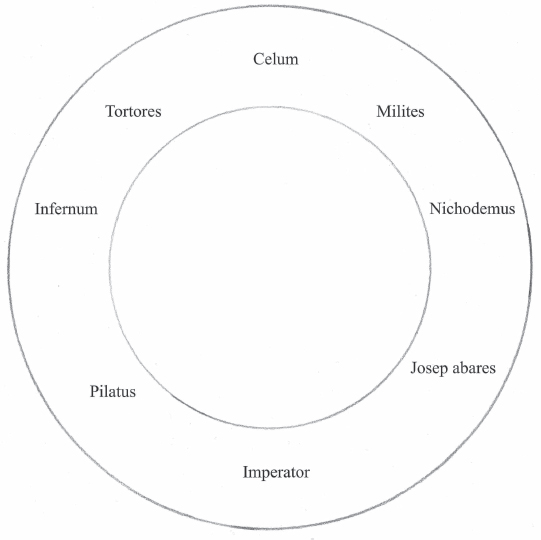 FIGURE 3.10 Transcription of the staging plan for the Resurrexio Domini of the Cornish Ordinalia
Clearly, the requirement to be ‘ready’ arises from observations of previous action that takes place in the performance reality and not the narrative equivalent. The observer witnesses preparation for the state of readiness. This is also the case as recorded in a stage direction in The playe of this tretye. Or meditation off the buryall of criste and mowrnyng þerat (Christ’s Burial), where it is observed that ‘Joseph, [who is] redy to tak Crist down, sais’.40
As demonstrated by the examples above, most players’ roles are designated by the personage’s name and not the player’s name.41 However, a later-added stage direction in Beunans Meriasek: The Life of St. Meriasek records both the personage’s and the player’s names: ‘And John ergudyn aredy a horse bakke yt was ye Justis wt constantyn ffor to play ye marchont’ (And John Ergudyn, who was the Justice with Constantine, on horseback ready to play the merchant).42 Thus, in order to prepare himself, John Ergudyn presumably changes the clothing he wears as the Justice to that of the Merchant, mounts his horse, and waits in view of the audience for his cue.43 ‘Waiting’ is not simply a default condition: it is a considered necessity that forms a didactic convention witnessed by the audience. Response to the cue signals the end of the waiting period and the state of readiness. It is perhaps because of the vital importance of the cue that such emphasis is put on the need to prepare and be ready. It is not possible to overstate the importance of the cue to medieval theatre practice. Unlike the modern actor, the medieval player has no recourse to help if he should miss his cue, whether this requires verbal or physical action or both.44 He is not able to improvise around the created problem because of the compartmentalised way in which he has received and learned his part. His cues are written beside his part. Thus, preparation for the arrival of the cue appears to be the critical reason for the concentrated attention given to ‘readiness’.
Readiness to play is also recorded in Beunans Meriasek: The Life of St. Meriasek when a later-added stage direction requires ‘a vysour aredy apon Constantyn ys face’ (A mask ready upon Constantines’ face).45 The specific need to mask Constantine is to signify the onset of leprosy. Here, use of the mask synthesises the narrative requirement to represent leprosy through facial disfigurement and its theatrical realisation through the convention of mask use. In this case, the primary theatrical function of the mask is not to disguise the player but to represent the leprosy. Later, upon ‘full healing’ of Constantine, a later-added stage direction establishes: ‘ye vysour away’ (The mask away)46. Such is the symbolic use of the mask to further representation and didactic clarity. The same possible use of mask is recorded in a stage direction in Nice Wanton when Dalila arrives: ‘Dalila commeth in ragged, her face hid or dissfigured haltinge on a staffe’. Dalila’s condition represents her contraction of venereal disease.47
The function of the mask worn by Constantine is to demonstrate his changed condition: its primary purpose is not to disguise him. In addition to masks, beards were also worn by personages to disguise, change or promote their identity.48 Another later-added stage direction in Beunans Meriasek refers to Meriasek when it records: ‘chappell aredy. Her a (he) weryth a rosset mantell and a berde’ (A chapel ready. Here he wears a russet mantle and a beard).49 He has previously not worn a beard. The wearing of the beard by Meriasek is intended to represent his time in the wilderness as ‘a hermit right truly to be’.
Not only are players recorded by stage directions to prepare to play, but other stage directions record observation of preparation for staged action. This is the case in the Passio Domini Nostri Jhesu Christi of the Cornish Ordinalia, where preparation of the instruments of torture for the crucifixion is recorded:
hic paratur flagellum per tortores et postis ad ligandum Jhm. (Jhesum) et corda et cathena et corona spinea paratur
[Here a whip is got ready by the executioners, and a stake to bind Jesus, and a cord, and a chain, and a crown of thorns is prepared].
hic paratur spinea pro corona Jhu (Jhesu)
[Here thorns are prepared for a crown to Jesus].
hic parantur cordae ad trahendum brachia Jhesu
[Here cords are got ready to drag the arms of Jesus].
hic paratur spongium cum felle et aceto
[Here a sponge is made ready, with gall and vinegar].50
Each of these stage directions is a later addition to the manuscript. The continued narrative from Christ’s crucifixion operates in the Digby The playe of this tretye. or meditation off the buryall of criste and mowrnyng þerat, where a stage direction (identified above) records Joseph’s readiness to take down Christ from the cross: ‘Joseph, redy to tak Crist down, sais’.51 This stage direction is one of the few outside the Cornish plays to record the need for readiness. It is easy to see why stage directions of this nature may be thought of as directions to players, for the practical content is completed by players. However, as with other stage directions, these examples do not appear to be instructions to players; they are records of observations made of earlier performance: the players’ preparation for action is conducted in the open and visible to all who witness the performance.52
Stage directions in the Chester Vintners’ play of the Magi (Play 8) also concentrate on the necessary preparation for action, although they are different in kind to the ones under investigation in the rest of this work. This is because they appear to have been copied from a post-1560 type of exemplar created by a stage manager or director type of figure as personal reminders or aides-memoires to action; they take the form of abbreviated marginal jottings delivered as instructions. They read in Lumiansky and Mills as follows: ‘Staffe’ (p. 163); ‘Staffe’ (p. 164); ‘Sword’ (p. 164); ‘Cast up’ (p. 164); ‘A bill’ (p. 168); ‘Et dicat, “Read one” ’ (‘And he shall say “Read on” ’) (p. 168); ‘Cast downe the sword’ (p. 170); ‘Breake a sword’ (p. 172); ‘Cast up’ (p. 172); ‘Cast up’ (p. 172); ‘The boye and pigge when they kinges are gonne’ (p. 173); ‘Staffe’ (p. 173); ‘Sword’ (p. 173). Although these stage directions might also be considered as records of earlier performance, their compression into single-word references to ‘Staffe’ and ‘Sword’ and short-phrase requirements for action indicate performance of the kind found in post-1560 and modern production notes.53 In effect, they are stage-management-type reminders to players to have the ‘Staffe’ and ‘Sword’, symbols of Herod’s authority and temper, ready for immediate use and prescribed actions. Three stage directions of the same kind are recorded in the margins of the Chester Cappers’ play of Moses and the Law; Balaack and Balaam (Play 5): ‘Florish’ (p. 83); ‘Caste up’ (p. 83); ‘Sworde’ (p. 84). The form in which these stage directions are offered is not typical of those recorded before 1560. Thus, it needs to be remembered that the predominent manuscript used by Lumiansky and Mills is that designated as ‘Hm’ from the Huntington Library and dated 1591—towards the end of Elizabeth I’s reign. By this time, the kinds of stage directions presented by the Vintners’ and Cappers’ texts were much more commonplace.54 It also seems likely that these kinds of abbreviated stage directions were written as shorthand imperatives to action.
Although the manuscript of the Beunans Meriasek: The Life of St. Meriasek is dated 1504 in the colophon and hitherto designated to Dominus Hadton, a revised and more accurate reading of this ascription is to ‘Rad.Ton’, for Radalphus Tone.55 Stokes identifies the work to be in his hand and later ‘corrected in several places by a subsequent possessor, who also inserted the stage directions to which I have prefixed a bracket, thus: [.’.56 Tone and the ‘subsequent possessor’ both presented stage directions the identities of which are different in character. It is not clear when the later stage directions were added to the manuscript, but some of them embody functions found in post-1560 stage directions. Later stage directions inserted into the manuscript at an unspecified date resemble those of the Chester Vintners and Cappers, where similar brevity conditions the form. Two such apparently comparable stage directions, state: ‘her yerdis aredy for tevdar and hys men’ (Here staves ready for Teudar and his men) and a ‘yerde aredy’ (a staff ready).57 Although these stage directions may appear to be similar to the equivalent Vintners’ and Cappers’ stage directions, they are not entirely of the same kind, for, like other Cornish stage directions that require ‘readiness’, the needs appear to be based upon observation of previous performance. The author of the stage directions has witnessed the preparation for the state of readiness along with the rest of the audience. The abbreviated Vintners’ and Cappers’ stage directions, on the other hand, are different in that they are effectively coded in their meaning and relevance and directed to those who intend to put on the play: they are the kinds of stage directions that were to develop after 1560. They resemble much more clearly what we might understand by stage directions today and, in particular, those stipulations that might be found in stage managers’ prompt books. The two stage directions in Beunans Meriasek: The Life of St. Meriasek may therefore be seen to contain early transitional features of evolving functions.
In addition to the readiness of players to play and stage action being made ready, a third grouping may be seen in the readiness to prepare objects for use (see Chapter 8 in this work). In the Gwreans An Bys: The Creacon of the World, a stage direction requires preparation of specific boat-building tools and equipment to construct Noah’s ark: ‘tooles and tymber redy. Wth planckis to make the arcke, a beam a mallet a calkyn yre[n] ropes mass[t]es pyche and tarr’.58 This stage direction is qualitatively different from others that simply contain previously observed detail by virtue of the demonstration of specific constructional knowledge and experience. In this case, it seems that the writer is keen to demonstrate his observation, understanding and appreciation of ship-building processes by providing a level of detail that seems unlikely to be necessary in the playing of the scene. Such detail is not the kind that might be found in a prompt-copy, as suggested by Brian Murdoch when he writes, ‘Otherwise the directions point to a prompt-copy, with directions for various props to be held ready for use and comments on the directing of the actors added later’.59 Prompt-copies do not contain this kind of descriptive detail for it is of no practical value to those delivering or receiving prompts or staging information. In spite of the late date of this MS, the function of these stage directions is still one of observation that now provides more information for those who put on the play. However, the detailed items and their presumed use might be intended to impress a similarly well-informed Cornish audience (or manuscript reader) and, from a didactic point of view, record the provision of appropriate symbols. Although the tools represented in the stage direction would, no doubt, be essential in building the ark, as described by the narrative, it is clear that the staged ark must be a simplified version the building of which merely represents the ark, even though God requires ‘An ark of planks planed’, ‘Rooms they shall be named’ and ‘Joists through it thou shalt place’.60 These extensive requirements imply preparation of the constructional elements of the ark. Timber sections must be pre-prepared and made ready to slot into place for theatrical expediency. Another stage direction in the Gwreans An Bys: The Creacon of the World again exhibits further detail that similarly provides an example of the changing function of the stage direction:
The garmentis of skynnes to be geven to adam and eva by the angell. Receave the garmentis. Let them depart owt of paradice and adam and eva folowing them. Let them put on the garmentis and shewe a spyndell and a dystaff.61
Unlike the medieval Cornish manuscripts of the Cornish Ordinalia, the Beunans Meriasek: The Life of St. Meriasek and Bewnans Ke: The Life of St Kea, the manuscript of the Gwreans An Bys: The Creacon of the World was transcribed in 1611,62 some 20 years after the stage directions in the Chester MS HM 2 and a further 50 years after my artificial cut-off point. The two stage directions in the Gwreans an Bys: The Creacon of the World provide examples of the subtle change in function of stage directions created through observation for the record and stage directions directed at those who put on the play.
Symbolic Use of Clothing
A stage direction in the Passio Domini Nostri Jhesu Christi of the Cornish Ordinalia extends the range of those that require people and objects to be ready for use by calling for the preparation of clothing: ‘hic paratur tunica alba propter ihesum et tradat consultor herodi’ (Here a white garment is made ready for Jesus, and the counsellor gives it to Herod).63 The significance of the ‘white garment’ is explained by the text to be ‘In token of his being a fool/ And all he has said folly’. Further explanation is offered by the same incident in the Chester Fletchers, Bowyers, Coopers, and Stringers Play of The Trial and Flagellation (Play 16) where a stage direction records: ‘Tunc Judei induent eum veste alba et dicat’ (Then the Jews shall dress him in a white garment; and the First Jew is to say).64 In the text, immediately before this stage direction, Herod says:
Cloth him in white, for in this case
to Pilate hit may be solace,
for Jewes custome before was
to cloth men that were wood
or madd, as nowe hee him mase,
as well seemes by his face;
for him that hase lost his grace
this garment is full good.65
The symbolism of white clothing to represent madness is repeated in the N.town play of Satan and Pilate’s Wife: The Second Trial Before Pilate by a stage direction that stipulates ‘þei xal don on Jesus clothis and ouyrest a whyte clothe’.66 Stipulation of the use of a ‘white garment’ is not only determined by the biblical narrative but is also a clear example of the typical use of symbolic items of clothing to realise representation.67 The mocking of Christ continues when he is dressed in purple. This is the colour associated with royalty and thus appropriate when his torturers label him as King of the Jews.68 In the Chester Fletchers, Bowyers, Coopers, and Stringers Play of The Trial and Flagellation (Play 16), a stage direction states: ‘Tunc posteaquam flagellaverunt eum, postea induunt eum purpurea ponentes in cathedram, et dicat’ (Then after they have scourged him. then they shall dress him in purple and sit him on a chair; and the First Jew is to say).69
The Statutes of the Realm for 1509–10 stipulate the importance of the colour purple to the Royal Family:
that no persone of whate estate condicion or degre that he be use in his apparell eny Cloth of golde of Purpoure [purple] Coloure or Sylke of Purpoure Coloure but onely the Kyng the Qwene the Kynges Moder the Kynges Chylder the Kynges Brethers and Susters, upon payne to forfett the seid Apparell wherwyth so ever yt be myxte, and for usyng the same to forfaite xx pounde70
The specifications contained in the sumptuary laws of 1510, 1514, 1515 and 1533 conditioned and attempted to control not only use of colour in clothing according to status and occupation, but also the kinds of materials that were used.71 Restrictions on the types of clothing worn by citizens were made by Parliament in order to discourage personal spending and ambitions to jump status barriers and groupings. The social hierarchy from the king to the beggar was recognised and fixed, and this ranking determined a commensurate range of hierarchical clothing. The sumptuary laws established the materials from which clothing was to be made, determined its composition, prescribed the colour range and set price ceilings on permissable materials. Thus, it was possible to recognise the status and/or occupation of people from their clothing. It is, therefore, within this context that clothing in plays mirrored and reflected that used and known of in wider society.72 Indeed, evidence of the making, hiring and loaning of play attire is well attested.73 In spite of the rigid demarcation of clothing types, materials and colour, enforcement of the laws was patchy and dependent on the respective workloads of mayors, aldermen, sheriffs and guilds in London and other provincial justices of the peace. Depending on status, offenders could face prison, fines or time in the stocks for breaking the laws. The books of the Merchant Taylors of London contain examples of breaches of sumptuary regulations as contained in their ordinances. In 1574 it is recorded:
Robert Maltby [was] committed to prison ‘for that he came to this house (hall) in a cloke of pepadore (purple?), a pair of hose lined with taffity, and a shirt edged with silver, contrary to ordinances’. Near the same date, Thomas Elliott, another member, is enjoined ‘to pay to this house a fine for wearing a cloke in this house contrary to the ordinances’. And it was at the same time ordered, in conformity with such ordinances, ‘as to those who should consider themselves in their apparell and array’, that a fine should be inflicted on any person, a member of the company, who should wear any dress or apparell which should be above his station in life’. In 1575, one Swaynson is warned in like manner respecting his dress, ‘he having on apparell not fit for his abilities to wear’; and is ordered to be fined if he does not reform’.74
Players’ clothing was the most important of all the conditioners of representation and resultant agreed pretence and superseded any criterion of the way the player played. As long as the player spoke with sufficient volume, clarity and understanding, he was deemed adequate to his task. His clothing defined and determined his personage. There are several ways in which the purpose and function of clothing provided symbolic value to the identity of personages. Predominantly, one set of clothing completed the appearance of the personage. Additionally, a player might have been required to play more than one personage (doubling) and thus change his attire to accommodate the new persona. A further change of clothing, or additions to it, could bring about and promote changed aspects of a personage’s personality, condition, role or status.75 Just as the sumptuary laws group people and their clothing into categories, so to do explicit stage directions and staging notes.
In the Chester Saddlers Play of Emmaus (Play 19), a stage direction records: ‘Tunc veniet Jesus in habitu peregrino et dicat eis’ (Then Jesus shall come in the dress of a pilgrim and is to say to them).76 Similarly, a stage direction in the Towneley Play of Pilgrims (Play 27) also determines: ‘Hic venit Iesus in apparatu pergrini’ (here Jesus comes in pilgrim’s gear).77 Interpretation of the Towneley stage direction points to additional accoutrements worn and carried by pilgrims. Conventional symbolic items, other than the basic gown, included the scrippe, or alms satchel, the bourdoun, or staff, and a broad-brimmed hat.78 Equipped with these items, all would presumably know this personage to be a pilgrim.
Further symbolic clothing occurs in the appearance of Jesus to Mary Magdalen where he is dressed as a gardener. St. John describes the encounter:
Haec cum dixisset, conversa est retrorsum et vidit Iesum stantem, et non sciebat quia Iesus est. Dicit ei Iesus, ‘Mulier, quid ploras? Quem Quaeris?’ Illa, existimans quia hortulanus esset, dicit ei, ‘Domine, si tu sustulisti eum, dicito mihi ubi posuisti eum, et ego eum tollam’.
[When she had thus said, she turned herself back and saw Jesus standing, and she knew not that it was Jesus. Jesus saith to her, ‘Woman, why weepest thou? Whom seekest thou?’ She, thinking it was the gardener, saith to him, ‘Sir, if thou hast taken him hence, tell me where thou hast laid him, and I will take him away”).79
In the play Her Begynnes His Resurrection on Pas[c]he daye at Morn (Christ’s Resurrection), a stage direction states ‘Jhesus intrat, in specie ortulani [hortulani], dicens’ (Jesus enters, in the guise of a gardener, and says).80 The play follows the narrative of John’s account, and the stage direction determines that the gardener’s attire is intended to operate as an initial disguise before Jesus makes himself known to Maudleyn. The style of gardener’s clothing varies in available manuscript images, but the sumptuary laws may give some indication of the restrictions imposed upon the legal make-up of the gardener’s attire. There appears to be little difference between the kind of clothing that yeomen and those ‘attending to husbandry’ were permitted to wear:
26. Also, that craftsmen and people called yeomen shall not take or wear cloth for their clothing or shoes of a higher price than 40s. for the whole cloth, by way of purchase or otherwise; nor precious stones, cloth of silk or silver, or a belt, knife, brooch, ring, garter, or clasps, ribbons, chains, bracelets, seals or other things of gold or silver, or any manner of apparel embroidered, enamelled or of silk, in any way […] 31. Also, that carters, ploughmen, drivers of ploughs, oxherds, cowherds, shepherds, swineherds, dairymaids and all other keepers of beasts, threshers of corn and all manner of people of the estate of groom attending to husbandry, and all other people who do not have 40s. in goods, nor chattels to the value of 40s., shall take or wear no manner of cloths except blanket and russet of 12d. for the ell; and they shall wear their girdles of linen according to their estate.81
Just as the pilgrim and the gardener are dressed in garments recognisable by personages and audience alike to signify their respective identities and occupations, so too are Christ’s disciples. Two stage directions in The Conversion of St. Paul state: ‘Her apperyth Saule in a disciplis wede, sayeng’ and ‘Here aperyth Saul in hys dyscyplys wede, sayng’.82 It is not immediately clear of what ‘disciplis wede’ consisted, although it may be conjectured from Gospel sources. Mark 12:38 states: ‘And he taught them, and sayde vnto them: Bewarre of the scrybes, that loue to go in longe garmentes, and loue to be saluted in the market, and syt gladly aboue in the synagoges and at the table’.83 Of course, the implication is that Jesus did not want his disciples to be dressed like the scribes anymore than he wished it for himself. Further implications may be conditioned by Luke 3:11 and Luke 9:3: ‘& [he] sayde vnto them: he that hath two coates, let him parte wt him yt, hath none: and he that hath meate, let him do likewyse’ and
And he sent them out to preach the kyngdome of God, and to heale ye sicke, and sayde vnto them: Ye shal take nothinge with you by the waye, nether staff, ner scryppe, ner bred, ner money: ner haue two coates.84
Thus, it is possible that the ‘disciplis wede’ consisted of a single knee-length tunic with, as Joan E. Taylor suggests, a belt around the waist and sandals.85 Presumed sandals are spoken of as ‘galoches’ in the Dives et Pauper exchange:
Pauper. Comonly all the apostles ben paynted bare fote in token of Innocencye & of penaunce. Neuertheles they wente not alwaye fully bare fote/but somtyme with galoches/ a sole byneth & a fastnynge aboue the fote/ of whiche galoches saynt Beda sayth in his Orygynall.86
Pauper is at pains to point out to Dives that painted images of the apostles found in churches were not always accurate. Picking up on Pauper’s understanding, Dives says, ‘They were not so gay in clothynge as they ben paynted.’ Pauper replies: ‘That is soth. For many of them were clothed in full harde clothyng and poore as saynt Poule sayth […] They wente about in broken skynnes/ in skynnes of gote nedy anguysshed’.87
Representational clothing is again determined by a stage direction in Mary Magdalen that requires: ‘Here þe on knygth make redy þe ston, and other bryng in þe wepars, arayyd in blak’.88 Here, Martha and Mary Magdalen are described as ‘wepars’ who are dressed in conventional Christian mourning colour. Their representational function as mourners at the death of Lazarus is again made obvious to other personages and the audience. The distinctive nature of the pilgrim’s, gardener’s, disciple’s and mourner’s clothing typifies, and is intended to typify, the respective roles of these personages. Jesus feigns the identities of pilgrim and gardener, whereas Saul assumes his identity as a disciple, and Martha and Mary establish their roles as mourners. In each of these cases, stage directions identify the sort of clothing meant to embody roles and functions of their wearers: these are straightforwardly simple symbols of identity to determine representation.
Somewhat more elaborate clothing is established by detailed stage directions in The N.town Plays, the play of Wisdom and John Bale’s A Comedy concernynge thre lawes, of Nature, Moses, & Christ, corrupted by the Sodomytes, Pharysees, and papystes. These are some of the most comprehensive stage directions that refer to different uses of clothing. In The N.town Plays, there are clear symbols and categories of clothing to define personages and reinforce representation:
Here xal Annas shewyn hymself in his stage beseyn aftyr a busshop of þe hoold lawe in a skarlet gowne, and ouyr þat a blew tabbard furryd with whyte, and a mytere on his hed after þe hoold lawe; ij doctorys stondyng by hym in furryd hodys, and on beforn hem with his staff of astat, and eche of hem on here hedys a furryd cappe with a gret knop in þe crowne; and on stondyng beforn as a Sarazyn, þe wich xal be his masangere, Annas þus seyng 89
This stage direction determines that Annas shall show himself dressed in the manner of ‘a busshop of þe hoold lawe in a skarlet gowne, and ouyr þat a blew tabbard furryd with whyte, and a mytere on his hed after þe hoold lawe’. The attire referred to here might be compared with that of a Jewish high priest, as described in the Vulgate, which consists of a
rationale et supernumerale, tunicam et lineam strictam, cidarim et balteum. Facient vestimenta sancta Aaron fratri tuo et filiis eius ut sacerdotio fungantur mihi. Accipientque aurum et hyacinthum et purpuram coccumque bis tintum et byssum
[a rational and an ephod, a tunick and a straight linen garment, a mitre and a girdle. They shall make the holy vestments for thy brother Aaron and his sons that they may do the office of priesthood unto me. And they shall take gold and violet and purple and scarlet twice dyed and fine linen].90
A similar image to the description in the N.town stage direction may be found in the fifteenth-century miniature from the Renaud de Montabaun cycle in the Bibliothèque de l’Arsenal. The mitre referred to in the stage direction of ‘þe hoold lawe’ is not one of the later kind with the pointed ‘horns’,91 but one as depicted in the de Montabaun cycle. This stage direction also offers a partial account of the kind of attire worn by the two doctors (counsellors): it determines that they wear ‘furryd hodys’ with ‘a furryd cappe with a gret knop in þe crowne’ and one carries a staff of estate. With regard to the use of fur, the sumptuary law of 1510 prescribes the limits of its use: ‘And that no mann undre the degree of a Gentilman […] use or were eny Furres, wherof ther ys no like kynde growyng in this lande of Englonde Irelonde Wales or in any Lande under the Kynges obeysaunce.’92 Additional details to confirm the doctors’ style of dress is contained in another N.town stage direction:
Here goth þe masangere forth; and in þe menetyme Cayphas shewyth himself in his skafhald arayd lych to Annas, savyng his tabbard xal be red furryd with white; ij doctorys with hym arayd with pellys aftyr þe old gyse and furryd cappys on here hedys; Cayphas þus seyng93
Clearly, the complementary clothing arrangements for Annas and Cayphas have been carefully coordinated, as has confirmation of the doctors’ head gear as consisting of ‘furryd cappys on here hedys’ with additional ‘pellys aftyr þe old gyse’. This latter description refers to further fur trimmings, possibly of a valuable kind, to operate as a trim or lining. These stage directions from the N.town Plays confirm details of the doctors’ dress, or ‘doctorys wede’, as referred to in a further N.town stage direction:
What tyme þat processyon is enteryd into þe place and þe Herowdys takyn his schaffalde, and Pylat, and Annas and Cayphas here schaffaldys also, þan [xal] come þer an exposytour in doctorys wede, þus seyng.94
Between them, these three stage directions fairly clearly establish the nature of the doctors’ style of clothing and strongly suggest the manner in which expositors dressed.95 Although these last three stage directions from the N.town Plays may be considered to be quite full in their detail, relative to stage directions in other plays, they do not offer the necessary information to complete the personages’ outfits. Peter Meredith refers to the N.town stage directions in Passion Play I by saying: ‘They are not full descriptions of costumes but tantalising, though to a considerable extent informative, hints’.96 The apparent reason for this may be likened to other stage directions that contain partial practical details by virtue of what the observer sees and selects to record in earlier performances.
Audience recognition of specific items of clothing to symbolise the identity of personages was clearly envisaged by John Bale in his brief stage directions in A Comedy concernynge thre lawes, of Nature, Moses, & Christ, corrupted by the Sodomytes, Pharysees, and papystes (1538), where he requires Sodomy to be dressed as a monk: ‘Sodomismus. Monachus’ (Sodomy [dressed as] a monk) (sig. Biiv); ‘Idololatria. Necromantic’ (Idolatry [dressed as] a Necromantic) (sig. Biijr); ‘Auaritia. lurisconsultus’ (Avarice [dressed as] Jurisconsultus) (sig. Cviir); ‘Hic veste spoliatum sordidioribus induunt’ (Here having removed his garment, they put more shabby ones on him) (sig. Fiv).97 The models of monk, necromantic and jurisconsultus that Bale uses for his personages in these brief stage directions are complemented by other more graphic staging notes:
The aparellynge of the six vyces, or fruites of Infydelyte.
Lete Idolatry be decked lyke an olde wytche, Sodomy lyke a monke of all sectes, Ambycyon lyke a byshop, Couetousnesse lyke a pharyse or spyrituall lawer, false doctryne, lyke a popysh doctour, and hypocresy lyke a graye fryre. The rest of the partes are easye ynough to coniecture.98
Here, ‘an olde wytche’, ‘a monke of all sectes’, ‘a byshop’, ‘a pharyse or spyrituall lawyer’, ‘a popysh doctour’ and ‘a graye fryre’ are selected by Bale not only to symbolise his personages but also to convey recognisable attitudes, prejudices and behavioural traits. Clearly, these descriptions are intended to operate as short cuts to personage recognition as well as signals to expected and imminent behaviour. Such understanding is required by those who put on the play as well as their spectators.99 The attire of all these personages is meant to make instant statements to an audience about the nature of pretence and communicate a critical authorial eye upon the personages. T. W. Craik refers to the same moment of transmission when he says: ‘Before a character [sic] opened his mouth, his dress spoke for or against him; his speech of introduction served merely to confirm the impression that his clothes had already made’.100 Bale does not single out a particular monastic order to receive congruence with Sodomy but likens him to ‘a monke of all sectes’. This identity is achieved by Sodomy through his habit when he is described by Infideliias (infidelity) as ‘knauebalde and pyepecked’ (tonsured with a particoloured habit).101 Conventional monks’ habits across the different orders consisted of ‘a habit belted with a girdle, a scapular (a tabard worn over the habit and not belted at the waist), a cowl or hood to cover the head, a shirt and undershirt and a cloak or mantle’.102 The particoloured clothes of Sodomy were presumably selected and arranged from the Benedictine and Cluniac black, the Cistercian and Carthusian white and the Franciscan grey.
As indicated earlier, each player had a distinctive set of clothing to syymbolise his personage. Should he take on another role—that is, double—then another set of clothing, or tokens of it, was adopted. When a change in personality or changed state of health occurred, then the addition or removal of single items may have symbolised the change. In Bale’s thre lawes, of Nature, Moses, & Christ, Law of Nature arrives having contracted leprosy. When Constantine makes a similar appearance in Beunans Meriasek: The Life of St. Meriasek, he, in like manner, is afflicted with leprosy, and his changed condition is symbolised through use of a mask. Bale does not determine the means by which Law of Nature’s ‘fowle dysease of bodye’ is represented.103 It could similarly be through the use of a mask or another technique, as employed in the later play of A Right Excellent and Famous Comedy Called the Three Ladies of London by Robert Wilson (1584). Here, ink spots are applied to the face of Conscience and sensually spread across her face as a means of symbolising her degradation. Effectively, her initially spotted face becomes a mask.104
Ostensibly, the explicit stage directions in the play of Wisdom present the most detailed clothing requirements of all medieval English stage directions. Explicit stage directions record the sumptuous detail of previously used clothing. Such lavishness, of itself, demotes the likelihood of Wisdom having been performed by a travelling company, for some care appears to have been necessary in retaining the magnificence of the described items of apparel.105 The first stage direction in the Macro manuscript of Wisdom describes the attire of Wisdom when it is recorded that he ‘enteryde’. This use of the verb ‘to enter’ records the action in the past tense and supports the concern for the role of explicit stage directions written in the present tense as ones to record earlier action:
Fyrst enteryde WYSDOME in a ryche purpull clothe of golde wyth a mantyll of the same ermynnyde wythin, hawyng abowt hys neke a ryall hood furred wyth ermyn, wpon hys hede a cheweler wyth browys, a berde of golde of sypres curlyed, a ryche imperyall crown þerwpon sett wyth precyus stonys and perlys, in hys leyfte honde a balle of golde wyth a cros þerwppon and hys ryght honde a regall schepter, thus seyenge:106
The colours of purple and gold in Wisdom’s clothing were clearly intended to make an instant statement about his status as a king. Similarly, the use of ermine on the inside of his ‘mantyll’ and his ‘ryall hood’ also defined his social standing. He wore a wig (cheweler) that incorporated eyebrows. His ‘berde of golde of sypres curlyed’ consisted of a fine fabric that was conventionally used for veils and kerchiefs.107 In this case, it appears that the ‘sypres’ was fashioned, and likely stiffened, into curls. His orb and sceptre completed the presentation of his image.
Two stanzas later, another stage direction records the entry of Anima, the Soul, dressed in the following attire:
Here entrethe ANIMA as a mayde, in a wyght clothe of golde gysely purfyled wyth menyver, a mantyll of blake þerwppeon, a cheueler lyke to WYSDOM, wyth a ryche chappelet lasyde behynde hangynge down wyth to [ij] knottys of golde and syde tasselys, knelynge down to WYSDOM, thus seyng:108
Anima, as a maid, enters dressed in white cloth with a black mantle handsomely bordered with fur, much like Wisdom, and a headdress decorated with tassels. Just as Wisdom is described by the stage direction to have ‘enteryde’, so too are the ‘fyve vyrgynes’ recorded to have ‘enteryd’:
Her enteryd fyve vyrgynes in white kertylls and mantelys, wyth cheuelers and chappelettys, and synge ‘Nigra sum sed formosa, filia Jerusalem, sicut tabernacula cedar et sicut pelles Salamonis’.109
As seen throughout this work, stage directions may be written in the present tense and yet still be determined by earlier performances. The same condition may be seen here in respect of Wisdom, where stage directions in both the Macro and Digby editions of the play refer to the act of entering as ‘entrethe’, ‘entreth’ and ‘entur’ (Macro) and ‘entreth’, ‘entre’, ‘entrith’ (Digby). However, reference to the two stage directions above that both make use of the words ‘enteryde’ and ‘enteryd’, in the past tense, refer even more graphically to earlier performance. Were it not evident from other explicit stage directions, in a wide range of plays, that stage directions written in the present tense refer to past performances, then it would be appropriate to suggest that caution be excercised in drawing conclusions from the distinction between the use of past and present tenses in stage directions. These stage directions, written in both the past and present tenses, are conditioned by earlier performance. The relationship between the complete Macro manuscript and the incomplete Digby manuscript has been well considered elsewhere.110
A further stage direction, typical of a number that refer to groups of personages, records the use of common attire to identify their roles and functions. For example:
Here in þe goynge owt þe FYVE WYTTYS synge ‘Tota pulcra es’ et cetera, they goynge befor, ANIMA next, and her folowynge WYSDOM, and aftyr hym MYNDE, WYLL, and WNDYRSTONDYNGE, all thre in wyght cloth of golde, cheveleryde and crestyde in sute.111
Lucyfer, disguised as a galont, has seduced Mynde, Wyll and Wndyrstondynge into corrupt ways and, on his withdrawal, tells them to change their clothing to something more appropriate to their coming new life. This they do. Not only are Mynde, Wyll and Wndyrstondynge dressed in their new ‘sute’, but so too are ‘six dysgysyde in þe sute of MYNDE’:
Here entur six dysgysyde in þe sute of MYNDE, wyth rede berdys, and lyouns rampaunt on here crestys, and yche a warder in hys honde; her mynstrallys, trumpes. Eche answere for hys name.112
This stage direction thus implies the nature of Mynde’s changed clothing. The significance of the specific detail in this stage direction is not immediately obvious. Eccles regards the play to be ‘a good show’ and declares that ‘Its main purpose is not political satire […] but exhortation to Christian living’.113 Other scholars disagree and create the case for the play to be specifically concerned with political satire.114 John Marshall identifies the significance of the ‘rede berdys, and lyouns rampaunt on here crestys, and yche a warder in hys honde’ as satirical references, through church imagery, to ‘the de la Pole family, especially William, the first Duke of Suffolk’.115 Mynde, Wyll and Wndyrstondynge, who suffer from worldly corruption, represent aspects of Anima, the Soul, and each promote a dance in which the dancers are dressed ‘in sute’ of their respective powers. They agree that maintenance, perjury and lechery are the principal evils. Thus, the purpose of the ‘six dysgysyde in þe sute of MYNDE’ is that they are so clothed in order to perform a dance of ‘Mayntnance’. Another stage direction records a description of the ‘sute’ of Wndyrstondynge to be presented in the dance of Perjury:
Here entrethe six jorours in a sute, gownyde, wyth hodys abowt her nekys, hattys of meyntenance þervpon, vyseryde dyuersly; here mynstrell, a bagpype.116
A third stage direction records the third dance, the dance of Lechery, which is supervised by Wyll:
Here entreth six women in sut, thre dysgysyde as galontys and thre as matrones, wyth wondyrfull vysurs congruent; here mynstrell, a hornepype.117
Those ‘six dysgysyde in þe sute of MYNDE’, those ‘six jorours in a sute’ (of Wndyrstondynge), and those ‘six women in sut’ (of Wyll) as ‘thre dysgysyde as galontys and thre as matrones, wyth wondyrfull vysurs congruent’ create accumulative theatrical statements of pretence through their congruous attire. The purpose of the three dances is to represent the worldly corruption to which Mynde, Wyll and Wndyrstondynge have succumbed. Given the satirical purpose of the play, the use of dance to promote this purpose is one that may be more powerful than equivalent statements through use of words and yet is capable of protecting its instigators from those being satirised.
Clothing with a specific theatrical purpose other than depicting identity and status is recorded in a stage direction that determines a change of attire for Anima: ‘Here ANIMA apperythe in þe most horrybull wyse, fowlere þan a fende’.118 This appearance is determined by provision of an ‘horrybyll mantyll’ when a stage direction records: ‘Here rennyt owt from wndyr þe horrybull mantyll of þe SOULL seven small boys in þe lyknes of dewyllys and so retorne ageyn’.119 Obviously, the ‘horrybull mantyll’ needs to be sufficiently voluminous to cover seven tightly grouped small boys who are not initially seen by spectators. The boys represent the seven deadly sins and are clothed as devils.
Towards the resolution of the play, Mynde, Wyll and Wndyrstondynge change back to their earlier clothing in line with their declaration of repentance:
Here entrethe ANIMA, wyth þe Fyve Wyttys goynge before, MYNDE on þe on syde and WNDYRSTONDYNGE on þe other syde and WYLL folowyng, all in here fyrst clothynge, her chapplettys and crestys, and all hauyng on crownys, syngynge in here commynge in: ‘Quid retribuam Domino pro omnibus que retribuit mihi? Calicem salutaris accipiam et nomen Domini inuocabo’.120 [How shall I make a return to the Lord for all that He has given me? I shall take up the chalice of salvation, and call upon the name of the Lord].
The play of Wisdom makes considerable use of its personae exchanging clothing in order to demonstrate changed frames of mind, understanding and belief. This does not refer to changes in personage but changes in personality of the same personage. The same persona changes clothing to represent a changed state of mind. This change of clothing needs to be recognised by the audience in order to satisfy and promote agreed pretence. Such changes do not constitute ‘doubling’—that is, one player playing two parts—but one player playing two different phases of the same personage. The player’s attire provides the symbol for audience recognition of the changed condition. Earlier in the play, a stage directions records: ‘And aftyr þe song entreth LUCYFER in a dewylls aray wythowt and wythin as a prowde galonte, seynge thus on thys wyse’.121 In this case, the requirement for agreed pretence between player and spectator needs to be established through the recognition of the two declared layers of clothing. The audience needs to know of the inner attire of the galonte and the outer clothing of the devil.
Notes
1. Bess Rowen, ‘Undigested Reading: Rethinking Stage Directions through Affect’, Theatre Journal, 70 (2018), 307–326 (p. 310).
2. Peter Brook, The Empty Space (Harmondsworth: Penguin, 1972), p. 155; OED Online represent, v. II. ‘To make present, bring to view. To depict, portray.’
3. Stokes, Beunans Meriasek: The Life of St. Meriasek, pp. 26–27, 238, 240, 246–47, 250–51.
4. Bewnans Ke: The Life of St Kea, A Critical edition with translation, ed. by Graham Thomas and Nicholas Williams (Exeter: University of Exeter Press/National Library of Wales, 2007), pp. 76–77.
5. The Macro Plays The Castle of Perseverance Wisdom Mankind, ed. by Mark Eccles, Early English Text Society, OS 262 (London: Oxford University Press, 1969), pp. 114, 119.
6. The Late Medieval Religious Plays of Bodleian MSS Digby 133 and E Museo 160, ed. by Donald C. Baker, John L. Murphy and Louis B. Hall, The Early English Text Society, OS.283 (London: Oxford University Press, 1982), pp. 60, 93.
7. Edwin Norris, The Ancient Cornish Drama, ed. and trans., 2 vols (Oxford: University Press, 1859), II, p. 34.
8. OED Online representation I. The action of standing for, or in the place of, a person, group, or thing, and related senses. 1. a. Something which stands for or denotes another symbolically; an image, a symbol, a sign. Chiefly with of. b. The action or fact of expressing or denoting symbolically; (also occasionally) an instance of this, a symbolic action.
9. Norris, Ancient Cornish Drama, I, pp. 398–99.
10. MED, signe n. 1b (a) ‘Some visible thing or circumstance with an allegorical significance; a physical analogy, symbol’; OED Online, gesture 3.(a) ‘In early use: the employment of bodily movements, attitudes, expression of countenance, etc., as a means of giving effect to oratory. Obsolete. (b) Now in narrower sense, as a generalized use of sense: movement of the body or limbs as an expression of feeling’; see Jean-Claude Schmitt, ‘The Rationale of Gestures in the West: Third to Thirteenth Centuries’, in A Cultural History of Gesture, ed. by Jan Bremmer and Herman Roodenburg (Ithaca, NY: Cornell University Press, 1991), pp. 59–70 (p. 68); Adam Kendon, Gesture: Visible Action as Utterance (Cambridge: Cambridge University Press, 2004), pp. 324–25; Jody Enders, ‘Of Miming and Signing: The Dramatic Rhetoric of Gesture’, in Gesture in Medieval Drama and Art, ed. by Clifford Davidson, Early Drama, Art, and Music Monograph Series 28, Medieval Institute Publications (Kalamazoo, MI: Western Michigan University, 2001), pp. 1–25; Butterworth, Staging Conventions, pp. 94, 96, 97; for a further definition, see Mills Recycling the Cycle, pp. 162–63.
11. Pecock, The Repressor, I, p. 162.
12. Lumiansky and Mills, Chester Mystery Cycle, I, p. 253.
13. John Bale, A Comedy concernynge thre lawes, of Nature, Moses, & Christ, corrupted by the Sodomytes, Pharysees and papystes (Wesel: Nicolaum Bamburgensem [Dirik van der Straten], 1538), sigs. Aiiijr, Aiiijv, Avr (title from the colophon).
14. Peter Happé, The Complete Plays of John Bale, 2 vols (Cambridge: D. S. Brewer, 1985), pp. 1–28; Peter Happé, ‘Properties and Costumes in the Plays of John Bale’, Medieval English Theatre, 2.2 (1980), pp. 55–65.
15. Lumiansky and Mills, Chester Mystery Cycle, I, p. 47.
16. See Lumiansky and Mills, Chester Mystery Cycle, I, pp. 43–45, for more information on some of the envisaged tools and processes. The ‘divers instruements’ recorded in the explicit stage direction above are alluded to by implicit stage directions that itemise: ‘an axe’ brought by Sem: ‘an hatchett’ brought by Cam: a forged ‘pynne’ and with it a ‘hammer’ to knock it in: a ‘hackenstocke’ [MED 1 (a) hakking(estocke ‘a chopping block’] ‘one [on] this you may hewe and knocke’: God requires Noah to bind the ‘Little chambers’ with ‘sliche […] within and without’ [MED n. (b) sliche (b) ‘pitch’]: Cames Wife declares that she will ‘goe gather slytche, the shippe for to clam and pitche’ [MED clammen v. ‘To smear’]. This quotation refers to the similar process of sealing by ‘caulking’: Richard Huloet, Abecedarivm Anglico-Latinvm (London: William Riddell, 1552): ‘Botes or shyppes calked with towgh’.
17. For the tools in a woodworker’s tool chest, see Richard Crips’s inventory in Calendar of Plea and Memoranda Rolls preserved among the Archives of the Corporation of the City of London at the Guildhall a.d. 1437–1457, ed. by Philip E. Jones (Cambridge: Cambridge University Press, 1954), pp. 139–41; John Clark, ‘Richard Crips the Wheeler—a Medieval Craftsman and his Tools’, Tools & Trades, 2 (1984), 13–28; Richard Darrah, ‘Working Unseasoned Oak’ (recorded as ‘Working Unseasoned Wood’ in contents page), pp. 219–30: Philip Walker, ‘The Tools Available to the Medieval Woodworker’, pp. 349–56, both articles in Woodworking Techniques before A.D. 1500, ed. by Sean McGrail, National Maritime Museum, Greenwich, Archaeological Series 7 (Oxford: B.A.R. International, 1982).
18. Lumiansky and Mills, Chester Mystery Cycle, I, p. 76.
19. Lumiansky and Mills, Chester Mystery Cycle, I, p. 82.
20. Lumiansky and Mills, Chester Mystery Cycle, I, p. 206.
21. For a clear example of this sequence in action, see A Chester Mystery Play: The Chester Purification and Doctors, dir. and des. by Meg Twycross, Joculatores Lancastriensis (Lancaster: Crossbow Productions, 1983); this incident is contained in the Stanzaic Life of Christ, ed. by Frances A. Foster, The Early English Text Society, OS166 (London: Oxford University Press, 1926 (for 1924), pp. 93–95.
22. Lumiansky and Mills, Chester Mystery Cycle, I, p. 201, II, p. 156; for an account of the death of Herod, see: William Whiston, The Genuine Works of Flavius Josephus, the Jewish Historian: Flavius Josephus of the Jewish War: or his History of the Destruction of Jerusalem, Book 1, Chapter 33 (London: W. Bowyer, 1737), pp. 754–57.
23. MED reprěsenten v. 2. (b) ‘to portray (sb. or sth.) in painting, sculpture, or dramatic action’; Henry Parker(?), Diues et pauper (Westmonstre: Wynkyn de Worde, 1496), sigs. i iiv–i iijr; OED Online realty, n. 1 1a. ‘Royalty; royal state, dignity, or power; (also) splendour, magnificence’; see Dives and Pauper, ed. by Priscilla Heath Barnum, The Early English Text Society, 2 vols in 3, OS.275, OS.280, OS.323 (London: Oxford University Press, 1976), I, p. 293: the Barnum edition does not contain the reference to ‘ryaltees’; see also V. A. Kolve, The Play Called Corpus Christi (Stanford, CA: Stanford University Press, 1966), pp. 132–33.
24. Speculum Sacerdotale, ed. by Edward H. Weatherly, The Early English Text Society, OS 200 (London: Oxford University Press, 1936), pp. 128–29; see Max Harris, Christ on a Donkey: Palm Sunday, Triumphal Entries, and Blasphemous Pageants (Amsterdam: Amsterdam University Press, 2019).
25. Thomas Nash, An Almond for a Parrat, Or Cutbert Curry-knaues Almes (London: Eliot’s Court Press, 1589), sig. A3v.
26. Thomas Taylor, A Commentarie vpon the Epistle of S. Paul (Cambridge: Cantrell Legge, 1612), p. 534.
27. Norris, The Ancient Cornish Drama, I, p. 198. See n. 73 below.
28. Stokes, Beunans Meriasek: The Life of St. Meriasek, pp. 174–75.
29. See Norris, The Ancient Cornish Drama: Ordinale De Origine Mundi, I, pp. 219: Passio Domini Nostri Jhesu Christi, I, p. 478: Ordinale De Resurrexione Domini Nostri Jhesu Christi, II, p. 200; Stokes, Beunans Meriasek: The Life of St. Meriasek, pp. 266–67.
30. Stokes, The Creacon of the World, pp. 28, 40.
31. Thomas and Williams, Bewnans Ke: The Life of St Kea, pp. 144, 330.
32. It is, of course, possible that players may mask each other from audience view through staging arrangements, but this is not an inherent problem created by the theatre form itself.
33. See Figs 1.1 & 1.2 in this work for the requirement that ‘Mankynde is bed schal be vndyr þe castel & þer schal þe sowle lye vndyr þe bed tyl he schal ryse & pleye’: Eccles, The Macro Plays, frontispiece. The seating banks at the two extant Cornish theatres-in-the-round of Perran Round and St Just form the demarcation to the playing area. Entrances into the playing area are cut through the audience banking, which permits a visible waiting space for players prior to their involvement in the action. These positions also happen to be the ones from which a player can make maximum visual contact with an audience.
34. Stokes, Beunans Meriasek: The Life of Saint Meriasek, pp. 228–29.
35. Butterworth, Theatre of Fire, pp. 79–80.
36. For examples of post-1560 stage directions that require preparation for on-stage action, see Alan C. Dessen, ‘Stage Directions and the Theater Historian’ in The Oxford Handbook of Early Modern Theatre, ed. by Richard Dutton (Oxford: Oxford University Press, 2009), pp. 513–27 (p. 517).
37. Norris, The Ancient Cornish Drama, pp. 318, 320, 324. In the stage direction translations, I have changed the Norris word ‘act’ to ‘play’.
38. Thomas and Williams, Bewnans Ke: The Life of St Kea, pp. 66, 236. References to ‘going up’ are generally understood to indicate that a personage goes up a scaffold that sits on the perimeter of the playing area or one that sits on or in the banking where such demarcation exists.
39. Stokes, Beunans Meriasek: The Life of St. Meriasek, pp. 88, 108, 150, 220.
40. Baker, Murphy and Hall, The Late Medieval Religious Plays, p. 154; Peter Meredith uses this stage direction as an example of one that is ‘suggestive of narrative links, and might seem to be appropriate to a reading text’. I suggest that this stage direction is more like those found in the Cornish plays outlined above: Peter Meredith, ‘ “The Bodley Burial and Resurrection”: Late English Liturgical Drama?’, in Between Folk and Liturgy, Ludus, Medieval and Early Renaissance Theatre and Drama, 3, ed. by Alan J. Fletcher and Wim Hüsken (Amsterdam: Rodopi, 1997), p. 134.
41. See John Marshall’s discussion of the conventions of recording payments to players: ‘Players of the Coopers’ Pageant from the Chester Plays in 1572 and 1575’, Theatre Notebook 33.1 (1979), 18–23; repr. in John Marshall, Early English Performance: Medieval Plays and Robin Hood Games, ed. by Philip Butterworth (Abingdon, UK: Routledge, 2019), pp. 23–29.
42. Stokes, Beunans Meriasek: The Life of St. Meriasek, p. 106.
43. The value of ‘waiting’ as a didactic convention is considered in Chapter 6 of this work.
44. Butterworth, Staging Conventions, pp. 61–77 (p. 71).
45. Stokes, Beunans Meriasek: The Life of St. Meriasek, p. 76.
46. Stokes, Beunans Meriasek: The Life of St. Meriasek, p. 104.
47. Stokes, Beunans Meriasek: The Life of St. Meriasek, p. 104; Anon, Nice Wanton, ed. John S. Farmer, The Tudor Facsimile Texts (London, Edinburgh: T. C. & E. C. Jack, 1909), sig. B.1v; Butterworth, ‘Putting On and Removing the Mask’, pp. 33–58.
48. Butterworth, Staging Conventions, pp. 113–18.
49. Stokes, Beunans Meriasek: The Life of St. Meriasek, p. 64–65.
50. Norris, The Ancient Cornish Drama, pp. 384, 390, 440, 456.
51. Baker, Murphy and Hall, Late Medieval Religious Plays, p. 154.
52. All the stage directions so far considered that require preparedness and preparation do so within the duration of performance. There are other requirements expressed in guild accounts that stipulate preparation for performance. For instance, in the Chester Painters’, Glaziers’ Emboiderers’, and Stationers’ Accounts, payment is recorded in 1571–72 ‘for payntes to bone the pleares ijd’ and in 1587–78 the same Accounts detail payment ‘for drincke att the bowninge of the Childe’. Both these recorded payments refer to ‘making ready’ outside performance: Baldwin, Clopper and Mills, REED: Cheshire including Chester, I, pp. 140, 219; MED bǒun adj 1. (a) ‘Of persons: ready, prepared’.
53. For plausible explanations of likely actions of these abbreviated staging notes, see Peter Meredith, ‘Scribes, Texts and Performance’, in Aspects of Early English Drama, ed. by Paula Neuss (Cambridge: D. S. Brewer, 1983), pp. 13–29 (p. 25); repr. in Peter Meredith, The Practicalities of Early English Performance: Manuscripts, Records, and Staging, Shifting Paradigms in Early English Drama Studies, ed. by John Marshall (London, New York: Routledge, 2018), pp. 73–90 (p. 83); see John Marshall, ‘Marginal Staging Marks in the Macro Manuscript of Wisdom’, Medieval English Theatre, 7 (1985), 77–82; for an analysis of the Vintners’ stage directions, see Meredith, ‘Stage Directions and the Editing of Early English Drama’, pp. 65–94 (pp. 81–84).
54. Lumiansky and Mills, Chester Mystery Cycle, I, pp. ix, xxxii–xxxiii, II, p. 130; for late sixteenth-century stage direction conventions, see the work of Linda McJannet, The Voice of Elizabethan Stage Directions: The Evolution of a Theatrical Code (Newark, NJ: University of Delaware Press, 1999), pp. 168–92; see the valuable dictionary of Alan C. Dessen and Leslie Thomson, A Dictionary of Stage Directions in English Drama, 1580–1642 (Cambridge: Cambridge University Press, 1999), passim; see also Sergi, Practical Cues and Social Spectacle in the Chester Plays, pp. 124–26.
55. I am not the first person to identify this more accurate designation; see Gilbert H. Doble, The Saints of Cornwall, Part One, Saints of the Land’s End District (Chatham: Dean and Chapter of Truro, 1960), p. 111, n. 3; The Life of Meriasek: A Medieval Cornish Miracle Play, ed. and trans. by Markham Harris (Washington, DC: The Catholic University of America Press, 1977), p. 3; Myrna Combellack-Harris, in her 1983 PhD thesis, also records this more accurate authorship, pp. 14–15.
56. Stokes, Beunans Meriasek: The Life of St. Meriasek, pp. v–vi.
57. Stokes, Beunans Meriasek: The Life of St. Meriasek, pp. 54–55, 216–17; see also pp. 70–71: ‘ye galovs aredy’ (The gallows ready), 74–75: ‘ye tumbe aredy’ (The tomb ready), 120–21, 142–43 ‘horse aredy’ (a horse ready). 158–59 ‘bollys aredy’ (bulls ready), 172–73 ‘meryasek yledyt’ (Meriasek led), 210 ‘cofyr aredy’ (A coffer ready).
58. Stokes, Gwreans An Bys: The Creation of the World, pp. 174.
59. Brian Murdoch, Cornish Literature (Cambridge: D. S. Brewer, 1993), p. 77. The ‘prompt-book’ is not recorded in the OED Online before 1768, and the ‘prompt copy’ is not recorded before 1792. The title page of Tancred and Sigismunda by James Thomson, published in 1792, records that the text was ‘Regulated from the Prompt-Books, by Permission of the Managers’. These named items are not medieval ones, although the functions of recording preparation for stage action occur in medieval stage directions. The ‘playbook’ is one medieval term that appears to have continued in use in the Elizabethan playhouses and should not be confused with the ‘promptbook’: ‘The playbook (sometimes anachronistically referred to as the “promptbook”) was the company’s fullest copy of the play-script, containing all the actor’s speeches and many of the stage directions’: Stage Directions and Shakespearean Theatre, ed. by Sarah Dustagheer and Gillian Woods, Bloomsbury Arden Shakespeare (London: Bloomsbury, 2018), pp. 2–3. See Chapter 2, n. 33, in this work.
60. Stokes, Gwreans An Bys: The Creation of the World, p. 175.
61. Stokes, Gwreans An Bys: The Creation of the World, p. 78.
62. Oxford, Bodleian Library, MS Bodley 219.
63. Norris, The Ancient Cornish Drama, I, pp. 364–65; The Vulgate Bible The New Testament Douay-Rheims Translation, ed. by Angela M. Kinney, 6 vols (Cambridge, MA: Harvard University Press, 2013), VI, Luke 23:11: ‘Sprevit autem illum Herodes cum exercitu suo et inlusit, indutum veste alba, et remisit ad Pilatum’ (And Herod with his army set him at nought and mocked him, putting on him a white garment, and sent him back to Pilate).
64. Lumiansky and Mills, Chester Mystery Cycle, I, p. 293: II, p. 233.
65. Lumiansky and Mills, Chester Mystery Cycle, I, p. 293: II, p. 239.
66. Spector, The N-Town Play, I, p. 314; cf Luke 23:11.
67. Significance of the colour ‘white’ extends beyond a representation of madness or folly. In Mary Magdalen, ‘clothyng of whyte is tokenyng of mekenesse’, and a stage direction stipulates ‘Here Mari woydyt, and þe angyll and Mary chongg hyr clotheyng, þus seyyng þe kyng’. Thus, assisted by the angel, ‘All in whyte was she cladd’: Baker, Murphy and Hall, The Late Medieval Religious Plays, p. 78; in the Gwreans An Bys: The Creacon of the World, a stage direction, examined in Chapter 2, stipulates ‘whytt lether’ as the body cover for Adam and Eve, ‘Adam and Eva aparlet in whytt lether in a place apoynted by the conveyour & not to be sene tyll they be called & thei knell & ryse’. Meg Twycross conjectures that the leather in this case was not dyed white but left in its natural state to approximate to natural body tone: Meg Twycross, ‘Apparell comlye’ in Aspects of Early English Drama, ed. by Paula Neuss (Cambridge: D. S. Brewer, 1983), pp. 30–49 (p. 36). In this case, it seems that the colour ‘whytt’ is chosen to represent purity: Stokes, Gwreans An Bys: The Creacon of the World, p. 28.
68. Kinney, The Vulgate Bible The New Testament Douay-Rheims VI, Matthew 27:28: ‘and stripping him, they put a scarlet cloak about him’; Coverdale, Biblia the Bible: Matthew 27:28: ‘[they] put a purple robe vpon him’; Mark 15:17: ‘[they] clothed him with purple’; and John 19:2 ‘[they] put a purple garment vpon him’.
69. Lumiansky and Mills, Chester Mystery Cycle, I, p. 299.
70. Statutes of the Realm: Printed by Command of His Majesty King George the Third in Pursuance of an Address of the House of Commons of Great Britain from original records and authentic mauscripts, ed. by Alexander Luders, Sir T. E. Tomlins, John France, W. E. Taunton, John Raithby, J. Caley and W. Elliot, 12 vols (London: Eyre & Strahan, 1810–28; repr. London: Dawsons, 1963), III, p. 430.
71. For an overview and comparative table of the conditions laid out in these sumptuary laws, see Maria Hayward, Rich Apparel: Clothing and the Law in Henry VIII’s England (London, New York: Routledge, 2009), pp. 29–39.
72. See Katie Normington, ‘Player Transformation: The Role of Clothing and Disguise’, in Medieval Theatre Performance: Actors, Dancers, and Automata and their Audiences, ed. by Philip Butterworth and Katie Normington (Cambridge: D. S. Brewer, 2017), pp. 76–92.
73. See Butterworth, Staging Conventions, pp. 116, 122, 123.
74. William Herbert, The History of the Twelve Great Livery Companies of London, 2 vols (London, Newton Abbot: Published by the Author; David & Charles, 1834, 1837; 1968), I, pp. 189–90; Hayward, Rich Apparel, pp. 24–25.
75. In the Ordinalia de Origine Mundi of the Cornish Ordinalia, Rex Sal (King Solomon) ordains a counsellor as a bishop, and three stage directions, the first of which is an original one, outline the process: ‘Consultor erit epc [episcopus]. et dicit’ (The counsellor shall be bishop; and he says); a later added stage direction observes ‘hic consultor induit vestimentum clic’ (Here the counsellor puts on the clerical dress); the third stage direction is also a later added one and records ‘hic dat metram episcopo’ (here he gives the mitre to the bishop): Norris, Ancient Cornish Drama, I, pp. 198–99. See n. 28 above. Further examples of changing clothing to enable ‘doubling’ to take place may be seen in stage directions in John Bale’s plays. In King Johan, a fullsome stage direction states: ‘her go owt vsurpid powr & pivat welth & sedycyon: vsurpyd powr shall drese for þe pope: pivat weltħ for a cardynall & sedycyon for [stevyn laṽton] a monke þe cardynall shall bryng in þe crose. & stevyn lavnton þe bocke bell & candell’: John Bale, King Johan, ed. by John Henry Pyle Pafford and W. W. Greg, The Malone Society Reprints (Oxford: Oxford University Press, 1931), fol. 13a: see also fols 2b, 4b, 7a, 13b, 17b,18b, 19a, 21b.
76. Lumiansky and Mills, Chester Mystery Cycle, I, p. 358; for additional play references to Christ dressed as a pilgrim, see Lumiansky and Mills, Chester Mystery Cycle, II, pp. 292–93.
77. Stevens and Cawley, Towneley Plays, I, p. 358. See The Towneley Cycle, ed. by Peter Meredith, 2 vols (Leeds: University of Leeds, 1989), II, p. 236. See also the 1415 A/Y Memorandum Book at York, fol. 254r in Johnson and Dorrell, Records of Early English Drama: York, I, p. 23, II, p. 708 for the title of Play 40, The Supper at Emmaus: ‘Iesus lucas & Cleophas in forma peregrinorum’ (Jesus Luke and Cleophas dressed as pilgrims).
78. MED scrip(pe n. (a) ‘A bag or satchel; a pilgrim’s wallet’; MED burdǒun n. (1) ‘A pilgrim’s staff; also a walking stick, a club, a spiked staff’; Barnum, Dives and Pauper, I, p. 260: ‘þei tokyn moulyd bred in her scrippis, sour wyn in here botaylis and lodyn assis with elde moulyd bred in elde sakkys’; John Lydgate, The Pilgrimage of the Life of Man, ed. by F. J. Furnivall, The Early English Text Society ES 77 (London: Kegan Paul, Trench, Trübner, 1899), p. 17: ‘I ffaillede a sherpe [scrippe] & bordon, /Wych al pylgrymes ouhte to have,/ In ther wey, hem sylff to save’.
79. Kinney, The Vulgate Bible, The New Testament Douay-Rheims, John 20:14–15.
80. Baker, Murphy and Hall, Late Medieval Religious Plays, p. 187.
81. The Parliament Rolls of Medieval England, Edward III, Scholarly Digital Editions/The National Archives/The History of Parliament Trust, ed. by C. Given-Wilson, P. Brand, A. Curry, R. E. Horrox, G. Martin, W. M. Ormrod and J. R. S. Phillips (Kew, UK: The National Archives, n.d.), membrane 3, items 26 and 31.
82. Baker, Murphy and Hall, Late Medieval Religious Plays, pp. 15, 18. The first of these stage directions is contained in a deleted section in the MS.
83. Coverdale, Biblia the Bible (Mark 12:38).
84. Coverdale, Biblia the Bible (Luke 3:11, 9:3).
85. Joan E. Taylor, What Did Jesus Look Like? (London: Bloomsbury, 2018), p. 177; Joan E. Taylor, ‘What Did Jesus Really Look Like, as a Jew in 1st-Century Judaea?’, The Irish Times, 9 February 2018 (www.irishtimes.com/culture/books/what-did-jesus-really-look-like-as-a-jew-in-1st-century-judaea-1.3385334) [accessed 29 May 2019].
86. Diues et Pauper, sig. biv; MED galoche n. (a) ‘A kind of footwear, consisting of a wooden sole fastened onto the foot with leather thongs’.
87. Diues et Pauper, sig. biv.
88. Baker, Murphy and Hall, Late Medieval Religious Plays, p. 52.
89. Spector, N.town, I, p. 252; for likely Sarazyn dress, see Twycross, ‘Apparell comlye’, p. 46.
90. The Vulgate Bible, ed. by Swift Edgar, The Pentateuch Douay-Rheims Translation, 6 vols (Cambridge, MA: Harvard University Press, 2010), I, Exodus 28:4–5; see Twycross, ‘Apparell comlye’, pp. 44–45; the 1560 Geneva Bible, Exodus, Chapter 28, contains an illustration of ‘The Garments of the High Priest’ together with a key to dress components that includes the Ephod, the robe, the tunicle or broydred coate, a mitre, & a girdle: The Bible and Holy Scriptvres Conteyned in The Olde and Newe Testament (Geneva: Rouland Hall, 1560), sigs. k.iir–k.iiv.
91. MED horn 6d (c) ‘one of the peaks of a bishop’s miter’; see the cover of Medieval Theatre Performance: Actors, Dancers, Automata and their Audiences, ed. by Philip Butterworth and Katie Normington (Cambridge: D. S. Brewer, 2017).
92. Luders and others, Statutes of the Realm, III, p. 8; see also Hayward, Rich Apparel, pp. 103–06.
93. Spector, N.town, I, p. 253; MED pelur(e n. 1. (a) ‘Fur esp. of a valuable kind; (b) fur trim or lining ~ trimmed or lined with fur’; OED pelisse, n. 2. ‘A fur-lined mantle or cloak’.
94. Spector, N.town, I, p. 295; Iris Brooke, Medieval Theatre Costume: A Practical Guide to the Construction of Garments (London: Adam & Charles Black, 1967), pp. 70, 79–80. See n. 44 in Chapter 4 of this work.
95. Doctors ‘arayd […] aftyr þe old gyse’ do not appear to have been medical doctors but doctors of law. As such, by 1515, the sumptuary laws permitted doctors of law and science to wear ‘sarsenet linings in their gowns and girdles; black satin linings in their tippets and riding hoods; and scarlet, murrey or violet cloth and grey and black budge, foins, shanks and miniver in their gowns and sleeveless coats’: Hayward, Rich Apparel, p. 302.
96. Meredith, Passion Play, p. 26.
97. Bale, A Comedy concernynge thre lawes, of Nature Moses, & Christ, corrupted by the Sodomytes, Pharysees and papystes (Wesel: Nicolaum Bamburgensem [Dirik van der Straten], 1538).
98. Bale, A Comedy concernynge thre lawes, sig.Giv.
99. The case for thre lawes to be regarded as a text ‘written to be read, as literature’, in spite of her presentation of evidence of Bale’s involvement in the play’s ‘production as drama’, is argued by Tamara Atkin, ‘Playing with Books in John Bale’s Three Laws’, The Yearbook of English Studies, 43 (2013), pp. 243–61; it is hard to accept arguments for play texts as ones to be ‘read’ as opposed to ones to be ‘performed’ when explicit stage directions are embedded into the text as records of previously performed plays.
100. T. W. Craik, The Tudor Interlude: Stage, Costume, and Acting (London: Leicester University Press, 1958), p. 73; Dessen, ‘Stage Directions and the Theater Historian’, pp. 518–19.
101. Bale, A Comedy concernynge thre lawes, sig. Bvv.
102. Hayward, Rich Apparel, p. 275; Mayo, History of Ecclesiastical Dress, pp. 17, 21–22, 25–27, 32–38.
103. Bale, A Comedy concernynge thre lawes, sig. Cijr.
104. R.[obert] W.[ilson], A Right Excellent and Famous Comœdy called the Three Ladies of London (London: R[oger] Warde, 1584), sig. E1v; see my ‘Putting On and Removing the Mask: Layers of Performance Pretence’, Early Theatre, 21.1 (2018), 33–58.
105. For discussions of the likely circumstances of the orignal production of Wisdom, see The Digby Mysteries. 1. The Killing of the Children. 2. The Conversion of St Paul. 3. Mary Magdalene. 4. Christ’s Burial and Resurrection, with an incomplete Morality of Wisdom, who is Christ, ed. by F. J. Furivall, The New Shakespeare Society (London: Trübner, 1882), pp. xiii–xiv; Eccles, Macro Plays, pp. xxxiv–xxxv; Baker, Murphy and Hall, The Late Medieval Religious Plays, pp. lxx–lxxii; John Marshall, ‘ “Her virgynes, as many as a man wylle”: Dance and provenance in three late medieval plays; Wisdom/ The Killing of the Children/ The Conversion of St Paul’ in John Marshall, Early English Performance: Medieval Plays and Robin Hood Games, Shifting Paradigms in Early English Drama Studies, Variorum Collected Studies, ed. by Philip Butterworth (Abingdon, UK, New York: Routledge, 2020), pp. 83–115 (pp. 91–95): see also in the same volume ‘ “Fortune in worldys worschyppe”: The satirising of the Suffolks in Wisdom’, pp. 116–43 (pp. 116–17).
106. Eccles, Macro Plays, p. 114; MED chevelĕr n. (b) ‘a coiffure or wig’; MED brǒue 1. (a) ‘An eyebrow (the hair, or the hair with the ridge)’.
107. MED cipre(s n. 2 (b) ‘a fine fabric used for veils, kerchiefs; lawn, crepe’.
108. Eccles, Macro Plays, p. 114; MED meni-ver n. (a) ‘The fur of some kind of squirrel, used in garments, etc., esp. as a trimming;? the winter belly fur of some species of gray squirrel’.
109. Eccles, Macro Plays, p. 119: ‘Nigra sum sed formosa, filia Jerusalem, sicut tabernacula cedar et sicut pelles Salamonis’. [I am black but beautiful, O daughters of Jerusalem, like the tents of Cedar, like the curtains of Solomon]; the Digby Wisdom records that the ‘fyve vyrgynes’ ‘entreth’: Baker, Murphy and Hall, The Late Medieval Religious Plays, p. 121.
110. Eccles, Macro Plays, pp. xxvii-xxx; Baker, Murphy and Hall, The Late Medieval Religious Plays, pp. lxiii-lxvii; The Macro Plays: The Castle of Perseverance ∙ Wisdom ∙ Mankind, A Facsimile Edition with Facing Transcriptions, ed. by David Bevington (New York; Washington D. C.: Johnson Reprint Corporation; The Folger Shakespeare Library, 1972), pp. xix-xx.
111. ‘Tota pulcra es’ et cetera’, [You are completely beautiful (referring to the Virgin Mary)]; Eccles, Macro Plays, p. 124.
112. Eccles, Macro Plays, p. 136; MED warder(e (b) ‘a short staff, truncheon, or cudgel; also, a baton carried as a symbol of office’.
113. Eccles, Macro Plays, p. xxxvi.
114. Walter Kay Smart, Some English and Latin Sources and Parallels for the Morality of Wisdom (Menasha, WI: George Banta, 1912), pp. 88–89; Ramsay, Robert Lee, ed., Magnyfycence A Moral Play by John Skelton, The Early English Text Society, ES 98 (London: Oxford University Press, 1908; rpr. 1958), p. lxxi.
115. Marshall, ‘ “Fortune in worldys worschyppe”: The satirising of the Suffolks in Wisdom’ in John Marshall, Early English Performance, pp. 116–43 (pp. 119–20).
116. Eccles, Macro Plays, p. 138.
117. Eccles, Macro Plays, p. 139.
118. Eccles, Macro Plays, p. 143.
119. Eccles, Macro Plays, p. 144.
120. Eccles, Macro Plays, p. 149.
121. Eccles, Macro Plays, p. 125.