

Doomsday is near; die all, die merrily.
Henry IV, Part 1
Between Luther’s visit to Rome in 1510–11 and 1610, when Galileo in Padua published Sidereus Nuncius (The Starry Messenger), his challenge to the theory of the geocentric universe, more seeds of change were planted in European soil than in any centenary period before the twentieth century. And even though the permanent effect of the northern (or German) Renaissance on the plastic arts would be fairly slight in comparison with the global remaking of human imagination effected by the Renaissance artists of Italy, it is worth our having a brief look at what the northerners, often prompted by Lutheran courage, accomplished in their smaller sphere of influence.
The strongest and most enduring manifestation of the Northern Renaissance, however, was not really dependent on Luther, for it is to be found in the images of Albrecht Dürer, many of which were known before Luther was even heard of. Despite many volumes of hot air blown by German critics attempting to exalt a passel of their artists, there is no one else like Dürer north of the Alps.1 He is in some respects the northern equivalent of Leonardo or Michelangelo, except for the fact that he stands alone and none of his Germanic fellows can cluster about him as do the many lesser lights of Italy about il Divino and his near equal.
In the years leading up to 1500, Christian Europe was full of babble about the imminent end of the world. It seemed so obvious: 1500 would be Earth’s last year, ushering in all the destructive events of the Apocalypse, as described in Apokalypsis Joannou,theRevelation of John the Divine, the Bible’s weird last book.2 The year 1000 had known somewhat similar excitement, though it had been confined to impressionable hysterics in the relatively small circles of those who could then read and count. By 1500, such circles had widened; and, as in our own day, those with the emptiest heads often have the most to squawk about.
Whether Dürer was gullible enough to take their squawking seriously (which I very much doubt), he was enterprising enough to take advantage of the excitement and ride it to fame. He contributed a series of fifteen woodcuts to a printed edition of Revelation. Readers found the large illustrations thrilling, and the illiterate were astonished at the pictures they held in their trembling hands. By 1500, the year of the anticipated apocalypse, Dürer had become famous throughout Germany, the first German artist to attain such renown. Soon enough, his fame, spread far and wide by the medium of printing, would make him the first pan-European artist, his name known to millions.
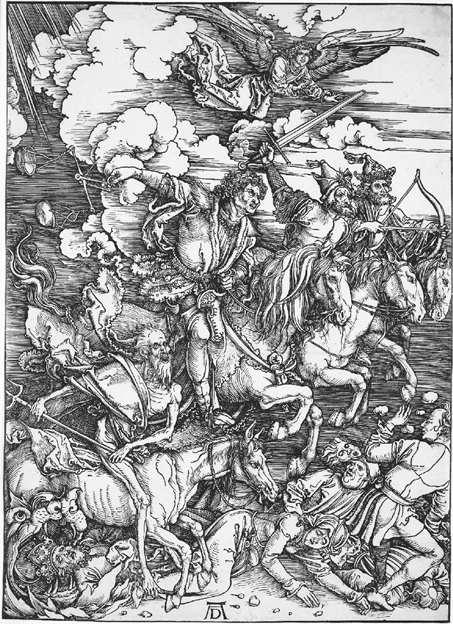
The woodcuts are wonderful, executed with a masterful sense of overall design, anatomical artfulness, and quirkily personal imagination. The most famous of the fifteen is the woodcut of The Four Horsemen, who, though they appear separately in the text of Revelation, are here shown sweeping over the world in concert, urged on by an angel from Heaven, Victory on the far right wielding his unbeatable Parthian bow, accompanied by War with his sword, Famine with his scales, and the pale figure of Death, riding an emaciated nag. In the lower left corner, the loathsome maw of Hell yawns, about to crush a crowned head in its fearsome teeth. The other victims—of lesser station, as their attire reveals—will soon slide toward those jaws of ultimate horror. So no one will escape the final accounting, neither king nor cottier.
(illustration credit 68)

(illustration credit 69)
The gruesomeness of apocalyptic retribution, wrought by nightmarish actors of convincing physicality, against identifiable contemporary figures—lords and commons such as anyone might encounter—seized the public and caused viewers to shudder at the horrifyingly thrilling possibility of the End Time. What if this were indeed about to happen? What if Frau Weibsbild down the lane is about to meet her awful last day along with millions of other unregenerate sinners, whilst I perhaps will be lifted up to Heaven with the elect? No creepy horror movie of our own time could have elicited more convincing yelps and yawls.
Another of the woodcuts depicts one of Revelation’s more puzzling scenes: “I heard a voice from the four horns3 of the golden altar which is before God, saying to the sixth angel which had the trumpet, ‘Loose the four angels which are bound in the great river Euphrates.’ And the four angels were loosed, which were prepared for an hour and a day and a month and a year, for to slay the third part of men.”
The four angels (I’m not sure anyone knows why these four had been previously bound in the Euphrates) are caught in the act of taking their vigorous exactions against one-third of humanity. You’ll note that the angel in the foreground is about to whack the pope, who wears his triply tiered papal tiara. Just behind His Holiness is the Holy Roman Emperor on the verge of receiving similar treatment. (The emperor sports the same mitered crown that then-emperor Maximilian I favored.) So, in 1498, almost two decades before Luther’s challenge, we have clear evidence that many Germans (and many Europeans beyond the German lands) would have been happy to see the pope lose his head and that virtually as many would have been content to see der römisch-deutsche Kaiser follow suit. However we may imagine what passed through the minds of the original viewers of these prints, however much we may attribute to them imaginative projections of their own deepest fears and desires, we can have no doubt that there was considerable public dissatisfaction with rulers, both sacred and profane. No one thought to upbraid Dürer for sending both pope and emperor to Hell. At the same time, it should be noted that it is the pope, not the emperor, who is in the foreground and that just behind him, indeed hovering at his backside as if in eternal sycophancy, is another bishop, wearing his miter of office. So, Dürer’s condemnation of papacy and church is more blatant than his condemnation of the civil power.4
Over the course of the fifteen prints, Dürer exhibits a graceful ease with the bizarre and unlikely figures that inhabit Revelation. If he is very good at capturing the heroically muscular action of the heavenly figures, he may be even better at depicting Gothic horrors. The nightmarish denizens of Hell have never found an abler portraitist. And the stark simplicity of black-and-white design has never found an abler dramatist. The depiction of the “war in Heaven” between the angelic forces of Saint Michael and the “great dragon” and his angels has an unforgettable visual force. The vigorous heavenly soldiers will win, no doubt. But even Saint Michael’s elongated and thrust weapon draws us visually to the great dragon—the Devil—and his horrific allies. Behind them the sky is dark, a series of simple horizontal lines. Below, by contrast, we see the lightsome and sweetly settled human communities of Earth in communion with nature, the ships in the harbor giving evidence of far-flung human communication. And yet, catastrophe is but a moment away: “Woe to the inhabiters of the Earth and of the sea! For the Devil is come down unto you [having been expelled from Heaven], having great wrath, because he knoweth that he hath but a short time.”
The starkness of the black-and-white medium of print only emphasizes the distance between Italian and northern European art. Dürer spent several years in Italy, absorbing everything he could of the Italian masters. His unerring sense of the drama of anatomy, movement, and layout shows what a keen student he was; and the examples of his art that survive from his pre-Italian period can be a trifle poky by comparison. Nonetheless, there are aspects of Dürer that, like Luther’s worst fantasies, derive their power from the nightmares of comfortless, endless northern winters and from the gloom of Germanic folktales, haunted by witches and goblins, not from the long, leafy, sun-drenched summers of Greco-Roman civilization, populated by nymphs and fauns.5

(illustration credit 70)

(illustration credit 71)
Despite all that Dürer learned in his lengthy Italian wanderings, he was never a mere imitator but always rooted in authentic northernness. Soon after his first Italian journey in 1494, he made one of his scariest, least Italian engravings, Junge Frau, vom Tode bedroht (Young Woman Attacked by Death) or Der Gewalttätige (The Rapist), in which the rapist Death rips the skirt of a young woman seated on his lap while she struggles to escape. It is a macabre variant on the many sketches of courting couples that were popular at the time—and it is one of the few prints of Dürer that lack his customary ad logo, which, in the absence of copyright laws, provided an assertion of ownership. Leonardo might not have cared for the face of Death, but the Brothers Grimm surely would have.
(Speaking of Leonardo, I am reminded that we stopped in Chapter II at his exceedingly famous image of the Vitruvian Man. But Dürer made an image that remains even more omnipresent: the Praying Hands, so recognizable that there is no need to reproduce it here. Two other images drawn by Dürer, however, are perhaps just a tad less well known than the Vitruvian Man: the humble Hare and the stupendous Rhinoceros, an animal never seen by Dürer. He created his attention-grabbing broadsheet using descriptions received by Nuremberg merchants from eyewitnesses in Lisbon harbor, where the first rhino to set hoof on European soil made for excited conversation.)

(illustration credit 72)

(illustration credit 73)

(illustration credit 74)

(illustration credit 75)
At the same time, it would be caricature to present Dürer as a fear-obsessed northerner, hounded by nightmares. His profound understanding of what the Italians had accomplished issues in some of his most treasured images, such as his engraving The Fall of Man(facing page, top), as deft and deep as anything by Michelangelo, especially if one views not just this black-and-white version, but Dürer’s exquisitely modeled and delicately colored oils of the same subject, twin panels hanging in the Prado, Madrid, and almost impossible to reprint successfully.
Dürer celebrated not only the ideal human body but every quotidian reality he could capture with his artist’s tools. His marvelous picture of the Prodigal Son (Luke 15:11–32), feeding the pigs on his master’s farm while kneeling in the muck and praying for a better alternative, contains, by the by, an exactingly detailed picture of an indifferently maintained German farmyard with its multiplicity of barns and dwellings and, beyond these, the roofs and chimneys of a town, including, on the far right, the turrets and steeples of a church, toward which the Prodigal directs his prayer (facing page, bottom).
Similarly, a much later engraving by Dürer (see next page, top) shows a dancing peasant couple in all their glorious ordinariness, the woman with her keys and other symbols of responsibility dangling from her waist, the man ineffectively shod, his left sleeve ripped at the elbow. They are neither ideal nor especially admirable; they may be cunning, but they are not intelligent. They are vulnerable human beings, having fun. Give them a break. Scenes such as this and The Prodigal Son open the door to the so-called genre painting of northern Europe, especially to such extraordinary (and extraordinarily sympathetic) artists of ordinary life as Bruegel the Elder and Vermeer.
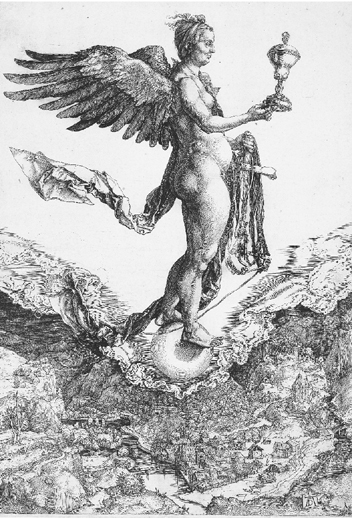
Occasionally, Dürer tried to crisscross the Italianate with the Germanic—to comic effect. One example is the engraving of Nemesis, the Greek goddess of Fate, who had never been depicted by the Greeks or by anyone else (see next page, bottom left). It turns out she looks like a naked middle-aged German frau, whooshing over the South Tyrol on her personal sphere. In her left hand, she holds a bridle and reins, symbolic of her intention to impose discipline. In her right, she offers a Gothic goblet, symbolic of her willingness to reward those who submit to her discipline. Beneath the clouds are the beautiful settlements of the Isarco Valley, whose inhabitants speak Italian as well as German. This goddess is not as awful as she might be, but she’s no Venus, boys. There seems to be a not-so-hidden commentary here on German women, as contrasted with the genuine goddesses of Italy. Perhaps I read too much into this, but we know that Dürer’s arranged marriage was an unhappy one and that he took off for Italy whenever he could get away.

(illustration credit 76)
(illustration credit 77)

(illustration credit 78)
In addition to Dürer’s astonishing self-portrait as Christ [second insert, Plate 36], Dürer made almost as many self-portraits as Rembrandt would, none more incredible than the one he made when he was thirteen, surely the earliest worthy self-portrait ever made, before or since. The confidence of this boy was amazing.
Dürer painted himself as a jaunty man-about-town two years before his Christ portrait and as an edgy Christ in his Passion more than two decades later—in 1522, just six years prior to his own death. But perhaps the most unexpected self-portrait is the pen-and-brush image on green grounded paper that Dürer made in 1505 (facing page, bottom right), just three years after his self-portrait as the handsome, curly-haired Christ. Here is surely a revelation: a man from head to knees, watchful, almost anxious, without curls and completely nude, his genitals, as Joseph Leo Koerner has remarked, “the most particularized area of the sketch, displaying an irregularity and profile distinctly their own.”6 This was a playful man who nonetheless wanted complete honesty, not facile idealization.
In the story of Jesus, Dürer, like Luther, found his way. There is another portrait by Dürer, the simplest of simple charcoals, finished with only a few strokes. It is the Head of the Dead Christ, curly-bearded, not curly-haired, garish face, undignified, as we all must be in death, and at its base the (proportionately) largest ad monogram in all of Dürer’s art. This is not Dürer as Christ but Christ as the ultimate figure Dürer would attach himself to. For Dürer, as for Luther, Jesus, even dead, makes sense of all our lives in a way that no one else can.

(illustration credit 79)
Looking at the dead Christ, the viewer may essay a wry smile but will hardly be tempted to laugh. Yet Dürer is fairly bursting with Luther-like humor, bold and hidden, harsh and gentle, and with references to the awful comedy of the human condition. Of his many engravings that feature portraits of his contemporaries, I would leave you with one: Albrecht of Brandenburg, the man who tripped off the Reformation by his involvement in the selling of indulgences throughout Germany (facing page, top). When we met him last (this page and following), he was a bishop. By the time Dürer sketched him, he had been made cardinal. How similar is his profile to Dürer’s depiction of another religious leader of some historical importance—Caiaphas, the Jewish high priest, as he judges Jesus, the prisoner who stands before him in the gloom of the night (facing page, bottom). For an artist of such consummate attention to detail, can the similarity be just a coincidence?

(illustration credit 80)

(illustration credit 81)
In connecting Dürer to Luther, I have one last, exceedingly northern image to show you, Dürer’s Knight, Death, and the Devil. No one has explained this mysterious picture—which has often been misinterpreted7—more eloquently than the German American theologian Paul Tillich:
It has rightly been said that Albrecht Dürer’s engraving, “Knight, Death, and the Devil,” is a classic expression of the spirit of the Lutheran Reformation and—it might be added—of Luther’s courage of confidence, of his form of the courage to be. A knight in full armor is riding through a valley, accompanied by the figure of death on one side, the devil on the other. Fearlessly, concentrated, confident he looks ahead. He is alone but not lonely. In his solitude he participates in the power which gives him the courage to affirm himself in spite of the presence of the negativities of existence. His courage is certainly not the courage to be as a part. The Reformation broke away from the semicollectivism of the Middle Ages. Luther’s courage of confidence is personal confidence, derived from a person-to-person encounter with God. Neither popes nor councils could give him this confidence. Therefore he had to reject them just because they relied on a doctrine which blocked off the courage of confidence. They sanctioned a system in which the anxiety of death and guilt was never completely conquered. There were many assurances but no certainty, many supports for the courage of confidence but no unquestionable foundation. The collective offered different ways of resisting anxiety but no way in which the individual could take his anxiety upon himself. He was never certain; he could never affirm his being with unconditional confidence. For he never could encounter the unconditional directly with his total being, in an immediate personal relation. There was, except in mysticism, always a mediation through the Church, an indirect and partial meeting between God and the soul. When the Reformation removed the mediation and opened up a direct, total, and personal approach to God, a new nonmystical courage to be was possible. It is manifest in the heroic representatives of fighting Protestantism.

(illustration credit 82)
These are extraordinary things to claim for any picture, especially one made in 1513, before Luther had even spoken aloud to the Germans. It is certainly hard cheese for any Roman Catholic or Orthodox Christian to digest, not to speak of any number of contemporary Protestants who have smoothed away the rough bits of classical Protestantism to create a gentler religion more to their liking.
But it speaks to an undeniable vein of northernness. So let us now consider some other northern visions.