

Beauty itself doth of itself persuade The eyes of men without an orator.
The Rape of Lucrece
Before the sobrieties of saints and the rigidities of reformers begin to consume all our attention, let us immerse ourselves once more in some of the unique pleasures bestowed on us all by those generous party givers, the Renaissance artists whose lavishness amazes still—even if we come to discern within their celebrations a singular seriousness of purpose and an unparalleled (and occasionally unpardonable) sense of self. There being no way, however, in a book of this size to do even rudimentary justice to Renaissance art, we shall have to content ourselves with a kind of morning bus tour, pointing out only a few of the more obvious delights in which this sensationally sensuous territory abounds.
The final collapse of the Greco-Roman world in the West entailed the loss of many things, among them statuary—or, more precisely, the classical tradition of sculpture. The freestanding figures, life-size and larger, that punctuated the public spaces of antiquity were sculpted no more; and gradually the ones that remained standing were lost beneath the waves of change and the rubble of decline. For one thing, Christian palates found nudity unacceptable (unless you were discreetly depicting Adam and Eve before the Fall), and so many of the subjects of ancient sculpture were nude. Worse still, so many of the nudes were pagan gods and goddesses, for whom there was no longer much call. And the idea of putting divinity and nudity together was downright scandalous. Yahweh, the God of the Jews who had become the God of Christians, was never described south of his waist. Whatever was there, no one had ever seen it. But more to the point (as it were), coupling divinity and nudity necessarily implied a sort of Holy Eroticism, an idea that could only make medieval standard-setters squirm. Whatever examples of Greco-Roman sculpture were not smashed or melted down mostly ended up buried or drowned, awaiting rediscovery in a more appreciative age.
The David of Donatello [Plate 1] must, therefore, have come as a great shock to viewers in Quattrocento Florence. This was not Donatello’s first David. An earlier one, sculpted perhaps as early as 1408, when Donatello had barely reached his twenties, and intended as a decoration for the Cathedral’s buttresses, is more in keeping with the artistic conventions of its time, well clothed in cloak and leather jerkin, if displaying a handsome right leg rising next to the severed head of the giant Goliath. But even in this earlierDavid, Donatello is an innovator, for David had all through the medieval centuries been portrayed as a bearded king of venerable years, playing his psalms on his plangent harp. This first David of Donatello is a sturdy boy, the sweet curls of his exquisitely shaped head bound by a viny chaplet, his wide-eyed face expressing the pathos and pietas of his young years. Though this youth would soon enough become the standard depiction of the biblical David, in the first decade of the Quattrocento (or 1400s) he was a startling departure.
But this figure was as nothing compared to Donatello’s second David, who stands free, never intended to be incorporated into niche, wall, or buttress as mere architectural adornment, as had been all the statues of the previous Middle Ages. He is intended—indeed, he demands—to be looked at solo, without reference to anything else. Struck in bronze, he is a boy, standing (as would a boy of the time) but two and a half inches higher than five feet. And he is brazen in more ways than one.
We don’t know what classical models Donatello may have used. Surely, he couldn’t have come up with this shameless child without having encountered some Greek-like sculptures, or parts of sculptures, or cartoons of sculptures in forms now lost to us. We are at a total loss to explain how Donatello could have conceived such a statue—such a Presence—because nothing still extant from his time gives us the least hint. In the words of Kenneth Clark, “How pleasure in the human body once more became a permissible subject of art is the unexplained miracle of the Italian Renaissance. We may catch sight of it in the Gothic painting of the early fifteenth century, revealed in the turn of a wrist and forearm or the inclination of a neck; but there is nothing to prepare us for the beautiful nakedness of Donatello’s David.”
Even more shocking, this David is no mere copy of a Greek original. Though it refers to the long-lost tradition of classical sculpture in its life-size boldness, its stand-alone uniqueness, its utter nudity, and its many anatomical perfections, it uses all these things—in fact, plays with them—by way of allusion, as if the sculptor were telling us, “Yes, yes, I know all about the great Greco-Roman tradition and I treasure it, but I wish to give you something New.”
Which he has. Unlike the chunky, chesty gods and athletes immortalized by the Greeks, with their perfect limbs and blank faces, their absolution from all normal human trials, and their unwillingness to take the least notice of us, their spectators, this child is not quite so absolved or abstracted. He seems rather pleased with himself as his left foot toys with the decapitated giant’s beard. What, for Heaven’s sake, is that serpentine thing slithering its way up David’s right leg and almost reaching his joining thighs? Why, it’s the tickling wing of Goliath’s helmet. How extraordinary, what can it be meant to mean? And the pose: almost Greek but more insouciant, more provocative, more (dare one say?) sexually inviting. The nearly thrust-out pelvis, the narrow, girlish breasts, the slightly exaggerated but gracefully balanced sway of the figure, the left hand on the hip virtually summoning us to take a walk around and examine the swelling buttocks—dear God, what a breathtaking display!
I am trying here not only to give voice to reactions of our contemporaries but to imagine the reactions in Donatello’s own day, when no one had ever seen anything remotely like this statue. Since we now have no record of any reaction whatever, we can only speculate. Are there no records because people didn’t trust themselves to say anything publicly? Was everything done sub rosa and behind the scenes, the statue banished to some private garden where it would not disturb the public? (We do know that whatever the original, and undoubtedly public, purpose of this commission, the figure ended up in the private courtyard of the Palazzo Medici.) I imagine an Italianate version of the reaction of Dorothy Helms, wife of the self-proclaimed “redneck” Senator Jesse Helms, as she inspected for the first time the homoerotic photography of Robert Mapplethorpe: “Lawd, Jesse, Ah’m not believin’ what Ah’m seein’!” Subsequently, Senator Helms did everything he could to blacken Mapplethorpe’s reputation and destroy any American gallery, museum, or government body that would sponsor his work. (Of course, Helms succeeded only in helping to ensure Mapplethorpe’s enduring reputation.)
We don’t even know when this second David was made. It might have been in the 1420s or ’30s or, most likely, ’40s, by which time Donatello would have reached his fifties. In the late 1970s, one art historian, H. W. Janson, at last uncovered a clue that the statue itself had concealed all along but that no one had previously decoded. Goliath’s highly unusual winged helmet had always been a stumper. Janson realized that the winged helmet was an emblem of the Viscontis, dukes of Milan, Florence’s mortal enemy. Thus was David, intended by Donatello to represent little Florence, able to slay even monstrous Milan. But this David with his pornographically high boots, his belaureled, pretend-butch huntsman’s hat, and his narcissistic visage is most unlikely to have appealed to aggressive Florentines as their military symbol. Even to the artistically dim, he must have looked too much like the toyboy of an aging artist. This was a kid who may have conquered Donatello but was hardly up to the task of conquering Florence’s enemies. So he ended up closeted in a private garden, rather than displayed as a public statement. “With Donatello,” remarks John M. Hunisak of this image, “we discover the first modern instance of the fusion of art and autobiography.”
Donatello has provided us with other expressions of autobiography, none more poignant than his Mary Magdalene [Plate 2], carved in wood for Florence’s famous Baptistry. Here, toward the end of his life, Donatello gives us a figure as far removed from the teasing provocation of the David as can be imagined: Magdalene, the penitent prostitute, as a desert figure like John the Baptist, clothed in rough animal skin, her old, emaciated limbs the opposite of the David’s self-satisfied plumpness (or the plumpness of virtually any other Renaissance figure). Her face speaks only of regret. One could misinterpret this depiction by suggesting that, in Donatello’s eyes, boys are for pleasure, women for pain and suffering, but I doubt Donatello would have had any difficulty imagining himself as a woman. Here is a figure that, unlike the David, might have been carved at almost any time in the Middle Ages. It leads us to contemplate faith and repentance, not Neoplatonic perfection. Like Lorenzo the Magnificent’s deathbed confession, it is an echo of an earlier time.
But to place Donatello’s scandalous David more securely in its historical context, we have only to ask ourselves: who was the next artist to sculpt a David and what did it look like? It took thirty years or more before another artist dared try his hand. The supremely competent Verrocchio, once the student of Donatello, cast his David [Plate 3] in 1476 or so. The result imitates Donatello, if in a wishy-washy way. Verrocchio imagined a young David, as had Donatello, who had succeeded in wiping away the former depiction of David as an aged musician. Like the earlier David, this one is cast in bronze, but at scarcely more than four feet it is somewhat shorter than life-size. And there is almost nothing in Verrocchio’s version to provoke the viewer’s lust. Here is a genial, skinny young fellow, a little bland, only the flowery nipples of his breastplate hinting at anything remotely unusual. Like Donatello’s Magdalene, this David would have been at home in an earlier age—as a figure in a Gothic niche.
But does the faint suggestion of a smile remind you of anyone? Perhaps of the Mona Lisa? At the time Verrocchio cast his David, the young Leonardo da Vinci was his apprentice and may even have served as a model for Verrocchio’s David—which may cast some light on what the statue does not say. For in 1476, the same year Verrocchio was casting this piece, complaints were twice put before the magistracy of Florence that Leonardo and other young artists were engaging in sodomy with (it would seem) a willing seventeen-year-old named Jacopo Saltarelli.
These incidents occurred two decades before Savonarola’s attempts to rid Florence of its sodomites by burning them all alive. What the anonymous accusers may have meant by sodomy and what the magistrates may have taken them to mean may remain a trifle unclear—and, in any case, it appears that the accusations were never proved. But we may note that, not only was there a marked tendency among Florentine artists and other humanists to engage in homosexual (as well as heterosexual) relations; they found their high-minded justification for these practices in the works and lives of the most admired Greek and Roman poets, artists, and philosophers. Though there was not a whisper of justification for such activities in Judeo-Christian sources (in which only the sternest condemnations could be found), there were many laudatory references to homosexual love in Greek art and literature and (more occasionally) in Roman poetry.
It is likely that the sodomy charge had some basis in reality. Leonardo never married and is known to have cohabited with a succession of young men. Some of his drawings and paintings would certainly indicate that he had an intense interest in beautiful male bodies. At the same time, there is no definitive proof, and there are even contrary indications—evidence that Leonardo may have been celibate, if not for his entire life, at least in his later years. I would speculate that the public accusations were sufficiently unsettling to Leonardo that they may have pushed him into a lifetime of concealment—his whereabouts in the years immediately following the accusations are unknown, but if he remained in Florence he was probably hiding out with the Medici—and that they even impelled Verrocchio, then at work on his David, to similar concealment, which is why this David is so sweetly bland. At the same time, nothing of Verrocchio’s ever created a scandal: he was a consummate professional who always satisfied his customers—which is why his extant works never rise to the level of Donatello’s or Leonardo’s. In the end, we are left with irreducible mystery.
Leonardo himself would have approved our tact, our unwillingness to reach beyond the evidence. He had an instinctive dislike of precipitate generalization. “Abbreviations,” he wrote in one of his famous notebooks, elaborate but unrevealing of his personal life, “do harm to knowledge and to love, seeing that the love of anything is the offspring of this knowledge, the love being the more fervent in proportion as the knowledge is more certain.… It is true that impatience, the mother of stupidity, praises brevity, as if such persons had not life long enough to serve them to acquire a complete knowledge of one single subject.”
Well, though he might have admired our tact, I have to admit that he would most certainly not have approved our morning bus tour of Renaissance art. This is the authentic voice of Leonardo: considered, exploring all angles, willing to wait as long as need be for knowledge, inspiration, insight, enlightenment. So willing was he to wait till a given task could be undertaken properly that his life was punctuated by partial, unfinished, and collaborative works.
The first of these should be accounted a painting once ascribed wholly to Verrocchio but later understood to be partly the work of Leonardo, a Baptism of Christ [Plate 4], dating to 1472, four years prior to the accusations, when Leonardo was just turning twenty. The angel on the far left is Leonardo’s—and how angelic and mysterious is this curly-haired visitor in contrast to Verrocchio’s pug-faced, earthbound child. The main action of Jesus and John the Baptist, surmounted by trinitarian symbols, is conventional and unremarkable. But the background, by Leonardo, speaks to us of mystery, surprise, delight, as does the landscape that, more than thirty years later, will frame Mona Lisa. As Yeats would describe such vistas:
Quattrocento put in paint
On backgrounds for a God or Saint
Gardens where a soul’s at ease;
Where everything that meets the eye,
Flowers and grass and cloudless sky,
Resemble forms that are or seem
When sleepers wake and yet still dream,
And when it’s vanished still declare,
With only bed and bedstead there,
That heavens had opened.
After this collaboration with his assistant, Verrocchio gave up painting altogether, devoting himself wholly to sculpture and goldsmithery. No more dreamscapes for him.
Despite Verrocchio’s ceding the field to Leonardo, the younger man’s first solo outing, The Annunciation [Plate 5] of the same year (or perhaps the following), is endearingly tentative. The perspective is carried out as if taken directly from a student manual—the vanishing point in the exact middle of the horizon and just two-thirds up from the bottom of the picture. There is something wrong with the positioning of the awkwardly elephantine lectern, the feet of which sit closer to the viewer than the Virgin’s right hand could possibly do, though both furniture feet and human hand all appear intended to occupy nearly the same plane. Leonardo was left-handed; and, as I know from personal experience, it takes left handers a bit longer to get such things right.
But for me the great charm of the conception lies in Mary’s attitude. Though she has yet to learn just who this deeply bowing visitor may be, she is slightly annoyed at being interrupted in her reading and, determined not to lose her place, has put the index finger of her right hand on the passage she was reading. Her raised left hand politely salutes the angel, another of Leonardo’s curly-haired marvels, but her right hand announces her hope that, whatever her winged visitor may have to say, he will keep it brief.
Of Leonardo’s own mother we know almost nothing, save that her name was Caterina and that she was a peasant girl who had an affair with a local notary named Piero, a man who had a “Ser” (Sir) in front of his name. She bore Leonardo out of wedlock; and though Caterina and Piero, being of different classes, never married, Piero acknowledged his son and maintained a relationship with him, later bringing him from their outlying village of Vinci to Florence and apprenticing him to Verrocchio, the best artist he could find. We have documentation indicating that in her later years Caterina lived with her son after he had moved to Milan and that she died there in his house. So Leonardo seems to have had a decent relationship with each of his parents, however brief their mutual relationship may have been; and I would guess that the quiet self-possession of Mary, herself a peasant girl, in the face of an angel invading her privacy is a hidden homage by Leonardo to the independent spirit of his own dear mother.
I would even take this unprovable speculation a bit further and wonder if Mary’s face—in its uncompromisingly realistic stare—may be a somewhat idealized version of Caterina’s. She doesn’t look much like Leonardo’s many other Marys, for whom he no doubt used local models. But her face, though unsmiling, does rather closely resemble the face of Verrocchio’s David.
At any rate, Leonardo’s interest in faces never lessens. One of his earliest completely self-assured works, The Virgin of the Rocks [Plate 6] of 1482–83, is a triumph of faces. Mary kneels before her infant son, her right hand encouraging the infant Baptist-to-be in his worship of his cousin Jesus, who raises his right hand in priestly blessing. The fourth figure, another curly-haired angel, is the most unearthly of all. But all four are profoundly, mysteriously otherworldly; their beautifully modeled light-dark faces speak of inner spiritual life, of individual selves connected to an unseen reality immensely larger than anything our eyes can see. And their pageant-like interactions are exquisitely framed by the mysterious but earthy rock formations that surround them. The figures are enclosed in an invisible triangle, which works in tension with the invisible column in which the Christ Child sits, formed by the pointing right hand of the angel and the protective yet demonstrative left hand of the Virgin. Her encouraging right hand and the shielding sweep of her cape protect not only the Baby Baptist but us, the human race—exules filii Evae, the banished children of Eve—whose representative he is meant to be.
“The design,” as Clark remarks of a much later painting of Leonardo’s,1 “has the exhilarating quality of an elaborate fugue: like a masterpiece of Bach it is inexhaustible. We are always discovering new felicities of movement and harmony, growing more and more intricate, yet subordinate to the whole; and, as with Bach, this is not only an intellectual performance; it is charged with human feeling.”
Leonardo’s interest in faces can take a comic turn, as in his sketch of a comely but diffident youth being inspected by a grotesque old man. The youth is almost certainly Giacomo Salai,2 who, though in Leonardo’s own words was a “thief, liar, pigheaded glutton,” boarded with Leonardo and was, despite his social faults, protected by the artist for years and even mentioned in his will. No one knows who the old uncle may be.

(illustration credit 63)
Both comedy, of a prickly kind, and mysterious beauty are to be found in the faces of those gathered for The Last Supper, one of Leonardo’s three most famous images. But this image, or what survives of it, must be accounted one of Leonardo’s great failures. It is still evident that Leonardo intended to bring a fresh sensibility to this scene. Whereas earlier artists had sought to portray the moment at which the central Christ figure institutes the Eucharist of bread and wine (“This is my Body”; “This is my Blood”), Leonardo meant to portray the moment at which Jesus predicts that “One of you will betray me” and the ensuing buzz of speculative interaction among the twelve apostles. (“Is it me?” “Is it him?”) But the wall on which Leonardo painted—in the refectory of the Dominican friary of Santa Maria delle Grazie in Milan—was damp. Moreover, Leonardo failed to employ standard fresco technique to fix the image to the wall.3 Rather, he worked on the project off and on for most of a year, 1497, and used a medium that contained oil and varnish. It was perhaps an experiment on his part. But even in his lifetime the painting began to disappear. By the mid-sixteenth century, the great Renaissance art critic Giorgio Vasari visited the friary and wrote that “there is nothing visible but a muddle of blots.” What we see today is the result of multiple “restorations,” seven or more, carried out by a variety of artists of varying skill, vision, and style over several centuries. It is scarcely possible to speak now of Leonardo’s Last Supper, but perhaps some may find a sort of defense in Leonardo’s most famous quotation: “L’arte non è mai finita, solo abbandonata” (Art is never finished, only abandoned).
As famous as this abused image is the Mona Lisa. Though her fate has been less terrible, she has hardly survived unscathed. To protect the painting from its millions of admirers, the countless tourists who flock to see it every year, the Louvre has elected to place it high on a wall, framed within a bizarre structure that almost gives the impression that the painting is submerged. Here is Vasari’s description of his unmediated encounter with the Mona Lisa:
The eyes had that lustre and watery sheen which is always seen in real life, and around them were those touches of red and lashes which cannot be represented without the greatest subtlety.… The nose, with its beautiful nostrils, rosy and tender, seemed to be alive. The opening of the mouth, united by the red of the lips to the flesh tones of the face, seemed not to be colored but to be living flesh.
Alas, as one strains to see the painting today, there is little color, and much of the subtlety has been erased, washed away by the underwater effect and perhaps by time as well. In the words of Kenneth Clark, who was able to view the painting up close and out of its frame in the early twentieth century:
She is beautiful enough even now … Anyone who has had the privilege of seeing the Mona Lisa taken down, out of the deep well in which she hangs, and carried to the light will remember the wonderful transformation that takes place. The presence that rises before one, so much larger and more majestical than one had imagined, is no longer a diver in deep seas. In the sunshine something of the warm life which Vasari admired comes back to her, and tinges her cheeks and lips, and we can understand how he saw her as being primarily a masterpiece of naturalism. He was thinking of that miraculous subtlety of modeling, that imperceptible melting of tone into tone, plane into plane, which hardly any other painter has achieved without littleness or loss of texture. The surface has the delicacy of a new-laid egg and yet it is alive.
And something of Leonardo’s own self shines through so many of his portraits. This woman, this Mona Lisa, is also in some sense Leonardo. One of the miracles of his art is how deeply personal it is, how revealing of the artist who did not revel in self-revelation. Which is why we, after gazing at a succession of the artist’s depictions of faces, can spot Leonardo as the model for Verrocchio, as well as the inner self of Mona Lisa. Of the actual, exterior Leonardo, we have but one probable self-portrait—in red chalk—and, like his notebooks, it reveals little, except that Leonardo, then but sixty, thought of himself as much older than he was.

(illustration credit 64)

(illustration credit 65)
We may find much more of Leonardo in his Vitruvian Man. This icon of the Renaissance has become in our time an icon for any number of things. One catches sight of reproductions of it at the offices of both medical doctors and homeopaths, on T-shirts and tattoos, NASA spacesuits, denominations of the euro, and computer operating systems. People who consider themselves humanists of one variety or another often employ it as a favorite symbol. I once taught at a “Center for Humanistic Studies” that used theVitruvian Man as its logo. Throughout the Americas and Europe perhaps only troops of fundamentalist Christians would find it inappropriate to their organizational purposes.
The image is called “Vitruvian” because it refers to the ancient Roman engineer Vitruvius of the first century BC who in his treatise on architecture showed how the ideal human (male) figure was constructed from a series of proportional measures and that these proportions could be projected beyond the body itself and used to create pleasing proportions in architecture. It was Vitruvius who came up with the idea of encompassing the male figure in a circle (with the central point his navel) and in a square. “The length of the foot,” wrote Vitruvius, “is one sixth of the height of the body; of the forearm, one fourth; and the breadth of the breast is also one fourth. The other members, too, have their own symmetrical proportions, and it was by employing them that the famous painters and sculptors of antiquity attained to great and endless renown. Similarly, in the members of a temple there ought to be the greatest harmony in the symmetrical relations of the different parts to the general magnitude of the whole.”
Whether such a system is truly workable I am not equipped to say. In our time, which is postclassical, postromantic, and postmodern, we are more likely to emphasize the subtle and even the grotesque variations from one human body to another rather than a system of ideal proportions. But there is no denying the powerful attractions of a vision that makes man the measure of all things and even his architecture an expression of his humanity—a world made (or remade) to a human scale.
Earlier attempts to interpret Vitruvius’s writings—and earlier artists’ sketches of the Vitruvian Man—had been failures. Leonardo, who had had little formal education, had taught himself Latin. He was the first to read Vitruvius’s Latin carefully enough to realize that all previous attempts at interpretation had misunderstood Vitruvius to mean that the circle and the square should have the same center, the human navel. By adjusting the position of the square, Leonardo succeeded in rendering the first correct reading of Vitruvius since antiquity. In this way, Leonardo made Vitruvian ideas of human anatomy and architecture accessible to the artists and architects of the Renaissance. Without this correction of Leonardo’s it is hard to imagine how the architectural works of Michelangelo, Bernini, Palladio, and even Christopher Wren could have come to be.
Leonardo was the ultimate Renaissance man. Painter, sculptor (of lost works), engineer (who sketched out workable inventions such as the helicopter, the tank, the calculator, and many smaller laborsaving devices that were manufactured in his own time), scientist (incisive student of optics, the first to offer a theory of plate tectonics), anatomist, military strategist, theoretician of architecture, peace-loving ambassador, vegetarian, a man who bought caged birds in order to free them, he died in 1519 in the arms, it was said, of his student and passionate protector, Francis I, king of France.
“In the normal course of human events,” wrote Vasari, “many men and women are born with remarkable talents; but occasionally, in a way that transcends nature, a single person is marvelously endowed by Heaven with beauty, grace, and talent in such abundance that he leaves other men far behind, all his actions seem inspired and indeed everything he does clearly comes from God rather than from human skill. Everyone acknowledged that this was true of Leonardo da Vinci, an artist of outstanding physical beauty, who displayed infinite grace in everything that he did and who cultivated his genius so brilliantly that all problems he studied he solved with ease.”
To pursue Leonardo’s other interests would take us several books. We have, in all truth, barely touched on his importance as an artist. I can only regret the many omissions forced on us here and say that we will have one additional chance to bow our heads in Leonardo’s direction—as we have a closer look at some Renaissance approaches to female anatomy.
There is probably no Renaissance artist more associated with the female form than Botticelli, whose celebrations of women’s bodies—at least in the early stages of his artistic journey—are second to none. Like every other artist, Botticelli did not emerge without precedent: there were indeed several earlier masters who influenced him. Of these we shall fleetingly consider two: Masaccio (born in 1401) and Piero della Francesca (born perhaps as early as 1415).
Masaccio’s baptismal name was Tommaso, a name easily shortened to “maso,” very close to “masso,” Italian for bulk (or mass). The added “-accio” serves to further deprecate the person so designated. A good translation of “Masaccio” would be “Fatso,” which pretty much describes the one likeness we have of him as a broad-faced, brooding onlooker, framed by a dark doorway, in his own fresco sequence on the life of Saint Peter in the Brancacci Chapel of Florence’s Church of Santa Maria del Carmine.
The wide panel in which Masaccio’s likeness is to be found [Plate 7] depicts a medieval legend that Saint Peter, before traveling to Rome and martyrdom, endeared himself to Theophilus, Roman prefect of Antioch, by raising the prefect’s son from the dead. By means of this miracle all Antioch received the gospel, the grateful Theophilus providing a church furnished with an appropriate bishop’s throne, where Peter could sit while expounding the new faith. (In the classical world teachers and others in authority sat rather than stood when they spoke to an audience; and Peter did sojourn in Antioch and make converts there. But the larger legend—of the miracle, the role of a bishop, and the building of a church—though it tells us a great deal about Renaissance Catholicism’s myth of itself, has no historical validity. In the time of Jesus’s apostle Peter, there were no bishops and no church buildings. These would be later developments. And the miracle itself is an ahistorical fantasy.)
The panel very nearly returns us to the time—a century earlier—of the great Giotto, whose vibrant sense of color, rounded volumes of figures, and close human interactions on a single plane are clearly the models that light Masaccio’s imagination. At the same time, there are no undraped nudes in Giotto’s work, not even one so obviously prepubescent as Theophilus’s son.
So let us turn to Masaccio’s extraordinary adult nudes, to be found in the same chapel. Masaccio worked on this sequence with an older master, Masolino, and, for the sake of comparison, it is worth our taking a look first at Masolino’s Adam and Eve [Plate 8], who seem to have been prepackaged to receive a PG-13 rating. They have no more human reality than Barbie dolls, their genitals might as well have been designed for assembly-line reproduction—and what are those slight protrusions on Eve’s chest supposed to be? Surely, not breasts? Okay, the proportions of the figures are fairly accurate and, uh, standard, but their bodies have none of the tactility of real flesh.
Next panel [Plate 9]: Adam and Eve—painted by Masaccio—as they are thrown out of Eden. (Masaccio seems to have been, too.) The figures are less standard, even less accurate, than Masolino’s: Adam’s arms are far too short, his right calf is impossibly bowlegged; Eve’s arms are of unequal length and she is dumpier than in Masolino’s version, with a fat back and hefty haunches and an awfully thick right ankle. But they are alive, believable, fleshy!—and being pushed forward into all the horror of real life. Adam’s stomach, sucked in and emphasizing his vulnerable ribs, displays the tension of inconsolable grief; Eve’s hands, placed to shield her belles choses (and copied by Masaccio from the teasing poses of ancient Venuses), have been transformed into demonstrations of irremediable shame. Her breast, peeking out above her wrist, is a real breast; and Adam’s genitals are downright funky—not smoothly attractive, not ready for the style section of the Sunday newspaper, just their grotty selves. Never before had such nudes been seen or even thought of. How far they are from the ideal figures of the ancients, as well as from the self-censoring expressions of so many Christian centuries.
You could say that Masaccio was inspired by the terrible event of the Expulsion from the Garden, which gives his depiction more drama and more forward force than was possible for Masolino, stuck with portraying the perfection and utter tranquility of the Garden itself. You could say that—but it doesn’t fully explain Masaccio’s embrace of these raggedy-limned but fully human bodies.
Masaccio never finished his work in the chapel; it would be completed many years later by Filippino Lippi in accordance with illustrative instructions Masaccio left behind. Masaccio died at Rome three years after abandoning work on his frescoes and just short of his twenty-seventh birthday. According to gossip of the time, he was poisoned by a rival painter. Some, probably much, of his work was subsequently destroyed.
The second influence on Botticelli that we must have a quick, morning-bus-tour glance at is Piero della Francesca. Piero, deserving of far more attention than we shall have space to devote to him, was an outsider in Florence, having been born in Borgo Sansepolcro (the Village of the Holy Sepulcher) at the opposite end of Tuscany in the vicinity of Arezzo. His extra-Florentine roots did not assist his fame: in his own time and for centuries thereafter, his works were treasured by local inhabitants in the towns where they were displayed, not becoming universally known much before their championing by the English critic Walter Pater in the nineteenth century. But unlike poor Masaccio’s, Piero’s was a long life: he died in his mid-seventies, though he seems to have stopped painting as much as twenty years before his death because, in all likelihood, he was going blind. In contrast to Masaccio’s sparse surviving output, works by Piero may be found throughout Tuscany, in Venice, Rimini, Urbino, Perugia, Milan, and even Rome (a nearly destroyed fragment of fresco) and hang today as far afield as Berlin, Lisbon, New York, Boston, Williamstown (Massachusetts), and especially London, where the English have been conducting a long-standing love affair with this artist’s work. Squadrons of British tourists may often be encountered throughout northern Italy in their sensible walking shoes, hard on the “Piero della Francesca Trail.”
This national fascination with Piero actually saved a painting of his from destruction. In a collection of travel essays published in 1925, Aldous Huxley had called Piero’s Resurrection [Plate 10], the fresco that decorates the Museo Civico of Sansepolcro, “the greatest picture in the world.” In the last days of World War II, as British soldiers began shelling Nazi-occupied Sansepolcro with the intention of reducing it to rubble, their captain, Antony Clarke, was trying to recall where he had heard the name “Sansepolcro” before. Suddenly, he remembered reading Huxley’s description—of a fresco Clarke had never seen in a Tuscan village he had never visited—and he called off the shelling. Soon thereafter, the Brits received a message informing them that the Germans had already retreated from the neighborhood, so continued shelling was unnecessary. Thanks to Captain Clarke’s tenacious memory and discerning sensibility (and to Huxley’s extravagant praise), both the village and the fresco survived the war.
Is Piero’s Resurrection the greatest picture in the world? Whether it is or not, it is surely a prime example of Piero’s treatment of human figures, which pop out from their two-dimensionality almost as if they were exceedingly subtle holograms. Even in their unruffled dignity and stillness—what Huxley terms Piero’s “passion for solidity”—they are hologram-like. Few poses in all of art are more definite, more authoritative, than the planting of Christ’s left foot at the edge of the sarcophagus (or san sepolcro), silent medium between Heaven and earth, life and death. The strapping Roman soldier in brown is Piero himself, and his head resting against the shaft of Christ’s banner (a Guelph4 banner, what else?) indicates the sleeper’s own silent hope of resurrection. For Huxley, the scene incarnates all the most noble qualities of the best ancient and the best Renaissance art. “A natural, spontaneous and unpretentious grandeur—this is the leading quality of all Piero’s work. He is majestic without being at all strained, theatrical or hysterical—as Handel is majestic, not as Wagner.” His risen Christ is not the usual portrayal, but in Huxley’s view “more like a Plutarchian hero than the Christ of conventional religion. The body is perfectly developed, like that of a Greek athlete.… It is the resurrection of the classical ideal, incredibly much grander and more beautiful than the classical reality, from the tomb where it had lain so many hundred years.”
The other image of Piero’s that I would have us examine points in its singularity of subject to the singularity of Piero’s imagination: La Madonna del Parto [Plate 11], the Madonna of Childbirth, the only treatment of this subject in the history of art. Piero has surrounded his main figure, a patently pregnant Mary, with twin angels engaged in a ritualized drama of presentation. What they are presenting to us is a woman of severe dignity who is nonetheless about to deliver a child. The Italian parto can mean either labor or delivery. If Mary is in labor, she is not at this moment experiencing a severe contraction. On the other hand, in classical theology, she did not actually experience labor, since medieval theologians reasoned that a child passing through the birth canal would rupture her hymen, rendering the Ever-Virgin no longer virginal.5 Thus, they imagined, the infant Jesus appeared in her arms, having passed miraculously through the wall of her womb without the usual labor necessary to birth. If such speculation seems rather silly to our contemporary ears, it was something Catholic orthodoxy once took with high seriousness (and still does, at least among its more unhinged partisans).
So what is Piero depicting here? I’d say we are looking at Jesus’s mother experiencing the first stirrings of his birth—which permits the artist to stay clear of the knottier aspects of the ascendant theology. He doesn’t need to allude to what happened next—though in his way he does prompt the viewer to speculate on that next stage of il parto. In the midst of such quiet dignity, is the woman about to fall to the ground screaming in pain? But theology aside, there is once again Piero’s uncanny ability to render aloof figures with an “unpretentious grandeur” that leaves us in awe.
Piero’s uncommon sense of spatial depth emerged not only in painting but in architecture. His two Latin treatises, De Prospectiva Pingendi (On Perspective in Painting) and De Corporibus Regularibus (On the Rules for Bodily Masses), were among the most influential scientific and theoretical writings of his time. The panel in Urbino’s National Gallery labeled Ideal City, though not painted by Piero, is a vivid demonstration of his architectural ideas.
Both Masaccio’s sense of the flesh and Piero’s respect for the architectural impact of the individual figure will find new life in the supremely lovely work of Botticelli, who also comes as close as any great painter ever did to the gorgeously pretty. What a celebration of bodiliness is the smashing, jaw-droppingly beautiful Primavera (Springtime) [Plate 12], a complex image that, like Leonardo’s much simpler Vitruvian Man, seems to sum up and ritualize an entire current of human experience.
In a densely, darkly imagined orange grove, its ripe fruit ready to hand, its wildflowers springing to abundant life beneath our feet, there emerges a procession of renowned figures: Venus, goddess of Love, commanding her central place, blindfolded Cupid above her head (for attraction is always blind in the sense of irrational and unprovoked), aiming his arrows everywhere. The male figures—Mercury to our left, winged Zephyr to our right—serve as framing devices to the central tableau of women. The Three Graces, those ancient bestowers of beauty, charm, and the enjoyment of life, in arabesques of elegance dance their eternal dance. From the union of stinging but unavoidable Zephyr, the west wind of March, and the bedazzled goddess Flora,6 already in his blue embrace, there issues Primavera, already standing, or, more accurately, floating from her mother’s embrace toward the middle of the orange grove, Primavera crowned, necklaced, cinctured, and dressed in every conceivable flower (more than five hundred plant species have been identified in this panel) and scattering large blooms of white, pink, and deep rose from the ample lap folds of her diaphanous dress. What an assembly greets us here!
These words are a defensible description of what we see. But the ultimate meaning of the allegory and especially its judgment on the human enterprise have been hotly debated for centuries, not surprising for a picture as suggestive as this one. Rather than pursue each of the vagaries of possible interpretation, I shall keep to the main road. And to do so, we shall need to invoke Plato, or rather Plato as seen through the eyes of his Christian interpreters—for Plato himself, who wished to banish all the witchery of poetry, art, and music from his ideal Republic, would never have countenanced such an extravagant display as Botticelli offers us here.
In the course of the Christian centuries, and especially in the time of Lorenzo’s Platonic Academy, many of Plato’s central assertions had been softened, almost without anyone noticing. One could now think human flesh a fine thing—the creation, after all, of God himself—rather than simply a rotting appendage to one’s immortal soul. Beyond this, the dark, fated, gloomy world of the Greeks (on full display in their tragic dramas, which end always in ruin, catastrophe, and abomination) had been lightened by the Gospel of Jesus (the Word of God made flesh), in which our end was to be found in eternal light and love, which is why Dante’s great poem on the meaning of the human enterprise was entitled not Tragedy but Comedy7—a viewpoint that would have made no sense to the ancients. Christian readers of Plato, such as Lorenzo and his philosophical and artistic friends, had of course made connections of their own between the myths of the ancients and the stories of Christianity—to such an extent that the two sets of literature and legend were now woven together in a sort of confluent whole that neither the ancients nor the Christians of the first centuries, who looked upon the pagans merely as potential converts, could ever have imagined.
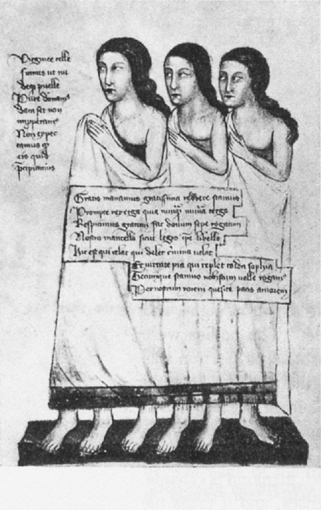
How far we have come from more primitive Christian approaches to the body. To review this progress visually we have only to glance at a twelfth-century depiction of the Three Graces in an Austrian manuscript. Poor, shapeless ladies, hovering behind their blanket, their unattractive feet splayed out before us, their barely functional legs just visible through their very necessary covering. Please, ladies, whatever you do, don’t drop that blanket.
(illustration credit 66)
But back to Botticelli. Venus, the central figure, is no longer just the ancient goddess of Love; she is now Humanitas, humanness, humanity itself, her dress the expression of Botticelli’s own time (as all instances of humanity must be set in a particular time), her face observant, thoughtful, expectant, haloed by the arbored arch of Nature. Here is humanity at its best, embodiment of the ideal. This sense of ideality, this enfleshed symbolic presence, has been made possible by the combination of an ancient sense of symbolism, to be found especially in the writings of Plato, and of a more hopeful, optimistic outlook on the world than the ancients could ever have achieved. What humanity is observing is the repeatable drama of Nature, seen under the aspect of its ideal, springtime. Symbolic ideals are shown in the manner of the ancient Greeks, pretty much absolved of clothing or adorned with the kind of clothing that makes the figures almost nuder than if they were merely nude. And these barely but beautifully draped figures are not only female: they are voluptuously female, females such as any male, however windy, would wish to impregnate, Zephyr’s intended target winking alluringly through Flora’s transparencies.
So why then is Mercury, the quick god with wings on his feet who delivers messages, turned away from all this sensuous fecundity? He’s using his caduceus, his famous serpent-entwined herald’s staff, to dispel rain clouds. More than this, it appears that he is summoning our eyes to something beyond. Indeed, the panel’s figures have been staged in such a way that our eyes are naturally drawn from right to left: from Zephyr’s importunate entrance to each of the six female figures to Mercury and past him to something outside the panel altogether.
Horizontal panels such as this were normally created to hang above daybeds in elegant palaces—and Italian daybeds were not intended just for napping. Primavera was hung in a house of the Medici, and we have good reason to believe that to Mercury’s right there hung a smaller panel by Botticelli: Athena and the Centaur [Plate 13], in which Athena, the reasonable goddess of wisdom, tames a hairy centaur, the very figure of human animality, by pulling his hair. Athena’s beautiful, vine-encircled breasts, at least as prominent as her serious expression, seem almost to offer a possible escape from the picture’s main message, which is that human reason and wisdom should tame human bestiality. Shall we, relaxing on our daybed, be moved to imitate Zephyr and the breezy ladies who celebrate springtime? Or shall we contemplate more soberly the triumph of wisdom over our animal nature? Hmm.
It seems clear that Botticelli himself was conflicted as to which resolution the siesta-takers should favor. At this point in his life, Athena is something less than his central ideal. Marginalized in a small panel beyond the fecund grove, she can hardly compete with the luscious Ludi Florales. But there is in Botticelli an ambivalence that twinkles at us through the translucencies.
It appears in another guise in another daybed panel, the postcoital Venus and Mars [Plate 14], in which Mars, utterly spent, snores openmouthed, while Venus, neither satisfied nor disgusted, simply wonders: What was that about? Her expression is a masterpiece of ambiguity, as she contemplates him, their future, her future. Was Mars just too frenzied to undress her properly? Is this wham-bam, followed by insensate snoring, what life will be like? The little imps playing with Mars’s weapons of war seem to undercut whatever residual dignity might have accrued to him. Though one imp blows a conch shell straight into the war god’s ear, we know that not even the shrill sound of that horn can waken him.
There is at least one more daybed panel, The Birth of Venus [Plate 15], Botticelli’s most famous painting, and in this one there is no ambiguity at all. Rather, The Birth of Venus seems so straightforward in its intention and so complete in its execution that it scarcely calls for commentary. Long ago I had a rather batty classics professor who always referred to this picture as Venus on the Half Shell, as if that were its actual title. It might as well be. The psychological connection between sex and food has never been more blatant. Venus is being served to us by chef Botticelli as the most exquisite morsel of his imagination. The face of Venus draws us. Neither as ambiguous as Venus contemplating the sleeping Mars nor as thoughtful as Venus observing the riot of Springtime, this Venus is at most calmly pensive, nearly smiling, and as sweetly content as any newborn.
Botticelli would use his sensational model for this Venus in other pictures as well, most notably in his Madonna of the Pomegranate [Plate 16]. But here Venus-Madonna seems not at all content. If the infant Jesus looks dazed, his mother looks downright depressed. No doubt the task awaiting them—redeeming the human race—would be enough to give anyone pause; and the succulent pomegranate, which was then believed to be the fruit with which the serpent tempted Eve and she Adam, surely served as a reminder of what lay before them. After this, Botticelli would give us but one more female nude, as the severe symbol of Truth in his strange and elegant Calumny. After Venus on the Half Shell, all of Botticelli’s surviving pictures are religious, many of them complexly allegorical, all (except for Calumny’s Truth) featuring elaborately clothed females.
What happened to Botticelli’s imagination? What became of his elegantly beautiful female nudes? Why did he excise them from his later work? It may be that only one word is needed by way of explanation: Savonarola. The crabbed Dominican friar changedBotticelli’s life and art as radically as any external force could possibly do, remaking Botticelli into a pious avoider of what he had formerly experienced as intense physical realities.
But there is also a more complicated possibility. Botticelli, so obviously heterosexual, never married. In fact, he claimed the very idea of marriage gave him nightmares. (In this he seems to have been at one with his Venus contemplating the snoring Mars.) But there was a rumor circulating in his lifetime that he was madly in love with Simonetta Vespucci, the honey-haired, creamy-fleshed model for The Birth of Venus. By the time Botticelli painted her as the Madonna of the Pomegranate, she was long since dead. Botticelli, who outlived Simonetta by thirty-four years, certainly never forgot her, for he asked to be buried at her feet. And there to this day his body lies at the foot of Simonetta’s grave in Florence’s Ognissanti, the Church of All Saints.
If any Renaissance artist—or, for that matter, any artist in history—is worthy of being approached on one’s knees, that artist is Michelangelo, il Divino, as he was hailed in his lifetime. He was born at Caprese, near Arezzo, in Tuscany; his parents were Florentines, and to Florence they returned within months of his birth. During his early childhood, however, his mother died, after which he was fostered out to the family of a stonecutter who lived in Settignano, a village with dramatic views, set on a hillside just northeast of Florence; and there he came in contact with the medium that would bring him such fame: marble. “If there is any good in me,” claimed Michelangelo to his biographer Vasari, “it is because I was born in the subtle atmosphere of your country of Arezzo. Along with the milk of my nurse I received the knack of handling chisel and hammer, with which I make my figures.”
Whether those claims are true, romanticized, or a biographer’s inflation, the words sound very much like Michelangelo, a man capable of humility and arrogance in the same sentence. He cared not a whit for riches, nor even for food or clothing. Throughout his long life of eighty-nine years he remained lean and muscular, silently despising those who were otherwise. He often slept in his clothes, not even bothering to remove his boots, and he never bathed. He cared only for the perfection of his art. He believed that every block of marble already contained a perfect form within it and that it was the task of the sculptor to free that form by chipping away all excess. To fall short of releasing such perfection was a moral as well as an artistic failure. He was often as dissatisfied with himself as he could be with others. An unsmiling loner, he hardly encouraged apprentices to attach themselves to him. Another early biographer, Paolo Giovio, wrote that “his nature was so rough and uncouth that his domestic habits were incredibly squalid and deprived posterity of any pupils who might have followed him.”
In many ways he was the opposite of Leonardo, the only other Renaissance artist who can approach him for greatness. Whereas Leonardo loved the natural world with the eye of a draftsman and the mind of a scientist, Michelangelo, Platonist to his core, saw little value in nature as such or even in the flesh as it actually is. The ideal form: that was what he wanted. Because of this, he looked down on painters as piddling draftsmen: they were as nothing compared to sculptors, who could release forms of such dynamic power as to remake mere nature and overwhelm the viewer completely.
At thirteen, Michelangelo was apprenticed to the Florentine painter Domenico Ghirlandaio.8 By the age of fourteen, the boy was already being paid a salary by Ghirlandaio, a most unusual development. In the same year, Lorenzo de’ Medici called Michelangelo to be part of his court, to roam through his gardens, and to behold—and to touch—his precious collection of classical statuary, then under the supervision of old Bertoldo di Giovanni, who had long ago been a student of Donatello’s. Michelangelo, teaching himself by trial and error—copying earlier works, especially paintings by Masaccio, experimenting with the fashioning of clay figures—soon felt himself ready to sculpt. By the age of fifteen or sixteen he had already produced two extraordinary bas-reliefs, theMadonna of the Steps and the Battle of the Centaurs, completely different from each other and so assured that the viewer finds he can credit the artist’s youth only by an almost painful contortion of faith. The young loner had also had a savage fistfight with another teenageartista, leaving Michelangelo with a squished nose for the rest of his life.
In the same period, the boy also carved in wood a slender and utterly nude Christ, nailed to his cross, a figure we may or may not still possess. This crucifixion was made as a gift to a local pastor who had allowed Michelangelo “a room to work in and bodies to study.” The bodies were, of course, corpses entrusted to the church for burial. Michelangelo was most grateful for the opportunity that the priest gave him to make this secretive study of anatomy—not an easy thing to pull off in those days—“for he could imagine nothing which would give him more pleasure” than to study these bodies.
The study certainly paid off. By his early twenties, Michelangelo was sculpting some of his most startlingly accomplished works, including a plumply muscular and inebriated Bacchus, god of wine and dark dreams, uncertain of his footing and trailed by a small but scary faun. The faun, smiling his creepy smile and sucking on bunches of grapes, clutches the lion skin that Bacchus holds indifferently in his left hand. The lion skin, symbolic of death and opposed to the life-giving power of the grapes, elegantly underlines Michelangelo’s meaning: self-indulgence in life leads to death.
Had Michelangelo been spending too much of his time amid corpses? Apparently not. His next work displays a grasp of human anatomy seldom if ever surpassed in the history of art: a Pietà [Plate 17], his first but hardly his last interpretation of the subject. The Italian word has many grades of meaning: pity, compassion, mercy, piety, devotion. Capitalized, however, it refers to a scene not found in the gospels but considered by medieval piety to be appropriate to the biography of Jesus: after the dead Jesus was taken down from the cross and before he was entombed by Joseph of Arimathea, it was imagined that his body would have been laid in the arms of his mother, Mary, who had followed him to his crucifixion (at least as reported in John’s Gospel). This unlikely scene is made even more unlikely by the difficulty of setting a grown man’s body in the lap of his (presumably) smaller and weaker mother. The medieval attempts at illustration are invariably awkward and unconvincing.
Michelangelo’s solution is extraordinarily clever, to such an extent that viewers are seldom aware of the visual trickery. Jesus is slightly smaller than his mother, but her draperies and her wide-kneed position successfully mask that reality. Moreover, the body of Jesus, slouching loose-limbed in an intensely realistic imitation of death, serves—along with Mary’s pose and her ample skirts—to attract our attention and to further mask the difference in the respective weights of the two figures. Perhaps even more important, the anatomy of Jesus is so exquisitely detailed as to demand soon enough almost our whole attention. But if that attention should stray, it will inevitably stray to Mary’s once-nurturing breasts, emphasized by the cross-band that slices through them and by the gathered cloth, and to Mary’s ever youthful but spiritual face, just bending forward over the body, resigned but—mysteriously enough—not inconsolable. She knows what has happened and why this was necessary.
Michelangelo was twenty-three when he finished this Pietà. His contempt for human self-indulgence and his sense of the need for human suffering will only grow as he ages. But it is worthy of note that this most loyal Platonist of all Renaissance artists, loving the reality of symbols, eschewing the follies of the flesh, is also an intensely loyal Christian, whose reverence for the episodes of the gospels and whose belief in the reality of the Redemption can be second to none. It is also worthy of note that Michelangelo’s piety takes at times an almost northern European turn. Before his Pietà, this grouping had been found almost exclusively north of the Alps, where it was called das Vesperbild (the Evening Image). As the respected contemporary critic Lutz Heusinger, professor of art history at Marburg, the original German Lutheran university, has written: “North of the Alps … the portrayal of pain had always been connected with the idea of redemption.” If Michelangelo’s Tuscan Platonism gives his Pietà a sinuosity that would be impossible for any German artist of this period, we should still bear in mind that Michelangelo’s mind and heart were open to very non-Italian and, from a strictly Roman Catholic viewpoint, dubiously orthodox Christian influences.
In the summer of 1501, Florence, after a long period of political chaos, was declared a republic once more, and friends of Michelangelo entered the government. Little more than a week after the declaration, Michelangelo was commissioned by Arte della Lana, the powerful wool guild, to sculpt a new David [Plate 18] that was to symbolize resurgent Florence. The result would be the most famous of all Davids, a historic symbol not only of Florence but of the human spirit. Michelangelo had spent his time well in the gardens of Lorenzo il Magnifico, where he seems to have learned all the secrets of the ancient Greek sculptors, none more valuable than their appreciation for what Italians came to call il contraposto (the opposition or antithesis), the art of sculpting a human body so that one half of it stands in opposition to the other half.
The earliest sculpture of every culture is symmetrical. On my desk, for instance, sits an ancient Canaanite fertility goddess—only her head is missing. But from her necklace a vertical line can be drawn reaching down the middle of her body, from her clavicle to the soles of her feet. On either side of this line her body appears in perfect symmetry, left shoulder mirrored by right shoulder, left breast by right breast, left hip by right hip, left leg by right leg, left foot by right foot. The only movement is in her forearms and her hands, her left hand pointing to her vulva, her right hand offering her left breast. This movement is an innovation, setting off this figure from the oldest prehistoric fertility figures, such as the Venus of Willendorf, which were rigidly symmetrical in all aspects.
The Greeks realized that such poses could quickly become static and boring and that the way to stir the viewer’s interest was to take even further such minimal movement as can be found in my Canaanite goddess and, in effect, force the sculpted body into a swivel, so that it will appear almost living. Thus, Michelangelo’s David stands in the Greek manner with his weight on his right foot, his whole right side at rest, even the right side of his face very nearly tranquil. But his left side is already moving forward, his left foot having taken its first step, his left buttock tensed, his left elbow jutting, his left hand (for like Leonardo, Michelangelo was left-handed) grasping the slingshot that will bring down the giant Goliath, the left side of his face resolute, ready, almost angry, even the curls of the left side of his head more tousled than those of his right.
Though the pubic hair and the dropped testicles alert us to the fact that David is no child, the oversized hands and feet (features the Greeks would have shunned as inelegant) remind us that this boy is still growing and possibly a little awkward. The breastbone pushing through his chest (another non-Greek feature) even elicits our tenderness for this boy-man. Though completely nude, this is no Donatellesque toyboy. Rather, to use an expression found in many languages, he’s got balls:9 this is a serious, even a grim figure, shown to us in his last moment before the decisive battle, when all is at stake.
A committee of citizens (including Leonardo) decided that the extraordinary work must be exhibited in Florence’s central square in front of il Palazzo Vecchio, the town hall. “It was,” remarks Heusinger, “the first time since antiquity that a large statue of a nude was to be exhibited in a public space.” Though local newsstands today sell postcards displaying, among other views of the statue, a close-up of David’s genitals, this is just an example of contemporary embarrassment before herculean greatness: there is nothing sexually suggestive about this David. Michelangelo would have pulled down the newsstands in short order.
What could an artist be expected to accomplish as an encore to a feat of such consummate grace? Why, the Sistine Chapel ceiling, of course.
When, at the command of the newly elected Pope Julius II, Michelangelo came to Rome in 1505, he was just turning thirty. He brought with him not only his own colossal talent but the entire Italian Renaissance, which till then had been almost wholly confined to Tuscany, largely to Tuscany’s capital. Julius, a titanic figure possessed of a will to match Michelangelo’s in strength, wished to build a tomb for his own eventual interment, and this the pope envisioned as an enormous freestanding monument with forty-five life-sized statues, to be constructed in a manner so grand that its like had not been seen since the burials of great men in ancient times. Michelangelo, the pope thought, was the obvious fellow for the job.
As the young artist settled into his work, the pope—at twice Michelangelo’s age—began to have trouble finding the right venue for his elaborate funerary erection. Meanwhile, he decreed, Michelangelo could keep busy by helping with plans for the new Saint Peter’s Basilica. Michelangelo, failing to obtain an audience with the pope to discuss these matters—and even barred by an officious little footman from entering the pope’s chambers—fled Rome. Soon enough, the artist found himself confined to Bologna and forced to work on most unwelcome tasks. Back in Rome by 1508, he was still prevented from working further on Julius’s tomb. Rather, the mercurial Julius decreed, Michelangelo could occupy himself by painting the ceiling of the Sistine Chapel.
In order to perform this feat, Michelangelo, who, as we know, despised painting, had to learn the elaborate art of frescoing, something he’d never done before—but, as we also know, Michelangelo was an incredibly quick study. Now, as Michelangelo grudgingly accepted the limits placed upon him by the pope and began to plot a complex scheme for the ceiling, Julius II “allowed himself to be carried away by Michelangelo’s creative violence and the two inspired each other in turn with always grander designs,” to quoteHeusinger.
The result was the most splendid work of this reluctant artist’s amazing career, a progressive set of illustrations of salvation history that to this day fills every viewer with an awe that overwhelms whatever historical or theological preconception one may bring to the chapel, drowning any and every objection you may wish to pose between yourself and this ceiling and finally exalting you mercilessly in its very nearly blinding illumination. As Yeats would put it:
Michael Angelo left a proof
On the Sistine Chapel roof,
Where but half-awakened Adam
Can disturb globe-trotting Madam
Till her bowels are in heat,
Proof that there’s a purpose set
Before the secret working mind:
Profane perfection of mankind.
It may be profane in the sense of its pagan roots in art history, but it is also deeply religious, profoundly rooted in the artist’s—certainly not the warrior-pope’s—biblical faith. While Michelangelo remained for four years wedded to the pope’s ceiling and his own elaborate plan for it, the equally busy pope—in silver armor—was leading papal armies through northern Italy, forming a holy league with Venice and Spain, then with England and Switzerland, driving the French from Italy, and adding Parma, Piacenza, and Reggio Emilia to the Papal States.
Michelangelo, meanwhile, was gradually being crippled in the execution of this commission, as he lay on his scaffold straining himself unnaturally toward the ceiling, ending up with a goiter in his throat and most of his muscles and joints pushed out of shape. As he put it in one of his many excellent poems:
La barba al cielo, e la memoria sento
in sullo scrigno, e ’l petto fo d’arpia,
e ’l pennel sopra ’l viso tuttavia
mel fa, gocciando, un ricco pavimento.
My beard toward Heaven, I feel the back of my brain
Upon my neck. I grow the breast of a Harpy:
My brush, above my face continually,
Makes it a splendid floor by dripping down.
Dinanzi mi s’allunga la corteccia,
e per piegarsi adietro si ragroppa…
In front of me my skin is being stretched
While it folds up behind and forms a knot…
Michelangelo had also to endure the curiosity of various papal insiders, as well as rival artists who, at work on other papal commissions, would inevitably attempt to steal a look at what he was up to. Raphael, in particular, was an annoyance. Eight years Michelangelo’s junior, he recognized the older artist’s enormous talent, but, a gifted imitator, he even tried to be appointed by Julius as Michelangelo’s replacement, once he had had a peek at the “new and marvelous style” in which Michelangelo was proceeding. Had his vile little conspiracy succeeded, we could have had a ceiling that gradually devolved from Michelangelo’s noble conceptions to a sweetly sentimental soup. Easy, untrustworthy Raphael, bon vivant, lover of many women, professional charmer, often painted in a mawkish style that he knew would be popular. Cute children and lovely women, whether the Virgin Mary or one of his current mistresses, tended to be his favored subjects. Essentially, he went Botticelli one better, though he lacked Botticelli’s underlying seriousness and owned no trace of Michelangelo’s unbending nobility. His late-night carousing shortened his life considerably: he died while still in his thirties. Let us memorialize him here with his sketch of Leda and the Swan, which he made in imitation of a lost work by Leonardo. (More of Raphael’s work may be found in the Portfolio of Egos, which follows.)
Once Julius was able to absorb what Michelangelo was about, it is hard to imagine his ever switching artists. Rather, the old pope found himself ever more attached to this artist of his ceiling: he “loved him utterly,” wrote Ascanio Condivi in Michelangelo’s own lifetime, “and was more caring and jealous for him than for anyone else whom he had around him.” And Michelangelo returned the sentiment, despite the shocking candor with which he often addressed God’s Vicar. When Julius ordered him to enrich his Old Testament figures by adding some gold leaf to their draperies, Michelangelo refused outright, saying, “My Lord, they were all poor men.”

(illustration credit 67)
The vaulted ceiling on which Michelangelo lavished such love that he became utterly loved by such a pontiff, a man exceedingly brusque and egotistical even for a pope, cannot be adequately described here, for indeed it cannot be adequately described anywhere. It contains, by my count, seventy-five principal images—both full-fledged scenes and dramatic single figures, such as a succession of Hebrew prophets and classical sibyls—each one set off by itself and framed by some architectural or trompe l’oeil effect. Kings of Israel, as well as figures from secular history, such as Alexander the Great, put in an appearance. David slays Goliath once more, as Judith decapitates Holofernes. Moreover, there are scores of cherubs and youthful nudes that serve as additional framing devices to the principal scenes and figures. And all is in aid of the central panels: the cosmic God of the Jews creating the universe and its first human beings, the Temptation in the Garden, the Expulsion, and the salvific story of Noah and the Flood.
There are whole books devoted to unpacking this ceiling, and this book cannot be one of them. Rather, we print here a photograph of the ceiling [Plate 19] and a close-up of one of the scenes—the most famous image of all: The Creation of Adam [Plate 20]. But to understand the “proof” that Michelangelo left for us one must, like the “globe-trotting Madam” of Yeats’s poem, behold the thing in itself, not merely in reproduction. Go early in the day, taking the first bus from Saint Peter’s Square at 8:30 a.m., when most tourists are still eating their breakfasts. And when the bus drops you at the Vatican Museum, do not linger over any of the astonishing riches to be seen along the way. Go straight to the Sistine Chapel. If possible, lie down on the floor. And look.
And as you look, the ceiling will greet you, welcome you, and take you in. As Elaine Scarry has described the confrontation with a supreme masterpiece: “Not Homer alone but Plato, Aquinas, Plotinus, Pseudo-Dionysius, Dante, and many others repeatedly describe beauty as a ‘greeting.’ At the moment one comes into the presence of something beautiful, it greets you. It lifts away from the neutral background as though coming forward to welcome you—as though the object were designed to ‘fit’ your perception.… It is as though the welcoming thing has entered into, and consented to, your being in its midst. Your arrival seems contractual, not just something you want, but something the world you are now joining wants.”
I promise you, you will feel you have come home.
When Julius died in 1513, his tomb remained unfinished. Though he had always been generous in his payments to Michelangelo (as to his many other artists)—in the process making Michelangelo a rich man—the pope probably never amassed the extraordinary sums necessary for his tomb, at least as originally planned, modern dictators never quite being able to pull off the depredations that ancient ones could manage. Julius, putting the brakes on his personal monument while sending Michelangelo off in other directions, forced the great sculptor to become both a great painter and a great architect. Michelangelo’s best-known achievement in architecture is of course the dome of Saint Peter’s, but there are numerous others.
Michelangelo very much wanted to construct an elaborate tomb for Julius, but both Julius’s occasionally straitened circumstances and, after his death, the parsimony of his heirs made that impossible. Today, his much-reduced monument stands in a side aisle of the otherwise modest Church of San Pietro in Vincoli (Saint Peter in Chains), its paltry size a commentary on the priorities of a formerly impoverished family—the della Rovere—made rich and powerful by their famous relative’s pontificate. But central to the monument is the statue of Moses [Plate 21], which Michelangelo considered his most lifelike creation. It is certainly a great work, as appropriate a tribute to the barely contained violence of Julius’s tremendous ego as to the austerely dominating will of Michelangelo. (Each man was, in his way, a kind of Moses.) The figure’s horns, a usual feature of Moses in Christian art because of a (probably) inaccurate translation of the Torah’s Hebrew into Latin, seem appropriate to this muscular middle-aged man, no longer a forward-moving, athletic aspirant like the David, but a singular, seated, unbendable authority.
Sadly, Michelangelo’s personal authority, however impressive, was no match for the authority of popes. Of the eight popes who succeeded Julius II in Michelangelo’s lifetime, most were enthusiastic patrons of the arts, but they lived in different times, and far more complicated political pressures than Julius had known forced them to look upon Michelangelo with caution and even, as time went on, with suspicion.
It was, of course, Julius, always in need of funds to implement his large ideas, who struck the match that lit the fires that would encircle these later popes. To finance the building of the grand new Basilica of Saint Peter’s, which would just have to be the most astounding building in all of Christendom, Julius arranged for a sale of indulgences. At the time, it seemed not at all a momentous move, almost routine, but it would serve to spark the Protestant Reformation and to help trigger, subsequently, a Catholic Counter-Reformation, the movements that will occupy us for the remainder of this book. The end result would entail the permanent fracture of Christendom.
Clement VII, a Medici bastard and the third pope after Julius II, would commission Michelangelo to paint a vast mural on the wall above the Sistine Chapel’s main altar. His successor, Paul III, would reign as Michelangelo completed the commission, a seven-year project. This mural, known today as The Last Judgment [Plate 22], was given by Michelangelo a much more positive title, The Resurrection.
At its dramatic center, a muscular Christ, accompanied by the Virgin Mary, raises his right arm in a gesture of repudiation. It appears that he is assigning some to Heaven, others to Hell, a depiction of the scene of final judgment related in Matthew 25. But there is mass confusion, especially among the figures on either side of Christ and his mother. There are actually four tiers of clustered nudes: the ones on the lowest level are either in Hell or on the nearby shore of the River Styx, waiting to be ferried to Hell by an exceedingly horrific Charon. Even at this lowest level, however, there are skeletons rising from their graves, yet to be clothed in flesh—and who knows where they will end up? On the second tier—of nudes floating on clouds—some seem about to sink below, while others appear destined to float higher. Next comes the tier with Christ, Mary, and large clusters of nudes who seem mostly uncertain as to where they will end up. The highest tier, whose floaters mostly embrace instruments of torture, are already safely Heaven-bound: the instruments they hold—a cross, a crown of thorns, a pillar—are the instruments of Christ’s own passion and possibly theirs. These are the martyrs.
Except for those already arrived in Hell and perhaps those few in the second tier who seem to have already despaired, Michelangelo appears to hold out the hope that many will reach Heaven. Why then is one’s initial impression that of sheer confusion or even despair? Surely, because this is part of the artist’s conception—to confuse viewers initially and foist a question on them: Will I make it or not? This is meant to be—finally—a hopeful scene, but offering hope only after one has made a personal examination of one’s own conscience and resolved henceforward to live a better life.
The moral was insufficient for Pope Paul III. He was shocked by so much nudity, as were many in his court—or at least they claimed to be—and the pope, egged on by his master of ceremonies, Biagio da Cesena, began objecting to the nudes long before Michelangelo was finished. To Michelangelo the nudity was unremarkable, even required: “Naked came I out of my mother’s womb,” insists the Book of Job, “and naked shall I return thither.” By 1541 when the mural was completed, it was clear that one of the nudes in Hell, the one sprouting donkey’s ears and encircled by a snake that was biting off his genitals, looked remarkably like the master of ceremonies. Biagio objected vigorously to Paul, insisting that the painting belonged in a tavern. The pope, unwilling to confront the artist, shrugged his shoulders and explained to Biagio that popes have no jurisdiction over Hell.
Papal Rome was at last singing a new and more solemn tune. Luther’s Reformation and its consequences had fragmented Europe politically as well as religiously, and, like Humpty Dumpty, the continent would never be put back together again. The Catholic Church’s own instrument of Reformation, the Council of Trent, was intermittently wending its tortuous way. Everyone now knew that public scandal would only hurt the Catholic Church further. Nudes were scandalous; in fact, they were pagan, not Christian, no matter what Michelangelo might have to say about their honesty, beauty, reality, or symbolic worth.
Walter Pater would describe the aging Michelangelo thus: “The world had changed around him. The ‘new catholicism’ had taken the place of the Renaissance. The spirit of the Roman Church had changed: in the vast world’s cathedral which his skill had helped to raise for it, it looked stronger than ever.… The opposition of the Reformation to art has been often enlarged upon; far greater was that of the Catholic revival. But in thus fixing itself in a frozen orthodoxy, the Roman Church had passed beyond him, and he was a stranger to it.”
Once Michelangelo was dead and could no longer wither others in confrontation, a subsequent pope—the exceedingly antipathetic Paul IV—hired Daniele da Volterra, one of Michelangelo’s old assistants, to paint perizome (loincloths) over all the visible genitals and backsides in the mural. This assistant also scraped and repainted whole figures that were judged too sexually suggestive. He never finished his work; most of it, though not all, has recently been removed.
Pants painters and pants sculptors were suddenly everywhere, concealing at the direction of the frozenly orthodox what had formerly been open to the light of day. Even a late marble sculpture of Michelangelo’s, one of his best, a nude Christ bearing his cross, a beautiful figure with a beautiful face, had to be assigned its (metal) drapery. Fig leaves became omnipresent. It is a shameful human dynamic that so often in history reformation should precipitate, and then codify, hypocrisy.