
7
7.1 Immediate and Later Reception of the Chronicle by Byzantine Authors
We begin this discussion by exploring the immediate reception of the Epitome by members of the Constantinopolitan literary circles. By ‘immediate’, I mean the reception of the work by its audience until roughly the 1170s, namely about thirty years after its ‘publication’. There are two testimonies which give us an idea of how approximate contemporaries of Zonaras approached and exploited the Epitome. These are the chronicles of Constantine Manasses and Michael Glykas.
It is hard to pinpoint exactly when Manasses lived and composed his Chronike Synopsis (henceforth: CS), a chronicle of 6620 fifteen-syllable verses which begins with the biblical Creation and continues up to the reign of Nikephoros Botaneiates.1 The only evidence we have for the date when the CS was written comes from the work itself. First, an epigram preceding the text reveals that the author dedicated his chronicle to a prominent literary patroness of the twelfth century, the sebastokratorissa Irene, the sister-in-law of the emperor Manuel Komnenos.2 Irene’s date of death, approximately 1152/3, is the terminus ante quem of the work. Second, a few laudatory lines addressed to ‘the greatest lord of the Ausones (Romans)’ (‘μέγιστον Αὐσονάνακτα’) Manuel demonstrate conclusively that the text was completed after his ascent to the imperial throne in 1143.3 The CS, therefore, can be dated to between 1143 and 1152.
The chronicle of Zonaras was one of the major sources employed by Manasses, even though he never mentions the name of his predecessor. This is not surprising given that, as a rule, Manasses avoids acknowledging his sources. The fact that the author makes use of a work which had only recently appeared may suggest that Zonaras’ Epitome must have made an impression on him or, as Treadgold supposes, his patroness.4 Treadgold assumes that Irene might have read Zonaras’ account and commissioned Manasses to write a more succinct universal chronicle. It is striking, but not altogether unexpected, that a text which was replete with remarks that were highly critical of the first Komnenian emperor would circulate through the networks surrounding the sebastokratorissa, whose relationship with Manuel was extremely tense in the last decade of her life. Following the death of her husband, the sebastokrator Andronikos Komnenos in 1142, Irene fell out of favour with the emperor, which led to her imprisonment and banishment from the capital. Despite the antipathy his benefactor had towards Manuel, Manasses was cautious lest he too fell into disgrace in court circles and therefore spoke in positive terms about Manuel.5 Omitting Zonaras’ harsh remarks about the Komnenian system of government, he professes that the reason why he terminated his history with the deposition of Botaneiates is that the achievements of the Komnenoi were too glorious to be expressed in words.6
The Epitome was a very useful compendium for Manasses. Unlike Zonaras, who gradually developed the project of a world chronicle on the basis of the source material he had managed to acquire, Manasses had a large store of material readily available to him, and one which covered the entire period he intended to relate in his writing. He consults Zonaras for his presentation of the biblical, the Roman, and the Byzantine past, and traces of the Epitome are found in the CS from the start. More often than not, though, Zonaras’ chronicle is not the principal source used by Manasses, who tends to use the Epitome in parallel with the text or texts on which he primarily bases his narrative.7
A first observation to make about Manasses’ method of work is that when drawing on the vocabulary of his fellow chronicler, he tries to fit Zonaras’ phrasing into the rhythmic structure of his verses. Manasses’ brief account of the legendary rape of Lucretia by Sextus Tarquinius is a case in point. To recount the history of the early Roman Empire, Manasses mainly follows the Roman Antiquities of Dionysius of Halicarnassus, but on reaching the story of Lucretia, he gives precedence to the Epitome. This is what Dionysius writes in his text: ‘Sextus attempted to corrupt this woman, because she was the most beautiful and prudent of all Roman women’ (‘ταύτην τὴν γυναῖκα καλλίστην οὖσαν τῶν ἐν Ῥώμῃ γυναικῶν καὶ σωφρονεστάτην ἐπεχείρησεν ὁ Σέξτος διαφθεῖραι’).8 The corresponding extract in the Epitome is as follows:
Lucretia was daughter of Lucretius Spurius, a senator, and wife of Tarquinius Collatinus, a prominent man. She was renowned for her beauty and prudence. Sextus, the son of Tarquinius sought to dishonour this woman […]
ἡ δὲ Λουκριτία θυγάτηρ μὲν ἦν Λουκριτίου Σπουρίου, ἀνδρὸς τῶν τῆς συγκλήτου ἑνός, γαμετὴ δὲ Κολλατίνου Ταρκυνίου τῶν ἐπιφανῶν, ἐπί τε κάλλει καὶ σωφροσύνῃ τυγχάνουσα περιβόητος. ταύτην Σέξτος ὁ τοῦ Ταρκυνίου υἱὸς αἰσχῦναι σπούδασμα ἔθετο […]9
In the chronicle of Manasses, we read that: ‘Since the child of Tarquinius committed a crime / and dishonoured the most prudent Lucretia, / wife of Collatinus, a most noble man […]’ (‘ἐπεὶ δὲ παρηνόμησεν ὁ παῖς τοῦ Ταρκυνίου / καὶ Λουκρητίαν ᾔσχυνε τὴν σωφρονικωτάτην, / τὴν Κολλατίνου γαμετὴν ἀνδρὸς εὐγενεστάτου […]’).10 Τhe segment of the Epitome ‘ταύτην Σέξτος ὁ τοῦ Ταρκυνίου υἱὸς αἰσχῦναι σπούδασμα ἔθετο’ provides Manasses with the inspiration for verses 1685–6 of his chronicle. He replaces the two-syllable word ‘υἱὸς’ with the one-syllable word ‘παῖς’ to form the second hemistich of the fifteen-syllable verse, which should consist of seven syllables. He prefers to employ a form of the verb ‘αἰσχύνω’, present in Zonaras’ narrative, instead of a form of ‘διαφθείρω’, which is used by Dionysius. In verse 1687 he takes the phrase ‘γαμετὴ δὲ Κολλατίνου’ almost verbatim from Zonaras’ text, as he can easily adapt it to form the first eight-syllable hemistich of the political verse.
A second point to notice is that Zonaras’ overall writing style was clearly too rigid for Manasses’ taste. The author of the CS certainly wished to relate the history of Christianity and the Roman nation, but was equally, or even more, concerned with composing a flowery narrative and recounting good stories to please and entertain his audience.11 As a rule, therefore, he selected short pieces of information from the Epitome and tried to enrich the text of his source with impressive literary motifs, such as fanciful metaphors and compound adjectives that he often coined himself. We can consider, for instance, how Manasses rewrites and expands the following sentence in which Zonaras talks about the library near the Chalkoprateia church in Constantinople. Zonaras writes: ‘There was an imperial building in the so-called basilica very close to the Chalkoprateia, where many books of both secular, and very noble and holy wisdom were found’ (‘οἶκος ἦν ἐν τῇ καλουμένῃ Βασιλικῇ ἔγγιστα τῶν Χαλκοπρατίων βασίλειος, ἐν ᾧ καὶ βίβλοι τῆς τε θύραθεν σοφίας καὶ τῆς εὐγενεστέρας καὶ θειοτέρας πολλαὶ ἐναπέκειντο’).12 In Manasses’ chronicle, we read:
Close to the courtyard of Saint Sophia,
an illustrious building was erected by the old emperors,
one could say a pretty garden of book-bearing trees,
a grove beautifully planted with all kinds of wisdom.
Τοῦ τεμενίσματος ἐγγὺς τῆς τοῦ Θεοῦ Σοφίας
οἶκος λαμπρὸς δεδόμητο τοῖς πάλαι βασιλεῦσι,
κῆπος, ἂν εἴποι τις, ἁβρὸς βιβλιοφόρων δένδρων,
ἄλσος ἀγλαοφύτευτον παντοδαπῆς σοφίας·13
As can be seen in these extracts, Manasses composes his verses by using Zonaras’ language as his primary material (‘οἶκος […] βασίλειος’ > ‘οἶκος […] τοῖς πάλαι βασιλεῦσι’, ‘ἔγγιστα > ἐγγὺς’, ‘σοφίας’), but modifies the austere narrative of his source to suit his own style. He therefore comes up with two well-turned similes, likening the library to a garden of ‘book-bearing trees’ and ‘a grove, beautifully planted with all kinds of wisdom’. He also makes use of two striking adjectives, ‘βιβλιοφόρων’ and ‘ἀγλαοφύτευτον’. The adjective ‘ἀγλαοφύτευτον’ was invented by Manasses himself and is a hapax legomenon in Greek literature, as a search in the Thesaurus Linguae Graecae database shows. Although he makes use of Zonaras’ text, in other words, Manasses seeks to produce a chronicle with higher literary pretensions than his predecessor’s.
Glykas was active during the reign of Manuel Komnenos.14 A former imperial secretary, he fell out of favour with the emperor, and was blinded and imprisoned in 1159.15 It is generally agreed that the chronicle was penned some time after Glykas’ release from prison in c.1164–1165.16 The text extends to the death of Alexios Komnenos in 1118 and is divided by the writer into four sections: (a) the Creation; (b) Jewish history; (c) Roman history; and (d) Byzantine history. Two of the most notable features of the work are the attention Glykas pays to the biblical and Jewish past, as well as the avid interest he exhibits in the natural world.17
The writer relies on the Epitome mainly to supplement the works of George the Monk, John Skylitzes, and Skylitzes Continuatus.18 He makes no use at all of Zonaras’ extensive account of the early Roman Empire and Republican Rome since, following George the Monk, he starts the Roman section of his work with Julius Caesar.19 He takes more material from the Epitome to record the history of Byzantium, particularly the events between the reign of Theophilos and the reign of Basil I,20 as well as those during the age of Alexios Komnenos. The part of the chronicle dedicated to Alexios is the only one that depends solely on the Epitome.21 On the whole, Glykas remains very close to Zonaras’ content and wording. Although he greatly abridges the narrative of his source, he includes in his text pieces of information which present Alexios in a negative light. We read, for instance, that he would reduce the wealth of those belonging to the senatorial class, that he would come up with unjust ways to collect taxes, and that he had given the rulership of the Empire over to his mother. Like Zonaras, Glykas, too, appears displeased with the Komnenian style of government, and therefore does not hesitate to repeat some of Zonaras’ critical remarks about the first emperor of the Komnenoi.22
It is worth mentioning that Glykas cites Zonaras by name four times in the course of his narrative. He tells us, for example, of the two different etymologies given by George the Monk and Zonaras for the word ‘palace’ (‘παλάτιον’).23 The former explains that the term derives from ‘Πάλας’, the name of a Persian eparch in Italy who built a magnificent house there.24 The latter associates the word with the Palatine Hill, where, according to tradition, the shepherd Faustulus found Romulus and where later Julius Caesar established his residence.25 Glykas repeats Zonaras’ text almost verbatim, which indicates that he must have had access to a manuscript of the Epitome. Also, the writer remarks that the accounts of Skylitzes and Zonaras do not agree with each other on the identity of Leo VI’s real father, with Zonaras arguing that Leo was actually the son of Michael III.26 Although the Epitome had been ‘published’ only a short time before, it seems that Glykas expected the recipients of his work to be familiar with Zonaras and his chronicle, just as he expected them to know the work of Josephus and the older chronicles of George the Monk and John Skylitzes, which he repeatedly names as his sources, too.27
This observation leads us to include in this discussion the references we find to Zonaras’ commentary on the holy canons in another work by Glykas, namely his Theological Chapters, a collection of ninety-five essays that interpret biblical passages or analyse canonical problems.28 The majority of these are written in the form of letters and are intended as replies to questions posed to the author by various individuals. Focusing on the identity of Glykas’ correspondents, Magdalino has observed that a great many of them were monks; only very few were laymen holding a high position in society.29 Scholars tend to believe that these essays were produced after 1165, although it is difficult to determine whether their composition predates that of the chronicle.30 Glykas quotes Zonaras’ hermeneutical work on the canons in letter no. 90, which is addressed to a monk called Ioannikios the Grammarian.31 The epistle focuses on an extract from Paul’s first epistle to the Corinthians, which concerns a man who had an affair with his stepmother.32 Paul urges the Corinthians ‘to hand this kind of man over to the devil to destroy his flesh, so that his spirit may be saved in the day of the Lord Jesus’ (‘παραδοῦναι τὸν τοιοῦτον τῷ σατανᾷ εἰς ὄλεθρον τῆς σαρκός, ἵνα τὸ πνεῦμα σωθῇ ἐν τῇ ἡμέρᾳ τοῦ Κυρίου Ἰησοῦ’).33 Glykas disagrees with those who interpret Paul’s words to ‘hand this man over to the devil’ as meaning excommunication from the body of the Church.34 Zonaras was the theologian who, as we read in the very first lines of the letter, interpreted Paul’s extract in this way. Glykas continues by listing a series of arguments which indicate that Zonaras’ opinion was incorrect. According to Glykas, Zonaras did not carefully consider the evidence found in the writings of other theologians, particularly those of Basil the Great, and was not particularly precise in the language he used.35 The entire letter is essentially a rebuttal of Zonaras. Although Glykas disagrees with Zonaras’ view, the fact that he produced an entire letter with the intention of refuting Zonaras’ thesis indicates that he thought highly of him as a theologian. His characterization of Zonaras as a ‘very learned’ man (‘λογιώτατος’) towards the end of this epistle further attests to his admiration for Zonaras’ theological knowledge. The impression is that Ioannikios, and generally the monastic audience to which this corpus of essays was directed, were expected to be aware of Zonaras and his canonical work. In contrast, Glykas obviously feels the need to introduce the pagan historical figures which he mentions, namely Pindar and Heraclitus.36 It is reasonable to infer, therefore, that by the time Glykas compiled his Theological Chapters, Zonaras had already earned some fame as a commentator on the canons among men with theological and exegetical interests.
These considerations accord well with the high esteem in which Theodore Balsamon held Zonaras as a canonist. Along with Alexios Aristenos and Zonaras, Balsamon was the third great commentator on canon law to be active during the twelfth century.37 His hermeneutical work on the canons must have been completed shortly after the death of Manuel Komnenos in 1180.38 Unlike Zonaras, whose interpretation of the canons rests extensively on a theological basis, Balsamon’s exegesis proceeds primarily from a legal point of view.39 In spite of this, he consults the work of his predecessor, occasionally repeating and expounding Zonaras’ comments.40 Twice in his account Balsamon calls his predecessor ‘extraordinary’ (‘ὑπερφυής’, ‘ὑπερφυέστατος’), showing his appreciation of Zonaras’ legal erudition.41 This reinforces the impression that no more than two decades after the ‘publication’ of his canonical work, Zonaras already stood out in the field of canonical legal literature.
The conclusion to draw on the basis of these observations is that Zonaras became known in a relatively short period of time on account of his broader scholarly activity. Both his chronicle and his exegesis of the canons attracted the attention fairly quickly of his close contemporaries. The Epitome was already being read aloud in the literary salons of the capital in the late 1140s or early 1150s, and must have been a success among the learned men of Manasses’ circle. When Glykas composed his own works, a little more than two decades later, he evidently expected that his readers would be familiar with the two most extensive compositions in Zonaras’ oeuvre.
At this point, I would like to note a paradox in the survival of manuscripts containing the Epitome. Although the use of the chronicle by Zonaras’ near contemporaries Manasses and Glykas betrays its circulation during the twelfth century, the earliest surviving manuscript of the Epitome, the Par. gr. 1715, dates to 1289, more than a hundred years after the text’s ‘publication’. In contrast, for example, the widely copied chronicle by Manasses is preserved in many manuscripts which date to the first hundred years after the work’s ‘publication’, with the prototypes of these dating to this period.42 Might this ‘delayed’ transmission of the Epitome indicate that the chronicle was not initially popular? The evidence presented above suggest the opposite, particularly in terms of the work’s circulation in Constantinopolitan circles. In addition, paradoxical occurrences in the circulation of literary texts in medieval times are common. Another peculiarity in the transmission of a Byzantine historical work concerns John Malalas’ chronicle, for instance, which survives in a single defective manuscript dated to the eleventh or twelfth centuries.43 Yet it is clear that earlier copies of the work did exist, as not only was Malalas employed by Byzantine authors such as Evagrios of Epiphaneia, John of Antioch, and Theophanes Confessor prior to the eleventh century,44 but also his chronicle was translated into Latin in the seventh century and started being used by Syriac chroniclers in the eighth.45 Striking peculiarities can also be seen in the survival of texts belonging to other genres, as is the case with Galen’s Therapeutics to Glaucon, a much-copied and influential work. Galen’s text (or fragments of it) is preserved in thirty manuscripts, the earliest of which date to the thirteenth century, with a few additional witnesses dated to the tenth.46 Despite this late transmission of the Therapeutics to Glaucon, commentaries and summaries of the text were produced as early as the fifth century,47 which proves that manuscripts of the work had been clearly circulating since much earlier. In the light of these remarks, therefore, the fact that the earliest surviving codex of the Epitome dates to the late thirteenth century is by no means an indicator of the work’s popularity prior to that period.
The Epitome continued to be held in high regard by authors of universal chronicles in the following centuries, too. A chronicle which is known to have taken much material from the Epitome is that of Ephraim from Ainos. Roughly dated to the first or second decade of the fourteenth century, the work consists of 9588 dodecasyllable verses and is arranged by reign.48 The first two sheets of the manuscript in which the text survives, the Vat. gr. 1003, have been lost. As a result, we do not know either the original title of the chronicle or its precise starting point.49 In its present form, the text commences with Caligula and concludes with the reconquest of Constantinople by Michael VIII Palaiologos in 1261.50 As a rule, the presentation of the Byzantine emperors (from Constantine the Great onwards) is more elaborate than that of the Roman emperors, to whom the author usually dedicates a terse paragraph each. Notable also is the intense focus of the narrative on each emperor’s contribution to Christianity and the development of orthodox dogma.
Ephraim owes much to Zonaras, with the Epitome being his principal authority for the period until the regime of Alexios Komnenos.51 Unlike Manasses, whose writing style is particularly rhetorical, he is not interested in rendering the narrative of his source in a different, more flowery mode. The author remains faithful not only to the content but also to the phrasing of Zonaras’ text. Depending on how easy it is to put the sentences of his source into verse, he even follows the syntactical structure of Zonaras’ narrative. This is revealed, for instance, by a comparative reading of the two brief segments that follow. In the Epitome, we read: ‘Since there were three emperors, namely Constantine himself, Licinius and Maxentius […]’ (‘Τριῶν δ’ ὄντων τῶν βασιλέων, αὐτοῦ Κωνσταντίνου καὶ Λικιννίου καὶ Μαξεντίου […]’).52 Ephraim writes: ‘Since there were three emperors then, / he [Constantine], Maxentius and Licinius […]’ (‘Τριῶν δ’ ὑπόντων αὐτοκρατόρων τότε, / τούτου Μαξεντίου τε καὶ Λικινίου […]’).53 Here, Ephraim stays very close to both the wording and the syntax of the Epitome. For metrical reasons, though, he uses the two-syllable participle ‘ὑπόντων’, instead of ‘ὄντων’ found in Zonaras’ text, replaces the noun ‘βασιλέων’ with ‘αὐτοκρατόρων’ and inserts the adverb ‘τότε’ to form his dodecasyllable verse.
In other instances, the writer sometimes paraphrases the Epitome by changing the order of the words, or seeks to find terms which are close synonyms of Zonaras’ and fit the metre of his text. According to the Epitome, for example, ‘Zeno came from the most shameful nation, that of the Isaurians, himself being most ugly in both his appearance and his soul […]’ (‘Ἦν δὲ ὁ Ζήνων ἐξ ἔθνους αἰσχίστου τοῦ τῶν Ἰσαύρων, αἴσχιστος καὶ αὐτὸς καὶ τὴν μορφὴν καὶ τὴν ψυχὴν γεγονώς […]’).54 In the corresponding passage of his chronicle, Ephraim replaces the word ‘ψυχὴν’, present in the Epitome, with ‘καρδίαν’, a metrically convenient synonym: ‘Zeno came from the Isaurians, as I said, / a most ugly man in both body and heart’ (‘Ζήνων δ’ ὑπῆρχεν ἐξ Ἰσαύρων, ὡς ἔφην, / αἴσχιστος ἀνὴρ καὶ δέμας καὶ καρδίαν’).55 Ephraim treats the other major sources of his chronicle—the historical works of Niketas Choniates and George Akropolites—in much the same way.
Ephraim displays an avid interest in the portrayals of emperors he finds in his sources. He usually inserts a short description of each emperor at the beginning of the section dedicated to his reign. For his presentation of Alexios Komnenos, he draws on the last part of Zonaras’ account of the emperor.56 One can observe that Ephraim eliminates all elements of Zonaras’ outspoken critique of Alexios. He leaves out the details that are unfavourable to the Komnenian emperor and thus conveys a much more positive image of him. Alexios is depicted as a moderate, accessible ruler, one who would not indulge in luxuries and would pay honour to virtuous men.57
The Epitome also furnished much material for a contemporary of Ephraim, Constantine Akropolites (d. c.1324), whose chronicle survives in the fourteenth-century codex Vind. hist. gr. 99.58 Constantine, the son of the historian George Akropolites, was a prolific writer who gained much fame, particularly for his metaphrases of saints’ lives.59 His chronicle is contained in ff. 15r–35r of the manuscript and is entitled Epitome of the rulership of the Roman state, and where the Romans came from and why they were called Romans (ἐπιτομὴ ἀρχῆς τῆς ῥωμαίων ἐπικρατείας, κἀκ τίνος κατάγονται καὶ πῶς ῥωμαῖοι ἐκλήθησαν). Alfred Heinrich was the first to identify Constantine as the author of this text in the late 1800s, based on the inscription found above the title of the text: ‘Of Akropolites the Master and Grand Logothete’ (‘τοῦ ἀκροπολίτου κυροῦ καὶ μεγάλου λογοθέτου’).60 Indeed, during the reign of Andronikos II Palaiologos (r. 1282–1328), Constantine rose first to the office of the Logothete tou genikou, and then, in 1294, to that of the Grand Logothete. He remained Grand Logothete to at least 1321. According to August Heisenberg, the work cannot have been penned by George Akropolites, who also occupied that office. As Heinrich noted, George explicitly stated in his History that he had no interest in composing a world chronicle, since a number of authors had already carried out such a project.61 The work starts with the arrival of Aeneas in Italy and ends in the years 1323 or 1341.
Only five passages of the chronicle have been edited.62 So far as one can tell from these extracts, Constantine’s narrative is extremely condensed and, in Donald Nicol’s words, ‘pedantic and unliterary’.63 Herbert Hunger has stressed that the writer based a large portion of his account on the historical works of Zonaras and Manasses.64 A comparative reading of the published extracts from Constantine’s chronicle and the corresponding sections of Zonaras makes it apparent that the Epitome is the chief, if not the sole, source exploited by Constantine for his presentation of Vespasian-Titus-Domitian, Constantine IV Pogonatos, John Tzimiskes-Basil II-Constantine VIII-Romanos III Argyros, and Romanos IV Diogenes-Michael VII Doukas. On this evidence, it is clear that the author relied on Zonaras for an extensive part of his narrative, at least from the period of the Principate to the late eleventh century.65 One may reasonably presume that he continued his use of the Epitome until the reign of Alexios Komnenos.
Constantine’s working method is unimpressive. He follows Zonaras’ text verbatim or paraphrases it only slightly. He collects and brings together pieces of information that are placed in different sections of his source without adding anything of his own. The author’s close adherence to Zonaras’ narrative is clearly illustrated, for example, in the chapter which focuses on Tzimiskes. First, let us look at a part of what Zonaras tells us of Tzimiskes.
When Tzimiskes rose to the imperial office, he made Romanos’ sons partners in leadership, although they were still children […] When these events happened, Tzimiskes was allowed entrance to the church and received the crown in the feast of the birth of our Saviour and God, and he banished Theophano to Prokonnesos.
ὁ δὲ Τζιμισκὴς τῆς βασιλείας γενόμενος ἐγκρατὴς καὶ τοὺς τοῦ Ῥωμανοῦ παῖδας κοινωνοὺς πεποίητο τῆς ἀρχῆς παῖδας ἔτι τυγχάνοντας […] Τούτων δὲ γενομένων, κατὰ τὴν γενέθλιον τοῦ σωτῆρος ἡμῶν καὶ θεοῦ ἑορτὴν ἅμα τε τὴν εἰς τὴν ἐκκλησίαν ἐπιτρέπεται εἴσοδον καὶ ἅμα τῷ διαδήματι στέφεται, τὴν δὲ Θεοφανὼ εἰς Προικόνησον περιώρισεν.66
Constantine introduces his chapter on the emperor by virtually copying certain segments of his source and leaving out details inessential to his account: ‘When Tzimiskes rose to the imperial office, he made Romanos’ sons partners in leadership and banished Theophano to Prokonnesos’ (‘ὁ δὲ Τζιμισκῆς τῆς βασιλείας γενόμενος ἐγκρατὴς καὶ τοὺς [τοῦ Ῥωμανοῦ] παῖδας κοινωνοὺς πεποίηται τῆς ἀρχῆς, τὴν δὲ Θεοφανὼ εἰς Προικό[ννησον πε]ριώρισε’).67 Assuming that Constantine uses the rest of his reading in such a way, his chronicle is of little historical or literary value.
Overall, with the exception of Manasses, these chroniclers were notably reluctant to imitate or exploit Zonaras’ account creatively. They would produce an abbreviated version of the Epitome, mainly by paraphrasing their source or even citing verbatim passages taken from Zonaras. However, the fact itself that Manasses, Glykas, Ephraim, and Constantine Akropolites all inserted a good deal of material from Zonaras’ chronicle into their works indicates how reliable they regarded the Epitome as a historical source. It also highlights that the language of the text was accessible and flexible, which helped later writers to pattern their own accounts on Zonaras’.
A text that clearly stands apart from all these in terms of the type of material it draws on the Epitome is the treatise conventionally entitled by its editor, Jean-Paul Migne, De Schismate Vitando.68 The work was written in the late thirteenth century by a monk named Methodios and records the history of the Patriarchate of Constantinople, extending to the early thirteenth century. In his treatise, Methodios turns against Arsenite churchmen who, he says, cause conflicts among Christians and divide the body of the Church. Introducing his text, he mentions that it is ‘a compilation of various short books’ (‘συλλογὴ ἐκ διαφόρων συνοπτικῶν βιβλίων’). He cites Zonaras by name when he relates the appointment of Proklos as patriarch of Constantinople in 434.69
Similar in character is a short ecclesiastical chronicle contained in the Oxon. Baroc. gr. 25, a manuscript dated to the late thirteenth or early fourteenth century.70 Covering ff. 233r–242v of the codex, this virtually unknown chronicle records the succession of patriarchs of Constantinople from the late fourth to the late twelfth centuries. The narrative is extremely succinct, giving only the names of patriarchs and a few pieces of information about each. Τhe anonymous writer of the work reveals at the end of his text that he ‘would move around here and there on account of Church scandals’ (‘διὰ τὰ τῆς ἐκκλησίας σκάνδαλα ἔνθεν κακεῖθεν περιφερόμενος’),71 from which one can infer that he had apparently an ecclesiastical office. He directs his chronicle at a person who must also have been a churchman or a monk, as he addresses to him as ‘Your Reverence’ (‘τῇ εὐλαβείᾳ σου’).72 Turning to his recipient, he concludes his narrative: ‘[…] and these which I am sending you I read them some time in the past, and therefore I forgot a great deal of them. But you, in order to derive wisdom from these, look for the relevant passages and what follows after (them). For it is said “give a wise man the occasion (to do something) and he will be wiser” ’ (‘[…] καὶ αὐτὰ γὰρ ἅπερ σοι πέπομφα πάλαι ἤμην ἀναγνοὺς, τὰ πλείω δὲ ἀπεβάλετό μου ἡ διάνοια. σὺ δ’ ἐκ τούτων ἵνα ἄγῃς σοφώτατα, ἐπιλόγισαι τὰ συγγενῆ καὶ ἀκόλουθα. “δίδου”, γάρ φησι, “σοφῷ ἀφορμὴν καὶ σοφώτερος ἔσται” ’).73 The author writes from memory; he consulted the works on which he based his presentation of patriarchal history long before and cannot recall many details given there. For this reason, he advises his addressee to search for the sources he used and consider material he has not included. The Epitome was one of these sources.
The writer relies heavily on Methodios’ De Schismate Vitando, through which he employed the Epitome as well. His reference to Zonaras concerning the accession of Proklos to the patriarchal throne is probably drawn from Methodios. Slightly paraphrasing Methodios’ acknowledgement of his source, the author says that ‘these events are recounted in the chronicle of the most wise Zonaras’ (‘ταῦτά δε μὲν ἱστόρηται ἐν τῇ χρονικῇ βίβλῳ τοῦ σοφωτάτου Ζωναρᾶ’).74 But the anonymous chronicler makes two more references to the Epitome which cannot be found in Methodios’ treatise. Thus, one can deduce that the author must have made direct use of the chronicle, too. He repeats the appreciative characterization of Zonaras as a very wise man when he discusses the quarrel between Ignatios and Photios; there, we are told that this information is present ‘in the chronicle of the monk John, most wise Zonaras’ (‘ἐν τῇ χρονικῇ βίβλῳ Ἰωάννου μοναχοῦ τοῦ σοφωτάτου Ζωναρᾶ’).75 It is clear that the writer greatly admired the Epitome, not only as a source of information about ecclesiastical affairs but also as the intellectual product of a prudent man. For him, Zonaras’ chronicle was a work of an edifying nature which would add wisdom to his own.
Another text that is pertinent to this discussion is a poem dedicated to a notable event in early Christian history, the fall of Jerusalem to the Romans in ad 70. The poem, composed in iambic trimetre, was written in the early fourteenth century by Nikephoros Kallistos Xanthopoulos, a priest in Hagia Sophia and a prolific author.76 Nikephoros himself claims that his poem derives material from Josephus, indicating that his source of information was the JW.77 Indeed, in the text we can find echoes of the most memorable episodes recounted in the JW, such as the teknophagia of Mary (a Jewish woman who ate her own child) and the scene of the Jews who swallowed their gold during the sack of Jerusalem.78 In the last eight verses of his poem, though, Nikephoros clearly draws on Zonaras’ chronicle, using pieces of information from the paragraph which serves as a conclusion to the Jewish section of the Epitome.79 He summarizes and versifies Zonaras’ statements that ‘the tribulations of Judea’ (τῆς Ἰουδαίας πάθη’) end at this point and that the Jews revolted again during the reign of Hadrian, but were once again defeated.80 It is striking that he employs much of Zonaras’ vocabulary (e.g. ‘πάθη’, ‘Τὴν ἐσχάτην ἄλωσιν ὑπὸ Ῥωμαίων / Ὑποστάσης’, ‘φθαρεισῶν’). The author apparently understood the function of this paragraph as a conclusion to Zonaras’ presentation of the early Christian past and made use of it to finish his own composition about the destruction of Jerusalem.
Taken in conjunction, these three texts, one penned by a monk and two by churchmen, confirm the suggestion put forward in the previous chapter that members of monastic and ecclesiastical circles with a good level of education would have been able to read and exploit the Epitome.81 Also, as I pointed out in the third chapter, in his proem Zonaras presents the Epitome as a work of use to readers looking for information about religious affairs, although the text proper pays greater attention to the history of the Byzantine state rather than the history of the Church.82 This is indeed the case. Unlike the writers discussed earlier, who took an interest in the Epitome as a compendium of Jewish and Roman imperial history, Methodios, the anonymous chronicler in the Oxon. Baroc. gr. 25 and Nikephoros Kallistos Xanthopoulos employed Zonaras’ text solely to derive material about the Church or Christianity.
7.2 The Evidence of the Manuscript Transmission
A practical way to widen the enquiry into the reception of the chronicle in later times is to examine the manuscript transmission of the Epitome. From the great bulk of manuscripts in which the work or parts of it survive, I have closely looked at those which are dateable to the thirteenth, fourteenth, and fifteenth centuries. In particular, I have studied forty-three manuscripts in terms of (a) the number of manuscripts that contain the entire Epitome or only a certain section of it, and (b) the number of manuscripts that transmit Zonaras’ chronicle alone or along with other texts. By examining (a), one gains a clear sense of what parts of the chronicle fascinated readers in general. For (b), it is crucial to consider not so much the manuscripts that preserve the Epitome exclusively as those that contain other works as well. The textual context of these codices can offer significant indications about the way in which audiences viewed the chronicle.
The forty-three manuscripts that have been taken into account in this investigation are listed in Table 7.1. This catalogue is arranged according to the part of the chronicle that each manuscript transmits. In their present state, manuscripts numbered from nos. 16 to 20 are mutilated, with leaves missing from either the beginning or the end of the codices. As has been shown by Pietro Leone and Boissevain, however, they must originally have preserved the whole work.83 The same is true for nos. 23, 24, 26, 27, 28, 33, and 41; they currently have varying degrees of damage, but must at one time have transmitted longer parts of the Epitome, those indicated in the corresponding sections of Table 7. 2.84 I have added an asterisk to nos. 30, 31, 35, 36, 37, 38, 39, 42, and 43, because they either start or stop at the ‘middle’ of a book. This, however, is a deliberate choice on the part of their scribes, not a result of the mutilated state of the codices.85
Table 7.1 The manuscripts
|
1. Par. gr. 1715 (dated to 1289) |
24. Vat. gr. 982 (13th cent.) |
|
2. Par. gr. 1714 (13th cent.) |
25. Par. gr. 1768 (14th cent.) |
|
3. Monac. gr. 324 (late 13th cent.–late 14th cent.) |
26. Ambros. gr. 691 = Q 92 (14th cent.) |
|
4. Vat. gr. 135 (13th cent.) |
27. Monac. gr. 325 (14th cent.) |
|
5. Vat. gr. 136 (13th cent.) |
28. Patm. 298 (14th cent.) |
|
6. Vat. pal. gr. 271 (13th–14th cent.) |
29. Vat. gr. 981 (14th cent.) |
|
7. Laur. plut. gr. 70.4 (13th–14th cent.) |
30. Oxon. Crom. gr. 24 (14th cent.)✻ |
|
8. Scor. gr. 165 (14th cent.) |
31. Mut. gr. 122 (14th–15th cent.)✻ |
|
9. Mut. gr. 177 (14th cent.) |
32. Par. coisl. gr. 137 (14th–15th cent.) |
|
10. Marc. gr. 400 (14th cent.) |
33. Alex. bibl. patr. 135 (15th cent.) |
|
11. Vind. hist. gr. 16 (14th cent.) |
34. Vind. hist. gr. 43 (14th–15th cent.) |
|
12. Lond. BL, Add. 28828 (14th cent.) |
35. Vat. gr. 1199 (15th cent.)✻ |
|
13. Marc. gr. 399 (15th cent.) |
36. Taur. gr. 220 (13th–14th cent.)✻ |
|
14. Ambros. gr. 411 = G 73 sup. (15th cent.) |
37. Vat. gr. 980 (14th cent.)✻ |
|
15. Par. gr. 1716 (15th cent.) |
38. Vat. urb. gr. 95 (13th–15th cent)✻ |
|
16. Scor. gr. 296 (13th cent.) |
39. Marc. gr. 523 (15th cent.)✻ |
|
17. Vat. gr. 1623 (13th cent.) |
40. Marc. gr. VII 13 (14th cent.) |
|
18. Const. vet. ser. gr. 50 (13–14th cent.) |
41. Vind. hist. gr. 68 (14th cent.) |
|
19. Ambros. gr. 912 = C 279 (14th cent.) |
42. Par. coisl. gr. 135 (13th–14th cent.)✻ |
|
20. 20. Balt. gr. 16 (15th cent.) |
43. Bon. bibl. univ. gr. 2412. (13th–14th cent.)✻ |
|
21. Par. gr. 1717 (13th–14th cent.) |
|
|
22. Marc. gr. 401 (13th cent.) |
|
|
23. Athen. gr. 1069 (15th cent.) |
Table 7.1 shows the manuscripts that have been studied for this investigation.
Table 7.2 shows how many of these codices contained or must have contained the entire chronicle, and how many other parts of the text.
Table 7.2 The contents of the manuscripts
|
Books of the Epitome |
Number of manuscripts |
|
1. The entire chronicle |
20 (nos. 1-20) |
|
2. Books 1–9 (entire first volume) |
1 (no. 22) |
|
3. Books 1–12 |
2 (nos. 21, 23) |
|
4. Books 10–18 (entire second volume) |
9 (nos. 24–29, 32–34) |
|
5. Books 10–18 |
2 (nos. 30, 31) |
|
6. Books 10–13 |
1 (no. 35) |
|
7. Books 10–15 |
1 (no. 36) |
|
8. Books 12–18 |
2 (nos. 37, 38) |
|
9. Book 13 |
1 (no. 39) |
|
10. Books 13–18 |
2 (nos. 40, 41) |
|
11. Books 17–18 |
1 (no. 43) |
|
12. Book 18 |
1 (no. 42) |
A comparison of the number of manuscripts that preserve the whole chronicle with those that transmit shorter sections of it is given in Figure 7.1.
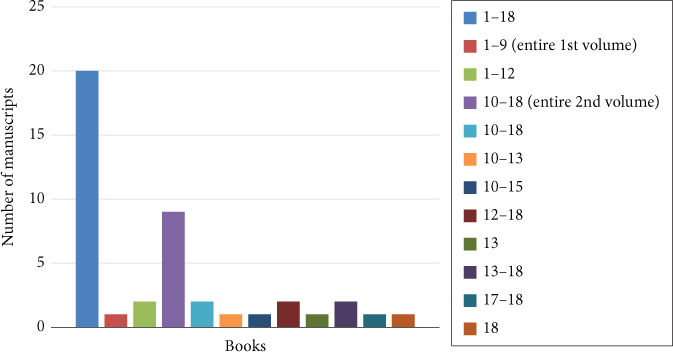
Figure 7.1 The number of manuscripts per books
What strikes us here is that almost half of the manuscripts studied transmit Zonaras’ entire text. This is an impressive figure, especially if one considers the gigantic length of the Epitome and the consequent cost of producing these manuscripts. It is remarkable that most patrons were keen on learning about the wide range of subjects covered by the chronicler. As they were interested equally in Jewish, Roman, and Byzantine history, they would ask for the entire work to be reproduced. These figures, furthermore, offer evidence concerning the circulation of the chronicle. They indicate that, at least from the thirteenth century onwards, the two volumes of the Epitome circulated independently of each other. Clearly, though, the second volume was in considerably greater demand than the first, which seems to have been much less popular.
Examining only the twenty-three codices that transmit shorter sections of the Epitome, one can identify certain literary trends among the patrons. Seventeen manuscripts (nos. 21, 23–38) include parts of the chronicle dedicated to the early imperial history of Rome, namely from the age of Julius Caesar to the accession of Constantine the Great to the throne as sole emperor (Books 10–12). There are twenty codices (nos. 24–43) which preserve parts of the work from the reign of Constantine as sole emperor onwards (from Book 13 to the end of the text). Taken together, these two pieces of evidence reflect a clear preference among these patrons for the imperial history of the Empire. However, there was apparently greater enthusiasm for the Empire’s more recent past, the period from the age of Constantine onwards. In other words, most patrons who did not wish to acquire the entire chronicle were interested in Zonaras as a source of information for Byzantine history. The patrons of only three manuscripts (nos. 21–23) displayed an interest specifically in the early history of Christianity, the first kings of Rome, and Republican Rome.
Let us now turn our attention to the number of codices in which the Epitome is transmitted alone or along with other texts. The overwhelming majority of manuscripts listed above—thirty out of the forty-three—contain Zonaras’ chronicle exclusively or shorter sections of it. These are nos. 1–11, 13, 15–16, 18, 20–28, 30, and 33–37. One reason why most codices transmit the Epitome alone may be that the manuscripts which preserved the whole work, as extensive as it is, and even those that preserved only one of the two volumes, were already bulky enough. In any case, the fact that most patrons commissioned codices containing the Epitome alone implies that they appreciated and read Zonaras’ text for its own sake, instead of including and using it in a manuscript of wider scope.
This is certainly true for some of the codices in which the chronicle survives along with other compositions. There are nine manuscripts that are essentially ‘historical’ (nos. 12, 14, 17, 19, 29, 32, and 40–42) in that they transmit mainly historical accounts. The histories of Niketas Choniates and George Akropolites are the works which usually appear along with the Epitome. In nos. 17, 29, 32, and 40, Choniates’ text is presented right after Zonaras’ chronicle and is followed by Akropolites’ and Nikephoros Gregoras’ histories in nos. 29 and 32, respectively.86 All four codices begin with Genesis, the starting point of the Epitome. Manuscripts 17 and 40 go as far as 1206, when Choniates finishes his account, manuscript 29 up to 1261, the point where Akropolites’ work comes to an end, and manuscript 32 up to 1351, when the eleventh book of Gregoras’ Roman History stops. It is evident that here the Epitome is being exploited as part of a larger project. Selecting and putting these texts into a chronological sequence, the owners of the manuscripts seemed to be aiming to create a world history for themselves.87
The production of a historical handbook must also have been the purpose of manuscripts 12, 14, and 41, where only the histories of Zonaras and Akropolites are included.88 Of course, with the absence of Choniates’ work, there is a clear break in the timeline between 1118 and 1204. That manuscript 29 transmits the Alexiad, in addition to Zonaras, Choniates, and Akropolites, points to the strong preference of its owner for historical writings.89 The same is probably true for the commissioner of codex 19, who requested, along with the Epitome, pieces from Skylitzes’ Synopsis and Skylitzes Continuatus.90 Manuscript 42 preserves, aside from Kedrenos, the part of Zonaras’ chronicle that covers the eleventh century, which may indicate that its owner had a special interest in this period.91
An important conclusion that emerges from the observation of these historical manuscripts is that Zonaras was apparently perceived by their owners as the author of a high-quality history, one worth reading in tandem with the works of Akropolites and the classicizing histories of Choniates and Anna Komnene.
Codex 31 is the well-known Modena manuscript famous for its wonderful illustrations of Byzantine emperors.92 In its current form, the manuscript was produced in two stages. A fourteenth-century scribe copied the second volume of the chronicle in the codex, without, however, being able to finish it. In the second half of the fifteenth century, another scribe added some extra folios at the front and the back of the manuscript in order to complete Zonaras’ text and to insert the series of catalogues he had at his disposal. Judging from the varied contents of these catalogues, from emperors to patriarchs and offices, this scribe sought to produce, in a sense, a complete guide to the history of the imperial capital. In the Epitome, he found the ideal text that could form the basis for this wide-ranging enterprise.
Special mention should be made of manuscript 39, which is a miscellany—a codex that includes a great number of extracts from different kinds of works. It preserves twelve brief texts and excerpts. It was produced by seven different scribes, the last of whom copied the part of the Epitome which begins with Constantine’s reign as sole emperor and ends shortly after the period of Arkadios and Honorius. Apart from Zonaras’ chronicle, excerpts from four historical texts also make their appearance in the codex: Appian’s Roman History; Diodorus Siculus’ Historical Library; the Greek translation of Eutropius’ Breviarium produced in the late fourth century by Paeanius; and the history of the city of Herakleia Pontike written by the ancient historian Memnon. The extract from Memnon’s work is derived from Photios’ Bibliotheca, since the original text had been lost by the fifteenth century. The contents of the manuscript certainly reflect the historical interests of its commissioner. What sets this manuscript apart from the other historical codices is that an extract of the Epitome is found in it along with works focusing on the ancient and late antique history of the Empire, instead of the more recent Byzantine history. This codex is known to have been commissioned by cardinal Bessarion (d. 1472) towards the end of his life and perfectly exemplifies Bessarion’s broad historical interests.93
It is worth noting here that all Marciani codices under consideration here (nos. 10, 13, 22, 39, and 40) were acquired by cardinal Bessarion, who made a systematic effort to collect and copy classical Greek and Byzantine historical writings. Bessarion was the first to bring together in a single manuscript the works of Herodotus, Thucydides, and Xenophon (Hellenica), the aim being to compile ‘a sequential “history of Greece” ’.94 A similar purpose would undoubtedly underlie his intention to acquire a codex containing both Zonaras’ and Choniates’ works (no. 40), and so to have at his disposal a continuous history of the Byzantine Empire from the Creation to the early thirteenth century.
At least three manuscripts provide us with some prosopographical information about their commissioners or early owners. The first is no. 3. In the bottom margin of f. 2r, where the chronicle begins, the person in possession of the codex writes, in his own hand, ‘The Zonaras of Basil, the Great Koumnos’ (‘ὁ Ζωναρᾶς τοῦ Βασιλείου τοῦ μεγάλου Κούμνου’).95 The surname Koumnos is probably a corrupted version of Choumnos, a well-known family name attested from the mid-eleventh century.96 Basil must have descended from this family and might, too, have occupied a significant post in the imperial bureaucracy, as the epithet ‘the Great’ suggests.97 A second manuscript whose original owner is revealed in a scribal note is no. 13, a codex which is securely dated to 1420 and eventually found its way into Bessarion’s collection.98 This one was commissioned by Demetrios Laskaris Leontares, a prominent statesman and general of the early fifteenth century, who, according to Doukas’ history, enjoyed high honours under John VII Palaiologos (r. 1390).99 Unlike these manuscripts, whose owners were laymen, codex 37 was in the possession of an ecclesiastic, a priest whose surname was Bolenos.100 It is not clear whether he also commissioned the codex. Bolenos is a good example of a relatively well-educated churchman who was able to read a text such as the Epitome with its archaizing, middlebrow Greek.
7.3 Scribal Practices and Marginalia
The investigation of this large body of manuscript material has helped to advance our understanding of the parts of the Epitome that were read most, by whom, and in what contexts. But my focus so far has been solely on evidence collected from the manuscript tradition of the chronicle, not the ways in which the text itself is actually written in the codices. First, what I would like to investigate here is whether the fact that Zonaras’ narrative was not divided into shorter books posed a problem for scribes who copied the work, and if so, how they tried to handle it. Next, I want to consider various marginal scholia which were penned by either the scribe of a manuscript or later readers commenting on the text.101
For practical reasons, this investigation inevitably relies only on a select sample of the codices listed in Table 7.1; these are nos. 1, 2, 3, 5, 6, 7, 11, 12, 21, 25, 27, and 30.102 The criteria by which these manuscripts were chosen were the date of production and accessibility. All twelve codices are dateable to the thirteenth or fourteenth centuries. Of these, nos. 1, 2, 3, 5, and 27 are codices on which the edition of the Epitome by Pinder and Büttner-Wobst was based.103 Most of these manuscripts have been made available online by the libraries in which they are kept. I was able to consult codex 30 in person in the Bodleian Library.
The first observation to make is that the copyists of these manuscripts share a common method for presenting Jewish and Roman history, the two broad thematic sections of the chronicle. They all understand this basic thematic articulation of the text, and find it necessary to make the thematic division of the work explicit to their readers. For the Roman section, the manuscripts nos. 1, 2, 11, 12, and 21 preserve exactly the same heading: ‘About the Romans and Rome itself’ (‘Περὶ ‘Ρωμαίων καὶ τῆς Ῥώμης αὐτῆς’), a likely echo of Zonaras’ original title.104 Traces of another transmission, in which the name of Romulus appears in the heading of the section, can be found in codices 5 and 7.105 All the scribes ensure that these titles stand out by writing them in large letters or within decorative patterns.
There are also other parts of text which several copyists try to separate from the rest of the narrative by using titles. Notable examples are the accounts of the fall of Jerusalem to the Romans and the birth of Christ.106 Such items were obviously considered by scribes to be of great significance and had to be highlighted accordingly. It is worth mentioning that the title given to the conquest of Jerusalem in codices nos. 1 and 12, namely ‘Epitome of the Capture of Jerusalem’ (‘Ἐπιτομὴ τῆς ἁλώσεως τῆς Ἱερουσαλήμ’), betrays the scribes’ perception of the narrative as an abbreviated form of a more extensive presentation of the fall of the Holy City, that of Josephus.
Notwithstanding these common features in the internal organization of the work, copyists treated the chronicle very freely. Zonaras’ account of Jewish history in particular is ‘raw’ material in terms of its division into shorter pieces. No tidy pattern emerges as to how scribes break the narrative. It would seem probable, therefore, that the Jewish section of the chronicle was originally a continuous narrative, or that it was split into several very extensive chapters. Scribes must have encountered long pieces of text and felt that these would be extremely inconvenient to readers. For this reason, they took it upon themselves to break them into shorter segments. They also added titles to shorter parts of Zonaras’ Jewish account, to make it easier for those reading the manuscripts to find information on certain subjects.
Titles in the presentation of the first Roman kings, and the Roman and Byzantine emperors follow a much more regular pattern in all twelve manuscripts. The copyists have a very good understanding of the author’s own organization of the text into units of reigns and use titles which correspond to this. Particularly for Zonaras’ narrative of imperial history—from the age of Augustus onwards—the titles take a standard form: ‘The reign of […]’, with scribes using the terms ‘μοναρχία’, ‘αὐταρχία’, ‘βασιλεία’, and ‘αὐτοκρατορία’ interchangeably. We also find titles such as ‘The accession of […]’ (‘ἀναγόρευσις/ἀνάρρησις τοῦ […]’) in nos. 3 and 12. It is noteworthy that in codices 1, 2, 7, 11, and 30, these titles are always written either on top of Zonaras’ narrative of an emperor (nos. 1, 2, and 30) or prior to it in a continuous text (nos. 7 and 11). The scribes are essentially employing them as headings to introduce the section dedicated to a new emperor, and to emphasize to readers the division of the chronicle into reigns.
Matters become more intriguing when one looks at idiosyncratic features that characterize certain scribes. Those who copied codices 25 and 30, for instance, occasionally include in the title of a new emperor the duration of his reign, apparently considering it a significant item of information that should be given special prominence.107 Manuscripts 5 and 6, in addition, bear a great number of marginal titles penned by their scribes that indicate pieces of the text which concern patriarchal history.108 The titles are typically as follows: ‘About patriarchs’ (‘Περὶ πατριαρχῶν’) or ‘About a patriarch’ (‘Περὶ πατριάρχου’). These scribes found that Zonaras’ material about ecclesiastical affairs, interwoven into imperial history, was not straightforward for a reader to find, and saw fit to make it stand out. They were probably aware that the work appealed to readers who had a great interest in Church history, as, for example, the author of the ecclesiastical chronicle in the Oxon. Baroc. gr. 25 or the priest Bolenos, who owned a copy of the Epitome, must have done.
The most peculiar example of adding titles to the reigns of individual emperors comes from codex 30; in this case, the scribe, judging from his neat handwriting, was probably a professional. The headings opening the reign of a new ruler are very clearly visible; they are written in red ink and large letters. For twenty-one emperors, from Augustus to Macrinus, the copyist lists next to the name of the emperor a series of strange epithets, usually five to nine in number, which designate features of his appearance and, less frequently, traits of his personality. It is worth providing a couple of examples. The first is the heading given to the section dedicated to the reign of Tiberius: ‘The monarchy of Tiberius, who was old, of medium height and slim, with curly hair, beautiful eyes, a dark complexion, short hair and a somewhat flat nose. He ruled for twenty-two years and five months’ (‘μοναρχία Τιβερίου, ὃς μὲν γέρων, διμοιραῖος, λεπτός, οὖλος, εὐόφθαλμος, μελάγχρους, κοντόθριξ, ὑπόσιμος. οὗτος ἐκράτησεν ἔτη κβ΄, μῆνας ε΄’).109 The title for the reign of Commodus is as follows: ‘The reign of Commodus, son of Marcus, and what he looked like. He was of medium height and good size; he had fair skin, greyish eyes, broad face, a good chest and beautiful hair; he was blond with a short beard’ (‘βασιλεία Κομόδου υἱοῦ Μάρκου καὶ οἷος ἦν: διμοιραῖος, εὔογκος, λευκός, ὑπόγλαυκος, πλάτοψις, εὔστηθος, γλυκόθριξ, ξανθός, ἀρχιγένειος’).110
The epithets found in the headings are not present in Zonaras’ narrative. The scribe derives them from an external source: the Chronographia of John Malalas, where they are used to characterize the same emperors.111 Unlike the scribe of the manuscript, however, Malalas continues to embed into his text such epithets for the emperors after Macrinus. A possible explanation why the scribe stopped making use of them at that point would be that he did not have the entire chronicle of Malalas readily available to him. Another explanation could be that the commissioner of the manuscript, who supervised the copying of the chronicle, was dissatisfied with this practice. The scribe usually repeats all the epithets encountered in his source in the same order, but sometimes omits or replaces one with a simpler synonym of the same root. Here are some examples.

It has been demonstrated that the Chronographia of Malalas was not a very well-known work among Byzantine readers.112 The copyist found this material about Roman emperors in Malalas’ chronicle and must have assumed it was unknown to his audience. He therefore decided to insert these pieces of information into his titles of Zonaras’ account of Roman emperors. He probably considered them useful and interesting, and thought they would complement Zonaras’ text.
In addition to the titles used by the scribes of these manuscripts, several items of marginalia also provide clues about readers’ reactions and responses to Zonaras’ narrative. Although he very rarely writes marginal scholia, the scribe of codex 11 feels that two extracts in the recording of Byzantine history need a word of comment. The first is the story of the iconoclast monk who was rumoured to have deceived the emperor Leo V the Armenian into resuming the campaign against icons. Prior to his accession to the throne, Leo was said to have received a prophecy by a monk at Philomelion, who predicted his imperial destiny. After he took up the reins of the state, he sent gifts to the monk, who, unbeknown to him, had died some time before. A monk in his place warned the emperor to abolish the ‘idols’ lest he should fall from power very soon.113 Struck by Zonaras’ account of how the iconoclastic controversy was rekindled, the scribe notes in the margin of the manuscript: ‘look at how powerful the Devil is’ (‘ὅρα πόσον ὁ Σατανὰς ἰσχύει’).114 He concludes from the text that this incident was a devilish deed, a belief he apparently wanted to make known to others who would read the codex after him. The second segment of the text that catches the scribe’s attention is the edifying moral that the author himself draws from the unfortunate end of the emperor Romanos Lekapenos and his sons, namely that providence always punishes those who commit a crime. In the margin just below this segment, the scribe adds in red ink his own interpretation of Zonaras’ claim: ‘This which is said is fearful’ (‘φοβερὸν τὸ ῥῆμα’).115 Only rarely do we find remarks such as these, which give us a glimpse of the emotional impact the text has had on a reader. For the copyist, this is a formidable claim by Zonaras, one which fills him with awe. In Chapter 3, I argued that the chronicler deliberately interpolated Skylitzes, his source for the reign of the Lekapenoi, in order to highlight to his audience that the fate of the usurpers was a result of divine retribution.116 This marginal comment demonstrates that he was successful in conveying, at least to some of his recipients, the ethical message of the story of the Lekapenoi.
There are a number of scholia in the margins of manuscript no. 1 which have been penned by different hands.117 The majority of them were inscribed by a later reader, the individual who composed the fairly lengthy commentary of the Epitome that appears in ff. 1r–2v of the codex. Neither these scholia nor the commentary, in other words, were written by the monk Mokios Taranes, the copyist of the manuscript. An extensive analysis of the commentary follows in the next part of this chapter. Most marginal notes by this hand are cursorily written and hence difficult to read. Some of the passages that are of interest to this individual relate to the biblical contents of the chronicle. I offer a couple of examples. Reaching the story of the prophet from Judah who visited king Jeroboam I,118 the reader records the sticheron of an ode chanted during Great Lent which concerns this particular prophet.119 Another passage that he finds worthy of note is the one recounting how Jacob blessed the two sons of Joseph. From Genesis and Zonaras, too, we learn that, despite Joseph’s displeasure, Jacob put his right hand on Ephraim, the younger boy, instead of on Manasseh, the older, because many nations would eventually descend from Ephraim.120 Reading Zonaras’ narrative, the unknown individual notes the following words in the margin of the manuscript: ‘look at how blessing was given to the nations’ (‘ὅρα ὅπως τοῖς ἐξ ἐθνῶν ἐδόθη εὐλογία’).121 It should be mentioned here that this reader repeatedly begins his scholia by using the verb ‘ὅρα’ (meaning ‘look’ or ‘note’), as if directly addressing subsequent readers of the manuscript.122
The short extract of the chronicle where Zonaras tells us that the emperor Leo VI was a fervent practitioner of divination and astronomy catches the eye of a later reader of codex 12, who, judging from his handwriting, can be dated to the fifteenth century.123 Written in a careless fashion, his scholion in the margins of ff. 334v–335r is hard to make out. As far as I can tell, it reads as follows:
[…] of divination, philosophy, astronomy […] astrology. Such were the seers of those times. You should look at the Roman emperors, also concerning their philosophers. Nobody practised divination without astronomy and philosophy and astrology.
*** μαντείας καὶ σοφίας καὶ ἀστρονομίας *** ἀποτελεσματικ<ῆς>. Τοιοῦτοι ἦτον οἱ μάντεις τῶν καιρῶν ἐκείνων. Πρόσχες καὶ τοὺς Ῥωμαίους τοὺς βασιλεῖς καὶ περὶ φιλοσόφους˙ οὐδεὶς ἐμέτεχε μαντείας χωρὶς ἀστρονομίας καὶ φιλοσοφίας καὶ ἀποτελεσματικῆς.124
Prompted by Leo’s aptitude for the ‘arts’ of foretelling the future, the commentator makes the general remark that in the time of the Roman emperors, nobody would practice divination without having a knowledge of astronomy, philosophy, and astrology. He implicitly criticizes all those who, in his own time, could supposedly predict the future, but had no idea about astronomy or philosophy.
The marginalia of codex 5 is worth detailed investigation. There exist three poems in the manuscript, all written in the popular dodecasyllabic verse and all penned by the scribe who copied the chronicle.125 Located in the margins of f. 33v and f. 61v, the first two are both six verses in length.126 Prior to the poem in f. 33v, we find the name of its composer: Constantine. I will elaborate on the identity of this person shortly afterwards, discussing the longest poem found in the manuscript. The impetus for the poem in f. 33v comes from Zonaras’ description of scaphism (‘σκάφευσις’), a gruesome method of execution common among ancient Persians.127 Taking material from the Plutarchean Life of Artaxerxes, the chronicler explains that victims subjected to the torture of scaphism would be fastened to a skiff and repeatedly stung by insects. They eventually died of septic shock.128 Constantine’s poem is as follows:
Of Constantine
What a tub and trough of flesh, not dough,
or also a furnace which dissolves flesh,
or a tomb or some sepulchre made of wood!
Oh bitterness, which gushes from honey
and milk! Ιt is not food what feeds
the worms that eat the one who is buried, oh my!
TΚωνσταντίνου
1βαβαὶ σκάφη καὶ μάκτρα σαρκὸς οὐ ζύμης
ἢ καὶ κλίβανος ἐκδαπανώσας σάρκας
ἢ τάφος ἢ σορός τις ἐκ ξυλουργίας˙129
ὦ τοῦ μέλιτος ἐκβρύουσα πικρία
5καὶ τοῦ γάλακτος οὐ τροφὴ τὸ δὴ τρέφον
σκώληκας οἴμοι τοῦ ταφέντος τοὺς φάγους.130
The narrative about scaphism clearly made a vivid impression on Constantine. In an almost lamentatory tone, the poet expresses how appalled he is by the cruel torture captives were subjected to.
The author of the verses in f. 61v, a poem also of an elegiac character, is spurred by similar feelings. He is repulsed when reading that Herod the Great ordered the strangling of his two sons, Alexander and Aristobulus, who were executed in about 7 bc.131 Inspired by Zonaras’ account of this episode, he writes the following verses:132
Oh, the former murderer of infants became murderer of [his] children
[and], to express his wickedness in short, a murderer of men.
A mind of leather or a heart of stone!
Οh, a man who kills all people bears the name ‘Herod’!133
You hate children, but animals love [their] children,
oh, nature fiercer even than lions!
1τεκνοκτόνος φεῦ ὁ πρὸ τοῦ βρεφοκτόνος˙
τὸ πᾶν συνάξειν πικρὸν, ἀνθρωποκτόνος˙
νοῦς δερμάτινος ἢ λίθινος καρδία˙
φερωνύμως φεῦ ἡρώδης παντοκτόνος˙
5σὺ μισοτεκνεῖς φιλοτεκνεῖ θηρία˙
ὧ καὶ λεόντων ἀγριωτέρα φύσις.
The composer of the poem employs four compound nouns whose second part is a derivative of ‘κτείνω’ (‘kill’) to stress the atrociousness of Herod’s crime. A detail about the use of the word ‘μισοτεκνεῖς’ should be mentioned. In the corresponding section of the JW, where Josephus recounts the execution of Alexander and Aristobulus by their father, Herod is called ‘μισοτεκνότατος’.134 There is a strong case, therefore, that the composer must also have had access to the source on which the chronicler himself relied for his presentation of the Jewish past. We cannot know with certainty whether this poem, too, was created by Constantine, although it seems more likely that both marginal poems (or, as we shall see, all three poems found in the codex) were indeed composed by the same person. In any case, these two poems clearly show how a group of readers could be emotionally engaged by Zonaras’ narrative and give vent to their feelings by composing their own pieces of writing.135
Overall, this selective number of marginal comments in manuscripts of the Epitome indicates that many different parts of the text caught the attention of the audience and provoked various responses.
7.4 Two Further Testimonies to the Reception of the Chronicle
Aside from the marginal notes found in these manuscripts, there are two longer pieces of writing that can help us identify the elements which made the Epitome a popular work. The first of these is a prose text of an encomiastic character which is included in codex no. 1 (Par. gr. 1715), the oldest manuscript that preserves the chronicle. The second is a poem of twenty-nine verses. It is transmitted in codex no. 5 (Vat. gr. 136), along with the two short poems discussed above.
7.4.1 The Prose Text of Codex No. 1 (Par. gr. 1715)
For the prose text, I use the term ‘commentary’, since its anonymous author provides us with extensive remarks about many things that attracted his attention in Zonaras’ narrative. It was noted earlier that the commentary was produced by the same person who added most scholia to the margins of the codex.136 The text can, therefore, be securely dated to after 1289, when the copyist of the manuscript, Mokios Taranes, completed his task.137 In the manuscript, the commentary precedes the Epitome, which starts on f. 3r. Due to the fact that he did not have enough writing space, the author of the commentary added a folio at the beginning of the codex.138 One would reasonably expect, therefore, that this person was the owner of the manuscript.
We are not given any clues about the author’s identity. Assuming that this person was the owner of the manuscript, we can deduce that he must have been a wealthy man who could afford to pay a competent professional scribe to reproduce a long text. Also, the commentary evidently came from the pen of a man who had received a good education and was able to use sophisticated grammar and vocabulary. The linguistic register of the commentary is archaizing, elevated middlebrow Greek. The author does not employ rare Attic Greek vocabulary or grammatical types of the pluperfect, but makes frequent use of forms of the perfect (for example, ‘ἐντέταχε’, ‘ἀνεληλακώς’, ‘πεφρόντικεν’, ‘διαπέφευγε’, etc.) and verbs in the optative (for example, ‘παραιτήσαιτο’, ‘θαυμάσειε’, ‘φαίνοιτ’ ἄν’, ‘γνοίη’, etc.). He is also familiar with some difficult grammatical forms, such as passive aorists (‘φιλοπονηθείσῃ’, ‘ἐξεδιαιτήθη’, ‘συνενεχθῆναι’, etc.) and irregular aorists (‘διέλωμαι’, ‘παρεθέμην’, ‘εἷλε’, ‘ἀναβῆναι’, ‘προείλετο’, etc.). Although some of the periods he writes are quite long, the flow of the text is easy to follow overall.
Grigoriadis considers it likely that the writer was a historian himself, since he seems well acquainted with the stylistic qualities that a remarkable historical account should possess and by which it should be judged.139 The scholar has put forward Niketas Choniates and Constantine Akropolites as possible candidates. The former, who lived and died much earlier than the date of the manuscript’s production, must definitely be excluded.140 The latter, however, is a definitive possibility.141 As was shown above, Constantine had access to or even possessed a copy of Zonaras, as he made abundant use of the Epitome for his own chronicle.142 Further, the manuscript he had at his disposal contained, if not the entire chronicle, at least the section from the Principate onwards,143 as is the case with codex 1. Constantine, moreover, would slightly paraphrase or repeat word for word the text of his source, from which one can infer that he admired the linguistic and literary virtues of Zonaras’ account. Likewise, the remarks of the anonymous commentator reflect much admiration for the chronicler’s language. Constantine was a well-known book collector, whose library included a remarkable variety of works, such as writings by Heraclitus and Aelius Aristides, and the poems of George Pisides.144 A survey of his collection reveals that he was fond of books which were ‘stockpiles’ of earlier texts; he possessed a copy of Andronikos Kamateros’ Sacred Arsenal and is known to have requested a friend to lend him an epitome of Aristotle’s works so that he could have his own copy made.145 Zonaras’ Epitome could well fit into this pattern of interest.
In terms of writing style, in addition, the commentary and Constantine’s works (his epistles and hagiographical texts) have some features in common.146 Both the commentator and Constantine write in elevated, archaizing Greek, mix lengthy and short sentences, and use rhetorical figures, such as chiasmi and homoioteleuta.147 Moreover, the author of the commentary introduces his text by composing a short encomium of Zonaras;148 this is strongly reminiscent of a saint’s life and reflects the commentator’s familiarity with themes typical of hagiographical literature. Topoi of a saint’s life that appear in the encomium of Zonaras and are also employed by Akropolites in his hagiographical works include praise of the person’s lineage and an emphasis on close links with the emperor.149 What is particularly noteworthy is that the overall style of the encomium, which is of a rhetorical character and offers limited prosopographical data about Zonaras, resembles that of Akropolites’ ‘rhetorical encomia’ of saints, which contain ‘little factual information’.150 According to the commentator, Zonaras was of noble extraction and belonged to the aristocracy. On account of his virtue and excellent rhetorical skills, the author was given great honours by the emperor and enjoyed the rare privilege of being able to talk to him freely. Whether these statements hold any truth is difficult to tell, since we have scarcely any information about Zonaras’ career in the service of the Komnenoi. The fact that he was entrusted with high offices in the bureaucracy certainly indicates an appreciation of his talents by the central government. That said, rhetoric seems to have got the better of reality in this case. The commentator clearly tries to emphasize Zonaras’ close relationship with the emperor as a means of exalting him. Towards the end of his encomium, he tells us that Zonaras decided to take the monastic oath when he realized how unstable human affairs can be and that, when he withdrew from public life, he did not turn against those who had caused him trouble. His impression, in other words, is that, prior to his retirement, Zonaras had experienced a drastic change in his circumstances and also some animosity against him. Apart from this vague information, readers are not offered any factual details about Zonaras’ legal background, his positions in the machinery of state and his scholarly activity. The commentator might have preferred to write an encomium of a more rhetorical, instead of a factual, nature not because he did not have much information about Zonaras at his disposal, but because the contemporary literary audience probably knew much about him already. In all, there is a fair chance, in my view, that the commentary preceding the chronicle in codex 1 was penned by Constantine Akropolites. If one accepts that the author of this text is indeed Constantine Akropolites, he may well be projecting his own profile onto the encomium of the chronicler here. Much like the image he draws of Zonaras, Akropolites came from an aristocratic family, received an exceptional education and occupied an enviable position in the court of Andronikos Palaiologos, who honoured him with very high offices in state administration. In telling us that Zonaras was allowed to speak freely to the emperor, Constantine may be revealing the nature of his own relationship with Andronikos—or how he would have wished it to be.
The chronicler’s idiosyncratic literary and linguistic style is one of the key issues discussed in the text.151 Expressing his admiration for Zonaras, the commentator enumerates a long list of stylistic virtues which characterize the chronicle and, in his view, befit a historical account. The most significant of these are clarity, a balance between a flat and a closely knit style, solemnity, conciseness, pleasantness, sweetness, flexibility, and pureness of expression. In contrast to Constantine Manasses, who found Zonaras’ narrative too austere and tried in his own way to make it more ornate and attractive, the commentator regards the chronicler’s vocabulary as flowery and rich. Although he acknowledges that the Epitome is not a rhetorical masterpiece, he highlights that Zonaras’ linguistic register represents a deliberate authorial choice. In composing his work, Zonaras does not wish to flaunt his linguistic skills. Instead, he aims to produce an account which will aid men to better their lives, adopting a writing style conducive to this goal. Thus, the commentator turns against those authors, primarily historians, who seem to care more for rhetorical elaboration than for the provision of useful and valuable advice.
In addition, he devotes a long paragraph to the presentation of the work’s contents; here he makes it clear how he understands the thematic organization of the text. According to the commentator, Zonaras structures his account into histories of peoples and empires: the history of Jews; and the histories of the Persian Empire, the Macedonian Empire under Alexander the Great, and the Roman Empire. The author of the treatise departs significantly from the way in which Zonaras presents the thematic arrangement of his composition. In the Epitome’s proem, the chronicler explains the division of the work into two broad sections—Jewish and Roman—and introduces the subjects of the Persian and the Macedonian rule in relation to the history of Jerusalem. The commentator, however, perceives the extensive digressions on Cyrus and Alexander as independent sections. His understanding of the text as a sequence of Jewish, Persian, Macedonian, and Roman history calls to mind the apocalyptic visions of Daniel, which predicted the historical sequence of four empires: the Babylonian; the Persian; the Greek under Alexander the Great; and the Roman. The author of the treatise might have thought that Zonaras had structured his text according to this pattern. What he adds after this clearly echoes the preamble of the chronicle: that Zonaras recounts not only the acts of the emperors but also those of the patriarchs. He comments approvingly that the chronicler was right to point out instances when a churchman trespassed against laws.
Prior to these remarks on the structure of the Epitome, the writer of the commentary lists a series of topics he identifies in the text. These include stories of lands, rivers, and cities, as well as the deeds and dispositions of men. According to the commentator, the narrative also features wars and naval battles, as well as explanations of how armies were positioned on the battlefield and the events that occurred prior to certain combats. Here we encounter yet another contrast with what Zonaras writes in his proem. Echoing the chronicler’s own views, the acquaintances who instigated him to compose the Epitome disapprove of long historical narratives discussing battles, strategies, and tactics. This obviously indicates that Zonaras’ work does not emulate previous histories and avoids elaborating on such themes. The fact that the author of the treatise makes special mention of them, however, indicates that they certainly appealed to him. More than that, he understands military history to be at the core of Zonaras’ narrative, a significant topic on which one can derive information from the chronicle.
Perhaps the most remarkable conclusions drawn from the commentary concern the reasons why the chronicle is worth reading. Two related yet distinct reasons are given by the commentator. The first concerns the inherent ethical and moral merit of the chronicle, a feature that is keenly emphasized from the first sentence of the text: ‘[…] from the stories themselves that are included in the present book, it is obvious that the book constitutes a school of virtue’ (‘διδασκαλεῖον καθέστηκεν ἀρετῆς ἠ παροῦσα βίβλος, αὐτόθεν καὶ ἀπ’ αὐτῶν ἐστι πρόδηλον τῶν αὐτῶν ἐμφερομένων διηγημάτων’).152 The Epitome, according to the commentator, may teach readers about various aspects of human affairs and guide them towards the best courses of action. One can also learn about how unexpectedly a man’s life can change. Τhe commentator underlines that the work speaks of both virtues and vices, offering ‘representations both of what is good and what is the opposite’ (‘ἀμφοτέρων γὰρ εἰκόνας, τοῦ ἀγαθοῦ καὶ τοῦ ἐναντίου’).153 He thus suggests that the text deserves to be studied because it offers models to imitate as well as to avoid. It should be stressed that the chronicle is understood by the commentator to have an educational value as a whole, as a composition which includes material from Christian but also from pagan writers.
The second reason why the Epitome is useful is that it is distinctively practical in character.154 The work is said to focus strongly on practical matters. It demonstrates how one should combine theoretical and practical knowledge, and thus accomplish one’s duties. The commentator classifies four categories of readers who could benefit from these instructions: private citizens; generals; emperors; and archpriests. This shows that, for him, the chronicle was intended for a wide readership, in the sense that it could recommend itself to the needs of people in different social positions. The view that individuals who occupy a certain office should act in a way appropriate to their station mirrors that of Zonaras, who, in his critique of Alexios Komnenos, claims that a leader is required to exhibit different qualities to those of a common citizen. The commentator does not specify what kind of things a private man and a general can learn from the chronicle. The text, in his view, advises archpriests to adhere firmly to orthodox beliefs and keep the body of the faithful safe. What is most striking, though, is that the author of the treatise explains in great detail how the work provides guidance to an emperor; it describes how a ruler should or should not behave. He clearly believes that the chronicle is addressed to emperors: ‘it [the book] urges emperors not to succumb to pleasures […]’ (‘παραινεῖ δὲ μὴ πρὸς ἡδονὰς ἐκκλίνειν τοὺς βασιλέας […]’).155 He says the text teaches that a ruler should always conform to the laws, care for the state and be lenient towards his subjects, as well as think hard and labour to take the best action. Also, emperors should disdain money, avoid burdening people with excessive taxation and entrust the government of public affairs to worthy people. This part of the treatise contains obvious echoes of Zonaras’ Kaiserkritk of Alexios, particularly in terms of a leader’s fiscal policy, his duty to put the common good above his own and to assign offices based on merit. One may suggest that the commentator essentially perceives the Epitome to be a ‘mirror for princes’.
The question that naturally follows these considerations has to do with the purpose of the commentary: why was it penned, and to whom might it have been addressed? Taking into account its place—on the first pages of the manuscript—and its overall content (basic information about the work’s author, style, subjects, and value), one can conclude that it was apparently written as an introduction to the Epitome. The reasons which probably prompted the owner of the codex to compose this introductory piece are open to discussion, since the treatise itself does not provide any details of the occasion. In my opinion, it is likely that the owner would do so if he intended to offer or lend it to a friend, a colleague, or a student. In this case, he would see fit to make a preliminary presentation of the work for the sake of his addressee and also give his own interpretation of it. This hypothesis is also supported by the scholia written by the commentator in the margins of the codex. As was observed earlier, many of his comments start with the verb ‘ὅρα’,156 which may be an indication that he is directing these remarks to someone reading the manuscript after him.
On the whole, this commentary offers a rare view of the reception of the Epitome by a reader who lived approximately one and a half centuries after the work’s ‘publication’. Like the recipients Zonaras had in mind when he wrote his text, this reader was a learned man. He is particularly impressed by the linguistic register of the narrative, which, in his view, is perfectly compatible with Zonaras’ purpose, namely to compose a work of a didactic character. Indeed, the commentator does not emphasize the historical value of the chronicle so much as the educational, stressing that it provides advice on ethical conduct as well as on practical matters. For him, these are the principal reasons why the Epitome should be read. Notably, moreover, he approaches certain aspects of the text in ways substantially different to the chronicler’s agenda, as this is outlined in the Epitome’s proem. He largely perceives the work to be a string of individual histories of distinct civilizations, rather than a compendium of Jewish and Roman history, and takes an interest in the events of military history which are recounted in the work, subjects that Zonaras does not find appealing in a historical account.
7.4.2 The Poem of Codex No. 5 (Vat. gr. 136)
The longest of the three poems contained in manuscript no. 5 deserves particular notice for its contents and the indications it offers about the circulation of the chronicle.157 Written in dodecasyllabic metre by the copyist of the codex, the poem has no title. Like that written in f. 33v, it is preceded by the name of its author: Constantine. In the seventeenth century, it came to the attention of Leo Allatius, who copied it in ff. 9r–v of the codex Vat. barb. gr. 74 and added ‘To John Zonaras’ (‘εἰς Ιωάννην τὸν Ζωναρᾶν’) as a title.158
The poem is a book epigram, a type of poem which is usually found at the beginning or in the colophon of a manuscript and relates to the text or texts that are included in it. Oddly enough, the epigram is located between the first and the second volume of the chronicle, in f. 101v of the codex. It is comparable, to some extent, to an anonymous book epigram contained in the Par. gr. 1640, an early fourteenth-century manuscript that preserves Xenophon’s Cyropaedia and Anabasis.159 This codex draws on a prototype produced in the late ninth or early tenth century, during the reign of Leo VI, to whom it was donated. The epigram was composed by the scribe of the original manuscript and was transmitted along with Xenophon’s works contained there.160 In the Paris manuscript, the epigram is placed between the Cyropaedia and the Anabasis, at f. 123v. What is remarkable, however, is that the poem attached to the manuscript of the Epitome is placed between the two volumes of the same text. As we shall see below, it is purposely located at this point because it pertains to the contents of the first volume alone.
Writing in the first person, Constantine addresses Zonaras, who is the imaginary recipient of his composition. The poem has a clearly encomiastic character. Its laudatory tone becomes apparent in the first two verses, where the poet addresses Zonaras and hails him as a writer who stands out among his fellow chroniclers: ‘You are to be greatly thanked for your great labours, / John, the wonder of chronographers’ (‘Χάρις μακρά σοι τῶν μακρῶν πόνων χάριν / Ἰωάννη, τὸ θαῦμα τῶν χρονογράφων’). The epigram begins in a striking manner, namely with the use of an adnomination, a rhetorical scheme in which words of the same grammatical root are repeated. Here, two forms of the noun ‘χάρις’ and the adjective ‘μακρός,-ά,-όν’ make their appearance within one verse. The choice of ‘χάρις’ in connection with the name ‘Ἰωάννης’ is deliberate: according to the Byzantines, the name was associated with grace.161 The poet continues by explaining why he benefited from reading the Epitome: the work provided him with knowledge, literally ‘cognitive food’ (‘γνωστικὴν τροφὴν’). From this statement, it emerges that, in Constantine’s opinion, the importance of the Epitome derives from its value as a source of information.
It is very common to find dedicatory epigrams addressed to the person to whom the manuscript would be gifted, but quite rare to encounter book epigrams addressed to the author whose works are included in the codex. For example, the anonymous composer of the epigram in the Par. gr. 1640 directs a line to Xenophon, saying: ‘Speak up, Xenophon, in support of what I am saying!’ (‘λέγε Ξενοφῶν τῷ λόγῳ συνηγόρει!’).162 Still, this is only one verse, not an entire poem. Constantine, however, appeared to favour this practice of composing epigrams which would praise the works he was copying. Ioannis Vassis has identified him as the same Constantine who wrote an epigram of four verses commenting on the third polemic of Theodore of Stoudios against iconoclasts.163 There, too, Constantine writes in the first person and addresses his words to ‘father’ Theodore, who is extolled for being ‘a spiritual spring of most wise lessons, / which spouts streams of orthodox dogmas’ (‘Πηγὴ νοητῶν πάνσοφων διδαγμάτων / βλύζουσα κρουνοὺς ὀρθοδόξων δογμάτων’). This metaphor of a text as something—either a spring or a vessel—which contains precious knowledge makes its appearance in both of Constantine’s epigrams, as will be shown shortly.
In the epigram dedicated to the Epitome, the chronicler is also praised for his method. Zonaras, we read, ‘would collect honey from flowers in the manner of a bee’ (‘τὸν μελίσσης ἀνθολεκτήσας τρόπον’). In turn, Constantine, as a reader of the work, is compared to a beekeeper who reaps the harvest of honey, the results of Zonaras’ labours. In Ancient and Medieval Greek literature, images of flowers and bees frequently appear in relation to poetic texts and anthologies of poetry and prose. Indicative of the wide use of these motifs in such literary contexts is that several Byzantine anthologies have come down to us today with the title Melissa; examples are the famous Melissa of Antony and the collection formerly known as Melissa Augustana.164 The fact that the poet employs this imagery in connection with a prose text essentially implies that he regards Zonaras’ chronicle as a compilation of earlier authors. Further, it shows that, much as a compilator chooses certain poems over others to incorporate in an anthology, Zonaras included in his account only a selection of the material he found in his source texts. Constantine highlights, moreover, that Zonaras displayed the information he had collected in such a concise manner that readers, including him, are able to learn about a series of subjects ‘very quickly’ (‘ἐπιτρόχου’). According to the poet, in other words, Zonaras put together his compilation for a specific purpose: to offer information in a succinct format. The Epitome is understood to be a useful compendium of carefully selected pieces from older accounts.
What follows next in the epigram is an outline of the topics presented in the first volume of the chronicle and a list of some significant sources used by Zonaras in this part of his work. Constantine tells us that, by reading the Epitome, he learned about the Octateuch and the Books of Kings, Chronicles, Esther, Judith, Tobit, and Esdras. He would certainly be familiar with the content of the Old Testament books, but the point he is making here is that, through the Epitome, he was able to remind himself about their contents very quickly. Apart from the Old Testament, the only other source he acknowledges is Josephus’ JA. These, of course, are the sole works Zonaras himself names as his sources in the proem of his chronicle. The poet says, in addition, that he learned of the Babylonian king Nebuchadnezzar, the Persian rulers Cyrus, Xerxes, and Cambyses, the Macedonian expansion in the time of Alexander and the division of the Macedonian Empire. These themes also appear in the proem of the Epitome, where Zonaras makes special mention of all these rulers (save Cambyses). Finally, concerning the history of the Roman state, we read that Constantine came to know about ‘the four types of Latin leadership’ (‘τὴν Λατίνων τετράτην αὐταρχίαν’) and ‘the various Roman generalships’ (‘Ῥωμαϊκὴν ποικίλην στρατηγίαν’). The term ‘αὐταρχία’, a word repeatedly employed by the chronicler in the course of his narrative of Rome, is encountered in the proem as well, when Augustus is said to have triumphed at the Battle of Actium, returned to Rome and ‘gained the leadership’ (‘τῆς αὐταρχίας ἀντεποιήσατο’) of the state. In the epigram, in combination with ‘τετράτην’, which literally means fourth, the term must designate the four types of Roman government identified in the proem and elsewhere: monarchy; tyranny; aristocracy; and republic. In other words, Constantine learned from Zonaras about the development of the Roman political system. From these observations, it can be inferred that Constantine composed his epigram mainly based on the proem of the chronicle. No doubt he found it more efficient to rely on the proem, where Zonaras summarizes the major themes of his work and records some of his most important sources, rather than trying to recall such information himself or search back through his bulky manuscript for it.
The final eight verses of the epigram are extremely interesting, for they reinforce the conclusion that, as early as the thirteenth century, the two volumes of the Epitome were circulating separately. The poet expresses his keen disappointment at not having the second volume of the chronicle at his disposal. Having been captivated by Zonaras’ narrative, he wants to read the entire text. He desires to learn about ‘the emperors of the new Ausones (Romans)’ (‘βασιλέας […] Αὐσόνων νέων’), Constantine the Great, and the emperors who reigned after him. Constantine is vaguely aware of the contents of the chronicle’s second volume. He would certainly have read Zonaras’ outline of the Roman and Byzantine material of his work in the Epitome’s proem. Also, he may have heard parts of the second volume being recited at the theatra. The epigram ends with Constantine wondering how he will manage to acquire the part of the text that is not available to him: ‘how, how will I receive the missing part of the sweet-flowing narrative?’ (‘ποῦ ποῦ τὸ λεῖπον τῆς μελιρροίας λάβω;’)
These remarks on the content of the epigram may help us to focus more closely on the circumstances surrounding its production. From an examination of the handwriting in ff. 2r–101r (the first volume of the chronicle), 101v (the epigram), and 102r–216r (the second volume of the chronicle), I deduce that the entire manuscript was copied by the same hand. Also, in ff. 110r and 125v one can clearly make out the quire numbers: β΄ and γ΄, respectively. This evidence attests that the part of the codex which transmits the second volume was produced separately by the same scribe who copied the manuscript of the first volume. Some time later, the two manuscripts were bound together. The epigram, in other words, is located at the colophon of the initial codex, which preserved only the first volume of the Epitome. Its position in that manuscript is related to its purpose. The concluding verses, containing the phrases ‘thirst’, ‘ask’, and ‘how will I receive […]?’, show that the poem was essentially a request. The person who composed or commissioned the composition of the epigram had read the first volume, but did not have access to the second. Through this epigram, he expressed his desire to read the rest of the work. Understandably, the poem would be read by those who accessed the manuscript. These would be learned friends of the manuscript’s owner, to whom he had lent his copy of the Epitome. It is also plausible that he would recite the epigram along with sections of the chronicle in the theatra he attended, and would thus appeal to other members of his literary circle to provide him with the rest of Zonaras’ work. Almost contemporary with the manuscript that included the first volume of the Epitome, the epigram should by extension be dated to the thirteenth century.
Concerning the identity of Constantine, the person whose name is inscribed before the epigram under consideration here as well as before the one in f. 33v, there exist three possibilities. First, Constantine might have been the owner of the manuscript and composed the epigrams himself. In this case, the scribe who copied the chronicle might have been asked by Constantine to copy his poems into the manuscript. A second possibility would be that Constantine was the copyist of the manuscript. He was commissioned by the owner of the codex to compose a poem that aimed to serve as a request for the second volume of the Epitome. Finally, it is plausible that Constantine was both the owner and the copyist of the manuscript.
Leone has remarked that the language of the text is a mixture of words derived from the koine and the ancient Greek literary tradition. The poet shows his creativity by inventing the new compound terms ‘ἀνθολεκτήσας’, ‘ἀρχαιόλεκτα’, and ‘μελιρροίας’, which are all hapax legomena in Greek literature. The vocabulary in the concluding verses of the chronicle is taken from the context of drinking and thirst. The poet stresses that he is ‘thirsting to drink the entire, later part of the narrative’ (‘διψῶ τὸν ἑξῆς ἐκπιεῖν ὅλον ῥόα’) and compares the book in its current incomplete form to ‘a narrow vessel’ (‘ἄγγος ἐστενωμένον’) which ‘did not entirely contain inside the immense flow [of words]’ (‘ἔστεξεν οὐ πάνυ ἔνδον ἄπλετον χύμα’). The abrupt cessation of the text leaves him ‘thirsty’ for the rest of Zonaras’ narrative. The image of Zonaras’ work as a vessel makes us recall the metaphor used in the other epigram attributed to Constantine—that of Theodore of Stoudios’ text as a spring from which precious knowledge gushed forth. Constantine would apparently draw on common literary topoi. The use of such language in the epigram dedicated to Zonaras aims, of course, to underline the intense desire on the part of the poet to obtain the second volume of the Epitome. In terms of metrical structure, the literary quality of the verses is not particularly high. Constantine makes demonstrable mistakes in the length of the vowels, not only in the ‘δίχρονα’ alpha, iota, and upsilon but also in the long and short vowels.165 Despite the metrical flaws of his epigram, however, Constantine must have been a relatively well-read individual who had studied the language of ancient Greek authors, and was also aware of the topoi of poetic tradition.
7.5 The Medieval Translations of the Epitome
The Epitome saw two translations into medieval languages, one into Church Slavonic and one into Aragonese, both of which date to the fourteenth century. In this investigation, I will concentrate on the features of the translations of the Epitome that caught the attention of foreign readers and the extent to which these were similar to the features of the original that were of interest to Byzantine audiences.
7.5.1 The Slavonic Translation
In the South Slavic world, the fourteenth century witnessed a revival of interest in Byzantine chronicles, as evidenced by the translations of four Byzantine chronicles into Church Slavonic, those of Zonaras, Constantine Manasses, George the Monk, and Symeon the Logothete, made during this period.166 The translation of Zonaras’ chronicle (henceforth: the Slavonic Zonaras), which has come down to us in eight manuscripts, was produced in Bulgaria during the rulership of tsar Ivan Alexander (r. 1331–1371), probably before 1344.167 Staying close to the original Greek text, it covers the period from the Creation to the early twelfth century. It circulated in a Serbian redaction as well, the so-called Paralipomenon, which was composed in 1407 or 1408 by a certain Gregory, a scribe and monk in the Hilandar monastery.168 Interestingly, the Slavonic Zonaras also furnished some material to the text known as the Bulgarian Short Chronicle, a brief historical text written in the margins of a manuscript preserving the Slavonic translation of Manasses’ chronicle.169 In addition, it has been suggested that an independent translation of the Epitome might have been appended to the Slavonic translation of Symeon the Logothete’s chronicle, thus extending the work beyond 948, when the oldest version of the original Greek text ended.170
One of the main reasons why Byzantine universal chronicles, such as Zonaras’, were of interest to South Slavic audiences is that they were important sources of information about secular and biblical history. Bringing together material related to the emergence of Christianity and the early Christian past, as well as to the rise of the Roman Empire and Byzantium, its successor state, Byzantine chronicles helped Slavic readers extend their geographical and historical knowledge.171 Naturally, reading the Slavonic Zonaras and other translated Byzantine chronicles, Slavic audiences adopted and accepted automatically the Byzantine perspective on historical developments.172 Moreover, considering that there existed no full translation of the Old Testament into Slavonic before the late fifteenth century,173 the Slavonic Zonaras and the other translations of universal chronicles must have attracted the attention of Slavic readers because they contained rich information about key events and figures mentioned in the Old Testament.
Additionally, the wide range of material included in the Epitome and Byzantine universal chronicles in general allowed Serbian and Bulgarian chroniclers to place the history of their own states within the context of world history. From the Slavonic Zonaras, Bulgarian readers in particular could learn about significant events that marked the history of Byzantine–Bulgarian relations, such as the marriage of Maria Lekapene, granddaughter of the emperor Romanos Lekapenos, to Peter of Bulgaria, son of tsar Symeon I, in 927. Interestingly, it was through the Slavonic Zonaras and other Slavonic translations of Byzantine chronicles that information on the relationship between Byzantium and Bulgaria was transmitted to Old Russian sources as well.174 South Slavic translators and redactors could even appropriate pieces of Zonaras’ narrative to reinforce the historical background of their own peoples. It is characteristic that the Dacians, the ancient peoples who had resided in a region that in medieval times formed part of the kingdom of Serbia and were mentioned by Zonaras in the Epitome, were given the name Serbs in the Slavonic Zonaras,175 thus allowing Serbian readers to trace the origin of their peoples back to Roman antiquity. Accordingly, Licinius, brother-in-law of Constantine the Great and emperor from 308 to 324, ‘who drew his lineage from the Dacians’ (‘ἐκ Δακῶν ἕλκοντα τὴν τοῦ γένους σειρὰν’),176 is rendered as a Serb by birth in the Paralipomenon.177 This is a telling alteration, one in line with various medieval genealogies of Serbian rulers, which presented the prominent Nemanjić dynasty as being descendants of Licinius and, consequently, related to Constantine the Great.178 The Paralipomenon was produced by the monk Gregory at the request of Stefan Lazarević, the despot of Serbia at that time, who himself descended from the Nemanjić rulers.179 Hence, as a royal commission, it served the ideological construct that the current despot was a descendant of Roman emperors, setting Stefan in a long line of rulers who led the Serbian land and stressing his political legitimacy.
Various evidence indicates that the translations of Byzantine chronicles, the Slavonic Zonaras included, were read for the purpose of moral instruction as well. Introducing his redaction of the Slavonic Zonaras, Gregory offers an insight into the reasons why Stefan took an interest in reading and copying the translation of the Epitome: ‘but so that he might adorn his own manners and discourse with their wisdom [the wisdom of these historical writings], and that he might lavishly instruct the soul and lead it to those called upon by God’.180 According to Gregory, Zonaras’ chronicle would be beneficial to the Serbian despot for two reasons: for applying the work’s wise teachings to the way he behaved and spoke; and for offering him a guide to the cultivation of Christian virtues. The implication of Gregory’s explanation is that the content of the Slavonic Zonaras would not only help Stefan improve his character but also instruct him on how to be a virtuous and good ruler. It appears, therefore, that the Slavonic Zonaras was perceived by Gregory, and perhaps by Stefan too, as a ‘mirror for princes’. The Slavonic translation of Manasses’ chronicle was also read as a ‘mirror for princes’, as can be inferred from the fact that readers of a sixteenth-century copy of the translation highlighted passages specifically concerning rulers and ‘the shifting fate of rulers’.181 Gregory’s appreciation of the Slavonic Zonaras as a text replete with wisdom is also connected to the fact that it gave an account of early Christianity, thus echoing Christian principles and doctrines. It is no coincidence that other historical texts which were translated from Greek into Church Slavonic and were related to the biblical and early Christian past were also characterized as wise. In addition to Zonaras, Gregory also commends George the Monk for his wisdom, calling him the ‘most wise chronicler George the Monk’,182 while, producing a copy of the Slavonic translation of JW, another fifteenth-century scribe attributes a similar characterization to Josephus.183
This brief overview of the reception of the Slavonic Zonaras by Slavic readers demonstrates that both the original Greek chronicle of Zonaras and its translation attracted the attention of their respective audiences for, to some extent, similar reasons. Byzantine and Slavic audiences took much interest in Zonaras as a historical source; hence, in both languages the chronicle offered material for the composition of later historical texts. One can assume, however, that in the South Slavic world the chronicle acquired special importance as a text preserving material specifically on Old Testament history. Moreover, both Byzantine and Slavic readers appreciated the practical dimension of the work, acknowledging its ethical and didactic purposes.
7.5.2 The Aragonese Translation
Aragonese was the first Western European language into which the Epitome was translated.184 Prior to this translation, Zonaras’ chronicle was unknown to the West. The Aragonese translation is partial, covering the section from approximately 717, when Leo III ascended to the Byzantine throne, to 1118, when the Epitome ends. It was commissioned by a notable bibliophile and literary patron of the late fourteenth century, the Aragonese Juan Fernández de Heredia, who was Grand Master of the Knights Hospitallers of Rhodes from 1377 to his death in 1396.185 After he assumed the post of Grand Master, Fernández de Heredia led a campaign in Epirus, where he was caught by the Albanians and was later sold to the Ottomans.186 It was during his time in captivity in central Greece that he developed a vivid interest in the Greek past, perhaps searching for and reading books about Greek history.187 He was eventually released and reached Rhodes in 1379. During his time on the island, he sponsored the translation of a number of Plutarchean Lives into Aragonese.188 He remained in Rhodes until 1382, when he departed for the papal court of Avignon, an important intellectual centre of the period. There, he commissioned translations of texts that covered a broad sweep of Ancient and Medieval Greek history: thirty-eight speeches from Thucydides,189 Zonaras’ chronicle and the fourteenth-century Chronicle of Morea,190 in addition to the Historia Troiana, a Latin poetic text dedicated to the destruction of Troy.191 The selection of these works reflects Fernández de Heredia’s general antiquarian interests in the continuous history of a region.192
The Aragonese translation of the Epitome is preserved in a single manuscript, codex 10131 of the Biblioteca Nacional de España in Madrid, in which the text is given the title Libro de los emperadores.193 It is included in ff. 1a–180b of the manuscript, followed by the Libro de los fechos et conquistas del Principado de la Morea (the translation of the Chronicle of Morea) in ff. 183a–266b. From the scribal notes in the manuscript, we learn that the name of the copyist was Bernard de Iaqua and that he completed the copying of the Libro de los emperadores on 5 March 1393. The translation is preceded by a prologue and a list of chapters, which were written in Avignon after Fernández de Heredia’s death. The Libro de los emperadores and the Libro de los fechos may not have been initially intended to form parts of the same manuscript, as the original folio numbers of the two texts are different and are written by different hands and with different ink.194 They were put together at some point by 1412, when the manuscript is listed in an inventory of the library of King Martin of Aragon (r. 1356–1410).195
The translation of the Epitome was completed in two stages. Zonaras’ original Greek text was first translated into contemporary spoken Greek by a certain Demetrios Kalodikes of Thessalonike, and then into Aragonese by Nicholas, the Dominican bishop of the titular see of Drenopolis, who was of Western origin.196 A similar two-stage translation process was followed in other projects instigated by Fernández de Heredia, notably the translations of Plutarch’s Lives and Thucydides’ speeches.197 Although the manuscript of the Epitome in Greek of a lower linguistic register does not survive,198 verbal echoes of this text, such as contemporary vocabulary which must have been used to replace the classicizing terminology in the Epitome, appear in the Aragonse translation.199
The prologue composed after Fernández de Heredia’s death offers no indications as to the reasons why the Grand Master undertook this project. It is of interest, though, because it makes clear that the translated text was perceived by the scholars in Fernández de Heredia’s circle as an account of the reigns of Greek emperors. The prologue explicitly states that the work deals with ‘notable and admirable authorities’ (‘notables e admirantes autoridades’), concerning emperors ‘who were in Greece’ (‘que fueron en Grecia’).200 In the list of chapters, too, most chapters are titled after the name of an emperor,201 which echoes, of course, Zonaras’ own structure of the chronicle into units of reign. The characterizations ‘notables e admirantes’ attributed to the Greek emperors, as figures of authority, imply that the work presents imperial actions that were of worthy of admiration and consequently imitation, perhaps by the kings of Aragon, to whom the Grand Master’s books passed after his death. It is interesting in this connection that king Joan of Aragon specifically asked to be sent a number of works that were in Fernández de Heredia’s possession and dealt with the history of Greece, including the ‘Emperados’, which might have been the translation of Zonaras’ chronicle.202 If regarded as a text focusing on imperial acts worthy of emulation, the Libro de los emperadores functioned essentially as a ‘mirror for princes’.
The Libro de los emperadores is not an accurate translation of the Epitome, but rather a redaction. Zonaras’ original proem is absent and is replaced with an introduction offering a brief account of the Isaurian dynasty up to the reign of Constantine VI and his mother, Irene, who ruled as regent. From this point on, the text proper begins and the narrative is more detailed. The introduction does not provide any explanation as to why the reign of the Isaurian emperors—the dynasty who launched iconoclasm—was chosen as the starting point of the translation. No prosopographical data about Zonaras or contextual information surrounding the production of the original Greek text are included either, presumably because Fernández de Heredia knew the basics about Zonaras already and was not interested in the details noted in the proem of the Epitome. In the text itself, much of Zonaras’ material is presented in an abbreviated form, while various segments of the original text, whether shorter or more extensive, are completely omitted.203 The text derives a range of different material found in the Epitome, from details on imperial policies and military expeditions to anecdotal stories related to an emperor’s origins and character. The Libro de los emperadores closes by briefly summarizing and translating Zonaras’ inference that there can be no perfect emperors and that no ruler is without fault.
In all, much like Byzantine readers, Fernández de Heredia, too, appreciated the value of Zonaras’ chronicle as a historical source transmitting abundant information on imperial history. Hence, he commissioned a partial translation of the chronicle into his native language. For him, however, the Libro de los emperadores was a work which focused on the reigns of Greek emperors and satisfied his broader antiquarian interests in the Greek past, rather than a text giving an account of the history of the Roman state.
It is now time to reach some conclusions. Bringing together all the evidence presented in the course of this chapter will help pinpoint the reasons why the chronicle was such a huge success among Byzantine readers.
To begin with, it was a very useful compendium, since it dealt with a wide array of subjects. Indicative of this is that most patrons who commissioned a copy of the chronicle were interested in accessing the whole text and therefore asked for the reproduction of both volumes, instead of one of the two or even shorter parts of the work. The variety of topics which, according to the commentator in the Par. gr. 1715 (no. 1), are covered by the chronicler exemplifies this perception of the work as a broad textbook. Readers, moreover, could derive substantial information about these subjects quite quickly, as Constantine, the composer of the epigram contained in the Vat. gr. 136 (no. 5), remarks.
Closely related to this point is that the Epitome was considered to be a significant and reliable historical source for authors to exploit in their own works. Byzantine writers who aspired to compose a universal chronicle themselves would depend heavily on Zonaras’ account of Jewish, Roman, and Byzantine history. Even authors in the Slavic world appreciated and employed the translation of the Epitome as a source for their own historical narratives. To Byzantine authors who sought to recount the history of the Church, furthermore, the chronicle offered a rich vein of material concerning ecclesiastical affairs. It would also accommodate the interests of readers who wanted to learn more about a particular historical period. As has been shown in the study of the codices that do not transmit the entire text, for instance, the Epitome attracted much attention as a source of imperial history. This was also the reason why Fernández de Heredia fostered the translation of the chronicle into Aragonese.
A further remarkable reason that accounts for the high esteem in which the chronicle was held is its ethical tone. Very enlightening in this respect is the characterization of Zonaras as a wise author that we encounter in the ecclesiastical chronicle of the Oxon. Baroc. gr. 25 and the introduction to the Slavonic translation of the Epitome, as well as the understanding of Zonaras’ account of the Lekapenoi as a moral lesson, in the case of the scribe of the Vind. hist. gr. 16. The author of the commentary in the Par. gr. 1715 also expresses the view that the chronicle offers valuable pieces of advice concerning human life and constitutes a practical guide to how people of a different status should behave. It is particularly noteworthy that certain readers of both the original Greek text and the medieval translations regarded Zonaras’ account as a work fit for the moral instruction of rulers.
Finally, the linguistic register of the Epitome certainly contributed to its popularity. Ιt is once again the anonymous commentator of the Paris manuscript who concisely explains the effectiveness of Zonaras’ language; the chronicler writes in a clear, not overly rhetorical style that befits a historical account. If we accept that Constantine Akropolites is indeed the author of the commentary, this must be the reason why, in his own chronicle, he copies Zonaras almost word for word. In any case, the fact that later chroniclers (Manasses, Glykas, Ephraim of Ainos, Constantine Akropolites) would draw on the language of the text attests to their appreciation of the Epitome as a literary product.
This overview illustrates then that Zonaras’ chronicle became widely popular in the Byzantine world and beyond for various reasons. Essentially, it was because the work corresponded to the tastes, the needs, and the aims of many different readers. It appealed to audiences of different social backgrounds—secular men of letters, churchmen, and monks, all of whom were able to understand a text written in middlebrow Greek.
John Zonaras’ Epitome of Histories: A Compendium of Jewish-Roman History and Its Reception. Theofili Kampianaki, Oxford University Press. © Theofili Kampianaki 2022. DOI: 10.1093/oso/9780192865106.003.0008
1 For information on the text, see Odysseas Lampsidis’ extensive preface in his edition of Manasses’ chronicle: Manasses, Breviarium Chronicum, I, xi–clix. See also Nilsson, Writer and Occasion, 145–53; For information on both Manasses and the CS, see also the detailed introduction to the German translation of the chronicle: Konstantinos Manasses Verschronik, 4–9. Generally, for Manasses, see Nilsson, Writer and Occasion, 13–15; Treadgold, Historians, 399–403; Macrides and Magdalino, ‘Fourth Kingdom’, 123–6; O. Lampsidis, ‘Zur Biographie von Konstantinos Manasses und zu seiner Chronike Synopsis’, Byz, 58 (1988), 97–111.
2 For information about the sebastokratorissa Irene, see E. Jeffreys, ‘The Sevastokratorissa Eirene as Patron’, in Female Founders in Byzantium and Beyond, ed. by L. Theis et al. (Cologne, 2014), 177–94; James of Kokkinobaphos (Jacob the Monk), Iacobi Monachi epistulae, ed. by E. and M. Jeffreys (Turnhout, 2009), xiv–xv, xxiv–xxxii; E. and M. Jeffreys, ‘Who was Eirene the Sevastokratorissa?’, Byz, 64 (1994), 40–68.
3 Manasses, Breviarium Chronicum, verses 2506–12.
4 Treadgold, Historians, 399.
5 We know, for instance, of an encomiastic ekphrasis composed by Manasses for Manuel: I. Nilsson, ‘Constantine Manasses, Odysseus, and the Cyclops. On Byzantine Appreciation of Pagan Art in the Twelfth Century’, Byzantinoslavica, 69 (2011), 123–36, at 125. As Magdalino observes, ambitious writers of the time struggled to strike a balance between their obedience to their primary patron and their loyalty to the emperor, particularly in cases when the relationship of the patron himself with the emperor was turbulent. Manasses and the court poet Manganeios Prodromos are two characteristic examples of authors whose loyalties lie both with the sebastokratorissa Irene and Manuel Komnenos: Magdalino, The Empire of Manuel, 351–2.
6 Manasses, Breviarium Chronicum, verses 6609–20.
7 The sources of the text are discussed by Lampsidis in the introduction to his edition: Manasses, Breviarium Chronicum, I, lii–liv. See also: Konstantinos Manasses Verschronik, 9–12; A. Rhoby, ‘Quellenforschung am Beispiel der Chronik des Konstantinos Manasses’, in Textual Transmission in Byzantium: Between Textual Criticism and Quellenforschung, ed. by J. Signes Codoñer and I. Pérez Martín (Turnhout, 2014), 391–415; Karpozilos, Βυζαντινοί Ιστορικοί, 551–3; E.-S. Kiapidou, ‘Ο λογοτέχνης Κωνσταντίνος Μανασσής συγγράφει Σύνοψη Χρονική. Οι πηγές του για την εξιστόρηση της πρωτοβυζαντινής περιόδου’, in Realia, ed. by Kotzabassi and Mavromatis, 57–66.
8 Dionysius of Halicarnassus, Dionysii Halicarnasei antiquitates Romanae quae supersunt, ed. by C. Jacoby, II (Leipzig, 1885; repr. Stuttgart, 1967), 108.8–10 (Book 4, chapter 64).
9 Epitome, II, 41.5–9.
10 Manasses, Breviarium Chronicum, verses 1685–7.
11 The most prominent example of such a story is that of the Trojan War, to which he dedicates more than 360 verses: Manasses, Breviarium Chronicum, verses 1108–470. Ingela Nilsson has thoroughly studied the literary qualities of Manasses’ chronicle in a series of papers. For an examination of the literary qualities of Manasses’ chronicle, see I. Nilsson and E. Nyström, ‘To Compose, Read, and Use a Byzantine Text: Aspects of the Chronicle of Constantine Manasses’, BMGS, 33 (2009), 42–60; I. Nilsson, ‘Discovering Literariness in the Past: Literature vs. History in the Synopsis Chronike of Konstantinos Manasses’, in L’écriture de la mémoire, ed. by Odorico, Agapitos, and Hinterberger, 15–31; D. R. Reinsch, ‘Historia ancilla litterarum? Zum literarischen Geschmack in der Komnenenzeit: Das Beispiel der Σύνοψις Χρονική des Konstantinos Manasses’, in L’écriture de la mémoire, ed. by Odorico, Agapitos, and Hinterberger, 81–94; I. Nilsson, ‘Narrating Images in Byzantine Literature: The Ekphrasis of Konstantinos Manasses’. JÖB, 55 (2005), 121–46.
12 Epitome, III, 259.18–260.2.
13 Manasses, Breviarium Chronicum, verses 4191–4.
14 For general information on Glykas, see Karpozilos, Βυζαντινοί Ιστορικοί, 585–624; W. Adler, ‘Did the Biblical Patriarchs Practice Astrology? Michael Glykas and Manuel Komnenos I on Seth and Abraham’, in The Occult Sciences in Byzantium, ed. by P. Magdalino and M. Mavroudi (Geneva, 2006), 245–63 (for Glykas’ intense interest in astrology); Macrides and Magdalino, ‘Fourth Kingdom’, 131–6.
15 O. Kresten, ‘Zum Sturz des Theodoros Styppeiotes’, JÖB, 27 (1978), 49–103, at 66–77.
16 According to Treadgold, the chronicle was presumably composed around 1170: Treadgold, Historians, 406.
17 Magdalino, The Empire of Manuel, 381.
18 The sources that were employed by Glykas for the early parts of his chronicle have been examined by Soultana Mauromati-Katsougiannopoulou in her book Η χρονογραφία του Μιχαήλ Γλύκα και οι πηγές της: περίοδος 100 π.Χ.–118 μ.Χ. (Thessalonike, 1984).
19 Glykas, Annales, 379. Cf. George the Monk, Chronicon, I, 293.8.
20 Karpozilos, Βυζαντινοί Ιστορικοί, 598.
21 Glykas’ narrative of Alexios is found in Annales, 618–25. Karpozilos discusses this part of the text in Βυζαντινοί Ιστορικοί, 616–24.
22 This, however, does not mean that he did not maintain his ties with members of the extended imperial family and the Constantinopolitan court. Indicative of this is a letter included in Glykas’ Theological Chapters, an epistolary collection with which I deal immediately afterwards, and is addressed to Theodora, a niece and mistress of Manuel Komnenos. Glykas writes a letter to console Theodora, who had killed a woman out of envy. He brings up as examples past emperors who had been implicated in murders: Glykas, Εἰς τὰς ἀπορίας, II, 118–27.
23 Glykas, Annales, 266.4–12.
24 George the Monk, Chronicon, I, 21.2–6.
25 Epitome, ΙΙ, 411.12–17.
26 Glykas, Annales, 551.16–552.4. Cf. Epitome, III, 414.16–415.5. Glykas further cites Zonaras in Annales, 530.16–531.2 and 546.7–10.
27 See, for example, Glykas, Annales, 8.15–16, 198.1, 227.22, 238.4–5 (for Josephus); 221.7, 229.19–230.2, 243.1–4, 294.14–15 (for George the Monk); 531.20–1, 545.6–7, 547.12–13, 593.9–10 (for Skylitzes).
28 For information about the text, see E.-S. Kiapidou, ‘Writing Letters and Chronography in Parallel: The case of Michael Glykas’ Letter Collection and Biblos Chronike in the 12th Century’, BZ, 113 (2020), 837–52; E.-S. Kiapidou, ‘Chapters, Epistolary Essays and Epistles. The Case of Michael Glykas’ Collection of Ninety-Five Texts in the Twelfth-century’, Parekbolai, 3 (2013), 45–64; Kiapidou, ‘Epistolography’; Magdalino, The Empire of Manuel, 370–7.
29 Magdalino, The Empire of Manuel, 372–6.
30 See Magdalino, The Empire of Manuel, 382 (note 233), who argues that the Theological Chapters might have been compiled prior to the chronicle. It has also been suggested that the questions Glykas was asked to answer might have later inspired him to write a world history: Macrides and Magdalino, ‘Fourth Kingdom’, 131. Karpozilos, on the other hand, is sceptical about this and leans towards the possibility that the chronicle may have provided some material for the Theological Chapters: Karpozilos, Βυζαντινοί Ιστορικοί, 601–3. Eirini-Sophia Kiapidou underlines that sometime after the original composition of the essays, Glykas must have edited and compiled them into a single corpus: Kiapidou, ‘Epistolography’, 181.
31 Glykas, Εἰς τὰς ἀπορίας, II, 405–9. There appears to have been a frequent correspondence between Glykas and the monk Ioannikios, as five essays contained in the Theological Chapters are addressed to Ioannikios: Kiapidou, ‘Epistolography’, 180 (note 49).
32 1 Corinthians 5.1–5.
33 Ibid., 5.5.
34 Glykas, Εἰς τὰς ἀπορίας, II, 405.3–7.
35 Ibid., 409.7–9.
36 Glykas, Εἰς τὰς ἀπορίας, I, 240.6–7 (for Pindar); II, 416.8–9 (for Heraclitus). This has also been underlined by Magdalino, The Empire of Manuel, 374.
37 For information on Balsamon, see Troiannos, ‘Canon Law’, 180–3; H. Hunger, ‘Kanonistenrhetorik in Bereich des Patriarchats am Beispiel des Theodoros Balsamon’, in Byzantium in the Twelfth-Century, ed. by Oikonomides, 37–59; J. Meyendorff, ‘Balsamon, the Empire and the Barbarians’, in Byzantium in the Twelfth-Century, ed. by Oikonomides, 533–42; Magdalino, ‘Constantinople and the “ ‘ξω Χῶραι’ ”.
38 Troiannos, ‘Canon Law’, 180–3.
39 B. Stolte, ‘The Past in Legal Argument in the Byzantine Canonists of the Twelfth Century’, in Byzantium in the Twelfth-Century, ed. by Oikonomides, 199–210, at 209.
40 Troiannos, ‘Canon Law’, 178. For Balsamon’s knowledge and use of Zonaras, see Macrides, ‘Nomos and Kanon’.
41 Rhalles and Potles, Σύνταγμα, II, 49; IV, 76.
42 See Lampsidis’ observations in Manasses, Breviarium Chronicum, I, xlv.
43 This is codex Oxon. Baroc. gr. 182. For information and a description of the state of the codex, see Jeffreys, ‘Malalas in Greek’, 245–7.
44 For details on the use of Malalas’ chronicle by these authors, see Jeffreys, ‘Malalas in Greek’, 249–52, at 257–60.
45 For the Latin translation of Malalas’ chronicle, see J. Stevenson, ‘Malalas in Latin’, in Studies, ed. by Jeffreys, 287–99. For information on the use of Malalas’ work by Syriac writers, see W. Witakowski, in Studies, ed. by Jeffreys, 299–310.
46 Bouras-Vallianatos, ‘Reading Galen’, 183.
47 I. Garofalo, ‘Galen’s Legacy in Alexandrian Texts Written in Greek, Latin and Arabic’, in Brill’s Companion to the Reception of Galen, ed. by P. Bouras-Vallianatos and B. Zipser (Leiden, 2019), 62–85, at 62; Bouras-Vallianatos, ‘Reading Galen’, 188–94.
48 For the dating of the text, see the introduction in Lampsidis’ edition of the text: Ephraim, Historia Chronica, xvii. For further information on the chronicle, see Ἐφραὶμ τοῦ Αἰνίου Χρονογραφία. Κείμενο, μετάφραση, σχόλια, trans. into Greek by O. Lampsidis, 2 vols (Athens, 1984); H. Hunger, Literatur, I, 478–80; O. Lampsidis, Beiträge zum byzantinischen Chronisten Ephraem und seiner Chronik (Athens, 1972). Ephraim (or a member of his circle) has been shown as the author of a series of epigrams, many of which exhibit striking parallels to his chronicle: J. Bértola, ‘Ephraim of Ainos at Work: A Cycle of Epigrams in the Margins of Niketas Choniates’, BZ, 114 (2021), 929–1000.
49 The work is also preserved in the seventeenth-century Vat. barb. gr. 146; this, however, is a copy of the Vat. gr. 1003.
50 According to Lampsidis, Ephraim must have begun his account with the reign of the emperor Tiberius: Ephraim, Historia Chronica, x. Hunger, however, is of the opinion that the text might have started with the age of Julius Caesar or Augustus: Hunger, Literatur, I, 478.
51 In the introduction of his edition, Lampsidis discusses the sources on which Ephraem was based for the composition of his chronicle: Ephraim, Historia Chronica, xl–xlii.
52 Epitome, III, 2.9–10.
53 Ephraim, Historia Chronica, verses 308–9.
54 Epitome, III, 128.5–6.
55 Ephraim, Historia Chronica, verses 966–7.
56 Ephraim’s account of Alexios Komnenos is found in Historia Chronica, verses 3482–708.
57 Ephraim, Historia Chronica, verses 3500–2. Cf. Epitome, III, 765.11–17.
58 Hunger, Katalog der griechischen Handschriften, 107.
59 For some biographical information about Constantine Akropolites, see K. Konstantinidis, Higher Education in Byzantium in the Thirteenth and Early Fourteenth Centuries (Nicosia, 1982), 38–42, 100–1. Donald Nicol provides a list of all works, both edited and unedited until that point, composed by Akropolites: Nicol, ‘Constantine Akropolites’. For Akropolites’ texts that were edited after the publication of Nicol’s article, see Talbot, ‘Hagiography’, 177–9, in footnote 14 (with bibliography).
60 See Akropolites, Chronicle, 10–11. It should also be mentioned that Heinrich believes that the part of the manuscript containing Constantine’s chronicle was copied in the late fourteenth or early fifteenth century. Detailed information on Akropolites’ chronicle and Vind. hist. gr. 99 can be found in Tocci, ‘Chronik’. See also Neville, Guide, 252–3.
61 George Akropolites, Georgii Acropolitae opera, ed. by A. Heisenberg (Leipzig, 1903), II, xxiv.
62 Akropolites, Chronicle, 11–15. A new edition of the text is currently being prepared by R. Tocci for the series Byzantinisches Archiv.
63 Nicol, ‘Constantine Akropolites’, 256.
64 Hunger, Literatur, I, 477.
65 The strong dependence of Akropolites’ chronicle is also emphasized in Tocci, ‘Chronik’, 200–1. Interestingly, Tocci identifies another source related to the Epitome that was used by Akropolites for this part of his chronicle. Akropolites incorporated into his text the descriptive subtitles that appear in the margins of a manuscript of the Epitome, the thirteenth-century Monac. gr. 324 (or an earlier copy of this manuscript, or later one completed prior to Akropolites’ chronicle): Tocci, ‘Chronik’, 203–4.
66 Epitome, III, 519.11–12–520.1, 521.8–12.
67 Akropolites, Chronicle, 13, να´.1–2.
68 Methodios, De Schismate Vitando. See also Beck, Kirche, 687.
69 Methodios, De Schismate Vitando, 781. At this point, one reads: ‘as Zonaras recounts in his chronicle’ (‘ὡς ὁ Ζωναρᾶς ἱστορεῖ ἐν τῷ χρονικῷ αὐτοῦ’).
70 For a description of the codex, see Coxe, Catalogi codicum, I, 32–6, and particularly at 33–4 for the chronicle. See also Leone, ‘La tradizione manoscritta’, 250; Büttner-Wobst, ‘Textgeschichte’, 242.
71 See Oxon. Baroc. gr. 25, f. 242v, lines 24–5; Coxe, Catalogi codicum, I, 34.
72 See Oxon. Baroc. gr. 25, f. 242v, line 23; Coxe, Catalogi codicum, I, 34.
73 See Oxon. Baroc. gr. 25, f. 242v, lines 25–8. The transcription of this passage is mine. Coxe read the words ‘σὺ δ’’ as ‘οἶδ’’, in which case, however, the text does not make sense. The quotation of the last line is taken from Proverbs 9.9. It is worth drawing attention to the use of the term ‘ἀφορμή’ in this segment. In the context of the Bible, the word means an ‘occasion for an act, a source of inspiration’: T. Muraoka, A Greek-English Lexicon of the Septuagint (Louvain, 2009), 109. I adopt this interpretation of the word since here we have to do with a standard proverbial phrase. It is likely, however, that the anonymous author makes use of this quotation because in Byzantine works of a historical character the term ‘ἀφορμή’ frequently has a technical meaning, that of ‘historical material’. See, for example, Theophanes, Chronographia, I, 4.2. The writer may be indirectly inviting his recipient to use these texts as sources for the composition of his own historical work.
74 See Oxon. Baroc. gr. 25, f. 234r, lines 1–2.
75 Ibid., f. 239v, line 18. The second reference to the Epitome which does not appear in Methodios is included in f. 240r, line 12.
76 For information on Nikephoros Kallistos Xanthopoulos, see A. Karpozilos, Βυζαντινοί Ιστορικοί και Χρονογράφοι. Τόμος Δ΄(13ος–15ος αι.) (Athens, 2015), 99–119. A survey of his oeuvre can be found in Beck, Kirche, 705–6. A new edition of this poem is currently in preparation by Professor Albrect Berger.
77 Nikephoros Kallistos Xanthopoulos, De Excidio, 601–2 (title in the Greek text).
78 Ibid., 603 and 602 respectively.
79 For information on the concluding paragraph of the Jewish section, see p. 32 of this book.
80 Nikephoros Kallistos Xanthopoulos, De Excidio, 606.
81 See p. 122 of this book.
82 See pages p. 31 and p. 65 of this book.
83 Leone, ‘La tradizione manoscritta’, 235–7; Boissevain, ‘Zur handschriftlichen Überlieferung’, 250–1 (for no. 19).
84 Leone, ‘La tradizione manoscritta’, 239–41, 244, 248; Boissevain, ‘Zur handschriftlichen Überlieferung’, 256 (for nos. 24, 26, 27), 257 (for no. 41) and 271 (footnote 1, for no. 23).
85 No. 30 commences with Zonaras’ narrative of Pompey (Book 10, chapter 3): Coxe, Catalogi codicum, I, 453. No. 31 starts from Cleopatra (Book 10, chapter 30) and ends with the first years of Alexios Komnenos’ reign (Book 18, chapter 25): see V. Puntoni, Indice dei codice greci della bibliotheca Estense di Modena (Florence, 1896), 461–3. Codex 35 extends to the appearance of Arius (Book 13, chapter 4) and codex 36 up to the death of Michael II the Stammerer (Book 15, chapter 25): Leone, ‘La tradizione manoscritta’, 243–5; Büttner-Wobst, ‘Textgeschichte’, 240 (for no. 35). No. 37 starts with the ascension of Diocletian to the Roman throne (Book 12, chapter 31): A. Turyn, Codices graeci Vaticani: saeculis XIII et XIV scripti annorumque notis instructi (Vatican, 1964), 131. Codex 38 contains an abridged version of Zonaras’ narrative from the succession of Constantius I by his son Constantine (Book 12, chapter 30) to the end of the chronicle: C. Stornajolo, Codices urbinates graeci Bibliothecae Vaticanae (Rome, 1895), 139–47. Codex 39 preserves the part which starts with Constantine’s reign as sole emperor and ends shortly after the accession of Arkadios and Honorius to the thrones of the Eastern and Western Roman Empire, respectively (Book 13, chapter 12): Mioni, Thesaurus Antiquus, 396–8. No. 42 transmits the text from the rise of Isaac Komnenos to the imperial office (Book 18, chapter 4) almost to the end: Devreesse, Les fonds coislin, 126–7. Codex 43 preserves a long part of the chronicle, that from the reign of Theodora as sole empress (Book 17, chapter 28) to the end of the work: V. Puntoni, Indicis codicum graecorum Bononiensium ab Al. Oliverio compositi supplementum, Studi Italiani di Filologia Classica, IV (1896), 370–3.
86 For no. 17, see C. Giannelli, Codices vaticani graeci: codices 1485–1683 (Vatican, 1950), 291–3; Choniates, Historia, xxvii–xxviii. For no. 29, see R. Devreesse, Le fonds grec de la bibliothèque vaticane des origines à Paul V (Vatican, 1956), 420, 452; Anna Komnene, Alexias, I, 15*–17*. The first five folios, which include excerpts of the work On the Peoples of India and the Brachmans, written by the historian Palladius of Helenopolis, are not original to the manuscript: Choniates, Historia, xxxvii–xxxviii. For no. 32, see Devreesse, Les fonds coislin, 128–9; Choniates, Historia, xliv–xlv. For no. 40, see E. Mioni, Bibliothecae Divi Marci Venetiarum codices graeci manuscripti. Volumen II: codices qui in sextam, septimam atque octavam classem includuntur continens (Rome, 1960), 28–9; Choniates, Historia, xxxviii–xxxix.
87 These codices may be considered the earliest precursors of the printed editions of the Corpus Historiae Byzantinae, a collective corpus which comprised the historical works of Zonaras, Choniates, Gregoras, and Laonikos Chalkokondyles, all popular in Early Modern Europe: G. Della Rocca de Candal, ‘Bibliographia Historica Byzantina: A Historical and Bibliographical Description of the Early Editions of the Corpus Historiae Byzantinae (1556–1645)’ (unpublished doctoral thesis, University of Oxford, 2016).
88 For no. 12, see M. Richard, Inventaire des manuscrits grecs des Fonds Sloane additional, Egerton, Cottonian et Stowe du British Museum (Paris, 1952), 52. For no. 14, see Leone, ‘La tradizione manoscritta’, 234–5; Martini and Bassi, Catalogus codicum, I, 493–4. For no. 41, see Hunger, Katalog der griechischen Handschriften, 77.
89 For bibliography on the manuscript, see p. 135 (footnote 59 above).
90 Martini and Bassi, Catalogus codicum, I, 1022–3; Skylitzes, Synopsis, xxiii–xxiv.
91 For bibliography on the manuscript, see p. 135 (footnote 58 above).
92 I. Spatharakis, The Portrait in Byzantine Illuminated Manuscripts (Leiden, 1976), 172–83; Büttner-Wobst, ‘Nachtrag’.
93 I. Hadot, Simplicius, sa vie, son oeuvre, sa survie (Berlin, 1987).
94 A. Kaldellis, Byzantine Readings of Ancient Historians (London, 2015), 7.
95 Leone, ‘La tradizione manoscritta’, 228; Molin Pradel and Hajdú, Katalog der griechischen Handschriften, 354–9.
96 A. Kazhdan, ‘Choumnos’, ODB, I, 433. We are aware of several bureaucratic officials with this surname, such as a certain Manuel Choumnos, a kouropalates who lived in the early twelfth century, a nomophylax and sebastos Theodore Choumnos, who in the late twelfth century served under Andronikos I, and, of course, the statesman and prolific scholar Nikephoros Choumnos, who rose to high office during the reign of Andronikos II. For the seal bearing the name of Manuel kouropalates, see V. Šandrovskaja, ‘Popravki i dopolnenija k ‘Katalogu molivdovulov’ B.A. Pančenko’, Vizantijskij Vremennik, 38 (1977), 102–19, at 117 (no. 59). For Theodore Choumnos, see P. Lemerle, A. Guillou, and N. Svoronos, Actes de Lavra. Première partie: Des origines à 1204, Archives de l’Athos, V (Paris 1970), 344.16. On Nikephoros Choumnos, see A. Riehle, ‘Epistolography as Autobiography: Remarks on the Letter-Collections of Nikephoros Choumnos’, Parekbolai, 2 (2012), 1–22.
97 The most obvious assumption is that he held the office of the Grand Logothete, but this cannot be proved. Notably, the name Basil appears in the family of Choumnoi, as we learn from a seal dated to c. the 1050s: C. Stavrakos, Die byzantinischen Bleisiegel mit Familiennamen aus der Sammlung des Numismatischen Museums Athen (Wiesbaden 2000), no. 279.
98 This date when the manuscript was completed is noted by the scribe, a priest called George Vastralites, in the last folio of the codex: Mioni, Thesaurus Antiquus, 151–2.
99 Doukas (historian), Dukas Chronographia—Byzantiner und Osmanen im Kampf um die Macht und das Überleben (1341–1462), ed. by D. R. Reinsch (Berlin and Boston, 2020), 252.7–16 (chapter 23.5), where the author provides some biographical information about Demetrios Leontares. See also E. Trapp, ‘Λεοντάρης Δημήτριος, Λάσκαρις’, Prosopographisches Lexikon der Palaiologenzeit, VI (1983), 162.
100 For information on the manuscript, see p. 140 (footnote 85) of the book.
101 Previous studies discussing marginal comments and their implications in codices transmitting historical works include, for instance: Theodore Skoutariotes, Chronica, ed. by R. Tocci (Berlin, 2015), 54*–63*; Choniates, Historia, xxi, xxiv–xxv, xxviii–xxx, xxxii, xliii, lii. See also the studies: A. M. Forcina, Lettori bizantini di Zosimo: le note marginali del cod. Vat. gr. 156 (Milan, 1987); R. Maisano, ‘Note su Giorgio Cedreno e la tradizione storiografica bizantina’, Rivista di studi bizantini e slavi, 3 (1983), 227–48.
102 H. Omont, Inventaire sommaire des manuscrits grecs de la Bibliothèque nationale (Paris, 1888), 128–9 (for nos. 1, 2, 21), 138 (for no. 25); Molin Pradel and Hajdú, Katalog der griechischen Handschriften, 354–9 (for no. 3) and 359–63 (for no. 27); Mercati and Franchi, Codices Vaticani, 161–2 (for no. 5); H. Stevenson, Codices manuscripti palatini graeci Bibliothecae Vaticanae (Rome, 1885), 148–9 (for no. 6); A. M. Bandini, Catalogus codicum graecorum Bibliothecae Laurentianae, II (Florence, 1768), col. 658 (for no. 7); Hunger, Katalog der griechischen Handschriften, 20–1 (for no. 11). For nos. 12 and 30, see, respectively, p. 143 (footnote 88) and p. 140 (footnote 85) of this book.
103 The last manuscript which has been used by Büttner-Wobst for the edition of Books 13 to 18 of the Epitome, the Monac. gr. 93, is dated much later, to the sixteenth century, and has therefore been excluded.
104 No. 1: 160v, no. 2: 107v, no. 11: 141v, no. 12: 97v, no. 21: 201r.
105 No. 5: 73r: ‘About Rome, and Romulus and the Romans’ (‘Περὶ ‘Ρώμης καὶ ‘Ρωμύλου, καὶ τῶν ‘Ρωμαίων’); no. 7: 65r: ‘About Romus and Romulus and the Romans’ (‘Περὶ Ῥώμου καὶ Ῥωμύλου καὶ τῶν Ῥωμαίων’).
106 For the part of the text recording the fall of Jerusalem, see no. 1: 150r, no. 5: 69r, and no. 12: 87r. For the chapter narrating the birth of Christ, see no. 1: 272r, no. 3: 297v, no. 27: 44r, and nο. 30:50r.
107 See, for example, no. 25: 254r, 259r, and 271v; no. 30: pages 18, 63, 71, and 89.
108 See, for example, no. 5: 154r, 161v, 194r, 198r, 203r, 211r[ and 242v; no. 6: 197v, 198v, 200v, 201v, 207v, and 238r.
109 Oxon. Crom. 24, page 63.
110 Ibid., page 113.
111 In Malalas’ text, similar epithets appear in connection not only with Roman emperors but also with Greek and Trojan heroes, as well as with the Apostles: E. and Michael Jeffreys, ‘Portraits’, in Studies, ed. by Jeffreys, 231–43. Pages 232–40 include a complete catalogue of all epithets along with their meanings, which has helped me to translate the two extracts of the Cromwell manuscript quoted above, and also the four epithets listed below.
112 W. Treadgold, ‘The Byzantine World Histories of John Malalas and Eustathius of Epiphania’, The International History Review, 29 (2007), 709–45. Older scholarship tended to believe that Malalas’ work was fairly popular.
113 Epitome, III, 322.13–323.7.
114 Vind. hist. gr. 16, f. 382v.
115 Vind. hist. gr. 16, f. 415r.
116 See p. 60 of this book.
117 Astruc and Géhin, Les manuscrits grecs, 56–7, at 56.
118 Epitome, I, 153–4.
119 The sticheron, in f. 45v of the Par. gr. 1715, is from the eighth ode chanted on Monday of the second week of the Great Lent. The reader writes: ‘This sticheron is in the Triodion: Who ate long ago the man of God? The wild lion, because he (the man) accepted the food of disobedience due to the deceit of the Prophet. Be careful, my soul, do not be deceived by the snake of gluttony’ (‘τόδε τὸ στιχηρὸν ἐν τῷ τριοδίῳ: τίς βιβρώσκει θεοῦ τὸν ἄνθρωπον πάλαι; θὴρ ὁ λέων, ἐκ πλάνης τοῦ προφήτου παρακοῆς τὰ βρώματα δεξάμενον. Βλέπε οὖν, ψυχή μου, μή σε ἀπατήσῃ γαστριμαργίας ὄφις’). I have corrected the spelling mistakes and the punctuation of the scribe.
120 Epitome, I, 51.
121 See Par. gr. 1715, f. 14r.
122 Such scholia are found, for instance, in ff. 57v, 59r and 82r of the manuscript.
123 Epitome, III, 445.14–446.1. The reader notes a mark beside this passage in the manuscript. He repeats the same mark in the top margin of the codex, where he inscribes his comment of the passage.
124 I correct the spelling mistakes that appear in the text.
125 For information on the manuscript, see p. 146 (footnote 102) in this book.
126 In their catalogue, Mercati and Franchi note only the first and the last verse of each poem: Mercati and Franchi, Codices Vaticani, 161–2. Below, I present my own edition of the poems. The second one is also edited in the DBBE with minor alterations, which I indicate in the footnotes.
127 Epitome, I, 223.12–224.15.
128 For information on scaphism, see J. Lockwood, Six-Legged Soldiers: Using Insects as Weapons of War (Oxford, 2009), 36.
129 In verse 2, the last word is not clear. To me, it seems it could be either ‘σάρκας’ or ‘σάρκαν’, with the first option being more plausible. The DBBE offers ‘κρέα’ instead: see DBBE (consulted 10.11.2020), https://www.dbbe.ugent.be/types/2332.
130 In verse 5, the DBBE offers ‘δὲ’, instead of ‘δὴ’.
131 Epitome, I, 451–52.
132 See also DBBE (consulted 10.11.2020), https://www.dbbe.ugent.be/occurrences/17770.
133 This phrase is difficult to translate. ‘Herod’ is a name of Greek origin: see W. R. F. Browning, ‘Herod’, in A Dictionary of the Bible, 2nd edn (Oxford, 2009), ebook. Although its etymology is not clear, the word does not seem to have connotations of crime. To my mind, the poet may mean that the name ‘Herod’ has become synonymous with ‘murderer’; when someone commits a mass murder, he is characterized as a ‘Herod’. Alternatively, he may create a neologism himself, employing and playing with the name ‘Herod’ as a synonym to ‘murderer’.
134 Josephus, JW, 134.14 (Book 1, chapter 589).
135 Another example of a manuscript in which we find short verses at the margins commenting on the historical works of the codex is the eleventh-century Par. gr. 1711: P. Odorico, ‘Poésies à la marge, réflexions personnelles? Quelques observations sur les poésies du Parisinus graecus 1711’, in Poetry and its Contexts in Eleventh-Century Byzantium, ed. by F. Bernard and K. Demoen (Farnham, 2012), 207–24.
136 See p. 150 of this book.
137 Astruc and Géhin, Les manuscrits grecs, 57.
138 Ibid., 57.
139 Grigoriadis, Studies, 113–14.
140 See also Kaltsogianni, Ἁγιολογικὸ καὶ ὁμιλητικὸ ἔργο, 8 (footnote 18).
141 Astruc and Géhin, too, argue that the treatise was composed by a scholar at the first quarter of the fourteenth century: Astruc and Géhin, Les manuscrits grecs, 57.
142 A man of Constantine’s social status would surely have the financial means to order his own copy of Zonaras’ work. From the will of Constantine Akropolites, we learn that he had inherited a substantial amount of money from his father, George Akropolites, which allowed him to live comfortably and devote himself to learning. The will, along with two other texts of Constantine Akropolites, has been edited by Maximilian Treu: C. Akropolites, Διαθήκη τοῦ μεγάλου λογοθέτου Κωνσταντίνου τοῦ Ἀκροπολίτου, ed. by M. Treu, in ‘Νέος κῶδιξ τῶν ἔργων τοῦ μεγάλου λογοθέτου Κωνσταντίνου τοῦ Ἀκροπολίτου’, Δελτίον της Ιστορικής και Εθνολογικής Εταιρείας της Ελλάδος, 4 (1892), 45–9, at 48.
143 This is the period broadly covered by the edited abstracts of Akropolites’ chronicle, from which one can deduce the strong dependence of Akropolites’ text on the Epitome: see C7.P28 of the book.
144 Konstantinidis, Higher Education, 144–5.
145 Ibid.
146 For some information on Constantine’s epistolary corpus, see S. Kotzabassi, ‘Reconsidering the Letters of Constantine Akropolites’, in Myriobiblos. Essays on Byzantine Literature and Culture, ed. by T. Antonopoulou, S. Kotzabassi, and M. Loukaki (Berlin and Boston, 2015), 211–16; S. Kotzabassi, ‘Zum Empfänger des 143. Briefes des Konstantinos Akropolites’, BZ, 89 (1996), 55–7. For information on Constantine’s hagiographical works, see Talbot, ‘Literati’; Talbot, ‘Hagiography’.
147 Talbot notes that chiasmi and homoioteleuta are among the rhetorical figures employed by Constantine in his epistles: Talbot, ‘Hagiography’, 179. In the commentary of the Epitome, chiasmi are the following, for instance, ‘teacher of life and model of the things that have been happening in the world’ (‘τοῦ βίου διδάσκαλον καὶ ὑπόδειγμα τῶν ἐν κόσμῳ [...] πεφυκότων’) and ‘both acts of people and dispositions of characters’ (‘πράγματα προσώπων τε καὶ ἠθῶν διαθέσεις’): see Commentary in the Par. gr. 1715, 568.27–8 and 569.18–19, respectively. In the first example, the structure of the Greek text is: noun in the genitive + noun in the accusative, a pattern which is reversed in the second half of the segment. Both nouns in the accusative refer to and characterize Zonaras’ history. In the second example, the structure is: noun in the accusative + noun in the genitive, a pattern which is reversed in the second half of the segment. Both nouns in the accusative refer to the contents of the Epitome. A homoioteleuton is, for example, the following: ‘he also cared for the conciseness which invigorates slow or tedious narratives making them “mobile” as it were by interrupting the flow of thought’ (‘ἐδέησε δὲ συντομίας τὸ οἷον δυσκίνητον ἢ νωθρὸν τῶν διηγημάτων διεγειρούσης καὶ οἷον εὐκίνητον τῇ διακοπῇ ποιούσης’): see Commentary in the Par. gr. 1715, 568.44–6. In the Greek text, the homoioteleuton is formed with the words ‘διεγειρούσης’ and ‘ποιούσης’. The translation of the extract is taken from Grigoriadis, Studies, 114.
148 Commentary in the Par. gr. 1715, 568.8–19 (approximately).
149 According to Talbot, when he was able to, Constantine tried to insert into his hagiographical texts a paragraph praising the saint’s ancestry: Talbot, ‘Literati’, 441; Talbot, ‘Hagiography’, 178. In Constantine’s hagiographical corpus, the theme of a saint’s close link with the emperor is found in: Encomium Euphrosynae iunioris auctore Constantino Acropolita e codice Ambrosiano H 81, ed. by F. Halkin, ‘Éloge de Sainte Euphrosyne la Jeune par Constantin Acropolite’, Byz, 57 (1987), 56–65, in 57.76–8 (chapter 1), 62–4 (chapters 9–10); Λόγος εἰς τὸν ὅσιον καὶ θαυματουργὸν Ζωτικὸν, ed. by T. S. Miller, in ‘The Legend of Saint Zotikos According to Constantine Akropolites’, Analecta Bollandiana, 112 (1994), 339–76 (the edition in 346–68), 350 (chapter 5), 354 (chapter 8).
150 Talbot, ‘Literati’, 441; Talbot, ‘Hagiography’, 178.
151 This section of the treatise was translated into English and subsequently analysed by Grigoriadis: Grigoriadis, Studies, 114–16.
152 Commentary in the Par. gr. 1715, 567.2–4.
153 Ibid., 568.1.
154 Ibid., 570.34–571.17.
155 Commentary on the Epitome, 570.43–4.
156 See p. 150 of this book.
157 The poem has been edited by Pietro Leone in ‘Miscellanea Critica (I)’. The quotations of the poem which appear below are taken from Leone’s edition. The poem has also been edited in the DBBE (consulted 10.11.2020), https://www.dbbe.ugent.be/occurrences/17771. The DBBE offers different readings of some verses of the poem; these, however, do not affect its meaning.
158 As Leone has pointed out, Allatius made very few amendments to the poem: Leone, ‘Miscellanea Critica (I)’, 65.
159 Pérez Martín, ‘The Reception of Xenophon’, 823–8; Lauxtermann, Byzantine Poetry, 208–12; Markopoulos, ‘Ἀποσηµειώσεις’.
160 There has been a debate among scholars who studied and commented on the epigram of the Par. gr. 1640 as to the content of the original manuscript. Both Markopoulos and Lauxtermann believe that it must have included the Cyropaedia as well as the Anabasis, whereas Pérez-Martín argues that the manuscript presented to Leo VI contained the Anabasis alone, which was preceded by the epigram: Markopoulos, ‘Ἀποσημειώσεις’, 196–7; Lauxtermann, Byzantine Poetry, 210. Pérez-Martín, ‘Xenophon’, 824.
161 Indicative of the is the epithet ‘χαριτώνυμος’, meaning ‘the one who is named after grace’, which is often used by authors to refer to a person called John. For example, the emperor John II Komnenos is characterized by Theodore Prodromos as the ‘the offspring of the holy porphyra who is named after grace’ (‘ὁ χαριτώνυμος βλαστὸς τῆς ἱερᾶς πορφύρας’): see Theodore Prodromos, Τῷ μεγαλονίκῳ αὐτοκράτορι κυρῷ Ἰωάννῃ τῷ Κομνηνῷ (poem 24), in Theodore Prodromos, Historische Gedichte, verse 22. In his chronicle, Ephraim of Ainos writes that Irene, the daughter of Theodore I Laskaris, was given as a bride ‘to a man of the Vatatzes family who is named after grace’ (‘ἀνδρὶ χαριτωνύμῳ Βατάτζῃ’), namely the future emperor John III Vatatzes: Ephraim, Historia Chronica, verses 7868–9. The association of Ἰωάννης with grace echoes the meaning of the name in Hebrew, namely ‘God is gracious’.
162 The translation of the verse can be found in Lauxtermann, Byzantine Poetry, 209.
163 I. Vassis, Initia carminum Byzantinorum (Berlin, 2005), 616. The epigram has been published in PG, 99, 435–6, the quote is in verses 1–2.
164 Both collections depend on the Loci Communes, the sacro-profane collection of Pseudo-Maximos. For the edition of the Melissa of Antony, dated perhaps to the eleventh century, see Antony, Antonii Monachi cognomento Melissae Sententiae sive Loci Communes, PG, 136, 765–1244. The Melissa Augustana or, as the collection is better known nowadays, the Florilegium Baroccianum or Florilegium Monacense, has been edited by É. Sargologos, Florilège sacro-profane du Pseudo-Maxime (Hermoupolis, 2001). In general, for the use of Melissa as a title for anthologies, see E. Jeffreys and A. Kazhdan, ‘Melissa’, ODB, II, 1335.
165 Leone, ‘Miscellanea Critica (I)’, 64.
166 Sophoulis, ‘Byzantine Chronicles’, 204–6; Todorov, ‘Monks’, 148–51. Here, I note the Byzantine chronicles according to the chronological order in which they were translated. The order in which the original Greek works were composed is different: George the Monk (mid-ninth century); Symeon Logothete (second half of the tenth century); John Zonaras; and Constantine Manasses. The Slavonic translation of George the Monk’s chronicle is based on the first version of the text, which appears to have been written in 846/847: Neville, Guide, 87.
167 For the translation of the Epitome into Slavonic, see Die Byzantinische Geschichte bei Joannes Zonaras in slavischer Übersetzung, ed. by A. Jacobs (Freiburg, 1970), which includes an edited section of the Slavonic text. For further information on the Slavonic Zonaras, see Sophoulis, ‘Byzantine Chronicles’, 203–4; Todorov, ‘Monks’, 149; Petrova, ‘Hamartolos or Zonaras’, 411–15.
168 Paralipomen Zonarin, ed. by O. D. Bodjanskij (Moscow, 1847). See also Ðurin, ‘Three Monks’, 15–19 for information on Gregory’s method of translation; Petrova, ‘Hamartolos or Zonaras’, 413–14.
169 This manuscript of the Slavonic Manasses is codex no. 38 of the Moscow State Historical Museum. For information about the Bulgarian Short Chronicle and its sources, see: M. Kaimakamova, ‘Turnovo-Constantinople: The Third Rome in the Fourteenth-Century Bulgarian Translation of Constantine Manasses’ Synopsis Chronike’, in The Medieval Chronicle IV, ed. by E. Kooper (Amsterdam, 2006), 91–104, at 96–8; The Chronicle of Constantine Manasses, trans. into English by L. Yuretich (Liverpool, 2018), 10–17 (introduction).
170 See the edition of the Slavonic translation of the Symeon the Logothete, Slavjanskij perevod Chroniki Simeona Logotheta, ed. by V. I. Sreznevskij (St Petersburg, 1905). However, Staffan Wahlgren notes that the similarities of the Slavonic Zonaras to the continuation of the Slavonic Symeon the Logothete could be explained in other ways, too, and therefore this subject deserves further investigation: Wahlgren, ‘The Old Slavonic Translations’, 165 (footnote 22).
171 Sophoulis, ‘Byzantine Chronicles’, 202–3.
172 Todorov, ‘Monks’, 147; Wahlgren, ‘The Old Slavonic Translations’, 164.
173 H. Cooper, Slavic Scriptures: The Formation of the Church Slavonic Version of the Holy Bible (Madison, 2003), 34–5.
174 Z. Brzozowska, ‘The Image of Maria Lekapene, Peter and the Byzantine-Bulgarian Relations Βetween 927 and 969 in the Light of Old Russian Sources’, Palaeobulgarica, 1 (2017), 40–55, at 42, 53–4.
175 Sophoulis, ‘Byzantine Chronicles’, 209; Petrova, ‘Hamartolos or Zonaras’, 411–12.
176 Epitome, II, 624.2–3.
177 Sophoulis, ‘Byzantine Chronicles’, 209; Petrova, ‘Hamartolos or Zonaras’, 412.
178 Vasiljević, ‘Imagining’, 79–81.
179 Ðurin, ‘Three Monks’, 18–19; Vasiljević, ‘Imagining’, 79–81, which mentions that Stefan’s connection to the Nemanjić dynasty was probably a fabrication.
180 The translated extract is included in Todorov, ‘Monks’, 155.
181 Ibid., 153.
182 Ibid., 157.
183 Kampianaki, ‘Perceptions’, 307–8.
184 For the Aragonese translation of the Epitome, see Zonaras, Libro de los Emperadores.
185 For information on the life and career of Fernández de Heredia, see Luttrell, ‘History’; Luttrell, ‘Greek Histories’.
186 N. Agrait, ‘Heredía, Juan Fernandéz de’, in The Oxford Encyclopedia of Medieval Warfare and Military Technology. Volume 1, ed. by C. J. Rogers (Oxford, 2010), 265–6, at 265; Luttrell, ‘Greek Histories’, 402.
187 Luttrell, ‘History’, 32; Shawcross, The Chronicle of Morea, 82.
188 Pade, ‘The Reception of Plutarch’, 538; Luttrell, ‘History’, 32–3; Shawcross, The Chronicle of Morea, 82–3.
189 M. Pade, ‘The Renaissance. Scholarship, Criticism, and Education’, in A Handbook, ed. by Lee and Morley, 26–42, at 26–7; J. C. Iglesias-Zoido, ‘The Speeches of Thucydides and the Renaissance Anthologies’, in A Handbook, ed. by Lee and Morley, 43–60, at 46–50; Pade, ‘Thucydides’, 784–5.
190 Shawcross, The Chronicle of Morea, 38–9.
191 M. Sanz Julián, ‘La Crónica Troyana de Juan Fernández de Heredia como amalgama de géneros’, Scriptura, 23–24–25 (2016), 65–91; Luttrell, ‘History’, 33.
192 One of the most notable historical compilations commissioned by Fernández de Heredia is the so-called La Grant Cronica de Espanya, ‘a history of Spain from early times onwards’: Luttrell, ‘History’, 31. A detailed list of the literary projects, particularly translations and historical compilations, instigated by Fernández de Heredia can be found in P. Conerly, ‘Fernández de Heredia, Juan’, in Dictionary of the Literature of the Iberian Peninsula. A–K, ed. by G. Bleiberg, M. Ihrie, and J. Pérez (Westport, 1993), 593–4.
193 For a detailed discussion about the manuscript, see Zonaras, Libro de los Emperadores, xxx–xxxii and Shawcross, The Chronicle of Morea, 38–9.
194 Luttrell, ‘History’, 35; Shawcross, The Chronicle of Morea, 39.
195 Luttrell, ‘History’, 35–6.
196 Zonaras, Libro de los Emperadores, xxxviii–xlviii. Interestingly, the fourteenth century saw a surge of interest in translations of Byzantine texts written in classicizing Greek into Greek of a lower register. In addition to Zonaras’ Epitome, two other significant historical works were given such translations in this period, Anna Komnene’s Alexiad and Niketas Choniates’ History: J. Davis, ‘Anna Komnene and Niketas Choniates “Translated”: The Fourteenth-Century Byzantine Metaphrases’, in History As Literature, ed. by Macrides, 55–70.
197 Luttrell, ‘History’, 32–3; Shawcross, The Chronicle of Morea, 83–4; Pade, ‘Thucydides’, 785.
198 The editors of the Libro de los emperadores believe that Kalodikes must have used a manuscript of the Epitome closely linked with the fourteenth-century Monac. gr. 325: Zonaras, Libro de los Emperadores, xxx.
199 Zonaras, Libro de los Emperadores, xxxviii–xxxix.
200 Ibid., 3–4. The writer of the prologue refers specifically to emperors of Greece clearly copying the text proper, where Byzantine rulers are called emperors ‘de Grecia’.
201 Zonaras, Libro de los Emperadores, 4–6.
202 Luttrell, ‘History’, 35; Shawcross, The Chronicle of Morea, 82.
203 Zonaras, Libro de los Emperadores, xxxv–xxxvi.