
‘An end, the end is come upon the four corners of the land.’ EZEKIEL VII, 2
There was rejoicing in Outremer when news came of the death of Baibars. His successor was his eldest son, Baraqa, a weak youth whose time was employed in trying to control the Mameluk emirs. The task was too much for him. In August 1279, the emir of the Syrian troops, Qalawun, revolted and marched on Cairo. Baraqa abdicated in favour of his seventeen-year-old brother; and Qalawun took over the government. Four months later Qalawun displaced the child and proclaimed himself Sultan. The governor of Damascus, Sonqor al-Ashqar, refused to accept his authority and proclaimed himself Sultan there next April. But he was unable to maintain himself against the Egyptians. After a battle close to Damascus in June 1280, he retired to northern Syria and soon made his peace with Qalawun, who thus obtained the whole of Baibars’s heritage.
The Franks made no use of the respite. In vain the Ilkhan Abaga and his vassal, Leo III of Armenia, urged an alliance and a Crusade. Their only advocate was the Order of the Hospital. Charles of Anjou, with his hatred of Byzantium and its Genoese allies, ordered his bailli at Acre, Roger of San Severino, to keep to an alliance with the Venetians, the Templars and the Mameluk Court. The Pope, who had been promised by the Emperor Michael the submission of the Byzantine Church, encouraged Charles in his Syrian schemes in order to distract him from an attack on Constantinople. King Edward I showed his sympathy with the Mongols; but he was far away in England and had neither the time nor the money for a new Crusade.
In Outremer Bohemond VII might have been willing to cooperate with his Armenian uncle, but he was on bad terms with the Templars; and in 1277 he quarrelled with the most powerful of his vassals, Guy II Embriaco of Jebail. Guy, who was his cousin and close friend, had been promised the hand of a local heiress of the Aleman family for his brother John. But Bishop Bartholomew of Tortosa desired the heritage for his own nephew and won Bohemond’s consent. Thereupon Guy kidnapped the girl and married her to John. Then, fearing Bohemond’s vengeance, he fled to the Templars. Bohemond responded by destroying the Templars’ buildings at Tripoli and cutting down a forest that they owned nearby at Montroque. The Master of the Temple, William of Beaujeu, at once led the knights of the Order against Tripoli, to make a demonstration outside the walls, and when he retired he burned the castle of Botrun; but his attempt to storm Nephin resulted in the capture of a dozen of his knights, whom Bohemond duly imprisoned at Tripoli. When the Templars had moved back to Acre, Bohemond set out to attack Jebail. Guy, with whom William of Beaujeu had left a contingent from the Order, went to meet him. A fierce battle took place a few miles north of Botrun. There were barely two hundred combatants on either side, but the carnage was tremendous. Bohemond was badly defeated. Amongst the knights that he lost was his cousin and Guy’s brother-in-law, Balian of Sidon, the last of the great house of Garnier.
1282: Civil War in Tripoli
After his defeat Bohemond accepted a truce for a year; but in 1278 Guy and the Templars attacked him again. Once again Bohemond was defeated; but twelve Templar galleys which attempted to force the harbour of Tripoli were scattered by a storm. Fifteen galleys that Bohemond then sent against the Templar castle of Sidon succeeded in doing some damage there before the
Grand Master of the Hospital, Nicholas Lorgne, intervened. He hastened to Tripoli and arranged another truce. But Guy of Jebail was still truculent. He determined to capture Tripoli itself. In January 1282, with his brothers and some friends, he smuggled himself into the Templar quarters at Tripoli. But there had been a misunderstanding and the Templar commander, Reddecoeur, was away. Guy suspected treachery and panicked. As he tried to take refuge in the House of the Hospitallers, someone warned Bohemond. The conspirators fled to a tower in the Hospital, where Bohemond’s troops besieged them. After a few hours they agreed, at the request of the Hospitallers, to surrender on condition that their lives were spared. Bohemond broke his word. All Guy’s companions were blinded, but Guy himself, with his brothers John and Baldwin and his cousin William, was taken to Nephin, and there they were all buried up to their necks in a ditch and left to starve to death.
The rebels’ ghastly fate horrified all Bohemond’s vassals. Moreover the Embriaco family had always remembered its Genoese origin; and there had been many Genoese amongst the conspirators. As the Genoese were good friends of the Armenians and advocates of a Mongol alliance, Bohemond held aloof from their policy. Meanwhile John of Montfort, who was a devoted ally of the Genoese, planned to move up from Tyre to avenge his friends. But Bohemond reached Jebail before him. Only the Pisans, who hated the Genoese, found unalloyed pleasure in the whole episode.
Politics were not much happier further south. Roger of San Severino’s government at Acre was resented by the local nobility. In 1277 William of Beaujeu attempted to bring John of Montfort over to his side and succeeded in reconciling John with the Venetians, who were allowed to return to their former quarters in Tyre. But John kept aloof from the government at Acre. In 1279 King Hugh suddenly landed at Tyre, hoping to rally the nobility round him. John gave him support, but no one else rose in his favour. The four months’ period for which he was legally entitled to claim the presence of his Cypriot vassals overseas was passed in inaction. When his knights returned to Cyprus the King had to follow. He blamed the Templars for his failure, with reason, for it was William of Beaujeu who had kept Acre loyal to Roger of San Severino. In revenge the Templars’ property in Cyprus was confiscated, including their castle at Gastria. The Order complained to the Pope, who wrote to Hugh to bid him restore the property; but he ignored the Papal command. Though he seems to have approved of the Mongol alliance, chiefly because Roger of San Severino opposed it, he was in no position to take any action on the mainland.
The Ilkhan was eager to strike against the Mameluks before Qalawun should be able to consolidate himself. Sonqor, ex-emir of Damascus, was still defying the Egyptians in northern Syria, when, at the end of September 1280, a Mongol army crossed the Euphrates and occupied Aintab, Baghras and Darbsaq. On 20 October it entered Aleppo, where it pillaged the markets and burned the mosques. The terrified Moslem inhabitants of the districts fled south towards Damascus. At the same time the Hospitallers of Marqab made a highly profitable raid into the Buqaia, penetrating almost to Krak and, as they returned, defeating near Maraclea the Moslem army sent to restrain them. But the Mongols were not in full enough strength to hold Aleppo. When Qalawun assembled his forces at Damascus, they retreated across the Euphrates. The Sultan contented himself with sending a force to punish the Hospitallers, who defeated it in front of Marqab.
1281: Battle of Horns
About the same time a Mongol ambassador appeared at Acre to tell the Franks that the Ilkhan proposed sending an army of a hundred thousand men to Syria next spring, and to beg them to supplement him with men and munitions. The Hospitallers sent the message on to King Edward; but at Acre itself there was no response. The news of the coming Mongol invasion frightened Qalawun. He made peace with Sonqor in June 1281, enfeoffing him with Antioch and Apamea; and he sent to Acre to suggest a ten years’ truce with the Military Orders. The truce made with the government at Acre in 1272 still had over a year to run. Some of the emirs in the Egyptian embassy told the Franks not to make terms with Qalawun, as he would soon be overthrown. When Roger of San Severino heard this, he at once wrote to warn the Sultan, who was able to arrest the conspirators in time. Meanwhile the Orders at Acre agreed to the treaty, which was signed on 3 May. On 16 July Bohemond made a similar truce. It was a diplomatic triumph for Qalawun. A united Frankish effort on his flank, even without reinforcements from the West, would have seriously complicated his campaign against the Mongols.
In September 1281, two Mongol armies advanced into Syria. One, commanded by the Ilkhan in person, slowly reduced the Moslem fortresses along the Euphrates frontier, while the second, under his brother Mangu Timur, first made contact with Leo III of Armenia, then marched down through Aintab and Aleppo into the Orontes valley. Qalawun had already gone to Damascus where he assembled his forces, and hurried northward. The Franks held aloof, except for the Hospitallers of Marqab, who refused to consider themselves bound by the truce made by the Order at Acre. A few of their knights rode out to join the King of Armenia. On 30 October the Mongol and Mameluk armies met just outside Homs. Mangu Timur commanded the Mongol centre, with other Mongol princes on his left, and on his right his Georgian auxiliaries, with King Leo and the Hospitallers. The Moslem right was under al-Mansur of Hama; Qalawun himself commanded the Egyptians in the centre, with the army of Damascus, under the emir Lajin, beside him, and on the left the former rebel Sonqor, with the northern Syrians and Turcomans.
When the battle was joined the Christians on the Mongol right soon routed Sonqor, whom they pursued right into his camp at Horns, thus losing touch with their centre. Meanwhile, though the Mongol left held firm, Mangu Timur himself was wounded in the course of a Mameluk attack on the centre. His nerve left him, and he ordered a precipitate retreat. Leo of Armenia and his comrades found themselves isolated. They had to fight their way back northwards, suffering heavy losses. But Qalawun had lost too many men to follow in pursuit. The Mongol army recrossed the Euphrates without further losses. The great river remained the frontier between the two Empires; and Qalawun did not venture to punish the Armenians.
The Prior of the English Hospitallers, Joseph of Chauncy, who was visiting the East, was present at the battle and wrote afterwards to Edward I to describe it. He said that King Hugh and Prince Bohemond had not been able to join the Mongols in time. He was probably trying to shield them both from the wrath of the English King, who was the only Western monarch still to take an interest in the Holy War, and who strongly favoured the Mongol alliance. But Edward’s perspicacity was not copied in the East. King Hugh had done nothing; Bohemond had made a truce with the Moslems; while Roger of San Severino, King Charles’s deputy, made a special journey to meet Qalawun and congratulate him on his victory.
1282: Collapse of Charles of Anjou’s Power
On the evening of 30 March 1282, the Sicilians, exasperated by the arrogance of Charles of Anjou and his soldiers, suddenly rose and massacred every Frenchman in the island. The Sicilian Vespers had far wider-flung effects than ever the angry islanders can have suspected. Charles’s great Mediterranean empire was shown to be without foundation. For the next decades he and his successors vainly tried to recover Sicily from the Aragonese princes who were elected to its throne. The Angevin kingdom of Naples was no longer a world-power; and the Papacy which had guaranteed to the Angevins their Sicilian kingdom, was humiliated and ruined financially in its attempts to restore its clients. Angevin schemes in the Balkans and further to the east were abandoned. At Constantinople the Emperor sighed with relief. He had no longer to infuriate his people by offering the submission of their Church to Rome if Rome would curb Charles’s ambitions. In Outremer Roger of San Severino suddenly found himself without any backing. He was summoned to return to Italy by his master, and left Acre towards the end of the year, confiding his position asbailli to his Seneschal, Odo Poilechien.
To the Mameluks of Egypt the collapse of Charles’s power came as a shock but also as a relief. Both Baibars and Qalawun had feared and respected him, and therefore had refrained from attacking his new province in Outremer. Now there was no one to restrain the Sultan, as long as the Franks could be kept from alliance with the Mongols. In June 1283, when the truce signed at Caesarea ended, Qalawun offered Odo Poilechien to renew it for another ten years. Odo gladly accepted, but he was unsure of his authority. The treaty was therefore signed on the Frankish side in the name of the Commune of Acre and the Templars of Athlit and Sidon. It guaranteed the Franks in their possession of the territory from the Ladder of Tyre, north of Acre, to Mount Carmel and Athlit, and also of Sidon. But Tyre and Beirut were excluded. The right of free pilgrimage to Nazareth was maintained.
Odo was glad to preserve the peace; for King Hugh was once more about to try to recover his mainland kingdom. The Lady Isabella of Beirut had recently died, and her city had passed to her sister Eschiva, the wife of Humphrey of Montfort, who was the younger brother of the Lord of Tyre. Knowing that he could trust the Montforts, Hugh sailed from Cyprus at the end of July, with two of his sons, Henry and Bohemond. He had intended to land at Acre, but the wind blew him to Beirut, where he arrived on I August and was well received. He sailed on a few days later to Tyre, sending his troops by land down the coast. On the way they were badly mauled by Moslem raiders, incited, so Hugh believed, by the Templars of Sidon. When he landed at Tyre, the omens were unfavourable. His standard fell into the sea. When the clergy came in procession to meet him the great Cross that they carried slipped and broke the skull of the Jewish court-physician. Hugh waited at Tyre; but no one at Acre made any move to welcome him there. The Commune and the Templars preferred the unobtrusive government of Odo Poilechien. His Cypriot nobles would not stay with him for more than the lawful four months. On 3 November, before the period was over, the most promising of his sons, Bohemond died. Even more serious to him was the death of his friend and brother-in-law, John of Montfort. John left no children; so the King allowed Tyre to pass to his brother and heir, Humphrey, Lord of Beirut; but he added a clause that should he wish he could buy the city back for the crown for a hundred and fifty besants. But Humphrey himself died the following February. After a suitable interval his widow was married to Hugh’s youngest son, Guy, to whom she brought Beirut. Tyre remained for the time under the rule of John’s widow, Margaret.
Even after his nobles left him Hugh remained on at Tyre. There he died himself, on 4 March 1284. He had done his best to restore authority in Outremer. His own qualities had handicapped him; for, with all his good looks and his charm, he was ill-tempered and tactless. But his failure was due far more to the hostility of the merchants of Acre and the Military Orders, who preferred an absentee, distant monarch, who would not interfere with them.
1285: Loss of Marqab
Hugh was succeeded by his eldest son, John, a handsome but delicate boy of about seventeen. He was crowned King of Cyprus at Nicosia on II May, and immediately afterwards crossed to Tyre where he was crowned King of Jerusalem. But outside of Tyre and Beirut his authority was unrecognized on the mainland. He reigned only one year, dying at Cyprus on 20 May 1285. His heir was his brother Henry, aged fourteen, who was crowned King of Cyprus on 24 June. He did not venture for the moment to cross into Syria.
There Qalawun was preparing to attack those of the Franks who were not protected by the truce of 1283. The widowed ladies who governed Beirut and Tyre, Eschiva and Margaret, hastened to ask him for a truce, which was granted to them. The Sultan’s objective was the great castle of the Hospital at Marqab, whose inmates had too often allied themselves with the Mongols. On 17 April 1285, the Sultan appeared with a great army at the foot of the mountain on which the castle stands, bringing a larger number of mangonels than had ever been seen together before. His men dragged them up the hillside and began to pound at the walls. But the castle was well equipped, and its own mangonels had the advantage of position. Many of the enemy’s machines were destroyed. For a month the Moslems could make no progress. At last the Sultan’s engineers succeeded in digging a mine under the Tower of Hope which rose at the end of the northern salient, and filling it with inflammable wood. On 23 May the mine was fired, and the tower came crashing down. Its fall interrupted the assault of the Moslems, and they were driven back. But the garrison had discovered that the mine penetrated far further under their defences. They knew that they were lost and capitulated. The twenty-five officers of the Order who were in the castle were allowed to retire with all their portable possessions, on horseback and fully armed. The rest of the garrison could go free but could take nothing with them. They retired to Tortosa and then to Tripoli. Qalawun made his formal entry into the castle on 25 May.
The loss of Marqab alarmed the citizens of Acre; and about the same time they learned that Charles of Anjou had died. His son, Charles II of Naples, was too deeply involved in the Sicilian war to trouble himself about Outremer; and the war was gradually embroiling the whole of western Europe. The time had come for a ruler nearer at hand. On the advice of the Hospital, Henry II sent an envoy from Cyprus, called Julian le Jaune, to Acre to negotiate for his recognition as King. The Commune acquiesced. The Hospital and the Teutonic Order sympathized. The Templars, after some hesitation, agreed to give their support; but Odo Poilechien refused to resign his bailli-ship. The French regiment, still provided by the King of France, supported Odo.
On 4 June 1286, Henry landed at Acre. The Commune received him with joy, though the Grand Masters of the three Orders thought it more prudent to be absent from his reception, saying that their religious profession obliged them to be neutral. Henry was taken in state to the Church of the Holy Cross. There he announced that he would lodge in the castle, as previous Kings had done. But Odo Poilechien refused to leave the castle, which he had garrisoned with the French. The Bishop of Famagusta and the Abbot of the Templum Domini at Acre went to plead with him and when he would not listen to them drew up a legal protest. The King, who was staying temporarily in the palace of the late Lord of Tyre, proclaimed three times that the Frenchmen could leave the castle in safety with all their belongings and no one must harm them. Meanwhile the citizens were growing exasperated with Odo and prepared to attack him. Thereupon the three Grand Masters, having seen which way the wind was blowing, persuaded Odo to hand the castle over to them, and they gave it to Henry. He made his solemn entry there on 29 June.
1286: The Last Festivities of Outremer
Six weeks later, on 15 August, Henry was crowned at Tyre by the Archbishop, Bonnacorso of Gloria, acting as vicar of the Patriarch. After the ceremony the Court returned to Acre, and there they held a fortnight of festivity. There were games and tournaments, and in the great Hall of the Hospital pageants were enacted. There were scenes from the Story of the Round Table, with Lancelot and Tristram and Palamedes; and they played the tale of the Queen of Femenie, from the Romance of Troy. Not for a century had there been so gay and splendid a festival in Outremer. The handsome boy-King charmed everyone; for it was not yet known that he was epileptic. Behind him, to advise him in everything, were his uncles, Philip and Baldwin of Ibelin, who were deeply respected. On their advice, he did not remain long at Acre but returned in a few weeks’ time to Cyprus, leaving Baldwin of Ibelin as bailli. His uncles knew that a resident King would not be to the liking of the people.
The Sultan at Cairo must have smiled to hear of the frivolous gaieties of the Franks; but to the Mongol Ilkhan at Tabriz it seemed that the time had come for more serious action. Abaga had died on r April 1282. His successor was his brother, Tekuder, who in his childhood had been baptized into the Nestorian faith under the name of Nicholas. But his tastes lay towards the Moslems. Hardly was he on the throne before he announced his conversion to Islam and took the name of Ahmed and title of Sultan. At the same time he sent to Cairo to conclude a treaty of friendship with Qalawun. His policy horrified the older Mongols of his Court, who complained at once to the Great Khan Kubilai. With Kubilai’s approval, Abaga’s son Arghun led a revolt in Khorassan, where he was governor. He was defeated at first. But Ahmed was soon deserted by his generals and was murdered in a palace conspiracy on 10 August 1284. Arghun at once mounted the throne. Like his father, Arghun was religiously eclectic. His own sympathies were for Buddhism, but his vizier, Sa’ad ad-Daulah, was a Jew, and his best friend was the Nestorian Catholicus, Mar Yahbhallaha. This remarkable man was Turk in origin, an Ongut born in the Chinese province of Shan-si by the banks of the Hoang-Ho. He had come with his compatriot, Rabban Sauma, westward in the vain hope of making a pilgrimage to Jerusalem. While he was in Iraq in 1281, the Catholicate fell vacant, and he was elected to the office. He had a great influence over the new Ilkhan, who longed to rescue the Holy Places of Christendom from the Moslems, but who always said that he would not do so unless the Christian Kings of the West gave their aid.
1287: Embassy of Rabban Sauma
In 1285 Arghun wrote to Pope Honorius IV to suggest common action, but he received no answer. Two years later he decided to send an embassy to the West, and he chose as his ambassador Mar Yahbhallaha’s friend Rabban Sauma. The ambassador, who wrote a vivid account of his mission, set out early in 1287. Sailing from Trebizond, he reached Constantinople about Easter-time. He was cordially received by the Emperor Andronicus and visited Saint Sophia and the other great shrines of the Imperial city. Andronicus was already on excellent terms with the Mongols and was ready to help them as far as his dwindling resources allowed. From Constantinople Rabban Sauma went to Naples, arriving there at the end of June. While he was there he saw a sea battle in the harbour between the Aragonese and the Neapolitan fleets. It was his first indication that western Europe was preoccupied with its own squabbles. He rode on to Rome. There he found that Pope Honorius had just died, and the conclave to elect his successor had not yet assembled. The twelve Cardinals who were resident in Rome received him, but he found them ignorant and unhelpful. They knew nothing of the spread of Christianity among the Mongols and were shocked that he should serve a heathen master. When he tried to discuss politics, they cross-questioned him about his faith and criticized its divergencies from their own. In the end he almost lost his temper. He had come, he said, to pay his respects to the Pope, and to make plans for the future, not to hold a debate on the Creed. After he had worshipped in the chief churches of Rome, he went gladly to Genoa. The Genoese welcomed him with great ceremony. The Mongol alliance was important to them, and they gave due attention to the ambassador’s proposals.
At the end of August Rabban Sauma crossed into France, reaching Paris early in September. There his reception was all that he could desire. An escort brought him into the capital, and when he was given an audience by the young King, Philip IV, he was paid sovereign honours. The King rose from his throne to greet him and listened with deep respect to his message. He left the audience with a promise that, if it pleased God, Philip would himself lead an army to the rescue of Jerusalem. The ambassador was delighted by Paris. The University, then at the height of its medieval glory, particularly impressed him. The King himself escorted him round the Sainte-Chapelle to see the sacred relics that Saint Louis had bought from Constantinople. When he moved on from Paris the King nominated an ambassador, Gobert of Helleville, who was to return with him to the Ilkhan’s Court and arrange further details of the alliance.
Rabban Sauma’s next host was Edward I of England, who was then at Bordeaux, the capital of his French possessions. With Edward, who had fought in the East and had long advocated a Mongol alliance, he found an intelligent and practical response to his proposals. The King struck him as the ablest statesman that he had met in the West; and he was particularly flattered when he was asked to celebrate Mass before the English Court. But when it came to making a time-table Edward prevaricated. Neither he nor Philip of France could say when exactly he would be ready to embark on the Crusade. Rabban Sauma went back to Rome a little uneasy in his mind. Pausing at Genoa for Christmas he happened to meet the Cardinal-Legate John of Tusculum and told him his fears. The Mameluks were preparing at that moment to extinguish the last Christian states in Syria, and no one in the West would take the threat seriously.
In February 1288, Nicholas IV was elected Pope; and one of his first actions was to receive the Mongol ambassador. Their personal relations were excellent. Rabban Sauma addressed the Pope as First Bishop of Christendom, and Nicholas sent his blessing to the Nestorian Catholicus and acknowledged him as Patriarch of the East. In the course of Holy Week the ambassador celebrated Mass before all the Cardinals, and he received Communion from the hands of the Pope himself. He left Rome, together with Gobert of Helleville, in the late spring of 1288, laden with gifts, many of them precious relics, for the Ilkhan and the Catholicus, and with letters for them both and for two Christian princesses at the Court and for the Jacobite Bishop of Tabriz, Denys. But the letters were a little vague. The Pope could not promise definite action on any definite date.
1289: The Ilkhan urges a Crusade
Indeed, as Rabban Sauma came to realize, the Kings of the West had their own distractions. The sinister ghost of Charles of Anjou combined with the old vindictiveness of the Papacy to block any Crusade. The Pope had given Sicily to the Angevins; and now that the Sicilians had turned against the Angevins, both the Papacy and France were obliged by the claims of prestige to fight for the reconquest of the island, against the two great sea-powers of the Mediterranean, Genoa and Aragon. Till the Sicilian question was settled neither Nicholas nor Philip was ready to think of a Crusade. Edward of England saw the danger, and managed in 1286 to arrange a truce between France and Aragon; but it was a precarious truce so long as fighting continued in Italy and on the sea. Moreover, Edward had his own troubles. He might yearn to save the Holy Land, but he found it of more urgent interest to conquer Wales and to attempt the conquest of Scotland. After the death of Alexander III of Scotland in 1286 his eyes were turned northward, as he planned to control the neighbour kingdom through the person of its child-heiress, Margaret, the Maid of Norway. The East must wait. Nor was there any force of public opinion to urge the monarchs on. As Pope Gregory X’s researches had shown, the Crusading spirit was moribund.
Arghun would not believe that the Christians of the West, with all their pious protestations of devotion to the Holy Land, could show such indifference to its threatened fate. He welcomed Rabban Sauma home with the highest honours, and showed cordiality to Gobert of Helleville. But he wished for greater precision than Gobert could give him. Just after Easter 1289, he sent a second envoy, a Genoese called Buscarel of Gisolf, who had long been settled in his lands, with letters for the Pope and the Kings of France and England. The letter to Philip still survives. It is written in the Mongol tongue, using Uighur script. In the name of the Great Khan Kubilai, Arghun announces to the King of France that, with God’s help, he proposes to set out into Syria on the last winter month of the year of the panther, that is to say, in January 1291, and to reach Damascus about the middle of the first month of spring, February. If the King will send auxiliaries and the Mongols capture Jerusalem, it will be given to him. But if he fails to co-operate the campaign will be wasted. Added to the letter is a note by Buscarel, written in French, which pays tactful compliments to the French King and adds that Arghun will bring with him the Christian Kings of Georgia and twenty or even thirty thousand horsemen, and will guarantee that the Westerners shall be amply victualled. A similar letter, now lost, must have been sent to King Edward, to whom the Pope added a note of recommendation and encouragement. Philip’s reply has not come down to us, but Edward’s can still be read. It congratulates the Ilkhan on his Christian enterprise and pays him friendly compliments. But as to an actual date nothing is said and no promises are given. The Ilkhan is merely referred to the Pope; who could do little without the co-operation of the Kings. Meanwhile another Frank, whose name is unknown, published a treatise showing how easy it would be to land a force of Westerners by Ayas in Armenia, whose King would be most helpful, and from there to make a junction with the Mongols. His advice was unheeded.
In spite of the unpromising answers with which Buscarel returned, Arghun sent him once again, with two Christian Mongols, Andrew Zagan and Sahadin. They went first to Rome, where Pope Nicholas received them, and then set out to visit the King of England, armed with urgent letters from the Pope, who seems to have considered him a likelier Crusader than King Philip. They reached him early in 1291. But the Maid of Norway had died the previous year, and Edward was immersed in Scottish affairs. The envoys returned disconsolate to Rome, there they stayed throughout the summer. By then it was too late. The fate of Outremer had been decided; and the Ilkhan Arghun was dead.
Had the Mongol alliance been achieved and honestly implemented by the West, the existence of Outremer would almost certainly have been prolonged. The Mameluks would have been crippled if not destroyed; and the Ilkhanate of Persia would have survived as a power friendly to the Christians and the West. As it was, the Mameluk Empire survived for nearly three centuries; and within four years of Arghun’s death the Mongols of Persia passed into the Moslem camp. It was not only the Franks of Outremer whose cause was lost by the negligence of the West but also the miserable congregations of Eastern Christendom. And this negligence was due primarily to the Sicilian war, itself the outcome of Papal bitterness and French imperialism.
1287: Fall of Lattakieh
Meanwhile Outremer gave an impression of still more feckless irresponsibility. King Henry had hardly returned to Cyprus from the festivities at Acre before open war started along the Syrian coast between the Pisans and the Genoese. In the spring of 1287 the Genoese sent a squadron under their admirals Thomas Spinola and Orlando Ascheri to the Levant. While Spinola visited Alexandria to obtain the friendly neutrality of the Sultan, Ascheri sailed up and down the Syrian coast, sinking or capturing any ships that he could find that belonged to Pisans or Franks of Pisan origin. Only the intervention of the Templars prevented the captured sailors from being sold into captivity. Ascheri then retired to Tyre, to plan an attack on the harbour of Acre. The Venetians joined their local fleet to the Pisans to protect the harbour; but Ascheri won a victory off the mole on 31 May 1287, though he could not penetrate into the port. When Spinola sailed up from Alexandria, the Genoese were able to blockade the whole coast. The Grand Masters of the Temple and the Hospital together with representatives of the local nobility at last persuaded them to sail back to Tyre and allow a free passage to shipping.
One seaport had been spared this conflict, having already met a worse fate. For some time past the merchants of Aleppo had been complaining to the Sultan that it was inconvenient to have to send their goods to the Christian port of Lattakieh, the last remnant of the Principality of Antioch. Qalawun’s opportunity came that spring. An earthquake on 22 March seriously damaged the walls of the town. Claiming that Lattakieh, as part of the old Principality, was not covered by the truce with Tripoli, he sent his emir, Husam ad-Din Turantai, to take it over. The town fell easily into his hands; but the defenders retired to a fort at the mouth of the harbour, joined to the land by a causeway. Turantai widened the causeway and soon induced the garrison to surrender on 20 April. There had been no attempt to come to its relief.
Its former lord, Bohemond VII, did not long survive its loss. He died, childless, on 19 October 1287. His heir was his sister Lucia, who had married Charles of Anjou’s former Grand Admiral, Narjot of Toucy, and now lived in Apulia. The nobles and citizens of Tripoli had no particular desire to summon to the East an almost unknown princess who was associated with the discredited Angevins. Instead, they offered the county to the Dowager Princess, Sibylla of Armenia. As soon as she received the offer she wrote to her old friend, Bishop Bartholomew of Tortosa, to invite him to be her bailli. But her letter was intercepted, and the nobles of the county came to her and told her that the Bishop was unacceptable. She refused to give way. After an angry scene the nobles withdrew and took counsel with the leading merchants; and together they proclaimed the dethronement of the dynasty and the establishment of a Commune, which would henceforth be the sovereign authority. Its mayor was Bartholomew Embriaco, whose father Bertrand had been the bitter enemy of Bohemond VI and whose brother William had been cruelly done to death, along with his cousin, the lord of Jebail, by Bohemond VII.
The Dowager retired to her brother in Armenia. But early in 1288, Lucia arrived with her husband at Acre, in order to go to Tripoli to take up her inheritance. She was well received by the Hospitallers, old allies of the dynasty, who escorted her as far as Nephin, the frontier town of the county. There she issued a proclamation, declaring her rights. The Commune responded by reciting a long list of grievances and complaints against the cruel and high-handed actions of her brother, her father and her grandfather. They would have no more of the dynasty. Instead, they put themselves under the protection of the Republic of Genoa. A messenger went to Genoa to inform the Genoese Doge, who at once dispatched the admiral Benito Zaccaria, with five galleys, to make terms with the Commune. Meanwhile the Grand Masters of the Three Orders, together with thebailli of the Venetians at Acre, had gone to Tripoli to plead the cause of the heiress, the Hospitaller for the old friendship of his Order for her family, the Templar and the Teuton because they backed Venice against Genoa. But they were told that Lucia must recognize the Commune as the government of the county.
1288: Lucia, Countess of Tripoli
When Zaccaria arrived he insisted on a treaty giving the Genoese many more streets in Tripoli and the right to have a podesta to govern their colony, while he guaranteed the liberties and the privileges of the Commune. But the citizens of Tripoli began to wonder whether Genoa would be a disinterested friend. Bartholomew Embriaco, who had secured control of Jebail by marrying his daughter Agnes to his young cousin, Peter, son of Guy II, coveted the county for himself. He sent a message to Cairo to find out whether Qalawun would support him if he proclaimed himself Count. His ambition was suspected; and opinion in Tripoli veered round to Lucia’s cause. Without informing the Genoese, the Commune wrote to her at Acre offering to accept her if she would confirm its position. Lucia shrewdly informed Zaccaria, who was at Ayas making a commercial treaty with the King of Armenia. He hurried to Acre to interview her. She agreed to confirm the privileges both of the Commune and of Genoa, and on those terms she was recognized as Countess of Tripoli.
The arrangement pleased neither the Venetians nor Bartholomew Embriaco. He was already in touch with Qalawun; but whether it was he or the Venetians of Acre who now sent two Franks to Cairo to ask the Sultan to intervene cannot now be known. The secretary of the Grand Master of the Temple knew the names of the envoys but preferred not to reveal them. They warned the Sultan that if Genoa controlled Tripoli she would dominate the whole Levant, and the trade of Alexandria would be at her mercy.
The Sultan was delighted to have an invitation to intervene. It justified him in breaking his truce with Tripoli. In February 1289, he moved the whole Egyptian army into Syria, without revealing his objective. But one of his emirs, Badr ad-Din Bektash al Fakhri, was in the pay of the Templars and sent word to the Grand Master, William of Beaujeu, that Qalawun’s destination was Tripoli. William hastened to warn the city and bid it unite and see to its defences. No one there would believe him. William was notoriously fond of political intrigue, and it was suspected that he had invented the story for his own profit, in the hope of being invited to mediate. Nothing was done, and the factions continued their quarrels till, towards the end of March, the Sultan’s huge army marched down through the Buqaia and assembled before the city walls.
Now, at last, the threat was taken seriously. Inside the city the Countess Lucia was given the supreme authority by the Commune and the nobles alike. The Templars sent up a force under their Marshal, Geoffrey of Vendac, and the Hospitallers under their Marshal, Matthew of Clermont. The French regiment marched up from Acre, under John of Grailly. There were four Genoese and two Venetian galleys in the port, as well as smaller boats, some of them Pisan. From Cyprus King Henry sent his young brother Amalric, whom he had just appointed Constable of Jerusalem, with a company of knights and four galleys. Meanwhile many non-combatant citizens fled across the sea to Cyprus.
1289: The Fall of Tripoli
Medieval Tripoli lay on the sea, on the blunt peninsula where the modern suburb of al-Mina stands. It was detached from the Castle of Mount Pilgrim, which, it seems, no attempt was made to defend. The city itself was gallantly defended. But, even though the Christians had command of the sea, the vast numerical superiority of the Moslems and their great siege-engines proved irresistible. When the Tower of the Bishop, at the south-east corner of the land walls, and the Tower of the Hospital, between it and the sea, crumbled before the bombardment, the Venetians decided that further defence was impossible. They hastily loaded their ships with all their possessions and sailed out of the harbour. Their defection alarmed the Genoese, whose admiral, Zaccaria, suspected them of trying to steal some of his boats. He too called off his men, and they left the city with everything that they could salvage. Their going threw the Christians into disorder; and that morning, 26 April 1289, the Sultan ordered a general assault. Hordes of Mameluks swarmed over the crumbling south-eastern wall into the city.
There the citizens struggled panic-stricken to reach the boats in the harbour. The Countess Lucia, with Amalric of Cyprus and the two Marshals of the Orders, sailed safely away to Cyprus. But the Commander of the Temple, Peter of Moncada, was slain, together with Bartholomew Embriaco. Every man found by the Moslems was at once put to death, and the women and children taken as slaves. A number of refugees managed to cross in rowing-boats to the little island of Saint Thomas, just off the point. But the Mameluk cavalry rode into the shallow water and swam across to it. There followed similar scenes of massacre; and when the historian Abu’l Feda of Hama tried to visit the island a few days later he was driven off by the stench of decaying corpses.
When the massacre and pillage were ended, Qalawun had the city razed to the ground, lest the Franks, with their command of the sea, might try to recapture it. A new city was founded by his orders at the foot of Mount Pilgrim, a few miles inland.
Mameluk troops went on to occupy Botrun and Nephin. There was no attempt to defend them. Peter Embriaco, lord of Jebail, offered his submission to the Sultan, and was allowed to keep his city, under strict surveillance, for about another decade.
The fall of Tripoli came as a bitter shock to the people of Acre. They had persuaded themselves for the last few years that, so long as they were not aggressive, the Sultan really had no objection to the continued existence of the Christian cities along the coast. He might attack their castles, which were a potential danger to him. He might resent the Military Orders whose business it was to fight for their faith, even though Moslems as well as Christians employed the Templars as bankers. But the merchants and shopkeepers of the seaports only wanted peace, and the luxury-loving barons of Outremer had clearly no desire for the embarrassment of a Crusade. Acre and her sister-ports were a commercial convenience for the Moslems as well as for the Christians; and their citizens had shown their good-will in refusing the Mongol alliance. The unprovoked attack on Tripoli showed them how false were their calculations. They were forced to realize that a like fate awaited Acre.
Three days after the fall of Tripoli King Henry arrived at Acre. He found there an envoy from Qalawun, bearing a complaint from his master that Henry and the Military Orders had broken their truce with him by going to the aid of Tripoli. Henry replied that the truce only applied to the kingdom of Jerusalem. If Tripoli were covered by it, the Sultan should not have committed aggression there. The excuse was accepted by the Moslems; and the truce was renewed, to cover the kingdoms of Jerusalem and Cyprus for another ten years, ten months and ten days. The King of Armenia and the Lady of Tyre hastened to follow this example. But Henry had little faith now in the Sultan’s word. He could not venture to appeal to the Mongols; for the Sultan would certainly have considered that a breach of the truce. But, before he returned to Cyprus in September, leaving his brother as bailli at Acre, he sent John of Grailly to Europe, to impress upon the Western potentates how desperate was the situation.
1290: Crusaders from Northern Italy
The Western potentates too had been shocked by the fate of Tripoli. But the Sicilian question still filled the minds of all except Edward of England; and his Scottish problem was reaching a crisis. Pope Nicholas IV received John of Grailly with sincere sympathy, and wrote in earnest sorrow to the Kings of the West to beg them to send help. But he himself was entangled in the Sicilian affair; he could do nothing more than write letters and urge his clergy to preach the Crusade. The princes and lords to whom he applied preferred to wait until King Edward made some move. He after all had taken the Cross and had some experience of the East. But Edward made no move. The Genoese republic, which had lost heavily by the loss of Tripoli, had taken reprisals by capturing a large Egyptian merchant ship in the waters off southern Anatolia and by raiding the undefended port of Tineh, in the Delta. But when Qalawun closed Alexandria to them, they hastened to make their peace. When the envoys came to Cairo, they found embassies from both the Greek and the German emperors waiting upon the Sultan.
It was only in northern Italy that the Pope’s appeal met with any response; and there it was answered not by any baron but by a rabble of peasants and unemployed petty townsfolk from Lombardy and Tuscany, eager for an adventure that would bring them merit and salvation and probably some loot. The Pope was not quite happy about them, but he accepted their help and put them under the command of the Bishop of Tripoli, who had come as a refugee to Rome. He hoped that under the restraining hand of a prelate that knew the East they would do nothing foolish. The Venetians, who had not wept to see Genoa lose its base at Tripoli but felt differently about Acre where they held the commercial hegemony, provided twenty galleys under the command of the Doge’s son, Nicholas Tiepolo, assisted, at the Pope’s request, by John of Grailly and Roux of Sully. Each of the three was entrusted with a thousand pieces of gold from the Papal treasury. But there was a lack of munitions. As the fleet sailed eastward it was joined by five galleys sent by King James of Aragon, who, though he was at war with the Papacy and Venice, was anxious to help.
The truce between King Henry and the Sultan had restored some confidence at Acre. Trade recommenced. In the summer of 1290 the merchants of Damascus began to send their caravans again to the coast. There was a good harvest that year in Galilee, and the Moslem peasants crowded with their produce to the markets of Acre. Never had the town been so lively and active. In August, in the midst of this prosperity, the Italian Crusaders arrived. From the moment of their landing they proved an embarrassment to the authorities. They were disorderly, drunken and debauched. Their commanders, who were unable to give them their regular pay, had no control over them. They had come, they thought, to fight the infidel, so they began to attack the peaceful Moslem merchants and peasants. One day, towards the end of August, a riot flared up. Some said it began at a drinking bout where Christians and Moslems both were present; others, that a Moslem merchant had seduced a Christian lady, and her husband appealed to his neighbours for vengeance. Suddenly the Crusader rabble rushed through the streets and out into the suburbs, slaying every Moslem that they met; and as they decided that every man wearing a beard was a Moslem, many local Christians also perished. The barons of the city and the knights of the Orders were horrified; but all that they could do was to rescue a few of the Moslems and take them to the safety of the castle, and to arrest a few of the obvious ringleaders.
1290: Death of Qalawun
It was not long before the news of the massacre reached the Sultan. His fury was well justified; and he decided that the time had come to eradicate the Franks from Syrian soil. The government of Acre hastened to send him apologies and excuses; but his envoys came to Acre and insisted that the men guilty of the outrage should be handed over to him for punishment. A council was called by the Constable Amalric. At it the Grand Master of the Temple arose and advised that all the Christian criminals that were then in the gaols of Acre should be delivered to the Sultan’s representatives as the perpetrators of the crime. But public opinion would not allow the dispatch of Christians to certain death at the hands of the infidel. The Sultan’s ambassadors received no satisfaction. Instead, there was a half-hearted attempt to prove that some of the Moslem merchants were guilty of starting the riot and to fix the blame on them.
Qalawun’s answer was to resort to arms. A debate between his lawyers satisfied him that he was legally justified in breaking the truce. He kept his plans secret. While he mobilized the Egyptian army, the Syrian army, under Rukn ad-Din Toqsu, Governor of Damascus, was ordered to move to the coast of Palestine, near Caesarea, and to prepare siege-engines. It was given out that the destination of the expedition was in Africa. But once again the emir al-Fakhri warned William of Beaujeu and the Templars of the Sultan’s real intentions. William passed on the warning, but, as at Tripoli, no one was willing to believe him. He sent an envoy to Cairo on his own initiative. Qalawun offered to spare the city in return for as many Venetian sequins as there were inhabitants. But when William put this offer before the High Court, it was scornfully rejected. William was accused of being a traitor and was insulted by the crowd as he left the hall.
The complacency of the people of Acre rose higher at the end of the year, when news came from Cairo that Qalawun was dead. He had given up any attempt to hide his intention of marching on Acre. In a letter to the King of Armenia he told of his vow not to leave a single Christian alive in the city. On 4 November 1290, he set out from Cairo at the head of his army. But no sooner had he started than he fell sick. Six days later he died at Marjat at-Tin, only five miles from his capital. On his death-bed he made his son, al-Ashraf Khalil, promise to continue the campaign. He had been a great Sultan, as relentless and merciless as Baibars, but with a finer sense of loyalty and honour.
Unlike Baibars, he left a worthy son to succeed him. His death was followed by the usual palace plot. But al-Ashraf was not taken unawares. He was able to arrest the ringleader, the emir Turuntai, and to establish himself firmly on the throne. It was now too late in the year to march against Acre. The campaign was postponed to the spring.
The government at Acre took advantage of the respite to send one more embassy to Cairo. It was led by a notable of Acre, Philip Mainboeuf, who was an accomplished Arabic scholar. With him was a Templar knight, Bartholomew Pizan, a Hospitaller and a secretary called George. The new Sultan refused to see them. They were thrown into prison, where they did not long survive.
The Moslem army began to move in March, 1291. Al-Ashraf’s preparations were careful and complete. Siege-engines were collected from all over his dominions. So heavily laden was the army from Hama that it took a month, in the wet, muddy weather, to travel from Krak, where it paused to collect a huge catapult, called the Victorious, down to Acre. Nearly a hundred other machines had been constructed at Damascus and in Egypt. There was a second great catapult, called the Furious, and lighter mangonels of a particularly efficient type, known as the Black Oxen. On 6 March al-Ashraf left Cairo for Damascus, where he deposited his harem. On April 5th he arrived before Acre with all his vast forces. Men spoke of sixty thousand horsemen and a hundred and sixty thousand infantrymen. However exaggerated those numbers may be, his army far exceeded the forces that the Christians could muster.
1291: The Defenders of Acre
The news of the Sultan’s preparations had at last brought the people of Acre to realize their plight. Earnest appeals had been sent to Europe during the course of the winter, but with very little result. A few isolated knights had arrived during the previous autumn. Amongst them was the Swiss Otto of Grandson, with some Englishmen sent by Edward I. The Temple and the Hospital gathered all their available men. The Grand Master of the Teutonic Order, Burchard of Schwanden, made a bad impression by choosing to resign his office at this very moment; but his successor, Conrad of Feuchtwangen, summoned numbers of his fellow-knights from Europe. Henry of Cyprus sent over Cypriot troops and his brother, Amalric, to command the defence, and promised to follow himself with reinforcements. Every able-bodied citizen of Acre was enlisted to play his part. But even so, the numbers were small. The whole civilian population of Acre comprised thirty to forty thousand souls. In addition there were less than a thousand knights or mounted sergeants and about fourteen thousand foot-soldiers, including the Italian pilgrims. The fortifications of the city were good, and they had recently been strengthened by King Henry’s orders. There was now a double line of walls to protect the peninsula on which the city and its northern suburb, Montmusart, were placed, and a single wall separated Acre from Montmusart. The castle lay on this latter wall, close to its junction with the double walls. There were twelve towers, set at irregular intervals, along both the outer and the inner walls. Many of them had been erected at the expense of some distinguished pilgrim, such as the English Tower built by Edward I and the Tower of the Countess of Blois next to it. At the angle where the walls turned from running northward from the Bay of Acre to go westward towards the sea, there stood, on the outer wall, a great tower recently rebuilt by King Henry II, opposite to the Accursed Tower on the inner wall. In front of King Henry’s Tower was a barbican built by King Hugh. The whole of this angle was considered the most vulnerable part of the defence. It was therefore entrusted to the King’s own troops, under his brother, Amalric. On his right were the French and English knights, under John of Grailly and Otto of Grandson, then the troops of the Venetians and the Pisans and those of the Commune of Acre. On his left, covering the walls of Montmusart, were first the Hospitallers, then the Templars, each commanded by their Grand Master. The Teutonic Knights supplemented the royal regiments by the Accursed Tower. On the Moslem side, the army of Hama, with which the historian Abu’l Feda was present in person, was stationed by the sea, opposite to the Templars; the army of Damascus was opposite to the Hospitallers, and the Egyptian army stretched from the end of the wall of Montmusart round to the bay of Acre. The Sultan’s tent was pitched not far from the shore, opposite to the Tower of the Legate.
1291: Accusations of Cowardice
Later, when all was over and lost, anger and grief gave rise to recriminations. The Christian chroniclers freely hurled accusations of cowardice at the garrison. But in fact, at this supreme moment of their fate, the defenders of Outremer showed a courage and a loyalty that had been sadly absent in recent years. It may be that when shiploads of women, old men and children were dispatched to Cyprus at the beginning of the siege, some men of fighting age fled with them. It may be that some of the Italian merchants showed a selfish anxiety about their own property. Genoa, indeed, took no part in the struggle. She had been virtually excluded from Acre by the Venetians and had made her own treaty with the Sultan. But the Venetians and Pisans fought valiantly. The latter were responsible for the construction of a great catapult that was the most effective of all the machines of the Christians.
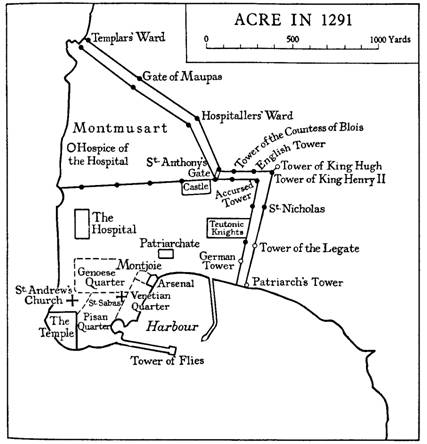
Map 4. Acre in 1291.
The siege began on 6 April. Day after day the Sultan’s mangonels and catapults flung their stone or pottery containers filled with an explosive mixture at the walls of the city or over them into the town, and his archers poured their arrows in clouds against the defenders on the galleries and tower-platforms, while his engineers prepared to move up to mine the crucial defences. He was said to have a thousand engineers to use against each tower. The Christians still had command of the sea, and provisions of food were brought in regularly from Cyprus; but they were short of armaments, and they began to realize that there were not enough soldiers to man the walls adequately against the overwhelming numbers of the enemy. But there was no talk of surrender. One of their ships was fitted with a catapult which did enormous damage in the Sultan’s camp. On the night of 15 April, when the moon was bright in the sky, the Templars, aided by Otto of Grandson, made a sortie right into the camp of the men of Hama. The Moslems were taken by surprise. But many of the Templars tripped over the tent-cords in the half-light and fell and were captured, and the others were driven back with heavy losses into the town. Another sortie made by the Hospitallers a few nights later in total darkness failed completely, as at once the Moslems lit their torches and fires. After this second check it was decided that sorties were too expensive in man-power. But the abandonment of aggressive enterprise did harm to the Christian morale. The feeling of hopelessness grew amongst them. Time was on the Moslems’ side.
On 4 May, nearly a month after the siege began, King Henry arrived from Cyprus with the troops that he could muster, a hundred horsemen and two thousand foot-soldiers, in forty ships. With him was the Archbishop of Nicosia, John Turco of Ancona. It was probably because of illness that he had not come sooner. He was received with joy. As soon as he landed he took command and put new vigour into the defence. But it was soon clear that these reinforcements were too few to make any difference to the outcome.
1291: Last Attempt at Negotiations
In a last attempt to restore peace the King sent two knights, the Templar William of Cafran and William of Villiers, to the Sultan to ask why he had broken the truce and to promise to redress any grievances. Al-Ashraf received them outside his tent, but before they could deliver their message he asked them curtly if they had brought him the keys of the city. On their denial he said that it was the place that he wanted; he was not interested in the fate of its inhabitants, and, as a tribute to the King’s courage in coming to fight when he was so young and ill, he would spare their lives if they surrendered to him. The envoys had hardly replied that they would be held as traitors if they promised capitulation when a catapult from the walls hurled a stone into the fringe of the group. Al-Ashraf was furious and drew his sword to slay the ambassadors, but the emir Shujai restrained him, bidding him not to stain it with the blood of pigs. The knights were allowed to return to their King.
The Sultan’s engineers were already beginning to mine the towers. On 8 May the King’s men decided that the barbican of King Hugh was no longer tenable. They set fire to it and left it to collapse. In the course of the following week the towers of the English and of the Countess of Blois were undermined, and the walls by Saint Anthony’s Gate and by the tower of Saint Nicholas began to crumble. The new tower of Henry II held out till 15 May, when part of its outer wall came down. Next morning the Mameluks forced their way into the ruin, and the defence was forced back into the inner line of walls. That same day there was a concentrated attack on Saint Anthony’s Gate, and only the gallantry of the Templars and the Hospitallers kept the enemy from passing into the city. The Marshal of the Hospital, Matthew of Clermont, distinguished himself by his bravery.
During the next day the Moslems strengthened their hold on the outer enceinte; and the Sultan ordered the general assault for the morning of Friday, 18 May. The attack was launched on the whole length of the walls from Saint Anthony’s Gate to the Patriarch’s Tower by the Bay, but the main effort of the Moslems was against the Accursed Tower at the angle of the salient. The Sultan threw all his resources into the battle. His mangonels kept up an unceasing bombardment. The arrows of his archers fell almost in a solid mass into the city; and regiment after regiment rushed at the defences, led by white-turbaned emirs. The noise was appalling. The assailants shouted their battle-cries, and trumpets and cymbals and the drums of three hundred drummers on camel-back urged them on.
It was not long before the Mameluks forced their way into the Accursed Tower. The Syrian and Cypriot knights that were its garrison were pushed back westwards towards Saint Anthony’s Gate. There the Templars and Hospitallers came to their assistance, fighting together as if there had never been two centuries of rivalry between them. Matthew of Clermont desperately tried to lead a counter-attack to recover the Tower, but though the two Grand Masters both followed him, they could make no impression. Along the eastern wall of the city John of Grailly and Otto of Grandson held their own for some hours; but after the fall of the Accursed Tower the enemy was able to pass along the crumbling walls and take possession of the Gate of Saint Nicholas. The whole salient was lost, and the Moslems were well established inside the city.
1291: The Flight from Acre
There was fierce fighting in the streets; but nothing now could be done to save Acre. William of Beaujeu, Grand Master of the Temple, was mortally wounded in the fruitless counter-attack against the Accursed Tower. His followers carried him to the Temple building where he died. Matthew of Clermont was with him, but returned to the battle and to his death. The Grand Master of the Hospital, John of Villiers, was wounded, but his men brought him down to the harbour and put him protesting on board a ship. The young King and his brother Amalric had already embarked. King Henry was later accused of cowardice in deserting the city; but there was nothing that he could have done, and it was his duty to his kingdom to avoid capture. On the eastern sector John of Grailly was wounded, but Otto of Grandson took control. He commandeered as many Venetian ships as he could find and placed John of Grailly and all soldiers that he could rescue on board, and himself was the last to join them. There was ghastly confusion on the quays. Soldiers and civilians, women and children amongst them, crowded into rowing boats, seeking to reach the galleys that lay off the shore. The aged Patriarch, Nicholas of Hanape, who had been slightly wounded, was placed by his faithful servants in a small skiff; but out of charity he allowed so many refugees to climb in with him that the boat sank with their weight and they were all drowned. There were some men who had the presence of mind to snatch hold of a boat and charge exorbitant fees from the desperate merchants and ladies on the quay. The Catalan adventurer, Roger Flor, who had fought bravely as a Templar during the siege, took command of a Templar galley and founded his great fortune on the blackmail that he extorted from the noblewomen of Acre.
The ships were far too few to rescue the fugitives. Soon the Moslem soldiers penetrated right through the city, slaying everyone, old men, women and children alike. A few lucky citizens who stayed in their houses were taken alive and sold as slaves, but not many were spared. No one could tell the number of those that perished. The Orders and the great merchant houses later tried to draw up lists of the survivors; but the fate of most of their members was unknown. Subsequent travellers to the East spoke of seeing renegade Templars living squalidly in Cairo and of other Templars working as wood-cutters by the Dead Sea. Some prisoners were freed and returned to Europe after nine or ten years of captivity. The slaves who had been knights and their descendants were said to have been treated with some respect by their masters. Many women and children disappeared for ever into the harems of Mameluk emirs. Owing to the plentiful supply the price of a girl dropped to a drachma apiece in the slave-market at Damascus. But the number of Christians that were slain was greater still.
By the night of 8 May all Acre was in the Sultan’s hands, except for the great building of the Templars jutting out into the sea at the south-west point of the city. The surviving Templars had taken refuge there, together with a number of citizens of both sexes. For several days its huge walls defied the enemy; and ships that had landed refugees in Cyprus came back to its aid. After nearly a week al-Ashraf offered the Marshal of the Order, Peter of Sevrey, to allow him to embark to Cyprus with all the people inside the fortress and with their possessions, if it were given up to him. Peter accepted the terms; and an emir and a hundred Mameluks were admitted into the fortress to supervise the arrangements, while the Sultan’s flag was hoisted over the tower. But the Mameluks were out of hand and began to molest and seize hold of the Christian women and boys. Furious at this, the knights fell on the Moslems and slaughtered them, and pulled down the enemy flag, ready to resist to the death. When night fell, Peter of Sevrey sent the treasury of the Order with its Commander, Tibald Gaudin, and a few non-combatants, by boat to the castle at Sidon. Next day al-Ashraf, seeing the strength of the castle and the desperate courage of its garrison, offered the same honourable terms as before. Peter and a few companions went out under a safe-conduct to discuss the surrender. But as soon as they reached the Sultan’s tent they were seized and bound and promptly beheaded. When the defenders on the wall saw what had happened, they closed the gate again and fought on. But they could not prevent the Moslem engineers from creeping up to the walls and digging a great mine beneath them. On 18 May the whole landward side of the building begun to crumble. Impatiently al-Ashraf threw two thousand Mameluks into the widening breach. Their weight was too much for the sagging foundations. As they fought their way in, the whole edifice came crashing down, killing defenders and assailants alike in its vast ruin.
1291: The Destruction of Acre
As soon as Acre was in his power, the Sultan set about its systematic destruction. He was determined that it should never again be a spearhead for Christian aggression in Syria. The houses and bazaars were pillaged, then burned; the buildings of the Orders and the fortified towers and castles were dismantled; the city walls were left to disintegrate. When the German pilgrim, Ludolf of Suchem, passed by some forty years later, only a few wretched peasants lived amongst the ruins of the once splendid capital of Outremer. One or two churches still stood, not wholly destroyed. But the fine doorway of the Church of Saint Andrew had been taken to ornament the mosque built in Cairo to honour the victorious Sultan; and amidst the crumbling walls of the Church of Saint Dominic the tomb of the Dominican Jordan of Saxony was untouched, as the Moslems had peered in and found his body uncorrupted.
The remaining Frankish cities soon shared the fate of Acre. On 19 May, when most of Acre was in his hands, al-Ashraf sent a large contingent of troops to Tyre. It was the strongest city of the coast, impregnable against an enemy that lacked command of the sea. In the past its walls had twice thwarted Saladin himself. A few months earlier the Princess Margaret, to whom it belonged, had handed it over to her nephew, the King’s brother Amalric. But its garrison was small; and, as soon as the enemy approached Amalric’s bailli, Adam of Caftan, lost his nerve and sailed away to Cyprus, abandoning the city without a struggle. At Sidon the Templars determined to make a stand. Tibald Gaudin was there, with the treasure of the Order; and the surviving knights had elected him Grand Master, to succeed William of Beaujeu. They were left in quiet for a month. Then a huge Mameluk army came up under the emir Shujai. The knights were too few to hold the town; so they retired, with many of the leading citizens, to the Castle of the Sea, built on an island rock a hundred yards from the shore, and recently refortified. Tibald at once set sail for Cyprus, to raise troops for the castle’s assistance. But once that he was there he did nothing, either from cowardice or despair. The Templars in the castle fought bravely, but when the Mameluk engineers began to build a causeway across the sea, they gave up hope and sailed away up the coast to Tortosa. On 14 July Shujai entered the castle and ordered its destruction.
A week later Shujai appeared before Beirut. Its citizens had hoped that the treaty made between the Lady Eschiva and the Sultan would preserve them from attack. When the emir bade the leaders of the garrison to come and pay their respects to him, they therefore anxiously complied, only to find themselves made prisoner. Without its leaders the garrison could not contemplate defence. Its members took to their ships and fled, carrying with them the relics from the Cathedral. The Mameluks entered the city on 31 July. Its walls and the castle of the Ibelins were pulled down, and the Cathedral turned into a mosque.
1291: The Death of Outremer
Soon afterwards the Sultan occupied Haifa without opposition on 30 July, and his men burned the monasteries on Mount Carmel and slew their monks. There still remained the two Templar castles at Tortosa and Athlit, but in neither was the garrison strong enough to face a siege. Tortosa was evacuated on 3 August and Athlit on the 14th. All that now was left to the Templars was the island fortress of Ruad, some two miles off the coast opposite Tortosa. There they maintained their hold for twelve more years, only quitting the island in 1303, when the whole future of the Order began to be in doubt.
For some months the Sultan’s troops marched up and down the coast-lands, carefully destroying anything that might be of value to the Franks should they ever attempt another landing. Orchards were cut down, irrigation-systems put out of order. The only castles that were left standing were those that were back from the coast, like Mount Pilgrim at Tripoli, and Marqab on its high mountain. Along the sea there was desolation. The peasants of those once rich farms saw their steads destroyed and sought refuge in the mountains. Those of Frankish origin hastened to merge themselves with the natives; and the native Christians were treated little better than slaves. The old easy tolerance of Islam was gone. Embittered by the long religious wars, the victors had no mercy for the infidel.
The lot of the Christians that escaped to Cyprus was not much better. For a generation they lived the miserable lives of unwanted refugees, for whom as the years passed sympathy wore thin. They only served to remind the Cypriots of the terrible disaster. And the Cypriots needed no reminder. For a century to come the great ladies of the island, when they went out of doors, wore cloaks of black that stretched from their heads to their feet. It was a token of mourning for the death of Outremer.