
‘Behold, I will turn back the weapons of war that are in your hands, wherewith ye fight against the king of Babylon, and against the Chaldean, which besiege you without the walls.’ JEREMIAH XXI, 4
In the moment of triumph Saladin had made one grave mistake, when he let himself be daunted by the fortifications of Tyre. Had he marched on Tyre immediately after his capture of Acre in July 1187, it would have been his. But he thought that its surrender had been arranged, and delayed a few days. When he arrived before Tyre, Conrad of Montferrat was there already and refused to consider capitulation. Saladin was not equipped at that moment to undertake a systematic siege of the town and moved on to easier conquests. It was not till after the fall of Jerusalem in October that he made a second attack on Tyre, with a large army and all his siege-machines. But the walls across the narrow isthmus had been strengthened now by Conrad, who devoted the money that he had brought with him from Constantinople to improve all the defences. After his engines proved ineffectual and his fleet was destroyed in a battle at the harbour entrance, Saladin lifted the siege once more and disbanded most of his troops. Before he came again to complete the conquest of the coast, help had arrived from overseas.
1188: Release of King Guy
The forces dispatched by William II of Sicily in the late spring of 1188 were not large, but they consisted of a well-armed fleet under the Admiral Margaritus and two hundred trained knights. The presence of these reinforcements caused Saladin to raise the siege of Krak des Chevaliers in July 1188, and deterred him from attacking Tripoli. He would have been glad now to negotiate a peace. There was a knight from Spain who had arrived at Tyre in time to share in its defence. His name is unknown, but from the armour that he wore men called him the Green Knight. His valour and prowess greatly impressed Saladin, who interviewed him near Tripoli in the summer of 1188, hoping to persuade him to arrange for a truce and himself take service with the Saracens. But the Green Knight answered that the Franks would consider nothing less than the restoration of their country, especially as help was coming from the West. Let Saladin evacuate Palestine; then he would find the Franks the most loyal of allies.
Though peace was not to be had Saladin showed his friendly intentions by releasing some of his eminent prisoners. It had been his practice to induce the captive Frankish lords to obtain their liberty by ordering the surrender of their castles to him. It was a cheap and easy way of obtaining the fortresses. His chivalry went further. When Stephanie, lady of Oultrejourdain, failed to persuade her garrisons at Kerak and Montreal to give themselves up in order that her son, Humphrey of Toron, might be released, Saladin returned him to her even before the obstinate castles were taken by storm. The price of King Guy’s release was to have been Ascalon. But the citizens there, ashamed of their King’s selfishness, refused to honour his undertaking. Ascalon now had fallen; and so Queen Sibylla wrote again and again to Saladin, begging him to give her back her husband. In July 1188, Saladin granted her request. After solemnly swearing that he would go back across the sea and never again take arms against the Moslems, King Guy, with ten distinguished followers, including the Constable Amalric, was sent to join the Queen at Tripoli. At the same time the aged Marquis of Montferrat was allowed to go to his son at Tyre.
Saladin’s generosity alarmed his compatriots. Not only did he allow the Frankish citizens in every town that surrendered to him to go and join their fellows at Tyre or Tripoli, but he further swelled the garrisons of these last Christian fortresses by setting free so many of the captive lords. But Saladin knew what he was doing. The party quarrels that had rent the latter years of the kingdom of Jerusalem had been healed by the tact of Balian of Ibelin only a few weeks before the battle of Hattin, and they had broken out again on the very eve of the battle. The disaster embittered them. The Lusignan and Courtenay supporters blamed it on Raymond of Tripoli, and Raymond’s friends, the Ibelins and the Garniers and most of the local nobility, blamed it, with better reason, on King Guy’s weakness and the influence of the Templars and Reynald of Chatillon. Raymond and Reynald were dead now, but the bitterness lasted on. Cooped up behind the walls of Tyre, the dispossessed nobles had little else to do but to hurl recriminations at each other. Balian and his friends who had eluded captivity now accepted Conrad of Montferrat as their leader. They had seen that it was he alone who had saved Tyre. But Guy’s supporters, emerging from prison after the worst of the crisis was over, merely saw him as an interloper, a potential rival to their King. Guy’s release, so far from strengthening the Franks, brought the quarrel to a head.
1188: Rivalry of Guy and Conrad
Queen Sibylla, probably to escape from an atmosphere hostile to her husband, had retired to Tripoli. On Raymond’s death in the autumn of 1187 Tripoli had passed to the young son of his cousin, Bohemond of Antioch; and Bohemond, who was easygoing and, perhaps, grateful to have the garrison at Tripoli reinforced, made no objections when the Lusignan partisans gathered round her there. Guy joined her as soon as he was freed; and at once a cleric was found to release him from his oath to Saladin. It had been made under duress and to an infidel. Therefore, said the Church, it was invalid. Saladin was angry to hear of this but cannot have been much surprised. After visiting Antioch, where Bohemond gave him a vague promise to help, Guy marched with his supporters from Tripoli to Tyre, intending to take over the government of what remained of his former kingdom. Conrad closed the gates in his face. In the opinion of Conrad’s party Guy had forfeited the kingdom at Hattin and during his captivity. He had left it without a government, and all would have been lost but for Conrad’s intervention. To Guy’s demand to be received as king, Conrad answered that he held Tyre in trust for the Crusader monarchs who were coming to rescue the Holy Land. The Emperor Frederick and the Kings of France and England must decide to whom eventually the government should be given. It was a fair enough claim, and it suited Conrad. Richard of England, as overlord of the Lusignans in Guienne, might favour Guy’s cause; but the Emperor and Philip of France were Conrad’s cousins and friends. Guy returned disconsolate with his party to Tripoli. It was well for the Franks that at this moment Saladin, with his army partly disbanded, was occupied in reducing the castles in the north of Syria, and that in January 1189 he sent further detachments to their homes. He himself, after spending the first months of the year at Jerusalem and Acre, reorganizing the administration of Palestine, went back to his capital at Damascus in March.
In April Guy came again with Sibylla to Tyre and again demanded to be given control of the city. Finding Conrad as obdurate as before, he encamped in front of its walls. About the same time valuable reinforcements arrived from the West. At the time of the fall of Jerusalem the Pisans and the Genoese were enjoying one of their habitual wars; but amongst the triumphs of Pope Gregory VIII in his short pontificate was the negotiation of a truce between them and the promise of a Pisan fleet for the Crusade. The Pisans set out before the end of the year but wintered at Messina. Their fifty-two ships arrived off Tyre on 6 April 1189, under the command of their Archbishop, Ubaldo. Soon afterwards Ubaldo seems to have quarrelled with Conrad; and when Guy appeared, the Pisans joined up with him. He also won the support of the Sicilian auxiliaries. During the early summer there was some slight skirmishing between the Franks and the Moslems. But Saladin still wished to rest his armies, and the Christians awaited more help from the West. Suddenly, at the end of August, King Guy broke his camp and set out to march with his followers southward down the coast road to attack Acre, and the Pisan and Sicilian ships sailed to keep him company.
It was a move of desperate foolhardiness, the decision of a brave but very unwise man. Thwarted of his wish to reign in Tyre, Guy urgently needed a city from which to reconstitute his kingdom. Conrad was seriously ill at the time; and it seemed to Guy a fine opportunity to show that he was the active leader of the Franks. But the risk was enormous. The size of the Moslem garrison of Acre was more than twice that of Guy’s whole army; and Saladin’s regular forces were in the offing. No one could have foreseen that the adventure would succeed. But history has its surprises. If Conrad’s ruthless energy had saved the remnant of Palestine for Christendom, it was Guy’s gallant folly that turned the tide and began an era of reconquest.
1189: Guy arrives before Acre
When the news reached him of Guy’s expedition, Saladin was in the hills beyond Sidon, laying siege to the castle of Beaufort. The castle, perched on a high cliff above the river Litani, belonged to Reynald of Sidon and had hitherto been preserved by the cunning of its lord. He had gone to Saladin’s court and had charmed the Sultan and his entourage by his deep appreciation of Arabic literature and his interest in Islam. He hinted that, given a little time, he would settle as a convert in Damascus. But the months passed and nothing happened except that the fortifications of Beaufort were strengthened. At last, early in August, Saladin said that the time had come for the surrender of Beaufort as a gage of Reynald’s intentions. Reynald was taken under escort to the castle gate where he ordered the garrison-commander in Arabic to yield up the castle and in French to resist. The Arabs saw through the ruse but were powerless to take the castle by storm. While Saladin brought up his forces to blockade it, Reynald was cast into prison at Damascus. Saladin first thought that Guy’s march was intended to draw the Saracen army away from Beaufort, but his spies soon told him that its objective was Acre. He then wished to attack the Franks while they were climbing over the Ladder of Tyre or the headlands of Naqura. But his Council would not agree. It would be better, they said, to let them reach Acre and catch them between the garrison and the Sultan’s main army. Saladin, who was not well at the time, weakly gave way.
Guy arrived outside Acre on 28 August and set up his camp on the hill of Turon, the modern Tel el-Fukhkhar, a mile east of the city, by the little river Belus, which supplied his men with water. When his first attempt, three days later, to take the city by assault failed, he settled down to await reinforcements. Acre was built on a small peninsula that jutted southward into the Gulf of Haifa. To the south and west it was protected by the sea and a strong seawall. A broken mole ran out south-eastward to a rock crowned with a fort called the Tower of Flies. Behind the mole was a harbour sheltered against all but the off-shore wind. The north and east of the city were protected by great walls, which met at a right angle at a fort called the Cursed Tower, at the north-east corner. The two land-gates were at either end of the walls, by the shore. A large sea-gate opened into the harbour, and a second on to an anchorage exposed to the dominant west wind. Under the Frankish kings Acre had been the richest town in the kingdom and their favourite residence. Saladin had often visited it during the last months and had carefully repaired the damage caused by his troops when he captured it. It was a strong fortress now, well garrisoned and well provisioned, capable of a long resistance.
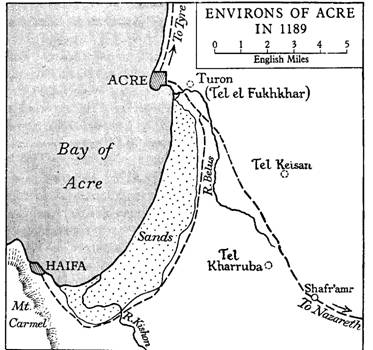
Map 1. Environs of Acre.
1189: Saladin moves to Acre
Reinforcements began to arrive from the West early in September. First came a large fleet of Danes and Frisians, undisciplined soldiers but excellent sailors, whose galleys were invaluable for blockading the city from the sea, especially when the death of William of Sicily in November led to the withdrawal of the Sicilian squadron. A few days later ships from Italy brought a Flemish and French contingent, led by the gallant knight, James of Avesnes, the Counts of Bar, Brienne and Dreux, and Philip, Bishop of Beauvais. Before the month was ended a party of Germans arrived, under Louis, Margrave of Thuringia, who preferred to travel with his followers by sea rather than accompany his Emperor. With him were the Count of Guelders and a party of Italians under Gerard, Archbishop of Ravenna, and the Bishop of Verona.
These arrivals alarmed Saladin, who began to gather his vassals again and who came down with part of his army from Beaufort, leaving a smaller detachment to finish the reduction of the castle. His attack on Guy’s camp on 15 September failed, but his nephew Taki was able to break round the Frankish lines and establish contact with the north gate of the city. He himself established his camp a little to the east of the Christians. Soon the Franks felt able to take the offensive. Louis of Thuringia, as he passed through Tyre, was able to persuade Conrad of Montferrat to join the Frankish army, so long as he did not have to serve under Guy’s command. On 4 October, after having fortified their camp, which was left under the command of Guy’s brother Geoffrey, the Franks launched a great attack on Saladin’s lines. It was a bitter battle. Taki, on the Saracen right, retired to lure on the Templars, who were opposite to him; but Saladin himself was deceived by the manoeuvre and weakened his centre to rescue him. As a result both his right and his centre were put to flight with heavy losses, some of his troops never reining their horses till they reached Tiberias. The Count of Brienne even penetrated to the Sultan’s own tent. But the Saracen left was intact; and when the Christians broke their ranks to pursue the fugitives Saladin charged with it and drove them back in disorder to their camp, which was at the same time assailed by a sortie from the garrison of Acre. Geoffrey of Lusignan held firm there; and soon the greater part of the Christian army was safe behind its defences, where Saladin did not venture to attack them. Many Frankish knights fell on the field, including Andrew of Brienne. The German troops panicked and suffered severely; and losses were high amongst the Templars. Their Grand Master, Gerard of Ridfort, who had been King Guy’s evil genius in the days before Hattin, was captured and paid for his follies with his death. Conrad himself only escaped capture by the gallant intervention of his rival, King Guy.
1190: Stalemate
The victory had been with the Moslems; but it was not a complete victory. The Christians had not been dislodged; and during the autumn more help came from the West. The Londoners’ fleet arrived in November, heartened by their success in Portugal. The chroniclers tell of many other Crusaders drawn from the nobility of France, Flanders and Italy and even from Hungary and Denmark. Many Western knights had refused to wait for their dilatory sovereigns. Thanks to this added strength the Franks were able to complete the blockade of Acre by land. But Saladin too was receiving reinforcements. The news of the Emperor Frederick’s journey, while it encouraged the Christians, induced him to summon his vassals from all over Asia; and he even wrote to the Moslems of Morocco and Spain to say that if Western Christendom was sending its knights to fight for the Holy Land Western Islam should do likewise. They answered him with sympathy but very little positive help. Nevertheless his army soon was large enough for him in his turn almost entirely to blockade the Christians. The besiegers were themselves besieged. On 31 October fifty of his galleys broke through the Frankish fleet, though with the loss of some ships, to bring food and munitions into Acre; and on 26 December a larger armada from Egypt reopened communications with the harbour.
Throughout the winter the armies faced each other, neither venturing on a major engagement. There were skirmishes and duels, but at the same time there was growing fraternization. The knights on either side began to know and to respect each other. A fight would be interrupted while the protagonists enjoyed a friendly conversation. Enemy soldiers would be invited to come to the feasts and entertainments arranged in either camp. One day the little boys living in the Saracen camp challenged the Christian boys to a gay mock-combat. Saladin himself was distinguished by the kindness that he showed to Christian prisoners and the courteous messages and gifts that he would send to the Christian princes. The more fanatical of his followers wondered what had happened to the Holy War that he had begged the Caliph to preach; nor did newly-come knights from the West find the atmosphere easy to comprehend. Superficially the bitterness had gone out of the war. But both sides kept a grim determination for victory.
Despite these pleasant courtesies life in the Christian camp was harsh that winter. Food was short, especially as the Franks had lost command of the sea. As the warmer weather approached, water became a problem and sanitary arrangements broke down. Disease spread through the troops. Chastened by the difficulties of their men, Guy and Conrad patched up an agreement. Conrad was to hold Tyre, with Beirut and Sidon when they should be recovered, and was to recognize Guy as king. When peace between them was thus made, Conrad left the camp in March and at the end of the month returned from Tyre with ships laden with food and armaments. Saladin’s fleet sailed out of the harbour of Acre to intercept him; but after a sharp battle the Saracen ships were driven back, in spite of their use of Greek fire, and Conrad was able to land the goods. With the help of the material that he brought, the Franks constructed wooden siege-towers, with which on 5 May they tried to assault the city. But the towers were burnt. Soon famine and sickness reappeared in the Christian camp; and it was little consolation to know that in Acre too there was famine, although from time to time Saracen ships fought their way into the harbour bringing new provisions. Throughout the spring contingents of Moslems joined Saladin’s army. On 19 May, Whit Saturday, he began an attack on the camp, which was only beaten off after eight days’ fighting. The next full-scale battle was on St James’s Day, 25 July, when the Frankish soldiers, led by their sergeants and against the wishes of their leaders, boldly attacked Taki’s camp, on Saladin’s right. They were terribly defeated and many perished. A distinguished English Crusader, Ralph of Alta Ripa, Archdeacon of Colchester, went to their rescue and was killed.
1190: Desultory Fighting
During the summer other high-born Crusaders arrived in the camp and were made welcome, though every new soldier meant another mouth to feed. Many of the greatest French and Burgundian nobles were among them, hurrying ahead of their King. There were Tibald, Count of Blois, and his brother Stephen of Sancerre, once a reluctant candidate for Queen Sibylla’s hand, Ralph, Count of Clermont, John, Count of Fontigny, and Alan of Saint-Valery, together with the Archbishop of Besancon and the Bishops of Blois and Toul and other prominent ecclesiastics. Their leader was Henry of Troyes, Count of Champagne, a young man of great distinction, for his mother, the daughter of Eleanor of Aquitaine by her French marriage, was half-sister to the Kings of England and France; and both his uncles thought highly of him. He was at once given a special position as representative and forerunner to the Kings. He took command of the actual siege operations, which hitherto James of Avesnes and the Landgrave of Thuringia had directed. The Landgrave, who had been ill for some time, probably with malaria, used his coming as an excuse to return to Europe. Frederick of Swabia, with the remnant of Barbarossa’s army, arrived at Acre early in October. A few days later an English contingent landed at Tyre and came down to Acre. At its head was Baldwin, Archbishop of Canterbury.
There was desultory fighting throughout the summer, each side awaiting the reinforcements that would enable it to take the offensive. The fall of Beaufort in July relieved men for Saladin’s army, but he had sent troops to the north to intercept Frederick Barbarossa and they did not return till the winter. Meanwhile skirmishes alternated with fraternization. The Christian chroniclers noted with complacency several incidents in which, by the hand of God, Saracens were discomfited and Crusader heroism rewarded; but every attempt to scale the walls of the city failed. Frederick of Swabia launched a fierce attack soon after his arrival and the Archbishop of Besancon soon afterwards tried out some newly constructed battering-ram. Both efforts were in vain. In November the Crusaders managed to dislodge Saladin from his position at Tel Keisan, five miles from the city; but he established himself in a stronger position at Tel Kharruba, a little further away. This enabled them to break through to Haifa on a foraging expedition, which slightly relieved the hunger in the camp. But both in the city and in the two camps there was hunger and illness. Neither side was fitted to make a supreme effort.
1190: Marriage of Conrad and Isabella
Amongst the victims of disease that autumn was Queen Sibylla. The two little daughters that she had borne to King Guy died a few days before her own death. The heiress to the kingdom was now the Princess Isabella; and Guy’s crown was in jeopardy. He had won the crown as the Queen’s husband. Did his rights survive her death? To the surviving barons of the kingdom, led by Balian of Ibelin, it seemed an opportunity for ridding themselves of his weak unlucky rule. Their candidate for the throne was Conrad of Montferrat. If he could be married to Isabella, his claims would be higher than Guy’s. There were difficulties in this solution. Conrad was rumoured to have one wife living at Constantinople and possibly another in Italy, and never to have troubled about any annulment or divorce. But Constantinople and Italy were far away, and if there were deserted ladies there, they could be forgotten. A more pressing problem was the existence of Isabella’s husband, Humphrey of Toron, who was not only alive but present in the camp. Humphrey was a charming youth, gallant and cultured; but his beauty was too feminine for him to be respected by the tough soldiers around him; nor had the barons ever forgotten his weak desertion of their cause in 1186, when Guy had secured the crown in defiance of the terms of Baldwin IV’s will. They decided that he must be divorced. Humphrey himself was easily persuaded to agree. He was not fitted for married life, and he was terrified of political responsibility. But Isabella was less amenable. Humphrey had always been kind to her, and she had no wish to exchange him for a grim middle-aged warrior. Nor had she ambitions for the throne. The barons left the matter to the capable hands of her mother, Queen Maria Comnena, Balian’s wife. She used her maternal authority to make the reluctant princess abandon Humphrey. Then she declared before the assembled bishops that her daughter had been forced into the marriage by her uncle Baldwin IV, and had only been eight years old when the engagement was arranged. In view of her extreme youth and Humphrey’s known effeminacy, the marriage should be annulled. The Patriarch Heraclius was too ill to attend the meeting and appointed the Archbishop of Canterbury to represent him; and the Archbishop, knowing that his master King Richard was devoted to the Lusignans, refused to pronounce the annulment. He mentioned Conrad’s previous marriage and declared that a marriage between Conrad and Isabella would be doubly adulterous. But the Archbishop of Pisa, who was Papal Legate, had been won over to Conrad’s cause, on the promise, it was said, of trade concessions for his countrymen; and the Bishop of Beauvais, who was King Philip’s cousin, used the Legate’s backing to secure a general agreement for Isabella’s divorce, and himself married her to Conrad on 24 November 1190. The Lusignan supporters were furious at a marriage that abolished Guy’s right to the throne; and King Richard’s vassals from England, Normandy and Guienne gave them full sympathy. But Archbishop Baldwin, their chief spokesman, after hurling excommunications on everyone connected with the affair, had died suddenly on 19 November. The English chroniclers did all that they could to blacken Conrad’s memory. Guy himself went so far as to challenge Conrad to single combat; but Conrad, knowing that legitimate right was now on his side, refused to admit that the case could be discussed any more. The Lusignans might call it cowardice. But all that had the future of the kingdom at heart realized that if the royal line was to be continued, Isabella must remarry and have a child; and Conrad, the saviour of Tyre, was the obvious choice for her. The newly wedded pair retired to Tyre, where, next year, Isabella gave birth to a daughter, called Maria after her Byzantine grandmother. Conrad, correctly, would not take the title of king till he and his wife should be crowned, but, as Guy refused to abdicate any of his rights, he would not return from Tyre to the camp.
1191: Famine in the Frankish Camp
The tribulations of the Crusaders continued throughout the winter months. Saladin’s reinforcements had arrived from the north, and the Frankish camp was now closely invested. No food could come by land, nor, during the winter months, could much be landed on the inhospitable coast, whereas Saracen ships could sometimes fight their way into the shelter of Acre harbour. Amongst the lords that died of sickness in the camp were Tibald of Blois and his brother, Stephen of Sancerre. On 20 January 1191, Frederick of Swabia died, and the German soldiers found themselves leaderless, though his cousin, Leopold of Austria, who arrived from Venice early in the spring, tried to rally them under his banner. Henry of Champagne was for many weeks so ill that his life was despaired of. Many of the soldiers, especially the English, blamed Conrad for their misery, because he was dallying at Tyre and refused to come to their aid. But, whatever his motive may have been, it is hard to see what else he could have done; the camp was sufficiently crowded without him. Now and then an attempt was made to scale the walls, notably on 31 December, when the wreck of a Saracen relief-ship at the harbour entrance was distracting the garrison. It failed; nor were the Crusaders able to profit by a collapse of part of the land-wall six days later. There were many deserters to the Moslems. Thanks to their help and to his excellent spy-system, Saladin was able to send a force to break through the Crusader lines on 13 February, with a fresh commander and garrison to relieve the weary defenders of the city. But he hesitated himself to make a final attack on the Christian camp. Many of his troops were weary, and when reinforcements arrived he sent detachments away to rest. The misery amongst the Christians seemed to be doing his work for him.
He was once again unwise in his forbearance. As Lent approached it seemed that the Franks could not long survive. In their camp a silver penny bought only thirteen beans or a single egg, and a sack of corn cost a hundred pieces of gold. Many of the best horses were slaughtered to provide their owners with food. The common soldiers ate grass and chewed bare bones. The prelates in the camp tried to organize some kind of relief but were hampered by the avarice of the Pisan merchants who controlled most of the food supplies. But in March, when everything seemed desperate, a fully laden corn-ship arrived off the coast and was able to land its cargo; and, as the weather improved, others followed. They were doubly welcome, for they brought not only foodstuffs but the news that the Kings of France and England were at last in Eastern waters.