
‘Can two walk together, except they be agreed?’ AMOS III, 3
The failure of the Fourth Crusade to send material help to Palestine was not without its compensations. For over ten years the little kingdom was left in peace. The truce that King Amalric had arranged with the Sultan held good. Without Western aid the Franks could not venture to break it, while al-Adil was sufficiently busy keeping together his own dominions not to trouble himself over the conquest of a state that was harmless, whereas if he were to attack it, he might well provoke a Crusade. For three years John of Ibelin was able to rule undisturbed as regent for his niece Queen Maria.
In 1208 the Queen reached the age of seventeen, and it was time to find a husband. An embassy consisting of Florent, Bishop of Acre, and Aymar, lord of Caesarea, was sent to France to ask King Philip to provide a candidate. It was hoped that the offer of a crown would lure some rich and vigorous prince to come to the rescue of the Frankish East. But it was not so easy to find a bridegroom. At last, in the spring of 1210, Philip announced that a knight from Champagne, called John of Brienne, had accepted the position.
1210: John of Brienne King of Jerusalem
It was a disappointing choice. John was a penniless younger son who had already reached the age of sixty. His elder brother Walter had married King Tancred of Sicily’s eldest daughter and had put in an ineffectual claim to the Sicilian throne; but John had spent his life in comparative obscurity as one of the French King’s commanders. It was rumoured that he was chosen now because of a love-intrigue with the Countess Blanche of Champagne which was scandalizing the Court. But, apart from his poverty, he was not ill-fitted for the post. He had a wide knowledge of international politics, and his age was guarantee that he would not embark on rash adventures. To make him more acceptable King Philip and Pope Innocent each gave him a dower of 40,000 silver pounds.
Meanwhile, till he should arrive, John of Ibelin carried on the government. In July 1210 the truce with al-Adil came to an end, and the Sultan sent to Acre to suggest its renewal. John of Ibelin presided over a Council at which he recommended the acceptance of the offer; and he was supported by the Grand Master of the Hospital, Guerin of Montaigu, and the Grand Master of the Teutonic Knights, Hermann Bardt. But the Grand Master of the Temple, Philip of Le Plessiez, persuaded the bishops to insist on rejecting the suggestion, on the legal ground that the future King could not be bound by any new truce. There was little actual fighting. Al-Adil sent his son, al-Mu’azzam, with a few troops to Mount Thabor and their presence there kept the Franks in check.
John of Brienne landed at Acre on 13 September 1210. Next day the Patriarch Albert of Jerusalem married him to Queen Maria; and on 3 October the royal pair were crowned at Tyre.
The new King soon became popular. He showed tact in the handling of his vassals and the Military Orders and caution in his dealings with the Moslems. While the court was at Tyre for the coronation al-Mu’azzam had raided the suburbs of Acre but had not ventured to attack the city itself. Early next summer John allowed some of his vassals to combine with the Templars on an expedition by sea to the Damietta mouth of the Nile; but it was ineffectual. A few months later he accepted a fresh offer from al-Adil to sign a truce for five years, which came into force in July1212. In the meantime messages were sent by the King to Rome, to ask that a new Crusade should be ready to come to Palestine as soon as the truce should expire.
The same year the young Queen died, after giving birth to a daughter called Isabella after her grandmother, but more usually known as Yolanda. Her death made John’s judicial position doubtful. He had reigned as the Queen’s husband. Now the kingdom had passed to Yolanda; and her father had no legal right. But he was her father, and he was accepted as natural regent of the kingdom, at least until she should marry. He continued to govern the country in peace till the coming of the next Crusade. To console himself in his widowhood he married in 1214 the Princess Stephanie of Armenia, daughter of Leo II. She proved a bad stepmother; and gossip attributed her death in 1219 to the severe beating that John had given her for having tried to poison the child Yolanda.
The neighbouring Latin states were less fortunate than the kingdom of Acre. In Cyprus King Amalric had been succeeded by his ten-year-old son Hugh, and the regency was given to Walter of Montbeliard, a French knight who had been Amalric’s constable and had married Hugh’s eldest sister Burgundia. He was an unsuccessful regent, who involved the island in an unhappy war with the Turks; and when he handed over the power to his brother-in-law in 1210 he was forcibly exiled on the suspicion of gross peculation during his period of office. King Hugh was now fifteen. Two years previously he had married his stepsister, Alice of Jerusalem, according to the arrangement made by their respective fathers. The negotiations for the actual marriage were conducted by the bride’s grandmother, Queen Maria Comnena, and the dowry was provided by Blanche of Navarre, Countess of Champagne, widow of the bride’s uncle. She feared that unless Alice and her sister were both safely married in the East, one of them might come and claim the county of Champagne from her own infant son. King Hugh was a youth with a fiery temper, whose relations with his neighbours, his vassals, his Church and the Papacy were consistently stormy. But he provided his kingdom with a firm government.
1201: The Succession at Antioch
The situation in the Principality of Antioch was far stormier. Bohemond, Count of Tripoli, had established himself there on his father Bohemond III’s death in 1201, in defiance of the rights of his nephew, Raymond-Roupen. Raymond’s maternal great-uncle, Leo of Armenia, continued to press his cause. Complications were introduced by Leo’s quarrel with the Templars, whose castle of Baghras he refused to return. The Hospitallers therefore sided with him against Bohemond. Bohemond, however, could call on the help of the Seldjuk Turks, with whom Leo was perpetually at war; and az-Zahir of Aleppo was always ready to send him reinforcements. Al-Adil was therefore hostile to Bohemond. The Kings of Jerusalem and Cyprus were inconstant in their sympathies. Religious problems added to the chaos. In the interests of the whole Crusading movement it was essential that the question of the Antiochene succession should be settled; and Pope Innocent felt it his duty to intervene. Two of his legates, Sofred of Saint-Praxedis and Peter of Saint-Marcel, in turn, then together, attempted to hear the case; but while Leo was verbally deferential to Rome, he refused to make peace with the Templars by the cession of Baghras, as the Pope bade him. Bohemond on the other hand denied the Pope’s right to take notice of a purely feudal question. Soon after Bohemond III’s death the Patriarch Peter of Antioch had joined Leo’s party, for which neither Bohemond IV nor the Commune of Antioch, which was strongly anti-Armenian, forgave him. But in 1203 Leo had written to the Pope to ask that the Armenian Church should be put directly under the jurisdiction of Rome; and in 1205 the Patriarch quarrelled with the Papal Legate Peter of Saint-Marcel over the appointment of the Archdeacon of Antioch. The Patriarch found himself without friends; and Bohemond could take vengeance on him.
Bohemond himself had his troubles. Though he held Antioch and had the support of the Commune, his power in the countryside was restricted. His county of Tripoli was disturbed at the end of 1204 by the revolt of Renoart, lord of Nephin, who had married the heiress of Akkar without Bohemond’s leave. Several lords joined him, including Ralph of Tiberias, whose brother Otto was now at Leo’s court; and the rebels had the sympathy of King Amalric. While Bohemond sought to suppress the revolt, Leo laid siege to Antioch and only retired when an army sent by az-Zahir of Aleppo came to Bohemond’s help. After Amalric’s death John of Ibelin withdrew any support for the rebels, whom Bohemond defeated at the end of the year, after losing an eye during the campaign. Meanwhile, to show that Antioch as a lay state was outside of the Pope’s jurisdiction, he announced that its overlord had always been the Emperor of Constantinople. When Maria of Champagne, wife of the new Latin Emperor Baldwin, visited Palestine in 1204 on her way to join her husband, he journeyed to Acre to pay her homage.
1206: A Greek Patriarch at Antioch
In 1206, irritated now both with the Pope and with his Patriarch, Bohemond deposed the latter, and summoned the titular Greek Patriarch, Symeon II, to take his place. It is probable that Symeon was already living in Antioch; and it is certain that Bohemond’s move was supported if not suggested by the Commune. Despite a century of Frankish rule the Greek element in Antioch was still large and prosperous, and, in the course of time, many of the Latin merchant families must have intermarried with Greeks. They all hated the Armenians; and the Pope’s flirtation with Leo turned them against Rome. Bohemond for his part, now that Byzantium could no longer menace him, was very ready to favour a Church whose traditions enjoined deference to the secular prince. It was ironical that the restoration of the Greek Patriarchate, for which the Byzantine Emperors of the last century had fought so hard, should have been achieved after the destruction of Byzantium by the Latins. The Latin Patriarch Peter at once made up his quarrel with the Legate, who restored to him his power of excommunication which had been questioned. With the full approval of Rome he excommunicated the Prince and the Commune. They answered by crowding to the Greek churches in the city. The Latin Patriarch then resorted to plots. Towards the end of the next year, 1207, he introduced some knights that were faithful to him into the city by night. They managed to capture the lower city but Bohemond collected his forces in the citadel and soon drove them out. The Patriarch Peter, whose complicity was patent, was tried for treason and thrown into prison. No food nor water was given to him there. In despair he swallowed the oil from his lamp and died in agony.
Pope Innocent began to weary of the interminable struggle, and handed the responsibility of settling it to the Patriarch of Jerusalem. In 1208 Leo angrily devastated the country round Antioch while Tripoli was invaded by al-Adil’s forces, who had come, unfairly, to avenge an attack by some Cypriots on Moslem merchants, and an aggressive raid by the Hospitallers. Bohemond saved himself by calling in the Seldjuks against Leo, while the Pope appealed to az-Zahir of Aleppo to save Antioch from the Greeks. There followed a diplomatic revolution. The Patriarch of Jerusalem, Albert, was a friend of Bohemond’s allies, the Templars. He offended Leo by insisting that the first preliminary to any settlement must be the return of Baghras to the Order. Meanwhile Bohemond agreed to accept a new Latin Patriarch, Peter of Locedio, in Antioch. Leo therefore forgot his obedience to Rome. He ostentatiously made an alliance with the Greek Emperor at Nicaea; he welcomed the Greek Patriarch of Antioch, Symeon, to Cilicia, and he gave much of the Latin church lands there to the Greeks. But at the same time he sought the friendship of Hugh of Cyprus, whose sister Helvis was married to Raymond-Roupen, and he gave castles in Cilicia to the Teutonic Order. The struggle went on.
In 1213 Bohemond’s eldest son, Raymond, who was aged eighteen, was murdered by a band of Assassins in the cathedral of Tortosa. It seems that the murderers were instigated by the Hospitallers, to whom the Assassins now paid tribute. The Patriarch Albert of Jerusalem, another enemy of the Hospitallers, was murdered by Assassins the following year. Bohemond sought vengeance, and with a Templar reinforcement attacked the Assassin castle of Khawabi. The Assassins appealed to az-Zahir, who in his turn appealed to al-Adil. The siege of Khawabi was lifted, and Bohemond apologized to az-Zahir. But az-Zahir was less ready now to support him. Moreover, rumours of a new Crusade brought the Moslem world together. Az-Zahir began to woo the friendship of his uncle al-Adil.
1212: The Preaching of the Children’s Crusade
Leo profited by the situation to make his peace once more with Rome. The new Patriarch of Jerusalem, Ralph, former Bishop of Sidon, was amenable, and the Pope was ready to forgive Leo if he would help in the coming Crusade. John of Brienne’s marriage with Leo’s daughter Stephanie sealed an alliance between Armenia and Acre. In 1216 Leo managed by a successful intrigue, in which the Patriarch Peter undoubtedly helped, to smuggle troops into Antioch and to occupy the city without a blow. Bohemond was away at Tripoli, and his troops in the citadel soon yielded to Leo. Raymond-Roupen was consecrated as Prince. In his joy at the successful outcome of the long war, Leo at last gave back Baghras to the Templars and restored the Latin church lands in Cilicia. But he paid for his victory by losing fortresses in the west and across the Taurus to the Seldjuk Prince Kaikhaus of Konya.
The question of Antioch had been settled just in time for the new Crusade. Ever since his disillusion over the Fourth Crusade Innocent had been preparing for a more meritorious effort to save the East. He had been troubled by many distractions. There had been the difficult problem of the heretics in southern France to solve; and the fierce solution of the Albigensian Crusade, though he had instigated it and given the Crusaders indulgences similar to those earned by a war against the infidel, had raised difficulties in its turn. In 1211, in answer to an invasion of Castile by the Almohad vizier, an-Nasir, he had preached the Crusade in Spain; and his efforts were justified by the magnificent victory of Las Navas de Tolosa, in July 1212, when the African army was routed and a new phase of Christian reconquest began. But there were few knights ready to make the journey to the Holy Land. The only response to the prayers for the rescue of Jerusalem came from a very different class.
One day in May 1212 there appeared at Saint-Denis, where King Philip of France was holding his court, a shepherd-boy of about twelve years old called Stephen, from the small town of Cloyes in the Orleannais. He brought with him a letter for the King, which, he said, had been given to him by Christ in person, who had appeared to him as he was tending his sheep and who had bidden him go and preach the Crusade. King Philip was not impressed by the child and told him to go home. But Stephen, whose enthusiasm had been fired by his mysterious visitor, saw himself now as an inspired leader who would succeed where his elders had failed. For the past fifteen years preachers had been going round the country-side urging a Crusade against the Moslems of the East or of Spain or against the heretics of Languedoc. It was easy for an hysterical boy to be infected with the idea that he too could be a preacher and could emulate Peter the Hermit, whose prowess had during the past century reached a legendary grandeur. Undismayed by the King’s indifference, he began to preach at the very entrance to the abbey of Saint-Denis and to announce that he would lead a band of children to the rescue of Christendom. The seas would dry up before them, and they would pass, like Moses through the Red Sea, safe to the Holy Land. He was gifted with an extraordinary eloquence. Older folk were impressed, and children came flocking to his call. After his first success he set out to journey round France summoning the children; and many of his converts went further afield to work on his behalf. They were all to meet together at Vendome in about a month’s time and start out from there to the East.
Towards the end of June the children massed at Vendome. Awed contemporaries spoke of thirty thousand, not one over twelve years of age. There were certainly several thousand of them, collected from all parts of the country, some of them simple peasants, whose parents in many cases had willingly let them go on their great mission. But there were also boys of noble birth who had slipped away from home to join Stephen and his following of ‘minor prophets’ as the chroniclers called them. There were also girls amongst them, a few young priests, and a few older pilgrims, some drawn by piety, others, perhaps, from pity, and others, certainly, to share in the gifts that were showered upon them all. The bands came crowding into the town, each with a leader carrying a copy of the Oriflamme, which Stephen took as the device of the Crusade. The town could not contain them all, and they encamped in the fields outside.
1212: The Children at Marseilles
When the blessing of friendly priests had been given, and when the last sorrowing parents had been pushed aside, the expedition started out southward. Nearly all of them went on foot. But Stephen, as befitted the leader, insisted on having a gaily decorated cart for himself, with a canopy to shade him from the sun. At his side rode boys of noble birth, each rich enough to possess a horse. No one resented the inspired prophet travelling in comfort. On the contrary, he was treated as a saint, and locks of his hair and pieces of his garments were collected as precious relics. They took the road past Tours and Lyons, making for Marseilles. It was a painful journey. The summer was unusually hot. They depended on charity for their food, and the drought left little to spare in the country, and water was scarce. Many of the children died by the wayside. Others dropped out and tried to wander home. But at last the little Crusade reached Marseilles.
The citizens of Marseilles greeted the children kindly. Many found houses in which to lodge. Others encamped in the streets. Next morning the whole expedition rushed down to the harbour to see the sea divide before them. When the miracle did not take place, there was bitter disappointment. Some of the children turned against Stephen, crying that he had betrayed them, and began to retrace their steps. But most of them stayed on by the sea-side, expecting each morning that God would relent. After a few days two merchants of Marseilles, called, according to tradition, Hugh the Iron and William the Pig, offered to put ships at their disposal and to carry them free of charge, for the glory of God, to Palestine. Stephen eagerly accepted the kindly offer. Seven vessels were hired by the merchants, and the children were taken aboard and set out to sea. Eighteen years passed before there was any further news of them.
Meanwhile tales of Stephen’s preaching had reached the Rhineland. The children of Germany were not to be outdone. A few weeks after Stephen had started on his mission, a boy called Nicholas, from a Rhineland village, began to preach the same message before the shrine of the Three Kings at Cologne. Like Stephen, he declared that children could do better than grown men, and that the sea would open to give them a path. But, while the French children were to conquer the Holy Land by force, the Germans were to achieve their aim by the conversion of the infidel. Nicholas, like Peter, had a natural eloquence and was able to find eloquent disciples to carry his preaching further, up and down the Rhineland. Within a few weeks an army of children had gathered at Cologne, ready to start out for Italy and the sea. It seems that the Germans were on an average slightly older than the French and that there were more girls with them. There was also a larger contingent of boys of the nobility, and a number of disreputable vagabonds and prostitutes.
The expedition split into two parties. The first, numbering according to the chroniclers, twenty thousand, was led by Nicholas himself. It set out up the Rhine to Basle and through western Switzerland, past Geneva, to cross the Alps by the Mont Cenis pass. It was an arduous journey for the children, and their losses were heavy. Less than a third of the company that left Cologne appeared before the walls of Genoa, at the end of August, and demanded a night’s shelter within its walls. The Genoese authorities were ready at first to welcome the pilgrims, but on second thoughts they suspected a German plot. They would allow them to stay for one night only; but any who wished to settle permanently in Genoa were invited to do so. The children, expecting the sea to divide before them next morning, were content. But next morning the sea was as impervious to their prayers as it had been to the French at Marseilles. In their disillusion many of the children at once accepted the Genoese offer and became Genoese citizens, forgetting their pilgrimage. Several great families of Genoa later claimed to be descended from this alien immigration. But Nicholas and the greater number moved on. The sea would open for them elsewhere. A few days later they reached Pisa. There two ships bound for Palestine agreed to take several of the children, who embarked and who perhaps reached Palestine; but nothing is known of their fate. Nicholas, however, still awaited a miracle, and trudged on with his faithful followers to Rome. At Rome Pope Innocent received them. He was moved by their piety but embarrassed by their folly. With kindly firmness he told them that they must now go home. When they grew up they should then fulfil their vows and go to fight for the Cross.
1212: The Fate of the Children
Little is known of the return journey. Many of the children, especially the girls, could not face again the ardours of the road and stayed behind in some Italian town or village. Only a few stragglers found their way back next spring to the Rhineland. Nicholas was probably not amongst them. But the angry parents whose children had perished insisted on the arrest of his father, who had, it seems, encouraged the boy out of vainglory. He was taken and hanged.
The second company of German pilgrims was no more fortunate. It had travelled to Italy through central Switzerland and over the Saint Gotthard and after great hardships reached the sea at Ancona. When the sea failed to divide for them they moved slowly down the east coast as far as Brindisi. There a few of them found ships sailing to Palestine and were given passages; but the others returned and began to wander slowly back again. Only a tiny number returned at last to their homes.
Despite their miseries, they were perhaps luckier than the French. In the year 1230 a priest arrived in France from the East with a curious tale to tell. He had been, he said, one of the young priests who had accompanied Stephen to Marseilles and had embarked with them on the ships provided by the merchants. A few days out they had run into bad weather, and two of the ships were wrecked on the island of San Pietro, off the south-west corner of Sardinia, and all the passengers were drowned. The five ships that survived the storm found themselves soon afterwards surrounded by a Saracen squadron from Africa; and the passengers learned that they had been brought there by arrangement, to be sold into captivity. They were all taken to Bougie, on the Algerian coast. Many of them were bought on their arrival and spent the rest of their lives in captivity there. Others, the young priest among them, were shipped on to Egypt, where Frankish slaves fetched a better price. When they arrived at Alexandria the greater part of the consignment was bought by the governor, to work on his estates. According to the priest there were still about seven hundred of them living. A small company was taken to the slave-markets of Baghdad; and there eighteen of them were martyred for refusing to accept Islam. More fortunate were the young priests and the few others that were literate. The governor of Egypt, al-Adil’s son al-Kamil, was interested in Western languages and letters. He bought them and kept them with him as interpreters, teachers and secretaries, and made no attempt to convert them to his faith. They stayed on in Cairo in a comfortable captivity; and eventually this one priest was released and allowed to return to France. He told the questioning parents of his comrades all that he knew, then disappeared into obscurity. A later story identified the two wicked merchants of Marseilles with two merchants who were hanged a few years afterwards for attempting to kidnap the Emperor Frederick on behalf of the Saracens, thus making them in the end pay the penalty for their crimes.
1216: Death of Pope Innocent III
It was not the little children that would rescue Jerusalem. Pope Innocent had larger and more realistic views. He decided to hold a great Council of the Church at Rome in 1215, where all the religious affairs of Christendom should be regulated and above all the Greek Church should be integrated. He wished to have a Crusade already launched by then. Throughout 1213 his legate, Robert of Courcon, toured France with orders, so great was the emergency, not to examine over-carefully the suitability of those that took the Cross. The Legate carried out his master’s instructions with a zeal that was excessive. Very soon the French nobles began to write to their King that their vassals were being excused their vows by the Legate’s preachers, and that an absurd collection of old men and children, lepers, cripples and women of ill fame had been gathered together to conduct the Holy War. The Pope was obliged to restrain Robert; and when the Lateran Council of 1215 opened, there was still no Crusade ready to embark. At the first session the Pope himself spoke on the plight of Jerusalem, and the Patriarch of Jerusalem rose to plead for aid. The Council hastened to reaffirm the privileges and indulgences to be accorded to Crusaders and to arrange for the financing of the expedition, which was to assemble in Sicily or Apulia and set sail for the East on June 1217.
The Council stirred the Church into activity. Throughout the spring of 1216 preachers set out all over Western Christendom, as far afield as Ireland and Scandinavia. The doctors of the University of Paris declared that anyone who took the Cross and then tried to avoid the fulfilment of his vow committed mortal sin. Popular visions were reported of crosses floating in the air and were given full advertisement. Innocent was hopeful. He had already noticed that the 666 years allotted in Revelation to the Beast were nearly spent. It was, indeed, six and a half centuries since the birth of Mahomet. He had written to the Sultan al-Adil warning him of the wrath to come and urging him to cede Jerusalem peaceably while there was still time. But his optimism was a little premature. Gervase, Abbot of Premontre, wrote to him confidentially to say that the nobles of France were ignoring the views of the doctors at Paris, and that something drastic must be done to keep the Dukes of Burgundy and Lorraine to their vows. He also wisely advised that there should be no combined French and German expedition. The two nations did not work together harmoniously. But the poorer people were taking the Cross with enthusiasm. They must not be discouraged by delay.
In May 1216 Pope Innocent went to Perugia to try to settle the long feud between Genoa and Pisa, that both might contribute to the transport of the Crusaders. There, after a short illness, he died on 16 July. Few Papal reigns have been more splendid or more outwardly triumphant. Yet his dearest ambition, to recover Jerusalem, was never realized. Two days after his death the aged Cardinal Savelli was elected Pope, as Honorius III.
1217: The Crusaders’ Delay
Honorius eagerly took over his great predecessor’s programme. A few days after his accession he wrote to King John at Acre to tell him that the Crusade was coming. John was growing anxious; for his truce with al-Adil was due to expire next year. Honorius also wrote round to the Kings of Europe. Few of them responded. In the far north King Ingi II of Norway took the Cross, only to die next spring; and when the Scandinavian expedition started out it was a paltry affair. King Andrew II of Hungary had already taken the Cross, but had been excused by Innocent from fulfilling his vow earlier because of civil war in his country. He now showed zeal, but he had another motive. His Queen was the niece, through her mother, of the Latin Emperor Henry of Constantinople, who was childless, and he had hopes of the inheritance. But when Henry died in June 1216, her father, Peter of Courtenay, was chosen in his place. King Andrew’s ardour began to fade; but he agreed at last to have his army ready by the following summer. In the lower Rhineland there was a good response to the preaching; and the Pope hoped for a large fleet manned by Frisians. But here again there were delays. Nor was the news from Palestine very encouraging. James of Vitry, who had recently been sent there as Bishop of Acre, with instructions to rouse the local Latins, gave a bitter report of what he found. The native Christians hated the Latins and would prefer Moslem rule, while the Latins themselves led indolent, luxurious and immoral lives and were completely Oriental. Their clergy was corrupt, avaricious and intriguing. Only the Military Orders were worthy of commendation, though the Italian colonists, who were wise enough to lead frugal lives, kept some energy and enterprise; but the mutual jealousy of the great Italian cities, Venice, Genoa and Pisa, made them unable ever to work together. In fact, as Bishop James discovered, the Franks of Outremer had no desire for a Crusade. Two decades of peace had added to their material prosperity. Since Saladin’s death the Moslems showed no tendency to aggression, for they too were profiting by the increased commerce. Merchandise from the interior filled the quays of Acre and Tyre. The palace that John of Ibelin had built at Beirut bore witness to revived prosperity. There were Italian colonies happily established in Egypt. With the purchasing power of Western Europe steadily growing, there was a fine future for the Mediterranean trade. But it all depended precariously on the maintenance of peace.
Pope Honorius thought otherwise. He hoped that a great expedition would be sailing from Sicily in the summer of 1217. But when the summer came, though various companies of French knights had reached the Italian ports, there were no ships. The King of Hungary’s army reached Spalato in Dalmatia in August, and was joined there by Duke Leopold VI of Austria and his army. The Frisian fleet only reached Portugal in July, and part of it remained at Lisbon. It was in October that the rest sailed in to Gaeta, too late to proceed to Palestine till the winter was over. At the end of July the Pope ordered the Crusaders assembled in Italy and Sicily to proceed to Cyprus; but still no transport was provided. At last in early September Duke Leopold found a ship at Spalato to take his small company to Acre. His voyage took only sixteen days. King Andrew followed him about a fortnight later; but the Spalatans could not let him have more than two ships; so the bulk of his army was left behind. About the same time King Hugh of Cyprus landed at Acre with the troops that he could raise.
The harvest had been poor that year in Syria, and it was difficult to feed an idle army. When the Kings arrived, John of Brienne recommended an immediate campaign. On Friday, 3 November, the Crusaders set out from Acre and marched up the plain of Esdraelon. Their numbers, though not great, were larger than any that had been seen in Palestine since the Third Crusade. Al-Adil, when he heard that the Christians were assembling, had come with some troops to Palestine, but he had not expected so early an invasion. He was outnumbered; so, when the Crusade advanced towards Beisan, he retired, sending his son al-Mu’azzam to cover Jerusalem, while he waited at Ajlun, ready to intercept any attack on Damascus. His fears were scarcely justified. The Christian army lacked discipline. King John considered himself as being in command, but the Austro-Hungarian troops looked only to King Andrew and the Cypriots to King Hugh, while the Military Orders obeyed their own leaders. Beisan was occupied and sacked. Then the Christians wandered aimlessly across the Jordan and up the eastern shore of the Sea of Galilee, round past Capernaum and back through Galilee to Acre. Their chief occupation had been the capture of relics. King Andrew was delighted to obtain one of the water-jugs used at the marriage feast at Cana.
King John was dissatisfied and planned an expedition of his own to destroy the fort that the Moslems had erected on Mount Thabor. Neither Hugh nor Andrew joined him, nor would he wait for the Military Orders. His first attack on the fort, on 3 December, failed, though in fact the garrison was ready to surrender. When the Orders arrived two days later a second assault was attempted, but in vain. Once more the army retreated to Acre.
1218: King Andrew returns Home
About the New Year a small band of Hungarians, against local advice and without their King’s approval, planned a foray into the Bekaa and was almost annihilated in a snowstorm when crossing the Lebanon. Meanwhile King Andrew rode off with King Hugh to Tripoli, where Bohemond IV, ex-Prince of Antioch, recently widowed of his first wife, Plaisance of Jebail, celebrated his marriage to Hugh’s half-sister, Melisende. There Hugh suddenly died, on 10 January, leaving the throne of Cyprus to an eight-month-old boy, Henry, under the regency of his widow, Alice of Jerusalem. King Andrew returned to Acre and announced his departure for Europe. He had fulfilled his vow. He had recently added to his relic-collection the head of St Stephen. It was time to go home. The Patriarch of Jerusalem pleaded with him and threatened him in vain. He took his troops northward, through Tripoli and Antioch, to Armenia, and thence, with a safe-conduct from the Seldjuk Sultan, to Constantinople. His Crusade had achieved nothing.
Leopold of Austria remained behind. He was short of money and had to borrow 50,000 besants from Guy Embriaco of Jebail, but he was ready to work further for the Cross. King John used his help for the refortification of Caesarea, while the Templars and Teutonic knights set about the construction of a great castle at Athlit, just south of Carmel, the Castle of the Pilgrims. Al-Adil meanwhile dismantled his fort on Mount Thabor. It was too vulnerable and not worth its upkeep.
On 26 April 1218 the first half of the Frisian fleet arrived at Acre, and a fortnight later the half that had wintered at Lisbon. There was news that the French Crusaders massed in Italy were soon to follow. King John at once took counsel about the best use to be made of the newcomers. It had never been forgotten that King Richard had advised an attack on Egypt; and the Lateran Council had also mentioned Egypt as the chief objective for a Crusade. If the Moslems could be driven out of the Nile valley, not only would they lose their richest province, but they would be unable to keep a fleet in the Eastern Mediterranean; nor could they hold Jerusalem long against a pincer attack coming from Acre and from Suez. With the Frisian ships at their disposal the Crusaders now had the means for a great attack on the Delta. Without hesitation it was decided that the first objective should be the port of Damietta, the key to the Nile.
1218: The Crusade lands in Egypt
The Sultan al-Adil was an old man now and had hoped to spend his latter years in peace. He had his worries in the north. His nephew, az-Zahir of Aleppo, died in 1216, leaving as his successor a child called al-Aziz, for whom a eunuch, Toghril, acted as regent. Az-Zahir’s brother, Saladin’s eldest son, al-Afdal, emerged from his retirement at Samosata to make a bid for the inheritance and summoned to his help the Seldjuk Sultan of Konya, Kaikhaus. The Anatolian Seldjuks were now at the height of their power. Byzantium was no more; and the Emperor of Nicaea was too busy fighting the Franks to disturb them. The Danishmends had faded out. Their Turcoman subjects were settled now and orderly, and prosperity was returning to the peninsula. Early in 1218 Kaikhaus and al-Afdal swept into the territory of Aleppo and advanced on the capital. The Regent Toghril, knowing al-Adil to be threatened by the Crusade, appealed to his young master’s cousin, al-Ashraf of Iraq, al-Adil’s third son. Al-Ashraf routed the Seldjuk army near Buza’a; al-Afdal retired back to Samosata; and the Prince of Aleppo had to acknowledge al-Ashraf as his overlord. But the Seldjuks remained a menace until the death of Kaikhaus next year, when he was planning to intervene in a disputed succession at Mosul. This enabled al-Ashraf to consolidate his power, and to become a serious rival to his brothers further south.
Up to the last al-Adil seems to have hoped that the Franks would not be so foolish as to break the peace. His son, al-Malik al-Kamil, viceroy of Egypt, shared his hopes. Al-Kamil was on excellent terms with the Venetians, with whom he had signed a commercial treaty in 1208. In 1215 there were no fewer than 3000 European merchants in Egypt. The sudden arrival that year at Alexandria of two Western lords with an armed company had frightened the authorities, who had put the whole European colony under temporary arrest. But good relations had been restored. In 1217 a new Venetian embassy was cordially received by the viceroy. The ineffectual meanderings of the Crusade of 1217 had not impressed the Moslems. They could not believe that there was any danger now.
On Ascension Day, 24 May 1218, the Crusading army, with King John in command, embarked at Acre in the Frisian ships, and sailed down to Athlit to pick up further supplies. After a few hours the ships lifted anchor, but the wind dropped. Only a few of them managed to leave the anchorage and sail on to Egypt. They arrived off the Damietta mouth of the Nile on the 27th, and anchored there to await their comrades. The soldiers did not venture at first to try to land, as there was no senior officer amongst them. But on the 29th, when still no fleet appeared, the Archbishop of Nicosia, Eustorgius, persuaded them to accept Count Simon II of Sarrebruck as their leader and to force a landing on the west bank of the river mouth. There was very little opposition; and the operation was nearly complete when the sails of the main Crusader fleet appeared over the horizon. Soon the ships came in across the bar and King John, the Duke of Austria and the Grand Masters of the three Military Orders stepped ashore.
Damietta lay two miles up the river, on the east bank, with its rear protected by Lake Manzaleh. As the Franks’ experience in 1169 had shown, it could not be efficiently attacked except by water as well as by land. As in 1169 a chain had been stretched across the river a little below the town, from the east bank to a tower on an island close to the west bank, blocking the only navigable channel; and a bridge of boats lay behind the chain. The Crusaders made this tower their first objective.
When the Moslems realized that the Crusade was directed against Egypt, al-Adil hastily recruited an army in Syria, while al-Kamil marched the main Egyptian army northward from Cairo and encamped at al-Adiliya, a few miles south of Damietta. But he had insufficient men and ships to attack the Christian positions, though he reinforced the tower. The first serious assault on the fort, at the end of June, failed. Oliver of Paderborn, the future historian of the campaign, then suggested the making of a new device, for which he and one of his fellow-citizens paid. It was a tower built on two ships that were lashed together, covered with leather and fitted with scaling-ladders. The fort could now be attacked from the river as well as from the shore.
On Friday, 17 August, the Christian army held a solemn service of intercession. A week later, on the afternoon of the 24th, the assault began. About twenty-four hours later, after a fierce struggle, the Crusaders managed to establish themselves on the ramparts and poured into the fort. The garrison fought on till only a hundred survivors remained; then it surrendered. The booty found in the fort was immense, and the victors made a small bridge of boats to carry it to the west bank. They then hacked down the chain and bridge of boats across the main channel, and their ships could sail through, up to the walls of Damietta.
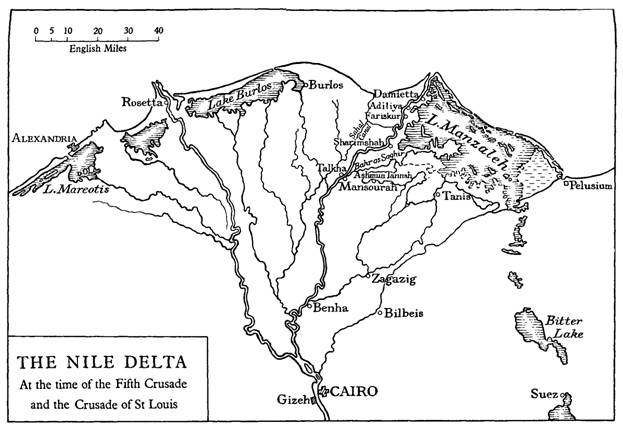
Map 2. The Nile Delta.
Al-Adil was sick when the news of the fall of the fort reached him at Damascus a few days later. He had just heard that his son al-Mu’azzam had taken and destroyed Caesarea; but the shock of the disaster at Damietta was too much for him. He died on 31 August, aged about seventy-five. Saphadin, as the Crusaders called him, lacked his brother Saladin’s remarkable personality; and his dealings with his nephews, Saladin’s sons, had shown a certain disloyalty and cunning. But he had held together the Ayubite Empire and had been a capable, tolerant and peace-loving ruler. To the Christians he had been consistently kindly and honourable, and he earned and kept their admiration and respect. He was succeeded in Syria by his younger son, al-Mu’azzam, and in Egypt by the elder, al-Kamil.
The disaster to the Moslems was not so great as al-Adil had feared. If the Christians had pressed on and at once attacked Damietta, the town might well have fallen. But after the capture of the fort, they hesitated and decided to await reinforcements. Many of the Frisians returned to their homes, to be punished for their desertion of the cause by death in a great flood that swept over Frisia the day after their arrival there. It was known by now that the long-planned Papal expedition had already left Italy. There had been constant delays. But at last Pope Honorius had been able to equip a fleet, at the cost of twenty thousand silver marks, to transport the troops that had waited over a year at Brindisi. At their head he put Cardinal Pelagius of St Lucia.
1218: Arrival of Cardinal Pelagius
About the same time two French nobles, Herve, Count of Nevers, and Hugh of Lusignan, Count of La Marche, negotiated with the Genoese for ships to take a company of French and English Crusaders to the East. Though the Count of Nevers was a notoriously bad son of the Church, the Pope allowed him to pay for the transport with a tax of a twentieth of their income taken from the ecclesiastics of France. The two Counts were joined at Genoa by the Archbishop of Bordeaux, William II, and the Bishops of Paris, Laon and Angers, and other lesser potentates, and by the Earls of Chester, Arundel, Derby and Winchester. The Pope sent Robert, Cardinal Courcon, to be spiritual director of the fleet, but without any legatine powers.
Cardinal Pelagius and his expedition arrived at the Christian camp in the middle of September. Pelagius was a Spaniard, a man of great industry and administrative experience, but singularly lacking in tact. He had been already employed to settle the question of the Greek Churches in the Latin Empire of Constantinople, and had only succeeded in making them more passionately hostile to Rome. His coming to Damietta at once caused trouble. John of Brienne had been accepted as leader of the Crusade. His leadership had been disputed the previous years by the Kings of Hungary and Cyprus; but the one had departed and the other was dead. Pelagius considered that as Legate he alone was in charge. The rivalry of the various participant nations was all too clearly visible. Only the Pope’s representative could keep them in order. He brought news that the young Western Emperor, Frederick II, had promised to follow with an Imperial army. When he came he would certainly be given supreme military command. But Pelagius was not going to take any order from King John, who was, after all, king only through his dead wife.
In October al-Malik al-Kamil had sufficient reinforcements to attempt an attack on the Crusaders’ camp by a flotilla that he sent down the river. It was driven off, chiefly through King John’s energy. A few days later the Moslems built a bridge across the Nile a little above the town. Pelagius organized an unsuccessful raid on the works; but al-Kamil did not follow up the construction by moving his army across the river. Instead, he made another attack from the water. It was a fierce onslaught; but it was too late. The first contingent of French Crusaders had arrived and led the defence. A second attack reached the edge of the camp itself, but was driven back into the river, where many of the Moslem troops were drowned.
After the whole French and English army arrived, late in October, there was a lull in the fighting. Al-Adil’s death had delayed the help that al-Kamil expected from Syria. He now awaited an army that his brother al-Mu’azzam promised him. The Christians had their own difficulties. They dug a canal from the sea to the river above the Moslem bridge, but they could not fill it. On the night of 29 November a northerly gale blew the sea in over the low land on which their camp stood. Every tent was flooded and the stores were soaked. Several boats were wrecked and others driven across to the Moslem camp. Horses were drowned. When the flood subsided, there were fishes lying about everywhere, a delicacy, says the chronicler Oliver of Paderborn, that everyone would gladly have foregone. To prevent a recurrence Pelagius ordered a dyke to be quickly constructed. All the wreckage, even torn sails and horses’ carcasses were used to raise it higher. The only good result of the flood was that the canal now was filled, and Christian boats could penetrate up the river.
1219: Occupation of al-Adiliya
Hardly was the camp repaired before a serious epidemic struck the army. The victims suffered from a high fever, and their skins turned black. At least a sixth of the soldiers died of it, including the Cardinal Robert Courcon. The survivors were left enfeebled and depressed. There followed a winter that was unusually severe. It was well for the Christians that the Moslems also suffered from illness and the cold.
Early in February 1219, Pelagius considered that the morale of the army could only be restored by activity. On Saturday, 2 February, he persuaded the army to set out to attack the Moslems. But a blinding rainstorm forced it back. The following Tuesday news reached the camp that the Sultan and his army were retreating. The Crusaders hurried across to al-Adiliya and found the site deserted. After driving back a sortie from the garrison of Damietta they occupied al-Adiliya, and thus cut the town off completely.
Al-Kamil’s sudden flight had been caused by his discovery of a conspiracy in his entourage. One of his emirs, Imad ad-Din Ahmed Ibn al-Mashtub, was planning to murder him and replace him by his brother al-Faiz. In his despair, not knowing how many of his staff were implicated, the Sultan thought of fleeing to Yemen, where his son al-Masud was governor, when he heard that his brother al-Mu’azzam was at last coming to his help. He moved with his troops south-eastward to Ashmun, where the two brother Sultans met on 7 February. Al-Mu’azzam’s presence with a large army cowed the conspirators. Ibn al-Mashtub was arrested and sent to prison at Kerak, while the Prince al-Faiz was banished to Sinjar and died mysteriously on the way there. Al-Kamil had saved his throne, but at the price of losing Damietta.
Even with al-Mu’azzam’s help al-Kamil could not now dislodge the Christians. The river, the lagoons and the canals made it impossible for the Moslems to take advantage of their superior numbers. Attacks on the two camps, on the west bank and at al-Adiliya, failed. The Sultan then set up his camp at Fariskur, some six miles south of Damietta, ready to attack the Crusaders in the rear should they try to assault Damietta. Throughout the spring the stalemate continued. There were fierce battles on Palm Sunday and again on Whit-Sunday, when the Moslems vainly tried to force their way into al-Adiliya. In Damietta itself, though food was still plentiful, the garrison had been greatly reduced by disease; but still the Christians did not dare to make an assault.
In the meantime the Sultan al-Mu’azzam decided to dismantle Jerusalem. It might be necessary to offer the Christians Jerusalem to terminate the war. If so, it would be handed over in a ruined and untenable condition. The demolition of the walls was begun on 19 March. It caused panic in the city. The Moslem citizens believed that the Franks were coming, and many of them fled in terror across the Jordan. The tenantless houses were then pillaged by the soldiers. Some fanatics wished to destroy the Holy Sepulchre; but the Sultan would not allow it. After Jerusalem the fortresses of Galilee, Toron, Safed and Banyas, were all dismantled. At the same time the two Sultans appealed for help throughout the Moslem world, addressing their prayers in particular to the Caliph at Baghdad; who promised to send a vast army, which never came.
The icy winter was followed by a burning summer; and the morale of the Crusaders fell again. Again Pelagius insisted on action. After a vigorous Moslem attack on the camp had been driven back on 20 July, with heavy losses on both sides, the Crusaders concentrated on the bombardment of the town walls. While they were so engaged, vainly, as the Greek fire used by their defenders did great damage to their engines and could not be quenched by wine and acid, another Moslem attack very nearly destroyed the whole Christian army, which was only saved by the sudden fall of darkness. A second assault on the walls on 6 August was equally ineffectual.
1219: Saint Francis of Assisi
The reverses roused the common soldiers of the Crusade to action. They blamed their leaders for sloth and bad generalship. Many of the more distinguished nobles had been killed, including the Counts of La Marche and Bar-sur-Seine and William of Chartres, Grand Master of the Templars. Others had returned to Europe. Leopold of Austria left the army in May. He had been the most energetic of the princes; but he had served for two years in the East, and no one could reproach him for returning to his own country. His gallantry had erased the ill-repute that his father had won by his quarrels with Coeur-de-Lion on the Third Crusade. He took home with him a fragment of the True Cross. But the convoy that took him to Europe carried others whose departure seemed a desertion of the cause. Towards the end of August, while King John and Pelagius wrangled over strategy, the one advocating a tightening of the siege, the other an attack on the Sultan’s camp, the soldiers took matters into their own hands and on the 29th poured out in a disorderly mass against the Moslem lines. The Moslems feigned retreat, then counter-attacked. Pelagius had tried to assume command; but despite his exhortations the Italian regiments turned round and fled, and soon there was general panic. It was only the skill of King John and the French and English nobles and the Military Orders that rescued the survivors and held the camp.
The battle had been watched with a sad dismay by a distinguished visitor to the camp, Brother Francis of Assisi. He had come to the East believing, as many other good and unwise persons before and after him have believed, that a peace-mission can bring about peace. He-now asked permission of Pelagius to go to see the Sultan. After some hesitation Pelagius agreed, and sent him under a flag of truce to Fariskur. The Moslem guards were suspicious at first but soon decided that anyone so simple, so gentle and so dirty must be mad, and treated him with the respect due to a man who had been touched by God. He was taken to the Sultan al-Kamil who was charmed by him and listened patiently to his appeal, but who was too kind and too highly civilised to allow him to give witness to his faith in an ordeal by fire; nor would he risk the acrimony that a public discussion on religion would now arouse. Francis was offered many gifts, which he refused, and was sent back with an honourable escort to the Christians.
The Saint’s intervention was not in fact needed, for al-Kamil himself inclined towards peace. The Nile had risen very little that summer, and Egypt was threatened with famine. The government needed all its resources to rush in food from neighbouring lands. Al-Mu’azzam was anxious to return with his army to Syria; and neither Sultan was happy about the activities of their brother al-Ashraf further north. At Baghdad the Caliph Nasr was in the power of the Khwarismian Shah, Jelal ad-Din, whose father Mohammed had destroyed the Seldjuk dominion in Iran and founded an empire stretching from the Indus to the Tigris. Jelal ad-Din could be used against al-Ashraf, but in view of his known ambitions it would be dangerous to encourage him too far. Al-Mu’azzam was ready therefore to support al-Kamil in any friendly overture to the Franks. Some time in September a Frankish prisoner came from the Sultan offering a short truce and suggesting that the Moslems would be prepared to cede Jerusalem. The truce was accepted; but the Christians refused to discuss further peace terms.
1219: Al-Kamil offers Peace-terms
The truce was spent by both sides in repairing their defences. Many of the Crusaders found it also a suitable opportunity for returning home. Some had already left at the beginning of the month, and on 14 September twelve more shiploads sailed away. The loss was recovered a week later when the French lord Sauvary of Mauleon arrived with a company transported in ten Genoese galleys. When al-Kamil broke the truce and attacked the Franks on the 26th, the newcomers successfully led the defence.
Al-Kamil still hoped for peace. He knew that Damietta could not be held. The garrison was too much thinned by disease to man the walls, and his attempts to throw in reinforcements had failed. Nor were the traitors in the Christian camp whose services he had bought successful in any of their projects. At the end of October he sent two captive knights to give the Franks his definite terms. If they would evacuate Egypt, he would return them the True Cross, and they could have Jerusalem, all central Palestine and Galilee. The Moslems would only retain the castles of Oultrejourdain, but would pay a tribute for them.
It was a startling offer. With no more fighting the Holy City, with Bethlehem, Nazareth and the True Cross, could be restored to Christendom. King John advised its acceptance, and his own barons and the barons from England, France and Germany supported him. But Pelagius would have none of it, nor would the Patriarch of Jerusalem. They thought it wrong to come to terms with the infidel. The Military Orders agreed with them for strategic reasons. Jerusalem and the Galilean castles had been dismantled; and it would anyhow be impossible to hold Jerusalem without the command of Oultrejourdain. The Italians were equally opposed to the terms. However little the Italian maritime cities had liked the breach with Egypt, now that it had come they wished to secure Damietta as a trading centre. The annexation of inland territory was of no interest to them. The dispute between the two parties grew so bitter that Bishop James of Acre believed the Sultan to have made his offer merely to cause dissension. At Pelagius’s insistence it was refused.
A few days later a scouting party sent by Pelagius reported that the outer wall of Damietta was unmanned. Next day, Tuesday, 5 November 1219, the Crusaders advanced in force and swept over it and over the inner wall, hardly opposed. Within the town they found almost the whole garrison sick. Only three thousand citizens were living, many of them too feeble even to bury the dead. Food and treasure were there in plenty, but disease had done the Christians’ work for them. As soon as the town was fully taken over, three hundred of the leading citizens were set aside as hostages; the young children were handed to the clergy to be baptized and used for the service of the Church, and the remainder were sold as slaves. The treasure was to be divided amongst the Crusaders, according to each man’s rank; but not all the Legate’s anathemas could prevent thieving and concealment of precious objects by the troops.
1220: Pelagius hopes for Allies
The future government of Damietta had next to be decided. King John at once claimed that it should be part of the kingdom of Jerusalem; and the Military Orders as well as the lay nobility were on his side. Pelagius maintained that the conquered city belonged to all Christendom, that is, to the Church. But, with public opinion against him, and with John threatening to sail back to Acre, he compromised. The King could govern it till Frederick of Germany joined the Crusade. Meanwhile part of the army had been sent to attack Tanis, on the Tanitic mouth of the Nile, a few miles to the east. The town was deserted by its frightened garrison; and the Crusaders returned with further booty, which only led to further quarrels. The Italians in particular believed that they had been cheated and, when Pelagius would not support them, broke into active revolt. The Military Orders had to drive them from the city. When winter came the whole victorious army was smouldering with discontent.
Pelagius in his first elation foresaw the final destruction of Islam. The Crusade would conquer all Egypt. Help would no doubt come from that gallant Christian potentate, the King of Georgia. Then there was Prester John, who was waiting, rumour said, to strike a new blow for Christendom. He had believed at first that Prester John was the Negus of Ethiopia, who, however, had never replied, to a letter from the Pope written forty years before. But now there was a new candidate for the role, an Eastern potentate whose name was Jenghiz Khan. Unfortunately the intended allies did not work together. In 1220 King George of Georgia’s army was routed by Jenghiz Khan’s Mongols on the borders of Azerbaijan, and the great military power built up by Queen Thamar was destroyed. The victors showed no interest in attacking the Ayubite empire. More serious co-operation was expected from the greatest potentate of Western Europe, Frederick, King of Germany and Sicily.
Frederick had taken the Cross in 1215; but Pope Innocent granted him leave to postpone the Crusade till he had put the affairs of Germany in order. Frederick still delayed. He had promised the Papacy to hand over the throne of Sicily, to which he had succeeded as a boy, to his young son Henry. But he soon discovered that by reiterating his determination to go Crusading, he could defer the division of his kingdoms and could bargain for his imperial coronation by the Pope. His desire to go to the East was genuine, though ambition rather than piety was its motive. He had inherited his father Henry VI’s Eastern aspirations, but he would not try to realize them except as Emperor, with his European kingdoms secure in his grasp. His intentions should have been clear to the Pope. But Honorius, who had once been his tutor, was a simple man who regarded his promises as genuine and continued to send messages to the Crusaders in Egypt telling them to expect the Hohenstaufen army.
The Crusade therefore stood still; and during its inaction the quarrels between Pelagius, King John, the Italians and the Military Orders intensified. A march on Cairo immediately after the fall of Damietta might have succeeded. Al-Kamil was in a desperate position. His army was discouraged. His subjects were starving. Al-Mu’azzam insisted on taking his forces back to Syria, fearing trouble in the north and believing that Islam could best be helped now by an attack on Acre itself. Expecting every day to hear of a Christian advance, al-Kamil established his camp at Talkha, a few miles up the Damietta branch of the Nile, and threw up fortifications on either side of the river to await an offensive that never came.
1220: King John leaves the Army
Leo II, King of Armenia, died in the early summer of 1219, leaving only two daughters. The elder, Stephanie, was the wife of John of Brienne; the younger, Isabella, daughter of Princess Sibylla of Cyprus and Jerusalem, was four years old. Leo had promised the succession to his nephew Raymond-Roupen of Antioch, but on his death-bed he named Isabella as his heir. John at once put in a claim on behalf of his wife and their infant son, and in February 1220 he received the Pope’s permission to leave the Crusade and visit Armenia. He was on such bad terms with Pelagius that there was little point in his remaining with the army, over which the Pope now unequivocally gave Pelagius full command. John left for Acre. As he prepared to sail for Cilicia his Armenian wife died, it was rumoured through his own ill-treatment. When their small son died a few weeks later, John had no further claim on the Armenian throne. But he did not return to Egypt. In March al-Mu’azzam invaded the kingdom, attacking the castle of Caesarea, which had just been rebuilt, then moving to lay siege to the Templar stronghold of Athlit. Templar knights were rushed back from Damietta, and King John kept his army in the offing. The siege lasted till November when al-Mu’azzam retired to Damascus.
Meanwhile the Crusade remained stationary at Damietta. There was some attempt to rebuild the town. On the Feast of the Purification in February the chief mosque was rededicated as the Cathedral of the Virgin. In March a company of Italian prelates arrived, led by the Archbishop of Milan, and accompanied by two envoys from Frederick II. They brought considerable forces and at once agreed with Pelagius that an offensive should be launched. But the knights would not agree. King John, they said, was the only leader whom all the nations would obey; and he was absent. When in July Matthew, Count of Apulia, brought eight galleys sent by Frederick Pelagius again vainly urged action. Even his own Italian mercenaries turned against him when he suggested a separate expedition. The only enterprise to be undertaken was a raid by the Military Knights on the town of Burlos, twenty miles west of Damietta. The town was pillaged, but the knights were ambushed on their return and several Hospitallers, including their Marshal, captured.
Al-Kamil had by now recovered confidence. Though he was still short of land-forces, he repaired his navy, and in the summer of 1220 sent out a squadron down the Rosetta branch of the Nile. It sailed to Cyprus, where it found a Crusader fleet lying off Limassol and by a sudden attack sank or captured all the ships, taking many thousands of prisoners. It was said that Pelagius had been warned of the preparations made by the Egyptian sailors but had ignored the warning. When it was too late he sent a Venetian squadron to intercept the enemy and attack the harbours of Rosetta and Alexandria, but to no effect. Lack of money prevented him from maintaining a sufficient number of ships of his own; and the Papal treasury could not spare him any more.
In September more of the Crusaders returned home. But at the end of the year Pope Honorius sent good news. Frederick had come to Rome in November 1220, and the Pope had crowned him and his wife Constance Emperor and Empress. In return Frederick definitely promised to set out for the East next spring. Honorius had been growing distrustful of Frederick’s promises, and even advised Pelagius not to turn down any peace proposition from the Sultan without referring it to Rome. But the new Emperor seemed now to be serious. He actively encouraged his subjects to take the Cross, and he dispatched a large contingent under Louis, Duke of Bavaria, which set sail from Italy early in the spring.
The news of the Duke’s approach so greatly elated Pelagius that when the Sultan offered peace terms in June, he forgot the Pope’s instruction and refused them, only then reporting them to Rome. Al-Kamil once again had proposed the cession of Jerusalem and all Palestine apart from Oultrejourdain, together with a thirty years’ truce and money compensation for the dismantling of Jerusalem. Soon after the terms were rejected, Louis of Bavaria arrived.
1221: The Crusaders Advance
Frederick had ordered Louis not to launch any major offensive till he should follow himself. But Louis was eager to attack the infidel; and when after five weeks there was no news of Frederick leaving Europe, he fell in with Pelagius’s wishes. When the Duke argued that if the reinforced army was to advance into Egypt it must do so at once, for the time of the Nile floods was near, and when the Legate declared that the army’s finances necessitated speedy action, the leading Crusaders were convinced. They only insisted that King John be summoned to play his part. There were a few dissentients. The Queen-Regent of Cyprus wrote to Pelagius that a great Moslem army was being formed in Syria by al-Mu’azzam and his brother al-Ashraf; and the Military knights had the news confirmed by their brothers in Palestine. But Pelagius found in it another argument for an immediate advance. He had heard prophecies that the Sultan’s domination was soon to be ended.
On 4 July 1221, the Legate ordered a three days’ fast in the camp. On the 6th King John arrived back with the knights of his kingdom, full of pessimism but unwilling to be accused of cowardice. On the 12th the Crusading force moved towards Fariskur, and there Pelagius drew it up in battle formation. It was an impressive host. Contemporaries told of 630 ships of various sizes, 5000 knights, 4000 archers and 40,000 infantrymen. A horde of pilgrims marched with the army. They were ordered to keep close to the river bank, to supply the soldiers with water. A large garrison was left at Damietta.
The Moslem army advanced as far as Sharimshah to meet them, but, seeing their numbers, retired behind the Bahr as-Saghir, running from the river to Lake Manzaleh, and waited in prepared positions at Talkha and at the site of the later Mansourah, on either side of the river. By 20 July the Crusaders were in occupation of Sharimshah. King John begged them to remain there. The Nile floods were due, and the Syrian army was approaching. But Pelagius insisted on further advance, backed by the common soldiers, who had heard a rumour that the Sultan had fled from Cairo. Just south of Sharimshah a canal came into the river from another branch. The Crusaders, as they pressed on, left no ships to guard its mouth, perhaps because they thought it not to be navigable. By Saturday, 24 July, the whole Christian army lay along the Bahr as-Saghir, facing the enemy.
The Nile had risen now, and the canal was full and easy to defend. But before it had filled too deeply the armies of al-Kamil’s brothers had crossed it near to Lake Manzaleh and established themselves between the Crusaders and Damietta. As soon as there was enough water in the canal by Sharimshah, al-Kamil’s ships sailed down it and cut the retreat of the Christian fleet. By the middle of August Pelagius realized that his army was outnumbered and completely surrounded, with food that would only last for twenty days. After some argument the Bavarians persuaded the command that the only chance of escape lay in an immediate retreat. On the night of Thursday, 26 August, the retreat began. It was ill-organized. Many of the soldiers could not bear to abandon their stores of wine and drank them all rather than leave them. They were in a stupor when the order came to move. The Teutonic knights foolishly set fire to the stores that they could not carry, thus informing the Moslems that they were abandoning their positions. The Nile was still rising; and the Sultan or one of his lieutenants gave orders that the sluices along the right bank should be opened. The water poured in over the low-lying lands that the Christians had to cross. They floundered through the muddy pools and ditches, closely pursued by the Sultan’s Turkish cavalry and Nubian foot-guards. King John and his knights beat off the former and the Military Knights drove back the Nubians, but only after thousands of the infantrymen and pilgrims had perished. Pelagius on his ship was carried by the floodwaters swiftly past the blockading Egyptian fleet; but as he had with him the medical supplies of the army and much of its food, his escape was a disaster. A few other ships escaped, but many were captured.
1221: Pelagius sues for Peace
On Saturday the 28th Pelagius gave up hope, and sent an envoy to the Sultan to treat for peace. He still had some bargaining assets. Damietta had been refortified and was well garrisoned and supplied with arms; and a strong naval squadron was in the offing under Henry, Count of Malta, and Walter of Palear, Chancellor of Sicily, sent by the Emperor Frederick. But al-Kamil knew that he had the main Crusading army at his mercy. He was firm but generous. After wrangling over the week-end, on the Monday Pelagius accepted his terms. The Christians would abandon Damietta and observe an eight years’ truce, to be confirmed by the Emperor. There would be an exchange of all prisoners on either side. The Sultan for his part would give back the True Cross. Till Damietta should be surrendered the Crusade must hand over its leaders as hostages. Al-Kamil named Pelagius, King John, the Duke of Bavaria, the Masters of the Orders and eighteen others, Counts and Bishops. He sent in return one of his sons, one of his brothers and a number of young emirs.
When the Masters of the Templars and the Teutonic knights were dispatched to Damietta to announce its surrender, the garrison at first rebelled against the decree, and attacked the houses of King John and the Orders. Henry, Count of Malta, had just arrived with forty ships; and they felt strong enough to defy the enemy. But winter was coming and food was short; their leaders were hostages and the Moslems were threatening to march on Acre. The rebels soon gave way. After al-Kamil had entertained King John at a splendid feast and had freely revictualled the Christian army the hostages were exchanged back; and on Wednesday, 8 September, the whole Crusade embarked on its ships and the Sultan entered Damietta.
The Fifth Crusade had ended. It had come very close to success. Had there been one wise and respected leader in the Christian army Cairo might have been occupied and the Ayubite rule in Egypt destroyed. With a friendlier government set up there — for the Franks could never have hoped to govern all Egypt themselves — it would not have been impossible to recover all Palestine. But the Emperor who alone could have filled the role, never came, despite all his promises. Pelagius was a haughty, tactless and unpopular man whose faults as a general were revealed by the last disastrous offensive, while King John, for all his gallantry, had neither the personality nor the prestige to command an international army. Almost every stage of the campaign had been wrecked by personal or national jealousies. It would have been wiser to accept the terms twice offered by the Sultan and have taken back Jerusalem. But the strategists were probably right when they said that without the castles of Oultrejourdain Jerusalem itself could never be held, at least so long as the Moslems in Egypt and Syria worked in alliance. As it was, nothing had been gained and much lost, men, resources and reputations. And the unhappiest victims were the most guiltless. Fear of the Christians from the West raised a new wave of fanaticism in Islam. In Egypt, despite al-Kamil’s personal tolerance, fresh disabilities were put upon the local Christians, both Melkites and Copts. Exorbitant taxes were levied, churches were closed, and many of them pillaged by the angry Moslem soldiery. Nor could the Italian merchants quite recover their former position in Alexandria. Their compatriots had encouraged the Crusade. Though they returned to their counters they could not be trusted so well. It was with a shame that was bitter and well-earned that the soldiers of the Cross sailed back to their own countries. They did not even bring back with them the True Cross itself. When the time came for its surrender it could not be found.