
4
On Passion Sunday, 9 April 1413, Henry of Monmouth was crowned as King Henry V at Westminster Abbey. Becoming king had a profound effect on him: Walsingham states that ‘as soon as he was made king he changed suddenly into another man, zealous for honesty, modesty and gravity, there being no sort of virtue that he was not anxious to display’. His biographer, Titus Livius, says that he reformed and amended his life. Elevated to kingship, he abandoned his dissolute young friends and paid heed to the experienced men of affairs on his Council. His main objective at the beginning of his reign was to distance himself from his father’s style of government and thereby earn fresh popularity and support for Lancaster.
In youth Henry had led a debauched life. The evidence for this cannot be discounted, although it may have been exaggerated in later years. Thomas Elmham, the chronicler, wrote that ‘passing the bounds of modesty, he was the servant of Venus’ and ‘found leisure for the excesses common to ungoverned age’. Having fought his first battle at fifteen, he had gained an early and wholly justified reputation as a brilliant soldier and military strategist. He also had a passion for singing, and was an accomplished musician.
According to Thomas Elmham, Henry V had ‘an oval, handsome face with a broad, open forehead, a straight nose, ruddy cheeks and lips, a deeply indented chin, small, well-formed ears, hair brown and thick, bright hazel eyes, and stature above the average’. In youth he was clean-shaven and wore his hair cut short and straight in the Norman military fashion. He was of lean and muscular build, agile and very strong. French envoys once described him as ‘a prince of distinguished appearance and commanding stature. His expression seemed to hint at pride.’ However, a French priest, Jean Fusoris, thought he looked more like a priest than a soldier.
Besides having a love of music, Henry V was an enthusiastic sportsman who enjoyed hawking, fishing, wrestling, leaping and running, in which ‘he excelled commonly all men’, being faster, it was said, than a dog or even an arrow. Surprisingly, he had little interest in jousting.
Books were his greatest treasure. He had an extensive library and was literate in English, French, Latin and Welsh. He enjoyed books on history, theology and hunting, as well as the works of Chaucer, Hoccleve and Lydgate. He was also a connoisseur of the arts and architecture, although not on the same scale as Richard II.
English chroniclers are unanimous in their praise of Henry V, excelling themselves in superlatives. Walsingham describes him as ‘prudent, far-seeing, magnanimous, firm, persistent, war-like and distinguished’. However, those who knew him found him a cold man who inspired respect rather than love. Taciturn in speech, a man of few words who could be a good listener and was gifted with a rather dry wit, he was highly self-disciplined and expected others to be too. He had a formidable presence, a lordly and severe manner, and was somewhat melancholy in temperament, tending to look serious at moments of triumph. However, he usually reacted positively to setbacks.
Henry had a good deal of common sense, being a perceptive man who was a wise judge of character, and he could also be persuasive and often aggressive when it came to asserting his rights. He was discreet, even secretive, but made it a point of honour to treat everyone with the utmost affability. ‘He went straight to the point,’ wrote a French envoy. On occasion he could appear sanctimonious and pedantic, parading his virtues, and making no secret of the fact that for seven years after his accession he remained chaste. His worst fault would prove to be a ruthless brutality that was only unleashed when his authority was challenged. Once, during a siege, a man danced on the wall of the fortress, mocking the King and blowing a trumpet so as to imitate a fart; when the town was captured Henry made a point of having him executed.
Henry V inherited the same insecurities his father had faced. Many regarded the House of Lancaster as a usurping dynasty and looked upon March as the rightful king; some even believed Richard II was still alive. However, in fourteen years of Lancastrian rule, people had generally grown used to the new dynasty and it had gained a considerable degree of acceptance, something that the new King was able to reinforce.
Henry V was fortunate in that he possessed all the attributes required of a successful mediaeval ruler. He was deeply pious in an unquestionably orthodox way, spending hours at prayer each day and making many pilgrimages to the shrines of saints. One of his ambitions was to wrest Jerusalem back from the Turks. He was severe with heretics and virtually stamped out Lollardy.
He was also a brilliant general, a courageous leader who took a personal interest in his men and in the routine practicalities of warfare, but who was also a stern disciplinarian prepared summarily to execute anyone who disobeyed him. His contemporaries saw him as the embodiment of the ‘parfait, gentil knight’ described by Chaucer, a Christian hero-king to whose name legends swiftly attached themselves. He embodied as such all the ideals of chivalry, and his magnificent reputation made a powerful impression on his contemporaries, and indeed on English history. Not for nothing was he called the flower of Christian chivalry.
He had ‘a great will to keep justice, wherefore the poor folk loved him above all others, for he was careful to protect them from the violence and wrong that most of the nobles had done them’. To the poor, he was approachable and generous: his justice was strictly impartial, meted out to friend and foe, high and low alike. He was not a merciful king and his enemies feared his vengeance, which made his conquests easier since his reputation rode before him.
Henry V was a born leader who ascended the throne with astonishing confidence, determined to provide England with ‘good governance’. Dedicated to his task, he proved an adept administrator and a superb politician, believing that the prosperity of the realm depended on the integrity and orthodoxy of its ruler and that any threat to the monarchy was a threat to a divinely ordered society. Even his enemies praised him as a wise ruler. He was careful in his spending, avoided borrowing money, and planned well ahead, all of which resulted in a significant recovery of the royal finances. Henry closely supervised the royal administrators who worked under him, and sacked any corrupt officials.
He made consistent efforts to win the support and co-operation of his magnates. His aggressive war policy united them behind him and also brought England to the forefront of European politics. The resultant concord between the King and his nobility made for a greater degree of success in his enterprises. He replaced Arundel as chancellor with Henry Beaufort, Bishop of Winchester, his ‘oldest uncle and closest councillor’, but relations between them were not always smooth. In 1417 the ambitious Beaufort accepted a cardinal’s hat and the office of papal legate from the Pope without first bothering to obtain Henry’s permission, as law and custom demanded. The King was furious and made him surrender both hat and appointment, which put paid to Beaufort’s ambition to occupy a position centre-stage in the European Church.
Shakespeare would later portray Henry V as the vindicator of the House of Lancaster, whose deeds and reputation removed the taint of usurpation that adhered to his dynasty. Certainly, England had not been so well governed since the time of Edward III.
Henry embarked upon a general policy of conciliation. As soon as he became king he demonstrated his confidence as a ruler by releasing the Earl of March, now twenty-one, from house arrest, and he also restored Hotspur’s son to the earldom of Northumberland. On the day before his coronation, Henry made March and his brother Roger Mortimer Knights of the Bath in a ceremony at the Tower of London. Clearly he did not regard March as a rival; nor did he acknowledge his superior claim to the throne, for he named his own brother Thomas, Duke of Clarence, as heir presumptive to the crown. March was a political unknown, unlikely to command significant support from the magnates, and a stranger to the populace at large, even if there were still those in high places who felt that he was rightful King of England and had been shabbily treated. Henry V took steps to rectify this: he made the Earl a member of his household and admitted him to his inner circle of advisers.
Fortunately for Henry, March was not particularly ambitious. His early experiences had perhaps crushed his self-confidence, and he lacked the qualities required of a king. He was a pleasant man, friendly and kind, entirely lacking the dynamism that drove Henry V. He found it hard to trust anyone, and went in fear of his awesome sovereign.
March was also, however, an impulsive and headstrong young man. Shortly after his release he secretly married his cousin, Anne Stafford, a great-granddaughter of Edward III, without first obtaining the requisite permission from the King. Henry was extremely displeased and fined the Earl £6666.13s.4d. (£6666.67). It has been conjectured that the forfeiture of such a vast sum made March resentful towards his sovereign, but since there is no record of his ever having paid the fine, it may well be that the King, knowing March’s loyalty was crucial, exercised his prerogative of mercy, having shown his cousin how easily he could ruin him.
March lived in great splendour in his London residence, Baynard’s Castle, on the banks of the Thames. His personal accounts survive and show him to have been an inveterate gambler. In the winter of 1413-14 he lost £157 at cards, backgammon, dice and cock-fighting. He kept a mistress called Alice at a house in Poplar, east of London, and spent large sums on her. He also frequented taverns and was not averse to the company of low-born folk.
By 1415, March had gained a degree of fame, and Jean Fusoris, who visited the English court from France that year, reported that many people would have preferred him to Henry for their king. However, their opinions were shortly to undergo a rapid change.
Not two months after Henry’s accession a poster had been nailed to the door of Westminster Abbey proclaiming that Richard II was still alive in Scotland. The monks of Westminster Abbey had continued to support those who wished to restore Richard, even to the extent of backing an earlier Lollard conspiracy against Henry IV, which was suppressed with shocking brutality: seven proven culprits were roasted in chains over a slow-burning fire and another twenty-four were hanged.
In 1413, therefore, Henry V arranged for the body of Richard II to be moved from Langley to Westminster Abbey by night in a ceremony conducted with great pomp. The reinterment took place by the light of 120 torches in the presence of the King and many mourners, who watched as the coffin was laid to rest in the tomb occupied by Anne of Bohemia. Henry had not ordered Richard’s reburial as an act of atonement, but to emphasise to the public that he was really dead. Nevertheless, claims by rebels that he was still alive were made twice in 1417 and even as late as 1419. Only then was the ludicrous pretence of the deposed king’s survival finally abandoned.
Having established himself firmly on the throne and taken steps to neutralise potential enemies, Henry V turned his attention to the fulfilment of an ambition he had cherished since he was Prince of Wales: the prosecution of his ancestral claim to the kingdom of France and the conquest of that kingdom. In this enterprise, Henry firmly believed that God was on his side, that his cause was just, and that he was undertaking a sacred duty. He also knew that the accomplishment of his desire would immeasurably strengthen his position and thereby ensure the future of his dynasty. By unifying his people, high and low, in such a cause, he would channel their energies and interests into a profitable enterprise and so avert any threat of rebellion.
The magnates, and the people at large, greeted Henry’s declared war policy with enthusiasm, as did Parliament, which did not hesitate to vote funds for an invasion force. This seemed the ideal moment to strike: the mad King Charles VI reigned in France and the country was divided by the aristocratic quarrels of the Burgundian and Armagnac factions.
Henry, blinded by zeal for his cause, cannot have imagined the enormity of the task he was about to undertake, nor did he foresee that England’s resources would never be sufficient to carry his plans through to their conclusion. It did not occur to anyone that the successful prosecution of Henry’s war policy depended on him alone.
One day, in the summer of 1415, as preparations for war were advancing steadily, Sir Thomas Grey of Heton was summoned to attend the Earl of Cambridge at Conisburgh Castle in Yorkshire. Grey held an important position on the King’s Council and was constable of the castles of Bamburgh and Norham in his native Northumberland. He was connected by marriage to the Nevilles and the Percies, and was a prominent and respected figure in the north, having distinguished himself also in a military capacity. His son was betrothed to Isabella, the four-year-old daughter of the Earl of Cambridge.
Cambridge was the King’s cousin, the younger son of Edmund, Duke of York, by Isabella of Castile. He had been born at Conisburgh in c. 1375-6, and the twelfth-century stronghold, improved by his father, became his principal seat. Richard was named after his godfather, Richard II, and during the reign of Henry IV he had supported at least one impersonator of the late king. Some time after June 1408, when a dispensation was granted, he had married his distant cousin, Anne Mortimer, March’s sister, who had been born in 1390 and spent her childhood at Wigmore Castle on the Welsh border. Anne’s second child, born on 21 September 1411, was a son named Richard, who would grow up to be one of the central protagonists in the Wars of the Roses. Sadly, Anne died during or soon after his birth, and was buried beside her father-in-law in King’s Langley Church. After her death Richard married Matilda, sister of John Clifford, Hotspur’s brother-in-law, but there were no children of this union.
In May 1414, in Parliament, Henry V had confirmed York, Richard’s elder brother, in his dukedom. At the same time, York had surrendered his father’s earldom of Cambridge to the King, who bestowed it on Richard, who was indentured to supply Henry, on request, with two knights, fifty-seven esquires and 160 mounted archers. The new Earl of Cambridge was not a wealthy man and had not the resources to support his new status. Normally, the monarch granted some endowment when he raised a man to the peerage, but Henry V had omitted to do so in Cambridge’s case. His title was an empty conceit and, being an ambitious man, he resented the fact.
The business that Cambridge wished to discuss with Grey at Conisburgh was treason: the assassination of Henry V and his brothers and the proclamation of Richard II – in the person of the Mummet in Scotland – as rightful king. If the Mummet proved to be an impostor then March would be raised to the throne. Cambridge was the most important of the plotters, but it is unlikely that he was the prime mover in the conspiracy. That honour probably belonged to Henry, 3rd Lord Scrope of Masham, a clever, gifted and attractive man who, like the other conspirators, the King should have been able to trust implicitly. Scrope was forty-two, well-born, well-connected and rich. Archbishop Scrope had been his kinsman but he had not been involved in his rebellion. He was a serious and pious man, given to reading mystical religious works, and owned eighty-three manuscripts, a sizeable library for the time. His private chapel was his pride and joy, and was stocked with ninety copes.
Scrope had been close to Henry V for some years, and on occasion they even shared a bed, a practice having no homosexual overtones in those days, when it was regarded as a sign of especial royal favour. Scrope had been Treasurer of England under Henry IV and was Treasurer of the Household to Henry V; Titus Livius called him ‘an ornament of chivalry’. Scrope’s second wife, Joan Holland, was the widow of Cambridge’s father, York. There were thus strong family ties between the conspirators, and these proved greater than their loyalty to the Crown.
Why Scrope should have plotted to kill the King remains a mystery. Most of his contemporaries believed he had been offered financial inducements – some said as much as one million pounds, though this must have been an exaggeration – by the French government, who were anxious to prevent the English from invading France. The timing of the plot argues this, and the bribes could have been offered during a recent visit by French envoys to the court at Winchester. Scrope later denied being the instigator, as did Cambridge; both claimed they had been persuaded to join the conspiracy by the others.
The Earl of Northumberland was also involved, and it was probably he who suggested that Cambridge enlist the support of Grey. At Conisburgh, the Earl took Grey into his confidence and told him the details of the plot. Grey enthusiastically committed himself to joining the conspirators, and he and Cambridge rode south to meet the others. Cambridge had most to gain if the outcome was successful: his son Richard was March’s heir, and March had so far remained childless. The Earl cherished dreams of his son wearing a crown.
As soon as Cambridge and Grey reached Southampton, Grey sought out Scrope, and several meetings of the conspirators took place. At this late stage, March was brought into the plot. It seems that the others persuaded his chaplain to urge him to claim the throne because it was his by rightful inheritance. March also owed Scrope large sums of money, and this may have been the price of his involvement, but he was a lukewarm conspirator, fearful of what would happen if the conspiracy failed, and not privy to all its details.
The conspirators were now meeting at March’s manor of Cranbury, near Winchester, and at a house at the Itchen Ferry, beneath the walls of Southampton. Various suggestions as to how to kill the King were considered, such as setting fire to the invasion fleet, but most were rejected. Eventually a plan was formulated: Northumberland would raise the north, while March would raise his standard in the New Forest and advance into Wales, where he would be proclaimed king and Henry V branded a usurper. The Scots and Welsh would be asked to support the rebellion, and even the legendary Glendower would be called out of retirement if he could be found. The notorious Lollard rebel, Sir John Oldcastle, then in hiding on the Welsh Marches, would help to raise the West Country, and the King would be assassinated on 1 August, after which March would be crowned as King Edmund I. It was a masterplan involving every contentious element in Britain, one of the most dangerous conspiracies of the late Middle Ages, and it had a very good chance of success.
However, March had angered the religiously orthodox Scrope by bringing the Lollards and the taint of heresy into the plot. Scrope had soundly berated him for ruining everything, and at this March’s courage – never very great at the best of times – failed him, and he tried to dissuade Scrope from going through with their plans. When this plea fell on deaf ears, he decided to confess everything to the King.
Henry had ordered the building of a fleet of ships for his invasion of France. On 1 August, the date set for his murder, he was at Porchester Castle inspecting his troops. That night, the Earl of March arrived, insisted on seeing the King urgently, and confessed all. Henry at once perceived that these were tidings ‘most ominous as a presage for the future’. He was bitterly hurt by Scrope’s betrayal, which was indeed incomprehensible to most people at the time.
Henry acted at once, summoning the chief magnates who were in his retinue to attend him. After urgent talks, they recommended that the King have the traitors arrested and tried. All were taken that same night, charged with high treason, and imprisoned in Southampton Castle, where they confessed their crimes.
Grey was tried on 2 August in the hall of what is now the Red Lion Inn in the Lower High Street of Southampton. He had made a written confession of his guilt and was condemned to a traitor’s death. He made a pitiful plea for mercy but this was ignored, although the King graciously commuted his sentence to simple decapitation. He was then taken from the court to the Bargate, the northern entrance to the town, and beheaded outside it. His head was sent to Newcastle to be exhibited as a warning to the men of the north.
On that same day, Cambridge and Scrope, as lords of the realm, claimed trial by their peers. A committee of twenty lords, including March and Cambridge’s brother York, was appointed to hear them. On 5 August they were brought to trial, found guilty, and sentenced to death. In Southampton Castle afterwards, Cambridge wrote to the King, begging for his life, but Henry was implacable, and later that day the Earl was beheaded outside the Bargate. His head and torso were buried in the chapel of God’s House in Southampton, and all his honours, titles and estates were declared forfeit to the Crown that same day.
The sentences on Grey and Cambridge had been commuted but no such mercy was shown to the faithless Scrope, who was seen as the most wicked of the conspirators and who consequently suffered the full punishment reserved for traitors. He had asked in his will to be buried with his kinsfolk in York Minster, but the King ordered that his head be displayed in York above the Micklegate Bar,
Walsingham says that Henry wept over the fate of Cambridge and Scrope, but his ruthless treatment of the plotters ensured that there were no more serious rebellions against the House of Lancaster during his reign. March was pardoned and thereafter remained staunchly loyal to the King, serving under him in France and helping to guard England against any naval threat from her enemy. In November, Parliament confirmed the sentences of the Southampton court by passing retrospective Acts of Attainder upon the condemned men. The foiling of the conspiracy strengthened Henry’s position, for people were inclined to see the hand of God in his preservation, Even Northumberland made his peace with the King, as did Oldcastle’s son after his father’s execution in 1417.
In 1421, March’s kinsman, Sir John Mortimer, made a futile attempt to place the Earl on the throne. He was arrested and imprisoned in an underground dungeon in the Tower, from which he managed to escape, only to be recaptured and held more securely. Mortimer had raised little support for his venture; in fact, few took him seriously, and in 1424, after a second attempted escape, he was convicted of treason and hanged, drawn and quartered at Tyburn.
In the late summer of 1415, Henry V crossed to France with an army of 10,000 men, laid siege to the port of Harfleur and took it. Many of his men died during the siege, not so much of wounds as of dysentery. The King then led his depleted force to Calais. Although he imposed strict discipline and banned prostitutes and alcohol, his men marked their progress through northern France by violence, murder, robbery, arson and rape; nor did Henry himself show any mercy to the French civilian population.
In October, the English scored an unexpected and spectacular victory over the flower of French chivalry at the Battle of Agincourt. Henry’s force was heavily outnumbered and, had it not been for his brilliant generalship, the victory would surely have gone to the French. Once again, as at Crécy and Poitiers in the reign of Edward III, it was the skill of the English archers that proved the decisive factor. The arrows from their longbows were deadly against the heavily armoured French knights who, once unseated, were often unable to rise from the ground, and in any case found it almost impossible to fight effectively on foot. Henry had positioned his troops in such a way that the initial advance of the French was across marshy ground, and he kept his own armoured cavalry in reserve until the charge of the French cavalry had been thrown into confusion by his archers.
The King, says Walsingham, ‘fought not as a king but as a knight, leading the way, the first to assail the enemy, giving and receiving cruel blows’. After the battle, however, he so far forgot his oath of knighthood as to order the slaughter of all disarmed prisoners, noble or otherwise, and his foot soldiers watched, deeply shocked, as two hundred archers stabbed, clubbed or burned the captives to death.
After returning to England, Henry was received in London with an outburst of rejoicing, and was feted with nine hours of pageantry and processions culminating in a service of thanksgiving in St Paul’s, as the bells of London pealed out. Not once, in all that celebration, was the austere King seen to smile, even though his people were wild with joy and shouting their acclaim.
The importance of Agincourt must not be underestimated. Apart from demoralising the French, it fired the imagination of every Englishman, made Henry V a popular hero, and bolstered the growing nationalism of his subjects. Few would now question the title of Lancaster to the throne, for both Henry and his people believed that God had vindicated his right by granting such a decisive victory. A grateful Parliament happily voted further subsidies to finance the continuation of the war, even though the cost of the campaign had been enormous and had placed some strain on an already overburdened treasury.
The English had suffered very few casualties at Agincourt. The only nobleman killed was Edward, Duke of York, who had commanded the right flank of the army during the battle. He was a big man and very overweight, and it was reported that he either suffocated to death in his armour or suffered a heart attack in the press of the fighting. His corpse was put in a huge cauldron of water and boiled all night, so that the flesh dissolved and the bones could be transported back to England, where they were buried in the collegiate church at Fotheringhay. A handsome monument to York’s memory was later raised on the orders of Elizabeth I, and may still be seen today.
York left no children, and on his death his dukedom fell into abeyance. The attainting of his dead younger brother Cambridge meant that the latter’s four-year-old son, Richard, could not inherit it, although he was able to inherit the entailed estates of the earldom of Cambridge, but not the title. Attainders, however, were often reversed, and there were those who foresaw that this little boy might one day inherit not only the dukedom of York, but also – through his mother – the vast wealth of the Mortimers, for he was also heir to the childless Earl of March, his maternal uncle. For the time being, however, the orphaned Richard, now a royal ward, was being brought up in Yorkshire, at Pontefract Castle and Methley Hall, under the guardianship of a royal retainer, Robert Waterton.
In 1417, Henry V began a well-planned campaign to conquer Normandy, the patrimony of his ancestors. Caen and Lisieux fell to him that year, Falaise, Domfront and Louviers in 1418. The Norman capital, Rouen, capitulated in 1419 after a long and bitter siege, occasioning great celebrations in London. Henry then went on to take Paris, the capital of the kingdom of France. In 1419 the Duke of Burgundy, England’s ally, was murdered by supporters of the Dauphin Charles, heir to Charles VI. The murder drove his son, the new duke, Philip the Good, into an even stronger alliance with the English, which was highly advantageous to King Henry.
As the war dragged on, the King’s reputation for cruelty grew. At the siege of Rouen, his harsh treatment of non-combatants – women, children and old men – resulted in 12,000 people dying from hunger and exposure. A French monk of the Abbey of St Denis accused Henry of abusing ‘the right of kings to punish disobediences’. Anyone bearing arms who refused to surrender to him was put to death, and once Henry had a deserter buried alive before his horrified companions. When Caen fell, 2000 people were rounded up into the market place and slaughtered, their blood running in rivulets through the streets. Henry himself turned a deaf ear to the cries of the doomed citizens until he came upon the corpse of a decapitated woman with a dead baby at her breast. Only then did he call a halt to the killing, although he allowed his men to continue to plunder and rape. As he rode by on his charger, stern and implacable, hordes of terrified people fell on their knees, crying for mercy.
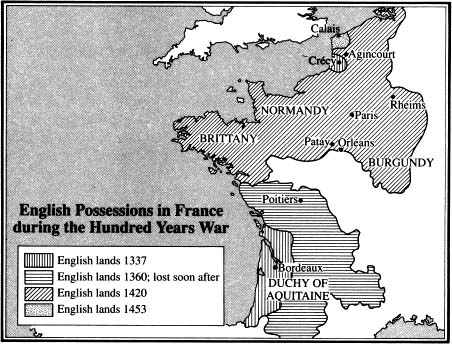
By 1420, Henry was master of Normandy, Brittany, Maine, Champagne and the Duchy of Aquitaine (or Guienne). But already there was in England a backlash of opinion against the war. The King was a hard taskmaster, and as the memory of Agincourt grew dimmer, Englishmen were becoming less enthusiastic about serving under him in France. Some of his soldiers were deserting and turning to a life of crime back in England.
Henry V ignored this, for the greatest prize of all was almost within his grasp. On 21 May 1420 a peace treaty was ratified at Troyes by the kings of England and France, by the terms of which Henry V and his heirs were designated the lawful successors to Charles VI. Normandy was formally ceded to Henry and he was appointed Regent of France until such time as he should succeed to his new inheritance. The Treaty of Troyes effectively disinherited the House of Valois and the Dauphin Charles, and marked the pinnacle of Henry V’s achievement in France. However, it made little difference to the war, and hostilities continued as before, while the Dauphin, a penniless exile, set up a rival court at Bourges.
The Treaty of Troyes was sealed by the marriage of Henry V to Katherine of Valois, youngest daughter of Charles VI; their ‘magnificent espousals’ took place on 2 June at Troyes Cathedral. The marriage was supposed to lend dynastic credence to Henry’s new status as heir to the French throne, and as he made his vows he appeared, according to one chronicler, ‘as if he were at that moment king of all the world’.
The marriage had been under discussion since 1414, and according to Martin’s Chronicle Katherine had ‘passionately longed’ for it; from the moment she set eyes on Henry, she ‘constantly solicited her mother till the marriage took place’. She was undoubtedly handsome, if not beautiful, but Henry would probably not have cared if she were otherwise; to him, she represented France. He was never a doting husband, and Katherine seems to have been somewhat in awe of him. Theirs was essentially a dynastic match, and it is unlikely that love played much part in it.
Katherine had been born in 1401 in Paris of a demented father and a nymphomaniac mother, Isabeau of Bavaria. She had had a terrible childhood: she and her sister Michelle were neglected by their parents and nobody cared much about their welfare. They were filthy, often starving, and frequently abandoned by their unpaid attendants. The two princesses scavenged around for food or had to rely on the charity of their remaining servants.
Their father, a terrifying and sometimes violent figure, rarely saw them, but once, when he had one of his periods of lucidity, he demanded to know why his daughters were so unkempt and dirty. Their governess told him the truth, and he gave her a gold cup to sell so that necessities could be provided for the girls. Occasionally Queen Isabeau visited them, but she was too preoccupied with her many lovers and her political intrigues to spare much time for her vast brood of children, not all of whom were the King’s. Eventually Katherine was packed off to be educated at the convent at Poissy, where she learned at least one language if little else. She seems not to have been a particularly bright girl, nor was she gifted with a vivacious personality, but she emerged from the convent with looks, her rank and her precocious sensuality to commend her, as well as the most engaging manners. The Burgundian chronicler, Jean de Waurin, called her ‘a very handsome lady, of graceful figure and pleasing countenance’, and her funeral effigy at Westminster Abbey shows her to have had a long neck, good bone structure, and the long Valois nose.
Henry and Katherine returned to England in December 1420, being carried ashore in triumph on the shoulders of the barons of the Cinque Ports. Katherine was crowned with due magnificence in February 1421, and in the summer of that year, the King left her pregnant when he returned to France for what was to be his last campaign. Before he went he is said to have forbidden her to go to Windsor for her confinement because of an old prophecy which foretold that ‘Henry of Windsor shall long reign and lose all’.
Katherine disobeyed him. She went to Windsor in the autumn and there, at four o’clock in the afternoon of St Nicholas’s Day, 6 December, after a painful labour, she bore a son, who was styled Duke of Cornwall from his birth. Henry V was besieging Meaux when he heard he had a male heir, and sent word that his son must be christened Henry and that his wife must without delay hear a mass of the Trinity and offer the child to God. Archbishop Chichele officiated at the baptism, while the King’s next brother, John,Duke of Bedford, Bishop Beaufort, and Jacqueline, Duchess of Hainault stood sponsors. There was great public rejoicing. The little prince throve, and in January 1422 one Joan Astley was appointed his nurse.
Henry V never saw his son, and when the Prince was six months old Katherine left him behind in England in the care of his uncle, Humphrey, Duke of Gloucester, Henry V’s youngest brother, and went to join her husband.
Henry V did not live to become King of France. The stresses of war and endless campaigning had prematurely aged him. In later life he grew a beard and let his curly hair grow long. A stone effigy of him in York Minster, executed around 1425 and recently identified as a true likeness, portrays him thus, as does the obverse of his great seal. He looks careworn and tired, and, indeed, he was intermittently ill from 1419 onwards.
In June 1422 Henry was at Senlis with the King and Queen of France when the Duke of Burgundy requested his aid in relieving a garrison on the Loire from attack by the Dauphin’s men. Although he was unwell, having contracted a ‘lengthy illness as a result of long and excessive labours’ during the siege of Meaux, which had ended in May, Henry set off on yet another expedition, having said what was to prove a final farewell to his wife. He tried resolutely to ignore his illness, which took the form of high fever with violent dysentery, but at length he became so incapacitated that he could not sit astride a horse and had to be carried in a litter. Even this caused him terrible agony, and he had to be taken by boat along the Seine to the castle of Bois-de-Vincennes, near Paris, having resigned his command to his brother Bedford.
On arrival at Vincennes, he insisted on riding on horseback to the castle, but could endure no more than a few steps. His attendants lifted him, half fainting, into a litter, where he lay wild with pain. The illness had so consumed his strength that the doctors dared not give him any medicines, and it was clear that he was dying.
On 31 August the King demanded to know the truth about his condition. His physicians told him he had at best two hours to live. Bedford had come to say farewell, as had his other captains, Thomas Beaufort, Duke of Exeter, and Richard de Beauchamp, Earl of Warwick. Queen Katherine was still at Senlis with her parents. As the evening of 31 August wore on, the dying King’s sufferings increased. His intestines, genitalia and lungs were already in a state of putrefaction. Shortly before two o’clock in the morning of 1 September 1422, Henry whispered that his constant desire had been to recapture Jerusalem from the Turks. Then, clutching a crucifix, he murmured, ‘In manuas tuas, Domine, ipsum terminum redemisti,’ and died.
His death, says Walsingham, ‘was deservedly mourned’ for ‘it left no one like him among Christian kings or princes. Thinking of his memorable deeds, people felt awe at his sudden and terrible removal,’ which in years to come proved to have been a greater tragedy than anyone then living could have foreseen.
When Henry died his body was so skeletal that there was little flesh left to decompose, and his corpse was prepared for burial in the usual way, with even the intestines left inside. So that it should not stink during the journey back to England, it was embalmed with aromatic herbs, wrapped in waxed linen, lead and silken cloth, and placed in a coffin. This was laid on a black-draped bier surmounted by an effigy wearing royal robes and a crown, and escorted by a mighty host of mourners in doleful procession through France, across the sea, and home to its final resting place. The Queen was chief mourner, and it was she who commissioned the fine tomb of Purbeck marble which was raised to Henry’s memory in a new chantry next to the shrine of St Edward the Confessor in Westminster Abbey. On this was placed an effigy of wood, painted in silver and gilt, with a solid silver head. During the Reformation of the 1530s, Henry VIII’s commissioners stripped the tomb of its silver, leaving only a headless effigy. This remained for over four hundred years until a new head, based on contemporary portraits, was added in the 1970s.
As a king, Henry V had been extremely successful: he had kept the peace at home by governing with firmness, justice and mercy, and had united his people behind him in a common endeavour. His victories had added lustre to the name of Lancaster, and he had restored the prestige and authority of the Crown. In fact, his achievements were regarded by his contemporaries as little short of miraculous, and his early biographers wrote extravagantly flattering accounts of him, thus giving rise to the legend of a hero-king that found its greatest expression in Shakespeare’s play and has influenced writers of English history to this day. Only now, in the twentieth century, are some of the less palatable truths about Henry V acknowledged.
His death was an unmitigated disaster for England. So much of France remained to be conquered and, even with a leader such as Henry, the enterprise would have been a forbidding task: ruled by an infant king, however diligent his regents, England could not hope to win the war, for her resources could not support it. Henry V had won much, but at enormous cost, and even in his lifetime there had been complaints. Parliament had become less ready to vote funds and had refused to grant further taxation; he had had to rely on loans to finance his campaigns in later years. This brought the Crown near to bankruptcy and burdened it with crippling debts. Henry had been unable to pay even his servants’ wages; how, then, was the completion of an English conquest of France to be financed?
Henry V’s reopening of the Hundred Years War had been intended to launch England into a new era of prosperity and glory. Instead he had saddled her with decades of expense and humiliation, which would ultimately bring about the ruin of his house. Even the dual monarchy established by the Treaty of Troyes was a precarious institution that Henry might not have been able to maintain, had he lived. The French people resented it, and large parts of France were as yet unconquered. In fact, the activities of Henry V in France did more than anything else to foster the growing sense of nationalism in that kingdom.
After his death, it was inevitable that divided opinion about the continuance or otherwise of the war with France would ensure that the English magnates would group themselves into factions: those in favour of following the late king’s example and prosecuting the war, and those who believed that a peaceful end to it was essential. These differences would institute half a century and more of government by factions, which in itself would undermine law and order and the stability of the realm and even of the Crown itself. Worse still, the throne had now passed from a strong and respected man to a helpless baby, consigning England to the uncertainties of minority government. Not for nothing was it commonly said, ‘Woe to thee, O land, when thy king is a child.’