
9.
I know you need a short sermon and a long table. May it please God not to make the time of the mass last too long for you.
—An Easter sermon by ROBERT DE SORBON
Churches in the thirteenth century are places where people go not only to pray or visit the shrines of saints, but for secular purposes, because churches are often the only large public buildings in town. Business life often centers around a town’s principal church. In Troyes the fairs crowd the precincts of St.-Jean and St.-Rémi. In Provins the stalls of the moneychangers are set up in front of St.-Ayoul. In many towns churches are used for town meetings, guild meetings, and town council sessions.
Everywhere the church is a familiar, friendly place. It is not, however, particularly comfortable. There are no benches or pews.1 Some worshippers bring stools and cushions, some kneel on the straw-covered floor. The building is chilly, even in mild weather, and in the winter many of the congregation come armed with handwarmers—hollow metal spheres holding hot coals.
A bell signals the start of service. The congregation stands as the procession of priests, choir, and clerks enters singing a hymn. The melody of Gregorian chant, seeming to wander at will, actually follows strict rules in mode, rhythmic pattern, phrasing, accent, and relationship of words to music. The group sings in unison, or sometimes in an antiphon between choir and cantor or between two halves of the choir. A momentous change is just taking place, however—the birth of polyphonic music. Out of a part of the chant in which the melody is accompanied by a sustained note in the tenor, music for more than one voice part is developing. First the tenor, from a single note of indefinite length, becomes a separate melody with its own rhythm; then another voice is added; and out of this grows a “motet,” a sort of little fugue. Another important innovation is the beginning of modern notation, with rhythm indicated as well as pitch.
The singers may be accompanied by a “portative organ,” which looks like the fruit of a union between an accordion and a full-sized organ. It is suspended from the player’s neck; he operates the bellows on the back of the instrument with his left hand and the keyboard with his right. Some churches have standard organs, powerful, clumsy, and generally out of tune. The one constructed at Winchester in 980, with four hundred pipes and two manuals, produced a noise so great that everyone “stopped with his hand his gaping ears, being in no wise able to draw near and hear the sound.” Instrumental keys, introduced in the twelfth century, are so heavy and stiff that they must be played with the clenched fist. Organs have a range of three octaves, and are the first instruments to become entirely chromatic.
The Gregorian liturgy, having triumphed over several rivals, is in use throughout western Europe. In almost any church in France, England, Germany, Italy, or Spain the service is celebrated exactly as it is in Troyes. The congregation stands, kneels, and sits in accordance with the ritual; otherwise, however, it takes little active part in the service.
Few present understand Latin, but sermons are delivered in the vernacular, except when the audience is clerical. The sermon usually lasts half an hour, measured by the water clock on the altar. The priest mounts the pulpit and begins by making the sign of the cross, then gives his thema or text in a short Latin passage from the Gospels, which he translates for the benefit of the congregation. This he follows with a rhetorical introduction explaining his unfitness to discuss the subject (the sentiments are humble but the language is flowery) and with an invocation to the divine spirit. Then he develops his text.
Frequently he runs over the time limit in order to get in his “example.” This indispensable part of the program consists of a story, illustrative of the sermon’s text, told with dramatic flair. For a sermon on the Christian virtues, a popular example goes like this:2
A merchant is returning from the fair, where he has sold all his merchandise and gained a large sum of money. Pausing in a city—such as Amiens or Troyes—he finds himself before a church, and goes into the chapel to pray to the Mother of God, Holy Mary, putting his purse beside him on the ground. When he rises, he forgets the purse and goes away without it.
A burgher of the city is also accustomed to visit the chapel and pray before the blessed Mother of God Our Lord, Holy Mary. He finds the purse and sees that it is sealed and locked. What is he to do? If he lets it be known that he has found it, people will cry that they have lost it. He decides to keep the purse and advertise for its owner, and he writes out a notice in big letters, saying that whoever has lost anything should come to him, and posts it on the door of his house.
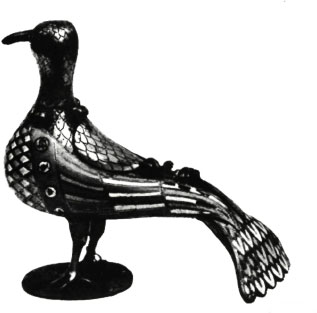
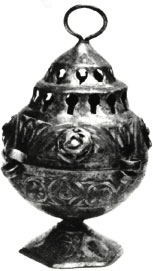
Religious objects, often richly decorated, were the products of prosperous city craftsmen. Among the most beautiful of the thirteenth century are this enamel eucharistic dove and censer. (Metropolitan Museum of Art; Cloisters Collection, Purchase 1947 and 1950)
When the merchant has gone a good distance, he realizes that his purse is missing. Alas, all is lost! He returns to the chapel, but the purse is gone. The priest, questioned, knows nothing about it. Coming out of the chapel, the merchant finds the notice, enters the house, sees the burgher who found the purse and says to him, “Tell me who wrote those words on your door.” And the burgher pretends he knows nothing but says, “Good friend, many people come here and put up signs. What do you want? Have you lost anything?” “Lost anything!” cries the merchant. “I have lost a treasure so great that it cannot be counted.” “What have you lost, good friend?” “I lost a purse full of money, sealed with such and such a seal and such and such a lock.” Then the burgher sees that the merchant is telling the truth, so he shows him the purse and returns it to him. And when the merchant finds the burgher so honest, he thinks, “Good sir God, I am not worthy of such a treasure as I have amassed. This burgher is far worthier than I.” “Sir,” he says to the burgher, “surely the money belongs to you rather than to me, and I will give it to you, and commend you to God.” “Ah, my friend,” says the burgher, “take your money; I haven’t earned it.” “Certainly not,” says the merchant, “I will not take it.” And he leaves.
The burgher runs after him crying, “Stop thief! Stop thief!” The neighbors take up the hue and cry and catch the merchant, and ask, “What has this man done?” “He has stolen my poverty and my honesty, which I have carefully preserved up to this moment.”
The congregation thoroughly enjoys the performance, with its moral, which the priest takes care to point out.
Besides homely anecdotes, the preachers find their examples in extracts from history or legend, lives of the saints, Bible stories, contemporary events, personal memories, fables from Aesop or other fabulists, morals drawn from bestiaries or from accounts of plants, the human body, or the stars.
Oratorical devices3 are not beneath a priest. If attention lags during the sermon, he may suddenly exclaim, “That person who is sleeping in the corner will never know the secret that I’m going to tell you!” Or when the ladies become restive during a sermon on the wickedness of women, he may address them: “Shall I speak of the good woman? I will tell you about that old lady there who has fallen asleep. For Heaven’s sake, if someone has a pin, wake her up; people who sleep during the sermon somehow manage to stay awake at table.”
The sermon is followed by the Creed, the Offertory, and the celebration of communion, which has been preceded by the Kiss of Peace. The priest kisses the Gospel, which is kissed in turn by every member of the congregation. Those who receive the sacrament come forward and stand before the altar with hands outstretched, palms touching, one knee bent slightly forward; they do not kneel. The priest celebrates communion in front of the altar with his back to the people—a recent innovation.
Communion over, the service nears its end, and the priest asks prayers for certain persons: for the Church, for Count Thibaut, his peace and prosperity, for the bishop and other priests, for the Holy Land and its defenders, for the dead, some of whom he mentions by name. He may even lower his voice and ask a blessing for an unlucky priest who has been disciplined. Everyone kneels and the prayers are recited together, with several Paters and Aves. Then the priest pronounces his final blessing, and the service is over.
Like the Christian service, worship in the synagogue retains an age-old universal form. The Almemar (the platform from which the Scriptures are read), and the ark containing the sacred scrolls stand in the center of the paved floor. Wax candles illuminate the interior. Tallow, though permitted for private use, is forbidden in the synagogue.
Services are read twice daily, in late afternoon and again in the evening. Behavior is casual, compared with that of a Christian congregation. Children are noisy, adults wander in and out. A Takkanah (edict) imposes a heavy fine for striking one’s neighbor in the synagogue. Jewish services are well attended, though workers who must rise at sunup are excused except on the Sabbath. The form of service is identical throughout northern France. The ancient custom by which men of the congregation read successive portions of the Scriptures has been modified, and the Reader performs this task, either alone or with various individuals who are called up. Sermons are delivered only on festivals, when the whole congregation sings the Hallel (Psalms 113–118), which is possibly what provoked a famous complaint by Pope Innocent III against excessive noise emanating from synagogues.
One of the features of the Christian religion which has given worship a distinctive character is the taste for intercessory saints. Though prayers to a saint may be said at home as well as in church, their effect is believed to be greatly enhanced by the presence of part of the saint’s mortal remains. This conviction dates from the martyrdom of the early Christians. Bones and other physical fragments of men stoned, burned, and tortured were reverently rescued and preserved.
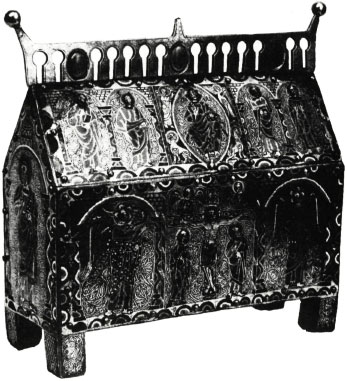
Reliquary chest. Sometimes reliquaries were made in the shape of the bone fragments they contained—an arm to contain an ulna, a head to contain a piece of skull. (Metropolitan Museum of Art, Gift of George Blumenthal, 1941.)
Saints and martyrs multiplied, and their relics multiplied even more rapidly. Churches were built on the tombs of martyrs. Princes and bishops went to extraordinary lengths to acquire relics. Constantinople became the center of a vast commerce, owing to its favorable position near the scenes of the Old and New Testaments. St. Helena, mother of Constantine, is said to have found the three crosses of Calvary and identified the True Cross by touching a dead man with it and bringing him to life. So precious was thisrelic that it was cut into bits and bestowed, traded, and sold all over Europe (to such effect that Calvin later counted enough pieces of it “to make a full load for a good ship”).
The capture of Jerusalem in 1099 brought a flood of relics—Judas’ pieces of silver, one of the Biblical sower’s wheat seeds, two heads of St. John the Baptist (“Was this saint then bicephalous?” acidly demanded Guibert of Nogent), and hundreds of other items. But this was a trickle compared to the torrent loosed by the capture of Constantinople in 1204. Bishop Garnier de Traînel, who served as chaplain of the Latin army, brought back many treasures to Troyes, among them a silver arm encompassing a relic of St. James the Greater; the skull of St. Philip the Apostle, incased in a reliquary decorated with a gold crown studded with precious stones; and several pieces of the True Cross, enclosed in a Byzantine cross of gilded silver set with five fine emeralds. The Crown of Thorns, pawned by the new Latin emperor to the Venetians, was eventually purchased by St.-Louis, who built the Sainte-Chapelle to receive it, apparently regarding it as superior in authenticity to the two other Crowns of Thorns that Paris already possessed. Other relics aroused skepticism even in a religious age: one of Christ’s baby teeth (How did anyone think to save it? wondered Guibert of Nogent), pieces of stone tablets on which God was said to have written the Ten Commandments, and the “authentic relic” of the Lord’s circumcision, claimed by a number of churches.
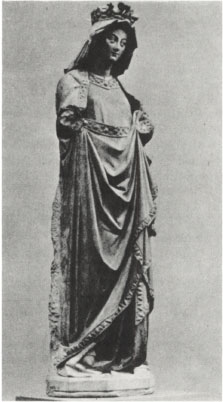
Virgin worship, as popular with city burghers as with the knights and peasants of the countryside, was at its height in the thirteenth century, when the newly founded Dominicans popularized the “hail Mary.” Statue above is from the Strasbourg Cathedral. (Metropolitan Museum of Art, Cloisters Collection, Purchase 1947)
Despite cavils, the cult of relics is at its zenith in the middle of the thirteenth century. Every church has its treasures. Besides the relics brought back by Garnier de Traînel, the cathedral treasury of Troyes displays the basin in which Christ washed the disciples’ feet; the surplice of St. Thomas of Canterbury, on which traces of his brains are visible, and a foot of St. Margaret. The treasury of Sens contains a drop of blood and a bit of the garment of St. Clement and one of Judas’ thirty pieces of silver. The church of Ste.-Croix at Provins has an arm of St. Lawrence and a fragment of the True Cross, given by Count Thibaut on his return from a Crusade in 1241. Sometimes relics are preserved in gold and enamel boxes, ornamented with jewels; sometimes they are fitted into a more artfully contrived reliquary—an arm-bone encased in a sculptured arm of brass, enamel and gold, or a piece of skull fitted neatly into a lifelike representation of a saint’s head in silver and brass.
The number of saints is large and indeterminate. In early Christian times cults were local, and inquiries into qualifications for sainthood were usually instituted by the bishop of the diocese in which the candidate lived. Not until the tenth century did the Pope come to play an important part in canonization, and in the twelfth, Alexander III established once and for all the principle that no person, however holy his reputation, could be venerated as a saint without direct papal authorization. In the thirteenth century the process of canonization is undergoing its final development.4 Petition must be made to the Pope, who appoints two or more commissioners as his representatives. They set up a court of inquiry, examine witnesses, and fill the role of devil’s advocate as well as of defendant and judge. The petitioners choose a proctor who marshals witnesses and expedites the suit if there is a delay. A record of the proceedings is kept, put into “public form” by a notary, and presented to the papal Curia, where canonization is finally granted or denied. The successful candidate is placed in the martyrology, but in 1250 church calendars still present wide local variations.
Despite the popularity of such regional patrons as St.-Loup, one saint stands far above all others in appeal. The prayers of Christians are directed more often to the Virgin Mary than to all the rest together. Virgin worship goes back to the fourth century, when controversies over the nature of Christ brought the need for a new intercessor between God and man. In the thirteenth century this worship is at its height. The monastic orders find in the Virgin an ascetic ideal. The Carmelites celebrate Our Lady of Carmel, the Franciscans have instituted the Feast of the Presentation, the Dominicans have popularized the Hail Mary. Works of Marian theology and devotion by St.-Bernard and St.-Bonaventure have been translated into the popular tongue and are widely read.
Many a burgher seeks the intercession of saints by visiting their relics, either to effect a cure or to do penance for a sin. One may make a pilgrimage to the new cathedral at Chartres and follow the “Chartres mile” on one’s knees—a labyrinth of concentric circles in the middle of the nave. Or the pilgrim may journey to Roc Amadour, where he strips to his shirt, binds himself in chains, and climbs the hundred and twenty-six steps to the Chapel of Our Lady on his knees. There a priest recites prayers of purification and removes the chains, presenting him with a certificate and a lead medallion with the image of the Virgin. Henry II, St. Dominic, St.-Louis, Blanche of Castille and thousands of others, famous and obscure, have climbed those steps.
Some burghers possess lead medallions from half a dozen pilgrimages, either the result of persistent attempts to cure an affliction, or exceptional piety—or perhaps a fondness for travel. Chaucer’s pilgrims were not the first to enjoy their trip.
If there are saints to pray to, there are also devils to fear. Every corner of hell is minutely described by the priests and depicted on church portals. People are often possessed by devils, which must be exorcised by the priest. Belief in demons is older than the Church, which has certified their existence (Thomas Aquinas cites the authority of the saints and of the Christian faith.) Thoughts of hell and purgatory give Christians moments of apprehension and even terror, and influence some decisions, especially in the realm of charity. But though merchants are aware that the Bible does not recommend laying up riches as a means of gaining the kingdom of Heaven, they go right on laying them up.
In the cosmos of the thirteenth century many mysteries are unsolved and, failing other hypotheses, must be explained by supernatural means. Yet the outlook of the burghers of Troyes is not devoid of skepticism and common sense. Though the Roman Church is at the pinnacle of its prestige, there is a strong current of resistance to its authority. The weapons of excommunication and interdict are not as effective as they used to be, partly through overuse. The late Bishop Hervée, quarreling with Thibaut the Songwriter over prerogatives, threatened the count with excommunication so frequently that the Pope felt constrained to caution the embattled prelate. And even the Pope’s own edict did not prevent Dandolo, the elderly Doge of Venice, and his fellow Crusaders from capturing the Christian city of Zara and dividing the spoils.
The cities, with their notorious worldliness, are widely blamed by the Church for the spread of skepticism and something worse—heresy. A powerful, subversive religious underground has stirred upheaval throughout Europe. Several heretical movements varying from moderate to lunatic-fringe have been suppressed, but one, the most dangerous of all, continues to alarm all right-thinking people. Albigensianism, or Catharism, originally brought to the West from Bulgaria by weavers and cloth merchants and fostered, as the Church complains, by the new independence and skepticism of the cities, has been the object of a vigorous crusade, lasting thirty-four years, with a ten-year interval of truce. Many of its practitioners have gone into hiding, and the Inquisition, placed in the hands of the new mendicant orders, is busy ferreting out suspects everywhere.
The orthodox majority hates and fears the heretics, whose doctrines are shocking enough without being exaggerated, as they naturally are. Cathars deny the Redemption and the Incarnation. Some claim that Christ’s entry into the world was made by way of Mary’s ear. They scoff at the Old Testament and take stock in neither hell nor purgatory, maintaining that this world is hell enough. They reject the cross, which they consider as a merely material object. Their conviction that marriage is evil, because procreation embeds souls deeper in the material world, has given an especially dubious reputation to the Cathars, who are believed to have originated in Bulgaria—hence the latter-day connotation in French and English of the word bougre, originally meaning Bulgar.
Parties of Dominican and Franciscan inquisitors journey from town to town inviting heretics to reform and Christians to inform. Heretics who confess and repent may get off with a penance, which sometimes takes the form of a saffron-colored cross sewed on breast and back. Whipping and imprisonment may be employed, though not torture—as yet. A guilty and unrepentant heretic may be “delivered to the secular arm” to be burned. Verdict is pronounced and sentence executed in the town square, and the ashes are cast into the nearest river.
The heresy hunters visited Champagne in the 1230s, their activities reaching a frightful climax in 1239, on the eve of Count Thibaut’s departure for the Holy Land. An old woman of Provins, Gille, called “the Abbess,” who had been in prison since 1234 awaiting sentence for heresy, bought her own release by disclosing the names of other heretics to the notorious inquisitor Robert le Bougre, an ex-Cathar turned Dominican. At Mont-Aimé, some fifty miles north of Troyes, one hundred and eighty-three men and women were burned in the presence of a huge throng of spectators. When the fires were lit, the Cathar leader raised his voice and gave his fellow-martyrs absolution, nobly explaining that he alone would be damned because there was no one to absolve him.