
6.
And he looks at the whole town
Filled with many fair people;
The moneychangers’ tables covered with gold and silver
And with coins;
He sees the squares and the streets
Filled with good workmen
Plying their various trades:
One making helmets, one hauberks,
Another saddles, another shields,
Another bridles, and another spurs,
Still another furbishes swords,
Some full cloth, others dye it,
Others comb it, others shear it;
Others melt gold and silver,
Making rich and beautiful things,
Cups, goblets, écuelles,
And jewels with enamel inlay,
Rings, belts, clasps;
One might well believe
That the city held a fair all year round,
It was full of so many fine things,
Of pepper, wax and scarlet dye,
Of black and gray velvet
And of all kinds of merchandise.
—CHRÉTIEN DE TROYES I
in Perceval, le Conte du Graal
Almost every craftsman in Troyes is simultaneously a merchant. The typical master craftsman alternately manufactures a product and waits on trade in his small shop, which is also his house. Sometimes he belongs to a guild, although in Troyes only a fraction of the hundred and twenty guilds of Paris1 are represented. Many crafts stand in no need of protective federation or have too few members to form a guild.
Each shop on the city street is essentially a stall, with a pair of horizontal shutters that open upward and downward, top and bottom. The upper shutter, opening upward, is supported by two posts that convert it into an awning; the lower shutter drops to rest on two short legs and acts as a display counter. At night the shutters are closed and bolted from within. Inside the shop master and apprentice and a male relative or two, or the master’s wife, work at the craft.
In a tailor’s shop, the tailor sits inside, cutting and sewing in clear view of the public, an arrangement that simultaneously permits the customer to inspect the work and the tailor to display his skill. When the buying public arrives—even if it is only a single housewife—tailors, hatmakers, shoemakers and the rest desert their benches and hurry outside, metamorphosing into salesmen who are so aggressive that they must be restrained by guild rules—for example, from addressing a customer who has stopped at a neighbor’s stall.
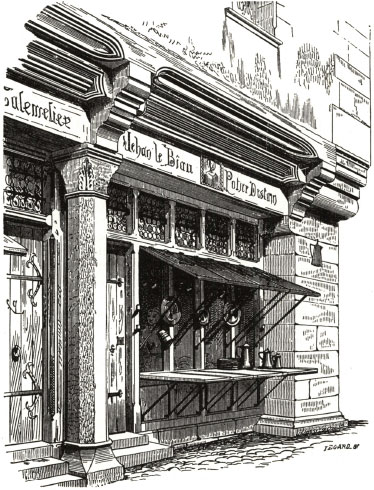
Medieval shop front, sketched in Brittany by Viollet-le-Duc, nineteenth-century architect. The horizontal shutter was raised when the shop was opened to form an awning over the merchandise.
Related crafts tend to congregate, often giving their name to a street. Crafts also give their names to craftsmen—Thomas le Potier (“Potter”), Richarte le Barbier (“Barber”), Benoît le Peletier (“Skinner”), Henri Taillebois (“Woodman”), Jehan Taille-Fer (“Smith”). With the rise of the towns, surnames are becoming important; the tax collector must be able to draw up a list. But neither in the case of the man nor the street is the name a reliable guide to the occupation. Just as a grocer’s son may be a chandler, so the Street of the Grocers may be populated by leather merchants and shoemakers.
Not far from the helmetmakers, armorers, and sword-makers one may be sure to find the smiths, who not only produce horseshoes and other finished hardware for retail sale, but supply the armorers with their wrought iron and steel. Iron ore is obtained almost entirely from alluvial deposits—“bog iron”—and only rarely by digging. Though coal is mined in England, Scotland, the Saar, Liège, Aix-la-Chapelle, Anjou, and other districts, iron ore is smelted almost exclusively by charcoal. A pit is dug on a windy hilltop, drains inserted to allow the molten iron to be drawn off, and charcoal and ore layered in the hole, which is sealed at the top with earth. The advantage of this method is that the iron drawn off has some carbon in it; in other words, it is steel of a sort. Medieval metallurgists do not really understand how this happens. This “mild steel” is taken in lumps to the smithy.
The blacksmith’s furnace is table-high, with a back and a hood, and like those of the smelters, burns charcoal. The smith’s apprentice plies a pair of leather bellows while the mith turns the glowing bloom with a long pair of tongs. When it is sufficiently heated, the two men drag it out of the furnace to the floor, where they break off a chunk and take it to the anvil, which is mounted on an oak stump. They pound, then return the chunk to the fire, then back to the anvil for more pounding, then back to the fire. Hour after hour the two swing their heavy hammers in rhythmic alternation, their energy slowly converting the intractable metal mass. This metal may vary considerably in character, depending on the accident of carbon-mixing at the smelter.
If the smith is fabricating wire, the next step will be to draw a piece of the hot metal through a hole with pincers. Several such drawings, each time through a smaller hole in a plate, accomplished with patience and much labor, produce a wire of the correct diameter, which is retempered and cut into short lengths. These are sold to the armorer up the street, who pounds them around a bar into links, the basis of chain mail.
The sages believe iron is a derivative of quicksilver (mercury) and brimstone (sulfur). The smith and the armorer know only that the material they get from the smelter sometimes is too soft to make good weapons or good chain mail, in which case they consign it to peaceful uses—plowshares, nails, bolts, wheel rims, cooking utensils. Other craftsmen who use the products of the forge include cutlers, nail makers, pin makers, tinkers, and needlemakers. But the great use of iron, the one that ennobles the crafts of smith and armorer, is for war, either real or tournament-style.
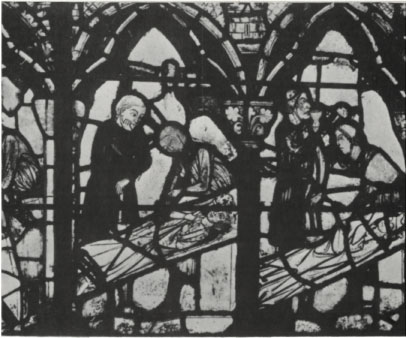
Sculptors at work, as shown in Chartres Cathedral window. Medieval sculpture, much of high quality, was created by men trained as stonemasons. Often the Master of the Works doubled as sculptor.
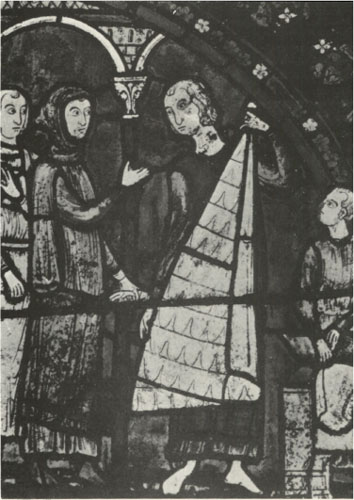
Merchant furriers. The furrier displays a cloak to a customer, while his apprentice stands behind him ready to hand out additional furs from the stock. The picture is the signature of the St. James window at Chartres, donated by the wealthy furriers’ guild.
There are also metalworkers on a more refined plane: goldsmiths and silversmiths. Since the twelfth century those of Troyes have enjoyed a wide reputation. The beautifully worked decoration of the tomb of Henry the Generous and the silver statue of the same count are justly famous. Goldsmiths are the aristocrats of handicraft, though not all are rich. Some goldsmiths scrape along working alone, making and selling silver ornaments, with hardly a thread of gold to their name. But most have an apprentice and a small store of gold, and fabricate an occasional gold paternoster or silver cup. The most prosperous have well equipped shops with two workbenches, a small furnace, an array of little anvils of varying sizes, a supply of gold, and two or three apprentices. One holds the workpiece on the anvil while the master hammers it to the desired shape and thickness, wielding his small hammer with incredible speed. Gold’s value lies not merely in its rarity and its glitter but in its wonderful malleability. It is said that a goldsmith can reduce gold leaf by hammering to a thickness of one ten-thousandth of an inch. Thin gold leaf embellishes the pages of the illuminated manuscripts over which monks and copyists labor.
Hours of labor, tens of thousands of blows, with the final passage of the hammer effacing the hammer marks themselves—these are the ingredients of goldsmithing, a craft of infinite patience and considerable artistry.
But the bulk of even a prosperous goldsmith’s work is in silver, the second softest metal. Sometimes a smith makes a whole series of identical paternosters or ornaments. To do this he first creates a mold or die of hardwood or copper and transfers the shape and design to successive pieces of silver by hammering. For repair jobs he keeps on hand a quantity of gold and silver wire, made in the same way the blacksmith makes his iron wire.
As the armorer depends on the smith, the shoemaker depends on the tanner, though he prefers to have his shop at a distance from his supplier’s operation. The numerous tanners of Troyes occupy two streets southeast of the church of St.-Jean. Hide-curing, either by tanning or the ancient alternative method of tawing, creates a pungent atmosphere. Masters and apprentices may be seen outdoors, scraping away hair and epidermis from the skins over a “beam” (a horizontal section of treetrunk) with a blunt-edged concave tool. The flesh adhering to the underside is scraped off with a sharp concave blade. Next the hide is softened by rubbing it with cold poultry or pigeon dung, or warm dog dung, then soaked in mildly acid liquid produced by fermenting bran, to wash off the traces of lime left by the dung.
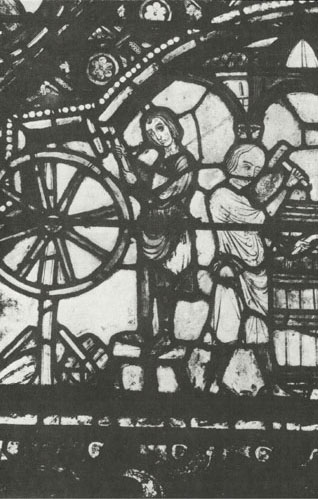
Cartwright and cooper, two skilled workers. This Chartres Cathedral window shows the cartwright finishing a wheel while the cooper fits a hoop to a barrel—one of the inventions of the Middle Ages.
For extra soft leather—shoe uppers, coverings of coffers, scabbards, bagpipes, bellows—the leather is returned to the beam to be shaved down with a two-handled currier’s knife. Then it goes to the pit, which is filled and drained with a succession of liquid baths. The first is old and mellow, the last fresh and green, their flavor imparted by oak bark, oak galls, acacia pods, and other sources of tannin. In the final stages the hides lie flat in the pit of liquid for several weeks, with crushed bark between the layers. The whole process of tanning takes months—usually, in fact, over a year. A new, quicker process, employing hot water, will appear later in the century, taking as little as ten days.
Tanning an oxhide is a laborious process, but it multiplies the skin’s value. Whitened oxhide and horsehide are even more expensive.
Footwear is insubstantial—little better than slippers. Ladies of fashion wear goatskin leather, or cordwain (from “cordovan,” a fine leather originally made by the Moors of Cordova), even less sturdy than ordinary cowhide.
The shoemaker is not only a skilled craftsman, but a merchant of some status, capable of acquiring modest wealth. A shoemaker of Troyes named Pantaléon has given his son Jacques an education in the Church. Jacques is today a canon at Lyons, soon will be bishop of Verdun, and will eventually become Pope Urban IV.
Besides shoemakers, hatmakers, candlestick makers, and other craftsmen, there are the practitioners of the service trades: food purveyors, oil merchants, pastrycooks, wine sellers, and beer sellers. In addition there is the wine crier, who is also an inspector. Each morning he goes into the first tavern he can find that has not yet hired a crier for the day; the tavern keeper must accept him. He oversees the drawing of the wine, or draws it himself, and tastes. Then, furnished with a cup and a leather flagon stoppered with a bit of hemp, he goes out to cry the wine and offer samples of it to the public. Before setting out he may ask those in the tavern how much the tavern keeper charged them, in order to check on the prices. Customers are served directly from the barrel; glass bottles are almost nonexistent.
There are some fifty vintages in thirteenth-century France. Among the favorites are Marly, Beaune, Epernay, Montpellier, Narbonne, Sancerre, Carcassonne, Auxerre, Soissons, Orléans, and, most highly regarded, Pierrefitte. Burgundy is already famous and northern Champagne produces excellent wine, though not the sparkling variety with which the province will centuries later become identified. Cider is unknown except in Normandy, and outsiders who have tasted it consider it to be a curse God has visited on the Normans. One observant chronicler reports that the French prefer white wine, the Burgundians red, the Germans “aromatic wines,” and the English beer.
Another trade closely associated with the taverns is prostitution. The girls of the Champagne Fair cities are famous throughout Europe. When the fair is on, servant girls, laundresses, tradeswomen, and many others find a profitable sideline. Child labor being the rule, prostitution begins at an early age.
Taverns are the chief setting for another vice—gaming. The dicemakers’ guild has strict laws against making fraudulent dice, which nevertheless find their way into the hands of professional sharpers. The fine for making such dice is heavy, so the sharpers pay a high price for them. Poor light in the taverns facilitates trickery.
Others engaged in service trades include the coal sellers, hay merchants, barbers, furniture menders, dish menders, and clothes menders—these latter three being the leading itinerants, whose peculiar rhymed gibberish echoes daily through the streets.
An ancient trade of the countryside, recently urbanized, is that of the miller. The numerous mills of Troyes are owned by the count, the bishop, the abbeys, the hospital, and various other proprietors. Most are situated on canals, with a few on the Seine below the city, mounted on floating hulls, the wheel over the side and the millstones seated on a cupola-shaped platform amidships. Sacks of grain are brought by boat to the miller, who pours the grain into the funnel over an opening in the upper stone. The current turns the wheel, which activates the stone, and the milled flour trickles into a sack beneath the platform.
Both millers and mills have other functions besides grinding grain. In slack periods the millers fish or spear eels. Mill wheels furnish power for a growing variety of businesses, notably tanning and fulling. The old undershot wheel, pushed lazily around by the current flowing against the lower paddles, is being supplanted by the overshot wheel, which is turned by water flowing over the top. Either type of wheel can be used when a weir or dam is constructed that creates a narrow, rapid current. The power of this current can be multiplied by guiding it to the mid-point of a waterwheel, so that the wheel’s turn starts underneath, or by guiding it to the top of the wheel, so that the wheel’s turn starts at the top. Although water mills are important, old-fashioned mills worked by horses and cattle still hold their own, because animals can work in all weather, whereas river and millrace currents may freeze in winter or dry up in summer.
From time to time the horse market is held in the Corterie-aux-Chevaux, near the Porte de la Madeleine. Nervous colts, sedate palfreys, powerful chargers, mares with foals trotting at their heels, broad-shouldered oxen, pack-asses and pack-mules, pigs, hogs, cows, chickens, ducks, and geese noisily crowd the market place. Knights, ladies, burghers and peasants bargain, argue, examine animals, turn back horses’ lips, feel coats and muscles, and now and then mount a palfrey or a charger.
Only nobles and rich burghers ride horses; everyone else rides donkeys or walks. A pregnant lady or wounded knight may be carried in a litter (carriages are far in the future). The knights who come to the horse mart sometimes take prospective mounts outside the city walls to try out. Often there are races, with the noisy assistance of the boys and young men.
The saddlemakers display their work at the market, and it is worthy of display. Bows of saddles are wooden, often ornamented with plates of ivory, hammered metal, or elaborately painted leather, with semiprecious stones soldered into the surface of the pommel and cantle. The saddlecloth is richly embroidered. Sidesaddles are manufactured for ladies, but not all ladies use them.
Farm implements, fashioned by the city’s blacksmiths, are on display too. These include sickles for harvesting grain, long-handled scythes with lateral grips added for efficient haymaking, sharp-bladed felling axes. Wooden spades have iron cutting edges. There are also farm machines—many-toothed harrows and wheeled plows, with coulter, plowshare and mouldboard for turning the earth to left or right.
The development of heavier breeds of horses has greatly augmented their value. They bring much higher prices than a mule or an ordinary draft horse. If Julius Caesar could wander through the horse market of Troyes, he would be startled far less by the wheeled plow and the new, heavily padded, rigid horse collar than by the size of the horses. Neither the Romans nor their foes ever rode anything like these. The Parthians and Byzantine Greeks began the development of the big warhorse, now completed in thisarea of northern France and Flanders. It is no accident that this is par excellence the region of feudal chivalry.
Guilds have two kinds of regulations. One has to do with external affairs, with what might be called the commercial side of the guild; the other deals with internal matters, such as wages, duration and conditions of apprenticeship, welfare, and obligations to the guild.
Every guild recognizes its stake in protecting the public, for since the guild restricts competition, it has an obligation to guarantee standards of quality. On being invested, the officers of the bakers’ guild solemnly swear that they will “guard the guild” carefully and loyally, and that in appraising bread they will spare neither relatives nor friends, nor condemn anyone wrongly through hatred or ill-feeling. Officers of other guilds swear similar oaths. Guild legislation on the quality of merchandise is painstakingly detailed. Precise quantities and types of raw materials are specified and supervision follows through all the stages of manufacture and sale. Ale must have no constituents except grain, hops, and water. The beadmaker must discard beads less than perfectly round. Butchers are not to mix tallow with lard or sell the flesh of dogs, cats, or horses. Makers of bone handles are forbidden to trim them with silver lest they pass them off for ivory. Knife handles may not be covered with silk, brass, or pewter for the same reason. If a tailor spoils a piece of cloth by faulty cutting, he has to make restitution to the customer and pay a fine besides. Chandlers must use four pounds of tallow for each quarter-pound of wick, and wax tapers are not to be adulterated with lard. A tailor may not mend old clothes, for that function belongs solely to the old-clothes mender, who in turn must not make new clothes. Sometimes the old-clothes mender does such a good job that the result looks like new; therefore, to keep the distinction visible, the mender is enjoined from pressing, folding, and hanging his products like new garments.
In most guilds inspection is no sham formality. Visits are made unexpectedly, scales checked, substandard goods confiscated on the spot, either to be destroyed or to be given to the poor, while the culprit pays a fine commensurate with the value of the merchandise. The jeweler found using colored glass and the spice dealer guilty of purveying false merchandise pay the highest fines.
Combinations to fix prices or to seek a monopoly on materials are forbidden. Retailers cannot buy eggs, cheese, and other produce from farmers except at the Friday and Saturday markets, and even here they cannot buy until the farmer is actually in the marketplace with his wagon or pack animal. They cannot buy from him on consignment, or arrange in advance to take his produce. These restrictions are all designed to prevent monopoly of food in time of famine, a threat never far distant. Unhappily, guild regulations and town ordinances alike frequently go unobserved.
The second kind of guild regulation, governing its internal affairs, often merely codifies ancient customs, such as observance of holidays, early closing on Saturdays during Lent and during the “short days” of the year.
The membership of most guilds is divided simply into masters and apprentices. A middle grade, the valet or journeyman, has been introduced in a few crafts where business demands more labor but masters do not want more competition. In most guilds a master is permitted only a single apprentice, or perhaps two. Grain merchants, ale brewers, goldsmiths, greengrocers, shoemakers, and some others are allowed more, and all masters are given great freedom in hiring relatives—as many sons, brothers, evennephews as they wish. Guild regulations reflect the nature of industry, which is small scale and familial.
Guilds often provide members with baptismal gifts when their children are born, help ill and destitute members, pay something toward hospital and funeral expenses, and do a little charitable work. This mutual-aid aspect of the craft guild goes far back. A guild that does not provide benevolent services usually has a “brotherhood,” an auxiliary that may be the original form of the association. Weavers, furriers, bakers, and many other crafts have brotherhoods, each under an appropriate patron saint: St. Catherine for the wheelwrights, because she was broken on the wheel; St. Sebastian for the needlemakers, because he was martyred by arrows; St. Mary Magdalen for the perfumers, because she poured oil on Jesus’ feet; St.-Barbe (“beard”) for the brushmakers; St.-Cloud (“nail”) for the nailmakers; St. Clare (“clear”) for the mirrormakers.
The contract between master and apprentice (regardless of whether they belong to a guild) is sometimes written, sometimes simply “sworn on the relics”—all medieval oaths are taken on sacred relics. The master undertakes to feed, lodge, clothe, and shoe his apprentice and “to treat him honorably as the son of a goodman.” Sometimes the apprentice receives a stipend—a small one. Sometimes the master also undertakes to educate the apprentice. Often he needs employees who can read and write and add and subtract. Twice a week the apprentice may go to the notary to learn his letters.
An apprentice’s day is long and hard. His situation depends very largely on the personality and condition of his master. A kind master is a blessing; perhaps an even greater blessing is a prosperous master. A kind mistress may be important too. Since the apprentice’s labor is not restricted to the trade and he may be called on to do any kind of household chore, many apprentices find themselves more tyrannized by mistresses than by masters. Guilds often specify in their regulations that an apprentice should not be beaten by the master’s wife.
Apprenticeship varies in duration, usually from four years to twelve; five years is common. The length of service is often related to the size of the initiation fee, as in the case of weavers, whose craft can be quickly learned and yet is remunerative. A weaver’s apprentice may become a master in four years by paying four pounds (livres), in five years by paying three pounds, in six years by paying one pound, in seven years without any payment. Brasswire makers require twelve years, or ten years plus a fee of twenty shillings (sous). Goldsmiths undertake a ten-year apprenticeship.
An apprentice has five obligations to fulfill. First, he must supply a certificate to the officers of the guild, stating that he is “prudent and loyal.” Second, he must demonstrate that he knows the craft. In some guilds the emerging apprentice must produce a “masterpiece.” An apprentice hatmaker fashions a hat, a cake baker bakes cakes. Third, the apprentice must show that he has enough capital to go into business. Sometimes his capital is his tools, sometimes he needs cash. Fourth, he must swear on the saints’ relics to uphold the guild’s law and customs, which the officers read aloud to him, explaining and clarifying as they go. Finally, he pays a fee, which goes not to the guild but to the prince—in Troyes the count of Champagne—for guilds “belong” to the sovereign. In 1160 Louis VII sold five of his Paris guilds (the leatherworkers, pursemakers, baldric makers, shoe repairmen and dockworkers) to the widow of a wealthy burgher, who thereafter collected the dues formerly owed the king.
On paying his fee, the apprentice becomes a member of the corporation, the inner body of the guild, that consists of the masters alone, or the masters and journeymen. His rise in status calls for a celebration—a round of drinks at the tavern, or possibly a dinner. Or he may merely pay five or ten sous to the corporation treasury.
An apprentice’s ambition may even soar beyond acquiring the status of a master. He may dream of some day being an officer of the corporation. Officers are elected by the masters, or by the masters and journeymen, and the election is ratified by the count’s provost.
Married apprentices are not unknown, and occasionally a master may even provide his apprentice with an allowance for taking his meals outside the master’s house. But such cases are the exception.
A craft may make a man modestly rich. Of course it may also make him stoop-shouldered, but this is a hazard of any trade. A man repeats the same motion with hammer, with maul, with saw, with shears, with needle, with loom, ten, twelve, fourteen hours at a stretch, day in and day out, transmitting the energy of his hand, arm and shoulder into chalice, statue, vestment or article of furniture. Forty years of such effort can leave him bent and crooked. His servile forefathers, however, ended their days not only crippled and deformed by their labors but with nothing to show for it.
In the old cité near the Abbey of St.-Loup is one of the crowded town’s most crowded districts. This is the Broce-aux-Juifs, the old ghetto of Troyes. Its streets are hardly distinguishable from the rest of the old quarter, except for the Mezuzah (a small parchment scroll inscribed with Old Testament writings) on every doorpost. The men, women and children on the streets do not look very different from their Christian neighbors, except that on the breast of each is sewn a yellow circle, or wheel. They speak perfectly good French, though they use Hebrew characters in writing. Jews make their living, like Christians, by manufacture and trade—as goldsmiths and leatherworkers, tanners and glass-blowers, weavers and dyers. In the south of France they practice viticulture, though agriculture generally is closed to them, as are many avenues of commerce. Some enlightened princes, like Louis IX of France and Edward I of England, favor abolishing the Jewish disabilities, even while Louis’ zeal for the Christian religion causes him to burn copies of the Talmud.
Many Jews lend money, mostly on a small scale, against pledges. A dozen are wealthy and even own land outside town. Some devote their lives to scholarship. The ghetto of Troyes, which had one of the earliest Jewish schools in northwest Europe, has been the home of several of the most famous Jewish scholars of the Middle Ages, such as Salomon ben Isaac (Rashi) and his grandson Jacob ben Meir, who presided over a major synod in Troyes in the previous century. The most important member of the community in the thirteenth century is the wealthy Jacob of Troyes, who holds the title “Master of the Jews.” He is in effect mayor of the ghetto, which is a separate, privileged community, a foreign colony, not unlike the Christian merchants’ colonies in the Levant, or the colonies of Italians and other nationalities in London. Jews do not belong to the commune and do not participate in the town government. A legal case involving a Christian and a Jew must be taken to the count’s court, where the testimony of a Christian against a Jew, or of a Jew against a Christian, must be corroborated by a coreligionist. A Jewish merchant receives full protection against thieves. If he is robbed in another principality, on the road to Troyes, the count demands restitution as forcefully as for a Christian merchant.
The same is true of other sovereigns. The Pope has threatened excommunication in defense of Roman Jewish bankers. When a Jewish merchant from Aragon was robbed by Castilian bandits, the king of Aragon promised to repay him at the expense of Castilian merchants unless the king of Castile made good the loss.
Princely punctilio about the rights of Jewish merchants and bankers is securely anchored in self-interest. But princely self-interest is a capricious force. The chief threat to Jewish life comes not from popular outbursts, which are rare, but from official edicts. A prince who needs money is tempted to lose his tolerance, listen to a charge (or cause one to be made), and order expulsion of all Jews from his territory. Expulsion automatically involves confiscation of goods.2 It also, almost as automatically, involves an increment to the sovereign at some later date when the Jews are graciously permitted to reenter the territory. Seventy years ago, at the time of the Third Crusade, the Jews of Troyes suffered expulsion, as did Jews in many other places. The synagogue in the old ghetto was taken over by Christians and converted to a church, St.-Frobert. A second synagogue in the new commercial quarter west of the cité suffered a similar fate, and became St.-Pantaléon. The street next to it remains, and will remain through the centuries, the Rue de la Synagogue.
Even the emotionally charged accusation of ritual murder is usually a pretext for a fine rather than capital punishment. An alleged ritual murder in London in 1244 resulted in an exorbitant fine—60,000 marks, levied against the Jewish community. Frederick II, king of Sicily and emperor of Germany, recently heard an indictment against the Jews of the town of Fulda. The scientific-minded emperor ordered an investigation, interrogating converted Jews from England. Concluding that there was no basis for the ancient charge, Frederick forbade further accusations. However, he did not neglect to collect a fine from the Jews of Fulda for breach of the peace. The Pope (Innocent IV) has also discredited the ritual murder superstition, which nonetheless persists among the ignorant masses.
Jewish conversion to Christianity is rare, but not unknown. Sometimes special protection is extended to converts not only against reprisals by Jews and insults by Christians, but against loss of property. More often, however, a converting Jew faces a considerable bill from his Christian prince, who does not wish to sacrifice the Jewish taxes without compensation. There are many other ways a prince may make money from his Jews. Henry III, present king of England, has recently mortgaged his Jews to his brother, Richard of Cornwall.
Forcible conversion is forbidden, as is interference with celebration of Jewish rites. However, the terms in which the prohibition is couched indicate that Christians are less tolerant than one could wish. “During the celebration of their festivals,” Pope Innocent III ruled, “no one shall disturb them by beating them with clubs or by throwing stones at them.” It is also expressly forbidden to extort money from the Jews by threatening to exhume the bodies of their dead from the Jewish cemetery.
Yet despite the suspicion and hostility with which the Broce-aux-Juifs is hedged around, contacts between Christians and Jews are numerous and not necessarily uncongenial. Jews have often served as bankers to the counts and have farmed tolls and taxes. The erudite Count Henry the Generous, the present count’s grandfather, is said to have consulted Jewish scholars on textual problems of the Old Testament. Jewish and Christian merchants and moneymen often embark on joint ventures. That many Jews of Troyes prosper is demonstrated by the fine houses along the Rue de Vieille Rome, south of the ancient donjon.
If the thirteenth century is not the best time to be a European Jew, neither is it the worst.