
5
Minoru Inaba
After the political break-up of the Abbasid caliphate in the first half of the ninth century, the history of Khurasan and Mā Warā’ al-Nahr (Transoxiana) is characterised by the further expansion of the Islamic world to the east. The period up to the thirteenth century witnessed a third wave of conquests, especially in Central Asia and South Asia, which were carried out by the non-Arab local Muslims. In Central Asia, the Saffarids and the Samanids played the leading roles in the initial stages of these advances. The former started to expand from Sistan, the southwestern part of present-day Afghanistan, and eventually incorporated Afghanistan and most of Khurasan under their rule. The latter expanded their realm in Mā Warā’ al-Nahr and, after emerging victorious from a decisive battle against the Saffarids in 287/900, secured their supremacy in the east. According to Jürgen Paul and Deborah Tor, both dynasties implemented a common policy of conducting vigorous jihād against non-Islamic lands to bolster their political legitimacy,1 and this policy of jihād is a distinct feature of expansion in the period in question.
It was, however, the Ghaznavids who continued this jihād policy and opened a new frontier in north-western India.2 The origin of the Ghaznavids lies in the military conquest of Ghazna, which had once been under the rule of the Saffarids, in the first half of the 350s/ 960s by Alptegin, a Samanid general of military slave origin. In this sense, the Ghaznavids inherited the legacy of these two earlier dynasties, and this paper outlines how these precedents were integrated within the process of Ghaznavid state formation, and how this was related to the frontier features of this region, thereby illustrating not only the economic aspects of the frontier but also the politico-military potential of this eastern frontier of the Islamic world in the period in question.
1. Alptegin
The well-known story of the conquest of the city Ghazna by Alptegin illustrates the characteristics of the Samanid military and jihād policy. Alptegin originally had been a Turkish ghulām of the Samanid Aḥmad b. Ismā‘īl (r. 295–301/907–914), and was gradually promoted until he became one of the most powerful figures in the army under Nūḥ b. Naṣr (r. 331–343/943–954). In the reign of ‘Abd al-Malik b. Nūḥ (r. 343–350/954–961), powerful local lords, such as Āl-i Muḥtāj of Chaghāniyān (the region along the Surkhāndaryā river, present-day Uzbekistan) and Turkish generals of slave origin were contending for effective control of the state.3 Alptegin, who was one of these Turkish generals, was most influential in the Samanid court as ḥājib-i buzurg (Chief Chamberlain). According to Gardīzī, he killed Bakr b. Mālik (d. 345/956), who was then serving as sipāhsālār (Commander-in-Chief) of Khurasan. Abū l-Ḥasan Muḥammad Sīmjūrī, who was also a Turkish general, was appointed as Bakr’s successor.4 After Abū l-Ḥasan was dismissed in 349/960–1 Alptegin managed to orchestrate the appointment of his successor, namely Abū Manṣūr Muḥammad b. ‘Abd al-Razzāq. Moreover, at the same time, the post of wazīr (Chief Minister) was given to Abū ‘Alī Muḥammad Bal‘amī, who was a trusted friend of Alptegin.5 According to Gardīzī, a Persian chronicler of the eleventh century, the amīr ‘Abd al-Malik, who was anxious about further extension of Alptegin’s power, tried to remove him from Bukhara by appointing him to the post of the governor of Balkh. Faced with Alptegin’s refusal, however, he abandoned this plan, and Alptegin was instead made sipāhsālār of Khurasan.6
In Dhū al-Ḥijja 349/February 961, Alptegin went to Nishapur, which was the centre of Samanid rule in Khurasan, and Abū Manṣūr, who was serving as sipāhsālār at the time, was forced to move to Tus.7 In November of the same year, ‘Abd al-Malik died abruptly. Alptegin and Bal‘amī thereupon manoeuvred together to enthrone Naṣr, a son of ‘Abd al-Malik. However, Fā’iq Khāṣṣa, who was also a Turkish general of slave origin and had been a companion of Manṣūr, a brother of the late amīr, succeeded in winning the support of the members of royal family and other notables of the Bukharan court for Manṣūr’s succession, and Naṣr was forced to abdicate in favour of his uncle after only one day on the throne.8 When Alptegin received the news at Nishapur, he immediately departed for Bukhara with his army, intending to gain control of the situation. When he arrived at Amul, a ford of the Amu Darya, there was already an army on the opposite side, which had been dispatched from Bukhara to bar his way.9 At the same time, the new amīr sent an order to Abū Manṣūr b. ‘Abd al-Razzāq, who had been entrusted by Alptegin with the affairs of Khurasan when the latter left Nishapur, to attack Alptegin from the rear, offering him the position of sipāhsālār as an incentive. Abū Manṣūr agreed and marched toward the shore of the Amu Darya. Realising that he was likely to be caught in a pincer movement, Alptegin decided to escape from Khurasan and marched along the Amu Darya up to Balkh.10
According to Niẓām al-Mulk and Shabānkāra’ī, Alptegin stayed at Balkh for a while and gathered volunteers by proclaiming a jihād against India. After successfully repelling the pursuit of the Samanid army at Khulm, he crossed the Hindukush mountains via Bāmiyān.11 The sources differ regarding the number of the people who were with him at that time. Gardīzī states that when Alptegin fought with the Samanid army between Balkh and Khulm, there were 700 ghulāms; Niẓām al-Mulk adduces the number of 2,200 ghulāms and 800 ghāzīs; Shabānkāra’ī records 700 ghulāms and 2,500 Tajiks; and Mustawfī counts 3,000 ghulāms. Even if we take the smallest number, given by Gardīzī, it is conceivable that there were from 1,500 to 2,000 people as a whole, since there must have been non-combatants with them.12
Emerging south of the Hindukush, Alptegin attacked Kabul. The city was garrisoned by the Indian army under the command of the son of the Kābulshāh (i.e. Hindūshāh), who tried to intercept the Muslim army near the city but was defeated. The troops of Alptegin then reached Ghazna, where the defeated son of the Kābulshāh had taken refuge. Alptegin besieged the city and a certain Lawīk, the ruler, surrendered and yielded the city to Alptegin.13 Subsequently, Lawīk and the son of the Kābulshāh are reported to have attempted once more to occupy the city, but were repelled by Alptegin. The exact date of Alptegin’s capture of the city is not known from the sources, but Muḥammad Nāẓim supposes it to have been in Dhū al-Ḥijja 351/January 963.14
Thus Alptegin’s exodus from Khurasan was the result of his defeat in a political struggle among various Turkish generals and notables that was triggered by the succession dispute that resulted from ‘Abd al-Malik’s death. As has already been pointed out by Barthold, the position of sipāhsālār of Khurasan, based in Nishapur, might be financially rewarding. Nishapur was, however, too distant from Bukhara to allow one to respond easily to the dynamic politics of the Samanid court, unless one had a trustworthy and capable deputy in the capital. It was fatal, in that sense, for Alptegin’s power bid that Bal‘amī quickly abandoned his support for the succession of Naṣr and took the side of Manṣūr.15
Alptegin’s departure from Khurasan follows a pattern that can be observed elsewhere: those who were defeated in the political struggles and/or lost their foothold there tended to quit the Samanid realm in search of new opportunities. Abū Manṣūr b. ‘Abd al-Razzāq, who had been promised by the Bukharan people the position of sipāhsālār, was eventually betrayed and fled to Gurgān via Marw to join the service of the Buyids. Another refugee to the Buyids was Abū ‘Alī Chaghānī (343/954),16 and as will be discussed below, the same is true of the cases of Qarategin Isbījābī and Muḥammad Ilyās some decades before Alptegin. Therefore, Alptegin’s self-imposed exile can be viewed as following a regular pattern observed in Samanid history. However, the question remains: why did he cross over the Hindukush instead of staying at Balkh or Ṭukhāristān? According to his own proclamation, the reason was simply that the region to the south of the Hindukush was ruled by the kāfirs (infidels) and was the target of jihād. Let us now examine this point more closely.
2. Pre-Ghaznavid eastern Afghanistan
(1) The ‘Gate of India’
The Ḥudūd al-‘Ālam, a Persian geographical work of the tenth century by an anonymous author, describes two cities in eastern Afghanistan as the ‘Gate of India (dar-i Hindūstān)’. One is Parwān on the south side of the Hindukush, at the northern edge of the so-called ‘Kabul Basin.’ The city was located at the confluence of the Panjshīr and the Ghorband rivers. These two rivers flow along the southern fringe of the Hindukush, and both river valleys served as routes connecting the two sides of the Hindukush. Parwān was situated on the intersection of these two routes, and it was actually a ‘Gate of India’ for the traveller from the north heading to India. However, the role of ‘Gate of India’ on the south of the Hindukush has been played by cities such as Kāpiśī and Kabul as well, in accordance with historical conditions.17 The other ‘Gate of India’ mentioned in the Ḥudūd al-‘Ālam is Bust, whose remains can still be seen in the vicinity of Lashkarigah in southern Afghanistan.18 It was located on the route connecting southern Afghanistan with the lower Indus valley via the Bolān Pass.19 However, in this case too, we should regard Bust as a part of a broader nexus where trunk routes joined each other. In fact, the route towards the lower Indus valley itself starts from the circular road surrounding the Central Afghan Mountain massif at al-Rukhkhaj (Qandahār), which lies to the east of Bust. Thus, the situation prior to the mid-tenth century in the Kabul Basin, and at Bust and al-Rukhkhaj, as well as at Ghazna, must be examined to understand the background of Alptegin’s crossing over the Hindukush.
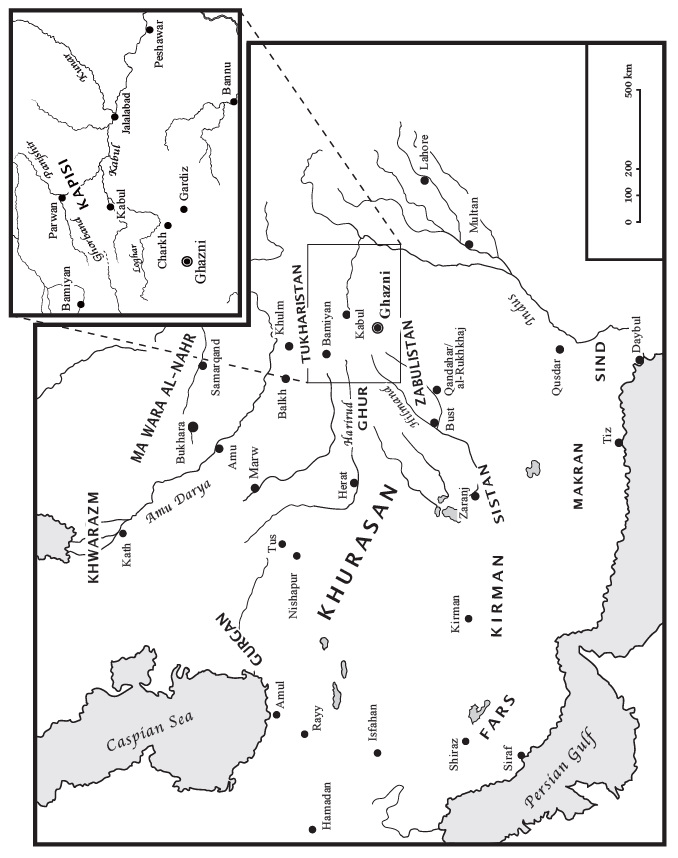
Figure 5.1 The Eastern Islamic world in the tenth century.
(2) Kabul
In or shortly after 40/660, the Arab Muslim army marched from Sistan to the north, which may have given the Turks in Kabul the opportunity to expand their rule and eventually to usurp the kingdom of the Kāpiśī dynasty which had ruled along the Kabul river as far as Gandhāra. These Turks are called the Kābulshāhs in the Islamic sources. Around 61/680, a member of the dynasty became independent in Zābulistān or Ghazna and established a kingdom whose rulers were named Rutbīl (or Zunbīl) by Muslims.20 From the Umayyad period to the Abbasids, nearly two centuries, these two kingdoms, while suffering from the intermittent attacks of the Muslims, held control of eastern Afghanistan. A significant change was brought about by the Saffarid conquest of Afghanistan in the 250s/870s. The Kābulshāhs, whose ruling family had changed from the Turkish dynasty to a ‘Hindu’ dynasty in the first half of the ninth century, had to abandon Kabul and withdraw to Gandhāra.21 Then, as mentioned above, when Alptegin attacked Kabul, the city was again under the rule of the Kābulshāh. This means that sometime in the first half of the tenth century, or maybe before, the city was retaken by the Hindūshāhs. However, judging from the continuous issuing of the Muslim coins on the southern side of the Hindukush, such as at Panjshīr, Parwān, and Bāmiyān, those places seem to have been more or less under the control of the Samanids in the first half of the tenth century. This implies that Kabul was at that time on the front line of the non-Muslim domains.22
(3) Bust/al-Rukhkhaj
Bust and al-Rukhkhaj were also incorporated into the Muslim world by the Saffarid conquest. However, after the defeat of the Saffarids by the Samanids in 287/900 and the seizure of the city of Sīstān by the latter in 299/911, Bust and al-Rukhkhaj were fought over by various powers. In 301/913–4, Faḍl b. Ḥamīd, who had been sent there by Badr b. ‘Abdullāh, the amīr of Fārs, on the Caliph’s behalf, fought with the Samanid army for rule over Bust. In the following years, Abū Yazīd Khālid b. Muḥammad, another general of the army of Fārs,23 rebelled against the Caliphate in Sistan but was eventually killed. Kathīr b. Aḥmad, a local leader and the former general of Khālid, became amīr of Sistan and ruled Bust, but he also was killed, in 306/919. In 320/932, Qarategin Isbījābī, who was another general of the Samanids and supported the revolt of Abū Zakaryā Yaḥyā against his own brother, Naṣr b. Aḥmad, the then amīr of the Samanids, fled to Bust and al-Rukhkhaj after being defeated. He himself died soon after, but his army may conceivably have remained in Bust for several more decades (see below).24
(4) Ghazna
(i) The Saffarid conquest of Ghazna
What was the condition of Ghazna, located between the two ‘Gates of India’? We know that the city was subject to a Samanid governor after the decline of the Saffarids from the fact that the Samanid garrison of Bust, reinforced from Ghazna, often fought with the army of Fārs.25 What is more interesting about this city is that, after the conquest by the Saffarids around 256/870, the city seems to have been reconstructed and renovated as a new centre for Muslim rule in eastern Afghanistan, and probably as a new bridgehead for jihāds on the Indian frontier. Gardīzī relates that the city of Ghazna had been severely destroyed by the conquest of Ya‘qūb b. al-Layth:
Then he (Ya‘qūb b. al-Layth) came from Sīstān to Bust and seized it, and from there marched against Panjwāy and Tegīnābād and attacked the Rutbīl. He employed a ruse and killed the Rutbīl, and seized Panjwāy in Rukhwad. From there he proceeded to Ghaznīn, occupied Zābulistān and razed the inner city of Ghaznīn to the ground.26
Another eleventh century chronicler, Abū l-Faḍl Bayhaqī, in his account of the flood which damaged Ghazna in 422/1031, suggests that the city was reconstructed in the reign of ‘Amr b. al-Layth, a brother and a successor of Ya‘qūb:
The water mounted and overflowed from its banks, and swept into the markets, reaching the quarter where the moneychangers lodged, inflicting much damage. The greatest calamity of all was that the torrent uprooted the entire bridge, together with the shops, from its foundations and water found its way everywhere. It also destroyed many caravanserais that were ranged along, and the markets were entirely obliterated. The waters reached the lower foundations of the citadel, which already existed before the time of Ya‘qub b. Layth; for it was ‘Amr, Ya‘qub’s brother, who restored the inner city and the citadel of Ghaznīn.27
(ii) The emergence of Ghazna/Ghaznīn
The appearance of references to the city in geographical works apparently correlated with its incorporation into the Islamic world. The table below shows whether the name of Ghazna (or Ghaznīn) is mentioned in major geographical works in Arabic and Persian written up to the eleventh century and in the major chronicles mentioning the events which occurred in eastern Afghanistan. As the table shows, there is a clear distinction between the work of Ibn Rusta, which was completed as late as 300/913, and the work of al-Iṣṭakhrī, whose earliest possible date is 318–321/930–933. We find the name of Ghazna in the works completed after al-Iṣṭakhrī, but not in the works before Ibn Rusta. This may imply that some change happened around Ghazna in that period. The descriptions of Kabul after its conquest by the Saffarids in 287/870 found in various geographical works helps to specify what this change was. Al-Iṣṭakhrī relates: ‘There is an impregnable castle in Kabul, which can be reached by only one route. Muslims are in the city. The city has a rabaḍ, where reside Indian infidels (kuffār).’28 Very similar passages are found in the works of Ibn Ḥawqal, of al-Muqaddasī, and in Ḥudūd al-‘ālam. What is described here must be the state of affairs of Kabul after the Saffarid conquest in 287/870. On the other hand, such a description of Kabul is not found in the works completed before the beginning of the tenth century. Thus, it is highly probable that the geographical works after al-Iṣṭakhrī’s depict eastern Afghanistan as it was conquered and ruled by the Saffarids, and that ‘Ghazna/Ghaznīn’ appears in those works after the Saffarid conquest. This assumption may be supported by the chronicles listed in the table, where ‘Ghazna/Ghaznīn’ only appears after the events of the end of the ninth century. In spite of their considerably detailed descriptions on the earliest Muslim invasions into this region in the second half of the seventh century, al-Balādhurī and al-Ṭabarī do not mention ‘Ghazna/Ghaznīn’ (see below). Needless to say, unlike the situation with the chronicles, it is difficult to evaluate the historical precision of the accounts of such geographical works. Also, the works listed in the table are far from being exhaustive. Nevertheless, it seems to be fairly obvious that the name ‘Ghazna/Ghaznīn’ came to appear in the principal written sources after the conquest of the Saffarids, and this must be related to the presumable renewal of it as a Muslim city by them.
This is not, of course, to imply that the name ‘Ghazna/Ghaznīn’ appeared then for the first time in history. Formerly, it had been assumed that ‘Ga(n)zaka’, which is listed as a region in Paropamisadai in Ptolemy’s Geography,30 is the oldest mention of the city Ghazna.31 This identification is based on the assumption that the word *gazn-, which is considered to have been the origin of ‘Ghazna/Ghaznīn’, derived from Old Persian *ganza- (treasure) as a result of the metathesis of -nz-/-nj- to -zn-. However, Walter B. Henning has shown that the way of the metathesis is likely to have been vice versa, namely, from -zn- to -nz-/-nj-, that the metathesis itself occurred in the Median language, and that it eventually was borrowed by Old Persian. According to him, the form with -zn- was widely distributed and observed in eastern Iranian languages, such as Parthian and Sogdian (Bactrian should be included now),32 and the form with -nz-/-nj- ‘belongs only to the western edge of the Iranian world’.33 Therefore, the identification of Ptolemy’s ‘Ga(n)zaka’ as the oldest mention of Ghazna can be doubted. Josef Marquart supposed that ‘al-Junza,’ which appears in the chronicle of al-Balādhurī as the place where the ‘Umayyad general ‘Ubaydallāh b. Zỉyād fought with the rebel troops of Kabul before or after the death of Yazīd I, is identical with ‘Ghazna.’34 As a matter of fact, it is possible that the army of ‘Ubaydallāh, which had started from Sīstān, met with the army from Kabul somewhere around Ghazna. However, unless ‘al-Junza’ was a clerical error for ‘al-Jazna’ or something similar, here also we see no good reason why the form with -nz-/-nj-, which appeared as a result of the metathesis in the remote past on the ‘western edge’, should appear as the name of Ghazna in the eastern fringe of the Iranian world in the seventh century.35
Table 5.1: Ghazna/Ghaznīn in the early Islamic sources.29
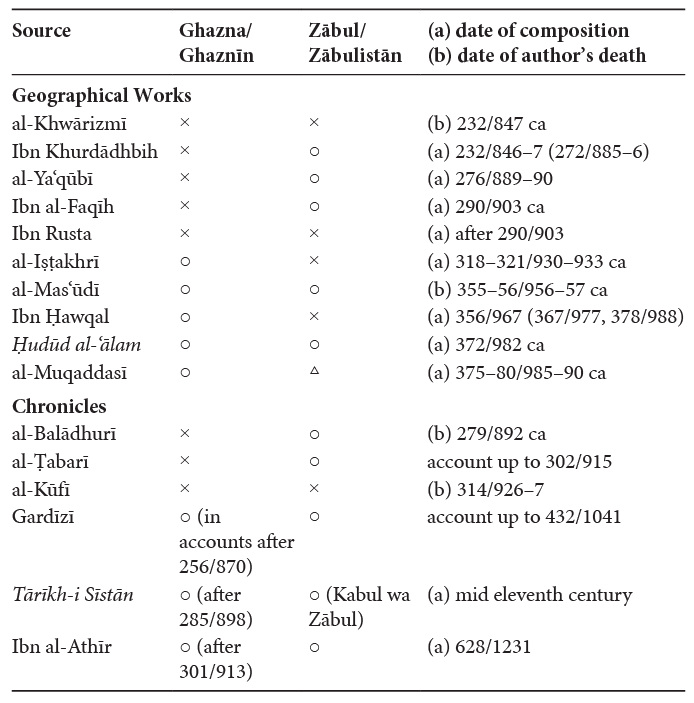
In fact, the name recorded by the Chinese Buddhist monk Xuanzang should be counted as the oldest obvious mention of ‘Ghazna/Ghaznīn’. He refers to He-xi-na (鶴悉那 *EMC: γak-sit-na < Ghazna) as a capital of the country Cao-ju-zha (漕矩 吒 *EMC: dzau-kǐu-ȶa < Zābul) in the first half of the seventh century.36 However, except for this, we have no reference to ‘Ghazna/Ghaznīn’ before the conquest of the Saffarids. Already in the Sāsānid period several coins are known to have been issued there, and several types of coins are recognised as having been issued in the time of the Rutbīl kingdom, i.e., from the second half of the seventh century to the first half of the eighth. Nevertheless, only Zābulistān (z’wlst’n) or Arachosia (lhwt’) are inscribed on those coins as mint names.37 Taking these pieces of information into account, one may assume that the city had usually been designated as Zābul/ Zābulistān before the Saffarids, and that ‘Ghazna/Ghaznīn’ was simply an epithet, or one of the epithets, of it. Presumably, the Saffarid ruler might have believed that the city, which was being renewed as a Muslim centre, should be provided with a different name, and ‘Ghazna/Ghaznīn’ was singled out from among the epithets of the city because of its auspicious meaning.38 The city came to be generally called ‘Ghazna/Ghaznīn’ from this time on up to the present day.39
(5) Entrepôts in eastern Afghanistan
The other interesting point we find in the accounts of geographical works is that the tenth century works, such as those of al-Iṣṭakhrī, of Ibn Ḥawqal, of al-Muqaddasī, and Ḥudūd al-‘ālam, especially note the prosperity of Kabul and Ghazna.
Kabul:
•There is an impregnable castle in Kabul to which leads only one road. …This place is a farḍa for India.40
•The city of Kabul has a reputed impregnable and invincible castle to which only one road leads…This city is also a farḍa for India. Trunk roads reach to the city from every direction…They sell indigo there, and with this item, the annual sales amount to more than two million dinars, according to the testimony of traders, for the product only in the city and the surrounding countryside, excluding the deposits of merchants...41
•Kabul has a populous suburb. The merchants meet in this town. It has a remarkable impregnable quhandiz. This is the land of the finest myrobalan, so prized by the people of India.42
•Kabul, a borough possessing a solid fortress known for its strength. Its inhabitants are Muslims and Indians…43 Ghazna:
•In the region of Balkh, there is no city which has more wealth and commerce than Ghazna. It is a farḍa for India.44
•In the region of Balkh and Bāmiyān, there is no city which has more wealth and commerce than Ghazna, because, though it changed after the conquest by ḥājib Alptegin and presence of his army there, it has been a farḍa for India.45
•Ghaznīn, the capital, is not big, though roomy and prosperous. Prices are low, meats plentiful, fruits excellent and abundant. There are important towns here, and the way of life is good. This is one of the mercantile towns (faraḍ) of Khurasan, one of the entrepôts (khazā’in) of al-Sind.46
•Ghaznīn, a town situated on the slope of a mountain, extremely pleasant. It lies in Hindustan and formerly belonged to it, but now is among the Muslim lands. It lies on the frontier between the Muslims and the infidels. It is a resort of merchants (jā-yi bāzargānān), and possesses great wealth.47
As for Ghazna, Ibn Ḥawqal obviously describes the state of affairs after the conquest of Ghazna by Alptegin.48 The account of the Ḥudūd al-‘ālam must imply that after the reigns of the Saffarids and the Samanids the region was once reoccupied by the non-Muslims, i.e., the Kābulshāh and the Lawīk.
We should also note the word farḍa (pl. faraḍ). This Arabic word has the meaning of ‘port, harbour.’ It appears, for instance, 24 times in al-Iṣṭakhrī’s work for the cities on shores of the seas and rivers as well as for some inland cities. Therefore, it should be translated as ‘entrepôt’ here. It is also possible to interpret it as something like the ‘port of trade’ of Karl Polanyi.49 In any case, these are at places where the cultural and political milieu changes, which may result in a temporary accu-mulation of merchandise in transit, and/or places where the geography changes and the means of transportation may need to be modified accordingly.
Kabul is called farḍa because the area around Kabul was a ‘Gate of India’. Unfortunately, we do not know how large the scale of the trans-Hindukush trade was at that time. However, we can conjecture that it endowed the city with considerable profit, judging from the vast pre-Islamic monuments around Kabul and Kāpiśī (including the huge Buddhist complex of Bāmiyān).50 As for Ghazna, which was also located on the frontier between South Asia and West Asia, it can be assumed that this city, too, was important because it was on the cultural as well as politico-military frontier between the Muslim world and Indian world from the seventh century.51 Such circumstances could have contributed to the commercial prosperity of the city as described by the geographers, and this wealth must have attracted the troops of Alptegin.
(6) Bases for a ‘venture’
Since both the Saffarids and the Samanids employed jihād to establish their legitimacy as Islamic rulers, warfare with non-Muslims would probably have been familiar to people in these eastern frontier regions, especially to those who were, or at least who endeavoured to be, good Muslims as well as good warriors. Unfortunately, we have no information about Alptegin’s personal devotion except for some conventional praise of his piousness.52 However, for Alptegin, the cities of Kabul and Ghazna under the rule of non-Muslims must have met his purposes. Both cities, being located on the border between the Islamic world and the Indian world, prospered as entrepôts and must have accumulated considerable wealth. Moreover, the mountains of the Hindukush could have been considered as a natural barrier against the pressure of the Samanids from Khurasan and Ṭukhāristān. Thus, the land to the south of the Hindukush was a kind of ideal place for the ‘venture’ of Alptegin and not only from the point of view of conducting jihāds. Though we do not know the exact reason why he chose Ghazna as his base instead of Kabul, the former could have been attractive as it had been renewed as a Muslim city by the Saffarids, although we have no trace of such renewal in the literary sources nor through the archaeological excavations so far.
3. From frontier troops to the Ghaznavids
(1) After Alptegin
Let us now look at the other story of Ghazna, from the time of the death of Alptegin until Sebüktegin, the first Ghaznavid, finally became the ruler. It is much less known than the circumstances of Alptegin’s revolt, but more significant for the purpose of this paper.
Alptegin died soon after the conquest of Ghazna, probably in the autumn of 352/963. His son, Abū Isḥāq Ibrāhīm, succeeded him.53 According to al-‘Utbī, Ibrāhīm went to the court of Bukhara accompanied by Sebüktegin and returned to Ghazna with a mandate for Ghazna bestowed by the Samanid amīr.54 Shabānkāra’ī relates that Ibrāhīm fell into disfavour with his father’s men and had to flee from the city to Bukhara. Then he returned with the mandate and reinforcements provided by the Samanid amīr, with which he successfully repelled the army of the Lawīk, the former ruler of Ghazna, who was attacking Ghazna.55 Jūzjānī explains that Ibrāhīm fled to Bukhara, driven out by the army of the Lawīk,56 while Ibn Bābā only speaks of the return of Ibrāhīm with the mandate of the Samanid amīr, without mentioning the reason for the former’s journey to Bukhara.57 Integrating these accounts, it is possible to summarise events as follows: In the reign of Ibrāhīm, Ghazna was retaken by the Lawīk, and Ibrāhīm went to Bukhara seeking aid. With a Samanid mandate and reinforcements, he could repel the Lawīk, but the course of events cast doubt upon his capability as a leader of the troops in Ghazna.58 This suggests that at that time the Muslim troops of Ghazna were still small in number and weak, surrounded by their enemies (kāfirs), and afflicted by discontent.
Ibrāhīm died around 355/966 and Bilgätegin, the former general of Alptegin, became the leader of Ghazna on account of his support from other Turkish generals.59 Shabānkāra’ī says that the city of Gardīz surrendered in his reign, while according to Ibn Bābā, Bilgätegin was killed during the siege of Gardīz by a stray arrow.60 Another Turkish general, Pīrī, succeeded him, but he was not a capable leader, and proved unable to control the Turks. The people of the city suffered much from this, and they wrote a letter to the Lawīk inviting him to come back and retake the city. As the army of the Lawīk, aided by the Hindūshāh, approached from India, the Turks of Ghazna agreed to make Sebüktegin as their commander, who then made a sally as far as Charkh, which lies midway between Kabul and Ghazna.61 After a fierce battle, the army of Ghazna succeeded in repelling the enemy. Consequently, in 366/977, Sebüktegin was enthroned as the ruler of Ghazna, marking the foundation of the Ghaznavid dynasty, which survived under his descendants until 581/1186.62
(2) Frontier troops
The movement of Alptegin and his troops from Khurasan to Ghazna was simply a search for a political refuge in a marginal area, by marginalised people, of which there are plenty of similar instances in the history of the Islamic world and elsewhere. I have discussed in previous work the anti-Abbasid refugees who sheltered in Ferghāna in Mā Warā’ al-Nahr at the beginning of the Abbasid period, and some of them even reached as far as China in search of opportunity.63 Qarategin Isbījābī, who remained at Bust with his troops, and Muḥammad b. Ilyās, who escaped to Kirmān, were more direct predecessors of Alptegin. This kind of military body is apt to become a rabble when their first leader disappears. In the case of Alptegin’s troops, there must have been many Turkish generals and officers who had been personal military slaves of Alptegin. When they lost Alptegin, the focus of their personal loyalty, they may have become out of control. This underlies why Alptegin’s son incurred the displeasure of the Turks.
As a social group, Alptegin’s troops had had no connection with the local interests of Ghazna or of eastern Afghanistan before they arrived there. This distinguishes them from both the Saffarids, whose background was among the local ‘ayyārs of Sistan, or the Samanids, who arose from the local dihqāns of Mā Warā’ al-Nahr. Alptegin and his men came to a land unknown to them, conquered the city by force, and tried to acquire new resources by force. In this respect, they can be viewed as purely professional warriors without any other means of providing for themselves than military domination. When such a body of men does not have the opportunity to engage with an enemy and obtain booty, it tends to use up the local resources of the place where it is staying. As far as we know from the sources, the conquest of Gardīz was the only remarkable military achievement by the troops of Ghazna after the death of Alptegin, which implies that the amount of resources which became newly available to them was, in fact, limited. This kind of situation may also have lain behind the estrangement of the people of Ghazna from the Turks when Pīrī was the leader of the troops.
(3) The emergence of the Ghaznavids
Qarategin Isbījābī’s troops in Bust seem to have been in a similar situation to the Turkish military in Ghazna. The former seem to have ruled Bust for nearly half a century, until Sebüktegin finally subjugated the city at the end of the 360s/970s. Why were neither they nor the Ilyāsids in Kirmān successful, while the troops of Ghazna could develop into an imperial power? The simplest and most convincing answer is that in Ghazna there appeared a highly capable leader in the person of Sebüktegin. The troops of Ghazna were able to unite against the Indian army under the leadership of Sebüktegin, which eventually led to the formation of the formidable Ghaznavid empire, in the same fashion as the Saffarids, with Ya‘qūb as their head, had developed from being a loose band of warriors into a mighty conquering army. As Bosworth has pointed out, the troops of Bust suffered both from internal strife and pressure from the Saffarids of Sistan, and could not resist the Ghaznavid attack.64 The same was true for the Ilyāsids in Kirmān, who had to confront the Buyid incursions into Kirmān, which finally resulted in the subjugation of the region by ‘Aḍud al-Dawla.65 In contrast, there is no doubt that the Ghaznavids’ success was facilitated by the decline of the Saffarids and the political break-up of the Samanids. In the reign of Sebüktegin, responding to requests for aid by the Samanids, the Ghaznavids were able to advance into Khurasan and defeat competing military factions such as the Sīmjūrids, Fā’iq, and others. In the meantime, in Mā Warā’ al-Nahr, the Samanids became enfeebled by the successive attacks of the Qarakhanids from the east, which enabled Maḥmūd, son of Sebüktegin, to inherit his father’s acquisitions in Khurasan.
An even more significant difference however might be the Ghaznavid involvement in north-western India, which constituted land previously unexploited by the Muslims. Toward this direction, they could mobilise various kinds of warriors, including volunteers and nomadic tribes.66 Through military activity on the Indian frontier, the Ghaznavids could unite some of the unruly tribal people in Afghanistan by giving them a direction to move and a pretext to fight. An example is the Khalaj. They were actually the remnants of the people who had established the kingdoms of Kabul and Zābulistān before the Saffarid conquest.67 Later, some of them were incorporated into the Ghaznavid army. As is seen in the case of Muḥammad b. Bakhtiyār, who led the Khalaj people to Bengal and allegedly gave a final blow to Buddhism there, they also played an important role in the Ghurid conquest of northern India. Even later, in 689/1290, another leader of this tribe, Jalāl al-Dīn Fīrūzshāh Khaljī, established the Khaljī dynasty in Delhi.68 Moreover, the remarkable success of the Ghaznavids in India also could have attracted other people from outside Afghanistan who sought new opportunities, which may have been one of the backdrops of the vigorous tribal migrations across the Amu Darya thereafter.
What was also important for these processes was that the Ghaznavids could secure the trunk routes towards India in the early stage of expansion. Al-Bīrūnī relates:
[Sebüktegin] preferred the holy war (ghazwa) and was surnamed with it. For his successors, he constructed several roads in order to debilitate the flanks of India. Yamīn al-Dawla Maḥmūd marched through those roads for more than thirty years.69
The two ‘Gates of India’ fell into the hands of the Ghaznavids in the reign of Sebüktegin. Kabul was finally secured when Sebüktegin won the battle against the Hindūshāh Jaypāl around 376/987.70 Bust and al-Rukhkhaj were, as stated above, subjugated by the Ghaznavids at the end of 360s/970s, and Sebüktegin (and later Maḥmūd) led expeditions to Quṣdār, in present-day Baluchistan, from this southern ‘Gate of India’.71 Through the two ‘Gates’ and the other roads between the Afghan highland and the Indus valley, the Ghaznavids could control the flow of people, merchandise, and information between South Asia and Central Asia as well as South Asia and West Asia. All of these points, of course, were intertwined with the frontier character of the early Ghaznavid state.
* * *
In essence, Alptegin, who had been defeated in the political strife within the Samanid court, had to seek a new opportunity, and therefore undertook the ‘venture’ of seizing a commercial, prosperous city, under the rule of the infidels, by conducting jihād, which was within the scope of the ethos of that period.72 In the regions to the south of the Hindukush, the base of his ‘venture’, a Muslim presence had been gradually established after the Saffarid conquest. However, most of the regions remained under the rule of non-Muslims in the mid-tenth century. In other words, the regions were located on the edge of non-Muslim lands opposed to the Muslim realm, and were potentially productive from an economic as well as politico-military viewpoint. First the defence of the city and then the acquisition of the ‘Gates of India,’ which were likely to have represented paths for success, may have given a common cause to the somewhat wayward troops of Ghazna, who were left at loose ends after the death of Alptegin. When they were combined together, the path to creating a great empire was opened.
Notes
1Jürgen Paul, The State and the Military: The Samanid Case. Papers on Inner Asia 26 (Bloomington, 1994); idem, Herrscher, Gemeinwesen, Vermittler: Ostiran und Transoxanien in vormongolischer Zeit (Beirut, 1996); D.G. Tor, ‘Privatized jihad and public order in the pre-Seljuq period: The role of the Mutatawwi‘a’, Iranian Studies xxxviii/4 (2005), pp. 555–73; eadem, Violent Order: Religious Warfare, Chivalry, and the ‘Ayyār Phenomenon in the Medieval Islamic World (Würzburg, 2007); eadem, ‘The Islamization of Central Asia in the Sāmānid era and the reshaping of the Muslim world,’ Bulletin of the School of Oriental and African Studies lxxii/2 (2009), pp. 279–99.
2For the general history of the Ghaznavids, see Wilhelm Barthold, Turkestan down to the Mongol Invasion, second edition, (Cambridge 1968); Muḥammad Nāẓim, The Life and Times of Sultān Maḥmūd of Ghazna (New Delhi, 1971 [reprint]); Clifford E. Bosworth, The Ghaznavids: Their Empire in Afghanistan and Eastern Iran, 994–1040 (Edinburgh, 1963); idem, ‘The early Ghaznavids,’ in Richard N. Frye (ed.) The Cambridge History of Iran, Vol. IV: From the Arab Invasion to the Saljuqs (Cambridge, 1975) pp. 162–97; idem, The Later Ghaznavids (Edinburgh, 1977).
3Abū Sa‘īd Gardīzī, Zayn al-Akhbār, ed. A. Ḥ. Ḥabībī, (Tehran, 1968), pp. 159–61: English translation by C. E. Bosworth, The Ornament of Histories: A History of the Eastern Islamic Lands AD 650–1041 (London and New York, 2011), pp. 65–7; Cf. Barthold, Turkestan, pp. 249–50.
4Gardīzī, Zayn al-Akhbār, p. 160 (trans., p. 66).
5Cf. Barthold, Turkestan, p. 250.
6Gardīzī, Zayn al-Akhbār, p. 161 (trans., p. 67); cf. Barthold, Turkestan, p. 250.
7Gardīzī, Zayn al-Akhbār, p. 161 (trans., p. 67).
8al-Muqaddasī, Aḥsan al-Taqāsīm fī ma‘rifat al-aqālīm, ed. M. J. de Goeje, (Leiden, 1967), p. 337: English translation by Basil Collins and M. H. Alta’i, The Best Divisions for Knowledge of the Regions (Reading, 2001), p. 274; cf. Barthold, Turkestan, p. 250.
9Gardīzī, Zayn al-Akhbār, p. 161 (trans., p. 67).
10Ibid, p. 162 (trans., p. 68); cf. Abū ‘Alī Ḥasan Niẓām al-Mulk, Siyar al-Mulūk, ed. H. Darke, (Tehran, 1976) pp. 148–50: English translation by Hubert Darke, The Book of Government or Rules for Kings, second edition, (London, 1978) p. 109–10.
11Gardīzī, Zayn al-Akhbār, pp. 161–2 (trans., pp. 67–9); Ḥamdallāh Mustawfi, Tārīkh-i Guzīda, ed. ‘A. Ḥ. Nawā’ī, (Tehran, 1984), pp. 379, 381.
12Gardīzī, Zayn al-Akhbār, p. 162 (trans., p. 68); Niẓām al-Mulk, Siyar al-Mulūk, p. 150 (trans., p. 111); Muḥammad b. ‘Alī Shabānkāra’ī, Majma‘ al-Ansāb. ed. M. H. Muḥaddith, (Tehran, 1985), p. 29; Mustawfī: Tārīkh-i Guzīda, p. 382. It is, of course, possible that some people other than ghulāms and volunteers were involved in his army.
13Niẓām al-Mulk, Siyar al-Mulūk, pp. 153–4 (trans., pp. 113–14); Shabānkāra’ī, Majma‘ al-Ansāb, pp. 30–1. ‘Abd al-Ḥayy Ḥabībī assumes that Lawīk should be read as ‘Loyak’, who was of a noble family of Ghazna from the second century and who then ruled Gardīz, too. See ‘A. Ḥ. Ḥabībī, Tārīkh-i Afghānistān ba‘d az Islām, (Tehran. 1985), pp. 31–47; cf. C. E. Bosworth, ‘Notes on the pre-Ghaznavid history of eastern Afghanistan’, The Islamic Quarterly 9 (1965), pp. 18–22.
14Barthold, Turkestan, pp. 250–1; R. N. Frye, ‘The Sāmānids,’ in R. N. Frye (ed.) The Cambridge History of Iran, Vol. IV. From the Arab Invasion to the Saljuqs (Cambridge, 1975), p. 112; cf. Abū Bakr Muḥammad Narshakhī, Tārīkh-i Bukhārā, ed. M. Riḍawī, (Tehran, 1965), p. 135: English translation by R. N. Frye, The History of Bukhara (Cambridge MA, 1954), p. 99.
15Barthold, Turkestan, p. 251. Mustawfī, Tārīkh-i Guzīda, p. 381 states: ‘In the reign of him (‘Abd al-Malik), Alptegin was the governor of Khurāsān, and incredible amount of money had been gathered by him’.
16Abū ‘Alī Chaghānī was a member of Āl-i Muhtāj, the local lord of Chaghāniyān, a region along the Surkhān Daryā river. He was appointed to the sipāhsālār of Khurāsān in 327/939 under amīr Nūḥ b. Naṣr. He revolted against the Sāmānids twice: in 333/945 when he was dismissed from the office while he was engaged in the conquest of Jibāl; in 343/954 again when Nūḥ died and his son ‘Abd al-Malik succeeded his father. Abū ‘Alī once took the complete control of Nīshāpūr, but eventually was expelled by the new sipāhsālār Bakr b. Mālik from the city. He fled to Ray to be protected by Rukn al-Dawla of the Būyids but was killed in the next year. As to the detailed career of Abū ‘Alī, see Barthold, Turkestan, pp. 246–9; C. E. Bosworth, ‘The rulers of Chaghāniyān in early Islamic times’, Iran xl (1981), pp. 4–9.
17As to the geographical setting of the Kābul basin, or the Kāpiśī/Kābul area, see for instance Alfred Foucher, La vieille route de l’Inde de Bactres à Taxila, i, Mémoires de la Délégation Archéologique Française en Afghanistan i, (Paris, 1942) pp. 29–30; ‘Kābul, i, Geography of the Province’, EIr.
18As to the site of Bust, see Jean-Claude Gardin, Lashkari Bazar II: Céramique et monnaies de Lashkari Bazar et de Bust, Mémoires de la Délégation Archéologique Française en Afghanistan VIII, (Paris, 1963), pp. 5–13; Terry Allen, ‘Notes on Bust,’ Iran xxvi (1988), pp. 55–68; idem ‘Notes on Bust (continued)’, Iran xxvii (1989), pp. 57–66; idem ‘Notes on Bust (continued)’, Iran xxviii (1990), pp. 23–30.
19Cf. Ḥudūd al-‘alām: ‘The Regions of the World’. A Persian Geography 372A.H.–982A.D., trans. V. Minorsky, second edition, (Cambridge, 1970), pp. 110, 112.
20Cf. Minoru Inaba, ‘The identity of the Turkish rulers to the south of Hindukush from the 7th to the 9th centuries A.D.’, Zinbun xxxviii (2005), pp. 1–19.
21Cf. Abdur Rahman, The Last Two Dynasties of the Śāhis (Islamabad, 1979), pp. 101–05; Inaba: ‘The identity of the Turkish rulers’.
22I will discuss this issue in detail elsewhere.
23The background of the intervention by the Abbasids in the affairs of Sīstān and the regions to the east of it, consisted in the previous conquest of Fārs by Ya‘qūb b. al-Layth in 261/875. Even after the death of Ya‘qūb and the decline of the dynasty after 287/900, the Ṣaffārids tried to retain their hold over Fārs, for which they fought several times with Sebük-eri, who had been a Turkish general of the Ṣaffārids but became semiindependent at Fārs winning the support from the caliphate. In this struggle, Sāmānid amīr Aḥmad b. Ismā‘īl (r. 907–14) participated by sending an army to the south which eventually conquered Zaranj in 911. However, when Aḥmad b. Ismā’īl died abruptly in 301/914, the Sāmānid rule over the peripheral areas of the empire seems to have been relaxed. Al-Muqtadir, the Abbasid caliph at that time, turned this into an opportunity to extend his authority as far as Sīstān and the regions beyond it. The army, which fought with the Sāmānids around Bust in 301/914, was dispatched by Badr al-Kabīr, the Abbasid governor of Fārs, for that purpose. See, C. E. Bosworth, The History of the Saffarids of Sistan and the Maliks of Nimruz (247/861 to 949/1542–3) (Costa Mesa and New York, 1994), pp. 240 ff., especially pp. 275–7.
24Ibn al-Athīr, al-Kāmil fī l-Ta‘rīkh, 13 Vols, ed. C. J. Tornberg, (Beirut, 1979), vii, pp. 79–80, 211; anonym., Tārīkh-i Sīstān, ed. Malik al-Shu‘arā’ Bahār, (Tehran, 1935), p. 326, n.1: English translation by Milton Gold, The Tārīkh-e Sistān (Rome, 1976), p. 266, n. 2.; cf. Bosworth, The History of the Saffarids, p. 305.
25Ibn al-Athīr, al-Kāmil, vii, p. 79; Tārīkh-i Sīstān, p. 304 (trans., p. 247).
26Gardīzī, Zayn al-Akhbār, p. 139 (trans., p. 47). Transliteration modified by Inaba.
27Abū al-Faḍl Bayhaqī, Tārīkh-i Bayhaqī. ed. ‘A. A. Fayyāḍ, (Mashhad, 1977), p. 342: English translation by C. E. Bosworth and M. Ashtiany, The History of Beyhaqi: The History of Sultan Mas‘ud of Ghazna, 1030–1041 by Abu’l-Fażl Beyhaqi, 3 Vols, (Boston and Washington D.C., 2011) i, pp. 367–8). Transliteration modified by Inaba.
28al-Iṣṭakhrī, al-Masālik wa al-Mamālik, ed. M. J. de Goeje, (Leiden, 1967) p. 280.
29The works referred to in the table, excluding those which are referred to in other notes, are the following (in order of appearance): al-Khwārizmī, Kitāb Ṣūrat al-‘Arḍ, ed. H. von Mzik, (Vienna, 1926); Ibn Khurdādhbih, Kitāb al-Masālik wa al-Mamālik, ed. M. J. de Goeje, (Leiden, 1967); al-Ya‘qūbī, Kitāb al-Buldān, ed. M. J. de Goeje, (Leiden, 1967); Ibn al-Faqīḥ al-Hamadānī, Kitāb al-Buldān, ed. Yūsuf al-Hādī, (Lebanon, 2009); Ibn Rusta, Kitāb al-A‘lāq al-Nafīsa, ed. M. J. de Goeje, (Leiden, 1967); al-Mas‘ūdī, Murūj al-Dhahab wa Ma‘ādin al-Jawhar, 9 Vols, ed. & trans. C. Barbier de Meynard and P. de Courteille, (Paris, 1861–77); al-Balādhurī, Futūḥ al-Buldān, ed. Ṣalāḥ al-Dīn al-Munajjid, (Cairo, 1956); al-Ṭabarī, Ta’rīkh al-Rusul wa l-Mulūk. ed. M. J. de Goeje, (Leiden, 1879–1901); al-Kūfī, Kitāb al-Futūḥ, 8 Vols in 4, (Beirut, 1986).
30Ptolemy, Claudii Ptolemaei Geographiae libri octo, ed. F. G. Wilberg, (Essen, 1838) p. 435; Claudii Ptolemaei Geographia, ed. C. F. A. Nobbe, (Leipzig, 1845) ii, p. 134.
31Cf. Émile Benveniste, ‘Le nom de la ville de Ghazna’, Journal Asiatique ccxxxvi (1935), pp. 141–3; Harold W. Bailey, ‘Asica,’ Transactions of the Philological Society (1945), pp. 1–38.
32Cf. Jonathan Lee and Nicholas Sims-Williams, ‘The antiquity and inscription of Tang-i Safedak’, Silk Road Art and Archaeology ix (2003), p. 166; N. Sims-Williams, Bactrian Documents from Northern Afghanistan Vol. II: Letters and Buddhist Texts (London, 2007), p. 205.
33Walter B. Henning, ‘Coriander’, Asia Major, New Series, x/2 (1963), pp. 195–9; cf. Ilya Gershevitch, Philologia Iranica, ed. N. Sims-Williams, (Wiesbaden, 1985), pp. 203–05.
34Josef Marquart, Ērānšahr nach der Geographie des Ps. Moses Xorenac‘i, (Berlin, 1901), p. 37.
35Alessio Bombaci, following Marquart, states that even in the Arabic sources ‘Ghazna’ was called ‘Ǵanza (Janza),’ referring to Yāqūt’s Mu‘jam al-Buldān (Alessio Bombaci, ‘Summary Report on the Italian Archaeological Mission in Afghanistan. I) Introduction to the Excavations at Ghazni’, East and West x/1–2 (1959), p. 21, but the relevant part of the source (Yāqūt al-Rūmī, Mu‘jam al-Buldān, 5 Vols, (Beirut, 1979) iii, p. 798) only has ‘Jazna,’ not ‘Janza’.
36Samuel Beal, Si-Yu-Ki: Buddhist Records of the Western World, 2 Vols, (London, 1884), ii, p. 283.
37Post-Sasanian and Arab-Sasanian coins issued in Zābulistān have been discussed by Rika Gyselen in detail. See R. Gyselen, ‘Two notes on post-Sasanian coins’, in R. Gyselen (ed.), Sources pour l’histoire et la géographie du monde iranien (224–710) (Leuven, 2009), pp. 143–72; eadem, ‘Umayyad’ Zāvulistān and Arachosia: Copper coinage and the Sasanian monetary heritage’, in M. Alram et al. (eds), Coins, Art and Chronology II: The First Millennium C. E. in the Indo-Iranian Borderlands (Vienna, 2010), pp. 219–41.
38The same could have happened in Qandahār in the end of the ninth century, too. See ‘Kandahar, iii, Early Islamic Period’, EIr.
39The name of the city appears in the Arabic sources basically as ‘Ghazna,’ and in the Persian sources as ‘Ghaznīn.’ As is mentioned above, the origin of both forms was *gazn- meaning ‘treasury’. Two different adjective suffixes -ag and -ēn were added to this stem, and they became *Ghaznag and *Ghaznēn, respectively (cf. Benveniste: ‘Le nom de la ville de Ghazna’). Under the heading ‘Ghazna,’ Yāqūt says that learned people take Ghaznīn as the correct form (Yāqūt, Mu‘jam al-Buldān, iii, p. 798). The reason why Arabic sources continued to use the form Ghazna is not known.
40Iṣṭakhrī, al-Masālik wa-l-Mamālik, p. 280.
41Ibn Ḥawqal, Kitāb Ṣūrat al-Arḍ, ed. J. H. Kramers, (Leiden, 1967), p. 450.
42al-Muqaddasī, Aḥsan al-Taqāsīm, pp. 303-04 (trans., p. 247).
43Minorsky, Ḥudūd al-‘Ālam, p. 111.
44al-Iṣṭakhrī, al-Masālik wa al-Mamālik, p. 280.
45Ibn Ḥawqal, Ṣūrat al-Arḍ, p. 450.
46al-Muqaddasī, Aḥsan al-Taqāsīm, pp. 303–04 (trans., p. 247).
47Minorsky, Ḥudūd al-‘Ālam, p. 111.
48Ibn Ḥawqal’s account on Kābul is unparalleled and significant especially for a description of the state of affairs in Kābul when Alptegin and his army crossed the Hindūkush. The geographer relates, as he witnessed, that as a result of the ‘entrance of the army with ḥājib there’ and the subsequent conflict with surrounding small principalities, the land tax and poll tax which were added to the previously fixed tribute were heavily imposed on the local people. The ḥājib appearing here is no one but Alptegin, as is obvious in Ibn Ḥawqal’s description of Ghazna (see above). Then this account may imply that Alptegin conquered Kābul at least once, though it is not clear if this happened when he first attacked Kābul or if he attacked the city again after he had conquered Ghazna. André Miquel says that Ibn Ḥawqal might have travelled to the east around 358/969 (André Miquel, ‘Ibn Ḥawḳal’, EI2, iii, pp. 786–8). Although, unfortunately, no further details are known so far, it seems that Ibn Ḥawqal’s account could well be the only contemporary record for eastern Afghanistan just after the conquest of Alptegin.
49Polanyi calls the cities such as ‘Kandahar and Ispahan’ ‘quasi ports of trade’, but without specifying the era (Karl Polanyi, ‘Ports of trade in early societies’, The Journal of Economic History xxiii/1 (1963), p. 31).
50For the economic background of the construction of the Bamiyan colossi, see Shoshin Kuwayama, Across the Hindukush of the First Millennium: A collection of the Papers (Kyoto, 2002), pp. 140–55.
51Cf. C. E. Bosworth, Sīstān under the Arabs, from the Islamic Conquest to the Rise of the Ṣaffārids (30–250/651–864) (Rome, 1968), pp. 33–7.
52For instance, see Niẓām al-Mulk, Siyar al-Mulūk, pp. 148–9 (trans., p. 104).
53Cf. Nāẓim, The Life and Times, p. 26.
54al-‘Utbī, Kitāb al-Yamīnī, 2 Vols, in Shaykh Manīnī’s al-Fatḥ al-Wahbī (Cairo, 1869), i, p. 57. Nāẓim, The Life and Times, p. 28 says that Sebüktegin became ‘Ḥajibu’l-Ḥujjāb’ of Ibrāhīm, though I could not find such description in ‘Utbī which Nāẓim refers to note 7.
55Shabānkāra’ī, Majma‘ al-Ansāb, p. 31.
56Minhāj al-Dīn Jūzjānī, Ṭabaqāt-i Nāṣirī, 2 Vols, ed. ‘A. Ḥ. Ḥabībī (Kābul, 1963), i, p. 227 (English translation by Henry G. Raverty, Ṭabaḳāt-i Nāsirī, 2 Vols, (New Delhi, 1970 [reprint]), i, pp. 71–2.
57Ibn Bābā al-Qāshānī, Kitāb Ra’s Māl al-Nadīm, in Bosworth, Later Ghaznavids, p. 134.
58Ibrāhīm apparently was a geographer as well. It is stated by Ibn Ḥawqal: ‘As is claimed by Abū Isḥāq Fārsī and Abū Isḥāq Ibrāhīm, who is the son of Alptegin, ḥājib of the Lord of Khurāsān, the empire of China covers an area of four months’ journey by three months’ journey’ (Ibn Ḥawqal, Ṣūrat al-Arḍ, p. 14). Moreover, as to the description of the people of Gog, the geographer says that no one is better informed about these people than Ibrāhīm, son of Alptegin, ḥājib of the Lord of Khurāsān (Ibn Ḥawqal, Ṣūrat al-Arḍ, p. 15). There is no doubt that Ibn Ḥawqal was personally acquainted with Ibrāhīm, who might have been a geographer. However, it is not known whether they met each other when Alptegin was in Khurāsān or when they had already moved to the south of the Hindūkush. In any case, if this means that Ibrāhīm was a person of scholarly type, it could have hindered him from appearing as a brave, heroic military leader.
59Nāẓim, The Life and Times, p. 26.
60Shabānkāra’ī, Majma‘ al-Ansāb, p. 32; Ibn Bābā, Ra’s Māl, p. 134.
61Geographically, this place forms a natural boundary between the Kabul region and the Ghazna region. There is a large pre-Islamic site called Kharwār in this region, which because of the security problem has not been duly excavated so far. Cf. Giovanni Verardi, ‘The archaeological perspective’, in G. Picco and A. Lui Palmisano (eds), Afghanistan. How much of the Past in the New Future (Gorizia, 2007), pp. 221–52.
62Shabānkāra’ī, Majma‘ al-Ansāb, pp. 31–3; Jūzjānī, Ṭabaqāt-i Nāṣirī, i, p. 227 (trans., i, pp. 71–4); Ibn Bābā, Ra’s Māl, p. 134; cf. Nāẓim, The Life and Times, pp. 26–7; Rahman, The Last Two Dynasties, p. 128. ‘Utbī, al-Yamīnī, i, p. 57, however, states that Sebüktegin was elected to the leader of the troop first, because there was no one in Alptegin’s descendants to succeed the throne and Sebüktegin was a preeminent in many virtues. Thereafter, he engaged in the jihād against India.
63M. Inaba, ‘Arab soldiers in China at the time of the An-Shi Rebellion’, The Memoirs of the Research Department of the Toyo Bunko lxviii (2010), pp. 35–61.
64Cf. Bosworth, The History of the Saffarids, p. 305.
65Cf. C. E. Bosworth, ‘The Banū Ilyās of Kirmān (320–57/932–68)’, in C. E. Bosworth (ed.), Iran and Islam. In Memory of the Late Vladimir Minorsky (Edinburgh, 1971), pp. 107–24.
66Cf. Bosworth, The Ghaznavids, pp. 107–14.
67Cf. Inaba, ‘The identity of the Turkish rulers’.
68Cf. Vladimir Minorsky, ‘The Turkish dialect of the Khalaj’, Bulletin of the School of Oriental Studies, x/2 (1940), pp. 417–37; Peter Jackson, The Delhi Sultanate: A Political and Military History (Cambridge, 1999), chap. 4 & 9. One hundred years after the decline of the Khaljī dynasty, a ruler with the name Muḥammad Shāh Khaljī appeared in the kingdom of Mālwā, and his family continued until 937/1531 when Mālwā was conquered by the Sultan of Gujarāt (cf. Upendra N. Day, ‘Malwa’, in M. Habib and K. A. Nizami (eds), A Comprehensive History of India, Vol. 5, second edition, (New Delhi, 1993), pp. 907 ff.).
69al-Bīrūnī, Taḥqīq mā lil-Hind, (Beirut, 1983) p. 19: English translation by Eduard C. Sachau, Alberuni’s India, 2 Vols, (New Delhi, 1983 [reprint]), i, p. 23.
70Cf. Nāẓim, The Life and Times, pp. 29–30. See also note 48 above.
71Cf. Nāẓim, The Life and Times, pp. 29, 74.
72See Tor, ‘The Islamization of Central Asia’, especially pp. 297–8.
Bibliography
Allen, Terry, ‘Notes on Bust’, Iran xxvi (1988), pp. 55–68.
Allen, Terry, ‘Notes on Bust (continued)’, Iran xxvii (1989), pp. 57–66.
Allen, Terry, ‘Notes on Bust (continued)’, Iran xxviii (1990), pp. 23–30.
Bailey, Harold W., ‘Asica’, Transactions of the Philological Society (1945), pp. 1–38.
al-Balādhurī, Futūḥ al-Buldān, ed. Ṣalāḥ al-Dīn al-Munajjid, (Cairo, 1956).
Barthold, Wilhelm, Turkestan down to the Mongol Invasion, second edition, (Cambridge 1968).
Bayhaqī, Abū al-Faḍl, Tārīkh-i Bayhaqī, ed. A. A. Fayyāḍ, (Mashhad, 1977).
Beal, Samuel, Si-Yu-Ki: Buddhist Records of the Western World, 2 Vols, (London, 1884).
Benveniste, Émile, ‘Le nom de la ville de Ghazna’, Journal Asiatique ccxxxvi (1935), pp. 141–3.
al-Bīrūnī, Taḥqīq mā lil-Hind (Beirut, 1983).
Bombaci, Alessio, ‘Summary report on the Italian archaeological mission in Afghanistan. I) Introduction to the excavations at Ghazni’, East and West x/1–2 (1959), 3–22.
Bosworth, C. E., ‘Notes on the pre-Ghaznavid history of Eastern Afghanistan’, The Islamic Quarterly ix (1965), pp. 18–22.
Bosworth, C. E., Sīstān under the Arabs, from the Islamic Conquest to the Rise of the Saffarids (30–250/651–864) (Rome, 1968).
Bosworth, C. E., ‘The Banū Ilyās of Kirmān (320–57/932–68)’, in C. E. Bosworth (ed.), Iran and Islam. In Memory of the Late Vladimir Minorsky (Edinburgh, 1971), pp. 107–24.
Bosworth, C. E., The Ghaznavids: Their Empire in Afghanistan and Eastern Iran, 994–1040 (Edinburgh, 1963).
Bosworth, C. E., ‘The early Ghaznavids’, in Richard N. Frye (ed.), The Cambridge History of Iran, Vol. IV: From the Arab Invasion to the Saljuqs (Cambridge, 1975), 162–97.
Bosworth, C. E., The Later Ghaznavids (Edinburgh, 1977).
Bosworth, C. E., ‘The rulers of Chaghāniyān in early Islamic times’, Iran xl (1981), pp. 4–9.
Bosworth, C. E., The History of the Saffarids of Sistan and the Maliks of Nimruz (247/861 to 949/1542–3) (Costa Mesa & New York, 1994).
Bosworth, C. E., The Ornament of Histories: A History of the Eastern Islamic Lands AD 650–1041 (London & New York, 2011).
Bosworth, C. E., and M. Ashtiany, The History of Beyhaqi: The History of Sultan Mas‘ud of Ghazna, 1030–1041 by Abu’l-Fażl Beyhaqi, 3 Vols, (Boston & Washington D.C., 2011).
Day, Upendra N., ‘Malwa’, in M. Habib and K. A. Nizami (eds), A Comprehensive History of India, Vol. 5, second edition, (New Delhi, 1993).
Foucher, Alfred, La vieille route de l’Inde de Bactres à Taxila, Vol. 1, Mémoires de la Délégation Archéologique Française en Afghanistan, (Paris, 1942).
Frye, R. N., The History of Bukhara (Cambridge MA, 1954).
Frye, R. N., ‘The Samanids’, in R. N. Frye (ed.), The Cambridge History of Iran, Vol. IV: From the Arab Invasion to the Saljuqs (Cambridge, 1975).
Gardin, Jean-Claude, Lashkari Bazar II: Céramiques et monnaies de Lashkari Bazar et de Bust, Mémoires de la Délégation Archéologique Française en Afghanistan, xviii (Paris, 1963), pp. 5–13.
Gardīzī, Abū Sa‘īd, Zayn al-Akhbār, ed. ‘Abd al-Ḥayy Ḥabībī, (Tehran, 1968).
Gershevitch, Ilya, Philologia Iranica, ed. N. Sims-Williams, (Wiesbaden, 1985).
Gold, Milton, The Tārīkh-e Sistān (Rome, 1976).
Gyselen, Rika, ‘Two notes on post-Sasanian coins’, in Rika Gyselen (ed.), Sources pour l’histoire et la géographie du monde iranien (224–710) (Leuven, 2009), pp. 143–72.
Gyselen, Rika., ‘“Umayyad” Zāvulistān and Arachosia: Copper coinage and the Sasanian monetary heritage’, in M. Alram et al. (eds), Coins, Art and Chronology II: The First Millennium C. E. in the Indo-Iranian Borderlands (Vienna, 2010), pp. 219–41.
Ḥabībī, ‘Abd al-Ḥayy, Tārīkh-i Afghānistān ba‘d az Islām (Tehran. 1985).
Henning, Walter B., ‘Coriander’, Asia Major, New Series, x/2 (1963), pp. 195–9.
Ḥudūd al-‘alām: ‘The Regions of the World’. A Persian Geography 372A.H.–982A.D., trans. V. Minorsky, second edition, (Cambridge, 1970).
Ibn al-Athīr, al-Kāmil fī l-Ta’rīkh, ed. C. J. Tornberg, 13 vols, (Beirut, 1965–7).
Ibn al-Faqīḥ al-Hamadānī, Kitāb al-Buldān, ed. Yūsuf al-Hādī, (Lebanon, 2009).
Ibn Ḥawqal, Kitāb Ṣūrat al-Arḍ, ed. J. H. Kramers, (Leiden, 1967).
Ibn Khurdādhbih, Kitāb al-Masālik wa-l-Mamālik, ed. M. J. de Goeje, (Leiden, 1967).
Ibn Rusta, Kitāb al-A‘lāq al-Nafīsa, ed. M. J. de Goeje, (Leiden, 1967).
Inaba, Minoru, ‘The identity of the Turkish rulers to the south of Hindukush from the 7th to the 9th Centuries A.D.’, Zinbun xxxviii (2005), pp. 1–19.
Inaba, Minoru, ‘Arab soldiers in China at the time of the An-Shi rebellion’, The Memoirs of the Research Department of the Toyo Bunko lxviii (2010), pp. 35–61.
al-Iṣṭakhrī, al-Masālik wa al-Mamālik, ed. M. J. de Goeje, (Leiden, 1967).
Jackson, Peter, The Delhi Sultanate: A Political and Military History (Cambridge, 1999).
al-Jūzjānī, Minhāj al-Dīn, Ṭabaqāt-i Nāṣirī, 2 Vols, ed. A. Ḥ. Ḥabībī, (Kabul, 1963); trans. Henry G. Raverty, Ṭabaḳāt-i Nāsirī, 2 Vols, (New Delhi, 1970 [reprint]).
al-Khwārizmī, Kitāb Ṣūrat al-Arḍ, ed. H. von Mzik, (Vienna, 1926).
al-Kūfī, Kitāb al-Futūḥ, 8 Vols in 4, (Beirut, 1986).
Kuwayama, Shoshin, Across the Hindukush of the First Millennium: A Collection of the Papers (Kyoto, 2002).
Lee, Jonathan and Nicholas Sims-Williams, ‘The antiquity and inscription of Tang-i Safedak’, Silk Road Art and Archaeology ix (2003), pp. 159–84.
Marquart, Josef, Ērānšahr nach der Geographie des Ps. Moses Xorenac‘i (Berlin, 1901).
al-Mas‘ūdī, Murūj al-Dhahab wa Ma‘ādan al-Jawhar, ed. & trans. C. Barbier de Meynard and P. de Courteille, 9 Vols, (Paris, 1861–77).
Minorsky, Vladimir, ‘The Turkish dialect of the Khalaj’, Bulletin of the School of Oriental Studies x/2 (1940), pp. 417–37.
Miquel, André, ‘Ibn Ḥawḳal’, EI2, iii, pp. 786–8.
al-Muqaddasī, Aḥsan al-Taqāsīm fī ma‘rifat al-aqālīm, ed. M. J. de Goeje, (Leiden, 1967); trans. B. Collins and M. Alta’i, The Best Divisions for Knowledge of the Regions (Reading, 2001).
Mustawfi, Ḥamdullāh, Tārīkh-i Guzīda, ed. A. Ḥ. Nawā’ī, (Tehran, 1984).
Narshakhī, Abū Bakr Muḥammad, Tārīkh-i Bukhara, ed. M. Riḍawī, (Tehran, 1965).
Nāẓim, Muḥammad, The Life and Times of Sultān Maḥmūd of Ghazna (New Delhi, 1971 [reprint]).
Niẓām al-Mulk, Abū ‘Alī Ḥasan, Siyar al-Mulūk, ed. H. Darke, (Tehran, 1976); trans. H. Darke, The Book of Government or Rules for Kings, second edition (London, 1978).
Nobbe, C. F. A. (ed.), Claudii Ptolemaei Geographia (Leipzig, 1845).
Paul, Jürgen, The State and the Military: The Samanid Case, Papers on Inner Asia 26, (Bloomington, 1994).
Paul, Jürgen, Herrscher, Gemeinwesen, Vermittler: Ostiran und Transoxanien in vormongolischer Zeit (Beirut, 1996).
Polanyi, Karl, ‘Ports of trade in early societies’, The Journal of Economic History xxiii/1 (1963), 30–45.
Ptolemy, Claudii Ptolemaei Geographiae libri octo, ed. F. G. Wilberg, (Essen, 1838).
Rahman, Abdur, The Last Two Dynasties of the Śāhis (Islamabad, 1979).
Sachau, Eduard C. (trans.), Alberuni’s India, 2 Vols, (New Delhi, 1983 [reprint]).
Shabānkāra’ī, Muḥammad b. ‘Alī, Majma‘ al-Ansāb, ed. M. H. Muḥaddith, (Tehran, 1985).
Sims-Williams, N., Bactrian Documents from Northern Afghanistan II: Letters and Buddhist Texts (London, 2007).
al-Ṭabarī, Ta’rīkh al-Rusul wa al-Mulūk, ed. M. J. de Goeje, (Leiden, 1879–1901).
Tārīkh-i Sīstān, ed. Malik al-Shu‘arā’ Bahār, (Tehran, 1935).
Tor, D. G., ‘Privatized jihad and public order in the pre-Seljuq period: The role of the Mutatawwi‘a’, Iranian Studies xxxviii/4 (2005), 555–73.
Tor, D. G., Violent Order: Religious Warfare, Chivalry, and the ‘Ayyār Phenomenon in the Medieval Islamic World (Istanbul, 2007).
Tor, D. G., ‘The Islamization of Central Asia in the Samanid era and the reshaping of the Muslim world’, Bulletin of the School of Oriental and African Studies lxxii/2 (2009), 279–99.
al-‘Utbī, Kitāb al-Yamīnī, 2 Vols, in Shaykh Manīnī, al-Fatḥ al-Wahbī (Cairo, 1869).
Verardi, Giovanni, ‘The archaeological perspective’, in G. Picco and A. Lui Palmisano (eds), Afghanistan. How Much of the Past in the New Future (Gorizia, 2007), 221–52.
al-Ya‘qūbī, Kitāb al-Buldān, ed. M. J. de Goeje, (Leiden, 1967).
Yāqūt al-Rūmī, Mu‘jam al-Buldān, 5 vols, (Beirut, 1979).