140
713–95/1314–93
Southern and western Persia
|
⊘ 713/1314 |
Muḥammad b. Muẓaffar Sharaf al-Dīn, Mubāriz al-Dīn, d. 765/1363 |
|
⊘ 759/1358 |
Shāh-i Shujā‘ b. Muḥammad Mubāriz al-Dīn, Abu ’l-Fawāris Jamāl al-Dīn, first reign |
|
⊘ 765/1364 |
Shāh Maḥmūd b. Muḥammad Mubāriz al-Dīn, Quṭb al-Dīn, d. 776/1375 |
|
767/1366 |
Shāh-i Shujā‘, second reign |
|
⊘ 786/1384 |
Zayn al-‘Ābidīn ‘Alī b. Shāh-i Shujā‘, Mujāhid al-Dīn |
|
789/1387 |
|
|
⊘ 793–5/1391–3 |
Shāh Manṣūr b. Shāh Muẓaffar |
|
795/1393 |
Tīmūrid conquest |
|
before 810/1407 |
|
|
or 812/1409 |
Sulṭān Mu‘taṣim b. Zayn al-‘Abidīn, attempted to seize Iṣfahān |
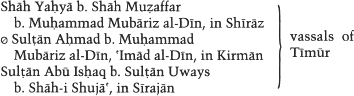
The Muẓaffarids, distantly of Khurasanian Arab origin, rose to power in Kirman, Fars and ‘Irāq-i ‘Ajam or Jibāl as the Il Khānid empire declined. Sharaf al-Dīn Muẓaffar was in the service of the Mongols, and was appointed by the Il Khān Ghazan to be commander of 1,000, with military and police duties in southern Persia. His son Mubāriz al-Dīn Muḥammad was the second founder of the dynasty. From a base at Yazd, during the chaos attendant on Abū Sa‘d’s death he expanded his possessions into Fars after protracted strugles with the Inju‘id Abū Isḥāq (see below, no. 141). A marriage to the daughter of the last Qutlugh Khānid ruler of Kirman (see above, no. 105) brought that province to him. By 758/1356 he was undisputed master of Fars and Iraq, and was tempted into invading Azerbaijan, where he captured Tabriz (Tabrīz) but was unable to hold on to it. Muḥammad was deposed by his own son Shāh-i Shujā‘, but Shāh Shuja‘ was involved in disputes with his brother Shāh Maḥmūd, governor in Iṣfahān, until the latter’s death. Shāh Maḥmūd had sought the help of the Muẓaffarids’ old enemies, the Jalāyirids (see below, no. 142), and, when he had at last secured Iṣfahān, Shāh-i Shujā‘ led an expedition into Azerbaijan against the Jalāyirid Ḥusayn b. Uways. But the shadow of Tīmūr was now falling across Persia. Shāh-i Shujā‘ hastened to submit to the great conqueror. His successors, however, were less circumspect. Before his death in 786/1384 Shāh-i Shujā‘ had divided his Kirman and Fars dominions among his relatives, and dynastic disputes were now fatally to weaken the dynasty. In Fars, Zayn al-‘Ābidīn ‘Alī submitted at first to Tīmūr, but Tīmūr later sacked Iṣfahān after his tax-collectors there had been killed in a popular uprising. The last Muẓaffarid, Shāh Manṣūr, was ruler over all Fars and Iraq when Timūr in 795/1393 resolved to extinguish the independent powers of western Persia; Shāh Manṣūr was killed in battle and most of the surviving Muẓaffarids massacred.
Although much of the Muẓaffarid period was racked by family strife, they were nevertheless patrons of such great figures as the poet Ḥāfiẓ and the theologian ‘ Aḍud al-Dīn Ījī, so that their cultural significance well outweighs their mediocre political aptitudes.
Justi, 460; Lane-Poole, 249–50; Zambaur, 254; Album, 48–9.
EI2 ‘Muẓaffarids’, ‘Shāh-i Shudiā’ (P. Jackson).
H. R. Roemer, ‘The Jalayirids, Muẓaffarids and Sarbadārs’, in The Cambridge History of Iran. VI. The Timurid and Safavid Periods, Cambridge 1986, 11–16, 59–64.