151
1193–1344/1779–1925
Persia
|
|
|
|
⊘ 1193/1779 |
Agha Muḥammad b. Muḥammad Ḥasan, ruler in northern and central Persia, after 1209/1794 ruler in southern Persia also, after 1210/1796 ruler in Khurasan also |
|
⊘ 1212/1797 |
Fath ‘Alī b. Ḥusayn Qulī, Bābā Khān |
|
⊘ 1250/1834 |
Muḥammad b. ‘Abbās Mīrzā b. Fatḥ ‘Alī |
|
⊘ 1264/1848 |
Nāṣir al-Dīn b. Muḥammad |
|
⊘ 1313/1896 |
Muẓaffar al-Dīn b. Nāṣir al-Dīn |
|
⊘ 1324/1907 |
Muḥammad ‘Alī b. Muẓaffar al-Dīn, d. 1343/1925 |
|
⊘ 1327–44/1909–25 |
Aḥmad b. Muḥammad ‘Alī, d. 1347/1929 |
|
1344/1925 |
Succession of the Pahlawīs |
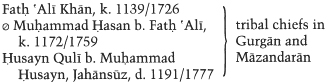
The Qājār tribe of Türkmens had probably been settled near Astarābād in the Caspian coastlands since Mongol times; later, they were one of the seven great Türkmen tribes supporting the early Ṣafawids and comprising the Qïzïl Bash. With the disintegration of the Ṣafawid empire in the early eighteenth century, the Qājārs began to play a more-than-local part in Persian affairs. The chiefs of the Qoyunlu clan of the Qājārs expanded across northern Persia in an endeavour to take over Nādir Shāh’s western territories, but it was not until 1209/1794 that Agha Muḥammad was finally victorious over the Zands (see above, no. 150); soon afterwards, Persian suzerainty was re-established, albeit temporarily, over Georgia, and the last Afshārid removed from Khurasan (see above, no. 149). The frightful Agha Muḥammad, whose excesses are doubtless in part explicable by the fact that, as a boy, he had been castrated by Nādir’s nephew ‘Ādil Shāh, was thus the founder of the dynasty under which Persia was to move definitely into the modern world, acquiring an important strategic and economic rôle in the international states-system. It was also under the first Qājār Shāh that Tehran (Tihrān), previously a town of only modest importance, became the capital (1200/1786); in this way began the movement of all life towards the centre which has characterised modern Persia.
Regular diplomatic relations with the European powers date from Fath ‘Alī Shāh’s reign, when Persia was courted by Britain on one side and by Napoleonic France on the other on account of her strategic position across the routes to the East. A by-product of this attention from the West was the introduction of European techniques and training into the Persian army. This was all the more necessary for Persia in that, during the nineteenth century, Imperial Russia, advancing now into the Caucasus and into Central Asia, was a continuing threat; by the humiliating Treaty of Turkmanchay in 1243/1828, Persia had had to relinquish all claims to territories in eastern Armenia and the Caucasus and had had to facilitate Russian commercial penetration of Persia. For their part, the Qājārs were for long reluctant to renounce the heritage of eastern conquests made by the Ṣafawids and by Nādir, and disputes with Afghanistan continued until the later nineteenth century (see below, no. 180).
Through the mutual rivalries of the European powers and the astuteness of Nāṣir al-Dīn Shāh, the geographically-compact land of Persia was much more successful than the disparate Ottoman empire in maintaining its territorial integrity. Nevertheless, the cost of warfare and royal extravagance were plunging the nation deeply into foreign indebtedness, thereby increasing the economic stranglehold of the European creditor nations. During the reign of Muẓaffar al-Dīn Shāh, there arose a movement demanding some degree of political liberalism and the granting of a constitution, demands which had to be met in 1906. The prestige and power of the Qājārs were now perceptibly failing. During the First World War, Persia remained officially neutral, but despite this, Turkish, Russian and British troops fought over her soil, and, at the end of the war, various local rebellions and separatist movements arose in the provinces. Accordingly, it was not difficult for a decisive military leader like Riḍā Khān to get the National Assembly to depose the Qājārs in 1925 (see below, no. 152).
Lane-Poole, 260; Zambaur, 261–3; Album, 59–61.
EI2 ‘Kādjār’ (A. K. S Lambton).
Gavin R. G. Hambly, ‘Āghā Muḥammad Khān and the establishment of the Qājār dynasty’, idem, ‘Iran during the reigns of Fath ‘Alī Shāh and Muḥammad Shāh’, and Nikki Keddie and Mehrdad Amanat, ‘Iran under the later Qājārs, 1848–1922’, in The Cambridge History of Iran, VII, 104–212, with a genealogical table at p. 962.