154
1007–1160/1599–1747
Transoxania and northern Afghanistan
|
⊘ 1007/1599 |
Jānī Muḥammad b. Yār Muḥammad |
|
⊘ 1012/1603 |
Bāqī Muḥammad b. Jānī Muḥammad |
|
⊘ 1014/1605 |
Walī Muḥammad b. Jānī Muḥammad |
|
⊘ 1020/1611 |
Imām Qulī b. Dīn Muḥammad b. Jānī Muḥammad as Great Khān in Transoxania, with Nadhr Muḥammad b. Dīn Muḥammad as lesser Khān in Balkh |
|
1055–61/1645–51 |
Nadhr Muḥammad, as ruler of the reunited khanate, then in Balkh only |
|
1061/1651 |
‘Abd al-‘Azīz b. Nadhr Muḥammad, Khān in Transoxania only, after Great Khān, with Ṣubḥān Qulī b. Nadhr Muḥammad as lesser Khān in Balkh |
|
1092/1681 |
Ṣubḥān Qulī as ruler of the reunited khanate |
|
1114/1702 |
‘Ubaydallāh b. Ṣubhān Quli |
|
⊘ 1123–60/1711–47 |
Abu ’1-Fayḍ b. Ṣubḥān Qulī |
|
1160/1747 |
De facto transfer of power to the Mangïts |
|
(1160–c. 1163/ |
|
|
1747–c. 1750 |
|
|
1164–5/1751–2 |
|
|
⊘ after 1172/1758 |
|
It was a Toqay Temürid force which killed the last Abu ’1-Khayrid Pīr Muḥammad (see above, no. 153). This group, under the leadership of Jānī Muḥammad, descendant of a prince from the ruling house of Astrakhan (see above, no. 131) (whence the name of Ashtarkhānids given to the family which was now to rule in Transoxania and the lands along the upper Oxus), then assumed the khanate for itself, with the general acquiescence of the Özbeg amīrs of Transoxania and Balkh, who regarded its members as being suitable continuers of the Chingizid system. Members of the Jānī Begid family of the Abu’l-Khayrids were elbowed aside. As in previous régimes, appanages were distributed to princes of the new ruling family; but for two considerable stretches during the seventeenth century, there was something like a double khanate system, with one brother in Transoxania as Great Khān and another brother in Balkh as lesser Khān. The Khāns in Bukhara had to preserve their authority against internal elements such as the Qazaqs and external powers like the ‘Arabshāhids of Khwārazm (see above, no. 153), activist and aggressive in the mid-seventeenth century under Abu ’1-Ghāzī and his son Anūsha Muḥammad, while those in Balkh were involved in relations with the Ṣafawids and the Mughals.
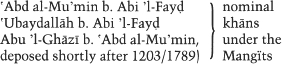
Latterly, the rise of powerful Özbeg chiefs and the ravages of the Qazaqs led to a serious decline in order and prosperity in Transoxania. After the death of the last powerful and significant Jānid ruler, Ṣubḥān Qulī, real political power at Bukhara fell more and more into the hands of the Khāns’ Atalïq or Chief Minister Muḥammad Ḥakim Biy Mangït and his son, and it was from the Mangïts that the ultimate line of Khāns of Bukhara was to arise (see below, no. 155). But at least two puppet khāns from the Jānid family were retained by the Mangïts after Abu ’1-Fayd b. Subḥān Qulī’s time (sc. after 1160/1747), and such fainéants seem to have continued on the throne at Bukhara until almost the end of the eighteenth century.
Lane-Poole, 274–5; Zambaur, 273; Album, 63.
EI2 ‘Djānids’ (B. Spuler); EIr ‘Central Asia. VI. In the 10th–l2th/16th–18th centuries’ (Robert D. McChesney). ‘VII. In the 12th–13th/18th–19th centuries’ (Y. Bregel).
Hélène Carrére d’Encausse, Islam and the Russian Empire. Reform and Revolution in Central Asia, London 1988, with a list of the rulers in Bukhara at p. 193.