20
916–1069/1510–1659
Morocco
|
916/1510 |
Muḥammad I b. ‘Abd al-Raḥmān, Abū ‘Abdallāh al-Qā’im al-Mahdī, in the Sūs |
|
923/1517 |
Aḥmad al-A‘raj b. Muḥammad al-Mahdī, north of the Atlas, then in Marrakech after 930/1524 until 950/1543 |
|
⊘ 923/1517 |
Maḥammad al-Shaykh b. Muḥammad al-Mahdi, Abū ‘Abdallāh al-Mahdī al-Imām, in the Sūs, then in Marrakech after 950/1543, and then in Fez after 956/1549 as sole Sa‘dī ruler in Morocco |
|
⊘ 964/1557 |
‘Abdallāh b. Maḥammad al-Shaykh, Abū Muḥammad al-Ghālib |
|
⊘ 981/1574 |
Muḥammad II b. ‘Abdallāh, al-Mutawakkil al-Maslūkh |
|
⊘ 983/1576 |
‘Abd al-Malik b. Maḥammad al-Shaykh, Abū Marwān |
|
⊘ 986/1578 |
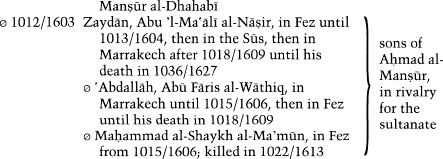
Aḥmad b. Maḥammad al-Shaykh, Abu ’l-‘Abbās al-Manṣūr al-Dhahabī |
|
|
|
|
⊘ 1015/1606 |
‘Abdallāh b. Maḥammad al-Shaykh al-Ma’mūn, al-Ghālib, at first in Marrakech, then after 1018/1609 in Fez until his death in 1032/1623 |
|
⊘ 1032/1623 |
‘Abd al-Malik b. Maḥammad al-Shaykh, al-Mu‘taṣim, in Fez until 1036/1627 |
|
⊘ 1036/1627 |
‘Abd al-Malik b. Zaydān al-Nāṣir, Abū Marwān, successor to his father in Marrakech until his death in 1040/1631 |
|
⊘ (1037–8/1628–9 |
Aḥmad b. Zaydān al-Nāṣir, Abu ’l-‘Abbās, claimant) |
|
⊘ 1040/1631 |
Muḥammad al-Walīd b. Zaydān al-Nāṣir, in Marrakech |
|
⊘ 1045/1636 |
Maḥammad al-Shaykh al-Aṣghar or al-Ṣaghīr b. Zaydān al-Nāṣir, in Marrakech |
|
1065/1655 |
Aḥmad al-‘Abbās b. Maḥammad al-Shaykh al-Aṣghar |
|
1069–79/1659–68 |
Power in Morocco divided between the Filālī or ‘Alawī Sharīfs of Tafilalt and the Dilā’ī marabouts of the Atlas |
From mediaeval times onwards, the Shorfā of Morocco (classical form Shurafā’, sing. Sharīf) have played an outstanding part in the country’s history. The Maghrib has often been receptive to the leadership of messianic or charismatic figures, and some of the most characteristic forms of popular Islam there have been the cult of holy men, saints and marabouts (<murābit< i="">: see above, no. 14) and the formation of religious fraternities organised round the religio-military centres of the zāwiyas. The strength of maraboutism and the rise to social preeminence of the Shorfā have been especially characteristic of Moroccan Islam, for Morocco, with its Mediterranean and Atlantic seaboards and its proximity to Spain and Portugal, bore the brunt of crusading Christian naval and military attacks from the thirteenth century onwards, provoking a Muslim reaction of commensurate intensity.</murābit<>
The Sharīfs are the descendants in general of the Prophet Muḥammad, but in Morocco most of the lines of Shorfā have traced their descent from the Prophet’s grandson al-Ḥasan b. ‘Alī, and the Sa‘dids and their successors the ‘Alawīs or Filālīs (see below, no. 21) claimed descent thus, specifically via al-Ḥasan’s grandson Muḥammad b. ‘Abdallāh, called al-Nafs al-Zakiyya ‘the Pure Soul’ (killed at Medina in 145/767). The Idrīsids (see above, no. 8) were the first line of Sharīfs to achieve power in Morocco, but in ensuing centuries various Berber dynasties from the Midrārids and Almoravids onwards (see above, nos 10, 14) dominated the history of the land. However, the chance of the Shorfā came in the sixteenth century when the power of the Berber Waṭṭāsids of Fez (see above, no. 19) was clearly waning. From a base in the Sūs of southern Morocco, the Sa‘did line of Shorfā – who had been quietly consolidating their position in southern Morocco for some two centuries – gradually extended northwards, seizing Marrakech in 930/1524 and Fez from the last Waṭṭāsids in 956/1549.
The full titles of the founder of the line’s fortunes, Sīdī Muḥammad al-Mahdī al-Qā’im bi-amr Allāh, show how messianic expectations in Morocco and feelings of religious exaltation and jihād against the Christians were utilised by the early Sa‘dīs. Their authority was now imposed over almost the whole of Morocco, and the Bilād al-Makhzan, or area where the sultan’s writ ran and from which taxation and troops were raised, reached its maximum extent. In the east, the Sa‘dids had a determined enemy in the Turks of Algiers, who aimed at extending Ottoman suzerainty over as much of the Maghrib as possible. Hence the Sa‘dids did not hesitate in the sixteenth century to ally with powers like Spain and Navarre against the Turks, but a long-term aim of theirs was ejection of the Portuguese from their presidios or garrison towns on the Atlantic coast. Under the greatest ruler of the dynasty, Mawlāy Aḥmad al-Manṣūr, trading relations were established with Christian powers as far afield as England, with the Barbary Company receiving commercial privileges within Morocco. But his greatest achievement was a vast expansion southwards in 999/1590 through the Sudan to the Niger valley, defeating the local ruler or Askia of Gao (in modern Mali) and extending Moroccan dominion over the Sāhil and Savannah belt of West Africa from Senegal to Bornu. The gold which now accrued to al-Manṣūr from the Sudan earned him his further honorific of al-Dhahabī ‘the Golden One’, while control of the salt-pans of the Western Sahara brought further economic benefits to Morocco. The social and fiscal privileges of the Shorfā were now further consolidated and confirmed by each new sultan on his accession, and it was the Shorfā also who, at this time, played a leading role in the formation of a Moroccan feeling, strongly xenophobic and imbued with feelings of jihād, and concerned to preserve the land against Christian and Turkish encroachments.
However, in the early seventeenth century the Sa‘dids were rent by succession disputes, with anarchy over much of Morocco and with various local adventurers and marabouts striving for power. The last Sharīfs tended to be confined to the Marrakech region, and, despite help at times from outside powers like the English and Dutch, the Sa‘dids disappeared in 1069/1659 as the authority of the ‘Alawī or Filālī Sharīfs of Tafilalt (see below, no. 21) rose pari passu with their decline and finally displaced them.
It should be noted that the honorific title Mawlāy ‘My Lord’ was frequently borne by and prefixed to the names of the Sharīfī sultans, both Sa‘dī and Filālī, with the exception of those who were called Muḥammad and were therefore called Sayyidī/Sīdī (with the same meaning), although the variant form Maḥammad (colloquial form M’ḥammed, used in the Maghrib with a hope of sharing in the baraka or charisma attached to the Prophet’s name without risk of the original form Muḥammad being profaned in any way) did not exclude the usage of Mawlāy.
Lane-Poole, 60–2; Zambaur, 81 and Table C; Album, 18.
EI1‘Shorfā’’ (E. Lévi-Provençal); El2‘Hasanī’(G. Deverdun), with a genealogical table; ‘al-Maghrib, al-Mamlaka al-Maghribiyya II. History’ (G. Yver*), ‘Sa‘dids’ (Chantal de La Véronne), with a genealogical table.
H. Terrasse, Histoire du Maroc, II, 158–235.
H. de Castries (ed.), Les sources inédites de l’histoire du Maroc de 1530 à 1845, Series I, Dynastie saadienne 1530–1660, vol. I, part 1, Paris 1905, with detailed genealogical table between pp. 382–3.