45
439–532/1047–1138
Yemen, with their capital at Ṣan‘ā‘ and then at Dhū Jibia
|
⊘ 439/1047 |
‘Alī b. Muḥammad al-Ṣulayḥi, Abū Kāmil al-Dā‘ī |
|
⊘ 459/1067 or 473/1080 |
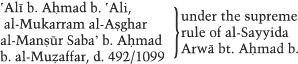
Aḥmad b. ‘Alī, al-Mukarram |
|
⊘ 467/1075 or 479/1086 |
|
|
c. 484/c. 1091 |
|
|
⊘ 492–8532/1099–1138 |
al-Sayyida Arwā bt. Aḥmad |
|
532/1138 |
Power assumed by the Zuray‘ids of Aden |
As well as becoming, because of its remoteness from the centre of the caliphate in Iraq, a centre for Zaydī Shī‘sm (see above, no. 41), Yemen also proved fertile ground for the Ismā‘īlī Shī‘ī da‘wa, and Carmathian or Qarmaṭī activity (see above, no. 40) is mentioned there from the early tenth century onwards. Once the Fatimids became established in Egypt in the second half of the tenth century (see above, no. 27), with the Holy Cities of the Hijāz acknowledging the new caliphs in Cairo, relations between Egypt and Yemen became close.
The Ṣulayhids ruled in Yemen as adherents of Ismā‘īlism and as nominal vassals of the Fātimids.‘ Alī b. Muḥammad, a member of the South Arabian tribe of Harndan and the son of a local Shāffi‘ī qādī or judge, became the khalifa or deputy of the chief Fātimid dffi in Yemen, Sulaymān b.‘ Abdallāh al-Zawahl, and was thus able to set up a principality in the Yemen highlands. He defeated the Abyssinian slave dynasty of the Najāḥids of Tiharna (see above, no. 44); by 455/1063 he had captured Ṣan‘a’ from the Zaydī Imāms and invaded the Hijāz; and in the next year, he took Aden from the Banū Ma‘n. Under his son al-Mukarram Aḥmad, the Ṣulayhid dominions reached their maximum extent. Yet these conquests could not be held beyond the eleventh century. The Najāḥids revived, Aden was usually independent, and the Zaydī Imāms remained at their centre of Sa‘da in northern Yemen. From the latter part of Aḥmad’s reign until her own death in 532/1138, effective authority was exercised by his capable and energetic consort, al-Sayyida Arwā. It was she who moved the Ṣulayhid capital to Dhū Jibia, controlling from there southern Yemen and Tihāma in a reign of some brilliance as the ‘Second Bilqis’.
After her death at the advanced age of 92, power passed to the Zuray‘ids, who were to hold it until the advent in 569/1174 of the Ayyūbid Turan Shāh (see above, no. 30, 8), although some Ṣulayhid princes continued to hold fortresses in Yemen down to the end of the twelfth century.
Lane-Poole, 94; Zambaur, 118–19 (both very inaccurate); Album, 26.
EI2 ‘Ṣulayḥids‘ (G. R. Smith).
H. C. Kay, Y aman: Its Early Mediaeval History, 19–64, with a detailed genealogical table at p. 335.
H. F. A. al-Hamdani and H. S. M. al-Juhanī, al-Ṣulayḥiyyūn wa ‘l-haraka al-Fdtimiyya fi‘l-Yaman, with a detailed genealogical table at p. 335.
Ramzi J. Bikhazi, ‘Coins of al-Yaman 139–569‘, 77ff.
G. R. Smith, in W. Daum (ed.), Yemen: 3000 Years of Art and Civilisation in Arabia Felix, 132, 138.